You don’t need Tor. You don’t need an .onion address. Today, some of the most dangerous corners of the internet are hiding inside an app already on your phone.
Telegram has become the go-to platform for a growing dark web-adjacent ecosystem, where stolen data, cybercrime recruitment, and underground networks operate not in hidden corners of the darknet. Still, in communities, anyone can join via a single link.
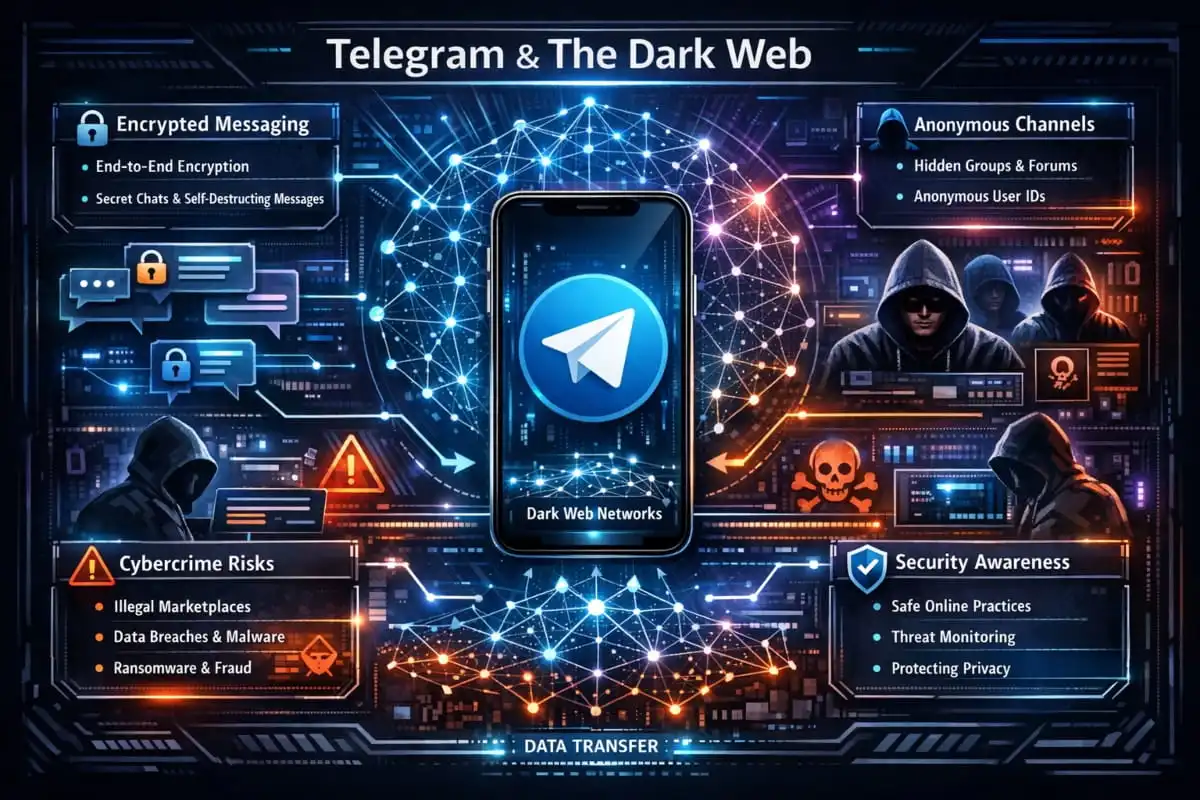
So when people ask, ” Is Telegram the dark web? The answer is no, but it’s more complicated than that. Telegram isn’t a dark website. It doesn’t run on onion routing or I2P. But in practice, it functions as a dark web on-ramp: faster to access, easier to scale, and far harder to shut down permanently than traditional dark web marketplaces.
What started as a privacy-first messaging app has quietly become a platform where dark web content circulates freely, cybercriminals organize in plain sight, and millions of users remain unaware of what’s happening inside the same app they use to message friends.
Telegram scams are increasingly tied to a dark web lite ecosystem where criminals operate underground markets with speed and reach. Instead of relying only on Tor-based dark web marketplaces, threat actors now sell and promote illicit services in plain sight, often behind private invites and rapidly replaced communities.
What’s being traded and promoted at scale:
- Stolen payment data (card dumps and account takeovers)
- Malware and access tools (loaders, droppers, stealer logs)
- Phishing infrastructure (templates, lures, plug-and-play kits)
- Botnet rentals and DDoS-for-hire services
- Money laundering as-a-service offerings (cash-out guides, mule recruiting)
Why this matters in 2026
Cybercriminals prefer Telegram because it’s simple to join, easy to broadcast, and hard to dismantle at scale. Telegram anonymity features, disposable identities, and fast-moving communities allow operators to regroup quickly when communities are removed or restricted, making Telegram a persistent distribution layer for cybercrime.
What is Dark Web Telegram?
“Dark web Telegram” is an informal term for Telegram communities that host illegal or high-risk activity, the kind historically found on Tor-based dark web marketplaces. Telegram is a widely used encrypted messaging app with both public and private communities. It is not the actual dark web; that term refers to hidden services reachable only through tools like Tor or I2P.
The confusion is understandable. Dark web Telegram spaces share the darknet’s feeling of opacity, pseudonymity, and a culture of secrecy, but their infrastructure is entirely different. You open Telegram the same way you open WhatsApp. The darkness isn’t in the network. It’s in what people use it for.
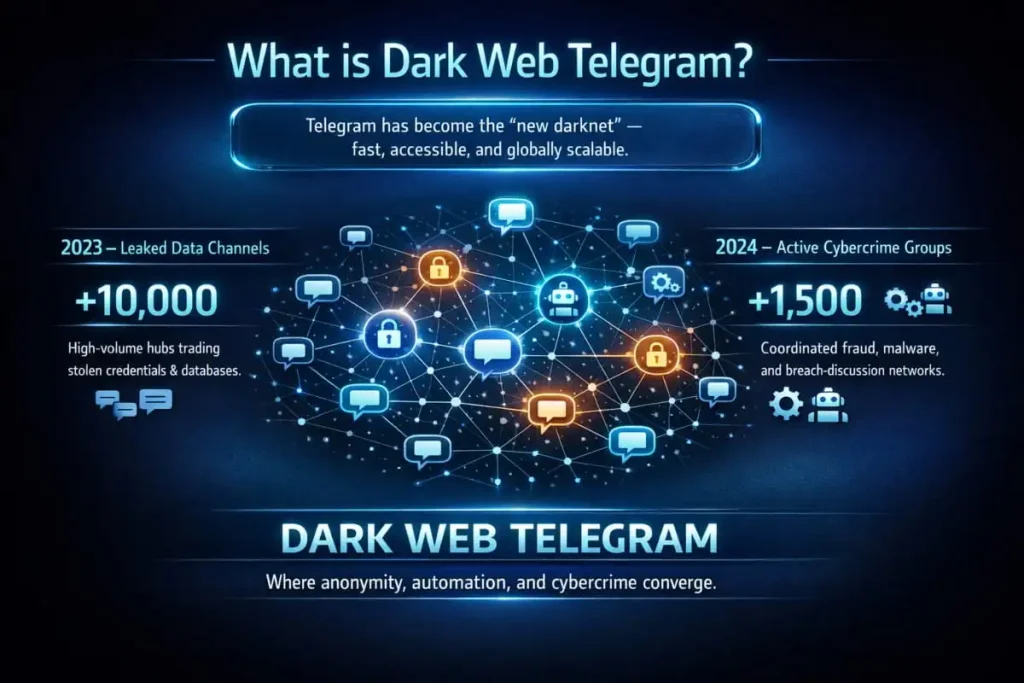
Is Telegram the dark web? The honest answer
Telegram sits on the regular internet (the surface web). Its servers are centralized. There are no .onion addresses, no multi-hop routing, and no inherent network-level anonymity. What makes certain Telegram spaces feel like the dark web is behavioral, not architectural: invite-only access, pseudonymous identities, fast-moving communities that rebrand when disrupted, and a culture of not asking where things come from.
In practice, Telegram functions as a dark web on-ramp and broadcast layer, a place where illicit trade is advertised, recruited for, and initiated before being completed elsewhere. The distinction matters because the risks and defenses are different. Tor protects the operator’s IP address. Telegram protects nothing by default; it just makes criminal operations easier to scale.
| Feature | Telegram (The New Frontier) | Traditional Dark Web (Tor/I2P) |
|---|---|---|
| Access | Standard app or browser; invite links or public search. | Requires Tor/I2P browser; hidden .onion addresses. |
| Anonymity | Pseudonymous; phone number at signup; no IP masking. | Designed for anonymity; Tor routes mask IP addresses. |
| Reach | Mainstream audience; communities scale very quickly. | Small, niche audience; high technical barrier to entry. |
| Encryption | Server-side by default; E2EE only in “Secret Chats”. | Layered onion encryption plus HTTPS on services. |
| Discovery | In-app search, link sharing, and invite chains. | No native search; community referrals and directories. |
| Disruption | Communities relaunch fast under new names after bans. | Sites persist until operators vanish or SEIZED. |
| Primary Illicit Use | Stolen data, scams, phishing kits, fraud recruitment. | Drugs, weapons, stolen data, hacking tools. |
Telegram is easier to access and faster to scale. The traditional dark web provides stronger operational anonymity. Most sophisticated threat actors now use both simultaneously: advertising and recruiting on Telegram, and completing transactions on Tor-based markets.
Why certain Telegram spaces feel dark
Some Telegram communities are structured specifically to avoid scrutiny:
- Invite-only access with rapidly rotated links
- Usernames and pseudonyms instead of verified identities
- Communities that migrate or rebrand when taken down
- A culture of “don’t ask, don’t tell” around sourcing and transactions
- Automated bots that handle delivery, payment, and customer queries
This combination creates the functional equivalent of an underground market even though the underlying platform is entirely mainstream.
What Telegram’s encryption actually protects (and what it doesn’t)
Telegram markets itself as a privacy-first platform, and that reputation draws users who assume all their activity is private by default. It isn’t.
Regular chats, communities, and most group conversations rely on server-side encryption. Telegram can read them, and so can anyone who gains server access or a valid legal request. End-to-end encryption only applies to Secret Chats, an opt-in feature that most users never activate. Metadata, such as who is talking to whom, when, and from what phone number, can still exist regardless of message content.
This matters for two reasons. For defenders, it means that Telegram activity leaves more traces than previously assumed, and lawful disclosure requests do yield results. For users who joined a high-risk community under the assumption of anonymity, this means the assumption is largely false.
How Telegram mirrors underground markets
While Telegram isn’t a hidden network, it functions as a dark web lite layer where illicit trade happens quickly and at scale. In practice, many actors have shifted distribution and sales to Telegram because it’s easier to access than onion markets and simpler to broadcast to large audiences.
Common examples seen in these ecosystems:
- Stolen data sales (compromised accounts, credential lists, payment info)
- Hacking tools and starter kits (phishing templates, malware builders, tutorials)
- Scam services (fake support teams, investment “signals,” counterfeit verification bots)
- Money movement services (cash-out claims, mule recruitment, laundering offers)
How organizations can detect and defend
Security teams should treat Telegram as a primary monitoring surface alongside traditional dark web sources. Effective detection combines threat intelligence feeds, keyword-based tracking of high-risk communities, and brand monitoring to identify impersonation, fake support accounts, and verification traps early.
Defense also requires fraud signal analysis and response readiness. Reused wallet addresses, recurring scam domains, counterfeit KYC bots, and phishing links shared in public communities provide clear indicators, while coordinated takedown and evidence-collection workflows help limit exposure before damage scales.
Deep Web Telegram: How Hidden Content Spreads on a Surface Web Platform
One of the most common misconceptions about Telegram is that it is the deep web. It isn’t. Telegram runs on ordinary internet infrastructure, it’s indexed, it has a public-facing website, and it’s available in every major app store. The deep web, by contrast, refers to any internet content that isn’t indexed by search engines: private databases, password-protected portals, internal systems, and the dark web layer beneath that.
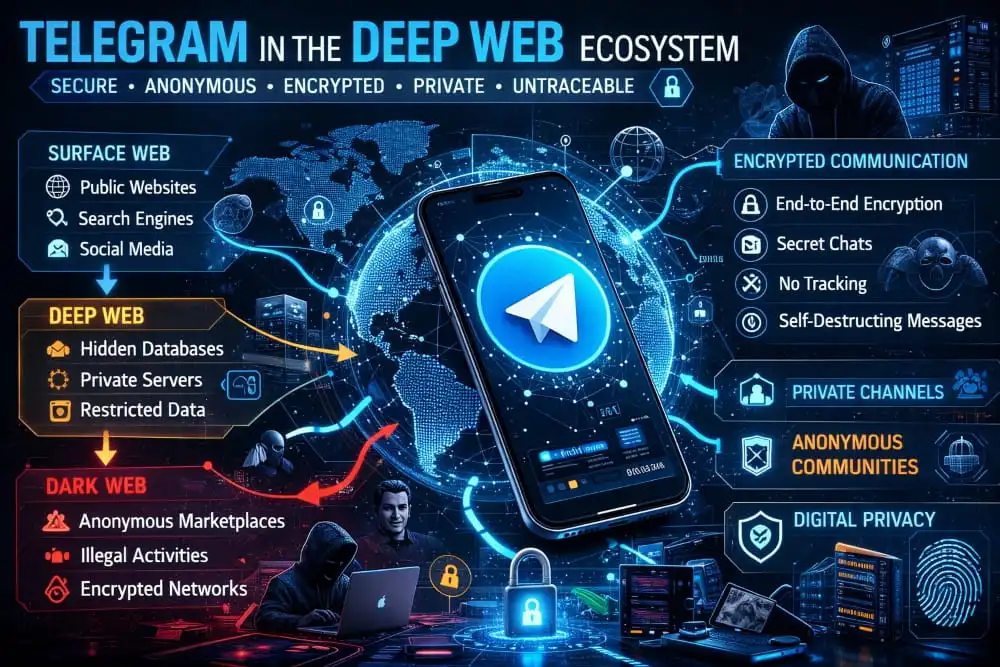
In this context, Telegram is a distribution layer. Content that originates on deep web forums or dark web marketplaces, stolen databases, hacking tools, leaked credentials, breach announcements, gets reposted, shared, and spread through Telegram communities at a speed and scale that traditional dark web infrastructure can’t match.
Why deep web content migrates to Telegram
Dark web forums require Tor, registration, invite codes, and reputation scores before most content becomes accessible. Telegram removes all of that friction. A database leaked on a dark web forum on Monday can be inside a large Telegram community by Monday afternoon, visible to thousands of users who never touched a Tor browser.
This migration pattern is consistent and well-documented. What starts as deep web or dark web content, breach data, phishing kits, malware builds, and or compromised account logs gets reposted to Telegram communities as a form of advertising, social proof, or simple distribution. The original dark web source gains credibility; Telegram provides reach.
Common categories of deep web content that circulate on Telegram include:
- Leaked credential databases and infostealer logs
- Links to dark web marketplaces and services
- Hacking tutorials, exploit code, and malware tools
- Ransomware victim announcements and extortion samples
- Phishing kit templates and infrastructure
The risk hidden inside “deep web Telegram” searches
People searching for deep web Telegram content are frequently targeted rather than informed. Many communities that advertise themselves as “deep web access” or “exclusive hidden content” are not what they claim to be. The more common reality is:
- Scam traps, communities designed to extract cryptocurrency, personal information, or payment under pretenses
- Malware distribution, files or links presented as tools, videos, or databases that deliver infostealers or remote access trojans upon download
- Phishing funnels, fake “verification” bots or login prompts that harvest credentials
- Social engineering entry points, communities that build false credibility before directing users toward fraud
Cybersecurity researchers consistently find that the communities most aggressively promoted as deep web access points are also the ones most likely to victimize the people who join them. Legitimate threat intelligence work on Telegram uses purpose-built tooling and controlled environments, not clicking unknown invite links from search results.
What organizations need to understand
For security teams, the practical implication is straightforward: your organization’s leaked data doesn’t stay on the dark web. If credentials, internal documents, or customer records surface on a deep web forum or dark web market, they are likely to appear on Telegram within hours.
This is why effective monitoring now requires coverage of both traditional dark web sources and Telegram simultaneously. Waiting for data to surface in a breach database or HIBP-style service means responding weeks or months after the initial exposure. Telegram is often where that exposure becomes actionable threat intelligence, fast enough to act on before attackers do.
DeXpose monitors Telegram alongside dark web markets, paste sites, and breach sources, giving security teams a unified view of where their data appears and how fast it’s spreading.
Deep Web Telegram vs Dark Web Telegram: What Does the Difference Actually Mean
The terms are used interchangeably, but they describe two different things, and the distinction has real practical implications for how you assess risk and where you focus your monitoring.
Deep web Telegram refers to Telegram communities that deal in content not readily accessible through normal search or public channels. This includes invite-only communities, private discussion spaces, and content that originates from restricted or non-indexed sources. The defining characteristic is accessibility, not criminality. A private corporate leak channel, a restricted journalism community, and a criminal credential-sharing feed are all technically “deep web Telegram” by this definition. What separates them is intent and content, not structure.
Dark web Telegram is a more specific term. It describes Telegram communities that operate as extensions of, or replacements for, traditional dark web ecosystems: stolen data markets, malware distribution, ransomware coordination, fraud tooling, and cybercrime recruitment. The content here originates from or feeds directly into the criminal infrastructure that security teams track on Tor-based forums and dark web marketplaces.
The clearest way to think about it: deep web Telegram describes how a community is structured (hidden, restricted, non-public). Dark web Telegram describes what a community is used for (criminal, underground, threat-relevant).
| Characteristic | Deep Web Telegram (Private) | Dark Web Telegram (Criminal) |
|---|---|---|
| Defining Characteristic | Hidden, restricted, or invite-only access. No public search footprint. | Criminal intent and underground activity is the primary driver. |
| Content Type | Private discussions, paywalled content, or restricted hobbyist communities. | Stolen data (DBs), malware, fraud tooling, and illicit trade. |
| Dark Web Relationship | May have no connection at all to criminal ecosystems. | Directly overlaps with Tor-based markets (e.g., Dread, RAMP mirrors). |
| Risk Level | Variable — Depends entirely on the specific group’s rules. | Consistently High — Purpose-built for illegal activity. |
| Who Monitors It | Researchers, private investigators, and specific interest groups. | CTI (Threat Intel) teams, law enforcement, and security platforms. |
| Discovery Method | Direct invitation or private referral only. | Hacker forums, “leaking” channels, or automated bots. |
In practice, the boundary between the two is blurry. Many communities start as invite-only private spaces (deep web Telegram by structure) and evolve into active criminal marketplaces (dark web Telegram by function). This is why monitoring programs that focus only on explicit dark web signals miss a significant portion of early-stage threat activity; the precursor communities are often classified as “just” private Telegram spaces until the criminal behavior scales enough to be obvious.
For security teams, the operational takeaway is to monitor intent signals rather than access structure. A community that is hard to find or invite-only is not, in itself, a threat indicator. What matters is whether it involves distributing stolen credentials, coordinating fraud, or discussing your organization as a target, regardless of whether it technically qualifies as “deep web” or “dark web” under any definition.
Dark Web Telegram Links: Why They Are Risky
Searching for dark web Telegram links is itself a risk signal. The phrase attracts a specific type of content, and the communities that actively promote themselves using it are overwhelmingly designed to exploit people looking for them, not to inform them.
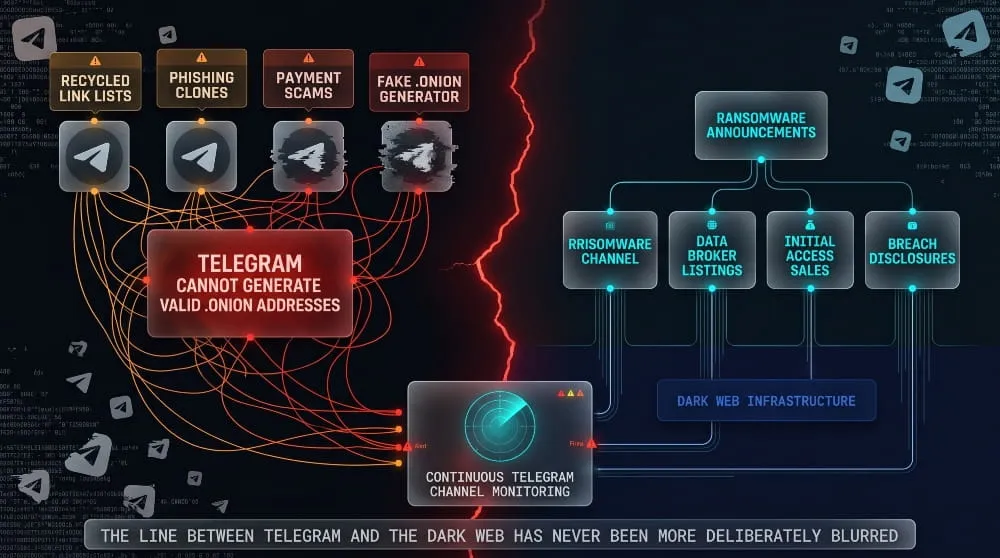
Here is what actually happens when someone searches for dark web Telegram links and follows the results.
What dark web Telegram links actually are
A dark web Telegram link is an invite URL, a t.me/ address that routes someone into a Telegram community. The link itself is surface web infrastructure. What varies is what’s inside: some communities share Tor-based marketplace URLs and .onion addresses, others distribute stolen data and hacking tools, and a significant portion exists purely to scam whoever joins.
The communities that most aggressively advertise themselves as “dark web access” or “onion links Telegram” are rarely what they claim to be. Legitimate dark web marketplaces do not need to recruit users through Telegram search results. The communities that do are either re-sharing publicly available .onion addresses as a hook, or using the framing to funnel users into fraud.
Why are these links dangerous?
The risks from dark web Telegram links fall into a few consistent patterns that cybersecurity researchers observe repeatedly:
Malware delivery. Files promoted as tools, databases, or exclusive content frequently contain infostealers, remote access trojans, or ransomware droppers. The preview looks legitimate: a credential dump, a hacking tutorial, a “free” software tool, and the payload is in the download.
Phishing infrastructure. Many communities include bots or pinned messages that direct users to “verify” their identity or claim something via an external link. These links harvest credentials, seed fake KYC flows, or redirect to lookalike login pages for exchanges, wallets, or other services.
Crypto fraud. Dark web Telegram link communities frequently operate at the top of a crypto scam funnel, offering investment signals, “exclusive” trading groups, and wallet-draining schemes that use dark web framing to manufacture urgency and false credibility.
Scam marketplaces. Some communities simulate dark web markets, accepting payment for goods or services that are never delivered. The dark web aesthetic, black markets, pseudonymity, and exclusive access are mechanisms of trust, not the actual content.
| Link Type | What It Typically Leads To | Risk Level |
|---|---|---|
| “Dark Web Access” Invites | Scam communities, malware drops (Infostealers), and phishing funnels. Often use keywords like “Deep Web Videos” to lure users. | Extremely High |
| Tor / .onion URL Sharing | Mostly public directory links or active markets. Some may lead to “Honey Pots” set up by law enforcement or hackers. | High |
| Leak & Credential Channels | Stolen database dumps and real-time infostealer logs. 2026 mein hackers yahan “Request-to-Join” buttons use karte hain detection se bachne ke liye. | Very High |
| Dark Web Discussion Groups | Mix of genuine cybersecurity research and criminal recruitment. Forums like “Dread” mirrors often operate here. | Medium – High |
| “Exclusive” Market Links | Fake marketplaces, exit scams, or “Buy-for-You” fraud schemes (e.g., discounted flights/hotels via stolen cards). | Extremely High |
The organizational risk dimension
For security teams, the danger isn’t just that employees might click a bad link. It’s that your organization’s data is moving through these communities whether you’re watching or not. Stolen credentials, internal documents, and customer records leaked on the dark web are redistributed via Telegram link-sharing ecosystems within hours of the original exposure.
This is why dark web Telegram link monitoring has become a standard component of threat intelligence programs, not to follow the links, but to detect when your organization’s data appears in the communities that share them. Early detection in these spaces consistently compresses incident response timelines and limits downstream damage.
Are dark web Telegram links ever safe?
Rarely, and not in the way the question implies. Cybersecurity researchers, journalists, and law enforcement do access these communities, but through purpose-built tooling, isolated environments, and controlled methodologies, not by clicking invite links from search results.
For anyone else: an unknown Telegram invite offering access to the dark web is not a shortcut to hidden information. It is a vector. The safest response to an unsolicited dark web Telegram link is not to click it, report it through Telegram’s in-app reporting, and, if you’re an organization, flag it to your security team so it can be analyzed in a controlled environment.
Why Telegram Scams and Dark Web Telegram Matter
The fraud economy has increasingly migrated into Telegram, turning the app into what researchers describe as a dark web Telegram layer. Instead of living only on hidden forums, underground trade now operates in semi-public spaces where discovery is fast, audiences are massive, and disruption is temporary at best.
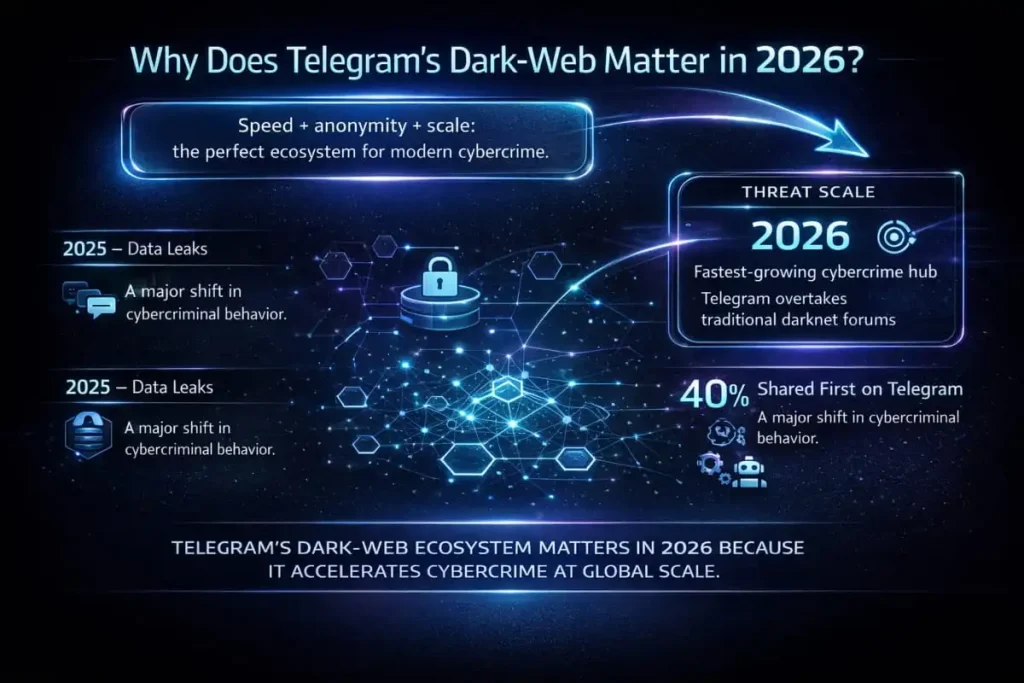
Telegram is now the fastest marketplace layer.
What makes Telegram different isn’t just volume, it’s velocity. In-app discovery, keyword search, and link-based access let bad actors connect buyers and sellers instantly, then rebuild quickly when communities get disrupted or removed.
This creates a repeatable funnel: a public broadcast space attracts attention, a private chat closes the deal, and a bot or mirror community restores reach when enforcement hits. The result is a constant churn of scams that look new but reuse the same playbooks and a threat surface that regenerates faster than takedowns can keep up with.
UNODC signals the scale and the region
A UNODC-backed warning highlighted that Southeast Asian criminal networks use Telegram at scale, with hacked datasets circulating through large, lightly moderated communities. That includes stolen card details and personal information that gets repackaged into account takeovers, impersonation attempts, and follow-on fraud.
In practical terms, Telegram becomes the broadcast layer for leaks and scam operations. Victims and buyers are pulled into private conversations where pressure tactics and social engineering do the most damage away from any public accountability.
Enforcement pressure reshaped takedowns and criminal behaviour.
Law enforcement pressure has intensified, raising the stakes for both defenders and criminals. Telegram’s founder, Pavel Durov, was arrested in France in August 2024 in a case tied to allegations of facilitating criminal activity on the platform, accelerating scrutiny of moderation and platform accountability.
Criminal networks responded the way they always do: fragmenting into backup communities, rotating names, and pushing traffic through invite chains. Takedowns still matter, but the new operational reality is faster disruption paired with faster rebuilds.
Transparency and legal compliance changed the risk calculus.
Telegram’s transparency reporting has pointed to a sharp rise in U.S. data disclosures, including hundreds of government requests in 2024 tied to phone number or IP information. That shift matters because it directly undermines the assumption that Telegram activity is automatically untraceable.
Telegram’s official moderation overview confirms proactive enforcement AI-assisted detection, user reporting pipelines, and large-scale blocking of public communities involved in prohibited activity. The platform is not a lawless space; it is a contested one, where enforcement exists, but criminal operators adapt faster than moderation scales.
For defenders, this makes evidence collection and reporting more meaningful, especially when abuse is tied to impersonation, fraud, or real-world financial harm.
Tor disruption pushed actors toward accessible platforms.
As Tor takedowns and marketplace instability disrupt traditional onion ecosystems, many threat actors don’t disappear; they relocate. Telegram offers the same market behaviour in a simpler package: phishing kits, malware, laundering services, and forged document offers can be promoted through posts, mirrors, and rapid reposting without any special infrastructure.
This isn’t Telegram replacing Tor entirely. It’s Telegram absorbing the growth layer where recruitment, advertising, and victim acquisition happen at scale before transactions complete elsewhere.
Financial regulators raised the stakes beyond online nuisance.
Financial regulators have treated these ecosystems as more than background cybercrime. In May 2025, FinCEN identified Cambodia’s Huione Group as a primary money laundering concern, and Reuters reported that Telegram had blocked major Chinese-language black-market services linked to guarantee markets operating on the platform.
That combination financial pressure plus visible platform action, signals a national security dimension to Telegram-based underground trade, not just a moderation problem.
The dark side of Telegram: risks, threats, and the platform’s reputation
Telegram’s reputation as a privacy-first platform has given it a darker shadow, one shaped by the abuse of its own features. Large public communities, anonymous account creation, and automated bots have made the platform attractive for scams, illegal trade, extremist content distribution, and cybercrime recruitment.
This doesn’t mean Telegram is inherently dangerous. The vast majority of its users communicate legitimately. But the risk profile changes significantly depending on behaviour: joining unknown communities, clicking unverified links, downloading files from unconfirmed sources, or interacting with unsolicited direct messages all substantially increase exposure to the threats documented throughout this page.
The platform is not the threat. How it is used and how well you understand those uses determine your actual risk.
Why this matters for defenders in 2026
Defending against modern fraud means monitoring Telegram alongside onion sites, because the earliest signals consistently appear where attention is easiest to capture. When dark web Telegram activity moves at platform speed, response has to match: brand monitoring, fraud detection, rapid reporting, and continuous threat intelligence, not periodic checks.
If you’re seeing Telegram-based impersonation or scam activity targeting your organization, DeXpose monitors Telegram alongside dark web sources and alerts you before exposure scales into an incident.
How Criminals Use Telegram: Real-World Examples
Telegram scams thrive because the platform lets criminal operations scale fast and feel anonymous. Instead of relying only on dark web forums on the Tor network or I2P, many threat actors use Telegram’s broadcast infrastructure and massive reach to move faster and access more victims than traditional dark web marketplaces allow.
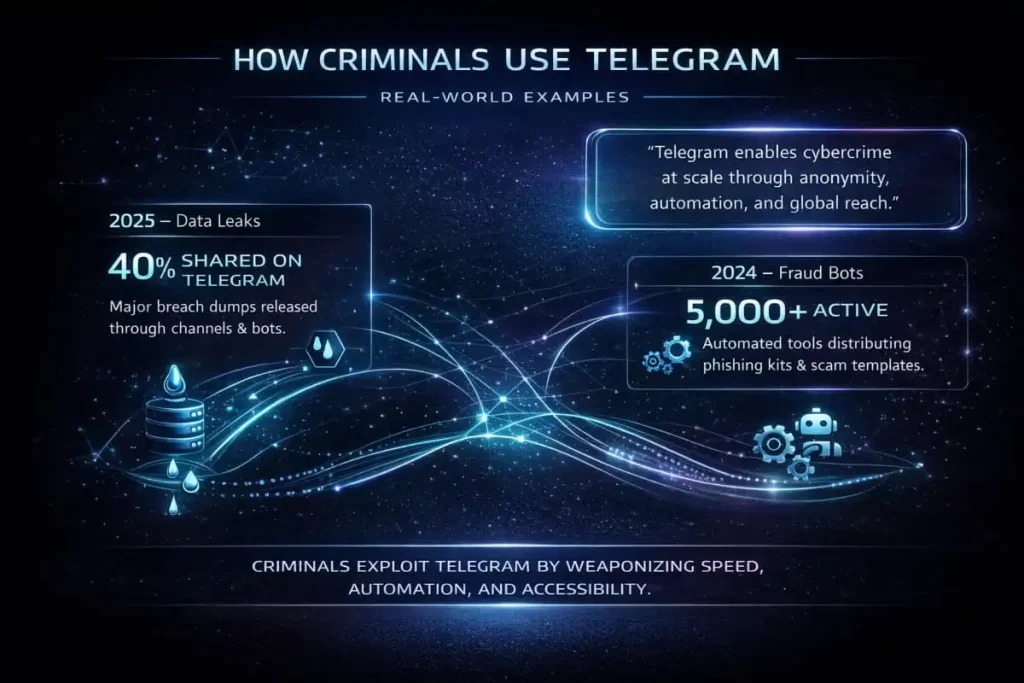
What follows are the primary criminal use cases documented by cybersecurity researchers between 2024 and 2026, not theoretical risks, but operational patterns observed repeatedly across threat intelligence reporting.
Stolen data markets
Underground sellers use Telegram to offer stolen databases, credit card dumps, credentials, and personal records packaged as bulk offerings with fixed prices and sample previews. The listings are written like storefront posts, complete with pricing tiers, customer reviews from prior buyers, and automated bot delivery once payment is confirmed.
This mirrors the structure of a darknet marketplace but with a critical difference: Telegram’s frictionless access means buyers don’t need Tor, an account, or a reputation score to transact. The barrier to purchasing stolen data has dropped to the same level as ordering from any other messaging-based marketplace.
Malware and cybercrime tooling distribution
Telegram is widely used to advertise and deliver malware-as-a-service, phishing kits, exploit frameworks, and ready-to-run attack tools, often targeting non-technical buyers who want operational capability without technical skill. Operators use automated bots to handle delivery, customer support, and payment instructions, turning what was previously a manual criminal operation into a streamlined, scalable business.
Common tooling distributed this way includes infostealer builds, ransomware-as-a-service affiliate packages, phishing page templates pre-configured for specific brands, and credential-stuffing scripts bundled with fresh proxy lists.
Investment fraud and pig-butchering scams
Pig-butchering operations and long-con crypto investment schemes rely on Telegram as their primary communication layer. Operators invest weeks building trust through regular conversation before introducing an investment opportunity. The platform’s private messaging infrastructure, combined with the ease of creating convincing personas, makes it well-suited for the extended social engineering these scams require.
Victims are guided toward lookalike trading platforms through fabricated proof of returns, fake support personas, and manufactured urgency. By the time the fraud becomes apparent, multiple deposit cycles have typically already occurred.
Money laundering and financial crime services
Telegram ecosystems advertise unlicensed exchange services, cash-out operations, and money mule recruitment, the financial infrastructure that converts criminal proceeds into usable funds. Some operators run what amount to full-service laundering offerings: accept dirty cryptocurrency, return clean funds via hawala networks, wire transfers, or gift card conversion, with fees taken at each stage.
Counterfeit document services operate alongside these financial offerings, providing forged identity documents used to open accounts, pass KYC checks, and establish the financial identities that laundering operations depend on.
Extremist content and illegal material distribution
Telegram has been exploited to distribute extremist propaganda and illegal content through private forwarding networks, material that is removed from mainstream platforms immediately. Still, it can circulate indefinitely through invite-only Telegram communities that reconstitute after each takedown. This category of abuse has driven significant regulatory and legal pressure on the platform, particularly in Europe, and was central to the context surrounding Pavel Durov’s 2024 arrest in France.
The operational logic that criminals follow.
Across all these use cases, the pattern is consistent: Telegram provides the recruitment and distribution layer, while transactions or deeper criminal activity are completed elsewhere. Discovery is frictionless, communities rebuild after bans under new identities, and automation via bots reduces the human effort required to run large-scale operations to near zero.
As criminal operations on Telegram evolve, the most sophisticated actors layer automation with social engineering using bots for initial contact and scale, then switching to human operators once a target shows genuine engagement. This hybrid model is why simple bot-detection or link-blocking is insufficient as a defense.
What to do if you encounter suspicious activity
If you receive an unsolicited message promoting investment returns, dark web access, or exclusive opportunities, or encounter a community distributing suspicious files or links, the right response is not to engage or click, and to report through Telegram’s in-app reporting tools before leaving.
For organizations: a suspicious Telegram interaction involving your brand, domain, or executive names is a threat signal, not just a nuisance. Document it and escalate to your security team so it can be analyzed in context rather than dismissed as isolated spam.
DeXpose monitors Telegram alongside dark web sources for brand impersonation, credential exposure, and early fraud signals, giving security teams visibility before criminal activity reaches customers at scale.
Common Telegram Scams: How Fraudsters Trick Users
Telegram’s scale is what makes it attractive to scammers. Hundreds of millions of users, anonymous account creation, automated bots that can message thousands of people simultaneously, and communities that anyone can join via a single link. These aren’t just features; they’re the operational infrastructure that modern fraud runs on.
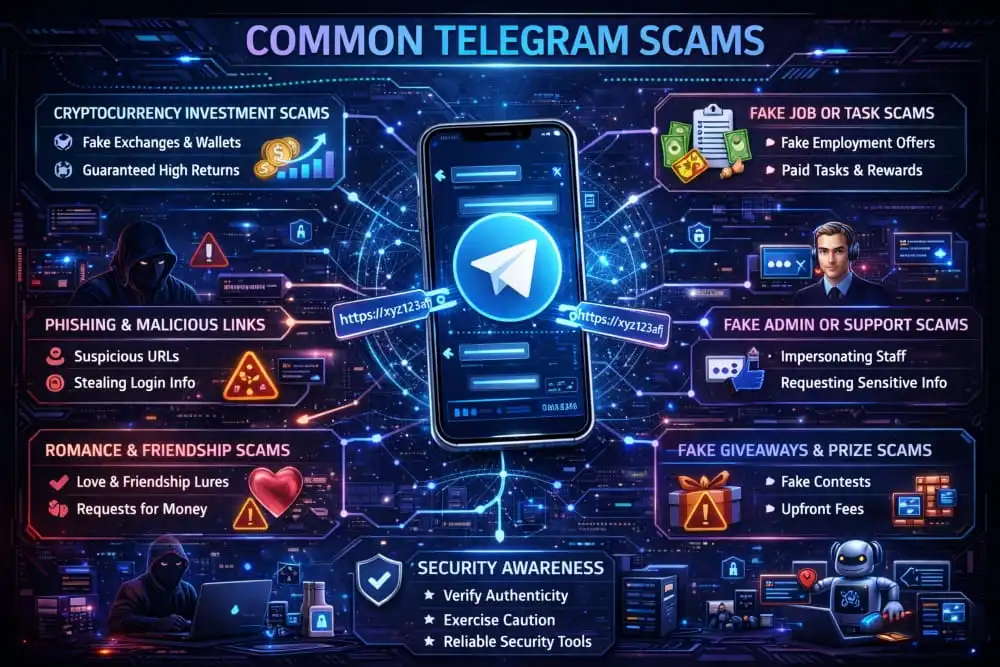
Between 2024 and 2026, cybersecurity researchers have documented a consistent set of scam patterns on Telegram. The mechanics vary, but the underlying logic is the same: establish false credibility, create urgency or emotional pressure, and extract money or credentials before the victim realizes what’s happening.
Cryptocurrency investment scams
Crypto scams are the highest-volume fraud category on Telegram. The setup is typically a community or direct message promoting a trading signal service, token launch, or “exclusive” investment opportunity with guaranteed returns. Some operators impersonate well-known crypto figures or financial analysts to add credibility.
Victims are asked to deposit cryptocurrency into a wallet or platform. Early participants sometimes receive small “returns” funded by newer deposits to build confidence before the operators disappear with the accumulated funds. This structure is the defining feature of pig-butchering scams, where the investment and trust-building phase can last weeks or months before the exit.
Fake job and task scams
Job scams have scaled significantly on Telegram since 2024. Fraudsters advertise easy remote work: reviewing products, liking social media posts, and completing micro-tasks, with payments that appear immediately to establish trust.
The pattern then shifts: victims are told they need to deposit to unlock higher-paying tasks, cover a “processing fee,” or maintain account standing. The initial small payments are the hook; the larger deposits are the actual fraud. By the time the scam becomes obvious, multiple payment cycles have typically already occurred.
Phishing links and credential harvesting
Phishing on Telegram takes several forms. The most common involves messages containing links to pages that mimic official services, crypto exchanges, wallet providers, account verification portals, or giveaway pages. When users enter their credentials, those details are captured and used immediately for account takeover.
A more sophisticated variant uses Telegram bots to simulate legitimate customer service interactions, guiding users through a multi-step “verification” process that culminates in credential submission or a wallet connection request. The bot interface makes the interaction feel procedurally legitimate even when nothing about it is.
Fake admin and support impersonation
Support impersonation exploits the fact that most Telegram communities have visible admin lists. Attackers create accounts with names and profile photos nearly identical to those of real admins or exchange support teams, then contact users, particularly those who have recently posted a question or complaint, claiming there is an issue with their account.
The ask is usually for a verification code, password reset confirmation, wallet recovery phrase, or two-factor authentication code. Any of these provides immediate access to the account. Legitimate platform administrators never initiate contact this way and never request authentication credentials through direct messages.
Romance and long-con relationship scams
Romance scams on Telegram are structurally patient. Attackers invest days or weeks in building a genuine-feeling relationship through private conversation before making any financial request. The request, when it comes, is framed around an emergency, a travel expense, or an investment opportunity that the victim would be missing out on.
These scams are disproportionately damaging because the psychological impact of a fabricated relationship compounds the financial loss. Researchers have documented cases in which victims continued sending money after being shown evidence that that the other person was a scammer, because the emotional investment made the reality difficult to accept.
Fake giveaways and prize fraud
Giveaway scams exploit urgency and social proof. A community or message announces that a user has won cryptocurrency, a device, or gift cards, usually tied to a legitimate brand or platform name, to add credibility. Claiming the prize requires either a “processing fee,” identity verification, or wallet connection.
No prize exists. The fee is the fraud, and any wallet connection enables asset drainage. These scams scale easily because the same template can be reused across thousands of targets with minimal modification.
Bot-automated mass fraud
Telegram bots allow a single operator to run fraud campaigns across thousands of simultaneous conversations. Bots handle the initial contact, simulate conversational responses, distribute phishing links, and manage payment instructions, reducing the human effort required to run large-scale scams to near zero.
This automation is why Telegram scam volume has grown disproportionately fast. The marginal cost of adding another thousand targets is effectively zero, meaning even low-conversion fraud campaigns generate meaningful returns for the operator.
How to identify a Telegram scam before it lands
Most Telegram scams share a small set of behavioral markers regardless of their specific format:
- Guaranteed returns or risk-free profits n. Noegitimate investment opportunity uses this language.
- Urgency pressure, limited-time offers, account suspension warnings, or “act now” framing are manipulation mechanics, not real deadlines
- Unsolicited contact, legitimate platforms do not reach out via direct message to resolve account issues.
- Requests for authentication credentials verification codes, passwords, recovery phrases, and wallet keys are never required by genuine support teams.
- Fee-to-receive structures any scenario where you must pay to claim a prize, unlock a task, or access a service is fraud by design.
- Links to external sites , pecially those that closely mimic legitimate domains but differ by a character or use unusual TLDs
If your organization’s brand, domain, or executive names are being used in Telegram scam infrastructure, DeXpose can identify impersonation activity early before it reaches your customers at scale.
Telegram’s Policies on Impersonation, Illegal Content, and Platform Enforcement
Telegram’s enforcement posture has changed more in the past 18 months than in the preceding six years. Understanding what the platform’s policies actually say, and how aggressively they’re now being applied, matters for brand owners reporting impersonation, organizations responding to fraud, and anyone trying to assess what recourse actually exists.
What Telegram’s Terms of Service prohibit
Telegram’s Terms of Service explicitly prohibit users from using the platform to send spam, run scams, or impersonate others. The core prohibited categories under the ToS and community guidelines include:
- Impersonation, creating accounts, communities, or bots that falsely represent another person, organization, or brand
- Spam and scam operations, unsolicited mass messaging, fraudulent offers, and deceptive schemes
- Illegal content distribution, sharing material that violates applicable law, including stolen data, malware, and child sexual abuse material
- Calls to violence and terrorist propaganda, content that incites or promotes violent acts or extremist organizations
- Harassment and threats, targeted abuse directed at individuals
Violations can result in account warnings, temporary restrictions, or permanent bans. Telegram’s enforcement system combines automated detection, user reporting, and proactive moderation, with the balance between these shifting significantly since September 2024.
Telegram’s CSAM enforcement: what the numbers show
Telegram enforces a zero-tolerance policy for Child Sexual Abuse Materials. Since 2018, public images have been automatically checked against a hash database of known CSAM. In 2024, the platform expanded this database to include hashes from organizations, including the Internet Watch Foundation, and now publishes daily transparency reports on CSAM removals.
Between September 16 and October 22, 2024, Telegram received 17,554 CSAM reports from Stichting Offlimits, all of which were banned immediately. The platform processes takedown requests from multiple international NGOs through automated submission addresses, with the top reporting organizations listed in its public moderation overview.
This level of proactive infrastructure represents a meaningful shift from Telegram’s earlier “minimal moderation” reputation, one directly relevant to organizations that assumed reporting illegal content to Telegram was futile.
The law enforcement disclosure shift: before and after September 2024
The most significant policy change in Telegram’s recent history is its expanded cooperation with government data requests. This shift occurred after the arrest of founder Pavel Durov in France in August 2024.
Before September 2024, Telegram would only share users’ IP addresses and phone numbers in cases involving terrorism, and had fulfilled only 14 requests affecting 108 users through the first three quarters of 2024.
After the policy shift, the numbers changed dramatically. Telegram handed over phone numbers and IP addresses to U.S. authorities on 900 occasions during 2024, affecting 2,253 users, a sharp increase concentrated in the final quarter of the year. In India, Telegram reported 14,641 incidents affecting 23,535 users during the same period.
The acceleration continued into 2025. During the first quarter of 2025, Telegram provided authorities with data on 22,777 users, up from 5,826 during the same period in 2024. That is nearly a fourfold increase year-over-year in the volume of user data disclosed to law enforcement globally.
For organizations building evidence files for criminal referrals, this shift matters practically: Telegram is now a realistic channel for legal process, not just a platform where requests disappear.
How to report impersonation on Telegram
Telegram provides several reporting mechanisms for impersonation and brand abuse, with different pathways depending on the type of violation:
In-app reporting (fastest for individual accounts and communities): Long-press any message and select “Report.” For accounts, tap the three-dot menu on the profile and select “Report.” For public communities, the report option is available in the community info screen. Telegram’s moderation team reviews in-app reports and is the primary pathway for most abuse cases.
The @NoToScam bot: Telegram maintains a dedicated bot for reporting scam accounts. Forwarding suspicious messages to @NoToScam submits them directly to Telegram’s anti-abuse team and is specifically designed for fraud and impersonation cases.
Legal and formal takedown requests: For brand impersonation, trademark violations, or cases requiring formal legal process, Telegram accepts requests through its official abuse reporting form at telegram.org/support. Organizations with documented trademark or brand rights can submit formal takedown requests through this channel. This pathway is slower than in-app reporting but produces more durable results for coordinated impersonation campaigns.
Law enforcement requests: Governments and law enforcement agencies can submit formal legal requests through Telegram’s dedicated legal process channel. As the disclosure data above shows, these requests are now receiving significantly higher compliance rates than at any prior point in the platform’s history.
What Telegram’s impersonation policy means for brand owners
The practical implication of Telegram’s current enforcement posture is that impersonation reports are more likely to yield results than before 2024, but speed and documentation still matter.
Fake support communities, lookalike accounts using your brand name, and phishing operations impersonating your organization can accumulate followers and run active fraud in hours. By the time a takedown completes, significant customer harm may already have occurred. Early detection remains more valuable than any reporting pathway.
When an impersonation case does reach the reporting stage, the evidence checklist covered earlier in this page, account IDs, screenshots with timestamps, message links, and any associated wallet addresses or external domains, determines whether your report produces a takedown or gets deprioritized. Telegram’s moderation team processes a high volume of reports; submissions with complete, verifiable evidence move faster than those with vague abuse flags.
DeXpose Brand Protection monitors Telegram for impersonation activity, lookalike account creation, and scam keyword patterns targeting your organization, providing early detection before a fake community scales into an active fraud operation, and documented evidence packages that support formal takedown requests.
What Security Teams Monitor on Telegram (And Why)
Telegram has become a primary intelligence surface for cybersecurity teams, not because analysts are joining criminal communities, but because so much threat activity is now visible there before it surfaces anywhere else. Ransomware victims get announced on Telegram before official disclosures. Stolen credentials appear in automated feeds hours after a breach. Phishing kits get distributed and updated in near real time.
For a deeper breakdown of the specific community types, active threat actor presence, and how to build a monitoring workflow around them, see our dedicated guide: Dark Web Telegram Groups & Channels: What Security Teams Need to Know.
What follows is a practical overview of the intelligence categories most relevant to detection and response teams.
Credential and infostealer log feeds
Stolen login data, usernames, passwords, session cookies, and authentication tokens harvested by infostealer malware circulate through automated Telegram feeds at scale. Families like LummaC2, RedLine, and Stealc push fresh logs continuously, often packaged in tiered subscription models. Security teams monitor these sources to identify compromised accounts before attackers use them for credential stuffing or lateral movement.
Breach announcement and data leak feeds
Early breach claims, sample data, and screenshots tied to newly compromised organizations appear on Telegram well ahead of official disclosures. Monitoring these sources gives SOC teams lead time to investigate, scope the exposure, and prepare communications before an incident becomes public. These feeds also help confirm whether your organization or a key vendor is affected.
Ransomware victim and extortion feeds
Ransomware groups frequently post victim announcements on Telegram alongside, or even before, their own leak sites. CTI teams track these feeds to analyze targeting trends by sector, geography, and company size, and to catch early warning signals for organizations in their monitoring scope. The overlap between Telegram announcements and dark web leak site posts is now significant enough that monitoring only one surface leaves gaps.
Phishing kit and fraud tooling distribution
Phishing templates, cloned login pages, harvesting scripts, and malware builders get distributed and updated through Telegram communities. Analysts follow these updates to anticipate campaign infrastructure before it reaches users, enabling faster domain blocking, filter tuning, and targeted employee awareness.
Carding and financial fraud intelligence
Stolen card data, identity bundles (fullz), and fraud workflow tooling circulate through financial crime communities on Telegram. Fraud and security teams monitor these spaces to spot emerging payment abuse techniques and adjust fraud rules before patterns have a significant impact on customers.
Hacktivist and threat actor communications
Groups like NoName057(16), RipperSec, and Dark Storm Team use Telegram as their primary broadcast channel, announcing DDoS targets, recruiting volunteers, and publishing attack results. Monitoring these communities provides advanced warning of coordinated campaigns and helps distinguish opportunistic hacktivism from targeted operations.
Bot-aggregated dark web intelligence
Automated bots collect and consolidate threat signals from across multiple Telegram sources and push summarized alerts into a single stream. Many security teams integrate these feeds into broader threat intelligence pipelines to reduce manual monitoring load while maintaining continuous coverage across a wide range of criminal activity.
For a full analysis of how each of these community types operates, who runs them, and how to structure a monitoring workflow that covers both Telegram and traditional dark web sources, see: Dark Web Telegram Groups & Channels.
Want Telegram monitoring without building it yourself? DeXpose covers Telegram alongside dark web markets and breach sources, giving your team early warning before exposure becomes an incident.
Is Telegram Traceable? What Investigators, Law Enforcement, and Victims Can Actually Find
The short answer is yes, under specific conditions, Telegram activity is traceable, and people do get caught using it for criminal activity. The longer answer explains what those conditions are, because the traceability question isn’t binary. It depends on what data exists, who is asking for it, and what operational mistakes the person being investigated made.
What Telegram stores and can disclose
Telegram holds several categories of data that are directly useful for identification:
Phone number. Every account is tied to one at creation. Phone numbers are linked to real identities through carrier records, which are obtainable through legal process in most jurisdictions. This is the most common identification pathway in documented Telegram investigations.
IP address logs. Telegram records the IP addresses associated with account logins and activity. These can be matched to ISP subscriber records, which identify the physical location and account holder behind the connection. VPNs complicate this but don’t eliminate it; IP leak vulnerabilities, VPN provider cooperation with legal requests, and operational mistakes regularly expose the real IP address behind a pseudonymous account.
Account metadata. Login timestamps, device identifiers, session history, and username change records all exist within Telegram’s infrastructure. Metadata alone has been sufficient to establish identity and a timeline in multiple documented criminal prosecutions, without any message content being disclosed.
Message content from standard chats. Regular Telegram conversations are server-side encrypted, meaning Telegram holds the decryption keys. Under a valid legal order in an applicable jurisdiction, this content can be produced. Telegram’s own transparency reporting confirms it responds to lawful requests, and the volume of those disclosures increased significantly in 2024.
What investigators can find without Telegram’s cooperation?
Even before any legal request reaches Telegram, several investigative pathways exist that don’t require platform cooperation.
OSINT from public activity. Usernames, profile photos, bio text, and messages posted in public communities are indexable and collectible. Investigators routinely build identification cases by cross-referencing a Telegram username with the same handle used on other platforms, in forum posts, or in past accounts where real identity information was disclosed.
Cryptocurrency transaction tracing. Criminal operations on Telegram almost always involve cryptocurrency payments. Blockchain analysis connects wallet addresses posted in Telegram communities to exchange accounts, withdrawal records, and ultimately to verified identities at the KYC stage. This pathway has produced convictions in multiple high-profile cases involving Telegram-based fraud and drug markets.
Device and network forensics. If a device used to access Telegram is seized, the local app data, including Secret Chat content stored only on the device, becomes accessible. Screenshots, cached media, and contact lists have all produced prosecution evidence in cases where Telegram’s servers were never accessed.
Coordinated reporting and platform action. When multiple users report an account, Telegram’s moderation processes can identify and remove operators and, in serious cases, preserve evidence for law enforcement. The assumption that Telegram ignores abuse reports is significantly less accurate after 2024 than before.
Why people still get caught despite thinking they’re protected
The gap between Telegram’s privacy reputation and operational reality is where most identifications happen. Common mistakes that lead to identification:
Phone number reuse. Creating a Telegram account with a personal number, even years before any criminal activity, permanently links that account to a verifiable identity. Switching to a username doesn’t remove the underlying linkage.
VPN failures. Users who rely on VPNs for anonymity on Telegram are protected only as long as the VPN connection is active, the VPN provider doesn’t log or comply with legal requests, and no IP-leak vulnerability is exploited. All three conditions have failed in documented cases.
Cross-platform identity reuse. Using the same username, writing style, profile photo, or contact list across Telegram and other platforms creates opportunities for correlation. OSINT investigators specifically look for these patterns when direct identification isn’t available.
Payment records. Accepting or sending cryptocurrency through wallets associated with exchange accounts, hardware devices, or prior transactions creates a traceable chain. Most Telegram-based fraud operators underestimate how much information blockchain analysis can extract from a wallet address.
Operational security failures under pressure. Investigators frequently note that subjects who maintain reasonable OPSEC during normal operations make identifying mistakes when they’re under pressure, responding to a law enforcement impersonation, disputing a transaction, or defending against a scam allegation.
Can Telegram bots be traced?
Yes. Telegram bots are associated with the developer’s account, which is tied to a phone number, and with IP address logs and payment records if the bot uses any paid Telegram features. Bots that interact with payment processors, webhooks, or external servers create additional infrastructure traces that can be subpoenaed separately from Telegram.
The assumption that running criminal operations through a bot provides an anonymity layer between the operator and the activity is not accurate. It adds one step to the investigation, not an insurmountable barrier.
Is Telegram safe in 2026? The honest risk assessment
Telegram is reasonably safe for everyday personal communication between known contacts, provided the security settings covered earlier in this guide are enabled. For that use case, messaging people you know, following public communities, and using legitimate bots, the risks are manageable.
The risk profile changes significantly in three scenarios:
Using Telegram for an activity that attracts law enforcement attention. The combination of phone number linkage, IP logging, metadata retention, and increasing platform cooperation with legal requests means that users who treat Telegram as a legally untouchable environment are operating on a false assumption. Multiple criminal prosecutions since 2024 have used Telegram data as primary evidence.
Relying on Telegram for communications that require genuine anonymity. Telegram was not designed for anonymity. It was designed for privacy from other users, which is a different property. Users whose threat model includes government surveillance, targeted law enforcement investigation, or sophisticated adversaries should use Signal for sensitive communications and treat Telegram accordingly.
Engaging with unknown communities, links, or bots. The traceability question cuts both ways. While criminal operators can be traced through Telegram, so can victims, and the same data infrastructure that helps investigators identify fraudsters also means that joining a malicious community, clicking a phishing link, or interacting with a credential-harvesting bot leaves traces in both directions.
Telegram is not the dark web. It is not anonymous. And in 2026, it is increasingly cooperative with legal investigations. Whether that makes it safe or dangerous depends entirely on what you’re doing with it.
Are Telegram Links Safe? How to Verify Before You Click
Most advice about Telegram links stops at “don’t click unknown links”, which is correct but not useful. People click on unknown links because they don’t know how to tell a dangerous one from a safe one before they tap it. This section covers exactly that: what a Telegram link actually is, what the specific risks are, and a practical verification process you can run before joining anything.
What Telegram links actually are
A Telegram invite link is a t.me/ URL that routes to one of four destinations: a public community (accessible to anyone), a private community (accessible only via the specific invite), a bot account, or an individual user profile. The link itself tells you almost nothing about what’s inside. A t.me/ address looks identical regardless of whether it leads to a legitimate customer service community, a credential-harvesting phishing funnel, or a malware distribution operation.
This is the core problem. The link format provides no safety signal. Everything that matters is on the other side of the tap.
What can actually go wrong when you click a Telegram link?
Understanding the specific mechanics of link-based attacks helps calibrate risk accurately rather than treating all unknown links as equivalent threats.
Nothing happens, most of the time. Clicking a t.me/ link and previewing a community before joining is generally low-risk on its own. Telegram’s link preview doesn’t execute code or install anything. The risk materializes when you take action inside the community: downloading a file, tapping an external link, interacting with a bot, or submitting any information.
Phishing via external redirect. The most common attack pattern involves a Telegram community that exists primarily to distribute a link to an external site, a fake exchange login page, a counterfeit wallet connection portal, or a lookalike verification flow. The Telegram community is the delivery mechanism; the external site is where credential theft or wallet drainage occurs. Clicking the t.me/ link is step one. Tapping the link inside is where damage happens.
Malware delivery through files. Communities that present themselves as offering tools, databases, cracked software, or “exclusive content” frequently deliver infostealer malware, remote access trojans, or ransomware droppers through file downloads. The download prompt looks like any other file share. The payload executes on open.
Bot-based credential harvesting. Some invite links route directly to a bot rather than a community. The bot simulates a verification, support, or onboarding flow and requests a confirmation code, password, or wallet recovery phrase as part of the process. Legitimate bots never ask for these. Any bot that does is harvesting credentials.
IP exposure via MTProxy links. As documented in Telegram’s January 2026 vulnerability disclosure, links formatted as t.me/proxy?… can trigger automatic connectivity checks that expose the real IP address of the device that tapped the link, bypassing VPN protection. This specific link format should be treated with particular caution.
How to verify a Telegram link before joining
Work through these checks in order before tapping any unknown t.me/ link.
Step 1: Check the URL structure itself. A standard public community link looks like t.me/communityname. Anything with additional parameters, t.me/+randomstring (private invite), t.me/proxy?… (proxy configuration), or t.me/joinchat/… (older private invite format), warrants additional scrutiny. Private invite links with random strings are riskier than public community links because they can’t be previewed in Telegram’s web interface before joining.
Step 2: Preview via Telegram’s web interface before opening the app. Paste the t.me/ URL into a desktop browser without a Telegram session active. Telegram’s web preview renders the community name, description, member count, and recent public posts for public communities, without joining and without executing any app-level code. This gives you a preview of the content and context without any account-level exposure. If the preview shows a recently created community with a generic name, very high member count, and posts consisting primarily of external links or file shares, treat it as high risk.
Step 3: Check member count and creation date against claimed identity—legitimate branded communities, official support, verified news, product announcements, and building audiences over time. A community claiming to be official support for a major platform but showing a creation date from last week and tens of thousands of members is almost certainly a fake. Telegram shows community creation dates in the community info screen after joining, but the web preview often surfaces enough context to assess this before you commit.
Step 4: Search for the community name independently. Before joining, search the organization’s official website, verified social media accounts, and documented community lists for the exact t.me/ handle being promoted. Legitimate organizations publish their official Telegram handles through verified channels. If the handle you’ve been sent doesn’t appear in any official source, or appears alongside reports of fraud, that’s a clear signal.
Step 5: Run the link through a URL reputation checker. Tools like VirusTotal (virustotal.com) and URLScan.io accept t.me/ URLs and check them against threat intelligence databases. These tools won’t catch every malicious community; many are too new to have reputation data, but they reliably flag known phishing domains, previously reported malicious communities, and links associated with documented attack campaigns. A clean result doesn’t confirm safety; a flagged result confirms danger.
Step 6: Assess the context in which you received the link. Where the link came from is as important as the link itself. Unsolicited links received via direct message, forwarded from unknown contacts, or promoted in other communities carry significantly higher risk than links published on an organization’s official website. Urgency language attached to the link, “join now before it expires,” “limited access,” “verify your account immediately”, is a social engineering signal, not a genuine constraint.
Are NSFW and adult Telegram communities safe to join?
This is a specific variant of the same question that generates significant search volume, and the honest answer is: the risk profile for adult-content communities on Telegram is materially higher than for general communities, for reasons that have nothing to do with the content itself.
Communities advertising explicit or restricted content as an entry hook are disproportionately used as social engineering entry points. The content premise creates both urgency and a reason for the target not to discuss the link with others before clicking. Common patterns observed by security researchers in this category include:
- Malware delivery disguised as content files, downloads presented as videos or image packs that execute infostealer payloads on open
- Verification bot phishing, bots that require “age verification” through an external link that harvests credentials or payment information
- Sextortion setups, communities that collect identifying information or images before using them as leverage for extortion
- Subscription fraud, payment requests for “premium” access to content that either doesn’t exist or is freely available elsewhere
The verification steps above apply equally to these communities. Additional caution: never submit payment information, personal identification, or images to any Telegram community or bot encountered through an unsolicited link, regardless of the stated purpose.
What to do if you’ve already clicked a suspicious link
If you joined a community, interacted with a bot, or downloaded a file from an unknown Telegram link, take these steps immediately:
If you only joined a community and didn’t interact: Leave the community, check your active Telegram sessions (Settings → Devices) and terminate any you don’t recognize, and monitor your account for unusual activity over the next 48 hours.
If you interacted with a bot or submitted any information: Change your Telegram password immediately, revoke all active sessions except your current one, and enable two-factor authentication if not already active. If you submitted credentials used on other platforms, change those immediately. If you submitted a verification code, your account may already be compromised. Contact Telegram support.
If you downloaded and opened a file, assume the device is compromised until proven otherwise. Disconnect from your network, run a full scan with up-to-date endpoint protection, and treat your saved credentials (passwords, session cookies, stored payment information) as potentially compromised. Change passwords for critical accounts from a separate, clean device.
If you submitted payment information or connected a wallet: Contact your payment provider or exchange immediately to freeze the account and report the transaction as fraudulent. Cryptocurrency transactions are generally irreversible; the speed of reporting determines what recovery is possible.
Telegram Security Issues & Concerns
Telegram markets itself as a privacy-first platform, and for everyday communication, it provides more protection than standard SMS or unencrypted email. But between 2024 and 2026, cybersecurity researchers have documented a consistent set of security limitations, infrastructure concerns, and feature-level vulnerabilities that users and the organizations they work for should understand before treating Telegram as a secure communication tool.
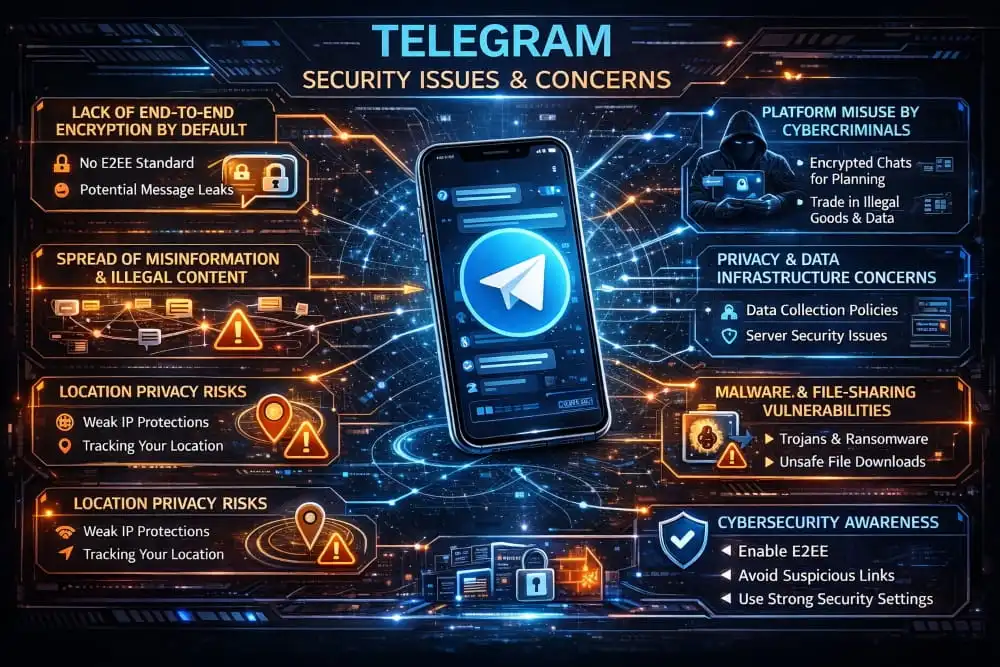
The risks aren’t hypothetical. Several have been actively exploited. Understanding where Telegram’s security model holds and where it doesn’t is the foundation of using the platform safely.
Encryption that isn’t end-to-end by default
The most consequential Telegram security issue is also the most misunderstood. Standard Telegram conversations, including most private messages, all community broadcasts, and all bot interactions, use server-client encryption. Messages are encrypted in transit but stored on Telegram’s cloud servers in a form the platform can access.
End-to-end encryption, where only the sender and recipient can read the content, is only available through Secret Chats, a manually activated feature that most users never use, that doesn’t exist for automated bots, and that isn’t available in any multi-person context. For users who assume their Telegram conversations are private by default, this gap is significant.
The practical implication: Telegram can read your standard messages, can be compelled to produce them under lawful legal requests, and could expose them if its server infrastructure were compromised. For sensitive communications, Secret Chats are the only option that provides genuine E2EE, and even then, metadata (who communicated with whom, when, from what device) may still be accessible.
The one-click IP leak vulnerability
In January 2026, security researchers publicly disclosed a critical vulnerability in Telegram’s mobile applications that allowed an attacker to capture a target’s real IP address with a single interaction, no malware, no social engineering, just one tap.
The mechanism exploited Telegram’s built-in MTProxy system, originally designed to help users bypass censorship. When a user tapped a proxy configuration link in the form t.me/proxy?…, Telegram automatically initiated a connectivity check to the proxy server before displaying any confirmation dialog. That check routed directly from the device’s real network interface, bypassing any VPN or proxy the user had configured.
An attacker controlling a malicious MTProxy server could log the connecting IP address and tie it to the Telegram account that tapped the link. For activists, journalists, and researchers who believed a VPN protected their identity, this vulnerability undermined that protection entirely. Telegram subsequently patched the behavior, but the incident illustrated a consistent pattern: features built for one purpose are regularly weaponized for another.
Platform misuse and criminal infrastructure abuse
Telegram’s architecture, anonymous account creation, large broadcast capacity, automated bots, and fast community reconstitution after takedowns have made it attractive to criminal operations as infrastructure. Security researchers have documented its use for malware command-and-control, coordinating distributed fraud campaigns, distributing infostealer logs, and recruiting money mules.
What distinguishes Telegram from traditional dark web infrastructure in this context is resilience. When a Tor-based marketplace is taken down, rebuilding takes months. When a Telegram community is removed, an operator with a subscriber list and an invite link can rebuild reach within hours. This asymmetry between disruption cost and rebuild cost is the defining security challenge Telegram poses for law enforcement and defenders.
Malware delivery through file sharing
Telegram’s file-sharing limit of up to 2GB per file makes it useful for legitimate collaboration and for distributing malware. Researchers have documented vulnerabilities in which malicious files were disguised as multimedia content, and active campaigns in which infostealers, remote access trojans, and ransomware droppers were distributed through communities as cracked software, credential dumps, or hacking tools.
Users who download files from unknown Telegram sources, regardless of how credible the sender appears, are operating without meaningful protection. File extensions, preview thumbnails, and community context can all be fabricated. Any file from an unverified source should be treated as potentially malicious until scanned in an isolated environment.
Location exposure through proximity features
Telegram’s People Nearby feature, designed to help users discover others in geographic proximity, was found by security researchers to be exploitable for precise location tracking. By making a series of distance queries from different positions, an attacker could triangulate a target’s location more accurately than the feature was intended to allow.
The feature has since been modified, but the underlying risk it illustrated, that convenience features can expose physical location data, remains relevant for users in sensitive operational contexts. Anyone with threat exposure from physical surveillance or stalking should turn off all location-related Telegram features entirely.
Telegram’s security features are worth using.
Despite these concerns, Telegram includes meaningful security controls, most of which are underused because they’re not enabled by default.
Telegram Data Privacy Concerns
Telegram’s privacy reputation is built on what it offers relative to mainstream messaging apps: more pseudonymity, optional end-to-end encryption, and a stated commitment to resisting government pressure. For most users, that reputation is enough. For users with genuine privacy requirements, the gap between Telegram’s marketing and its actual data practices is worth understanding in detail.
The concerns documented here reflect how Telegram’s architecture actually works, what data the platform retains, and under what circumstances that data leaves Telegram’s control. The encryption architecture is covered in detail in the security section above. What follows focuses on the data retention and disclosure questions that sit beneath it.
Metadata collection and retention
Even when message content is protected, metadata is not. Telegram collects and retains operational metadata, including IP addresses at login, device identifiers, session timestamps, and account activity patterns. This information exists regardless of whether a user has enabled Secret Chats or any other privacy setting.
Metadata is frequently more revealing than message content in investigative contexts. IP address logs establish physical location and identify users behind pseudonymous accounts. Login timestamps and session patterns confirm presence in a location or establish behavioral profiles. Username change history links current and past identities across time. None of this is unique to Telegram; it’s standard for any cloud-based platform, but it runs directly counter to the assumption that pseudonymous Telegram use is meaningfully anonymous.
Phone number linkage
Every Telegram account is created with a phone number, and that linkage persists regardless of what username or display name a user later adopts. Telegram’s privacy settings let users hide their phone numbers from most other users. However, contacts who already have the number saved can still identify the associated Telegram account through contact syncing.
For users who created accounts with a personal number and later shifted toward pseudonymous use, that original linkage remains in Telegram’s infrastructure. Law enforcement or platform administrators who obtain the account can trace it to the phone number and, from there, to the subscriber identity behind it. Burner or VoIP numbers reduce this risk, but don’t eliminate it. Reuse patterns and payment records have been used to identify users behind temporary numbers in documented investigations.
Legal disclosure and government cooperation
Telegram’s position on government data requests has shifted materially since 2024. The platform’s transparency reporting confirms it now responds to lawful requests from a significantly wider range of jurisdictions, with disclosures accelerating sharply following the legal proceedings involving Pavel Durov.
The data typically disclosed in response to legal requests includes IP addresses, phone numbers, and account metadata, the categories most useful for identifying who is behind an account. Message content from standard conversations can also be produced where servers fall within the requesting jurisdiction’s legal reach.
The scale of this shift is documented: in the first quarter of 2025 alone, Telegram provided authorities with data on 22,777 users, compared to 5,826 during the same period in 2024. For users who treated Telegram’s historical resistance to data requests as a privacy guarantee, this trajectory represents a fundamental change in the platform’s practical privacy posture. It reflects deliberate policy evolution, not an isolated exception.
Exposure through public community participation
Participating in large public Telegram communities carries privacy risks entirely separate from Telegram’s server-side data practices. Usernames, profile photos, and message content posted in public communities are visible to all members. Third-party tools, including commercial threat intelligence platforms, OSINT researchers, and law enforcement monitoring systems, can collect them.
Users who post in public Telegram communities under accounts linked to their real identity, or who use consistent pseudonyms across multiple communities, are building attributable behavioral profiles. The scale and searchability of Telegram communities make this exposure more significant than most users assume. A pseudonym used consistently across dozens of public communities creates a more complete behavioral record than the same user posting on a forum under the same name.
How to actually improve your Telegram privacy
Most of Telegram’s privacy risks are reducible but not eliminatable. The following controls address the most common exposure vectors:
Account-level controls:
- Enable two-factor authentication to protect against SIM-swap account takeover regardless of other settings
- Set phone number visibility to “Nobody” in Privacy & Security settings
- Disable contact syncing if you don’t want your account discoverable by people who have your number
- Regularly audit active sessions and terminate any you don’t recognize
Communication-level controls:
- Use Secret Chats for any conversation that requires genuine confidentiality, E2EE, not stored on Telegram servers
- Enable self-destructing messages in Secret Chats for conversations where you don’t want a persistent record
- Restrict who can add you to communities; unsolicited additions are a common vector for scam and malware exposure
Behavioral controls:
- Treat everything posted in a public community as permanently public and attributable
- Don’t reuse usernames across platforms if pseudonymity matters to you
- Avoid downloading files from unknown sources, regardless of how credible the sender or community appears
For users whose threat model requires genuine anonymity, not just Privacy from other users, but protection from platform-level disclosure, Telegram is not the right tool for sensitive communications. Signal provides E2EE by default across all conversation types and retains significantly less metadata. Telegram serves a different purpose: scale, reach, and community—understanding which tool fits which need is the most important privacy decision a user can make.
How to Stay Safe on Telegram (For Individuals and Organisations)
Telegram safety isn’t primarily a technical problem , it’s a behavioral one. Most successful attacks on Telegram users don’t exploit platform vulnerabilities. They exploit the decisions people make after receiving a message: clicking a link, downloading a file, sharing a verification code, or joining an unknown community because the invite looked credible.
The controls below address both the technical settings and the behavioral patterns that determine actual exposure.
Use Telegram with OSINT hygiene
Treat unknown Telegram communities the way you’d treat an unverified website. Join only spaces you can independently verify, avoid sharing personal details in any community you didn’t seek out yourself, and consider a separate alias-based account if you need to monitor risky or unknown spaces without exposing your primary identity.
The key principle: your presence in a community is data. Your username, your activity patterns, and any messages you post are all visible to every member and collectible by third-party tools. Operating with that awareness is the foundation of safe Telegram use.
Reduce click and download risk
Most Telegram scams begin with a single action , clicking an invite link, opening a file, or tapping a “verify your account” prompt. The design is always the same: create urgency, reduce hesitation, and get the action before the target thinks carefully.
Verify invite links from reputable, independent sources before joining. Never download files sent by unknown contacts or posted in communities you haven’t vetted. Treat any message that pushes you to act quickly as a social engineering attempt until proven otherwise , urgency is a technique, not a reason.
Monitor for exposure and impersonation
For individuals, set alerts for your name and any identifiers you use publicly , email addresses, usernames, domains. For organizations, monitoring should cover brand names, executive names, product terms, and domain variations across Telegram and connected threat surfaces including paste sites and dark web sources.
Impersonation on Telegram moves fast. A fake support community using your brand can accumulate followers and run active fraud operations within 24 hours of being created. Early detection compresses your response window from weeks to hours. DeXpose Brand Protection flags impersonation activity and scam keywords targeting your organization across Telegram and dark web sources before customer damage scales.
Report and stay legally compliant
If you encounter stolen data being sold, impersonation of your organization, or clear criminal activity, document it and report through proper channels , Telegram’s in-app reporting, your legal team, and law enforcement where appropriate. Do not engage with the operators, attempt to purchase data to assess scope, or participate in any transaction as a test.
Telegram has significantly increased cooperation with legal investigations since 2024. Participation in illegal transactions , even with investigative intent , creates legal exposure for the participant. Document, report, escalate.
Harden defences beyond Telegram
Telegram is the distribution and recruitment layer. The actual damage happens downstream, when credentials harvested or social engineering completed on Telegram are used to access business systems, email accounts, or financial services.
Enforce MFA everywhere , email, admin tools, financial systems, and any account that could be used to reset access to others. Run regular credential exposure checks so compromised passwords are rotated before they’re weaponized. Treat Telegram-based social engineering as a precursor to a broader attack, not a self-contained incident.
Train people on real-world scam patterns
The fastest security wins come from awareness. Most Telegram-based attacks depend entirely on persuasion rather than technical exploitation , fake investment support, romance manipulation, urgent verification requests, and suspicious link delivery are all social engineering, not hacking.
Train staff on what these patterns look like in practice, with real examples drawn from current threat reporting. The behavioral goal is simple: pause, verify through an independent channel, and report rather than react. One staff member who recognizes a pig-butchering approach or a fake admin contact and reports it is worth more than any technical control that triggers after the damage is done.
Telegram Threat Model: Who Is Actually After You and What They Can Do
Most Telegram security advice treats all risk as equivalent: “Be careful, don’t click links, enable 2FA.” That framing is accurate but not useful. A practical threat model starts by naming the specific actors you’re defending against, understanding what they can realistically accomplish, and building defenses that match their actual capabilities rather than a generalized fear of the platform.
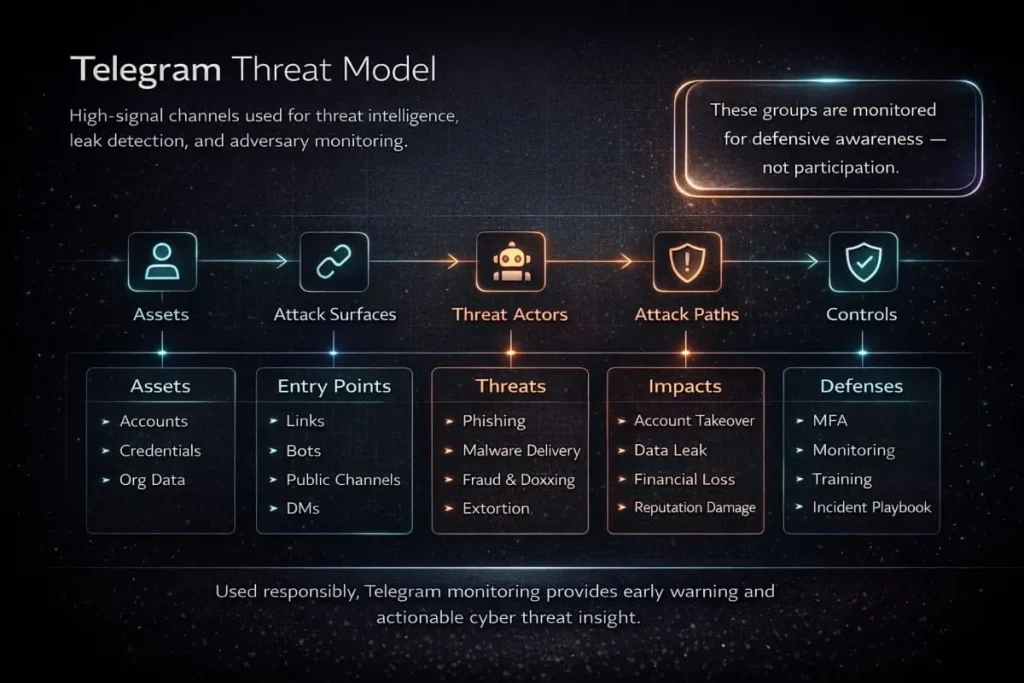
In most Telegram threat scenarios, three actor types account for the overwhelming majority of harm: scammers, data sellers, and impersonators. They have different objectives, different methods, and critically, different weaknesses.
Scammers
Scammers operate on persuasion. Their goal is to manipulate a target into a single high-value action, sending cryptocurrency, handing over credentials, installing a malicious file, or authorizing a payment, before the target has time to verify what’s actually happening. Technical sophistication is rarely required. What they need is a convincing message template, a broadcast mechanism to reach enough targets, and a payment channel to collect.
The most effective scam operations on Telegram run on a hybrid model: automated bots handle discovery and initial contact at scale, then human operators take over the conversation once a target shows genuine engagement. This transition is deliberate; bots maximize reach, humans maximize conversion. It’s why purely automated defenses, such as link filtering and bot detection, are insufficient on their own. The bot gets you into the funnel. The human closes it.
What scammers cannot do without additional access: access your accounts without credentials you provide, cause financial harm without an action you take, or maintain a persistent presence after a community is removed. Their power is entirely front-loaded into the persuasion moment. Disrupting that moment, through awareness training, verification habits, and slowing down before any financial action, is the most effective defense available.
Data sellers and leak traders
Data sellers are not primarily targeting individuals. Their operational model is volume: aggregate stolen credentials, infostealer logs, and identity bundles from multiple breach sources, then distribute them at scale through Telegram to buyers who use them for credential stuffing, account takeover, and downstream fraud across entirely separate platforms.
The critical implication for defenders is that Telegram security settings are almost irrelevant to this threat. Your organization’s credentials don’t need to be stolen via Telegram; they appear there after being harvested elsewhere. The risk isn’t what happens on the platform; it’s what happens to accounts and systems whose data surfaces there.
What matters against data sellers is the defensive layer after Telegram: MFA across all business systems so stolen credentials can’t be used directly, credential monitoring so you know when your organization’s data appears before attackers exploit it, and rapid response protocols that treat a credential appearing in a Telegram leak feed as an active incident, not background noise.
Impersonators and brand abusers
Impersonators cause two kinds of harm simultaneously, financial and reputational, and the reputational damage often outlasts the fraud itself. Customers who lose money to a fake “support” community, a lookalike executive account, or a fraudulent verification flow associate the loss with the brand being impersonated, not the attacker. That association persists even after the fake community is removed and the fraud is documented.
The mechanics are straightforward: create an account or community that closely resembles a legitimate brand presence, accumulate enough followers to appear credible, then direct victims toward fraudulent verification flows, off-platform payments, or malware downloads. Telegram’s in-app search makes lookalike communities discoverable to users specifically looking for legitimate support, which is exactly the moment of highest vulnerability.
The defining characteristic of impersonation threats is that scale is the enemy. A community of 100 followers who impersonate others is a nuisance. One with 10,000 is an active fraud operation. Detection before scale is the only response that effectively limits damage, which means monitoring for lookalike account creation, not just waiting for customer reports.
What these actors can and cannot do
A realistic threat assessment distinguishes between what Telegram enables and what attackers can actually accomplish.
What they can do: reach large audiences instantly, rebuild disrupted operations under new identities within hours, combine automated and human social engineering at low cost, and exploit the assumption of platform anonymity that many users hold incorrectly.
What they cannot do: compromise your systems simply by being in the same community as you, bypass strong authentication without a credential or foothold obtained through user action, cause lasting damage without some combination of clicking, downloading, sharing, or payment authorization, or operate indefinitely without leaving the metadata traces that platform cooperation and investigation can connect to real identities.
The biggest risk is not Telegram itself. It is the decisions users make in the seconds after they receive a message on it.
Defensive priorities
A Telegram defense built around these three actor types focuses on three corresponding controls:
Against scammers: awareness training on what social engineering looks like in practice, the urgency framing, the verification code requests, and the investment opportunity that appeared from nowhere. Staff who recognize the pattern and slow down are more effective than any technical filter.
Against data sellers: MFA everywhere that matters, credential monitoring that covers Telegram alongside traditional dark web sources, and incident response playbooks that treat credential exposure as an active threat from the moment it’s detected.
Against impersonators: proactive monitoring for brand mentions, lookalike account creation, and fake support infrastructure, before customer harm scales to the point where cleanup costs more than prevention would have.
DeXpose covers all three surfaces: Telegram monitoring alongside dark web markets, breach sources, and brand protection, giving security teams early detection across the full threat landscape rather than point coverage of individual channels.
Telegram Bots: Helpful vs Harmful
Telegram bots are automated accounts that respond to messages, deliver content, and execute workflows without a human operator behind each interaction. For legitimate purposes, they’re genuinely useful; alert delivery, customer support routing, community moderation, content scheduling, and information lookups are all well-suited to bot infrastructure. Most large Telegram communities use bots for at least some administrative functions.
The same architecture that makes bots useful for legitimate operations makes them efficient for criminal ones. A bot doesn’t sleep, doesn’t make off-script mistakes, and can run thousands of simultaneous conversations at zero marginal cost per additional target.
How bots enable criminal operations
In fraud ecosystems, bots function as always-on operators: greeting contacts, collecting information through scripted conversation flows, and guiding targets through multi-step processes that feel procedurally legitimate because responses arrive instantly and consistently. The immediacy is the manipulation, hesitation that a slow human response might create, simply doesn’t exist.
The most common criminal bot pattern is fake support simulation. A bot receives a user through a spoofed community, presents a help desk interface, walks the target through a “verification” or “account recovery” flow, and terminates with a request for a confirmation code, wallet recovery phrase, or payment. The interaction closely mimics what a legitimate support process looks like, so targets who haven’t seen the pattern before don’t question it until it’s too late.
The bot has no stake in whether the target suffers harm. It will run the same script on the next target immediately after.
Escrow theater and guarantee fraud
Some criminal operations deploy bots specifically to simulate trust infrastructure, presenting an automated system as a neutral escrow holder or transaction validator that protects both parties. In practice, the “escrow bot” is controlled by the same operator running the fraud. The appearance of a third-party mechanism is the final piece of credibility required to get a target to commit funds.
This pattern appears most frequently in fake marketplace contexts and investment scam setups, where the perceived existence of a safety mechanism directly overcomes the target’s remaining hesitation. Recognizing escrow theater requires knowing that legitimate escrow services in any financial context do not operate through Telegram bots; they use regulated third parties with verifiable identities.
Phishing distribution at scale
A bot converts a single phishing campaign into a continuously running machine. Rather than a one-off link delivery, a bot sends the same lure to thousands of contacts in sequence, responds to engagement questions to maintain the interaction, adapts the delivery approach based on how targets respond, and redirects to cloned pages or malicious downloads at the appropriate moment in the conversation flow.
The economics are what make this dangerous at a systemic level. The marginal cost of running the campaign against an additional thousand targets is effectively zero. Even a conversion rate of a fraction of a percent yields meaningful fraud returns for the operator, so there is no minimum target value that makes a campaign not worth running.
Command-and-control infrastructure
Beyond fraud operations, security researchers have documented Telegram bots being used as command-and-control infrastructure for deployed malware, receiving instructions from operators and reporting back exfiltrated data through Telegram’s API. This use case is relevant for security teams because it means that Telegram bot traffic in a corporate environment may indicate compromised endpoints communicating outbound, not just inbound scam delivery.
What defenders should look for
Bot interaction patterns are more revealing than account characteristics. The indicators worth flagging:
Conversation structure: scripted responses that don’t adapt naturally to unexpected questions, an inability to handle off-topic input without defaulting to a fixed prompt, and a conversation flow that always routes toward the same terminal action regardless of what the user says.
Request type: any bot that requests passwords, verification codes, wallet recovery phrases, two-factor authentication codes, or payment outside an established, verified platform is either compromised or criminal. Legitimate business bots do not request these things. There are no exceptions.
Timing and reach: bots that initiate unsolicited contact, particularly around account issues, prize claims, or support inquiries the user didn’t originate, are operating outside any legitimate use case.
External link delivery: bots that exist primarily to deliver external links, particularly on first contact or early in an interaction, are operating as phishing distribution infrastructure regardless of how the surrounding conversation is framed.
Any bot interaction matching these patterns warrants immediate disengagement, in-platform reporting, and escalation to your security team if organizational accounts or credentials were involved.
Telegram Evidence Checklist for Incident Response
When a Telegram-based incident occurs, such as impersonation, fraud, credential distribution, or targeted harassment, the window for evidence collection is short. Display names, profile photos, and community titles can change or disappear within hours of a report being filed or a community being flagged. The stable identifiers are the ones that persist through those changes, and capturing them before taking any reporting action is the difference between an investigation that produces results and one that dead-ends when the account disappears.
Work through this checklist in full before filing any in-platform report or takedown request. Platform action can remove content you still need.
Account and community identifiers
These remain stable even when everything visible about an account changes:
- @username, the handle, not the display name. Copy it exactly, including capitalization.
- Account or community ID number, visible in Telegram’s web interface URL and accessible via the Telegram API. This number never changes, even if the account is renamed or migrated.
- Display name at time of incident, screenshot with timestamp; this is what victims will remember and what will appear in any legal filing.
- Invite URLs, copy all associated t.me/ links in full. These may stop working after a takedown, but remain useful for investigation.
- Profile photo, screenshot and download. Reverse image search can identify reuse across platforms.
- Bio text and linked external accounts, copy in full. External links in bios often point to the actual infrastructure supporting the Telegram presence.
Message-level evidence
- Full screenshots showing timestamps, usernames, and message content together in a single frame. Partial screenshots without timestamps are difficult to use in formal proceedings.
- Message links: right-click any message in Telegram’s web interface to copy a direct permalink. These are stable and can be referenced in reports and legal filings.
- Forwarded content, preserve the forwarding metadata showing the source. Forwarded messages often expose the originating account even when the redistributing account has been cleaned up.
- Bot interaction logs: if you interacted with an automated bot, screenshot the full conversation flow, including any prompts, buttons presented, and responses. The scripted flow itself is often the clearest evidence of fraudulent intent.
- Files and media are preserved without opening directly. Use a sandboxed environment or submit to a security team for analysis. Files are frequently the payload delivery mechanism and constitute primary evidence.
Financial and fraud artefacts
- Cryptocurrency wallet addresses, copy in full. Even a single address can be traced through blockchain analysis to exchanges, prior transactions, and ultimately verified identities.
- For any payment made, record the transaction ID immediately. This is the starting point for fund tracing and exchange reporting.
- Payment request screenshots, including the stated amount, currency, stated purpose, and any attached deadline or urgency language. Urgency framing is relevant to establishing fraudulent intent.
- External websites and payment platforms, any domains, URLs, or third-party platforms referenced in the fraud flow. These frequently have registration records, hosting metadata, and prior abuse reports that support the broader investigation.
Reporting and escalation sequence
The order matters: collect everything first, then report.
- Complete all evidence capture above before any in-platform action.
- File in-platform reports via Telegram’s reporting function for the account and any associated communities. Use @NoToScam for fraud-specific reporting.
- For brand impersonation: escalate to your legal team and submit a formal takedown request to telegram.org/support with the full evidence package. A documented trademark or brand rights claim moves significantly faster than a generic abuse report.
- For financial fraud: file with your national cybercrime reporting body, Action Fraud (UK), IC3 (US), or the equivalent in your jurisdiction, and provide wallet addresses for tracing alongside the transaction documentation.
- For data distribution: if your organization’s credentials or data appear in a Telegram distribution community, treat it as an active credential incident in parallel with the reporting process. Rotate exposed credentials, notify affected users, and initiate your standard breach response playbook.
Conclusion
Telegram has become the high-speed distribution layer for modern cybercrime, where Telegram scams spread through public Telegram channels and Telegram groups in minutes. It’s where attackers advertise, recruit, and funnel victims quickly using search, invite links, and bots, often before defenders even realise a campaign has started.
The dark web on the Tor network still matters, but it often functions more like the deeper context layer where reputation, negotiations, and higher-risk listings live behind tighter access. When you only monitor one side, you miss either the fast-moving scam funnels on Telegram or the source discussions and marketplaces that shape what appears there.
The best defence in 2026 is layered: monitor both Telegram and Tor for early warning signals, respond fast with evidence capture and takedown workflows, and harden accounts to reduce the impact of exposure. When monitoring, response, and security controls work together, you turn fragmented signals into actionable prevention instead of post-incident cleanup.
If you need continuous visibility into Telegram scams, impersonation, and leaked credentials, DeXpose provides monitoring, alerts, and brand protection support.