
What Is the Dark Web? Explanation, Risks & 2026 Status
The dark web is the hidden layer of the internet that standard browsers cannot access and search engines cannot index. It runs on encrypted networks, most commonly Tor (The Onion Router), where both users and site operators remain deliberately anonymous. Sites on the dark web use .onion addresses instead of .com or .org, and they are entirely invisible to the regular web.
The dark web is not the same as the deep web. The deep web includes all private, login-protected content, your email inbox, banking portal, hospital records, and accounts, which together make up roughly 90% of the internet. The dark web is a small, intentionally hidden slice within that deeper layer, representing approximately 0.01% of the internet by total volume. It is far smaller than most people assume. Its impact on cybercrime and data security, however, is outsized relative to its size.
In 2026, the dark web is still very much active. Over 2.5 to 3 million users access the Tor network daily. Underground markets continue trading stolen credentials, corporate network access, malware kits, and personal identity records, often within days of a data breach occurring. At the same time, the dark web is a legitimate tool for privacy used by journalists, activists, and cybersecurity researchers around the world.
What Is the Dark Web and How Does It Work? (2026)
The dark web is a hidden layer of the internet that standard browsers cannot access and search engines cannot index. It runs on encrypted networks, most commonly Tor, where users and site operators remain deliberately anonymous, and websites use .onion addresses instead of the familiar .com or .org domains you find on the everyday web.
To understand where it fits, picture the internet as three distinct layers. The surface web is what most people use daily: Google, YouTube, news sites, and it accounts for roughly 5–10% of total internet content. Beneath it lies the deep web: private, login-protected content such as email inboxes, banking portals, and corporate databases, which makes up around 90% of the internet. The dark web is a small, intentionally hidden portion of that deeper layer, representing less than 0.01% of the internet by volume. It requires special software to reach, and is entirely invisible to the rest of the web.
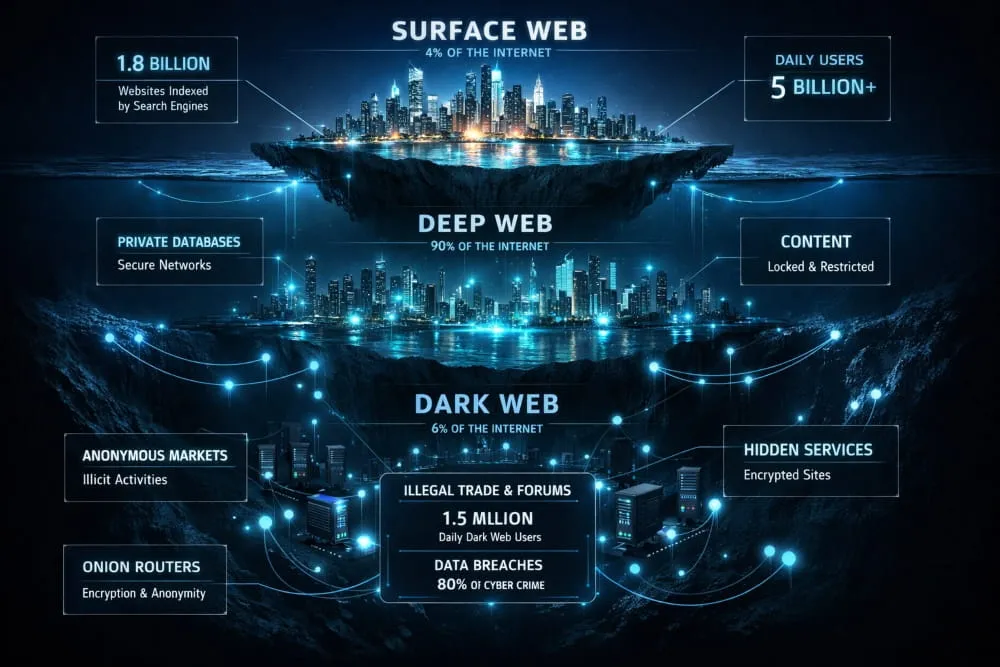
How the Dark Web Works
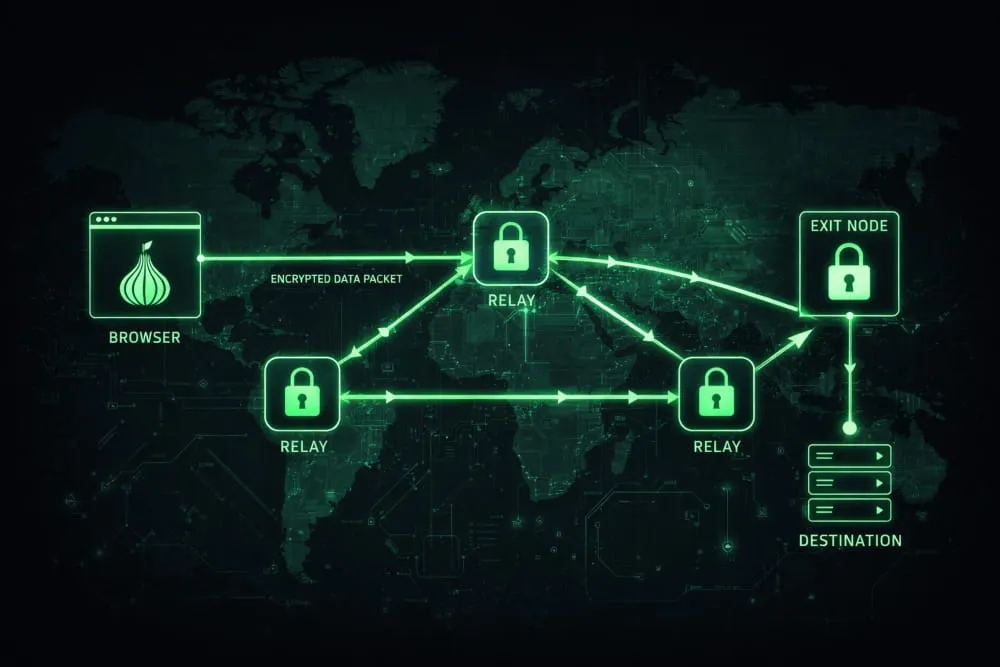
Access requires a specialized browser, most commonly Tor (The Onion Router). When you connect, your traffic is encrypted in multiple layers, like the layers of an onion, then routed through a series of volunteer-run servers called relays. Each relay knows only the step before and after it, never the full path. By the time your request reaches its destination, your identity and location are effectively hidden.
That layered routing is why tracing a dark web user is extremely difficult. It is not impossible, however. Law enforcement agencies have repeatedly de-anonymized users through operational mistakes, reused usernames, unencrypted communications, and cryptocurrency trails.
Why Was the Dark Web Created?
The dark web was not built for criminal purposes. The U.S. Naval Research Laboratory originally developed it in the mid-1990s to enable secure, anonymous communication for intelligence operatives, a use case that quickly extended to journalists, whistleblowers, and activists operating under authoritarian governments. SecureDrop, the whistleblower platform used by major news organizations worldwide, runs on this infrastructure. So do .onion versions of the BBC and The New York Times, maintained specifically so readers in censorship-heavy countries can access independent journalism.
The same anonymity that protects those users also attracts criminal networks. That is the genuine complexity of the dark web: it is a privacy technology with legitimate foundations that has also become one of the internet’s most active platforms for cybercrime. Understanding which side dominates, and by how much, is what separates accurate risk assessment from myth.
What’s Actually on the Dark Web in 2026?
The dark web is not exclusively criminal, but criminal activity dominates it. Research consistently shows that more than half of active dark web sites are linked to illegal content, and the underground economy they support is large, organized, and growing. Understanding the full picture matters, because accurate risk assessment requires knowing both what the dark web protects and what it enables.
Legitimate Uses
A meaningful portion of dark web activity exists to protect privacy and free speech, not circumvent the law. Whistleblower platforms like SecureDrop run on .onion infrastructure so journalists and sources can exchange sensitive information without leaving a traceable record. Major news organizations, the BBC, The New York Times, Deutsche Welle, operate .onion mirror sites specifically so readers in censorship-heavy countries can access independent journalism. Privacy-focused communities use the dark web because identity protection, not criminal intent, is their primary need.
For cybersecurity teams, the dark web is also a professional monitoring environment. Analysts scan underground forums and breach markets to detect leaked credentials and emerging threats before they translate into active attacks, often days or weeks before public disclosure.
What Criminal Activity Actually Looks Like
The criminal side of the dark web is not a collection of amateur forums. It is a functioning underground economy with product listings, vendor ratings, escrow systems, and customer support. Stolen credentials and data dumps, usernames, passwords, financial records, identity documents harvested from breaches, make up the largest single category of traded goods. Alongside them: malware kits, ransomware tools, phishing templates, and DDoS-for-hire services sold to buyers with no technical background. Drug marketplaces ship narcotics through postal networks using cryptocurrency settlement. Financial fraud listings offer stolen credit card data, bank login credentials, and counterfeit documents at scale.
The category with the highest downstream risk, however, is initial access listings: compromised corporate VPN or RDP credentials sold directly to ransomware groups seeking a way into enterprise networks. These listings are what connect a data breach at a vendor to a ransomware attack on a hospital six months later.
What Is Sold and What It Costs
Transactions on dark web marketplaces almost exclusively use cryptocurrency: Monero for anonymity, Bitcoin for broader acceptance. Prices reflect a mature, competitive market:
| Item | Typical Price | Security Impact |
|---|---|---|
| Single Social Security Number | $1–$3 | Identity theft, tax fraud |
| Full Identity Profile (Fullz) | $10–$100+ | Account takeover, fraudulent loans |
| Stolen Credit Card Data | $5–$20 per card | Fraudulent transactions, cloning |
| Corporate Network Access | $1,000–$50,000+ | Ransomware deployment, data exfiltration |
| Entry-Level Ransomware Kit | $50–$200 | Enables low-skill attackers to launch encryption attacks |
The wide price range on corporate access reflects network size and privilege level; a domain admin credential at a Fortune 500 company commands a very different price than a contractor VPN login at a mid-market firm. Both end up on the same marketplaces.
The practical implication for security teams is straightforward: criminal content vastly outnumbers legitimate use on the dark web, and the infrastructure supporting it is professional enough that stolen data from a breach can reach an active buyer within hours. Dark web monitoring is not an advanced capability reserved for enterprise security programs; it is baseline visibility in 2026.
How Big Is the Dark Web? (2026)
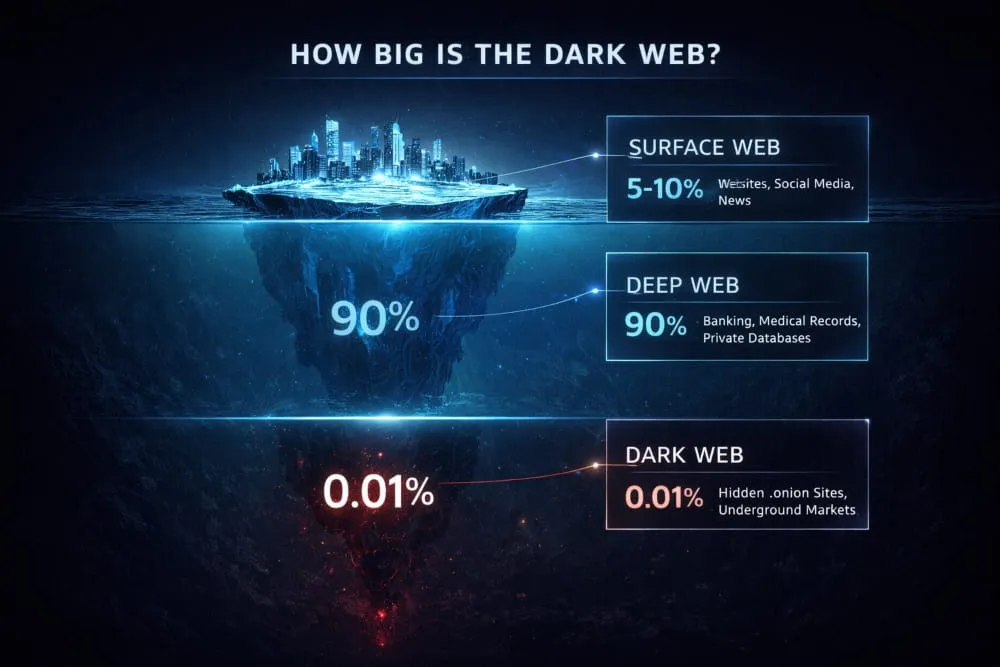
The dark web is far smaller than most people assume. It represents approximately 0.01% of the total internet by volume, not a shadow internet running parallel to the web you use every day, but a narrow, encrypted layer sitting within the much larger deep web. The myth of a vast hidden internet persists because the dark web’s anonymous architecture makes it difficult to measure precisely, and because media coverage focuses almost exclusively on its most sensational uses.
How the Internet Layers Compare
To put the dark web’s size in context, the internet divides into three layers. The surface web, every site Google can index, every page you can reach through a standard browser, accounts for roughly 5–10% of total internet content. The deep web sits beneath it: private, unindexed content including email inboxes, banking portals, academic databases, hospital records, corporate intranets, and government systems. Researchers estimate the deep web is 400 to 500 times larger than the surface web, containing the majority of the internet’s actual data. The dark web is a small, intentionally hidden subset of the deep web, encrypted, inaccessible to standard browsers, and designed for anonymity. It contains a tiny fraction of what the deep web holds.
The confusion between “deep web” and “dark web” is common and worth correcting. Your bank account portal is deep web. A darknet market selling stolen credentials is dark web. They are not the same thing and carry very different risk profiles.
How Many Dark Web Sites Actually Exist?
The Tor network, the primary infrastructure for accessing the dark web, hosts an estimated 65,000 to 100,000 active .onion services at any given time, though this figure shifts constantly. Dark web sites are inherently unstable: marketplaces disappear after law enforcement operations, administrators exit-scam their users and vanish, and infrastructure gets repeatedly disrupted. Many listed .onion addresses are mirrors or duplicates of existing sites, which inflates the apparent count of unique destinations. Researchers consistently find that a large proportion of dark web content is replicated rather than original.
Among active, unique sites, studies estimate that more than half host content linked to illegal activity. The remainder includes legitimate whistleblower platforms, privacy-focused communities, mirror sites for major news organizations, and research infrastructure used by cybersecurity teams.
Why the Dark Web Seems Larger Than It Is
Three factors combine to make the dark web feel bigger than the data supports.
Its hidden nature makes measurement inherently imprecise; no crawler can index .onion services the way Googlebot indexes the surface web, so estimates carry wide uncertainty ranges. Mirroring and duplication create the appearance of a sprawling ecosystem, even though much of the content is redundant. And media coverage amplifies the most dramatic cases- major marketplace seizures, billion-dollar cryptocurrency seizures, high-profile arrests- while the quiet majority of Tor traffic, which is people browsing the regular internet privately, goes unreported.
The result is a persistent gap between public perception and technical reality. The dark web is not a vast, parallel internet. It is a small, volatile, and disproportionately impactful layer of the overall web, one whose influence on cybercrime, data markets, and corporate risk far exceeds what its raw size would suggest.
The dark web’s risk profile in 2026 is defined less by its technology than by its ecosystem. Professional cybercrime marketplaces operate with vendor ratings and escrow systems. Data breach inventories, passwords, credit card numbers, and identity records are sold in bulk within days of a compromise. Cryptocurrency transactions are difficult to reverse and harder to trace. These are not emerging trends; they are the established infrastructure of an underground economy that has been growing for over a decade and has proven resilient to repeated law-enforcement disruptions.
The consistent thread across every dark web risk, legal, technical, and organizational, is that exposure is rarely discovered in real time. Credentials from a breach sit on markets for weeks before a security team finds them. Malware installed through a dark web interaction can persist on a device for a long time before triggering a detectable event. The gap between when something goes wrong and when an organization learns about it is precisely where dark web monitoring operates. Understanding the risks is the first step. Closing the visibility gap is the second.
Is the Dark Web Still Active in 2026?
Yes, the dark web is still active in 2026, and by most measurable indicators, it is more active than ever.
The Tor network serves between 2.5 and 3 million daily users. Tens of thousands of .onion services are online at any given time. Darknet markets are processing billions of dollars in cryptocurrency transactions annually. Ransomware groups are publishing new victims on dark web leak sites every week. Underground forums are trading fresh credential dumps from recent breaches in near real time.
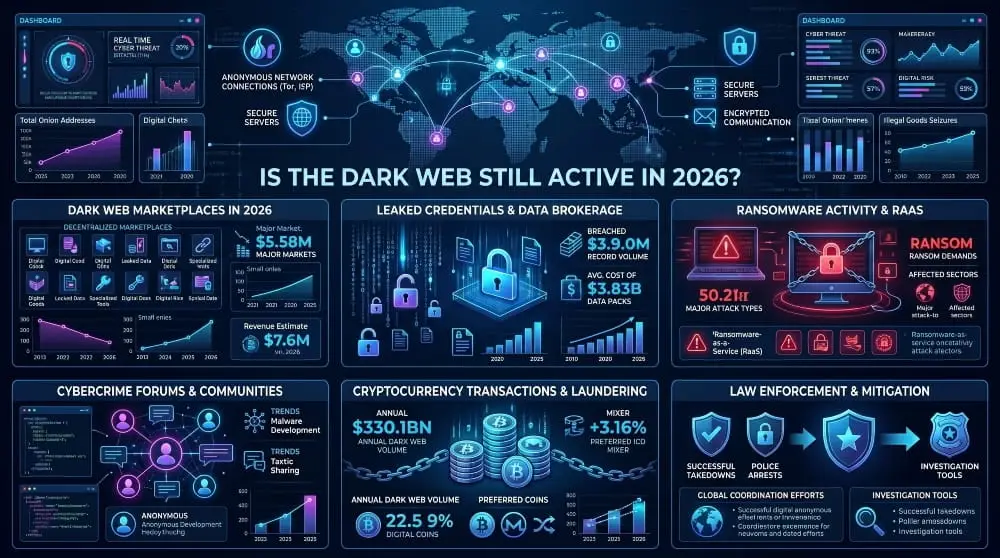
The dark web has not contracted under sustained law enforcement pressure; it has restructured. Major marketplace takedowns in 2025 and 2026, including those of Hydra, AlphaBay, Genesis Market, Archetyp, and others, disrupted specific platforms and led to genuine arrests. None of them reduced aggregate dark web activity. Each displaced user base migrated to successor platforms within weeks, and the overall volume of underground commerce continued rising. By mid-2026, there were more active darknet marketplaces than at any prior point, most of them smaller, more decentralized, and structurally harder to dismantle than the centralized giants that preceded them.
The nature of dark web activity has also evolved. The era of a single dominant marketplace, Silk Road, then Hydra, then AlphaBay, has given way to a fragmented ecosystem of specialized platforms, invite-only forums, and encrypted Telegram-adjacent communities. The dark web is not disappearing. It is dispersing, which makes it more resilient rather than less.
For organizations and individuals asking whether dark web exposure is still a live concern in 2026: it is. Credentials from breaches years ago continue circulating. Fresh data from recent incidents appears within days. The infrastructure enabling attackers to find, purchase, and weaponize stolen data is fully operational. The dark web is not a historical threat that law enforcement has contained; it is an active, adaptive environment that security teams monitor continuously, precisely because it remains relevant.
Dark Web Statistics 2026
The dark web accounts for approximately 0.01% of the total internet, a fraction of a fraction, yet it supports a fully functioning underground economy that processes billions of dollars annually and holds stolen data on hundreds of millions of people. These are not estimates from fringe researchers. They come from Tor Project usage data, blockchain analytics firms tracking darknet market transactions, and cybersecurity companies monitoring breach inventories in real time.
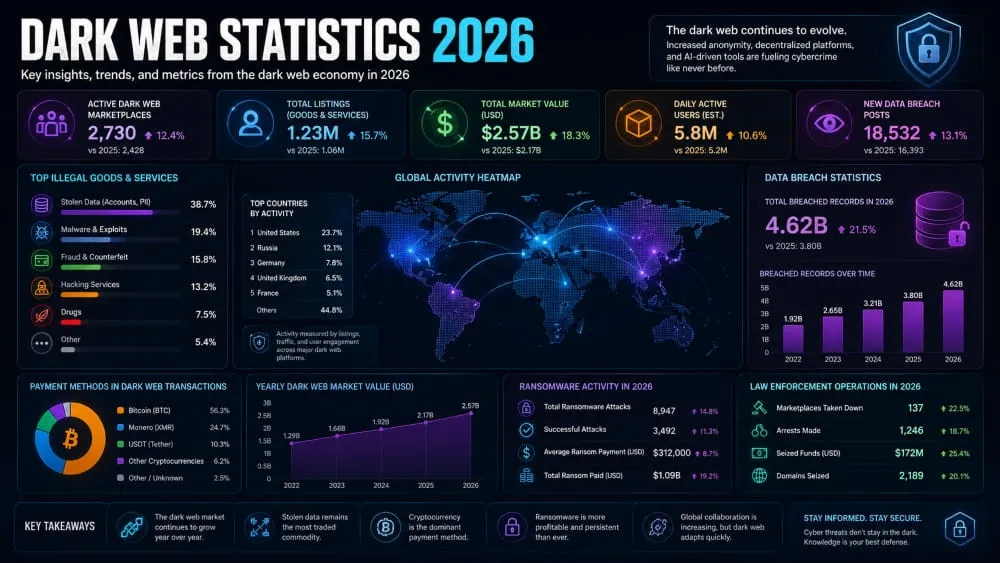
Size and User Base
The Tor network, the primary infrastructure for accessing the dark web, recorded between 2.5 and 3 million daily users in 2026, a figure that has grown consistently over the past three years. Across a full month, tens of millions of unique users access Tor-based services. The network itself operates through more than 7,000 active relays globally and hosts an estimated 65,000 to 100,000 active .onion services at any given time. However, the number fluctuates as sites appear, migrate, and disappear under enforcement pressure.
Underground Economy
Dark web markets handled an estimated $1.5 billion or more in cryptocurrency transactions in recent years, despite repeated high-profile takedowns, with figures rising. Monero has become the dominant transaction currency for illicit trades due to its privacy-by-default architecture; Bitcoin remains in use but is declining among vendors aware of its traceability.
Stolen credentials represent the single largest category of traded goods. By early 2026, cybersecurity researchers estimated that more than 24 billion username and password combinations were circulating across dark web forums and markets, a figure that grows with every major breach. The average time between a corporate data breach and the appearance of that organization’s credentials on a dark web marketplace is approximately 12 days.
Content Distribution
Research from multiple cybersecurity organizations consistently finds that more than 57% of active dark web sites host content linked to illegal activity. That includes credential markets, drug marketplaces, malware distribution, fraud services, and extremist forums. Legitimate use, whistleblower platforms, privacy communities, and censorship-bypass tools account for the remaining portion, but they are a minority.
Initial access listings, compromised corporate credentials sold to ransomware groups, have grown into one of the most consequential dark web categories. A verified domain administrator credential at a mid-market company typically lists for $500 to $5,000. At an enterprise, the same access can sell for $10,000 to $50,000 or more, depending on network size, industry, and the level of privilege the credential carries.
Awareness and Context
Around half of U.S. adults now report familiarity with the dark web. This figure reflects both media coverage and the growing number of people who have received breach notifications telling them their data appeared there. Dark web forum activity surged by more than 40% during early COVID-19 lockdowns, driven by a combination of increased online activity, economic disruption, and a spike in credential theft targeting remote-work infrastructure.
Law enforcement has responded with sustained pressure; Hydra, AlphaBay, Genesis Market, and dozens of smaller platforms have been dismantled in coordinated international operations. None of it has reduced the overall scale. Each takedown disperses users to smaller, more decentralized replacements, and the aggregate volume of dark web commerce continues to climb year over year.
The data tells one consistent story: the dark web is not a static threat. It is an adaptive, resilient ecosystem, and the organizations best positioned to manage its risks are those that monitor it continuously rather than respond after the fact.
Dark Web Current Status (2026)
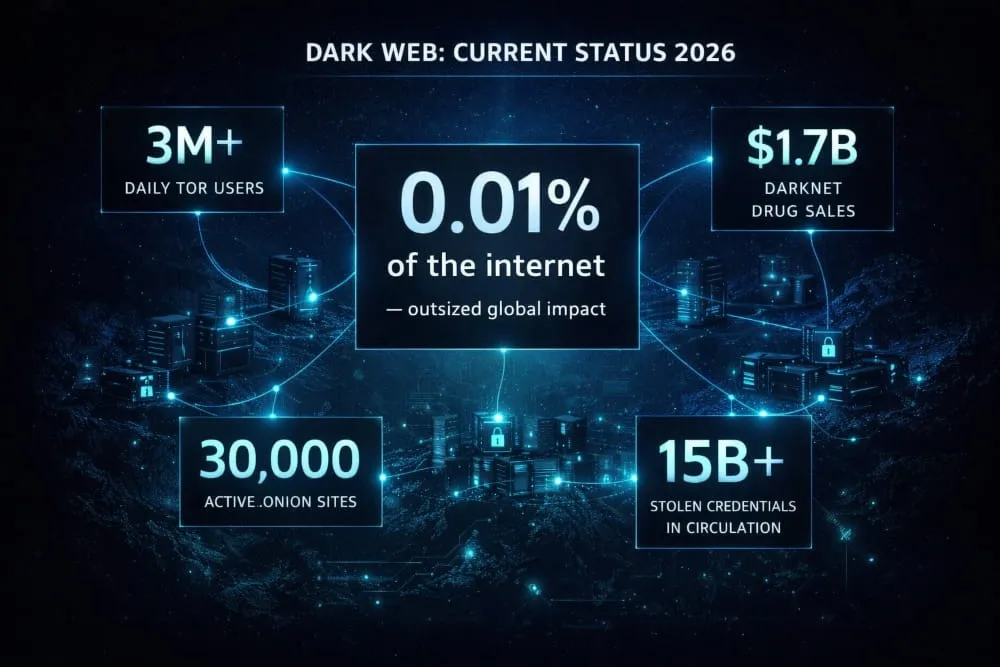
The dark web in 2026 is not shrinking; it is restructuring. The Tor network still serves over 2.5 to 3 million daily users, underground markets continue processing billions in cryptocurrency transactions annually, and new communities replace every marketplace that law enforcement dismantles. What has changed is the architecture. The era of large, centralized darknet markets is giving way to something harder to target: smaller, encrypted forums, invite-only communities, and decentralized trading infrastructure that fragments activity across dozens of nodes rather than concentrating it on a single, takedown-vulnerable platform.
Current Status of the Tor Network (2026)
Tor remains the primary gateway to the dark web. Its network operates through thousands of volunteer-run relays globally and hosts tens of thousands of active .onion services at any given time. Daily usage has grown consistently over the past three years, not because more criminals discovered it, but because demand for private, surveillance-resistant browsing is rising broadly. The majority of Tor users never touch a darknet market. They are journalists, researchers, activists in censored regions, and privacy-conscious individuals who want their traffic invisible to ISPs and government monitoring systems.
That context matters for accurate threat modeling. Tor itself is a legitimate privacy tool. The dark web ecosystem it enables is the more complex question.
How Darknet Markets Have Adapted
The pattern over the last several years has been consistent: a major marketplace operates at scale, draws law enforcement attention, is dismantled in a coordinated international operation, and, within months, its user base migrates elsewhere. Hydra, AlphaBay, Genesis Market- each takedown was significant. None ended underground commerce. In 2026, the market has undergone structural change. Centralized platforms are being replaced by decentralized models that use peer-to-peer transaction infrastructure and encrypted messaging channels, Telegram-based shops, private Discord-adjacent forums, and I2P-hosted communities, specifically because they present a smaller, more distributed enforcement target.
The practical implication is that dark web monitoring has become more technically demanding. Threat intelligence teams can no longer watch one or two major markets and call it coverage. Effective monitoring now requires continuous surveillance across fragmented, shifting infrastructure.
Who Uses the Dark Web and Why?
The dark web serves two communities simultaneously, and the line between them is cleaner than popular coverage suggests.
Legitimate Users
Journalists and whistleblowers use SecureDrop and similar .onion platforms to exchange sensitive information without leaving a traceable record. Activists and dissidents operating under authoritarian governments rely on Tor to organize, communicate, and access uncensored news that their governments have blocked on the surface web. Privacy-conscious individuals use it to avoid the tracking and behavioral profiling that follows ordinary browsing. None of these users are interacting with criminal infrastructure; they are using the same anonymity technology for the purpose for which it was originally designed.
The use case most relevant to cybersecurity professionals is monitoring. Security teams scan dark web forums and breach markets to detect stolen credentials, leaked internal documents, and early-stage attack planning before it reaches the operational phase. This discipline, dark web intelligence, has moved from a specialist capability into a baseline expectation for mature security programs. Early warning of a credential leak gives an organization the window to force password resets and revoke access before attackers monetize what they have.
Criminal Users
The same anonymity that protects a journalist in Tehran makes the dark web attractive to criminal networks operating at scale. Stolen credential markets, ransomware-as-a-service platforms, initial access brokers, drug marketplaces, and data leak sites all run on the same .onion infrastructure. What distinguishes criminal use is not the technology but the volume; illicit activity accounts for the majority of active dark web content, and the underground economy it supports is professional, competitive, and resilient to enforcement pressure.
The Accurate Position
The dark web is a dual-use technology, and both uses are real. A journalist hiding from a hostile government and a criminal selling stolen credit cards exist on the same network, often using identical tools. For anyone making security decisions, neither extreme captures the reality: treating the dark web as purely criminal oversimplifies the threat landscape; treating it as a fringe space dominated by privacy enthusiasts understates the risk.
The honest assessment is that legitimate use exists, criminal activity vastly outweighs it, and the gap is wide enough that continuous dark web monitoring is no longer an advanced security capability; it is the baseline.
Dark Web Usage: Global Reach and Geographic Distribution
Dark web activity is not concentrated in a single region or demographic; it is distributed across every major internet market worldwide. The United States generates the largest share of Tor traffic, followed by Germany, India, the Netherlands, the United Kingdom, France, and South Korea. Even mid-sized markets show substantial participation: Italy alone records more than 76,000 daily Tor users, a figure that underscores how thoroughly dark web access has normalized across geographies far beyond the tech-hub countries that tend to dominate cybersecurity coverage.
This global distribution has a direct implication for organizations assessing their exposure. A breach affecting customers or employees in any of these markets, which is to say, almost any organization operating internationally, creates potential dark web exposure across multiple jurisdictions simultaneously. The data does not remain in a single market’s underground forums.
Public familiarity has grown alongside usage. Surveys indicate that nearly half of U.S. adults now report some awareness of the dark web, driven primarily by high-visibility data breach reporting, ransomware coverage, and regulatory disclosure requirements that have made breach notifications a routine part of the news cycle. The dark web is no longer a niche concept that requires explanation; it is a term used in mainstream financial reporting, healthcare incident notifications, and consumer fraud advisories.
During the early stages of the COVID-19 pandemic, underground forum activity surged by 44% during lockdown periods, driven by the intersection of increased time online, a spike in remote-work credential exposure, and economic disruption that pushed more users toward digital black markets. That acceleration did not fully reverse when restrictions lifted. The elevated baseline established during 2020–2021 has persisted, and dark web infrastructure, the number of active sites, the volume of traded data, and the daily user count have continued to grow from that higher floor.
Dark Web Marketplaces and Economy (2026)
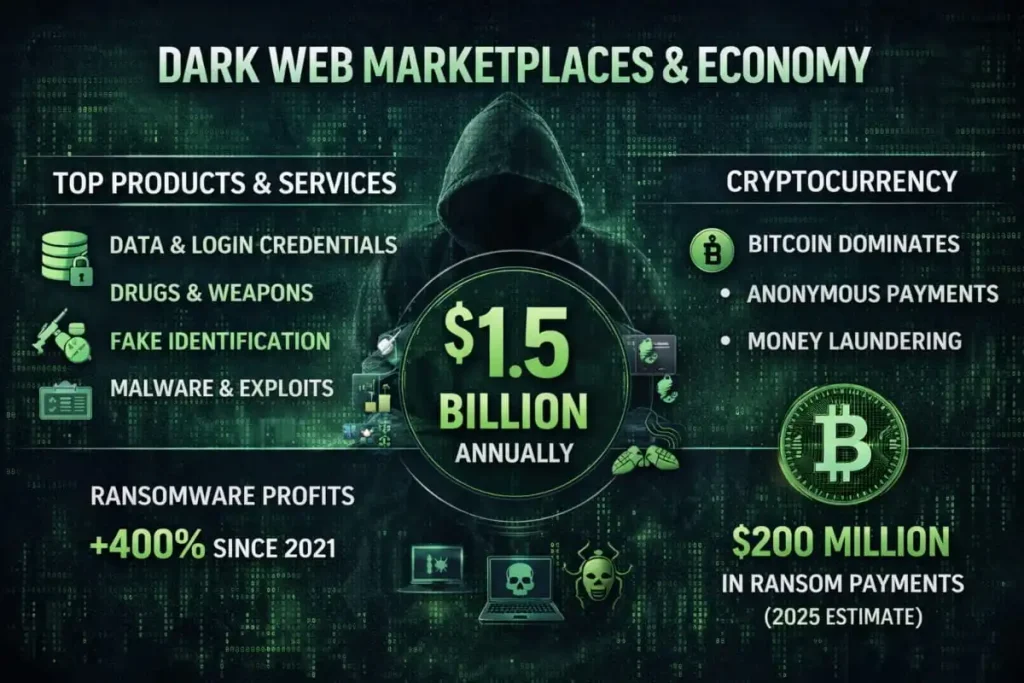
The underground economy operating on the dark web processes billions of dollars in transactions annually and has grown more resilient, not less, despite sustained international law enforcement pressure. By 2026, there will be dozens of active darknet marketplaces, and the aggregate volume of illegal digital commerce will continue to climb year over year. What has changed is not the scale but the structure: the dark web economy has professionalized to a degree that most people outside the threat intelligence industry do not appreciate.
How Darknet Markets Actually Work
Active darknet marketplaces function with the operational sophistication of mid-tier e-commerce platforms. Vendors maintain profiles with ratings, feedback histories, and product listings. Transactions settle through cryptocurrency escrow systems that hold funds until buyers confirm delivery. Dispute resolution processes, vendor verification requirements, and entry bonds- and deposits sellers must post before listing- are standard features across major platforms. Many now require invitation-only access and multi-factor authentication for account security.
This infrastructure exists because trust is the core operational problem in anonymous criminal commerce. A buyer cannot sue a vendor who disappears with payment. A vendor cannot verify a buyer’s identity. Escrow systems, reputation mechanisms, and bonded listings are the market’s solution to that trust deficit, and they work well enough that the underground economy has sustained consistent growth through the takedowns of its largest individual platforms.
Scale of the Dark Web Economy
Analysts estimate that $20–25 billion in cryptocurrency flowed through dark web markets and related illicit activity by 2022, a figure that has continued rising. Darknet drug markets alone, the most consistently measured segment, generated approximately $470 million in cryptocurrency revenue in 2022 following the Hydra Market takedown, up from an estimated $315 million in prior years. By 2024, global darknet drug sales exceeded $1.7 billion, with year-over-year growth running above 20%.
Forecasts suggest the broader market for illegal digital goods and services could reach nearly $3 billion by the early 2030s. Given current growth trajectories, that figure may prove conservative.
Stolen data and credentials account for the largest share of non-drug dark web activity by volume. By 2022, more than 15 billion compromised credentials were circulating across underground forums, an increase of over 80% from the prior year. Identity-related listings dominate the ecosystem: complete identity profiles, login credentials, and government-issued identifiers make up roughly two-thirds of all illicit listings. Payment card data- hundreds of millions of stolen credit card records- is traded alongside them across multiple competing platforms.
Cybercrime-as-a-Service
Beyond data markets, the dark web supports a mature cybercrime-as-a-service economy where technical capability is a commodity, not a barrier. Ransomware groups lease their tools to affiliates who execute attacks in exchange for a revenue share. Malware kits, phishing templates, exploit frameworks, and DDoS-for-hire services are sold to buyers with no technical background at price points that make entry-level cybercrime accessible to anyone willing to pay.
The category with the highest downstream impact is initial access listings. Initial Access Brokers, a distinct class of dark web operator, specialize in compromising corporate networks and selling the resulting credentials rather than exploiting them directly. A verified VPN or RDP credential at a mid-market company lists for hundreds to low thousands of dollars. Domain administrator access at an enterprise can sell for $10,000 to $50,000 or more, depending on network size, industry, and privilege level. Ransomware groups are the primary buyers. The operational chain from initial access listing to ransomware deployment can run in under two weeks.
Cryptocurrency and Payment Infrastructure
Cryptocurrency underpins every significant dark web transaction. Bitcoin dominated early darknet commerce but has been losing ground to Monero, a privacy coin with built-in transaction obfuscation, as blockchain analytics firms have made Bitcoin tracing increasingly effective. By 2026, Monero accounts for the majority of dark web payments by value. Bitcoin remains in use for roughly one-third of transactions, primarily among less sophisticated vendors and buyers who have not migrated. Mixing services and chain-hopping, converting between cryptocurrencies to break transaction trails, are standard operational practice among serious dark web operators.
The improved traceability of Bitcoin is one of the few concrete enforcement advantages that has altered dark web behavior at scale. It has not reduced commerce volume; it has shifted payment infrastructure.
Market Resilience Under Enforcement Pressure
Every major darknet marketplace takedown of the past decade has followed the same pattern: disruption, migration, re-emergence at similar or larger scale. Hydra Market, the largest Russian-language darknet market, was seized in April 2022 in a joint German-U.S. operation. Within months, its user base had fragmented across a half-dozen successor platforms, and aggregate dark web drug revenue for 2022 surpassed pre-Hydra figures. AlphaBay, Genesis Market, and dozens of smaller platforms have followed the same arc.
The structural reason is straightforward: demand does not disappear when supply is disrupted. Dark web commerce serves persistent demand for drugs, stolen data, criminal tools, and anonymous access. As long as that demand exists and cryptocurrency provides anonymous settlement infrastructure, new marketplaces will emerge to serve it. By mid-2026, the ecosystem had more active platforms than at any prior point, was smaller and more distributed, and was structurally harder to dismantle than the centralized giants that preceded it.
For security teams, the implication is not that enforcement efforts are pointless; they impose real costs and disrupt criminal operations. It is that market resilience makes reactive monitoring insufficient. The data that ends up on a dark web marketplace after a breach does not wait for law enforcement to act.
Dark Web Crime Trends in 2026
The dark web does not just host cybercrime; it industrializes it. In 2026, the most consequential shift in the threat landscape is not the emergence of new criminal categories but the lowering of the skill threshold required to execute serious attacks. Access, tools, and operational guidance are available for purchase. The underground economy has separated technical capability from criminal intent, and that separation is what defines the current threat environment.
Credential Theft and Account Takeover
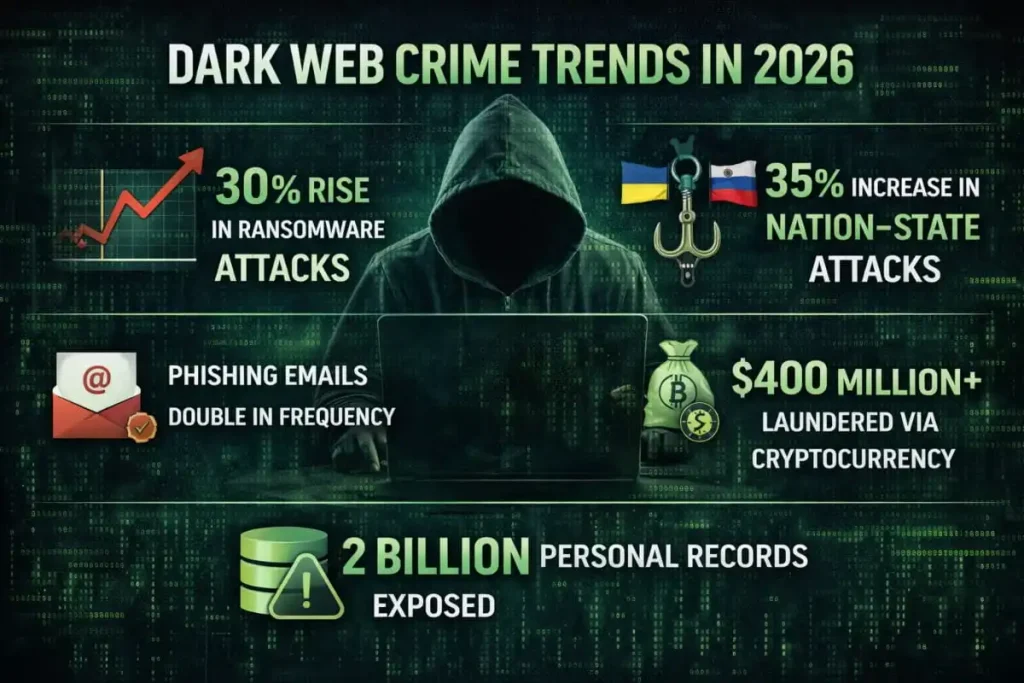
Stolen login credentials remain the foundational commodity of the dark web economy. Vast collections of usernames, passwords, and associated personal data trade continuously across forums and markets, feeding account takeovers, identity theft, and targeted phishing campaigns at scale.
Research indicates that close to 80% of compromised email accounts eventually appear for sale on dark web marketplaces. For organizations, the exposure risk extends well beyond the individual whose credentials were leaked: attackers routinely use stolen employee credentials for credential stuffing, automated login attempts across dozens of platforms using the same username and password combination, to identify reuse and move laterally into corporate systems. Organizations with employee credentials actively circulating on dark web forums are measurably more likely to experience a network breach within the following 90 days than those without confirmed exposure.
The flow of stolen credentials into the dark web is effectively continuous. Every significant data breach adds to the available inventory, and that inventory compounds over time; older credentials from breaches years ago remain in circulation and continue generating value as long as users have not reset passwords on every affected platform.
Ransomware and Cyber Extortion
Ransomware operations are structurally dependent on the dark web in ways that go beyond payment collection. Most major ransomware groups- RansomHub, DragonForce, Play, Medusa, and others active in 2026- maintain dedicated dark web leak sites where they publish victim names, proof-of-compromise data, and countdown timers. The leak site is not incidental to the attack; it is the primary leverage mechanism—victims who refuse to pay face public exposure of their data, regulatory scrutiny, and reputational damage. The threat of publication transforms a data breach into an extortion campaign that compounds the original harm.
Activity linked to ransomware continued rising through 2026, with the number of victims listed on active leak sites increasing sharply year over year. Ransom demands in attacks against mid-market and enterprise targets routinely reach six figures; attacks on healthcare infrastructure, critical utilities, and financial services institutions have drawn demands in the millions. Healthcare remains the sector absorbing disproportionate impact, a combination of high-value data, time-critical operational pressure, and historically underinvested security infrastructure.
The dark web also enables the ransomware supply chain that precedes each attack. Initial Access Brokers sell the network entry point. Ransomware-as-a-service platforms lease the encryption and extortion toolkit. Underground forums facilitate affiliate recruitment and operational coordination. The result is a model where a ransomware attack can be assembled from purchased components by actors who wrote none of the code themselves.
Market Sophistication and Fragmentation
Dark web marketplaces have steadily professionalized over the past several years, and 2026 marks the maturity of that trajectory. Escrow systems, dispute resolution, vendor bonding requirements, reputation scoring, and invite-only access controls are standard features across major platforms. These mechanisms exist specifically to sustain trust in anonymous criminal commerce and reduce the exit-scam rate that plagued earlier-generation markets.
At the same time, the market structure is fragmenting by design. Platforms increasingly specialize in narrow categories, stolen identities, network access credentials, malware kits, pharmaceutical drugs, rather than operating as general-purpose bazaars. Specialization serves two purposes: it allows vendors and buyers to find each other more efficiently, and it reduces the surface area that law enforcement can target in a single operation. A takedown that dismantles a specialized credential market does not touch the drug marketplace running on different infrastructure, serving a different operator community and user base.
Beyond Fraud: The Full Scope of Dark Web Criminality
The dark web’s criminal ecosystem extends into categories that carry severe human consequences independent of financial harm. Hidden forums facilitating the trade of child sexual abuse material remain a high-priority target for international law enforcement, with coordinated operations resulting in arrests across multiple jurisdictions annually. Weapons trafficking persists across marketplaces, with thousands of listings observed in researcher surveys. Botnet access, pre-infected systems, zero-day exploits, and advanced persistent threat toolkits are available for purchase at price points that make nation-state-grade attack capability accessible to well-funded criminal groups.
Fraud infrastructure, phishing templates, counterfeit document sets, social engineering scripts, and scam call center guides circulate freely and at low cost, functioning as an on-ramp for criminal actors who lack the technical background to develop their own tools. This infrastructure is why the barrier to entry for cybercrime continues to fall, even as the sophistication of attacks rises.
What These Trends Mean for Security Teams
The through-line across every 2026 dark web crime trend is accessibility. Ransomware no longer requires a sophisticated developer. Credential theft no longer requires a skilled attacker. Large-scale fraud no longer requires an organized crime background. The dark web has commoditized capabilities across every tier of the criminal ecosystem. That commoditization makes organizational exposure, credentials, access, and internal data available for purchase a material risk regardless of whether a company has ever been directly targeted.
The organizations that manage this risk most effectively are not those that react to breach disclosures. They are the ones with continuous visibility into what the dark web holds about them before an attacker acts on it.
Impact on Cybersecurity and Data Breaches
Dark web activity does not stay on the dark web. When stolen credentials or sensitive records appear on underground forums, they are validated, resold, and weaponized, often within days. In 2023, the average cost of a data breach in the United States reached $4.88 million, and stolen credentials were involved in roughly one in five incidents. Those credentials did not appear from nowhere. They came from prior breaches that fed into the same dark web ecosystem, creating a self-reinforcing cycle in which each compromise generates the raw material for the next.
Global cybercrime losses reflect the scale of this pipeline. Analysts estimate that total cybercrime damage could reach $12 trillion in 2026, driven by ransomware, fraud, intellectual property theft, and business disruption, most of it traceable to dark web infrastructure where tools are sold, data is traded, and operations are coordinated.
For organizations, the most actionable insight from the research is this: dark web exposure is a leading indicator of breach risk, not a lagging one. Companies whose employee credentials appear on underground forums are measurably more likely to experience a successful intrusion shortly afterward. Mentions of an organization on hacker forums or dark web-adjacent Telegram channels carry the same signal; they indicate active attacker interest before an attack has been executed. The window between dark web exposure and operational attack is where monitoring creates its value.
Law Enforcement Takedowns, and Why the Dark Web Persists
Law enforcement has demonstrated repeatedly that the dark web is not beyond reach. What it has not demonstrated, despite years of coordinated international operations, is the ability to reduce dark web commerce permanently. Every major takedown produces real disruption and genuine intelligence. None has bent the growth curve.
Operation DisrupTor (2020) was an early signal of coordinated capability. Led by U.S. and European agencies targeting opioid trafficking, it resulted in nearly 180 arrests across multiple countries and substantial seizures of drugs, cash, and cryptocurrency. Critically, it targeted individual vendors and buyers, not just marketplace operators, establishing that participation at any level of the dark web supply chain carried enforcement risk.
Hydra Market (2022) was the largest single dark web takedown to date. Hydra had processed more than $5 billion in cryptocurrency transactions over its lifetime as the dominant Russian-language darknet marketplace. German federal police, supported by U.S. agencies, seized its servers and shut down its infrastructure in April 2022. The Eastern European dark web drug trade was disrupted for weeks. Within months, successor platforms had absorbed the displaced user base and 2022 ended with darknet drug revenues higher than the pre-Hydra baseline.
Operation RapTor (May 2026) was one of the largest coordinated darknet crackdowns on record, involving agencies across multiple continents targeting fentanyl and opioid trafficking. It resulted in hundreds of arrests, large-scale drug and cryptocurrency seizures, and the confiscation of firearms. Its signal value to the threat landscape was clear: mid-level vendors and buyers are identifiable and trackable, and operational security failures on the dark web have consequences that may arrive years after the activity.
Operation Deep Sentinel (June 2026) dismantled Archetyp Market, the longest-running active dark web drug marketplace at the time, with more than five years of operation, hundreds of thousands of users, and hundreds of millions in illegal transactions. Key operators were arrested. Users migrated to competing platforms within days.
The pattern across every major takedown is consistent: disruption is real, deterrence is real, and the ecosystem recovers. The dark web’s resilience is structural, not incidental. Demand for illegal goods and services does not disappear when a marketplace does, and the dark web’s decentralized architecture ensures that no single enforcement action can eliminate the infrastructure that serves that demand. By 2026, law enforcement and the dark web criminal ecosystem are engaged in a sustained, technically sophisticated contest in which the defenders have improved substantially, but the attackers have adapted in kind.
How Stolen Data Actually Moves From the Dark Web Into Real Attacks
When stolen data is described as “available on the dark web,” the phrase understates what actually happens. Stolen data does not sit in a database waiting to be used. It moves through a structured pipeline: validation, distribution, resale, and weaponization, that turns a single breach into multiple attack vectors against multiple targets, often across months or years.
Stage 1: Breach and packaging. Attackers extract data through phishing, malware, credential stuffing, or misconfigured systems. The raw data is packaged into structured dumps, formatted for easy processing, and posted to underground forums. At this stage, the goal is proving volume and freshness, not immediate exploitation.
Stage 2: Validation. Within closed forums, other actors test samples. Credentials are run against live systems to confirm they still work. Identity records are checked for completeness. Successful validation increases the seller’s reputation score and the data’s market price. This step is why fresh credentials from an unannounced breach carry a premium; they have not yet been tested to failure by the market.
Stage 3: Distribution. Validated data spreads across dark web marketplaces, private forums, and broker networks. Simultaneously, distribution extends beyond the dark web itself: Telegram channels advertise dumps, negotiate prices, and accelerate transaction velocity. The dark web functions as the trust and storage layer; Telegram functions as the distribution and deal-making layer.
Stage 4: Weaponization. Credentials are loaded into automated credential-stuffing tools. Phishing kits are customized using leaked personal details to increase plausibility. Ransomware groups purchase initial access from brokers and deploy encryption tools against corporate networks. What began as one breach now enables account takeovers, financial fraud, business email compromise, and ransomware intrusions, simultaneously, against different targets, by different actors who purchased data from the same original dump.
Understanding this lifecycle matters because it changes the defensive posture. The breach is not the attack. The breach marks the beginning of a process that leads to attacks. Organizations that detect their data in Stage 1 or 2, before weaponization, retain the ability to respond: force password resets, revoke compromised credentials, alert affected users, and close the access paths attackers are preparing to use.
How Long Stolen Data Stays Valuable
Not all breached data decays at the same rate, and defenders who treat breach response as a one-time event consistently underestimate the long tail of exposure.
Fresh credentials command the highest prices. Login details tied to corporate networks, cloud platforms, or financial accounts that are still active are bought and weaponized within days or weeks of appearing on dark web forums. As passwords are reset, accounts are locked, and breaches become public, prices fall. Aged credential dumps continue to sell at lower prices for low-effort attacks and broad credential-stuffing campaigns, where volume compensates for the lower success rate per record.
But decay is not uniform. Some data appreciates. Corporate credentials overlooked in incident response may remain active for months, making them attractive for delayed attacks by buyers who wait for defender attention to shift. Initial Access Brokers actively resurface older credentials against organizations that have become complacent after the initial response window. Seasonal demand creates price spikes: tax account credentials in Q1, healthcare portal access around enrollment periods, retail logins ahead of high-volume shopping seasons.
The practical implication is that dark web monitoring cannot be a snapshot. A breach discovered and remediated in 2024 can generate active attack attempts in 2026 if the remediation was incomplete, if one credential set was missed, if one system was not audited, or if one access path was not closed. Monitoring for new exposure matters, and tracking whether old exposure has been fully remediated matters equally.
Defending Your Organization Against Dark Web Threats
The organizations managing dark web risk most effectively share one characteristic: they treat exposure detection as a continuous operational function, not a periodic audit.
Monitor continuously, not reactively. Waiting for a breach notification or a law enforcement alert means responding to damage that has already been done. Continuous dark web monitoring, tracking credential dumps, forum mentions, leak site activity, and underground discussions referencing your organization, your vendors, or your industry creates an early warning window that enables a response before weaponization. Modern threat intelligence frameworks treat dark web monitoring as a baseline requirement for external visibility, not an advanced capability.
Reduce the value of what gets exposed. Stolen credentials are the most traded commodity on the dark web. Strong, unique passwords combined with multi-factor authentication dramatically reduce the operational value of leaked login data. Credential stuffing attacks depend entirely on password reuse; eliminating reuse across systems closes the primary attack path enabled by dark web credential markets. Least-privilege access controls ensure that a compromised account cannot reach beyond its authorized scope.
Treat phishing as the primary vector for credential leaks. A significant proportion of the credentials circulating on the dark web originated not from technical breaches but from phishing and social engineering. Security awareness training that focuses on recognizing phishing attempts, fake login pages, and impersonation campaigns addresses the supply side of the credential market, reducing the amount of fresh data that enters the pipeline in the first place.
Integrate dark web intelligence into threat response. Dark web forums surface emerging attack methods, newly leaked datasets, and active exploitation discussions, often before they manifest as incidents against specific organizations. Security teams that monitor these signals gain context that accelerates response: seeing attackers actively trading access related to your environment prompts faster patching and investigation rather than post-incident analysis.
Plan for breach response before it is needed. Assuming that some exposure will occur is a practical security posture, not a pessimistic one. Organizations with a documented incident response plan that covers technical containment, legal obligations, customer communication, and forensic investigation respond faster and more effectively than those improvising under pressure. Increasingly, cyber insurance providers require evidence of proactive monitoring, testing, and response planning as a condition of coverage.
The dark web will continue evolving as a criminal infrastructure layer. The organizations that reduce its impact are not those trying to prevent every breach; they are the ones with the visibility, response capability, and credential hygiene to ensure that what gets exposed cannot easily be turned into a successful attack.
Dark Web Myths vs Reality (2026)
The gap between public perception of the dark web and its operational reality is wide enough to cause genuine security misjudgments, in both directions. Organizations that treat the dark web as an irrelevant criminal fringe underestimate their exposure risk. Individuals who believe accessing it is inherently illegal avoid legitimate privacy tools they are entitled to use. Both errors have consequences.
The following is a direct comparison of the most persistent dark web myths against the evidence.
| Myth | Reality |
|---|---|
| The dark web makes up 90%+ of the internet | The dark web represents approximately 0.01% of the internet by volume. The deep web — private databases, email inboxes, banking systems — accounts for roughly 90%. The dark web is a small, hidden subset of the deep web, not a parallel internet. |
| Everything on the dark web is illegal | More than half of active dark web sites are linked to illegal activity — but a meaningful portion serves legitimate purposes. Whistleblower platforms, .onion versions of major news organizations, privacy communities, and cybersecurity research infrastructure all operate on dark web networks. |
| Accessing the dark web is illegal | In most countries, accessing the dark web is entirely legal. The Tor browser is legitimate privacy software used by millions of people daily. Illegality is determined by what a user does on the dark web, not by the act of accessing it. |
| The dark web is impossible to monitor or trace | Tor significantly raises the cost of attribution, but it does not make users invisible. Law enforcement agencies have repeatedly de-anonymized dark web operators through operational security failures, blockchain analysis, and server seizures. Operations RapTor and Deep Sentinel in 2026 both resulted in arrests of actors who believed they were untraceable. |
| The dark web and the deep web are the same thing | They are not. The deep web is any internet content not indexed by search engines — your bank account, your email, hospital records. It is largely benign. The dark web is a small, intentionally hidden subset of the deep web that requires specialized software to access and is designed for anonymity. |
| Dark web data is only useful to sophisticated hackers | Entry-level cybercrime tools — phishing kits, credential-stuffing scripts, ransomware kits — are available on the dark web for tens to hundreds of dollars, with no technical skill required. The dark web has lowered the barrier to serious cybercrime to the point where skill is no longer the limiting factor. |
| Once a breach is old news, dark web exposure stops mattering | Breached credentials remain on the dark web indefinitely and continue generating value. Aged datasets are used for credential stuffing, sold at lower prices, and resurface when defenses relax. A breach from 2022 can fuel an attack in 2026 if remediation was incomplete. |
The Deep Web vs Dark Web Distinction
The conflation of “deep web” and “dark web” is the single most common source of confusion in public discourse about internet security, and it matters because the risk profiles are completely different. The deep web is mundane; it is the majority of the internet, most of it private and benign. The dark web is a narrow, deliberately hidden layer within it, with specific access requirements, specific anonymity properties, and a disproportionate concentration of criminal activity relative to its size.
Using the terms interchangeably leads to poor risk assessments. A company whose employee data appears in a dark web credential market faces a materially different threat than one whose data is simply unindexed. Understanding the distinction is foundational to accurate threat modeling.
The Accurate Frame
The dark web is neither the vast criminal empire of popular imagination nor a harmless curiosity that poses no real risk. It is a small, technically specialized network that concentrates illegal activity, stolen data, criminal tools, and underground markets, with an outsized impact on global organizational security. Its legitimate uses are real. Its criminal dominance is also real. Both facts are necessary for an accurate threat assessment, and neither cancels out the other.
Check your organization’s dark web exposure now, for free. DeXpose’s Free Dark Web Report scans dark web markets, malware logs, and breach databases for your organization’s credentials, domains, and data, and delivers an immediate exposure report at no cost.
Conclusion
The data from 2026 points in one direction: the dark web is small in scale and outsized in impact, and that gap is not narrowing. It accounts for 0.01% of the internet. It processes billions of dollars in criminal transactions annually. It holds credentials, corporate access, and identity records belonging to hundreds of millions of people who have no idea their data is there. The underground economy it supports is professionally structured, technically sophisticated, and has proven resilient to sustained law enforcement pressure across every major jurisdiction on earth.
The practical implication for any organization operating in 2026 is not that the dark web might affect them. It is that it almost certainly already has, through a supplier breach, a credential leak, an employee whose password appeared in a dump two years ago and was never reset. The question is not whether exposure exists. The question is whether you have visibility into it.
That visibility is where the defensive opportunity lives. The same openness that enables criminals to trade stolen data on underground forums also enables security teams to monitor them for potential organizational exposure. Credentials being discussed on a hacker forum, a corporate network access listing appearing on a darknet market, internal data surfacing on a leak site- these are all detectable before an attacker acts on them, if you are watching. Dark web monitoring turns the threat surface from a blind spot into an early warning system, and organizations that use it effectively respond to exposure before it becomes a breach rather than investigating it after the fact.
The dark web is not invincible or abstract. It is a measurable risk environment with documented pricing, known infrastructure, and well-understood attack pipelines. Treat it accordingly, with continuous monitoring, strong credential hygiene, and a response plan that does not start from scratch when something goes wrong.
Cybercrime Explained | The Complete Guide to Types, Causes, Costs & Prevention
Cybercrime is any criminal activity that targets or uses a computer, network, or internet-connected device, from stealing financial data and holding systems for ransom to impersonating…
Read more
Cybercrime Laws Around the World | A Complete Investigator’s Reference Guide
Cybercrime laws are the country-specific and international legal frameworks that define which online acts- unauthorized access, data theft, fraud, harassment- count as crimes and what penalties…
Read more
Lesser-Known Ransomware Groups Still Targeting Businesses in 2026
Groups like Monti, Vice Society, Royal (now rebranded as BlackSuit), Cuba, Nokoyawa, Yanluowang, and Lorenz rarely make national headlines like LockBit or Qilin, but they’re still…
Read more