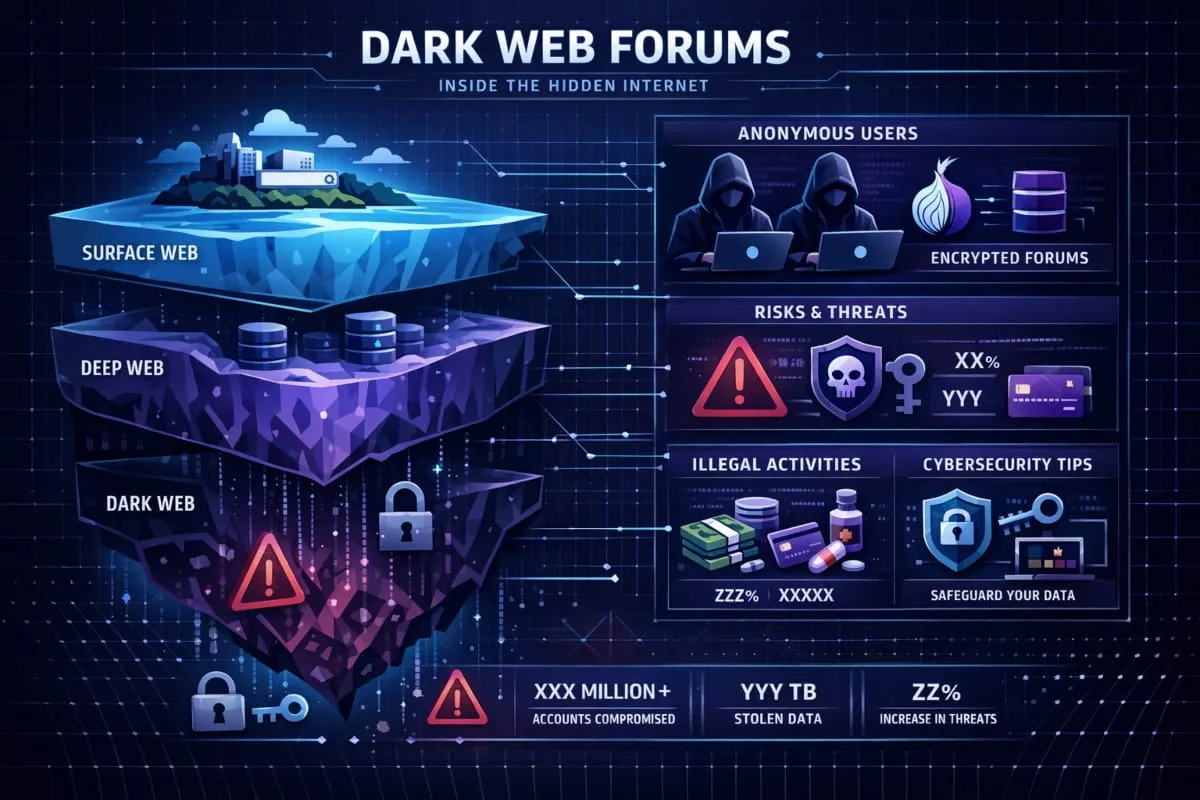
Dark web forums are among the most consequential corners of the internet that most people will never see, and that most organizations can’t afford to ignore. In 2026, this landscape spans active communities like DarkForums, Dread, XSS, and DamageLib, along with a constantly shifting list of leaked forums and leak forums fighting to replace what BreachForums left behind.
Unlike the surface web, dark web forums operate predominantly on the Tor network, designed for anonymity and resistant to conventional monitoring. These aren’t fringe communities. Active darknet forums host tens of thousands of registered users, process millions of dollars in illicit transactions, and frequently surface stolen data, compromised credentials, and breach disclosures weeks before organizations even know they’ve been targeted.
The dark web forum landscape in 2026 looks significantly different from just twelve months ago. Operation Talent in January 2025 seized two of the largest clearnet cracking forums. The alleged XSS administrator was arrested in July 2025. BreachForums, for years the dominant leaked forum and leaks forum, collapsed definitively in April 2025. New platforms emerged almost immediately to fill the vacuum: DarkForums absorbed much of the displaced community and remains active, with rapid growth. At the same time, DamageLib launched as a splinter forum built by former XSS moderators who no longer trusted the platform’s new administration.
Deep web forums and dark web communities now operate across a fragmented, fast-moving ecosystem. Threat actors increasingly split their activity between traditional Tor-based darknet forum communities and private Telegram channels, using forums for reputation and high-value coordination and Telegram for rapid data distribution. Understanding this dual-surface environment is no longer optional for security teams; it’s foundational.
This guide covers:
- What dark web forums are and how they differ from deep web forums, leak forums, and surface-web hacking forums
- The most active dark forums, darknet forums, and dark web forum communities in 2026, including the current status and onion link situation for each
- Major 2025 events that reshaped the dark forums ecosystem, from BreachForums’ collapse to the rise of new leaked forums
- What security teams watch for across forum dark web environments, including carding forums and cracking forums
- How organizations monitor dark web chat forums, leaks forums, carding forums, and related communities without direct exposure
Whether you’re a threat intelligence analyst tracking breach forum alternatives, a security engineer evaluating LeakBase and its successors, or an executive trying to understand your organization’s exposure across the dark web, this guide gives you the current 2026 picture, including which forums are active, which have gone dark, and what changed.
What Are Dark Web Forums?
Dark web forums, sometimes called darknet forums or dark forums, are online discussion communities hosted on privacy-focused networks that are not indexed by traditional search engines. Like any standard forum, a dark web forum allows users to create accounts, post threads, reply to discussions, and build reputations within the community. The key difference is the infrastructure: dark web forums operate through anonymity-focused systems that conceal both user identities and server locations.

Unlike mainstream discussion boards that appear in Google search results, dark web forums and their deep web forum counterparts require specialized networks to access. This technical barrier, combined with pseudonymous participation, creates an environment that feels more private but also less regulated.
It’s important to understand that the term “dark web forums” does not automatically imply illegal activity. While some communities have been linked to criminal behaviour, including the trade of leaked forums data and stolen credentials, others revolve around privacy advocacy, discussions of digital freedom, or general anonymous conversation. The reputation of the space often comes from its most extreme examples, like leak forums trading breach data, rather than from the full spectrum of activity.
What watching should mean (for legal, practical safety)
If you’re researching dark web, darknet, or leak forums for education, journalism, or cybersecurity awareness, watching should mean monitoring risk signals without engaging, participating, or attempting to access illegal communities.
The most useful signals to track safely across dark forums and leaked forums include:
- Brand impersonation: fake official accounts and lookalike names claiming authority on darknet forum communities
- Leak claims: vague screenshots, unverifiable proof, and posts designed to drive panic, common across leak forums and leaks forum communities
- Phishing and bait: exclusive access, verified vendors, or join now pressure tactics.
- Scam patterns: escrow tricks, reputation laundering, and too good to be true offers
- Narrative shifts: sudden spikes in chatter that get amplified elsewhere (especially on social platforms)
This is the section that maps directly to your biggest GSC opportunity — the entire “[forum name] status 2026 / onion link / current domain” cluster sitting at position 1-6 with 0% CTR. I’ll rewrite it to lead with explicit status framing for each forum (since that’s literally what those searchers are typing), while keeping the awareness-only disclaimer intact, and weave in the keyword variants naturally throughout.
Top Dark Web Forums to Watch
People searching for the top dark web forums or the current status of a specific darknet forum are usually trying to understand what gets referenced in cybersecurity conversations, not looking for a directory to access. It’s also important to know that names, communities, and popular hubs in this space can change quickly due to takedowns, migrations, rebrands, and internal scams. That instability is exactly why static lists of dark forums are unreliable, and why this section is framed for situational awareness, not recommendations.
In threat-intelligence reporting and online discussions, certain forum names come up constantly, including XSS, DamageLab, BreachForums, Dread, LeakBase, Nulled, Exploit, RAMP, and DarkForums. You may see them cited in breach chatter, cybercrime rumours, or alleged leak claims, often mixed with misinformation, impersonation accounts, and scam posts designed to exploit curiosity about their current onion link or status.
XSS
Status as of 2026: Active but compromised, use with caution
XSS has historically been one of the most significant Russian-language dark web forums for credential sales, phishing infrastructure, malware distribution, and initial access brokering. The forum was closely linked to major ransomware groups, including REvil, LockBit, and Conti, during their peak operational periods.
In July 2025, Europol, French authorities, and Ukrainian law enforcement arrested an individual alleged to be the XSS administrator. The forum has remained online under new, unknown administration, but user counts and posting activity have declined significantly. A significant portion of the community suspects that XSS is now operating as a law-enforcement honeypot, following cryptocurrency fund seizures and waves of unexplained bans. Former XSS moderators launched a separate darknet forum, DamageLib, explicitly citing distrust of the new administration.
XSS remains a high-value monitoring target for credential dumps, initial access listings, and early-stage breach indicators. Still, the honeypot’s uncertainty means that direct participation by security researchers carries an elevated risk. Passive monitoring via aggregation is the appropriate approach.
Exploit
Status as of 2026: Active
Exploit. in primarily operates as a Russian-language forum focused on vulnerability research, exploit development, and the sale of tools. Membership comes with real barriers; RAMP forum membership often requires an established reputation on Exploit or XSS, making it a more exclusive tier of the underground.

This dark web forum has remained relatively stable compared to data-leak-focused platforms, partly because it serves a more technical niche rather than the mass-market credential-dumping ecosystem that draws law enforcement attention. Exploit. In discussions, zero-day vulnerability research frequently surfaces weeks before public disclosure.
Exploit. in is a tier-1 early warning source for vulnerability intelligence. Credential and organizational exposure monitoring here provides leading indicators of targeted attack planning.
Dread
Status as of 2026: Active, highly influential
Launched in February 2018 as a Tor-based alternative to Reddit, Dread has become the closest thing the dark web has to a community hub. A 2025 peer-reviewed study identified more than 1,700 active sub-communities, called “subdreads,” covering darknet markets, harm reduction, privacy advocacy, and general news. Dread operates as a major coordination point for ransomware groups, which use it to share victim announcements, challenge payment negotiations, and communicate with researchers.
Despite persistent DDoS attacks and periods of extended downtime, this darknet forum has remained operational since launch, an unusual level of resilience in the dark web ecosystem. Its hybrid role as both a general discussion platform and an indirect commercial facilitator makes Dread uniquely broad in scope.
Dread is a must-monitor platform. Ransomware victim disclosures frequently appear here before or alongside leak site publications, providing compressed incident response timelines. The forum also provides reliable intelligence on market shutdowns, exit scams, and law enforcement operations.
RAMP
Status as of 2026: Active, restricted access
RAMP launched in July 2021 and gained significant notoriety through association with high-profile ransomware operations, including the Colonial Pipeline attack. The forum operates as a multilingual platform (Russian, Chinese, English) and serves primarily as a coordination space for Ransomware-as-a-Service operators and their affiliates.

RAMP entry requires either an existing reputation for XSS or Exploit In, or a vouching process, making it a closed tier that focuses on sophisticated threat actors. Its “partners program” allows ransomware operators to recruit affiliates and sell access to compromised networks. This operational model makes RAMP discussions directly relevant to understanding which ransomware groups are actively recruiting and targeting which sectors.
RAMP is a primary intelligence source for ransomware campaign planning, affiliate recruitment, and sector-targeting. Organizations in critical infrastructure, healthcare, and financial services should monitor RAMP as a leading indicator.
DarkForums
Status as of 2026: Growing, now one of the largest active leaked forums
DarkForums emerged in 2023 in the immediate aftermath of the first BreachForums shutdown. It received limited attention initially but gained substantial traction through 2025, particularly after BreachForums’ final collapse in April 2025 triggered another wave of community migration toward this leak forum. As of early 2026, DarkForums reports more than 12,000 registered users and continues to attract former BreachForums users.

The forum’s feature set closely mirrors BreachForums: leaked databases, stealer logs, combo lists, malware tools, cracked accounts, and a tiered membership model (VIP, MVP, GOD ranks). Premium members receive access to private Telegram channels, including a restricted data leak feed. DarkForums serves as the current primary landing point for displaced credential and data-leak trading that previously occurred on BreachForums.
DarkForums is now a tier-1 monitoring target for organizational data exposure. Database leaks and stealer log dumps appearing on this DarkForums platform often represent early disclosure of breaches that will surface publicly weeks later.
DamageLib
Status as of 2026: Active, growing post-XSS-arrest
DamageLib is a newer entrant that emerged in the wake of the uncertainty following the arrest of the XSS administrator in July 2025. Former XSS moderators launched this darknet forum explicitly because they did not trust the new XSS administration and suspected law enforcement involvement. The forum positions itself as privacy-first, stating it does not track users.
DamageLib focuses on hacking tutorials, malware development discussion, exploit and vulnerability research, and indirect sales. It represents an interesting intelligence source precisely because it is attracting the most security-conscious portion of the XSS community, threat actors who specifically moved to avoid a potential honeypot environment.
DamageLib is an emerging forum that warrants monitoring. Its privacy-first positioning and the caliber of its founding community suggest it may evolve into a significant source of technical threat intelligence.
BreachForums
Status as of 2026: Effectively defunct; clone sites exist but lack trust
BreachForums was, for several years, the most influential leak forum for discussing data breaches and cybercrime. Founded in March 2022 by the pseudonymous “Pompompurin” as a successor to the seized RaidForums, it quickly became the primary venue for major breach disclosures, credential trading, and cybercrime discussion.

The platform collapsed through a series of events: Pompompurin’s arrest in 2023, leadership transition to “Baphomet” and ShinyHunters, continued arrests including the disappearance of prolific threat actor IntelBroker, and a final shutdown in April 2025. Multiple clone sites have appeared under the BreachForums name and using the current domain, but without verified PGP keys or original leadership, most have failed to gain meaningful traction. The primary community has largely migrated to DarkForums.
Legacy BreachForums data remains valuable for historical breach investigations and threat actor profiling. Current clone sites and onion links claiming to be BreachForums pose a high risk of scams or law enforcement operations; avoid them as direct intelligence sources.
Cracked
Status as of 2026: Active under a new domain following the FBI seizure
Cracked is unusual in the dark web forum landscape because it primarily operates on the clear web rather than the Tor network. This cracking forum covers combo lists, credentials, stealer logs, hacking tools, and software vulnerabilities, and features 12 language-specific subforums. In January 2025, the FBI’s Operation Talent resulted in a domain seizure, alongside simultaneous action against Nulled. to.

Despite the seizure, Cracked quickly migrated to a new domain and resumed operations, demonstrating the resilience pattern common across underground forums. Its clear-web presence makes it more accessible to less technically sophisticated threat actors and gives it a broader geographic reach than Tor-based alternatives.
Cracked’s clear-web operation means its data circulates more widely and quickly than Tor-exclusive forums. Credential dumps appearing on this hacker forum often propagate to Telegram channels within hours.
BHF
BHF, widely known as Best Hack Forum or BHF Pro, is a long-running Russian-language hacker forum that has been active for more than a decade and is accessible via both clear- and dark-web infrastructure. As a cybercrime forum, BHF is associated with a wide spectrum of illicit topics, including software cracking, credential abuse, spam, data leaks, and local fraud schemes targeting banks and online platforms.

BHF hosts dedicated sections for the exchange of cracked software, stealer logs, payment card and cryptocurrency wallet data, large-scale combolists, and a wide range of malware tools and related resources, making it one of the more comprehensive cracking forums still active today.
Nulled
Status as of 2026: Status uncertain following law enforcement action

Nulled is frequently referenced as a large English-language underground forum operating across the deep and dark web ecosystems, with discussions and listings that often revolve around account compromise and mass abuse. It’s commonly associated with the circulation of stolen logins, combo datasets, and automation-oriented resources that enable credential stuffing and other high-volume, low-skill attacks. By lowering the barrier to entry and emphasizing scale, communities like this leak forum can amplify opportunistic cybercrime, while also attracting scams, impersonation, and unreliable too-good-to-be-true offerings.
Altenen
Status as of 2026: Active
Altenen is often described as an Arabic-language underground forum that has broadened its reach beyond a regional audience, becoming a discussion space where fraud-centric tactics and monetization schemes are shared and repackaged for wider use. As one of the more established carding forums, its influence is frequently framed around how repeatable methods can spread across communities and borders, turning localized know-how into scalable, copy-and-paste abuse.

Like many dark web and fraud-related forums, the anonymity and low accountability that attract users also create fertile ground for scams, misinformation, and opportunistic exploitation.
Leaked Forums vs. Leak Sites: What’s the Difference?
The terms “leaked forums” and “leak sites” are often used interchangeably. Still, they describe two distinct phenomena, and the distinction matters for anyone trying to understand where breach data first surfaces.
Leaked forums are community-driven discussion platforms, like DarkForums or the historical BreachForums, where leaked databases, stealer logs, and combo lists are posted, discussed, and traded by registered members. These leak forums function like any other forum: threads, replies, reputation systems, and tiered membership, but the core activity revolves around distributing and monetizing stolen data rather than general conversation. Most of the platforms covered in this guide, including DarkForums, BreachForums, and Nulled, fall into this category.
Leak sites, by contrast, are typically single-purpose pages operated directly by ransomware groups to name publicly and pressure victim organizations, sometimes with sample data attached as proof, ahead of a ransom deadline. They aren’t discussion communities; they’re closer to a static extortion bulletin, often hosted on infrastructure separate from any forum.
The overlap between the two is significant in practice. Ransomware groups frequently cross-post leak site announcements to forums like Dread or RAMP to amplify pressure and reach a wider audience of buyers or affiliates, which is part of why “leaked forums” and “leak sites” get conflated so often in casual searches.
Why the distinction matters for monitoring: if an organization is tracking exposure, a leak site disclosure usually indicates an active ransomware incident with a public deadline, while a leaked forum posting can range from a fresh breach to old, recycled data being resold years later, and treating the two the same risks either overreacting to stale data or underreacting to an active extortion attempt. This is also why automated dark web monitoring typically tracks both surfaces separately rather than collapsing them into a single alert category.
Current Status Tracker: Dark Web Forums in 2026
Domain and onion link details reflect the most recent reported state in threat intelligence sources and are not intended as access guidance. These details change frequently, sometimes within days, so treat any single listing as a point-in-time snapshot rather than a permanent reference.
| Forum | Status (2026) | Last Known Domain/Onion State | Notable 2025 Event |
|---|---|---|---|
| XSS | Active but compromised, use with caution | Same .onion address since admin arrest; community suspects honeypot | Admin arrested July 2025 |
| Exploit.in | Active | Stable domain, no reported migration | — |
| Dread | Active, highly influential | Recurring DDoS-driven downtime; onion link periodically rotated for resilience | 1,700+ subdreads documented |
| RAMP | Active, restricted access | Stable, vouch-gated entry; no public migration reported | — |
| DarkForums | Active, growing | Current domain stable since post-BreachForums migration | Primary BreachForums successor |
| DamageLib | Active, new | New onion link established at launch in mid-2025; no reported migration since | Formed by ex-XSS moderators |
| BreachForums | Effectively defunct | Original domain seized; multiple unverified clone domains circulating, treat as high-risk | Final collapse April 2025 |
| Cracked | Active under new domain | Migrated to new clearnet domain after January 2025 seizure | FBI Operation Talent (Jan 2025) |
| Nulled | Status uncertain | Migrated domain after January 2025 seizure; current stability unconfirmed | FBI Operation Talent (Jan 2025) |
| LeakBase | Active | Stable, no major reported migration | — |
| BHF | Active | Long-running, dual clear-web/dark-web presence | — |
| Altenen | Active | Relaunched on Tor in 2022 following earlier disruption; stable since | — |
Status, domain, and onion-link details for every forum in this table can shift without notice due to law enforcement action, exit scams, or voluntary migration. Rather than searching for a single “current” link, the more reliable approach is to check back here, where this page’s last-verified date is kept up to date, or to rely on automated dark web monitoring rather than direct verification.
Dark Web Forum Alternatives
As established forums collapse, get seized, or fall under suspicion, search interest naturally shifts toward alternatives. This section addresses that demand directly, while reinforcing the same caution that applies to the rest of this guide: alternative platforms inherit the same risks, and often more, since unproven newcomers lack the track record to gauge trust or stability.
BreachForums Alternatives
Since BreachForums’ final collapse in April 2025, the primary community has migrated almost entirely to DarkForums, which has absorbed the bulk of displaced credential and data-leak trading. Several Telegram channels have also picked up overflow traffic for faster, lower-friction distribution. Clone sites using the BreachForums name continue to surface. Still, without verified PGP keys or original leadership, most carry a high risk of being scams or law enforcement operations rather than genuine continuations of the original leak forum.
LeakBase Alternatives
LeakBase operates as a credential redistribution forum, and its alternatives largely overlap with the broader leak forum and leaked forum ecosystem, particularly DarkForums and BreachForums-successor platforms. As with any leak forum, a sudden surge of new “alternative” sites following a takedown is itself a signal worth treating cautiously, since exit scams and impersonation are common during these transition periods.
Sites Like Altenen
Altenen is one of the more established carding forums. Platforms covering similar fraud-centric territory, payment card data, BIN lists, and financial fraud tactics tend to cluster around the same carding forum and cracking forum ecosystem referenced elsewhere in this guide. Searches for “sites like Altenen” often surface forums with far less moderation and a higher concentration of scams, since Altenen’s relative stability since its 2022 Tor relaunch is the exception rather than the norm in this space.
Sites Like Nulled
Nulled’s status has been uncertain since the January 2025 Operation Talent seizure alongside Cracked.io, and forums covering similar territory- cracked software, leaked panels, and credential stuffing tools- exist across both clearnet and Tor-based hacker forums. As with BreachForums alternatives, a wave of new platforms claiming to be Nulled’s successor tends to follow any major seizure, and the same scam-and-impersonation risk applies.
The pattern across all of these: alternatives multiply fastest in the weeks right after a takedown, when verification is hardest, and risk is highest. Treating a forum’s longevity and documented history as a trust signal, rather than its name recognition or its recent launch, is a safer lens for evaluating any so-called alternative.
Why Forums Exist on the Dark Web
Forums on the dark web exist for many of the same reasons forums on the surface web do: people want to discuss ideas, share information, and connect with like-minded individuals. However, three core factors explain why some communities choose anonymity-based networks over standard discussion boards:
1. Privacy Concerns: Some users prioritize digital privacy and prefer discussion environments that limit tracking, advertising, and exposure of their identities. This is a major reason dark forums and darknet forums continue to attract users even outside of explicitly criminal contexts.
2. Censorship Evasion: In regions with strict internet controls, anonymous networks may provide a channel for political discussion or controversial topics that would otherwise be restricted.
3. Anonymity and Reputation Systems: Dark web communities often rely on pseudonyms rather than verified identity. Instead of real-world credentials, credibility on a typical darknet forum is built through account history and peer feedback. While this can foster open discussion, it also creates opportunities for deception and fraud, especially on leak forums and carding forums where trust directly enables transactions.
The same anonymity that protects users can also shield bad actors, which is why risk awareness is essential regardless of which dark web forum is being discussed.
Common Forum Categories
When people search for lists of dark web forums, darkforums, or leaked forums, they are usually trying to understand what kinds of discussions take place there. Rather than focusing on specific sites, it’s more useful to understand the broad categories typically found across this ecosystem:
General Discussion Communities: Some dark web forums mirror traditional boards, hosting conversations about technology, privacy tools, current events, and digital culture.
Privacy & Security Conversations: Topics may include encryption, anonymity practices, and online identity protection. These discussions on dark forums sometimes overlap with cybersecurity education.
Cryptocurrency Discussions: Certain communities focus on digital currencies, privacy coins, and financial anonymity. Because cryptocurrency is often associated with anonymous transactions, it frequently appears in conversations across darknet forums.
Conspiracy & Alternative Narratives: Anonymous environments can attract unmoderated discussions involving conspiracy theories or controversial viewpoints. The lack of oversight may allow misinformation to spread more easily than on mainstream platforms.
While media coverage often highlights the most extreme examples, the reality is more nuanced. A popular dark web forum may include both benign and high-risk conversations. The defining feature is not necessarily the topic itself, but the anonymity of the environment in which it occurs.
Understanding what dark web forums are, and how they differ from leak forums, carding forums, and surface-web communities, is the first step toward evaluating their legal implications, potential dangers, and personal safety considerations.
Why monitoring priority skews toward Data Leak and Ransomware/RaaS forums: these two categories represent the most direct financial and reputational risk to an organization, since they’re where stolen credentials, breach data, and active extortion campaigns surface first, often weeks before a breach becomes public knowledge.
How Dark Web Forums Typically Operate (And What Onion Link or Status Even Means)
A dark web discussion forum functions much like a traditional message board on the surface web. Users create accounts, start threads, reply to posts, and build ongoing conversations around shared interests. The difference lies in the infrastructure and culture.
| Category | What Happens There | Monitoring Priority |
|---|---|---|
| Data Leak Forums | Stolen credentials, database dumps, and breach data are listed and sold on leak forums and leaked forums. Primary source of early breach detection. | Critical |
| Ransomware / RaaS Forums | Ransomware groups recruit affiliates, announce victims, and negotiate payments. Dread and RAMP are key examples of this type of dark web forum. | Critical |
| Exploit Trading Forums | Zero-day exploits, initial access brokers, malware tools. XSS and Exploit.in are historically dominant darknet forums in this category. | High |
| General Cybercrime Forums | Wider mix: fraud, carding forums, phishing kits, tutorials. Cracked, Nulled, and Altenen operate as cracking forums in this space. | Medium |
| Privacy / Discussion Forums | Whistleblowing, anonymity discussion, political dissident communities. Dread has a significant component of this among dark web forums. | Low-Medium |

Unlike standard community platforms, dark web forum websites operate on anonymity-centred networks. They are intentionally structured to reduce traceability, limit indexing by search engines, and protect user identities. This technical foundation shapes how communities behave, how trust is formed, and why these spaces can be both attractive and risky.
While some dark web forum sites mirror the layout and features of ordinary forums, their operational model relies heavily on pseudonymity and decentralized trust rather than real-world identity verification.
What Onion Link and Status Actually Mean
People researching dark, leak, or darknet forums frequently search for a forum’s “onion link” or “current status.” These terms have specific meanings worth clarifying:
An onion link is the .onion address used to access a forum via the Tor network, the dark web equivalent of a regular website’s URL. Standard search engines do not index onion links and are frequently updated. A forum’s onion link can shift due to law enforcement seizures, voluntary migrations, DDoS mitigation, or exit scams, which is why a static “onion link” published once becomes unreliable within weeks or months.
Status refers to whether a forum is currently operational, compromised, restricted, or defunct. A forum’s status can shift quickly: an active darknet forum can go offline overnight following a takedown. In contrast, a “defunct” leak forum can resurface under new ownership using the same name. This is why this guide frames forum status as a snapshot rather than a permanent fact, and why we include a verification date alongside any status claim.
Neither term implies anything about legality on its own. They’re simply the vocabulary threat intelligence reporting uses to describe a forum’s current accessibility and operational state, which is exactly the kind of signal security teams track without needing direct access.
Anonymity and Pseudonymous Reputations
One defining characteristic of a dark web discussion forum is pseudonymous participation. Users rarely operate under real names. Instead, they create handles that function as long-term digital identities within that community.
Over time, these pseudonyms accumulate reputation through:
- Post history
- Community feedback
- Account longevity
- Participation quality
Because real-world identity is hidden, credibility is built through behaviour rather than personal verification. A long-standing account with consistent activity may carry more weight than a newly created one. However, anonymity also lowers accountability, which can make deception easier.
This balance between privacy and risk is central to how dark web forums, including high-traffic dark forums and leaked forums, operate.
Moderation, Trust, and Reputation Systems
Contrary to popular belief, many dark web sites and forum communities are not entirely unmoderated. Some have administrators and moderators who enforce internal rules, remove spam, and manage disputes. However, enforcement standards vary widely across dark forums and carding forums alike.
Trust systems often rely on:
- Peer reviews or ratings
- Trusted member badges
- Escrow-style mechanisms (in certain discussion contexts)
- Community-vetted status levels
Because users cannot rely on legal contracts or traditional enforcement structures, reputation systems become critical. In theory, this creates a self-regulating ecosystem. In practice, however, manipulation, fake reviews, and coordinated scams can undermine trust mechanisms.
The lack of centralized accountability is one reason these communities pose a higher risk than mainstream platforms.
Why Forum Names, Domains, and Onion Links Change Frequently
One noticeable pattern across dark web forum sites is instability. Communities often disappear, rebrand, migrate, or relaunch under new names, domains, and onion links. Several factors contribute to this volatility:
- Law enforcement actions
- Internal conflicts among administrators
- Technical shutdowns
- Exit scams, where operators abandon a platform unexpectedly
- Infrastructure migrations for security reasons
Because these platforms operate in a high-risk digital environment, longevity is never guaranteed. A dark web site forum that appears stable today, with an active status and working onion link, may vanish tomorrow. This fluid nature is why so-called best lists quickly become outdated and should be viewed with caution, and why “current onion link” or “current status” searches rarely yield a single, permanent answer.
Understanding how dark web, darknet, and leak forums operate at a structural level provides context for evaluating their legal exposure, cybersecurity implications, and overall reliability. While they may resemble conventional online communities on the surface, their anonymity-driven framework fundamentally changes how trust, moderation, and continuity function.
Are Dark Web Forums Illegal?
Legality depends on the activity, not on curiosity.
A common question about dark web, darknet, and leak forums is whether simply visiting or reading them is illegal. The short answer is: legality depends far more on what you do than on where you are browsing.
The existence of a dark web forum, whether it’s a general darknet forum or a more specialized leaked forum, is not, in itself, unlawful. However, activities within certain communities can certainly cross legal boundaries. Understanding that distinction is critical for anyone researching the topic from an educational, journalistic, or cybersecurity perspective.
Legal vs. Illegal Use of Dark Web Forums
Not every forum on the dark web exists for criminal purposes. Many communities are built around entirely legitimate interests, such as digital privacy advocacy, encryption research, free speech in politically restricted regions, and technical discussion that simply requires anonymity to happen safely. Participating in those spaces is not inherently unlawful.
The distinction matters because the law does not criminalize curiosity, research, or the use of anonymizing technology. It criminalizes conduct. Purchasing stolen credentials, facilitating fraud, trafficking prohibited materials, or coordinating cybercrime activity- the kind of activity associated with carding forums and certain cracking forums- is where legal exposure begins, regardless of the platform involved.
In practical terms, reading a discussion thread about privacy tools on a dark forum is fundamentally different from engaging in an illicit transaction. The platform does not determine legality. Behavior does.
For security researchers, threat intelligence professionals, and organizations monitoring for data exposure, this distinction is operationally important. Passive monitoring of dark web and leak forums, observing content to identify organizational risk, falls into a different legal and ethical category than active participation in those communities. Most enterprise security programs treat direct forum access as a legal and operational risk in itself, which is why automated monitoring platforms exist to provide coverage of dark, leaked, and similar communities without direct exposure.
Understanding the legal boundary is not just compliance housekeeping. It shapes how organizations structure their threat intelligence programs and what methods they use to stay informed about forum dark web activity without crossing into legally or ethically compromised territory.
The Real Risks (Even When You’re Just Browsing)
Many people assume that simply observing conversations on dark web, darknet, or leak forums poses little to no danger. While passive viewing is different from active participation, it does not eliminate risk. The structure of these communities- anonymous accounts, limited oversight, and unstable platforms- creates an environment where deception is common, and accountability is minimal.
Even without posting or interacting, users can encounter scams, malicious software, and financial traps designed to exploit curiosity. Understanding these risks is essential for anyone researching dark web, leaked, or carding forums from an educational or cybersecurity perspective.
Scams, Phishing, and Impersonation
Deception is endemic to dark web forum communities. Because identities are pseudonymous and verification is essentially absent, impersonation is not an edge case; it is a routine tactic across dark forums and leak forums alike. Fake administrator accounts, lookalike usernames mimicking trusted members, and phishing messages directing users to counterfeit login pages are all common. So are exclusive access offers that require upfront credentials or payment.
Scammers invest significant effort in appearing legitimate. Hijacking dormant accounts with established reputations, convincing backstories, and fabricated vouches are standard tools. In an environment with no identity infrastructure, distinguishing a legitimate participant from a sophisticated fraudster is genuinely difficult, even for experienced users of established darknet forums.
Malware and Credential Theft
Links shared in discussions on dark forums and hacker forums often lead to dangerous places. Infected downloads disguised as tools or guides, credential-harvesting clones of legitimate platforms, and browser-based exploits embedded in compromised pages are all documented avenues of exposure. Even users who believe they are passively browsing a leak forum or cracking forum can expose their devices to spyware or credential-stealing malware without executing a single intentional action.
Once credentials are compromised, the damage rarely stays contained. Attackers routinely attempt credential reuse across email, banking, and social media accounts, turning a single visit to a dark web forum into a multi-platform breach.
Extortion, Doxxing, and Social Engineering
Anonymity does not protect against manipulation; in many cases, it amplifies it. Social engineering is particularly effective in dark web forum communities where trust is reputation-based and real-world accountability is absent. Coercive messaging after brief interactions, casual conversations engineered to extract personal details, and blackmail schemes are all documented patterns across darknet forums.
Doxxing, the exposure of personal identifying information, can occur even when individuals believe their operational security is sound. Reused usernames, linked accounts, or minor technical missteps can give an attacker enough leverage to cause serious real-world harm.
Financial Traps
Formal consumer protections do not exist in dark web forum or carding forum ecosystems, which makes financial manipulation a persistent and effective threat. Fake escrow services that vanish after funds transfer, fraudulent verified vendor badges, coordinated cryptocurrency pump-and-dump schemes, and platform exit scams, where operators collect deposits before disappearing, are recurring features of the landscape across leak forums and leaked forums.
The combination of anonymity, absent enforcement, and community trust systems built on reputation creates near-ideal conditions for sophisticated financial fraud. Even experienced users of long-running dark forums regularly fall victim.
Why Risk Awareness Matters
The structure of dark web forums, darknet forums, and leak forums, pseudonymous accounts, unstable hosting, and decentralized trust create a high-risk ecosystem. While curiosity and research are not illegal, the surrounding environment carries cybersecurity and financial exposure that should not be underestimated.
Understanding these risks allows readers to approach the topics of dark, carding, and cracking forums with informed caution rather than sensational fear. Awareness, not alarmism, is the key to staying safe.
Language & Region Context (Russian, Chinese, Turkish, French Communities)
When researching dark web, darknet, and leak forums, it quickly becomes clear that they are not a unified global space. Instead, many communities cluster around language and geography. Searches such as Russian dark web forums, Chinese dark web forums, Turkish dark web forums, dark web forum français, or dark web forum linkleri reflect a broader sociological reality: language shapes trust, trade, culture, and risk across dark web forums and leaked forums alike.
Understanding why these regional communities form and how their dynamics differ helps readers approach the topic with awareness rather than assumption.
Why Regional Forums Form
Language is the first and most obvious driver. Users naturally gravitate toward discussion spaces where they can communicate clearly and efficiently. But language is only part of the story behind how dark forums and carding forums cluster regionally.
1. Shared Payment Systems and Financial Infrastructure
Some communities form around region-specific payment methods or cryptocurrency preferences. Financial tools, exchange access, and local banking systems influence how discussions evolve within a particular language group, particularly on carding forums and cracking forums.
2. Local Cybercrime Trends and Scams
Different regions experience different types of digital fraud. For example, certain scams may target government benefit systems in one country, while others focus on regional banking vulnerabilities. As a result, leak forums and dark web forums sometimes reflect local criminal trends or security conversations.
3. Cultural and Political Context
In regions with stricter online censorship or surveillance, anonymous platforms may attract users seeking freer discussion. This partly explains the presence of communities described in searches for “Russian dark web forums” or “Chinese dark web forums.” However, anonymity does not eliminate legal risk, and in some jurisdictions, it can increase it.
4. Trust Through Language Familiarity
A Turkish dark web forum, or a dark web forum in French, may feel more trustworthy to native speakers simply because communication barriers are lower. Unfortunately, familiarity does not reduce the likelihood of scams on any darknet forum. In fact, localized deception can feel more convincing because it reflects shared cultural norms.
Extra Risk Signals to Watch Across Languages
While the structure of dark web forums may vary by region, certain warning signs remain consistent across languages, whether the platform is a leak forum, a hacker forum, or a regional dark forums community.
- Rapid Reputation Inflation: Accounts that appear trusted unusually quickly, especially in regional communities, may be part of coordinated manipulation.
- Localized Scam Campaigns: Scammers often tailor schemes to regional audiences, using culturally specific language or references to increase credibility.
- Payment Pressure in Familiar Currency: When discussions on dark forums encourage transactions in locally preferred methods, it can create a false sense of security. The risk of fraud remains high, regardless of currency or crypto preference.
- Misinformation Amplification: Smaller language communities can accelerate the spread of rumours. Without broad cross-language scrutiny, false claims about a forum’s status or onion link may circulate longer before being challenged.
- Rebranded or Migrated Platforms: Whether it’s a dark web forum link search in Turkish or a French-language community discussion, frequent rebrands and sudden shutdowns are common across leaked forums and carding forums. Instability is not unique to one region; it’s a structural feature of the underground forum ecosystem.
A Sociological, Not Sensational, View
It’s important to approach regional dark web communities analytically rather than sensationally. Not every forum associated with a particular language is engaged in criminal activity. However, the anonymity-driven environment creates similar risk dynamics across all regions, whether discussing darknet forums, leak forums, or cracking forums:
- Limited accountability
- Elevated scam exposure
- Frequent platform instability
- Higher cybersecurity threats
The language may change. The underlying risks do not.
Understanding the regional dimension of dark web forums provides context, not endorsement. It highlights how culture, economics, and technology intersect within anonymous networks, and why awareness is critical regardless of geography.
How to Protect Yourself Online
Practical, legal safety strategies for researching high-risk topics
Whether you’re researching dark web, darknet, or leak forums for academic, journalistic, or cybersecurity awareness purposes, personal safety should always come first. You don’t have to participate in illegal activity to encounter risk. Even curiosity-driven browsing on dark forums can expose users to phishing, malware, impersonation attempts, or financial scams.
The goal is not fear; it’s preparedness. Smart digital habits dramatically reduce exposure, help you stay within the law, and protect your identity and devices.
Identity Separation Basics (Accounts, Passwords, Device Hygiene)
One of the most important cybersecurity principles is identity separation. Mixing personal, financial, and research-related activities increases risk, especially when exploring unfamiliar or leaked darknet forums.
- Use Unique Passwords for Every Account: Reusing passwords is one of the fastest ways to turn a minor data leak into a major breach. If credentials are harvested from a compromised leak forum or dark web forum, attackers often test them across email, banking, and social media platforms.
- Enable Multi-Factor Authentication (MFA): Whenever possible, activate MFA for sensitive accounts. Even if a password is compromised, MFA adds an extra layer of protection.
- Avoid Using Primary Email Addresses for Risky Spaces: Your primary email is often tied to financial services, recovery systems, and personal contacts. Keeping it separate from research or experimental browsing on dark forums reduces long-term exposure.
- Maintain Device Hygiene: Keep operating systems and browsers updated. Many security breaches occur through outdated software vulnerabilities rather than deliberate user mistakes.
- Be Cautious With Downloads: Avoid downloading files from unverified sources. Malicious attachments are among the most common infection routes in high-risk online communities, including cracking forums and carding forums.
Good digital hygiene is not about paranoia; it’s about minimizing unnecessary exposure.
Recognizing Scam Patterns Quickly
Scam tactics evolve, but their psychological triggers remain consistent across dark forums and leak forums. Recognizing patterns early can prevent larger problems.
- Urgency and Pressure: Messages that demand immediate action, urge action now, offer limited time, or promise exclusive access are designed to override rational thinking.
- Too-Good-To-Be-True Offers: Promises of guaranteed profits, insider access, or verified status should raise immediate scepticism.
- Impersonation Attempts: Fake administrators, cloned usernames, or official-looking messages are common tactics used across dark web forums and discussion spaces.
- Credential Harvesting Pages: Be wary of login prompts that appear unexpectedly or redirect to unfamiliar domains.
If something feels rushed, overly persuasive, or unusually generous, pause. Scams rely on emotion and speed.
If You Think You Were Exposed (What to Do Immediately)
If you suspect your information, device, or credentials may have been compromised, possibly through a leak forum, leaked forum, or breach forum disclosure, act quickly.
1. Change Passwords Immediately: Update passwords for any affected accounts and any other accounts that reused the same credentials.
2. Enable or Strengthen Multi-Factor Authentication: If MFA wasn’t active, turn it on immediately. If it was, review backup codes and recovery settings.
3. Run a Security Scan: Use reputable security software to check for malware or suspicious programs.
4. Monitor Financial Accounts: Review bank and credit card statements for unusual activity. Early detection limits damage.
5. Consider Credit Monitoring (If Sensitive Data Was Shared): If personal identifiers were exposed, monitoring services can alert you to fraudulent applications or identity misuse.
6. Report Fraud When Necessary: If financial theft or identity misuse occurs, contact your financial institution and follow official reporting procedures in your country.
Acting quickly significantly reduces long-term impact. Organizations facing this at scale, rather than as an individual, often turn to continuous dark web monitoring to detect exposure across leak and darknet forums and breach databases before it becomes a full-blown incident.
You don’t need to engage in illegal behaviour to encounter risk in high-anonymity online environments. Education, strong password hygiene, scam awareness, and rapid response habits provide real protection.
Understanding how dark web forums, dark forums, and leak forums operate is valuable for research and cybersecurity, but protecting your digital identity is even more important. Awareness combined with practical safeguards allows you to stay informed without compromising your safety or legal standing.
Major 2025 Events That Reshaped the Forum Landscape
January 2025, Operation Talent
The FBI, in coordination with international law enforcement agencies, executed simultaneous seizures of Cracked.io and Nulled. Two of the largest clearnet cracking forums and hacker forums at the time. The operation disrupted established networks for distributing stolen credentials and cracked accounts. Both platforms migrated to new domains within weeks, a pattern of resilience common across underground forums.
April 2025, Final BreachForums Collapse
After a series of leadership changes, arrests, and internal trust crises beginning in 2023, BreachForums, long the dominant leaked forum and leaks forum in the English-speaking underground, effectively ceased operating as a unified platform in April 2025. The collapse created significant demand for alternatives, benefiting DarkForums primarily, as well as several Telegram channels that absorbed community segments previously hosted on this leak forum.
July 2025, XSS Administrator Arrest
Europol, French judicial authorities, and Ukrainian law enforcement jointly arrested a threat actor alleged to be the administrator of XSS. The forum was confirmed to have more than 50,000 registered users and generated millions of euros in illicit revenue. The arrest triggered a trust crisis within the XSS community and directly led to the formation of DamageLib, a new darknet forum founded by former moderators.
The Telegram Convergence
Running parallel to forum dynamics, 2025 and early 2026 have seen accelerated convergence between traditional Tor-based dark web forums and Telegram channels. Threat actors increasingly use both simultaneously: dark forums and darknet forums for reputation-building and high-value transactions, Telegram for fast distribution of credentials and breach samples. This dual-surface operation is now the operational norm rather than the exception across leak forums and carding forums alike.
Conclusion
Dark web forums, darknet forums, and leak forums are often misunderstood, sensationalized as either mythically powerful or dismissed as irrelevant noise. The reality sits in between. These communities exist because anonymity changes the rules: it can enable privacy-focused discussion, but it also creates ideal conditions for scams, misinformation, and illegal activity to spread with less accountability.
Across 2024, 2025, and into 2026, one pattern remains consistent: instability. Crackdowns, exit scams, migrations, and rebrands make the dark web ecosystem fluid, which is exactly why most popular lists and any single forum’s current status or onion link are unreliable and sometimes deliberately outdated. What matters most isn’t chasing names. It’s understanding the structure, the risks, and the signals that indicate deception or harm.
If you’re researching dark web, leaked, or carding forums out of curiosity, cybersecurity awareness, or professional interest, the safest approach is to stay informed and risk-aware: protect your identity, avoid interactions with illegal activity, and treat unverified claims with scepticism. Knowledge is useful, but only when it’s paired with caution, legality, and strong digital hygiene.