
Cyber threats keep changing, and defending against them takes more than one-off fixes. Cyber Threat Management must be a continuous program that blends innovative tools, transparent processes, and human judgment. In this guide, you’ll get a practical, step-by-step look at how to build a strong program, how Cyber Threat Management Platforms fit in, and which capabilities matter most. Whether you drive a security operations centre or lead risk for a small firm, this post will help you make decisions that cut real danger, not just noise.
What this guide covers
- Clear explanation of core concepts and roles.
- How Threat Intelligence Platforms support detection and response.
- Practical steps for adding Dark Web Monitoring and Digital Risk Protection.
- A realistic performance roadmap and metrics you can use.
- A comparison table to pick the right platform and five short FAQs.
Why Cyber Threat Management matters now
Threats today move fast. Attackers combine automation, social engineering, and data leaks to find weak spots. Without a coherent Cyber Threat Management program, teams drown in alerts or miss the signals that matter. A strong program helps you find real threats sooner, reduce the blast radius of an incident, and make recovery faster and cheaper.
Good threat management isn’t just about buying tools. It’s about connecting prevention, detection, and response, including a free dark web scan, so that people can act on the right intelligence at the right time.
Key concepts and terms you should know.
Threat intelligence
Actionable information about threats, such as attack patterns, indicators of compromise, and actor tactics. It comes in many forms, from automated feeds to analyst-written reports.
Threat Intelligence Platforms
Tools that collect, normalise, enrich, and share threat data across security systems and teams. They reduce manual labour, improve alert quality, and help teams make better decisions.
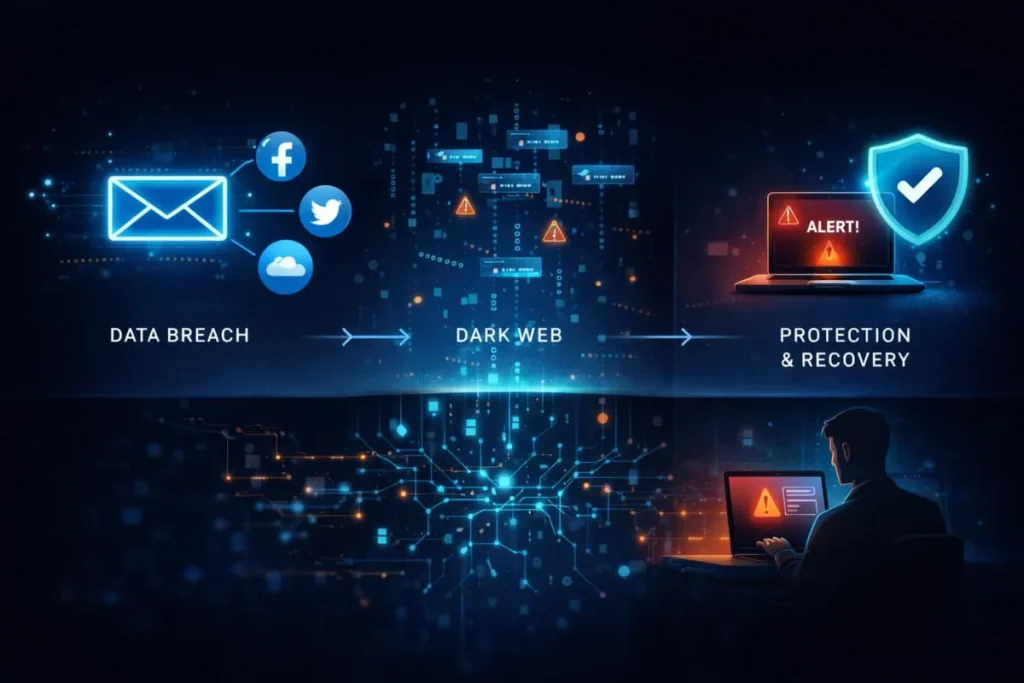
Dark Web Monitoring
The practice of scanning hidden and anonymised online spaces for stolen credentials, leaked data, or chatter about your organisation. It helps find exposed assets before attackers exploit them.
Digital risk protection
A set of services and processes that monitor an organisation’s digital footprint outside the network, such as cloud assets, shadow IT, brand impersonations, and data leaks. It prevents attacks that start outside traditional perimeters.
Indicators of compromise and tactics
Short-lived signals like malicious IPs or hashes, and higher-level techniques like phishing campaigns or ransomware playbooks, all affect brand protection. Both matter indicators give immediate warnings, while tactics explain intent and help with prevention.
Core components of Cyber Threat Management
A complete program has people, process, and tech. Here are the main building blocks.
1. Governance and roles
Define who owns threat management, who makes decisions during an incident, and how actions escalate. Create clear handoffs between security operations, IT, legal, and business units.
2. Threat intelligence intake and prioritisation
Sources can include vendor feeds, open sources, internal telemetry, and partner sharing groups. Use a uniform scoring model so analysts focus on the highest-impact alerts.
3. Detection tooling and telemetry
Collect logs from endpoints, network devices, cloud services, applications, and dark web monitoring services. Centralise data so analysts can correlate events quickly.
4. Investigation and enrichment
Analysts need tools that increase raw alerts with context: asset owners, recent patches, threat actor profiles, or related incidents.
5. Response playbooks
Pre-built steps for common incidents, like credential compromise or ransomware. Playbooks save time and reduce costly mistakes under pressure.
6. Learn and adapt
After each incident, run a structured study to update playbooks, detection logic, and training. Threats evolve, and your program should improve after every event.
Deep dive: Threat Intelligence Platforms (TIPs)
Threat Intelligence Platforms are a force multiplier when used correctly. They sit between raw threat data and your security tools.
What TIPs do
- Ingest many feeds automatically.
- Normalise and deduplicate arrows.
- Enrich indicators with context (geolocation, malware family, related incidents).
- Score and prioritise intelligence.
- Push curated threats to SIEM, EDR, firewalls, and ticketing systems.
How TIPs improve incident handling
- Reduce the time analysts spend cleaning data.
- Provide context that turns noisy alerts into actionable cases.
- Automate the blocking of known bad needles across enforcement points.
- Enable threat sharing with partners, which amplifies visibility.
Choosing a TIP: practical criteria.
- Integration coverage with your SIEM, EDR, NAC, and ticketing tools.
- Support for enrichment sources you trust, such as malware analysis or reputation services.
- Flexible scoring and workflow automation.
- Ease of use: analysts should be able to build playbooks without heavy scripting.
- Vendor transparency on data sources and falsely favourable rates.
Dark Web Monitoring and why it should be part of your plan

Dark Web Monitoring tools are not just about seeing stolen credentials. It uncovers early signs of targeted reconnaissance and data leakage.
What to monitor
- Stolen credentials and PII.
- Leaked internal records and source code.
- Threat actor chatter mentioning your brand or executives.
- Offers to sell access to your systems.
How you use what you find
- If credentials appear, force a password reset and check for lateral movement.
- If sensitive files appear, identify the leak source and start containment.
- Use chatter to tune detection rules for specific IOCs or tactics.
Practical tip: start small and focus
Begin by monitoring high-risk assets: privileged charges, executive emails, and exposed cloud storage. As you mature, expand to brand mentions and wider data types.
Adding Digital risk protection to the stack
Digital risk protection broadens coverage beyond internal telemetry. It finds risks that live in public and semi-public spaces.
Typical DPR capabilities
- Brand and domain monitoring for impersonations.
- Shadow IT discovery to locate unmanaged cloud apps.
- Data leak detection across paste sites, file-sharing platforms, and code repositories.
- Social media and mobile app monitoring for fraudulent apps.
How DPR and TIPs work together
DPR feeds signals, including free dark web activity, into TIPs, which then enrich and distribute those signals to enforcement tools. This creates an end-to-end chain from discovery to containment.
Integrating intelligence with detection and response
Collecting intelligence is only valuable when it reaches you and your tools fast.
Integration patterns
- Push high-confidence indicators to EDR for containment.
- Create SIEM correlation rules that reference TIP scores and context.
- Use SOAR playbooks to automate repetitive actions, like quarantining devices.
- Add analyst workflows for human review before any user-impacting block.
Maintain balance: automation vs human judgment.
Automate low-risk actions like Email Dark Web Scan, enhancing indicators, and opening tickets. Keep human review for blocking actions that could affect business operations.
Implementation roadmap: from zero to mature
Below is a phased plan you can adapt to your organisation’s size and risk profile.
Phase 1: Foundations (0–3 months)
- Inventory assets and map owners.
- Collect baseline telemetry into a major log store.
- Start a threat intel intake from one or two trusted sources.
Phase 2: Detection and response (3–6 months)
- Deploy endpoint detection and make sure it integrates with your log store.
- Build basic playbooks for phishing and credential compromise.
- Add a simple TIP or managed service that feeds prioritised indicators.
Phase 3: Expand visibility (6–12 months)
- Count Dark Web Monitoring and Digital Risk Protection.
- Integrate TIP with SIEM, EDR, and firewall.
- Run table-top exercises with stakeholders.
Phase 4: Automate and measure (12+ months)
- Implement SOAR workflows for common incidents.
- Tune detection rules and reduce false positives.
- Measure mean time to detect and respond, and report to leadership.
Selecting tools: comparison table
Here’s a practical comparison to guide vendor selection. The table lists typical capabilities you’ll evaluate when choosing a Threat Intelligence Platform, Dark Web Monitoring, and Digital Risk Protection service.
Detection rules that actually work
Good detection focuses on behaviour and context. Here are several government ideas you can apply.
- Unusual authentication patterns: repeated failed logins from new geolocations followed by success.
- New data exfiltration to unsanctioned cloud storage from a privileged account.
- Lateral movement signatures combined with recently leaked credentials.
- High volume of outbound connections from a server after a suspicious process execution.
Use TIP context to lower false positives. For instance, if multiple high-confidence sources flag an IP, escalate it faster.
Practical playbooks: short, repeatable actions
Create short playbooks that reduce decision fatigue.
- Phishing with credential exposure: isolate instrument, reset password, check for lateral activity, and preserve evidence.
- Confirmed ransomware: disconnect affected segments, notify leadership, begin containment, assess backups, and communicate with legal.
- Credential leak from Dark Web Monitoring: force reset, check MFA logs, review privilege escalation.
Each Open Source Intelligence (OSINT) playbook should list roles, required evidence, and touch templates for stakeholders.
Metrics that matter
Track a few high-value metrics rather than many vanity numbers.
- Mean time to detect (MTTD).
- Mean time to respond (MTTR).
- Number of validated incidents per month.
- Percentage of alerts that were actionable after enrichment.
- Time saved per analyst through automation.
Use these metrics to show progress to management and to justify further investment.
Common implementation errors and how to avoid them
- Overloading analysts with raw feeds.
- Fix: Use a TIP to score and de-duplicate indicators.
- Automating blocking without clear rules.
- Fix: Start with low-impact automation, add human review for high-risk blocks.
- Neglecting external attack surface monitoring.
- Fix: Add Dark Web Monitoring and Digital risk protection for high-risk assets.
- Not measuring improvements.
- Fix: Pick simple metrics (MTTD, MTTR) and report monthly.
A short checklist to get started (quick wins)
- Centralise logs and basic telemetry collection.
- Add one trusted threat feed into a lightweight TIP or service.
- Set up Dark Web Monitoring for privileged credentials.
- Build two playbooks: phishing and credential middle.
- Run a simple table-top exercise to test roles.
Use cases: realistic scenarios
Scenario 1: Credential leak discovered on a marketplace
Your Dark Web Monitoring finds a set of employee credentials with free access to the dark web. Response: verify affected accounts, reset passwords, enable or confirm MFA, review recent permit logs, and look for lateral movement.
Scenario 2: Suspicious outbound connections from a critical server
TIP enriches the IOC and shows it’s linked to a known botnet. Response: isolate the server, scan for persistence, block IPs at the firewall, and start forensic imaging.
Scenario 3: Brand impersonation detected on social media
Digital risk protection flags a fake page collecting user info. Retort: issue takedown requests, notify customers if data was exposed, and close the loop with legal and communications.
People, training, and culture
Tools matter, but people make decisions. Train analysts to interpret intelligence, not just to follow automation. Encourage cross-team drills, and keep playbooks updated. Make it safe for staff to report suspect events without fear of blame.
Budgeting and resourcing
Match your spend to risk. Start with focused pilots and build ROI by measuring time saved and incidents averted. TIPs often reduce analyst time on manual enrichment, while a dark web monitoring solution and digital risk protection help lower prevention and brand damage costs.
Vendor checklist: questions to ask
- What are your direct data sources, and how do you validate them?
- How do you reduce false positives and stale indicators?
- Which integrations are supported out of the box?
- Can analysts create and modify playbooks without code?
- What reporting and metrics do you provide?
Security and privacy considerations
When sharing intelligence, redact sensitive internal details and follow privacy law when handling PII. For Dark Web Monitoring, verify that vendors operate ethically and do not engage in dubious data collection practices.

Tools and resources (including one free option)
- TIPs from established vendors for centralised intelligence.
- Managed Dark Web Monitoring services that notify on leaked credentials.
- Digital risk protection services for broad external monitoring.
- Open-source threat feeds for initial testing.
- For quick checks, consider a free dark web scan to surface obvious exposures.
If you want to quickly check whether an email address appears in shared breach lists, use a reputable service to check email data breach reports and then follow up with a password reset and MFA review.
Four short recommendations to improve your security posture
- Focus on high-value assets first, like admin tabs and cloud keys.
- Connect threat intelligence to your enforcement tools, not to a silo.
- Automate repetitive enrichment tasks, keep blocking human-approved initially.
- Run frequent, realistic table-top exercises to test playbooks.
Conclusion
A practical Cyber Threat Management schedule ties intelligence, detection, and response into a single feedback loop. Start with clear roles and a small set of prioritised detections. Add a Threat Intelligence Platform to compress time from detection to action: Layer Dark Web Monitoring and Digital risk protection to catch threats that start outside your network. Measure what matters, and keep improving through exercises and after-action reviews.
Build the program in phases, and focus on making analysts more effective, not busier. With the right mix of tools, process, and training, you’ll reduce risk in measurable ways and respond faster when incidents happen.
FAQs
What is the first step in building Cyber Threat Management?
Start by inventorying assets and logging required telemetry. Without visibility, you can’t detect or respond effectively.
How do Threat Intelligence Platforms help a SOC?
They normalise and enrich threat data, prioritise indicators, and push meaningful alerts to detection and response tools.
Is Dark Web Monitoring worth the cost?
Yes, especially if you handle sensitive accounts or IP. It helps find exposed credentials and leaked data before detractors act. Can automation replace analysts?
No. Automation speeds routine tasks, but human judgment is needed for high-risk decisions and complex investigations.
How should I measure success in threat management?
Track mean time to detect and mean time to respond, plus the percentage of alerts that are actionable after enrichment.