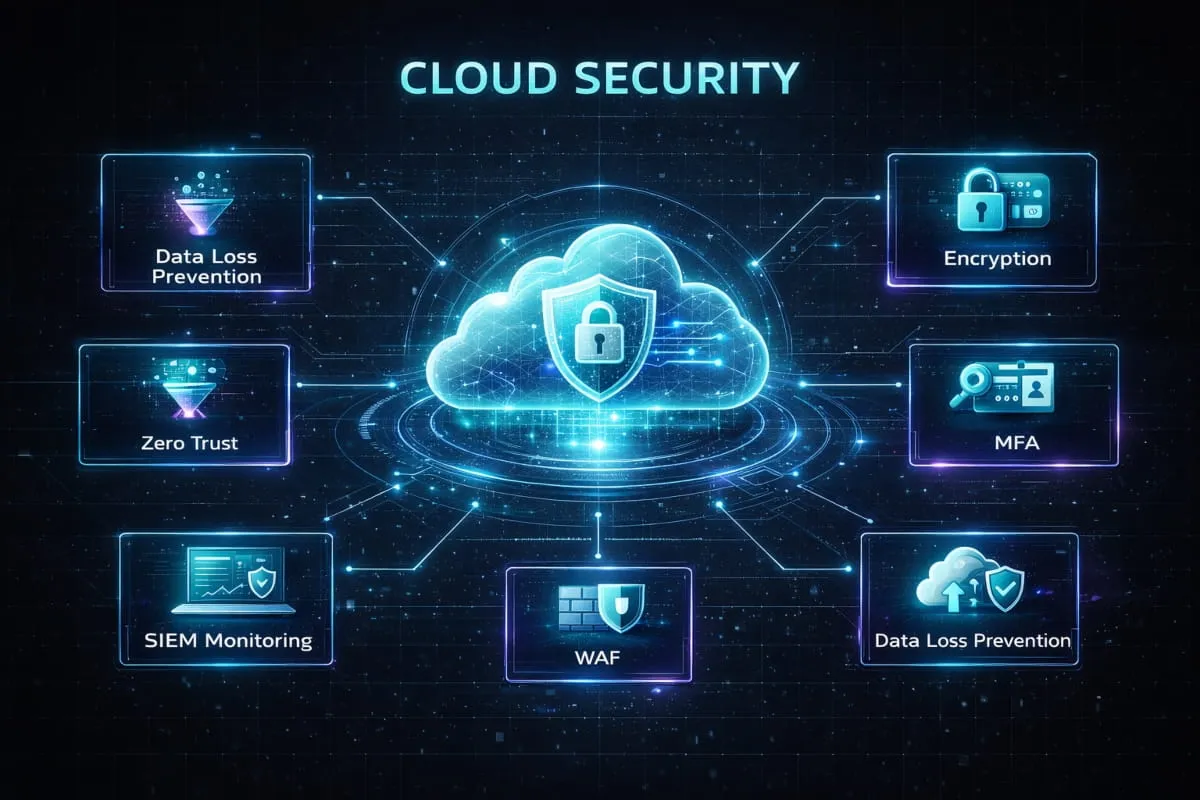
Cloud security is no longer a technical afterthought; it is the foundation of modern digital infrastructure. As businesses move critical applications, data, and workloads to AWS, Microsoft Azure, Google Cloud, and hybrid environments, securing those environments has become a strategic priority. In 2026, cloud security is not just about preventing breaches; it’s about building resilient, compliant, and scalable systems that can withstand evolving cyber threats.
At its core, cloud security encompasses technologies, policies, controls, and services that protect cloud-based systems, data, and infrastructure. It operates under a shared responsibility model, in which cloud providers secure the underlying infrastructure, while organizations are responsible for securing their data, access controls, configurations, and applications. Misunderstanding this model remains one of the biggest causes of cloud-related security incidents.
The risks are real and increasing. Misconfigurations, exposed APIs, account hijacking, insider threats, and data leakage continue to dominate cloud security incidents worldwide. As cloud adoption accelerates, so does the attack surface. A single improperly configured storage bucket or over-permissioned identity can expose millions of records. That’s why cloud security today demands continuous monitoring, strict identity governance, encryption standards, and zero-trust architecture.
Cloud security also varies depending on the deployment model. Public cloud environments prioritize scalability and provider-managed infrastructure security. Private cloud security offers greater control but requires stronger internal governance. Hybrid and multi-cloud environments introduce additional complexity, requiring unified visibility and consistent policy enforcement across platforms.
To address these challenges, organizations rely on structured cloud security frameworks such as NIST, ISO 27001, SOC 2, and the Cloud Security Alliance (CSA) controls matrix. These frameworks provide standardized guidance for risk management, compliance, and operational resilience. When implemented correctly, they transform cloud security from reactive defense into proactive risk mitigation.
This guide explores cloud security in depth, from its definition and core components to common risks, deployment types, and recognized security frameworks that shape 2026 best practices. Whether you are evaluating your current posture or building a cloud security strategy from scratch, understanding these fundamentals is the first step toward protecting your digital assets in an increasingly cloud-first world.

What Is Cloud Security?
Cloud security refers to the technologies, policies, controls, and procedures designed to protect cloud-based infrastructure, applications, and data from cyber threats. It covers public, private, hybrid, and multi-cloud environments, ensuring that digital assets remain secure under the shared responsibility model between cloud providers and organizations. By combining identity management, encryption, monitoring, and governance, cloud security safeguards systems against unauthorized access, data breaches, and service disruptions.
Why It Matters
As businesses increasingly rely on cloud platforms to store sensitive data and run mission-critical applications, the security of those environments directly impacts operational continuity and customer trust. A single misconfiguration or compromised account can expose large volumes of data, damage reputation, and trigger regulatory penalties. Effective cloud security reduces these risks by enforcing strict access controls, maintaining visibility across environments, and aligning with recognized compliance frameworks. In today’s cloud-first landscape, strong security is not optional; it is essential for resilience, scalability, and long-term growth.
Types of Cloud Security Controls
Cloud security relies on layered controls that work together to reduce risk and protect digital assets across cloud environments.
Identity & Access Management (IAM)
IAM controls who can access cloud resources and what actions they can perform. It includes role-based access, multi-factor authentication (MFA), and least-privilege policies to prevent unauthorized access and account compromise.
Data Encryption
Encryption protects sensitive data both at rest and in Transit. By converting information into unreadable code without proper keys, encryption ensures that even if data is intercepted or exposed, it cannot be misused.
Network Security
Network security controls protect cloud infrastructure from external and internal threats. This includes firewalls, virtual private networks (VPNs), intrusion detection systems, and segmentation strategies that limit lateral movement within cloud environments.
Endpoint Protection
Endpoint protection secures devices and workloads connected to the cloud, including virtual machines, containers, and user devices. It helps detect malware, suspicious behavior, and vulnerabilities before they can impact the broader system.
Compliance & Governance
Compliance and governance controls ensure cloud environments meet regulatory standards and industry frameworks such as ISO 27001, SOC 2, and NIST. They establish policies, auditing mechanisms, and continuous monitoring processes to maintain accountability and risk management.
Why Cloud Security Is Important in 2026
Cloud security has become a business-critical priority in 2026 because the cloud now sits at the center of how companies operate, scale, and compete. As more organizations move sensitive data, customer platforms, and revenue-driving applications into cloud environments, the impact of a security failure grows exponentially. Cloud security isn’t just about preventing attacks, it’s about protecting uptime, reputation, revenue, and compliance in a world where digital systems are always connected.
Cloud adoption continues to accelerate across every industry, from startups building cloud-native products to enterprises migrating legacy systems into hybrid and multi-cloud setups. That growth expands the attack surface. Each new workload, API, container, and identity creates another potential entry point if configurations, access permissions, and monitoring aren’t handled correctly. In practical terms, the more cloud you use, the more security becomes a continuous, always-on discipline rather than a one-time setup.

At the same time, data breach trends show attackers increasingly targeting cloud environments because they offer high-value access at scale. Misconfigured storage, exposed credentials, over-permissioned accounts, and vulnerable third-party integrations remain some of the most common weaknesses. What makes cloud incidents especially damaging is speed; an attacker can move quickly, extract data, or disrupt services long before traditional security teams detect what’s happening, especially without strong cloud visibility and real-time alerts.
Regulatory pressure is also rising. Privacy laws, industry compliance requirements, and contractual security expectations have tightened across regions and sectors. Organizations are expected to prove that data is protected, access is controlled, and security controls are actively monitored. This is where cloud security connects directly to governance: strong policies, audit readiness, encryption standards, and continuous compliance monitoring reduce legal exposure and make it easier to meet frameworks like ISO 27001, SOC 2, and NIST-aligned controls.
In short, cloud security matters more in 2026 because cloud adoption is growing, threats are evolving faster, and accountability is stricter. The organizations that treat cloud security as a strategy, not a checklist, are the ones that stay resilient, compliant, and trusted as cloud-first operations continue to dominate.
Types of Cloud Security
Cloud security isn’t one-size-fits-all. The controls, risks, and responsibilities shift depending on how your cloud environment is built and managed. In 2026, most organizations operate across multiple models, often mixing platforms, providers, and on-prem systems, so understanding the main types of cloud security helps you apply the right protections without gaps or duplicated effort.

Public Cloud Security
Public cloud security focuses on protecting workloads running on shared infrastructure provided by vendors like AWS, Microsoft Azure, and Google Cloud. While the provider secures the underlying hardware and core services, your organization is responsible for securing data, identities, access permissions, configurations, and applications. This model demands strong Identity & Access Management (IAM), encryption, continuous monitoring, and configuration controls because missteps, like exposed storage or overly permissive roles, are common causes of cloud incidents.
Private Cloud Security
Private cloud security applies to cloud infrastructure dedicated to a single organization, whether hosted internally or through a managed provider. Because the environment offers greater control and customization, it also places more responsibility on your internal teams for security architecture, patching, network segmentation, and governance. Private cloud security typically emphasizes tighter internal access controls, stronger change management, and consistent auditing since security outcomes depend heavily on how well the organization maintains the environment.
Hybrid Cloud Security
Hybrid cloud security protects environments that combine public cloud services with private cloud or on-prem infrastructure. The biggest challenge here is consistency; security policies, access rules, and monitoring tools can become fragmented across systems. Hybrid setups require unified identity management, secure connectivity between environments, and centralized visibility so teams can detect threats across both sides. In 2026, hybrid cloud security will also depend heavily on automation to enforce policies at scale and prevent drift across environments.
Multi-Cloud Security
Multi-cloud security covers organizations that use more than one public cloud provider simultaneously, for example, running applications across AWS and Azure, or using GCP for analytics while hosting infrastructure elsewhere. The benefit is flexibility and resilience, but the security complexity increases. Each provider offers different services, configurations, and identity structures, which can create blind spots and misaligned policies. Multi-cloud security works best with centralized governance, standardized baseline controls, and tools that provide cross-cloud visibility, such as CSPM or CNAPP platforms, so security remains consistent even when infrastructure spans multiple providers.
Choosing the right approach starts with matching security controls to your cloud model. Once you know which type of cloud security you’re operating under, you can build a strategy that reduces risk, supports compliance, and scales with your infrastructure, without creating gaps between environments.
Core Components of Cloud Security
Effective cloud security is built on layered protection. Instead of relying on a single tool, strong security in cloud environments combines identity controls, data protection, network defenses, visibility, and governance. In 2026, this layered approach is essential because cloud infrastructure changes quickly, access is distributed, and attackers increasingly target misconfigurations and weak credentials rather than “breaking in” the traditional way.

Identity & Access Management (IAM)
IAM is the front door of cloud security. It controls who can access cloud resources, what they can do, and under what conditions. When IAM is configured correctly, using least privilege access, role-based permissions, and multi-factor authentication, it reduces the risk of account hijacking and limits damage if a credential is compromised. In most cloud breaches, access is the first point of failure, which is why IAM sits at the center of any cloud security strategy.
Encryption
Encryption protects sensitive information by making data unreadable without the correct keys. In cloud environments, encryption matters both in Transit (as data moves between users, apps, and services) and at rest (when stored in databases, backups, or object storage). Beyond basic encryption, key management is critical in 2026 because control over keys often determines whether a breach becomes a headline or a contained incident.
Firewalls
Cloud firewalls help control traffic at the network level by filtering what can enter and leave your environments. They enforce rules that restrict unauthorized connections, block known malicious sources, and reduce exposure of cloud services to the public internet. In modern cloud architecture, firewalls are often combined with segmentation so that even if one area is compromised, attackers can’t easily move laterally across workloads.
CASB (Cloud Access Security Broker)
A CASB adds visibility and control over how users access cloud applications and cloud data, especially in SaaS environments. It helps enforce policies like data loss prevention, risky login detection, device-based restrictions, and shadow IT monitoring. For organizations managing remote teams and multiple cloud apps, CASB plays a key role in keeping cloud usage secure without slowing productivity.
SIEM (Security Information and Event Management)
SIEM tools collect and correlate security logs across cloud systems, applications, and identity platforms to detect suspicious activity. In 2026, cloud environments generate enormous volumes of events, and SIEM helps security teams turn that noise into actionable alerts. When paired with automated response workflows, SIEM becomes a core layer for real-time cloud threat detection and incident response.
Zero Trust
Zero Trust is not a single tool; it’s a security approach based on one principle: never trust by default, always verify. In cloud security, Zero Trust means continuously validating identity, device posture, and access context before granting permissions. It also reduces implicit Trust inside networks by limiting access paths, enforcing least privilege, and monitoring behavior. As cloud environments become more dynamic and distributed, Zero Trust provides a model that maintains consistent security even as infrastructure constantly changes.
Together, these core components form the backbone of cloud security. When they’re aligned, identity is tightly controlled, data is encrypted, networks are protected, activity is monitored, and access is continuously verified, you get a cloud environment that is not only secure, but resilient and scalable for 2026 and beyond.
Common Cloud Security Risks
Despite advances in technology and tooling, cloud security risks continue to evolve as organizations expand their digital infrastructure. In 2026, most cloud incidents are not caused by sophisticated zero-day exploits, but by preventable weaknesses in configuration, access control, and monitoring. Understanding these common cloud security risks is the first step toward building stronger protection.

Misconfigurations
Misconfigurations remain the leading cause of cloud security breaches. Incorrect storage permissions, overly permissive identity roles, exposed databases, or disabled logging can unintentionally open cloud environments to public access. Because cloud platforms are highly customizable, even small configuration errors can create significant exposure. Continuous monitoring and automated configuration checks are essential to reduce this risk.
Data Leaks
Data leaks occur when sensitive information is exposed to unauthorized users, either accidentally or through exploitation. In cloud environments, this often happens due to unsecured storage buckets, weak access policies, or insufficient encryption. Since cloud systems frequently store customer data, financial records, and intellectual property, even a single data leak can result in regulatory penalties and long-term reputational damage.
Insider Threats
Insider threats involve employees, contractors, or partners who misuse legitimate access to cloud systems. This can be intentional, such as data theft, or accidental, like sharing confidential files improperly. Because cloud environments are accessible from anywhere, managing identity permissions and auditing activity becomes critical. Strong IAM policies and behavioral monitoring help reduce the impact of insider risks.
API Vulnerabilities
Cloud services rely heavily on APIs to connect applications, services, and external integrations. If APIs are poorly secured, lack proper authentication, or are left exposed without rate limiting, attackers can exploit them to access data or disrupt operations. Securing APIs with authentication tokens, encryption, and regular testing is a key part of maintaining cloud security in modern architectures.
Account Hijacking
Account hijacking occurs when attackers gain control of user credentials through phishing, credential stuffing, or brute-force attacks. Once inside, they can escalate privileges, access sensitive data, or deploy malicious resources. Since cloud environments are identity-driven, compromised credentials can provide broad access if not properly restricted. Multi-factor authentication, least privilege access, and continuous login monitoring significantly reduce this threat.
Cloud security risks often stem from visibility gaps and overconfidence in default settings. By recognizing these vulnerabilities, misconfigurations, data leaks, insider threats, API weaknesses, and account compromise, organizations can proactively strengthen their defenses and maintain secure, resilient cloud environments.
Cloud Security Frameworks
Cloud security frameworks provide organizations with a structured approach to managing risk, demonstrating compliance, and establishing consistent security controls across cloud environments. In 2026, frameworks matter more than ever because cloud infrastructure changes fast, new services, new identities, new integrations, and security teams need a reliable standard to keep policies aligned and audit-ready. Rather than relying on guesswork, cloud security frameworks provide measurable requirements, control categories, and implementation guidance that help organizations protect data while meeting legal and contractual expectations.

NIST
The National Institute of Standards and Technology (NIST) provides widely adopted guidance for cybersecurity and risk management. In cloud security, NIST frameworks help organizations identify threats, implement protective controls, detect incidents, respond effectively, and recover with minimal disruption. Many companies use NIST as a foundation for building cloud security policies because it supports a practical, lifecycle-based approach that works across industries and cloud providers.
ISO 27001
ISO/IEC 27001 is an international standard for establishing and maintaining an Information Security Management System (ISMS). For cloud security, ISO 27001 is often used to formalize governance, policies, processes, access control, asset management, incident handling, and continuous improvement. It’s especially valuable for organizations that need a globally recognized compliance standard to reassure customers and partners that security controls are not only implemented, but actively managed and regularly reviewed.
CSA CCM (Cloud Controls Matrix)
The Cloud Security Alliance (CSA) Cloud Controls Matrix is a cloud-specific framework designed to map security controls directly to cloud risks and cloud operating models. It’s highly useful for assessing cloud providers, evaluating cloud security posture, and aligning security responsibilities under the shared responsibility model. In 2026, CSA CCM is often referenced when organizations seek a more cloud-native control framework that complements broader standards such as NIST and ISO.
SOC 2
SOC 2 is an assurance framework focused on how service organizations protect customer data, based on Trust Services Criteria such as security, availability, confidentiality, and privacy. For cloud security, SOC 2 is particularly relevant for SaaS companies and cloud service providers that need to demonstrate their systems are designed and operated securely. Achieving and maintaining SOC 2 compliance typically requires strong access control, logging, incident response procedures, and documented governance, making it both a credibility asset and a security discipline.
Choosing the right cloud security framework depends on your industry, customer expectations, and compliance requirements. Many organizations use a combined approach, leveraging NIST for security lifecycle strategy, ISO 27001 for governance and certification, CSA CCM for cloud-specific controls, and SOC 2 for third-party assurance. The key is consistency: frameworks are most effective when they’re embedded into daily cloud operations, not treated as a once-a-year audit exercise.
Cloud Security vs Cybersecurity
Cloud security and cybersecurity are closely connected, but they’re not the same thing. Cybersecurity is the broader discipline focused on protecting all digital systems, networks, devices, applications, and data from threats. Cloud security is a specialized branch of cybersecurity that focuses on securing cloud environments, including public, private, hybrid, and multi-cloud infrastructure.

The easiest way to understand the difference is by looking at the scope. Cybersecurity covers everything from endpoint protection on employee laptops to securing on-premise servers and defending against phishing attacks. Cloud security narrows that focus to the cloud layer, where identity-based access, shared infrastructure, APIs, and cloud-native services introduce unique risks and responsibilities. In 2026, that distinction matters because cloud environments operate differently from traditional IT systems, and they require security strategies designed for speed, automation, and continuous change.
Another key difference is responsibility. Traditional cybersecurity often assumes the organization owns and controls the full technology stack, from hardware to software. Cloud security operates under the shared responsibility model, in which cloud providers secure the underlying infrastructure, while customers are responsible for securing configurations, user access, workloads, data, and applications. This is why many cloud incidents stem from customer-side gaps, such as misconfigurations, over-permissioned identities, or exposed APIs, rather than failures at the provider level.
Cloud security is also more identity-driven. In cloud environments, access management is often the strongest line of defense because users, services, and applications interact through permissions, roles, and tokens. A compromised identity can be more damaging than a compromised device if access controls are weak. Cybersecurity includes identity security, too, but cloud security places it at the center of daily operations because the cloud runs on authentication, authorization, and policy enforcement.
Finally, cloud security depends heavily on visibility and automation. Cloud infrastructure can scale up or down in minutes, and cloud services are constantly updating. That pace makes manual security approaches unreliable. Cloud security uses continuous monitoring, configuration management, and automated policy enforcement to prevent drift and detect threats early, especially in complex hybrid and multi-cloud environments.
In short, cybersecurity is the umbrella, and cloud security is the cloud-focused layer underneath it. If cybersecurity protects the entire digital ecosystem, cloud security ensures that the most dynamic and widely adopted part of that ecosystem, the cloud, remains resilient, compliant, and protected against modern threats.
| Basis of Comparison | Cloud Security | Cybersecurity |
|---|---|---|
| Definition | A specialized branch of cybersecurity focused on protecting cloud-based infrastructure, applications, and data. | A broad discipline focused on protecting all digital systems, networks, devices, and data from cyber threats. |
| Scope | Limited to public, private, hybrid, and multi-cloud environments. | Covers on-premise systems, endpoints, networks, applications, and cloud environments. |
| Responsibility Model | Operates under a shared responsibility model between cloud provider and customer. | Typically managed fully by the organization for its internal IT infrastructure. |
| Primary Focus | Identity management, configuration security, cloud workloads, APIs, and cloud data protection. | Network security, endpoint protection, firewalls, malware defense, phishing prevention, and overall threat management. |
| Infrastructure Control | Infrastructure is partially controlled by the cloud service provider. | Infrastructure is usually fully owned and controlled by the organization. |
| Risk Factors | Misconfigurations, exposed storage, API vulnerabilities, account hijacking. | Malware, ransomware, phishing, DDoS attacks, insider threats. |
| Security Approach | Identity-driven, automation-heavy, continuous monitoring across dynamic environments. | Broad layered defense across networks, endpoints, applications, and systems. |
| Compliance Alignment | Often aligned with cloud-specific frameworks like CSA CCM along with ISO, NIST, SOC 2. | Aligned with general cybersecurity frameworks such as NIST, ISO 27001, CIS Controls. |
| Environment Dynamics | Highly dynamic and scalable; requires automated security controls. | Can include both static and dynamic environments. |
Cloud Security Best Practices
Strong cloud security in 2026 isn’t about buying more tools; it’s about applying the right controls consistently across your cloud environment. As organizations scale across AWS, Azure, Google Cloud, and hybrid environments, the biggest risks often stem from weak identity controls, misconfigurations, and gaps in visibility. These cloud security best practices focus on practical actions you can implement to reduce risk, strengthen compliance, and keep workloads protected as your infrastructure evolves.
Cloud security becomes stronger when these practices work together, identity is controlled, configurations are continuously validated, data is protected with encryption, and threats are detected early through monitoring. When implemented consistently, these cloud security best practices not only reduce breaches but also improve resilience, compliance, and trust across your cloud operations.

15 Cloud Security Best Practices
Cloud security best practices in 2026 are all about consistency. Cloud environments change rapidly, with new users, services, integrations, and deployment cycles. That speed is exactly why most cloud security incidents don’t happen because attackers are “genius hackers,” but because basic controls weren’t enforced everywhere. The best approach is layered: secure access, protect data, reduce exposure, and maintain continuous visibility.
1) Enforce Multi-Factor Authentication (MFA)
Multi-factor authentication is one of the simplest upgrades with the biggest payoff. Even if credentials are stolen through phishing, credential stuffing, or reused passwords, MFA adds a second verification step that blocks most unauthorized logins. In cloud environments where identity is the gateway to everything, MFA should be mandatory for administrative accounts, developer access, and any user with access to sensitive data or production workloads. If you do nothing else, do this first, because cloud breaches often start with a compromised login.
2) Apply Least Privilege Access
Least privilege means users and services should have only the permissions they truly need, nothing more. Over-permissioned roles are a silent risk because they don’t “look dangerous” until something goes wrong. If one account is compromised, excessive privileges allow attackers to move faster, access more resources, and cause more damage. Use role-based access controls, assign permissions to roles rather than individuals, and review privileges on a schedule. In cloud security, access control is not a set-and-forget step; it’s ongoing hygiene.
3) Encrypt Data at Rest and in Transit
Encryption protects data whether it’s stored in databases, storage buckets, backups, or moving between services and users. Data at rest should be encrypted using cloud-native tools, and data in Transit should be protected with secure protocols such as TLS. The overlooked piece here is key management, which controls key rotation and audits access to keys. Encryption is only as strong as how keys are managed, which is why key governance is a major part of modern cloud security.
4) Regularly Audit Configurations
Misconfigurations are still one of the most common causes of cloud security incidents. A public-facing storage bucket, an open port, a permissive security group, or disabled logging can expose systems without anyone realizing it. Regular configuration audits help you identify risky settings, enforce baseline standards, and prevent configuration drift as teams deploy changes. Cloud environments are dynamic, so auditing should be continuous, not just “once a quarter.”
5) Use Zero Trust Architecture
Zero Trust is a mindset and a design approach: never assume Trust simply because something is “inside” the system. In cloud environments, where work is remote, and services communicate through APIs, Zero Trust reduces implicit trust and forces continuous verification. That means strongly authenticating users, validating devices and context, limiting access by default, and reducing lateral movement across workloads. Zero Trust supports resilience because it assumes breaches can happen and focuses on containing them.
6) Monitor Cloud Logs Continuously
Without visibility, cloud security becomes reactive. Cloud platforms generate logs for identity activity, API calls, configuration changes, network traffic, and workload events. Continuous log monitoring helps detect unusual behavior early, such as a new admin role being created, a spike in failed login attempts, data access at odd hours, or resources being deployed unexpectedly. The goal is not to collect logs solely for compliance, but to use them for real-time detection and faster incident response.
7) Secure APIs
APIs are the backbone of cloud services, integrations, and modern applications. If an API is exposed without strong authentication, authorization, encryption, and rate limiting, it becomes an easy entry point for attackers. Secure APIs with proper identity validation, tokens, least privilege access, and input validation. Also monitor API usage patterns, as suspicious behavior often manifests as abnormal calls, high request volumes, or unexpected endpoints being accessed.
8) Patch Regularly
Patching closes known vulnerabilities, and attackers often exploit unpatched systems because it’s faster than developing new exploits. Cloud environments can include virtual machines, containers, managed services, and third-party apps, each with its own update requirements. A solid patching process includes prioritization (critical systems first), automation where possible, and validation to ensure updates don’t break production. Regular patching isn’t glamorous, but it’s one of the most reliable ways to reduce security risk.
9) Back Up Critical Data
Backups are your safety net against ransomware, accidental deletions, corruption, and operational failures. The key is to back up not only data, but also configurations and critical infrastructure components when applicable. Backups should be encrypted, access-controlled, and stored in a way that prevents attackers from deleting them during an incident. Most importantly, backups must be tested, because an untested backup is just a comforting assumption, not a recovery plan.
10) Use Automated Threat Detection
Manual monitoring can’t keep up with cloud scale. Automated threat detection tools help identify anomalies, malware activity, suspicious identity behavior, and unusual network patterns across workloads. In 2026, automated detection is especially important for hybrid and multi-cloud environments where visibility can be fragmented. Automation doesn’t replace a security team; it gives them the speed and signals they need to respond before small issues become large incidents.
11) Implement Network Segmentation
Network segmentation limits how far an attacker can move if they gain access to one part of your environment. Instead of letting everything communicate freely, segmentation creates boundaries between workloads, environments, and sensitive systems. For example, development environments should not use the same access paths as production environments, and critical databases should not be accessible from the public internet. Segmentation is a practical way to reduce blast radius and improve containment.
12) Secure DevOps Pipelines
Modern infrastructure is built through code, templates, pipelines, and automated deployments. If your CI/CD pipeline is compromised, attackers can inject malicious code, leak secrets, or deploy insecure configurations. Secure DevOps pipelines by protecting credentials, scanning infrastructure-as-code templates, enforcing approvals for high-risk changes, and monitoring pipeline activity. In 2026, cloud security and DevOps are deeply connected, and the pipeline is part of your security perimeter.
13) Train Employees
People remain a top risk factor, especially through phishing, weak password habits, and accidental data exposure. Training should be practical, consistent, and role-based. Developers need to be aware of secure coding and cloud configuration. Admins need access to hygiene. General users need protection against phishing and credential theft. A well-trained team reduces mistakes and speeds up response when something feels “off.”
14) Apply Compliance Frameworks
Compliance frameworks such as ISO 27001, SOC 2, and NIST provide structure for cloud security controls and governance. They help organizations set policies, prove accountability, and maintain consistent risk management across teams. The goal isn’t compliance for its own sake; it’s using frameworks to standardize how cloud security is implemented, audited, and continuously improved. In many industries, strong compliance is also a competitive advantage because it builds Trust with customers.
15) Test Disaster Recovery Plans
Disaster recovery is where cloud security meets business continuity. It’s not enough to have a plan written down; you need to test it. Recovery testing validates that backups restore correctly, that failover processes work, that teams know their roles, and that downtime can be minimized. In 2026, testing disaster recovery plans is a key best practice because threats and failures aren’t hypothetical; they’re inevitable. The organizations that recover fastest are the ones that practice recovery before they need it.
When these cloud security best practices are implemented together, they create a system that is harder to breach, easier to monitor, and faster to recover. The goal is not perfection, it’s resilience: controlling access, protecting data, detecting threats early, and reducing impact when incidents occur.
Best Practices by Cloud Model (AWS, Azure, GCP)
Cloud security best practices stay consistent in principle: strong identity controls, encryption, monitoring, and governance, but the way you implement them differs across AWS, Microsoft Azure, and Google Cloud Platform (GCP). Each provider has its own identity system, logging stack, security tools, and terminology. In 2026, the smartest approach is to standardize your security outcomes while using each cloud’s native capabilities to enforce them efficiently.

AWS Cloud Security Best Practices
In AWS, cloud security starts with controlling identities and reducing account-level risk. Because AWS environments often scale across multiple accounts and services, governance and permission design must be deliberate from day one. Use strong IAM policies, avoid long-lived access keys where possible, and enforce multi-factor authentication for every privileged user. Permissions should be role-based and tightly scoped, especially for automation and DevOps workflows, since over-permissioned roles are a common source of cloud exposure.
Logging and visibility matter just as much in AWS. Centralize audit trails to track who did what, when, and from where, especially for sensitive services such as storage, compute, networking, and identity changes. Continuous monitoring helps detect risky configuration changes early, such as publicly exposed storage, open security groups, or unexpected privilege escalations. For data protection, ensure encryption is applied consistently and that key usage is controlled and auditable, so sensitive data stays protected even when systems expand.
Azure Cloud Security Best Practices
In Azure, identity is typically the core of everything, especially for organizations already using Microsoft ecosystems. Strong cloud security in Azure means enforcing consistent identity governance, applying conditional access policies, and making sure privileged users are properly controlled with time-bound access whenever possible. Least privilege access should be applied across roles, subscriptions, and resource groups so permissions don’t spread unchecked as teams add new services.
Azure environments often integrate deeply with enterprise workflows, which makes configuration management and governance essential. Enforce policies that prevent insecure deployments, such as public exposure of resources or weak network boundaries. Logging and monitoring should be centralized across identity, workloads, and network events to catch suspicious behavior early. For data security, use encryption by default, and ensure key management supports access restrictions and auditing, especially for customer data, regulated workloads, and business-critical systems.
GCP Cloud Security Best Practices
In GCP, cloud security is heavily policy-driven, and organizations benefit from designing permissions and controls with clear separation between projects and environments. Least privilege access should be consistently enforced across identities, service accounts, and workloads. Service account misuse is a common risk in GCP, so permissions for automation should be carefully scoped, monitored, and regularly reviewed.
Visibility is also a key success factor in GCP. Ensure audit logs are enabled and retained properly, and centralize monitoring so your team can identify unusual activity, risky permission changes, and abnormal service behavior. For data protection, encryption should be treated as a baseline, not a feature, especially for storage and analytics workloads that often hold large volumes of sensitive information. Governance policies should be designed to reduce misconfiguration risk, including restrictions around public access, external sharing, and insecure networking patterns.
A Practical Way to Stay Consistent Across All Three
If you operate across AWS, Azure, and GCP, the biggest risk is inconsistency: different teams using different rules, tools, and definitions of “secure.” The best strategy is to standardize a baseline cloud security posture that applies everywhere: MFA for privileged access, least privilege permissions, encryption standards, centralized logging, and continuous monitoring. Then map those requirements to each provider’s native tools so security isn’t dependent on manual effort or individual teams remembering the rules.
When cloud security best practices are correctly implemented in the cloud model, you reduce misconfiguration risk, strengthen detection, and maintain governance, regardless of whether workloads run in AWS, Azure, or GCP. The goal is simple: consistent security outcomes, implemented in the most effective way for each cloud platform.
What Are Cloud Security Solutions?
Cloud security solutions are the tools, platforms, and services designed to protect cloud environments from threats, misconfigurations, and unauthorized access. They help organizations secure cloud infrastructure, applications, identities, and data across public, private, hybrid, and multi-cloud environments. Instead of relying on manual checks, cloud security solutions provide continuous visibility, policy enforcement, threat detection, and automated responses, enabling security to scale as fast as the cloud itself.
In practical terms, these solutions reduce the most common cloud security risks by doing three things well: preventing exposure before it becomes a breach, detecting suspicious activity early, and helping security teams respond quickly with clear evidence and guided remediation. That includes identifying misconfigured storage, flagging overly permissive access roles, monitoring cloud workloads for malicious behavior, securing APIs and integrations, and producing compliance-ready reporting aligned with frameworks such as ISO 27001, SOC 2, and NIST controls.

What makes cloud security solutions different from traditional security tools is how they operate. Cloud environments are dynamic, resources are created and destroyed automatically, permissions change frequently, and services connect through APIs. Cloud security solutions are built for this pace. They integrate directly with cloud providers and cloud services to monitor configurations, events, and identity activity in real time, helping organizations maintain a strong cloud security posture without slowing down engineering teams.
For enterprises, cloud security solutions are not just “nice-to-have.” They are a core part of risk management, compliance, and business continuity in 2026, especially as cloud usage expands, attacker tactics evolve, and regulatory expectations become stricter.
What Enterprises Need From Cloud Security Solutions in 2026
Modern enterprise buying decisions are driven by three things: risk reduction, operational efficiency, and audit readiness. Enterprises want solutions that reduce misconfiguration and identity risk, automate security controls at scale, and provide reporting that supports compliance frameworks without creating extra work. The best tools also integrate cleanly into DevOps pipelines, support multi-cloud environments, and provide centralized visibility so teams aren’t forced to jump between dashboards.
How to Choose the Right Cloud Security Solution
Enterprise buyers often make the mistake of choosing tools based on buzzwords. A better approach is to choose based on your highest-risk gaps and the maturity of your security operations.
Start by identifying your biggest risk drivers. If you struggle with exposed resources and inconsistent configurations, prioritize CSPM or CNAPP solutions that enforce policy and continuously detect drift. If identity sprawl and excessive permissions are your main issues, CIEM should be a top priority. If workloads and production runtime threats are the concern, CWPP becomes essential. For SaaS-heavy environments, CASB plays a key role in controlling data access and shadow IT.

Next, evaluate multi-cloud coverage and integration. If you operate across AWS, Azure, and GCP, you need a cloud security solution that provides consistent policy enforcement and reporting across providers. Integration with DevOps pipelines is also critical in 2026, as infrastructure is now deployed through code. The best enterprise tools fit into how teams build, not just how security teams audit.
Finally, assess operational reality. A tool that generates thousands of alerts without context will slow you down. Look for solutions that reduce noise, intelligently prioritize risk, and support automated remediation workflows. The right cloud security solution should improve security outcomes without increasing daily operational burden.
What Best Looks Like for Enterprises in 2026
For most enterprises, the strongest approach is a modern stack built around visibility, posture management, identity control, and detection. Many organizations consolidate around platforms that unify these capabilities to reduce complexity, but consolidation only works if the platform truly supports your cloud models and maturity level. The goal is not to buy the most tools, it’s to build the most coherent cloud security program.
If you want, I can convert this into a buyer-ready page section next (with tool-category comparisons, evaluation checklist, and a short “how to choose” framework) while keeping your keyword strategy clean and avoiding cannibalization with your Cloud Security pillar and Best Practices page.
Types of Cloud Security Solutions
Enterprise cloud environments require more than one layer of protection. Different cloud security solutions focus on different risk areas, some reduce misconfigurations, others control identity permissions, and others monitor runtime threats. Understanding these categories helps buyers evaluate tools without confusion and build a cloud security strategy that consistently covers posture, workloads, identity, and access.

CSPM (Cloud Security Posture Management)
CSPM solutions continuously monitor cloud environments for misconfigurations, insecure settings, and compliance gaps. They identify exposed storage, overly permissive network rules, risky IAM policies, and policy violations across AWS, Azure, and GCP. CSPM is essential for preventing configuration-driven cloud security incidents.
CWPP (Cloud Workload Protection Platform)
CWPP tools focus on protecting cloud workloads such as virtual machines, containers, and serverless functions. They detect vulnerabilities, malware, and suspicious runtime behavior within active workloads. For enterprises running production systems in the cloud, CWPP adds visibility and protection at the compute layer.
CASB (Cloud Access Security Broker)
CASB solutions provide visibility and control over how users access cloud applications, especially SaaS platforms. They help enforce security policies, prevent data loss, monitor shadow IT usage, and detect risky access behavior. CASB is particularly valuable for organizations with distributed teams and heavy SaaS adoption.
CIEM (Cloud Infrastructure Entitlement Management)
CIEM tools analyze and manage cloud identity permissions. They identify excessive privileges, dormant accounts, and potential privilege escalation paths. Since identity is central to cloud security, CIEM plays a critical role in reducing the risk of account compromise and limiting blast radius.
CNAPP (Cloud-Native Application Protection Platform)
CNAPP solutions combine multiple cloud security capabilities, often integrating CSPM, CWPP, and identity insights into a unified platform. CNAPP is designed to reduce tool sprawl while offering broader coverage across posture management, workload protection, and DevSecOps processes.
Cloud Workload Protection
While sometimes included within CWPP, cloud workload protection can also refer more broadly to tools that secure active workloads against threats, vulnerabilities, and runtime anomalies. This includes container security, serverless protection, and host-level defense mechanisms tailored to cloud infrastructure.
SIEM (Security Information and Event Management)
SIEM solutions aggregate and analyze security logs from cloud services, identity systems, applications, and networks. They help detect suspicious patterns, correlate events, and support incident response. In cloud environments, SIEM is critical for centralized visibility and faster threat detection.
SASE (Secure Access Service Edge)
SASE solutions combine network security and secure access capabilities into a cloud-delivered model. They support Zero Trust access, secure remote connections, and consistent policy enforcement across distributed users and multi-cloud environments. For enterprises with remote workforces, SASE strengthens cloud access security without relying on traditional perimeter-based controls.
Each of these cloud security solutions addresses a different layer of risk. The most effective enterprise strategies align the right mix of tools with the organization’s cloud architecture, maturity level, and compliance requirements, ensuring strong protection without unnecessary overlap or complexity.
Cloud Security Solutions for Modern Businesses
Modern businesses run on the cloud because it’s fast, scalable, and built for constant change. But that same speed is what makes cloud security more complex in 2026. Teams deploy new services in minutes, integrate dozens of third-party tools, and manage access across remote workforces, often across multiple cloud providers. Without the right cloud security solutions in place, small gaps like misconfigurations, weak permissions, or exposed APIs can quickly turn into high-impact incidents.
Cloud security solutions help businesses protect cloud infrastructure, workloads, identities, and data with continuous visibility and control. Instead of relying on manual checks, these solutions monitor environments in real time, enforce policy standards, detect threats early, and support faster incident response. For organizations scaling cloud usage, they’re not just defensive tools; they’re operational safeguards that keep growth secure without slowing innovation.

For many companies, the priority is reducing exposure. Misconfigured storage, overly permissive network rules, and unmanaged identities are still among the most common causes of cloud security incidents. Cloud security solutions address these risks by continuously scanning for posture issues, tightening access controls, and alerting teams when policies drift. This matters because cloud environments rarely stay static; security must keep up with every new deployment, integration, and user.
Modern businesses also need cloud security solutions that support compliance without creating friction. Customers, partners, and regulators increasingly expect proof that data is protected, access is controlled, and systems are monitored. The right solutions make it easier to align with recognized frameworks such as ISO 27001, SOC 2, and NIST-style controls by generating audit-ready reporting and consistently enforcing governance standards across environments.
Most importantly, cloud security solutions help businesses stay resilient. Preventing attacks is critical, but so is detecting suspicious activity early and responding quickly when something goes wrong. With centralized logging, automated threat detection, and guided remediation, businesses can reduce the time it takes to identify risk, contain incidents, and restore operations, protecting both reputation and revenue.
In short, cloud security solutions are how modern businesses secure what they build in the cloud. They create a stronger security posture, simplify compliance, and provide the visibility and automation needed to protect cloud environments at the pace of modern operations.
Top Cloud Security Tools in 2026 (Vendor Comparisons, Neutral Tone)
Enterprise buyers in 2026 aren’t just shopping for “a tool,” they’re choosing an operating model: platform consolidation vs. best-of-breed. With multi-cloud environments, SaaS sprawl, and identity-driven attacks, the strongest cloud security programs typically standardize on a small set of tools that cover posture, workload protection, identity risk, and detection/response, without creating overlapping dashboards and duplicated alerts. Industry consolidation is also accelerating, which matters for long-term vendor stability and roadmap alignment.

CNAPP Platforms (Broadest Coverage: Posture + Workloads + Risk Prioritization)
If you want a single platform to unify cloud security outcomes, misconfiguration visibility, workload risk, and threat context, CNAPP is where most enterprise evaluations start. Peer-driven rankings commonly place Wiz, Palo Alto Networks Prisma Cloud, Microsoft Defender for Cloud, SentinelOne Singularity Cloud Security, and Orca Security among the most shortlisted options heading into 2026.
- Wiz is frequently positioned as a top CNAPP shortlist choice and has been a major player in consolidation conversations (including reported acquisition activity), which can influence buyer confidence and integration strategy.
- Prisma Cloud (Palo Alto Networks) is often evaluated by enterprises that want tighter alignment with a broader security ecosystem (network/security operations integrations matter at scale).
- Microsoft Defender for Cloud tends to stand out when an organization is deeply invested in Microsoft security and Azure governance, where native integration can reduce friction.
- Orca Security is commonly evaluated for agentless visibility and posture coverage across cloud estates.
- SentinelOne Singularity Cloud Security is often mentioned as a contender for teams seeking CNAPP coverage aligned with broader detection and response workflows.
How to compare CNAPP tools without bias: focus on multi-cloud coverage depth, identity risk visibility, runtime protection needs (containers/serverless), and whether the platform meaningfully reduces alert noise through contextual risk prioritization (not just more findings).
CASB Solutions (SaaS Control + Data Protection)
If your biggest exposure is SaaS, shadow IT, risky sharing, unmanaged devices, and data leakage, CASB is a priority. PeerSpot’s January 2026 ranking highlights Prisma Access, Cisco Umbrella, Netskope, Microsoft Defender for Cloud Apps, and Cisco Secure Access as leading CASB options.
A neutral way to evaluate CASB vendors is to compare the strength of DLP controls, breadth of SaaS coverage, ease of deployment for remote teams, and integration with your identity provider and endpoint stack.
SIEM / Security Analytics (Central Visibility + Investigations)
When your goal is enterprise-wide detection, correlation, and incident investigation across cloud + on-prem, SIEM remains foundational. Gartner defines SIEM as a system that collects, aggregates, and analyzes security event data across environments for detection and response.
In practice, enterprise shortlists often include:
- Splunk (now under Cisco ownership) is widely used for large-scale log analytics and SOC workflows.
- Microsoft Sentinel is commonly adopted in Microsoft-heavy environments for integrated detection workflows.
- Google Chronicle is often evaluated for cloud-scale analytics and detection engineering.
Neutral comparison criteria: ingestion cost model, detection content maturity, investigation UX, and how easily you can operationalize cloud logs without drowning in telemetry.
SASE Platforms (Secure Access for Hybrid Work + Zero Trust)
For enterprises securing remote users, branch access, and cloud app access, SASE is a frequent evaluation track. Common enterprise comparisons in 2025–2026 discussions include Zscaler, Netskope, Palo Alto Prisma Access, and Cloudflare One, each with different strengths depending on traffic patterns, data controls, and integration needs.
A fair comparison lens: global performance, policy consistency, SSL inspection capabilities, data protection depth, and operational simplicity (how fast teams can roll it out without breaking user experience).
CWPP / Workload Protection (Runtime Security for VMs, Containers, Serverless)
If your enterprise runs complex workloads and container-heavy production environments, CWPP capabilities matter, sometimes as part of CNAPP, sometimes as a dedicated runtime layer. Analysts note a strong emphasis on CWPP among large cloud security vendors, with enterprises often evaluating platforms that can handle vulnerability management and runtime threat prevention at scale.
Neutral CWPP criteria: runtime coverage (Kubernetes/container depth), performance overhead, detection fidelity, and how well it integrates into DevOps workflows.
The Most Buyer-Ready Way to Present a Shortlist
Instead of asking Which tool is best?, position the shortlist around your environment:
- Multi-cloud + fast DevOps → CNAPP-first evaluation
- SaaS-heavy workforce + data leakage concerns → CASB/SASE-first evaluation
- Mature SOC + cross-environment detection → SIEM-first evaluation
- Container and serverless production footprint → CWPP depth becomes non-negotiable
Cloud Security Solutions vs Traditional Security Tools
Cloud security solutions and traditional security tools both aim to reduce risk, but they’re built for very different environments. Traditional security tools were designed for a world where infrastructure lived on-prem, networks had clear perimeters, and systems changed slowly. Cloud environments don’t work like that in 2026. They scale in minutes, rely heavily on APIs, and use identity as the primary control plane. That shift is exactly why cloud-native security has become its own category.

Traditional tools often focus on protecting a fixed network boundary: firewalls at the edge, intrusion prevention inside the network, and endpoint tools on known devices. In the cloud, boundaries are blurred. Workloads are distributed across regions, services communicate through cloud APIs, and users access systems remotely. Cloud security solutions are built to secure that reality by continuously monitoring cloud configurations, enforcing policies through automation, and correlating cloud activity logs to detect suspicious behavior early.
Another major difference is visibility. In on-prem environments, visibility comes from network traffic inspection and centralized hardware control. In the cloud, visibility comes from telemetry, cloud logs, identity events, configuration data, and API activity. Cloud security solutions integrate directly with AWS, Azure, and GCP to read those signals at scale. That’s how they detect misconfigurations, exposed resources, and risky permissions that traditional tools often miss because the “network perimeter” isn’t where cloud risk lives.
Identity is the biggest dividing line. Traditional security approaches still treat identity as one layer among many. Cloud security solutions treat identity as the center of the system because a compromised credential can provide instant access to storage, compute, admin roles, and sensitive data. Tools like CIEM and CNAPP exist primarily to control permissions, reduce privilege sprawl, and prevent account takeover from turning into full cloud compromise.
Finally, cloud security solutions are designed to move at DevOps speed. Infrastructure is deployed through code, changes happen continuously, and security must be enforced without slowing releases. Cloud security solutions fit into CI/CD pipelines, scan infrastructure-as-code, and automate remediation workflows. Traditional tools can still play a role, especially for endpoints and network security, but they often require adaptation to keep up with cloud-native operations.
In practice, modern enterprises rarely choose one or the other. The strongest approach is using cloud security solutions to secure cloud posture, identity, and workloads, while keeping traditional security tools where they still excel, such as endpoint defense and broader cybersecurity coverage outside the cloud.
Table
10 Essential Cloud Security Tips for Businesses
Cloud environments move fast. New users, new services, and new integrations are added constantly, which means small security gaps can quickly become serious risks. These cloud security tips are designed for immediate action, practical steps businesses can apply today to strengthen protection without redesigning their entire infrastructure.
1. Enable MFA Immediately
Multi-factor authentication should be active for all administrative and high-privilege accounts. Since cloud environments rely heavily on identity, a compromised password can expose a significant portion of your infrastructure. MFA significantly reduces the risk of account hijacking and is one of the fastest ways to improve cloud security.
2. Disable Unused Services
Inactive services, test environments, and forgotten resources expand your attack surface. Regularly review your cloud account and shut down anything that is no longer needed. The fewer exposed services you have, the lower your risk.
3. Monitor Access Logs
Enable logging across identity, storage, and compute services, then consistently review those logs. Access logs help detect unusual login attempts, privilege changes, or suspicious API activity before it escalates into a full security incident.
4. Encrypt Sensitive Data
Sensitive data should always be encrypted both at rest and in Transit. Encryption ensures that even if data is exposed or intercepted, it cannot be easily exploited. Proper key management is equally important to maintain strong data protection.
5. Rotate Credentials Regularly
Long-lived credentials are a common security weakness. Rotate API keys, access tokens, and passwords on a schedule. Automated credential rotation adds another layer of defense against unauthorized access.
6. Secure APIs
APIs connect cloud services, applications, and third-party integrations. Protect them with authentication, authorization controls, encryption, and rate limiting. Unsecured APIs are a common entry point for cloud attacks.
7. Restrict Public Access
Review storage buckets, databases, and compute resources to ensure they are not publicly accessible unless necessary. Many cloud security breaches happen because sensitive resources were unintentionally exposed to the internet.
8. Use Firewall Rules
Apply strict firewall rules and network security group settings to control inbound and outbound traffic. Limiting access by IP range or service type reduces unnecessary exposure and helps contain potential threats.
9. Automate Backups
Regular automated backups protect against ransomware, accidental deletion, and system failures. Make sure backups are encrypted, stored securely, and tested periodically to ensure recovery works when needed.
10. Run Penetration Tests
Periodic penetration testing helps identify vulnerabilities that automated tools may miss. Simulating real-world attack scenarios allows businesses to uncover weaknesses in cloud configurations, identity controls, and application security before attackers do.
These cloud security tips focus on quick wins, actions that immediately reduce exposure and strengthen your overall security posture. Even small improvements, when applied consistently, can significantly lower the likelihood and impact of a cloud security incident.
Conclusion
Cloud security is no longer optional; it is a fundamental part of running a modern business. As organizations continue to scale across public cloud, hybrid environments, and SaaS platforms, the risks evolve just as quickly as the technology itself. Misconfigurations, over-permissioned accounts, exposed APIs, and weak identity controls remain some of the most common causes of cloud security incidents, but they are also preventable with the right strategy.
The key is consistency. Whether you are implementing cloud security best practices, evaluating cloud security solutions, or applying quick cloud security tips, the goal is the same: reduce exposure, strengthen access control, maintain visibility, and prepare for recovery. Security must move at the same speed as your cloud operations, automated where possible, continuously monitored, and aligned with recognized frameworks.
Businesses that treat cloud security as an ongoing discipline, not a one-time setup, build resilience into their infrastructure. They detect threats earlier, respond faster, maintain compliance with confidence, and protect customer trust over the long term.
In 2026 and beyond, strong cloud security is not just about defense. It is about enabling secure growth, protecting digital assets, and ensuring that cloud innovation does not come at the cost of control.