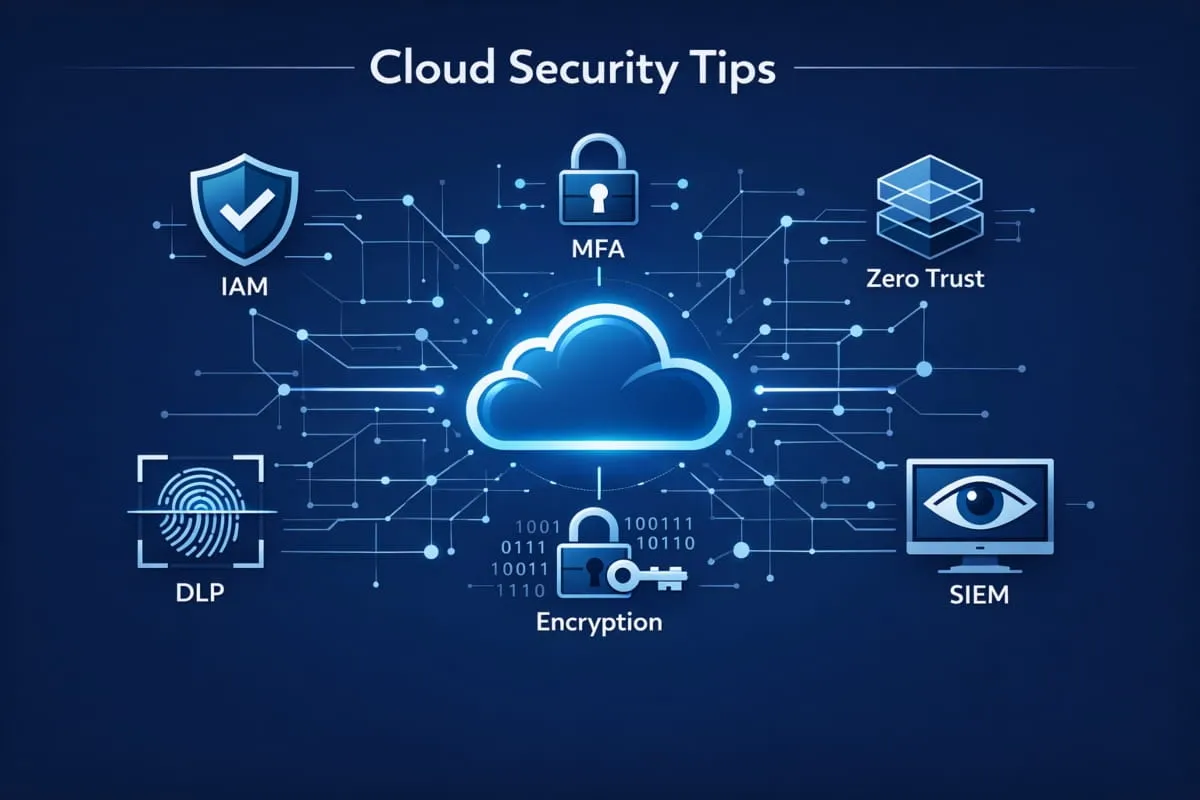
Cloud environments don’t fail because security teams stop caring. They fail because the cloud moves faster than most security programs do. Resources spin up in seconds, configurations drift quietly, and permissions accumulate without anyone noticing until something goes wrong.
The numbers reflect how serious the gap has become. Businesses are facing roughly 1,925 cyberattacks per week on average, and 80% of organizations reported at least one cloud breach in the last 12 months. The average cost of a single breach now sits at $4.35 million globally, and that figure climbs significantly higher in healthcare and finance. What makes this particularly frustrating is that the majority of these incidents trace back to predictable, preventable mistakes rather than sophisticated attacks.
These 25 cloud security tips are built around that reality. They cover the full spectrum from identity to infrastructure, from governance to incident response, everything needed to build and maintain a resilient cloud security posture.
1. Make IAM and MFA Your Starting Point
Identity and Access Management is the foundation on which everything else rests. Start by enforcing phishing-resistant multi-factor authentication for every user; hardware tokens that conform to FIDO/WebAuthn standards are significantly more reliable than SMS or app-based codes.
Layer on role-based access control, conditional access policies, and dedicated Privileged Access Workstations for administrative users. Use a secrets management tool so credentials are never stored in plain text. Conduct regular access reviews to ensure least privilege is genuinely in place, not just a policy on paper.
2. Understand Exactly What You’re Responsible For
The shared responsibility model defines who is responsible for what in a cloud environment. Your provider manages the underlying physical infrastructure. You manage your data, your configurations, your applications, and who has access to them.
Open storage buckets and poorly secured APIs are almost always the customer’s problem, not the provider’s. Making these boundaries explicit within your team eliminates the assumption gaps that lead to avoidable breaches.
3. Build Security Awareness Into the Culture
No technical control compensates for a team that doesn’t know how to recognize a phishing email or why password reuse matters. Security awareness must be ongoing, covering phishing detection, safe data-sharing practices, secure use of cloud applications, and MFA hygiene.
Training should also extend to vendor and third-party access governance. When people understand the reasoning behind security policies, they follow them more consistently.
4. Stay Current on Patches
Unpatched systems are among the most reliable entry points for attackers. Automate patch management wherever possible and prioritize remediation based on CVE severity and real-world exploitability, not just the schedule.
This applies equally to operating systems, third-party applications, and cloud-native services. A disciplined patching cadence is non-negotiable.
5. Deploy Data Loss Prevention Controls
Sensitive data, PII, intellectual property, and financial records move constantly across cloud storage, endpoints, and collaboration tools. Data Loss Prevention solutions let you enforce policy-based controls that monitor this movement and block or flag risky sharing behavior before it becomes a breach.
DLP integration with cloud collaboration platforms adds a critical layer of protection for organizations that rely on shared workspaces.
6. Test Your Incident Response Plan Before You Need It
Every cloud environment will eventually face a security incident. What separates a contained event from a crisis is whether the response is rehearsed or improvised.
A solid incident response plan defines roles, documents playbooks for common attack scenarios, and outlines communication procedures. Tabletop exercises and simulated breach drills turn the plan from a document into a practiced capability.
7. Apply Least Privilege Consistently
Users should have access to exactly what they need to do their jobs, nothing more. This sounds simple, but drift is common. Accounts accumulate permissions over time; machine identities and API access go unreviewed; inactive accounts stay open long after they should have been removed.
Audit existing permissions regularly, align access policies with a Zero Trust mindset, and treat dormant accounts as an active risk.
8. Protect Applications With CNAPP and WAF
For cloud-native workloads, a Cloud-Native Application Protection Platform (CNAPP) provides unified visibility across your environment, vulnerability scanning, runtime protection, compliance monitoring, and threat intelligence in a single view.
Pair it with a Web Application Firewall to protect HTTP/HTTPS traffic from XSS, SQL injection, and DDoS attacks at the application layer. Together, these tools represent one of the highest-impact combinations in cloud workload protection.
9. Use SIEM and Build Security Into Development
A Security Information and Event Management system aggregates logs from across your cloud environment and surfaces anomalies, unauthorized access attempts, unusual privilege changes, and lateral movement in real time.
On the development side, embed security into the Software Development Lifecycle through static and dynamic analysis (SAST/DAST), automated vulnerability scanning, and compliance checks at every stage. Catching issues in development is far less costly than catching them in production.
10. Manage Third-Party and Vendor Access Deliberately
Vendors and managed service providers often need access to your systems. Without proper oversight, that access becomes one of your most significant blind spots.
A vendor risk management program should include security certification requirements, least-privilege access for all third parties, separate vendor accounts, and full logging of vendor activity. Contracts should clearly specify breach notification timelines and responsibilities.
11. Encrypt Data and Manage Keys Properly
Encryption of data in transit and at rest is a baseline requirement, not an advanced measure. Use current standards, TLS 1.3, AES-256, IPSec, and take advantage of cloud-native key management services like AWS KMS, Azure Key Vault, or hardware security modules.
Automate key rotation and enforce separation of duties so that no single individual controls both the keys and the access they protect.
12. Bring Shadow IT Under Visibility
Employees regularly use unsanctioned cloud applications to get work done faster. Each one represents an unknown risk, data being stored somewhere outside your policies, accessed without proper controls.
Cloud Access Security Brokers (CASBs) detect these unsanctioned services, enforce policy controls, and monitor usage. Integrate CASB with your DLP and anomaly-detection stack to achieve real coverage across the tools your team actually uses.
13. Segment Your Network
Robust network segmentation limits how far an attacker can move once they’re inside. Virtual Private Clouds, Network Security Groups, and Access Control Lists all reduce the opportunity for lateral movement. Favor private connectivity over public Internet access for sensitive workloads.
Micro-segmentation takes this further by isolating individual applications or services at a granular level. Combined with flow logging and cloud-native traffic monitoring, segmentation provides both containment and visibility.
14. Run Vulnerability Scans and Penetration Tests
Automated scans are valuable but incomplete. Regular penetration testing, configuration reviews, and manual security assessments identify weaknesses that automation misses, particularly in application logic, software dependencies, and IaaS workload configuration.
Prioritize remediation using both CVSS scores and real-world exploitability. Pair this with a well-defined secure configuration baseline so deviations are immediately visible.
15. Establish a Governance Framework
Without a formal framework, cloud security becomes a collection of one-off decisions. Adopting recognized standards, such as NIST CSF, CIS Benchmarks, or ISO 27001, provides your program with a structure: defined roles, documented risk tolerance, compliance objectives, and oversight processes.
Use cloud-native monitoring and reporting tools to track adherence over time. Governance is the scaffolding that holds every other control in place.
16. Maintain a Real-Time Asset Inventory
You cannot protect what you cannot see. Maintain a current inventory of all cloud resources, workloads, and services across every environment, AWS, Azure, GCP, and beyond. Asset discovery tools surface orphaned resources, shadow services, and unsanctioned deployments before they become attack vectors.
Visibility is the prerequisite for almost every other cloud security control on this list.
17. Automate Your Incident Response
When a threat is detected, manual response is often too slow. Automated playbooks and orchestration tools can isolate compromised workloads, rotate credentials, revoke access, and notify stakeholders in minutes rather than hours.
This is where investment in detection and response pays off most clearly; the speed of containment directly determines the scale of damage.
18. Enforce Secure Configuration Baselines
Cloud environments change constantly. Storage buckets, virtual machines, containers, serverless functions, and APIs all need to be deployed against a defined, secure baseline and monitored for drift from it over time.
Automated tools that detect configuration deviations and trigger remediation workflows reduce the window between when a misconfiguration occurs and when it is corrected.
19. Monitor Behavior, Not Just Logs
Standard log collection is necessary but insufficient. Effective cloud security monitoring means actively tracking audit trails, configuration changes, access patterns, and workload behavior, and looking for what’s unusual within that data.
Unexpected login locations, abnormal data movement, and traffic spikes that don’t match known patterns are often early indicators of compromise. Behavioral analytics integrated with SIEM turns this monitoring into actionable detection.
20. Standardize Security Across Multi-Cloud Environments
Operating across multiple cloud providers or in hybrid environments increases flexibility but also expands the attack surface and creates inconsistency in how controls are applied.
Standardize security policies across all environments, enforce consistent compliance monitoring, and apply governance uniformly regardless of which platform a workload runs on. Fragmented visibility is one of the most exploited characteristics of multi-cloud deployments.
21. Adopt Zero Trust as a Design Principle
Zero Trust operates on a simple premise: never trust, always verify. In practice, this means continuously validating identities, enforcing least-privilege access, and applying context-aware authentication to every request, regardless of its origin.
Zero Trust also involves workload isolation through microsegmentation and real-time activity monitoring. Security experts increasingly treat it not as an add-on but as the foundational model for cloud security architecture.
22. Audit for Compliance Continuously
Depending on your industry, your cloud environment needs to meet specific regulatory standards, such as HIPAA, GDPR, SOC 2, and PCI DSS. Waiting for a formal audit to discover gaps is a costly approach.
Automated continuous compliance tools track adherence in real time and generate reporting for stakeholders. Compliance done properly isn’t a checkbox exercise; it reinforces every dimension of a strong cloud data security posture.
23. Secure Every Workload Type
Containers, serverless functions, ephemeral compute, and autoscaling environments each carry a different threat model than traditional on-premises servers. Runtime protection, image scanning, configuration control, and workload isolation all need to be applied specifically to the workload type in question.
A single unscanned container image or misconfigured serverless function can expose far more than it appears to.
24. Integrate Threat Intelligence Into Your Defenses
The threat landscape doesn’t hold still. AI-driven attacks, state-sponsored campaigns, and ransomware operations targeting cloud infrastructure are evolving continuously.
Real-time threat intelligence integrated into your detection and response stack lets you act on emerging indicators before they become incidents. This is what separates proactive organizations from those permanently in reactive mode.
25. Choose Tools That Reinforce Each Other, and Partner Wisely
Processes matter, but tools ensure consistent enforcement at scale. The right combination of CSPM, SIEM, CASB, CNAPP, and DLP creates overlapping layers of visibility and control.
Partnering with a specialist that offers cloud security posture management gives you full-environment visibility, automated misconfiguration detection, real-time remediation workflows, and compliance monitoring across AWS, Azure, and GCP from a single platform.
For dark web monitoring specifically, DeXpose tracks whether your credentials or cloud access tokens have surfaced in breach data, providing continuous visibility into exposure risks that internal tooling typically doesn’t cover.
Where to Focus First
No organization implements all 25 of these simultaneously. Start with identity, MFA, least privilege, and IAM governance, because compromised credentials are behind the majority of cloud breaches. Add visibility through asset inventory and configuration monitoring. Then layer in the detection, response, and governance controls that turn reactive security into a proactive discipline.
Cloud security isn’t a project with an end date. It’s an ongoing practice, and the organizations that treat it that way are the ones that stay ahead.
The organizations that handle it well aren’t necessarily the ones with the largest security budgets. They’re the ones who treat security as an ongoing discipline, consistently monitoring, regularly reviewing access, and fixing misconfigurations before attackers find them first.
If you want to know whether your credentials or organizational data have already surfaced somewhere they shouldn’t, DeXpose monitors the dark web continuously and alerts you before a breach becomes a crisis.
Conclusion
Cloud security isn’t something you configure once and walk away from. The environment changes, the threats evolve, and the gaps that didn’t exist last quarter can quietly open up today. That’s the nature of operating in the cloud, and it’s exactly why security has to be treated as a continuous discipline rather than a one-time project.
The 25 tips covered here aren’t a checklist to complete. They’re a framework to build on. Some organizations will start with identity and access management because that’s where most breaches begin. Others will prioritize visibility because they’re operating across multiple cloud environments with fragmented oversight. The right starting point depends on where your exposure is greatest, but the direction is always the same: close the gaps before someone else finds them.
What ties all of these practices together is a simple principle: that most cloud security failures aren’t inevitable. They’re the result of misconfigured systems that went undetected, permissions that weren’t reviewed, and incidents that weren’t responded to quickly enough. The organizations that stay ahead aren’t necessarily the ones with the largest security budgets. They’re the ones that stay consistent.
If part of that consistency means knowing whether your credentials or organizational data have already surfaced somewhere they shouldn’t, DeXpose monitors the dark web continuously, so you’re alerted before exposure becomes exploitation.