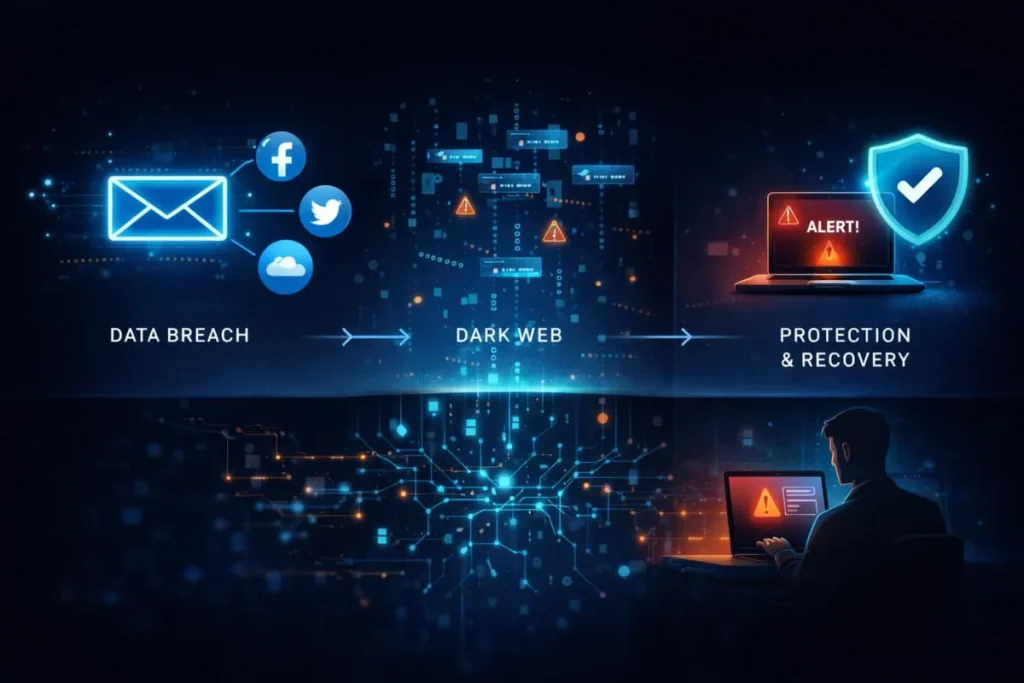
If you’ve ever worried about your email, passwords, or business data being sold online, you’ve probably wondered, what is dark web monitoring, and how can it help protect you? Dark web monitoring watches hidden corners of the internet where stolen credentials, personal records, and private documents are traded, then alerts you so you can act fast. In this post, we’ll explain how it works, what it can and can’t do, and how to use it as part of a practical security plan.
What is Dark Web Monitoring, and why does it matter to your security?
Most people picture the internet as one vast location, but it’s actually layers. The open web is what search engines index, the deep web contains private databases and gated pages, and the dark web is the hidden layer where anonymity tools are used to sell stolen data. Criminals use these spaces to exchange login details, payment records, passports, and more. If attackers find your data there, they can commit fraud, account takeover, or identity theft.
What is Dark Web Monitoring? It helps you find out early when your information shows up in hidden online markets, so you can respond before attackers take advantage.
How dark web monitoring works
Data collection and crawling
A dark web monitoring service uses a mix of automated crawlers, manual research, and human intelligence to discover data leaks. Crawlers access forums, marketplaces, private chat channels, and paste sites using the right tools and credentials. Analysts then verify the information to reduce false positives.
Matching and identity mapping
The service compares leaked material to the identifiers you register, like email addresses, domain names, brand names, and employee lists. Good services use identity mapping to link variations of a username or company name, so they catch related leaks.
Alerting and remediation guidance
When a match appears, the provider sends an alert with details: where the data was found, what was exposed, and recommended next steps. That might include changing passwords, revoking credentials, or contacting affected customers.
What dark web monitoring can detect (and what it can’t)
Typical discoveries
- Stolen credentials, like username and password pairs
- Compromised email lessons and associated metadata
- Financial data, such as card numbers that have leaked
- Company-confidential files and source code posted on file-sharing sites.
- Personal ID documents and scanned images
Limitations and false negatives
- Not all leaks are public. Private sales, invitation-only forums, and encrypted channels can hide exposures.
- Some services report only assured matches. That keeps false alarms low, but it can delay alerts.
- Monitoring won’t prevent theft. It tells you after data has been shared, so it needs to be paired with strong preventive controls.
Who should use dark web monitoring?
Individuals
Anyone with an online company should consider checks for exposed email addresses and credentials using a dark web monitoring solution. If you bank, shop, or work with acute services online, a regular check can flag problems before attackers use them.
Small businesses
SMBs often lack dedicated security teams. A monitoring service helps small businesses detect credential leaks that could let attackers into customer accounts, payment systems, or cloud services.
Enterprises and brands
For larger organisations, dark web monitoring sustains brand protection, leak detection, and regulatory needs. It helps detect stolen corporate credentials, IP exposure, and data that could harm customers or reputations.
Dark web monitoring and cyber threat management
Dark web monitoring is a key part of broader cyber threat management. It supplies early indicators about aggressor focus and tactics, letting security teams prioritise containment and patching. Integrating dark web findings into incident response playbooks shortens time to remediation and reduces impact.
Integrating with a Threat Intelligence Platform
A Threat Intelligence Platform (TIP) helps collect, formalise, and act on data from multiple sources. Feeding dark web alerts into a TIP lets teams correlate leaks with malware, phishing campaigns, and vulnerability data. That improves context, so you don’t treat every alert the same.
Digital risk protection and brand protection
Dark web monitoring is one component of digital risk protection. While monitoring finds exposed credentials and data, digital risk defence looks at impersonation, fraudulent ads, and social engineering campaigns that target your customers. Together, these services protect a brand’s reputation and reduce customer harm.
Practical steps after a dark web alert

- Verify the alert. Confirm whether the leaked item corresponds to a real account or system.
- Contain exposure. Reset affected passwords, revoke tokens, and force reauthentication where possible.
- Investigate scope. Check logs for suspicious access and see if the credentials were used.
- Notify affected parties. If customers or employees are involved, tell them what happened and what to do.
- Harden defenses. Add multi-factor authentication, improve password policies, and patch vulnerable systems.
Credentials Leak Detection and what to do about password reuse
One common discovery is credentials for reused passwords. Credentials Leak Detection helps you find when the same password appears across multiple accounts, which is risky. If you find reused passwords, change them, and use a password manager to make unique passwords for each site. Then enable multi-factor authentication everywhere you can.
Monitoring the dark web: full-service solutions vs DIY
Full-service platforms
Paid monitoring the dark web solutions offers comprehensive coverage, verified intelligence, and remediation help. They often include:
- 24/7 crawling of closed forums
- Analysts to verify and contextualise leaks
- Integration with SIEMs or Threat Intelligence Platforms
- Support for incident response
DIY checks and free tools
If the budget is tight, you can run basic checks using free dark web scan options. Some providers offer a free dark web scan where you enter an email and get a quick Free Dark Web Report. Those tools permit finding obvious exposures, but they don’t replace continuous monitoring or analyst validation.
How to choose a dark web monitoring solution
When evaluating a dark web monitoring solution, consider these points:
- Coverage: Does the provider search forums, marketplaces, paste sites, and private channels?
- Verification: Does the service validate conclusions, or will you get raw, unverified data?
- Integration: Can alerts feed into your Threat Intelligence Platform or security stack?
- Remediation support: Does the provider offer clear, actionable steps or help with takedowns?
- Privacy and compliance: How does the provider handle your data, and do they meet regulatory requirements?
- Cost and scalability: Can the service grow with your needs, from an individual to enterprise scale?
Free Dark Web Monitoring tools and when to use them
Free options are suitable for an initial check. Free Dark Web Monitoring tools, such as those that offer a free dark web scan or a Free Dark Web Report, can quickly show whether an email address or domain appears in known breaches. Use these tools to:
- Spot immediate credential leaks for personal emails
- Validate whether a suspected breach is fundamental.
- Decide if you need to upgrade to a paid service for ongoing coverage.
But remember, free tools often give a snapshot, not continuous protection.
Open Source Intelligence and dark web research
Open Source Intelligence, or OSINT, overlaps with dark web research. Analysts use publicly available information connected with dark web findings to piece together attacker methods and likely targets. OSINT can help you understand if leaked data is being used in wider campaigns, like coordinated phishing or fraud.
Legal and ethical considerations
Accessing the dark web involves risk. Legitimate monitoring providers operate within legal boundaries, using safe assembly methods and reporting findings responsibly. If you probe hidden marketplaces on your own, you could accidentally interact with criminal activity or violate terms of service. Rely on reputable providers or trained analysts when in doubt.
Privacy and data handling
When you sign up for monitoring, you transfer identifiers like emails, domain names, or employee lists. Make sure the provider keeps that data secure, limits access, and uses it only for monitoring. Ask about retention policies, encryption, and whether your data is shared for research.
Using dark web monitoring as part of cyber resilience
Monitoring is one piece of a resilience strategy. Integrate it with:
- Multi-factor authentication to reduce account takeover risk
- Strong password management across accounts
- Regular security training for staff to spot phishing
- Patch management to close exploitable vulnerabilities
- Cybersecurity partnership with a trusted vendor or MSSP for around-the-clock support
That mix reduces risk and speeds recovery when incidents happen.
Industry use cases and real-world examples
Recovering from a credential leak
A company notices a spike in fallen logins. Dark web monitoring finds a trove of employee credentials posted on a forum. After immediate password resets and forcing MFA, the IT team traced the leak to a vendor breach and isolated the issue before customer data was exposed.
Protecting a brand from impersonation
Monitoring turned up a fake support site using the trademark’s logo. The digital risk protection team took down the site and alerted customers through official channels, minimising fraud and reputational damage.
Detecting early phishing campaigns
Dark web postings hinted at a targeted phishing campaign, including stolen customer lists. Teams used that intel to warn clients, block malicious domains, and adjust email filters. This limited the campaign’s effectiveness.
Cost versus value: Is monitoring worth it?
The cost of monitoring varies by scope and depth. For individuals, free checks might be enough. For businesses, the cost of a leak loss of revenue, regulatory fines, and reputational harm—usually outweighs monitoring fees. Think of dark web monitoring as an early caution system that pays off by reducing incident response costs and customer harm.
Common mistakes to avoid
- Treating a single alert as proof of compromise without investigation. Verify details first.
- Relying solely on free one-time scans for ongoing protection.
- Neglecting to enforce multi-factor authentication behind a leak.
- Choosing a provider based only on price, not coverage or response support.
Implementing an internal playbook for dark web alerts
Create a simple, repeatable process:
- Triage: Validate the alert and assign severity.
- Contain: Block or reset affected accounts.
- Investigate: Search logs and confirm unauthorised access.
- Notify: Inform stakeholders and concerned users.
- Remediate: Patch root causes and document lessons learned.
- Review: Update policies to prevent repeat incidents.
This playbook makes your response fast and consistent.
How monitoring helps compliance and customer trust
Regulatory frameworks often require breach detection and timely notification. Dark web monitoring helps fulfil those obligations by showing evidence of exposure and the actions you took. For customers, proactive monitoring and transparent communication build trust and reduce churn after incidents.
Tips for getting the most from your monitoring service
- Register all important domains and worker email addresses.
- Integrate alerts into your SIEM or TIP for context and automation.
- Use analyst-verified alerts to reduce noise.
- Combine monitoring with penetration testing and vulnerability scanning.
- Treat monitoring as part of ongoing risk management, not a one-off fix.
Free dark web and paid monitoring: a balanced approach
Start with a free dark web scan to understand primary exposures. If you find issues, step up to a paid solution for continuous coverage. Many organisations use a layered approach: free checks for individual users, paid monitoring for critical assets, and advanced threat intelligence for high-risk systems.
Choosing vendors: questions to ask
- What sources do you crawl (forums, marketplaces, paste sites)?
- How do you verify findings and reduce false positives?
- Can you integrate with our Threat Intelligence Platform or SIEM?
- What remediation guidance do you provide?
- How do you protect the data we give you, like employee lists?
- Can you support takedowns or legal follow-up when necessary?
A quick guide to a free dark web scan
If you want to check an email right now, many providers offer a free dark web scan. Enter the email, and you’ll get a Free Dark Web Report showing known breaches that include that address. Use that as a starting point, then plan follow-up steps like changing passwords and enabling multi-factor authentication.
The role of human analysts versus automated tools
Automation scales, but human reviewers add context. Robots find matches, but analysts sort valid leaks from scams, translate foreign posts, and confirm whether data is live or stale. The best solutions combine both accuracy and speed.
Monitoring beyond credentials: protecting intellectual property
Dark web monitoring can spot leaked records, source code, or trade secrets. For companies that rely on IP, this capability is crucial for brand protection and limiting competitive damage.
Preventive controls that reduce dark web exposure
- Use unique, complex passwords and a password director.
- Require multi-factor authentication for all critical accounts.
- Limit access rights on a least-privilege basis.
- Vet third-party merchandisers and include security clauses in contracts.
- Monitor logs for unusual access patterns and threat indicators.
How to respond if your email shows up in a breach
If you check email data breach status and find your address listed, assume the password is compromised. Reset passwords on that account and anywhere the same password was used. Turn on multi-factor authentication, and monitor for suspicious activity.
Credentials Leak Detection and Identity Theft Prevention
A prompt response to credentials leaks prevents account takeover and identity theft. If sensitive identity documents are exposed, consider credit monitoring or a fraud alert with credit bureaus. Quick action limits the attacker’s window.
Working with a cybersecurity partner
If your organisation lacks staff or experience, consider a cybersecurity partnership with a managed service provider. Partners bring expertise, run continuous monitoring, and coordinate incident response. They can also help integrate dark web alerts into your security operations.
What to expect from a quality dark web monitoring report
A helpful report includes:
- Clear description of what was uncovered and where
- The exact identifiers involved (emails, domains, file hashes)
- Risk level and suggested remediation steps
- Evidence or screenshots to prove context
- Contact details for follow-up help
Red flags for low-quality services
- Overly general alerts without proof
- No analyst verification or follow-up support
- Lack of integrations with security tools
- No clear privacy or data handling policy
Future trends: how monitoring is evolving
Dark web monitoring is getting smarter. Providers are using better identity resolution, richer context from Open Source Intelligence, and automated integrations with security stacks. As attackers move to more private channels, monitoring will need stronger analyst webs and partnerships.

Final thoughts
Knowing what dark web monitoring is gives you a practical tool to reduce risk. It doesn’t stop breaches, but it gives you time to act. When combined with preventive controls like multi-factor authentication, password managers, and a strong incident response plan, monitoring is a high-value part of modern cybersecurity.
FAQs
How fast will I be notified after a leak is found?
Notification speed varies by provider, but many assistance providers send alerts within hours of discovery. Faster alerts mean quicker containment, so look for near-real-time monitoring.
Can dark web monitoring find everything about me online?
No. It finds data traded or posted in observed areas, but private sales and encrypted channels can hide some leaks. Use it alongside other security measures.
Are free dark web scans functional?
Yes, they’re a good starting point to check an email or domain. Free scans are not continuous, so upgrade to paid monitoring for ongoing protection.
Will monitoring stop fraud or identity theft?
Monitoring alerts you to exposure, but it doesn’t block misuse. Immediate action, like password resets and MFA, helps prevent fraud after alerts.
Is it safe to give my employee list to a monitoring provider?
Reputable vendors protect submitted data with encryption and limited access. Ask about retention, encryption, and compliance before sharing sensitive lists.