If your company handles customer data, employee records, or any valuable business information, you need Dark Web Monitoring for Business to spot leaks before they become crises. Early detection matters more than ever. A quick alert about exposed credentials, stolen consumer lists, or leaked intellectual property can save weeks of damage control, lost revenue, and reputation harm. This post explains why monitoring matters, how it works, what to look for in a solution, and how to build a practical program that reduces risk and provides decision-makers with clear, timely intelligence.
What is the dark web, and why does it matter?
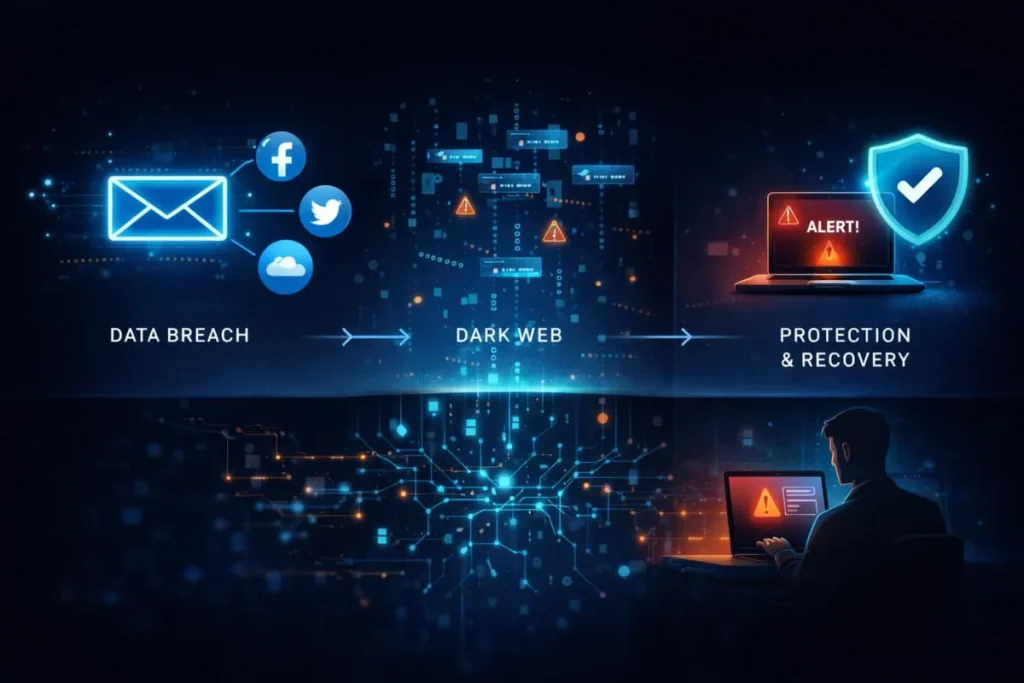
Most people think the dark web is just a place for criminals, but the truth is more practical. The dark web is a collection of secret sites and private channels where stolen data, credentials, and hacked files are bought, sold, or shared. Threat actors often post or trade data there long before a public disclosure or news story appears. For businesses, that means that by the time a breach occurs in mainstream sources, the data has already been used by others.
How leaks show up on hidden channels
- Stolen email and password pairs, often from credential stuffing or phishing.
- Corporate documents, scanned contracts, and proprietary code.
- Customer databases or payment records that are packaged for resale.
- Internal chat logs, screenshots, or administrative keys.
Because these items appear in many formats and places, a human-led search can’t keep up. That’s where automated monitoring comes in.
How dark web monitoring works, in simple terms
Dark web monitoring combines automated crawling, data matching, and human validation to find mentions of your assets across hidden networks. Tools collect data from multiple sources, including confidential forums, paste sites, and peer-to-peer sharing channels. They then run pattern matching and identity correlation to determine whether the exposed item belongs to your organisation.
Key steps in the process:
- Discovery: Crawlers and feeds reach hidden sources and archives.
- Matching: Algorithms compare scope against company indicators such as domains, employee email addresses, and product names.
- Validation: Analysts confirm findings to reduce false positives.
- Alerting: Teams get prioritised notifications with context and remediation steps.
This mix of automation and analyst review is what separates casual scans from a complete dark web monitoring solution.
The real risks to your business
Many leaders misjudge how disclosure on the dark web translates to real harm. Here’s what can happen when data surfaces there.
Fast paths from leak to loss
- Credential reuse leads to account takeover for corporate email, cloud services, or payment systems.
- Stolen customer records fuel fraud and account takeover outside your systems.
- Leaked intellectual property undermines competitive advantage and patent value.
- Public reputation damage and regulatory penalties if personal data is exposed.
These outcomes are costly. A prompt alert and a clear response plan often stop damage early. That’s why digital risk protection must include proactive monitoring.
Benefits of proactive monitoring
Adopting a disciplined monitoring schedule gives measurable benefits.
Faster detection, lower impact
Finding an exposed database the day it appears reduces the window for attackers, limiting fraud and preventing further leakage.
Actionable context
Modern systems enrich alerts with where the data was posted, likely actor behaviour, and suggested next steps. That saves time for security teams.
Stronger incident response
When monitoring feeds into your retort playbooks, you can isolate accounts, reset passwords, and notify affected customers more quickly and accurately.
Regulatory and legal readiness
Monitoring supports compliance efforts by documenting discovery and reaction timelines through Dark Web Surveillance. This is important if regulators or auditors ask about your breach-handling process.
What to monitor: practical indicators
Not all indicators are equal. Focus your monitoring on things that give you early, actionable warnings.
- Employee and admin emails, especially generic addresses and domain names.
- Internal service keys, API tokens, and SSH credentials.
- Customer PII and payment records.
- Proprietary code, design files, and contractual documents.
- Brand mentions and executive names on forums and social channels.
You can also supplement Dark Web Monitoring for Business with Open Source Intelligence to gain broader context, including public leaks and related infrastructure.
Choosing a solution: what to look for
“Picking the right platform matters. Here are the capabilities to prioritise when evaluating a dark web monitoring solution to check email data breach risks.

Breadth of coverage
Make sure the vendor indexes private forums, paste sites, peer-to-peer channels, and archived dumps. Good coverage reduces blind spots.
Threat intelligence and enrichment
A strong Threat Intelligence Platform will enrich raw conclusions with actor profiles, similar incidents, and potential impact. That context cuts investigation time.
Actionable alerts and prioritisation
You don’t need every mention; you need high-confidence alerts with suggested next steps and risk scoring.
Integration with existing tools
Look for out-of-the-box connectors to SIEMs, ticketing procedures, and your incident response workflow. Integration turns alerts into action quickly.
Legal and ethical sourcing
Confirm the provider uses lawful collection methods and protects privacy, especially when scanning sensitive channels.
While corresponding vendors test the best Dark Web Monitoring tools with a realistic data set and measure detection speed, false positives, and analyst support.
Building a practical monitoring program
A tool alone won’t fix risk. You need a process that turns detection into remediation.
Step 1: Inventory and signal selection
List critical assets to monitor: corporate domains, admin emails, outgrowth names, and cloud accounts.
Step 2: Baseline and tuning
Run initial scans to establish a baseline and tune watchlists to reduce noise.
Step 3: Alert handling playbook
Define who receives alerts, what levels trigger password resets, and when to escalate to legal or PR.
Step 4: Remediation templates
Prepare email templates, incident steps, and containment inventories so your team can act quickly.
Step 5: Continuous improvement
Review incidents monthly, update watchlists, and add new signals as your business evolves.
This structured approach keeps alerts meaningful and keeps security teams focused on the right work.
How monitoring ties into broader defences
Dark web intelligence is one part of a defensive stack. When blended with other controls, it improves resilience.
Identity and access management
When a credential appears in an Email breach checker scan, integrate with identity systems to force resets and enable multifactor authentication on affected accounts.
Endpoint protection and network controls
Use indicators from surveillance to hunt for the centre across endpoints and block suspicious infrastructure at the firewall level.
Data loss prevention and secure development
Data findings often reveal weak points in how sensitive data is stored or moved. Use those signals to tighten DLP rules and code reviews.
This layered approach turns external intelligence into internal hardening.
Common false assumptions and myths
Let’s clear up a few often-repeated misinterpretations.
Myth: “If we haven’t been publicly breached, we’re fine”
No. Many breaches first appear on hidden channels or in private dumps. A public notice is usually the last step in a long chain.
Myth: “Free scans are enough”
A free dark web scan or a public email breach checker can give a temporary check, but they often miss private forums and offer minimal context. They’re helpful for swift, limited checks; they do not replace ongoing monitoring.
Myth: “We can do it all manually”
Manual checks miss scale and speed. Automation plus analyst review is the practical path.
How to evaluate alerts and reduce false positives
A common complaint is noisy alerts. Dwindle false positives by:
- Validating ownership before escalating. Cross-check domain registration and internal logs.
- Correlating with internal telemetry, like failed logins or unusual access patterns.
- Prioritising exposures that include credentials, financial data, or admin keys.
Pairing data breach monitoring with internal logs provides explicit confirmation and prevents wasted effort.
Integrating social and open sources for a richer context
Dark Web Monitoring for Business is strongest when combined with Social Media Intelligence and Open Source Intelligence. Shared chatter on social channels can signal that a campaign is starting, while open sources often reveal the same actor using multiple handles. Together, these insights provide a broader view of intent and reach.
Legal, privacy, and ethical concerns
Monitoring must respect laws and privacy. Keep these points in mind:
- Limit searches to company-owned or authorised assets.
- Avoid collecting personal data beyond what you need for handling.
- Work with legal teams to ensure evidence handling meets regulatory standards.
A compliant program protects victims and keeps your organisation defensible.
Real-world example: learning from significant incidents
High-profile breaches show standard patterns. For example, large corporate leaks sometimes include certifications that are later used in targeted campaigns. Public reporting after incidents like the Oracle data breach demonstrates how exposed data can cascade across suppliers and partners. Monitoring helps identify these chains early, allowing you to warn suppliers and prevent downstream impact.
Measuring value and ROI
How do you justify investment? Contemplate these metrics:
- The mean time to detection is reduced by proactive monitoring.
- Number of incidents contained before public disclosure.
- Reduction in account takeover and fraud losses.
- Time saved per alert due to enriched intelligence.
When Dark Web Monitoring for Business invariably shortens your response window and reduces remediation costs, it pays for itself.
Implementation checklist: from pilot to production
Use this checklist to get started quickly.
- Define critical assets and watchlist items.
- Run a pilot with real test data and measure detection time.
- Map alerts to answer owners and set SLAs.
- Integrate alerts into your existing ticketing or SIEM.
- Train response teams and run tabletop exercises.
- Scale to full coverage and automate routine containment steps.
A phased rollout reduces operational friction and proves value early.
Selecting the correct vendor: questions to ask
When speaking with providers, ask these direct questions:
- What sources do you index, and how are they usually updated?
- How do you enrich alerts, and who validates results?
- Can you integrate with our SIEM, ticketing, and identity systems?
- What legal and ethical measures govern your collection?
- Can you show a sample alert for our domain and explain the evidence?
Their answers will reveal coverage, maturity, and fit for your program.
Beyond detection: proactive steps for prevention
Monitoring is reactive by design, but you can use its signs to act proactively.
- Enforce unique passwords and use a password manager to prevent reuse.
- Require multifactor authentication for high-privilege accounts.
- Harden third-party vendor contracts and include security clauses.
- Adopt secure coding and secrets management to prevent leaks at source.
Preventing leaks reduces the amount of downstream detection work needed.
When Businesses Should Use Outside Experts for Dark Web Monitoring
If your team lacks experience with threat actor behaviour or legal disclosure requirements, bringing in specialists can help. Dark Web Monitoring for Business, offered via managed data breach monitoring services, provides analyst validation, 24/7 coverage, and playbook-driven remediation support. This approach is beneficial for smaller security teams or highly targeted industries.

Costs and pricing models
Expect vendors to charge based on coverage, number of observed assets, and analyst support. Some offer tiered plans that vary by coverage depth and the level of response assistance. Weigh cost against the potential financial and reputational impact of a missed exposure.
Avoiding common procurement mistakes
Don’t buy solely on price or shiny dashboards. Focus on:
- Detection speed and coverage homogeneity.
- Quality of enrichment and analyst support.
- Integration with your workflows.
- Clear SLAs for response and false positive handling.
These factors determine whether the tool will be used in practice.
Future trends to watch
Threat actors are continually shifting their behaviour. Look for these trends:
- Increased use of private chat platforms for data swaps.
- Greater automation by actors to test stolen credentials across services.
- More data is sold in targeted packages, increasing the need for precise correlation.
Keeping your monitoring approach adaptive is crucial.
Action plan summary: what to do this month
- Add critical emails and domains to a watchlist.
- Run a free dark web scan and an Email Dark Web Scan to see baseline results.
- Trial a reputable dark web monitoring service for 30 days.
- Update your incident response playbook to include steps for handling exposed credentials.
- Train your SOC on handling validated dark web alerts.
These steps give a quick lift while building toward a complete program.
Conclusion
Dark web monitoring for business is no longer optional. A dark web vulnerability scan delivers early warning, context, and a bridge to fast remediation. When you combine a strong monitoring forum, transparent processes, and targeted prevention, you reduce the chance that a small leak becomes a significant incident. Start with an honest inventory, choose a solution that offers broad coverage and analyst validation, and make sure alerts feed cleanly into your reply playbook. Doing that protects customers, reduces cost, and preserves trust.
FAQs
What is the simplest way to check if an email was exposed?
Use an Email breach checker or an Email Dark Web Scan to see if an address appears in known leaks quickly. Follow up with internal log checks for suspicious logins.
Can free dark web scan tools protect my company?
They can give a quick baseline, but free tools are limited. For unremitting protection, rely on a complete monitoring program with enrichment and analyst validation.
How fast will a monitoring service find exposed data?
Detection time varies by source coverage, but good services catch many exposures within hours to days and provide context for prioritisation.
Is monitoring legal and safe to use?
Yes, when providers use lawful assembly methods and follow privacy rules. Confirm their legal practices and data handling before purchase.
Should monitoring be part of compliance work?
Yes. Monitoring helps document discovery and response steps, supports regulatory reporting, and demonstrates due diligence.