Dark web sites are websites hosted on encrypted networks, primarily the Tor network, that are invisible to standard browsers and unindexed by conventional search engines. Accessing any dark website requires specialized software such as the Tor Browser, which anonymizes traffic by routing it through multiple layers of encryption before reaching its destination.
Not all dark web websites are created equal. A significant portion serves legitimate purposes: encrypted communication platforms, whistleblower submission systems, independent journalism outlets, and privacy tools used by activists operating under authoritarian regimes. But running parallel to these legitimate services is a sprawling ecosystem of cyber threats, from ransomware-as-a-service operations and credential marketplaces to illegal websites trading in stolen data, forged documents, and compromised corporate access.
This duality is precisely why cybersecurity teams, threat intelligence analysts, and law enforcement agencies actively monitor the dark web. The sites that appear harmless on the surface often link to networks that distribute malware, leak enterprise data, or coordinate attacks against critical infrastructure. For security professionals, understanding which dark web sites are active, what they traffic in, and how they’re structured is not optional; it’s foundational to early threat detection.
This guide explains how dark web websites work, which categories pose the highest risk, and what organizations can do to monitor their exposure before threat actors act.
What Are Dark Web Sites?
Dark web sites are websites hosted on encrypted, anonymized networks, most commonly the Tor network, and identified by .onion addresses that standard search engines cannot index or crawl. Reaching them requires specialized software such as the Tor Browser, which masks user identity by routing traffic through a layered chain of encrypted relays.
These sites serve a wide range of purposes. Some host encrypted communication tools, independent journalism platforms, and secure whistleblower systems. Others operate illegal marketplaces, credential-trading forums, and ransomware infrastructure. What unites them is inaccessibility through conventional browsers and deliberate anonymity by design.
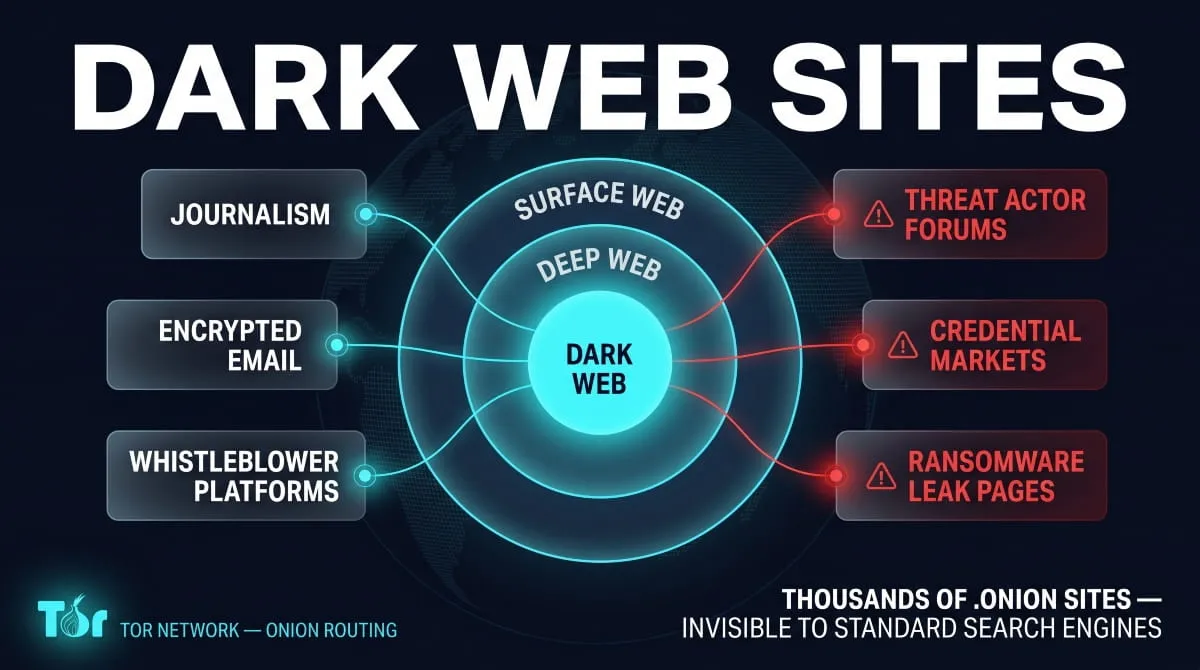
Dark web sites are not the same as the deep web. The distinction matters:
- Surface web, publicly indexed pages that Google, Bing, and other search engines can crawl and return in results.
- Deep web, private but non-malicious content: email inboxes, banking portals, healthcare records, subscription platforms. Enormous in scale, invisible to search engines, but accessible through normal browsers with valid credentials.
- Dark web, a smaller, intentionally hidden layer within the deep web, accessible only through tools like Tor. Sites here use .onion domains that exist entirely outside the standard DNS system.
Ordinary users never encounter most dark web websites. But for threat actors, they represent operational infrastructure, and for cybersecurity teams, they’re an early warning system for emerging attacks, leaked credentials, and stolen enterprise data.
How Dark Web Sites Work
The majority of dark web sites operate on the Tor network, a decentralized system of volunteer-run servers, called nodes or relays, that anonymizes internet traffic by routing it through multiple encrypted hops before it reaches its destination. Each relay in the chain decrypts only one layer of encryption to learn the next stop, and nothing more. No single node knows both who is sending the data and where it’s ultimately going. This architecture is called onion routing, named for the layered encryption that wraps every connection.

When you access a dark web site, the sequence works like this:
- The Tor Browser connects your device to the Tor network through an entry node, concealing your real IP address from the outset.
- Your traffic is encrypted in layers and passed through a chain of intermediate relays, each stripping one layer before forwarding it.
- The final exit node, or, for .onion sites, the hidden service itself, receives the request with no traceable path back to the originating user.
- Dark websites using .onion addresses never even touch the public internet. They exist entirely within the Tor network, making them invisible to standard DNS lookups and conventional search engines.
What this means in practice: Tor reduces traceability, but it does not guarantee invisibility. Dark web sites can still be compromised through operational security failures, malicious exit nodes, browser exploits, or law enforcement infiltration. Anonymity is a property of the network architecture, not a guarantee of safety for either operator or visitor.
For cybersecurity professionals, this infrastructure is precisely what makes dark web monitoring technically demanding. Threat actors exploit the same onion routing system that protects journalists and activists, which means detecting leaked credentials, stolen data, and attack planning requires purpose-built intelligence tools that can operate within the network itself.
Are Dark Web Sites Illegal?
Visiting dark web sites is not automatically illegal in most countries. The Tor Browser is legal software. Accessing .onion addresses is legal. Simply being on the dark web carries no criminal liability in the United States, the UK, the EU, or most other jurisdictions.
What determines legality is not where you go; it’s what you do when you get there.
The distinction is straightforward:
- Accessing dark web websites for privacy, research, journalism, or secure communication is legal in most parts of the world.
- Engaging with illegal dark web sites, purchasing stolen credentials, ordering contraband, downloading CSAM, or procuring ransomware tools is a criminal offense regardless of the network used to reach them.
The dark web does not create a legal exception. Illegal activity conducted through Tor is still illegal. Law enforcement agencies, including the FBI, Europol, and Interpol, have successfully prosecuted dark web operators and users by exploiting operational security failures, infiltrating marketplaces, and working with hosting providers, despite the anonymity protections Tor provides.
The practical risks for organizations differ. Whether or not visiting dark web sites is legal for your security team, the data being traded there- employee credentials, customer records, proprietary source code, internal documents- may already be circulating on dark web forums and marketplaces without your knowledge. The legal question and the exposure question are separate problems. Both need an answer.
Best Dark Web Sites List | Legitimate Onion Services Worth Knowing
Not every dark web site is a marketplace for stolen data or a hub for cybercrime. A meaningful portion of the dark web hosts verified, legitimate onion services built for privacy, censorship resistance, secure journalism, and encrypted communication, tools used daily by activists, researchers, journalists, and security professionals operating in high-risk environments.

The dark web sites listed below are among the most widely referenced legitimate onion services active today. Each has a verified .onion address published by the organization itself. They are included here not as browsing recommendations, but as documented examples of how onion services can serve genuine public-interest functions, and to help security teams distinguish legitimate infrastructure from suspicious or malicious dark web websites during threat research.
Treat every onion site as untrusted until verified. Always confirm .onion addresses against official sources before connecting.
DuckDuckGo, Privacy-Focused Dark Web Search Engine
DuckDuckGo operates one of the most widely used legitimate dark web sites: an official onion version of its privacy-first search engine. It does not track queries, store user data, or build behavioral profiles, making it one of the few dark web search engines that mirrors the privacy guarantees of its surface web counterpart.
For users and researchers entering the Tor network, DuckDuckGo’s onion service functions as a trusted navigation starting point, surfacing open web results without exposing search behavior to surveillance or profiling.
Best for: Searching the open web anonymously from within the Tor network. Verified .onion address: duckduckgogg42xjoc72x3sjasowoarfbgcmvfimaftt6twagswzczad.onion (published on DuckDuckGo’s official help pages)
The Hidden Wiki, Dark Web Directory Hub
The Hidden Wiki is one of the most frequently cited names on any dark web sites list, a community-maintained directory that organizes links to onion services by category. It functions as a catalog, not a recommendation engine, and has historically been used as an entry point for navigating the dark web’s fragmented landscape.
Approach it with significant caution. “The Hidden Wiki” is not a single authoritative site; it is a label applied to dozens of mirrors, forks, and impersonations, many of which have linked to harmful or illegal dark web websites. No verified primary .onion address can be confirmed from an official source, which itself reflects the trust problem inherent in unverified dark web directories.
Best for: Understanding how onion site directories are structured, not as a trusted source of dark web links. Verified .onion address: Not available; no single authoritative source exists.
Proton Mail, Encrypted Email on the Dark Web
Proton Mail is one of the clearest examples of a legitimate dark web site operated by a mainstream privacy company. Its official onion service provides an additional layer of network-level anonymity for users who require confidential communication in high-risk environments, journalists communicating with sources, activists operating under surveillance, or security researchers handling sensitive disclosures.
Unlike most dark web websites, Proton Mail’s onion presence mirrors a fully functional consumer product with end-to-end encryption, minimal data collection, and a public transparency record.
Best for: Encrypted email access with network-level anonymity via Tor. Verified .onion address: protonmailrmez3lotccipshtkleegetolb73fuirgj7r4o4vfu7ozyd.onion (published on Proton’s official Tor access page)
ProPublica, Investigative Journalism on the Dark Web
ProPublica was among the first major news organizations to launch a verified dark web site, establishing a precedent for mainstream media to operate there. Its .onion mirror exists for two reasons: to allow readers in censored or surveilled regions to access independent journalism freely, and to provide a more secure channel for sources to reach reporters without exposing their identities or locations.
ProPublica’s dark web presence is widely cited in threat intelligence and cybersecurity research as a benchmark example of how dark web websites can serve public-interest functions entirely distinct from criminal activity.
Best for: Accessing independent investigative reporting in censored or high-surveillance environments. Verified .onion address: p53lf57qovyuvwsc6xnrppyply3vtqm7l6pcobkmyqsiofyeznfu5uqd.onion (published by ProPublica’s newsroom)
SecureDrop, Whistleblower Submission Platform
SecureDrop is one of the most operationally significant legitimate dark web sites. Developed by the Freedom of the Press Foundation, it provides an open-source whistleblower submission system used by major news organizations, including The New York Times, The Washington Post, and The Guardian, to receive sensitive documents from sources anonymously.
Every SecureDrop instance operates as its own .onion site, accessible only through Tor. The architecture is specifically designed to prevent any metadata from linking a document submission back to its source, making it the standard infrastructure for high-stakes secure disclosure worldwide.
Best for: Anonymous document and file submission to verified newsrooms and NGOs. Verified .onion address: sdolvtfhatvsysc6l34d65ymdwxcujausv7k5jk4cy5ttzhjoi6fzvyd.onion (published in the SecureDrop directory footer)
Facebook, Tor Mirror for Restricted Regions
Facebook operates one of the most prominent institutional dark web sites, a Tor mirror maintained specifically to allow users in regions where the platform is blocked or surveilled to access it securely. It is notable less for its content than for what its existence signals: that large-scale commercial platforms recognize the Tor network as a legitimate channel for accessibility and censorship circumvention.
For security researchers, Facebook’s presence on the dark web is a useful reference point for distinguishing verified institutional dark web websites from impersonation sites and phishing onion domains. This distinction matters significantly in dark web threat monitoring.
Best for: Accessing Facebook in restricted or surveilled regions via Tor. Verified .onion address: The historic address facebookcorewwwi. The Tor Project publicly references onion. The current v3 address should be confirmed directly from Meta’s official channels before use, as it cannot be independently verified at the time of publication.
Dark Web Sites to Visit in 2026: Categorized by Purpose
Not every dark web site worth knowing is a privacy tool or whistleblower platform. The legitimate onion ecosystem spans search, journalism, encrypted communication, academic research, and censorship circumvention, each category serving a distinct user need. Below is a categorized reference of the best dark web sites active in 2026, organized by function rather than reputation alone.

All .onion addresses listed here are sourced from official organizational pages or verified third-party security publications. Verify every address independently before connecting. Never use links sourced from forums, Reddit threads, or unverified directories.
Dark Web Search Engines
Most users’ first question when entering the Tor network is the same: how do you find anything? Standard search engines don’t index dark web websites, so purpose-built onion search engines are the primary navigation tool.
Ahmia, one of the most trusted dark web search engines in active use, was built by security researcher Juha Nurmi and indexes only .onion sites that explicitly allow crawling and pass a content screening filter. It actively blocks illegal and abusive material, making it one of the safer entry points for security researchers and privacy-focused users exploring the network. juhanurmihxlp77nkq76byazcldy2hlmovfu2epvl5ankdibsot4csyd.onion
Torch, one of the oldest continuously operating dark web search engines, indexes millions of onion pages and returns broad, unfiltered results. Useful for researchers who need comprehensive discovery rather than curated results. Approach with the same skepticism you’d apply to any unfiltered index; not every result is legitimate or safe. xmh57jrknzkhv6y3ls3ubitzfqnkrwxhopf5aygthi7d6rplyvk3noyd.onion
Haystak, a crawler-based dark web search engine that filters dangerous content and offers a premium tier with advanced search, historical archives, and alert functionality. Particularly well-suited for journalists and threat analysts who need research-grade access rather than casual browsing. haystak5njsmn2hqkewecpaxetahtwhsbsa64jom2k22z5afxhnpxfid.onion
Dark Web News & Journalism Sites
Some of the most credible institutions on the surface web maintain verified dark web mirrors, specifically to reach readers in censored regions and provide a safer channel for sensitive disclosures.
ProPublica, the first major news organization to launch a verified .onion site, maintains a dark web presence that allows readers in restricted regions to access independent investigative journalism without the risk of surveillance or censorship. A benchmark example of legitimate dark web websites serving public-interest functions. p53lf57qovyuvwsc6xnrppyply3vtqm7l6pcobkmyqsiofyeznfu5uqd.onion
The New York Times launched its Tor mirror in 2017 to extend access to readers in countries where its journalism is blocked. The onion version mirrors the full site, excluding paywalled content specific to the dark web, delivering the same content with censorship-resistant delivery. nytimesn7cgmftshazwhfgzm37qxb44r64ytbb2dj3x62d2lljsciiyd.onion
BBC, the BBC’s international edition Tor mirror, launched in 2019, gives users in restricted regions access to its global reporting. Note that BBC iPlayer and certain regional features are unavailable through the onion version. The primary purpose is information access, not media streaming. bbcnewsd73hkzno2ini43t4gblxvycyac5aw4gnv7t2rccijh7745uqd.onion
Encrypted Communication & Privacy Tools
Privacy-first communication is one of the most well-established legitimate use cases for dark web sites, particularly for users operating in high-surveillance environments where standard email and messaging are at risk of interception.
Proton Mail is the most widely referenced encrypted email service with a verified onion presence. End-to-end encrypted, operated under Swiss privacy law, with minimal data collection. Its dark web access layer adds network-level anonymity on top of the encryption, particularly valuable for journalists, lawyers, and activists handling sensitive communications. protonmailrmez3lotccipshtkleegetolb73fuirgj7r4o4vfu7ozyd.onion
Riseup, a volunteer-operated email and communications platform originally built for activists, now serves over six million users worldwide. Riseup runs its entire infrastructure, email, mailing lists, and chat, as onion services, making it one of the few providers where the anonymity layer extends across every communication channel, not just the web interface. vww6ybal4bd7szmgncyruucpgfkqahzddi37ktceo3ah7ngmcopnpyyd.onion
Keybase, an identity verification and encrypted file-sharing service that allows users to cryptographically link their online identities, PGP keys, social profiles, and cryptocurrency addresses into a single verifiable record. Useful for security researchers and journalists who need to establish authenticated contact with sources or collaborators without exposing personally identifying infrastructure. keybase5wmilwokqirssclfnsqrjdsi7jdir5wy7y7iu3tanwmtp6oid.onion
Institutional & Government Onion Presence
Several major institutions operate verified dark web sites not for anonymity, but for accessibility, to extend their reach into censored regions and provide secure inbound channels for sensitive information.
SecureDrop, the Freedom of the Press Foundation’s open-source whistleblower submission infrastructure, is deployed by major newsrooms including The Guardian, The Washington Post, and The New York Times. Every SecureDrop instance runs as its own .onion address, specifically designed so that no submission metadata can be traced back to its source—the gold standard for secure document disclosure. sdolvtfhatvsysc6l34d65ymdwxcujausv7k5jk4cy5ttzhjoi6fzvyd.onion
CIA, the Central Intelligence Agency operates an official Tor site as an inbound channel for anonymous tip submissions and intelligence from sources who cannot safely contact the agency through conventional means. Its existence reflects the U.S. intelligence community’s recognition of Tor as a legitimate operational security tool. ciadotgov4sjwlzihbbgxnqg3xiyrg7so2r2o3lt5wz5ypk4sxyjstad.onion
Facebook’s Tor mirror exists primarily for censorship circumvention, allowing users in countries that block the platform to access it without VPN dependency. Its scale makes it one of the most visited dark web websites globally. For cybersecurity teams, it’s also a useful reference point when distinguishing verified institutional onion infrastructure from impersonation and phishing dark web sites, which frequently clone the Facebook login interface. facebookwkhpilnemxj7asaniu7vnjjbiltxjqhye3mhbshg7kx5tfyd.onion
Research & Archive Dark Web Sites
Archive. Today, a web preservation service that stores snapshots of surface web pages, making it possible to retrieve content that has since been removed, altered, or censored. Widely used by journalists, researchers, and investigators tracking changes to government and corporate websites over time. Accessible via Tor for users in regions where the main domain is blocked. archiveiya74codqgiixo33q62qlrqtkgmcitqx5u2oeqnmn5bpcbiyd.onion
Is It Illegal to Visit Dark Web Sites?
Visiting dark web sites is legal in most countries. Using the Tor Browser to access .onion addresses carries no criminal liability in itself, just as using a VPN or an encrypted messaging app is not illegal simply because criminals also use those tools. What determines legality is never the network. It is always the activity.

That said, the legal landscape varies by jurisdiction, and in a small number of countries, accessing the dark web itself is restricted or outright banned.
Legality by Country
🇺🇸 United States: Legal Accessing dark web sites is fully legal under U.S. law. The Tor Browser was originally developed with U.S. government funding; the Naval Research Laboratory built onion routing as a secure communication tool. Federal agencies, including the FBI, DEA, and CIA, operate their own .onion presences. The legal line is drawn at activity: purchasing illegal goods, accessing CSAM, or conducting financial fraud on dark web platforms are federal offenses regardless of the network used to reach them.
🇬🇧 United Kingdom: Legal Dark web access is legal in the UK. The Investigatory Powers Act 2016 grants broad government surveillance authority over internet activity, meaning dark web browsing is not illegal but may be monitored. Engaging with illegal dark web websites, drug markets, weapons trading, and stolen data exchanges falls under existing criminal statutes including the Misuse of Drugs Act, Computer Misuse Act, and Proceeds of Crime Act.
🇪🇺 European Union, Legal (varies by member state). Across EU member states, visiting dark web sites is generally legal. Germany, France, the Netherlands, and Sweden all permit Tor usage with no criminal restriction on access alone. However, several EU jurisdictions have active law enforcement task forces, including Europol’s dark web monitoring operations, targeting illegal dark web marketplaces and their users. Legal access does not mean unmonitored access.
🇨🇦 Canada: Legal access to dark web websites is legal in Canada. The Criminal Code applies to activity conducted there; trafficking, fraud, and child exploitation material are prosecuted regardless of the network. Canadian law enforcement participates in international dark web operations through partnerships with Europol and the FBI.
🇦🇺 Australia, Legal with caveats: Dark web access is legal in Australia. Still, the Australian Federal Police and the Australian Signals Directorate actively monitor dark web activity for threats to national security and critical infrastructure. Possession of certain content types accessible on the dark web, including CSAM and some categories of extremist material, carries strict mandatory penalties under Australian federal law.
🇮🇳 India, Legal: India has no specific legislation targeting access to the dark web or Tor usage. Visiting dark web sites is not prohibited, though the Information Technology Act 2000 and its amendments apply to cybercrime conducted through any channel. India’s regulatory environment around the dark web remains largely undefined compared to Western jurisdictions.
🇨🇳 China: China’s Great Firewall blocks Tor exit nodes and most .onion infrastructure. Accessing dark web sites requires circumvention tools that are themselves illegal under China’s cybersecurity law. Using Tor in China without authorization can result in fines and, depending on the content accessed, criminal prosecution. The legal risk here is the access method, not just the destination.
🇷🇺 Russia, Restricted: Russia partially blocked Tor in December 2021 following pressure from Roskomnadzor, the federal telecommunications regulator. Access remains possible via Tor bridges and obfuscation tools, but Roskomnadzor has signaled ongoing intent to expand blocking. Accessing dark web sites in Russia exists in a legally grey zone, not explicitly criminalized for ordinary users, but increasingly technically restricted and politically scrutinized.
🇦🇪 UAE, Illegal: The UAE takes one of the strictest positions globally. Accessing dark web websites can be prosecuted under the Cybercrime Law (Federal Decree-Law No. 34 of 2021), which broadly prohibits accessing systems or networks “without authorization.” Using a VPN to circumvent blocked content is also illegal. The legal and technical risks of accessing the dark web in the UAE are among the highest in any jurisdiction outside active authoritarian states.
🇧🇷 Brazil, Legal: There is no specific prohibition on accessing the dark web. The Marco Civil da Internet (Internet Civil Rights Framework) governs online activity, and existing criminal statutes apply to illegal activity conducted through any channel. Law enforcement participation in international dark web operations has increased significantly since 2022.
The Universal Rule
Across every jurisdiction where dark web access is legal, the same principle applies without exception: the network does not create a legal exemption. Buying stolen credentials on a dark web marketplace is fraud. Purchasing controlled substances through an illegal dark web site is drug trafficking. Accessing CSAM through a Tor browser is a federal offense in every country that criminalizes it on the surface web.
Legal access means you can visit dark web sites without criminal liability for the act of connecting. It does not mean your activity is unmonitored, that your identity is protected, or that law enforcement cannot trace transactions back to you. Dozens of dark web marketplace operators and users have been prosecuted globally, not because Tor failed, but because operational security failed.
Are Dark Web Sites Safe?
No, not by default, and not without deliberate precautions. Even users who access dark web sites purely for research, journalism, or security analysis face a threat environment that is materially more hostile than anything on the surface web. Anonymity cuts both ways: the same architecture that protects legitimate users also removes the accountability structures that make surface web services relatively safe to navigate.

The risks are not hypothetical. They are active, documented, and in several cases automated.
Security Threats on Dark Web Sites
Malware and Drive-By Exploits: Many dark web websites are seeded with malicious code designed to execute the moment a page loads, no download required, no click prompted. Both cybercriminals and law enforcement have used browser-based exploits targeting Tor Browser vulnerabilities to de-anonymize users. Even on legitimate-looking dark web sites, a single unpatched browser vulnerability can compromise a device. JavaScript is the primary attack vector, which is why security professionals who access dark web sites for research routinely turn it off entirely in the Tor Browser’s “Safest” security setting.
Phishing and Fake Onion Sites: The dark web has no equivalent of SSL certificate authorities or domain registrars that verify organizational identity. Any actor can register a .onion address that closely resembles a legitimate dark web site, and many do. Phishing replicas of Proton Mail, DuckDuckGo, SecureDrop, and major dark web marketplaces operate continuously, harvesting credentials from users who connect to the wrong addresses. A single character difference in a 56-character v3 .onion address is virtually undetectable at a glance.
Dark web sites, particularly paste sites, leak forums, and breach repositories, actively host stolen data: email addresses, passwords, financial records, corporate credentials, and personally identifiable information exfiltrated from breached organizations. Visiting these sites for research purposes is legal in most jurisdictions, but the data itself poses an active exposure risk to the individuals and organizations it belongs to. Security teams use dark web monitoring tools specifically because waiting to discover this exposure manually is not a viable strategy.
Scams, Exit Fraud, and Fake Services Fraud are structural on the dark web, not incidental. Dark web sites claiming to offer services such as document forgery, data retrieval, hacking-for-hire, and escrow are overwhelmingly scams. Even within established dark web marketplaces, exit fraud (where operators abscond with funds and inventory) is a recurring event. There are no consumer protection mechanisms, no chargebacks, and no recourse. Trust is enforced only through community reputation systems that are themselves manipulable.
Surveillance and Law Enforcement Operations: Several major dark web sites that appeared fully operational were later revealed to be law enforcement honeypots, platforms deliberately kept running after seizure to identify and collect evidence against users. AlphaBay, Hansa, and Operation Onymous are documented examples. Visiting or transacting on a dark web site that is under active investigation creates evidentiary exposure, even for users who believe they are operating anonymously.
Minimum Safety Practices for Legitimate Dark Web Research
If your organization’s security team, journalists, or researchers access dark web sites for threat intelligence or investigative purposes, these are the baseline operational controls:
- Use Tor Browser exclusively; never access .onion sites in a standard browser or through a third-party Tor wrapper.
- Set security level to “Safest” to disable JavaScript, WebGL, and other exploit surfaces.
- Verify .onion addresses against official organizational sources; never use addresses from forums, Telegram channels, or unverified directories.
- Run Tor inside a dedicated virtual machine isolated from production systems and personal data.
- Use a no-log VPN before connecting to Tor to obscure Tor usage from your ISP in jurisdictions where that matters.
- Never download files from dark web sites unless in a fully isolated, air-gapped environment.
- Assume every dark web website you visit logs connection metadata even if it claims not to
The Exposure Risk You Can’t See
The most consequential dark web safety risk for most organizations is not what their employees do on dark web sites; it is what is already being done with their data on those sites without their knowledge.
Leaked credentials, stolen customer records, compromised VPN access, and internal documents surface on dark web forums and data leak sites continuously. By the time a breach becomes public, the data has typically been circulating on private dark web channels for weeks or months. Organizations that rely on reactive breach disclosure, waiting for a notification or a public report, are consistently behind the threat.
Proactive dark web monitoring closes that gap. Detecting your organization’s data on dark web sites before it is weaponized is the difference between early containment and incident response after the fact. DeXpose’s dark web monitoring scans continuously across dark web sources, marketplaces, leak forums, stealer log channels, and paste sites. Hence, your security team knows before the threat actor acts.
Run a free dark web exposure report to see what’s already out there.
Dark Web Sites for Specific Use Cases
The dark web is not a monolithic environment. Different professional communities use it for structurally different purposes, and the dark web sites relevant to a security researcher are almost entirely distinct from those used by an investigative journalist or a privacy activist operating under authoritarian surveillance. Understanding who uses the dark web and why dismantles the assumption that presence on the network implies criminal intent.
Dark Web Sites for Security Researchers and Ethical Hackers
For cybersecurity professionals, the dark web is an operational intelligence environment, not a browsing destination. Security researchers and ethical hackers access dark web sites to monitor emerging threats before they reach production environments: tracking new malware strains as they are advertised on dark web forums, identifying stolen credentials from their organization before they are used in an attack, and observing the tactics, techniques, and procedures of active threat actor groups.
The specific dark web sites relevant to this use case include:
Threat intelligence forums and leak sites, where stolen corporate data, credential dumps, and initial access listings are posted before being sold or weaponized. Security researchers monitor these to identify early organizational exposure. Access is legal in most jurisdictions for research purposes; using the data commercially or to access systems is not.
Malware repositories and exploit markets, documented by researchers to track the commoditization of attack tooling. Understanding what exploit kits and ransomware variants are actively being sold informs defensive posture and vulnerability prioritization.
Dark web search engines (Ahmia, Torch, Haystak) are used by threat analysts for systematic dark web reconnaissance rather than manual directory browsing. These tools allow structured queries across indexed onion content, making research faster and more comprehensive.
Dark web monitoring platforms are the operationally sound alternative to manual dark web research for most security teams. Rather than navigating dark web sites directly, with all the associated exposure risks, purpose-built platforms like DeXpose continuously index dark web sources and automatically surface relevant threat signals. This approach delivers the intelligence value of dark web monitoring without placing analyst devices and identities inside the network.
For ethical hackers conducting penetration testing or red team engagements, dark web reconnaissance can reveal what an actual threat actor would find when targeting a client organization: exposed credentials, leaked internal documentation, and advertised access listings before the engagement begins.
Dark Web Sites for Journalists and Investigative Reporters
Investigative journalists were among the earliest professional adopters of dark web infrastructure, not to access illegal content, but to protect sources and bypass censorship. The dark web sites most relevant to journalism serve two functions: secure inbound communication and uncensored outbound publishing.
SecureDrop is the foundational tool. Operated by the Freedom of the Press Foundation and deployed by over 80 newsrooms globally, SecureDrop runs each instance as its own verified .onion address. It allows sources, whistleblowers, government insiders, and corporate employees to submit documents and communicate with reporters without any metadata linking the submission to their identities: no email address, no phone number, no IP address. For investigative journalism involving government corruption, corporate fraud, or national security matters, SecureDrop is not optional infrastructure; it is the minimum viable security posture.
Institutional onion mirrors, such as ProPublica, The New York Times, and the BBC, all operate verified dark web sites specifically to reach readers and sources in censored regions. For journalists reporting on authoritarian governments, these platforms allow them to publish and receive information in environments where the surface web equivalents are blocked at the ISP or national firewall level.
Ahmia and Haystak, dark web search engines used by investigative journalists for open-source research into onion-hosted content: leaked documents, dark web forum discussions referencing specific organizations or individuals, and publicly accessible dark web databases relevant to an investigation.
The legal position for journalists accessing dark web sites is the same as for any other user: access is legal; activity determines liability. Journalists are not granted a special legal exemption to access illegal dark web content in the course of reporting. However, courts in several jurisdictions have recognized journalistic purpose as relevant context in prosecutorial decisions.
Dark Web Sites for Privacy Activists and At-Risk Individuals
For privacy activists, dissidents, and individuals living under authoritarian governments, dark web sites are not a curiosity; they are critical infrastructure. The Tor network was built in part for exactly this use case: enabling secure, censorship-resistant communication for people whose safety depends on it.
Encrypted communication platforms, Proton Mail’s onion service, and Riseup’s full onion infrastructure provide email and messaging that combines end-to-end encryption with network-level anonymity. For activists communicating with international journalists, lawyers, or human rights organizations, this combination is the baseline requirement. Standard encrypted email, even without Tor, still exposes metadata, sender location, connection timing, and recipient patterns that can be forensically meaningful to a state adversary.
Censorship-resistant news platforms, such as the BBC, New York Times, and ProPublica, have onion mirrors for users in regions where those outlets are blocked. For activists and dissidents needing access to independent journalism in China, Iran, Russia, Belarus, or similar environments, these dark web sites provide the same content that their governments actively suppress on the surface web.
The Tor Project itself maintains an onion version of its own website (2gzyxa5ihm7nsggfxnu52rck2vv4rvmdlkiu3zzui5du4xyclen53wid.onion) for users in countries where torproject.org is blocked. Someone attempting to download Tor in a country that restricts it can access the download through the onion site, a practical recursion that reflects how deeply the tool is designed for adversarial network environments.
Dark web forums for operational security: privacy-focused communities discuss threat modeling, surveillance evasion, and secure communication practices relevant to activists in high-risk environments. These are among the legitimate dark web forums that exist well outside the cybercrime ecosystem, though the absence of moderation on most onion forums means quality and safety vary significantly.
For at-risk individuals, the critical distinction is between using dark web sites as communication infrastructure, which is legal and often operationally necessary, and using them to access illegal content, which carries the same legal consequences as on the surface web regardless of the user’s broader circumstances.
The Common Thread
Across all three use cases- security research, journalism, and activism- the dark web functions as an environment where the cost of surveillance, censorship, or interception is structurally higher than on the surface web. That property is what makes it valuable to legitimate users and attractive to threat actors simultaneously. The network does not distinguish between them. The difference lies entirely in purpose, method, and the operational security practices each brings to their dark web activity.
For organizations, the relevant question is not whether their employees or adversaries are using dark web sites; they almost certainly are, on both sides. The question is whether the organization has visibility into what is being done with their data on those sites. Dark web monitoring answers that question continuously, rather than after the fact.
Dark Web Data Leak Sites | What They Are and How to Monitor Them
Dark web data leak sites are onion-hosted platforms where stolen, exfiltrated, or compromised data is published, traded, or sold following a breach. They are the end destination of most successful cyberattacks, the point at which stolen information moves from private threat actor possession into active circulation, and where organizational exposure becomes measurable, documented, and often irreversible without intervention.
For security teams, dark web data leak sites are not background noise. They are an early warning system, one that most organizations have no direct visibility into.
What Gets Posted on Dark Web Leak Sites
The data circulating across dark web leak sites spans every category of sensitive organizational and personal information:
- Credential dumps, email and password combinations harvested from breaches, phishing campaigns, or infostealer malware. Typically sold in bulk and used for credential stuffing attacks against corporate VPNs, SaaS platforms, and email systems.
- Stealer logs, raw output from infostealer malware infections, containing saved browser credentials, session cookies, autofill data, and system fingerprints. Among the most operationally dangerous data types because they enable account takeover without requiring password cracking.
- Ransomware leak pages and dedicated dark web sites operated by ransomware groups, where stolen data is published as leverage to extort victim organizations that refuse to pay. Groups including LockBit, BlackCat/ALPHV, Cl0p, and RansomHub maintain active leak pages with countdown timers, victim naming, and staged data releases.
- Corporate document leaks, internal communications, financial records, merger and acquisition documents, source code, and strategic planning materials exfiltrated during network intrusions and published on dark web forums or dedicated paste sites.
- Personal data marketplaces, databases of personally identifiable information including Social Security numbers, passport scans, financial account details, and medical records, sold individually or in bulk on dark web marketplace listings.
- Database dumps from breached organizations, full or partial exports of customer databases, employee records, and user tables posted following successful SQL injection, cloud misconfiguration exploitation, or insider theft.
Types of Dark Web Data Leak Sites
Not all dark web leak sites operate the same way. Understanding the ecosystem helps security teams know where to look, and what they are looking at when they find their organization’s data.
Ransomware Dedicated Leak Pages (DLPs): Every major ransomware group operating a double-extortion model maintains its own dark web site, a dedicated leak page where victim organizations are named and stolen data is progressively published if ransom demands go unmet. These sites are structured, branded, and actively maintained. They are also indexed by threat intelligence platforms, making them one of the more monitorable corners of the dark web leak ecosystem. When an organization appears on a ransomware DLP, it is a confirmed breach event, with a clock attached.
Dark Web Forums and Paste Sites: Credential dumps and database leaks often surface first on dark web forums and onion-hosted communities, where threat actors share, sell, and trade stolen data. Breach Forums, historically one of the most active English-language dark web forums for data trading, was seized by law enforcement in 2024 but successor communities emerged within weeks. Paste sites, both surface and dark web variants, are used for rapid, low-friction data dumps where the poster prioritizes speed and visibility over profit.
Initial Access Broker Listings: A specific and high-value category of dark web leak site content: listings by initial access brokers (IABs) advertising compromised corporate network access for sale. These are not data dumps; they are offers to sell authenticated entry points into specific organizations’ environments. VPN credentials, Remote Desktop Protocol access, and domain administrator accounts appear regularly on dark web forums and dedicated IAB storefronts, priced by organization size, industry, and access level.
Stealer Log Channels and Markets: Infostealer malware output is distributed through a parallel ecosystem of dark web markets and Telegram channels. Platforms like Russian Market and Genesis Market (the latter seized in 2023, with successor platforms emerging) specialize in stealer log trading, packaging raw malware output into structured, searchable databases of compromised device fingerprints. For threat actors, stealer log marketplaces provide ready-made account-takeover capabilities. For security teams, they represent one of the highest-priority targets for dark web monitoring.
Why Organizations Cannot Monitor Dark Web Leak Sites Manually
The structural barriers to manual dark web monitoring are prohibitive for most security teams:
Scale: thousands of active dark web sites, forums, paste sites, and Telegram channels publish breach-related content continuously. No human team can maintain comprehensive coverage manually.
Access barriers: many dark web forums require invitation, reputation scoring, or cryptocurrency deposits to access. Threat actor communities actively screen for law enforcement and security researchers, using behavioral analysis and operational security tests to identify and ban non-members.
Velocity: Stolen data is often used within hours of being listed. By the time a manual monitoring effort surfaces a credential dump, the attack using those credentials may already be underway.
Technical environment: sustained dark web monitoring requires dedicated infrastructure, including isolated virtual machines, Tor-native tooling, and operational security practices to prevent analyst identity exposure. Running this infrastructure internally requires specialized expertise most organizations do not maintain.
Ephemerality: dark web sites go offline, migrate addresses, and reappear under new .onion addresses continuously. Maintaining an accurate map of the leak site ecosystem requires active, automated tracking rather than periodic manual checks.
How Dark Web Data Leak Monitoring Works
Purpose-built dark web monitoring platforms solve the coverage, access, and velocity problems that make manual monitoring unviable. The operational model works in three stages:
Continuous Indexing: Automated systems maintain persistent coverage across dark web forums, ransomware leak pages, paste sites, stealer log markets, and breach repositories. New content is ingested and processed in near real-time, rather than through periodic sweeps.
Entity Matching, organizational identifiers, domain names, email address patterns, IP ranges, employee credential formats, and brand terms are matched against ingested dark web content to surface relevant exposures. A credential dump containing @yourcompany.com addresses triggers an alert regardless of which dark web site it appeared on.
Actionable Alerting: when a match is confirmed, security teams receive structured intelligence: what data appeared, where it was posted, when it was first observed, and what the likely source event was. This intelligence drives immediate responses, password resets, access revocation, and an incident investigation before the exposed data is weaponized.
DeXpose’s dark web monitoring operates across the full stack, continuously scanning dark web marketplaces, leak forums, ransomware DLPs, stealer log channels, and paste sites to detect your organization’s exposed data. When your credentials, documents, or customer records appear on dark web data leak sites, you find out before the threat actor acts on them.
Run a free dark web exposure report to see what’s already circulating about your organization.
Understanding Dark Web Sites Is Only Half the Picture
Dark web sites are not going away. The ecosystem grows more sophisticated each year, with more ransomware groups operating dedicated leak pages, more stealer log markets trading compromised credentials, and more initial access brokers advertising entry points into corporate networks. The structural anonymity that makes the dark web useful for journalists, activists, and security researchers is the same property that makes it the preferred operational environment for the threat actors targeting your organization.
Understanding how dark web websites work, which categories pose genuine risk, and what data circulates on dark web leak sites is foundational knowledge for any security-conscious organization. But knowledge of the threat landscape is not the same as visibility into your specific exposure.
What Your Organization Doesn’t Know Is the Real Risk
Most organizations discover their data is on the dark web one of three ways: a law enforcement notification, a journalist’s inquiry, or an active breach already in progress. By the time any of those signals arrive, the data has typically been circulating on dark web forums, stealer log markets, and leak pages for weeks, sometimes months.
The gap between when your data appears on a dark web site and when you find out about it is where the damage happens. Credential stuffing attacks, account takeovers, targeted phishing campaigns, and ransomware deployments are all downstream consequences of dark web exposure that went undetected too long.
Closing that gap requires continuous monitoring, not periodic checks, not manual searches, not waiting for breach notification letters.
DeXpose: Dark Web Monitoring Built for Security Teams
DeXpose monitors the dark web continuously across the sources that matter: ransomware dedicated leak pages, dark web marketplaces, credential forums, stealer log channels, paste sites, and breach repositories. When your organization’s data, employee credentials, customer records, internal documents, or brand assets appear on dark web sites, DeXpose surfaces them immediately with the context your team needs to act.
No manual dark web browsing. No exposure risk to analyst devices or identities. No delay between detection and response.
Start with a free exposure check. The DeXpose Free Dark Web Report scans dark web sources immediately and returns a snapshot of your organization’s current exposure, credentials, breached assets, and dark web mentions in minutes.
If your data is already on a dark web site, you should be the first to know.
Run Your Free Dark Web Report →
Need deeper coverage? DeXpose’s full dark web monitoring platform delivers continuous alerting, breach intelligence, and supply chain visibility across your entire attack surface, so your security team stays ahead of threats before they become incidents.