
Dark Web Marketplaces in 2026 | Which Are Active, Which Are Gone
As of 2026, a small but active set of darknet markets continues to operate despite a wave of law enforcement seizures, exit scams, and voluntary shutdowns over the past 18 months. This guide covers the current status of the most significant dark web marketplaces, including which are active, which have been taken down, and what each one means for organizations tracking credential exposure, financial fraud, and data breaches.
Recent disruptions shape the active market landscape in early 2026. The December 2024 takedown of Archetyp Market, previously one of the largest English-language platforms, reshuffled activity toward TorZon Market, WeTheNorth, and a handful of specialized data marketplaces, including Russian Market and STYX Market. BidenCash, a major carding platform, was seized by U.S. authorities in June 2025. Abacus Market, which dominated Western darknet activity through 2024, went offline in mid-2025, according to threat intelligence analysts, who assessed it as a likely exit scam.
For security teams, these platforms matter less as criminal curiosities and more as supply chains for real-world attacks. Stealer log marketplaces circulate compromised credentials, session cookies, and browser-stored data that directly enable account takeovers, business email compromise, and ransomware staging. Carding markets like Brian’s Club trade stolen payment card data linked to point-of-sale skimmers and third-party breaches. When a market goes dark, the data doesn’t disappear; it migrates, gets reposted, and resurfaces on competing platforms within days.
Tracking these markets doesn’t require visiting them. Effective dark web monitoring focuses on signals such as credential samples posted as proof-of-breach, migration announcements on Telegram channels, and mentions of company domains across Tor-based forums. This guide maps the current state of darknet markets as of March 2026, what each platform trades, and which threat patterns matter most for exposure assessments and fraud prevention.
Current Landscape
As of 2026, seven marketplaces account for much of the activity across drugs, stolen data, and digital crime services:
- Abacus Market and TorZon Market operate as multi-purpose hubs that offer drugs, compromised data, and digital goods to a global user base.
- STYX Market specializes in financial fraud services.
- Brian’s Club focuses on stolen credit cards and payment data.
- Russian Market and BidenCash (until its mid-2026 takedown) concentrate on breached credentials and stealer logs.
- WeTheNorth serves as a regional marketplace primarily targeting Canada.
These platforms function much like significant e-commerce marketplaces, enabling anonymous transactions across multiple illicit categories.
ACTIVE MARKETS, 2026
| Marketplace | Status | Active Since | Primary Focus | Risk to Organizations |
|---|---|---|---|---|
| TorZon Market | Active | 2022 | Drugs, stolen data, cybercrime tools | High — credentials, stealer logs |
| WeTheNorth | Active | 2021 | Canada-focused, drugs, fraud docs | High — identity fraud, ATO |
| STYX Market | Active | 2023 | Financial fraud, cash-out services | High — payment fraud, BEC |
| Russian Market | Active | 2019 | Stealer logs, credentials, RDP access | High — initial access, ransomware |
| Brian’s Club | Active | ~2015 | Stolen payment card data (carding) | High — card fraud, POS skimmers |
DISRUPTED / DEFUNCT MARKETS
| Marketplace | Status | Closed | Primary Focus | Closure Reason |
|---|---|---|---|---|
| Abacus Market | Exit Scam | Jul 2025 | Drugs, stolen data, cybercrime | Operators vanished with escrow funds |
| BidenCash | Seized | Jun 2025 | Stolen payment cards (carding) | U.S. authorities — ~145 domains seized |
| Kingdom Market | Seized | Dec 2023 | Narcotics, malware, forged IDs | Multi-agency law enforcement raid |
| Tor2door Market | Exit Scam | Sep 2023 | General contraband, fraud goods | Operators disappeared with funds |
| Omicron Market | Hacked | Jul 2022 | General contraband | Platform compromised, shut down |
| AlphaBay | Seized | Jun 2017 | Drugs, malware, forged IDs | FBI / Europol joint operation |
| Silk Road | Seized | Oct 2013 | Drugs (pioneered darknet markets) | FBI takedown, founder arrested |
Abacus Market
Abacus Market launched in 2021 and spent the next three years quietly becoming the dominant English-language darknet marketplace. It didn’t achieve that position through a single high-profile moment; it accumulated it through operational stability, consistent vendor trust mechanisms, and the absence of exit scams and law enforcement actions that took down its main competitors. By 2024, it held an estimated 70% share of Bitcoin-enabled transaction volume across Western-facing darknet markets, a concentration that made it effectively the default destination for English-language darknet commerce.
At its peak, Abacus operated across three primary categories: illegal drugs and unlicensed pharmaceuticals; counterfeit and forged documents; and cybercrime goods, including stolen financial data, compromised accounts, and crimeware tooling. Vendor counts ran into the thousands. Its escrow system, reputation mechanics, and dispute resolution processes were considered among the most reliable in the ecosystem, which is precisely why its collapse hit users harder than most.
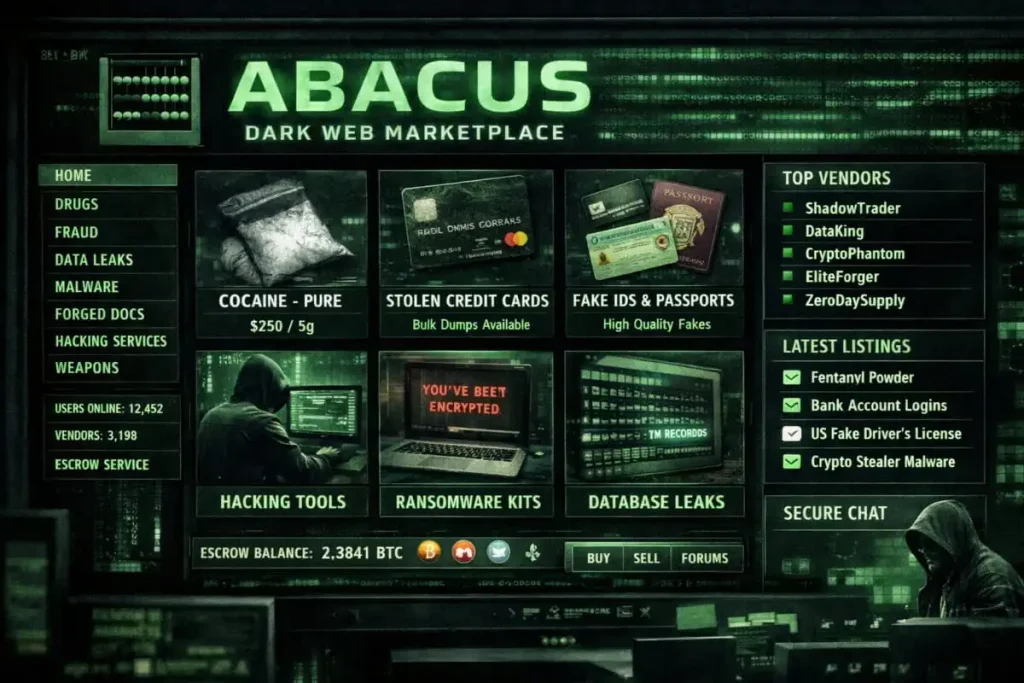
Abacus Market 2026 Status: Exit Scam
In early July 2025, Abacus went dark. No seizure notice. No law enforcement announcement. The platform simply stopped responding, with funds held in escrow inaccessible to vendors and buyers. Threat intelligence analysts assessed it as a likely exit scam, operators disappearing with pooled escrow funds. However, the possibility of a covert law enforcement action was noted in early reporting and could not be entirely ruled out at the time.
By mid-July 2025, the assessment had solidified: Abacus was gone. In practical terms for defenders in 2026, it is treated as a collapsed market.
What the Abacus Exit Means for Security Teams
The disappearance of a market the size of Abacus doesn’t reduce the volume of data in circulation; it redistributes it. In the weeks following the July 2025 exit, threat intelligence reporting documented a measurable spike in vendor registrations on TorZon Market and Russian Market, along with increased listing activity on STYX Market for fraud-adjacent goods. Datasets previously sold exclusively through Abacus resurfaced on competing platforms, often reposted by vendors re-establishing reputation on new storefronts.
This migration pattern is consistent across every major darknet market collapse. The blast radius of an exit scam or seizure extends well beyond the platform itself:
- Vendors move their existing inventory, including previously sold or recycled stolen data, to surviving markets within days.
- Buyers follow established vendors, rapidly concentrating their activity on the platforms that host the most credible sellers.
- The “vacuum period” between a market’s collapse and the consolidation of its successor generates elevated scam activity, impersonation attempts, and fraudulent mirror sites.
For organizations conducting dark web exposure assessments in 2026, the Abacus exit is a case study in why monitoring a single platform, or checking exposure only after a known market goes offline, misses the actual risk window. Data posted on Abacus before July 2025 did not become inaccessible when the market closed. It moved. If your organization’s credentials, customer records, or payment data appeared on Abacus during its operational period, the working assumption is that they remain in active circulation on its successor platforms today.
Dark web monitoring that tracks signals across active markets, not just known breach databases, is the only reliable way to detect whether Abacus-era exposure is still being traded against your organization.
STYX Market
STYX Market emerged in early 2023 following the disruption of Genesis Market, one of the most significant fraud-access ecosystems ever taken down by law enforcement. Where Genesis specialized in packaged browser fingerprints and account access, STYX positioned itself as a broader financial crime hub, attracting the vendors and buyers displaced by Genesis’s collapse and expanding the category into a more comprehensive fraud-enablement marketplace.
Unlike the generalist drug-and-data markets that dominate darknet commerce by volume, STYX is fraud-centric by design. Its listings are organized around financial crime workflows: stolen payment card data, compromised account access, identity datasets, cash-out and money laundering services, and the kind of fraud-enabling tooling, forged documents, synthetic identity packages, and SIM swap services that reduce friction for actors operating at scale.
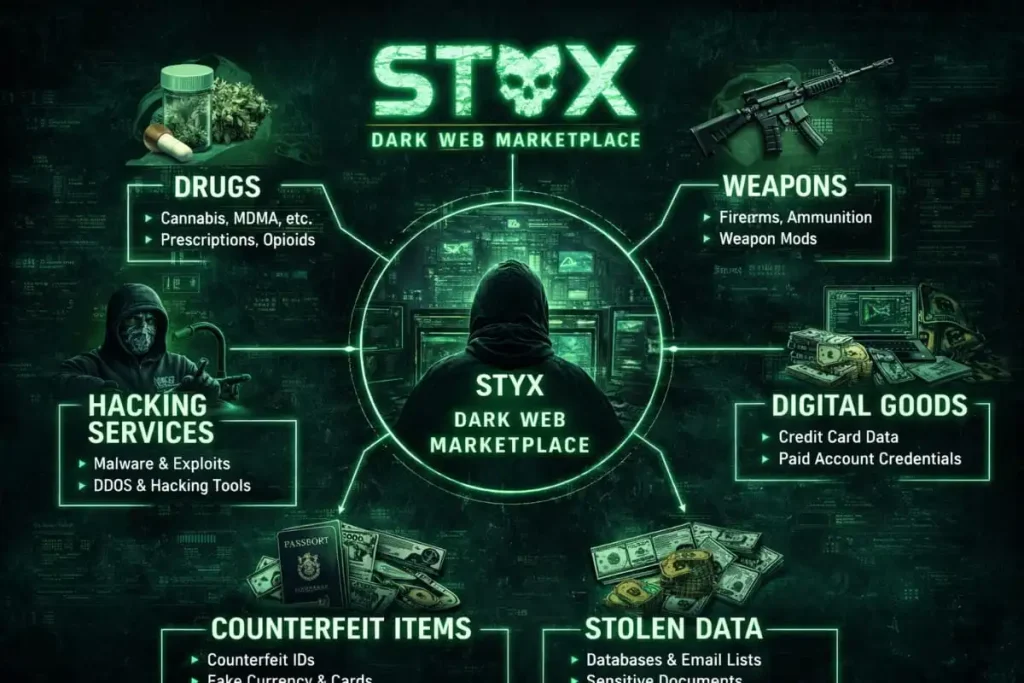
That specialization matters for defenders because it signals intent. A credential appearing on the Russian Market might be purchased by anyone, from a low-level account thief to a ransomware operator conducting reconnaissance. A credential appearing on STYX is almost certainly destined for a financial fraud workflow, account takeover, business email compromise, payment fraud, or identity-linked scams. The platform’s audience self-selects for financially motivated actors, which makes its listings a higher-priority signal for fraud teams and financial institutions.
STYX Market 2026 Status
As of mid-2026, STYX Market has no confirmed seizure notice or documented law enforcement takedown. Threat intelligence reporting continues to reference it as an active marketplace in the fraud ecosystem. That said, the “STYX” name circulates across multiple domains and lookalike sites; analysts consistently caution against treating any single URL as definitively representing the original operation. Status can change rapidly, and the safest operational posture is to treat STYX as active-until-confirmed-otherwise while monitoring for migration signals.
How to Monitor STYX Market Exposure
Security teams searching for STYX Market’s onion address or current URL are typically trying to answer one of two questions: is the market still operational, or is our organization’s data listed there? Direct access answers neither question reliably; onion addresses rotate; mirror sites proliferate after enforcement attention; and manual searches return incomplete results even when the platform is fully operational.
Effective STYX Market monitoring doesn’t require visiting the platform. The signals that matter for organizational risk assessment are detectable without direct access:
Credential and account exposure. Stealer log packages sold through STYX typically reference harvested data by domain, industry, or geography. Monitoring for mentions of your organization’s domains, email patterns, or executive names across STYX-adjacent Telegram channels and forum discussions surfaces exposure before purchased credentials are acted on.
Financial fraud indicators. STYX listings for cash-out services and payment fraud tooling often reference specific bank names, payment processors, or card BINs. Organizations in financial services or those processing high transaction volumes should treat BIN-linked listings as direct exposure signals requiring card-level review.
Migration and repost activity. When STYX experiences downtime, whether due to enforcement pressure, DDoS, or operational disruption, its vendor community typically announces alternative platforms via Telegram channels and Dread forum posts. Monitoring these migration signals is often more reliable than tracking a single onion address, because it reflects where activity actually moves rather than where it was last seen.
Vendor overlap with other markets. Established STYX vendors frequently operate across multiple platforms simultaneously. Identifying vendor handles associated with your organization’s data on any single market often reveals parallel listings on STYX and vice versa, a cross-platform signal that point-in-time scans miss entirely.
DeXpose dark web monitoring covers STYX Market, along with all active darknet marketplaces, stealer log sources, and fraud-adjacent Telegram channels. Hence, your security team gets exposure alerts without direct platform access. Check your organization’s current dark web exposure with a free report.
Brian’s Club
Brian’s Club (often styled as BriansClub / Brian’sClub / BrianCC) is a long-running carding marketplace that has operated since the mid-2010s and is best known for selling stolen payment card data. Its branding is widely described as a taunt aimed at journalist Brian Krebs, whose reporting has chronicled carding ecosystems for years.
Brian’s Club is primarily associated with the sale of:
- Stolen card data used for payment fraud (e.g., “dumps”/track-style data and card-not-present data bundles)
- Identity-linked financial datasets are sometimes packaged for impersonation and account fraud
Unlike multi-vendor “everything markets,” it’s often described as a specialized store focused on payment-card fraud supply chains.
In 2019, a large cache of data associated with Brian’s Club was leaked and shared with financial institutions, enabling banks to identify and replace exposed cards. Krebs’ reporting and follow-up analysis commonly cite tens of millions of card records tied to the incident, accumulated over several years.
Brian’s Club 2026 Status
Public reporting around “is it shut down?” remains noisy: there have been repeated claims of disruptions or shutdowns, alongside indications of mirrors/continuations/rebrands that keep the name circulating. The most defensible way to describe it in 2026 is that the “Brian’s Club” ecosystem persists in some form. Still, precise operational status is difficult to verify from open sources because of copycats, mirrors, and churn.
Why it matters for defenders in 2026
Carding shops like Brian’s Club are essential to monitoring programs because they signal:
- Payment card exposure (often tied to skimmers, POS compromises, or third-party breaches)
- Fraud risk escalation windows (when newly posted data tends to be most actionable)
- Downstream identity and account takeover risk when card data is bundled with identity attributes
That’s why many organizations treat this category as a core input to dark web exposure assessments and fraud/threat intelligence.
WeTheNorth Market
WeTheNorth (WTN) emerged in 2021 as a regionally branded darknet marketplace with a strong Canadian identity. Unlike large “global” markets, WTN built traction by targeting local preferences and cultivating a community-first reputation, including bilingual positioning (English/French) and a vendor base associated with Canada.
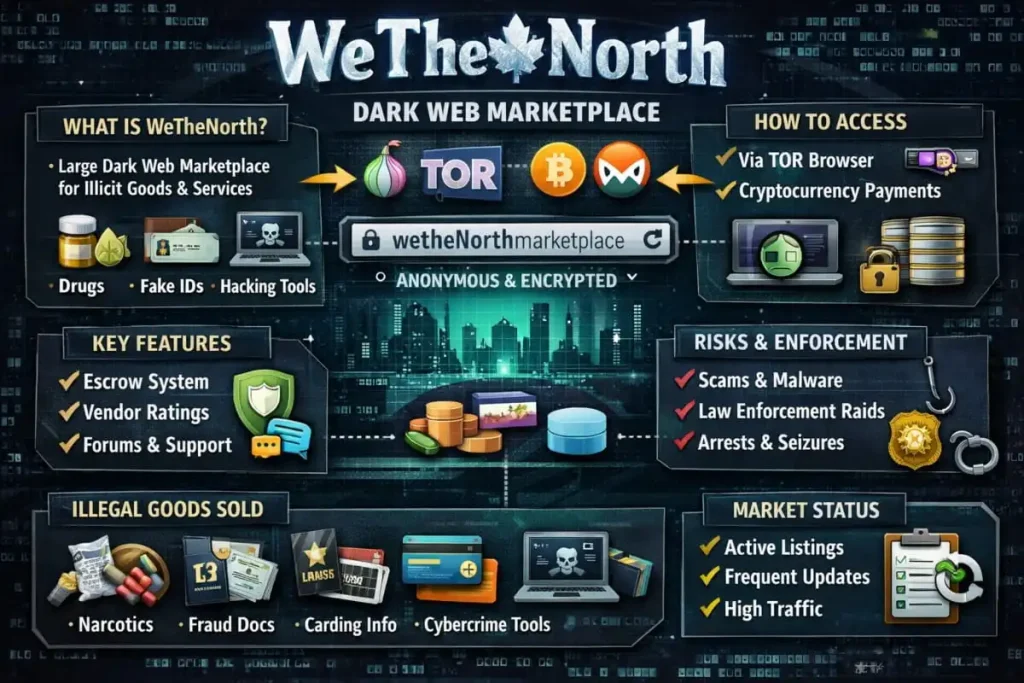
As reported in ecosystem discussions, WTN has been linked to multi-category illicit listings, often with a regional emphasis:
- Controlled substances and regulated products (commonly described as a primary category for the Market).
- Counterfeit and identity fraud materials, including documents and supporting artifacts, are often aligned with Canadian contexts.
- Financial fraud–related items, including compromised payment data and related tooling (generally viewed as smaller in scale than specialist platforms).
- Cybercrime-adjacent goods and services, including malware/tooling and “hire services” offerings.
- Digital guides/tutorial content that can indicate a “training” layer for lower-skilled actors.
For defenders, the most crucial point is that markets like WTN can act as local distribution nodes for fraud enablers and compromised data, especially when they prioritize regional “trust” and repeat transactions.
WTN is frequently described as emphasizing trust and moderation compared to larger, higher-chaos markets. In practice, markets that push “community rules” and vetting can:
- Reduce open scamming (increasing buyer confidence and repeat purchasing)
- Improve vendor stability (making supply more predictable)
- Increase the likelihood that stolen data and fraudulent goods circulate longer within a smaller, loyal audience
WTN has also been described as prohibiting specific high-heat categories (e.g., weapons, explosives, extremist content, child exploitation). Whether due to ethics or risk avoidance, such restrictions often serve as law-enforcement risk management and brand positioning, rather than reducing overall harm.
WTN is generally portrayed as mid-sized relative to global giants, but meaningful within Canada-focused trade. A steady-growth model (rather than explosive expansion) can be a survival strategy: smaller markets may attract less immediate disruption while still generating consistent illicit activity.
WeTheNorth 2026 Status
By late 2025, WTN is commonly characterized as still operating and comparatively stable (with periodic disruption risks typical of the ecosystem). For defenders, “stability” increases relevance: stable markets are more likely to show recurring patterns of data resale and repeat-vendor behavior, which can be monitored for exposure signals.
Why it matters for organizations
WTN is relevant in 2025 because regional markets can be a source of:
- Credential exposure and account takeover risk (employee/customer accounts)
- Identity fraud and synthetic identity creation (especially where local documents are emphasized)
- Payment fraud enables (stolen card data, bank-access artifacts)
- Early signals of compromise when datasets referencing a company, domain, or customer base appear
Defensive implication: treat WTN as an exposure-and-fraud signal source in threat intelligence workflows, especially for organizations with Canadian customers, operations, or employee populations.
TorZon Market
TorZon (often stylized TorZon/Torzon) is a multi-category darknet marketplace that emerged in 2022 and gained visibility as larger markets faced seizures, instability, or closures. By 2025, it is frequently discussed as one of the prominent English-language marketplaces in the broader ecosystem.
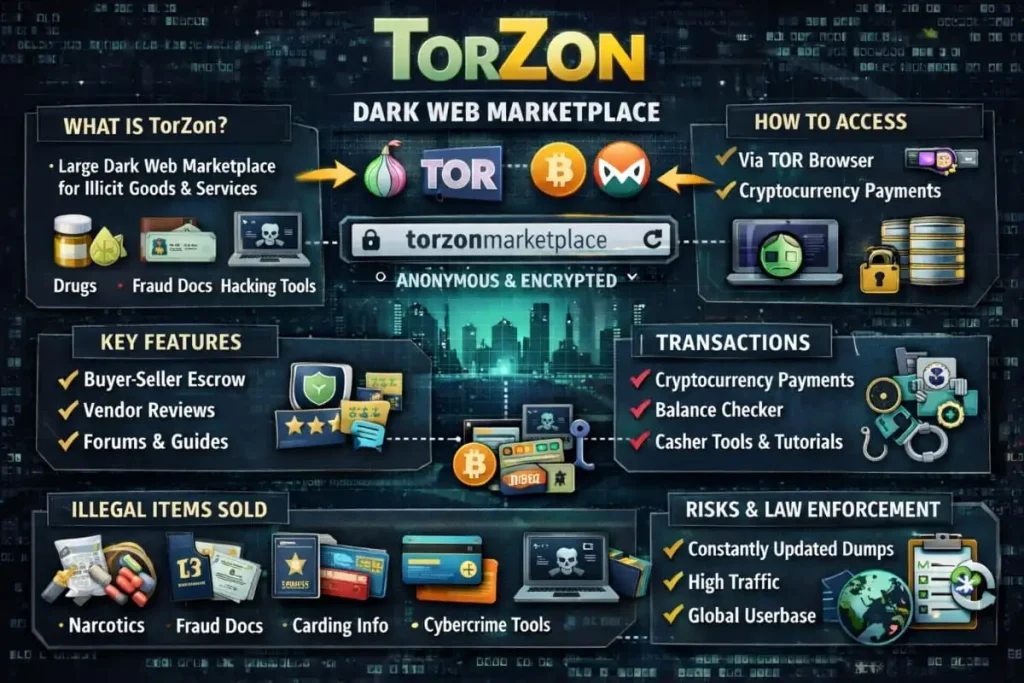
TorZon is commonly described as a generalist marketplace rather than a niche platform, with listings spanning multiple illicit categories. In threat-intel terms, the categories that matter most for organizational risk include:
- Stolen data and compromised accounts (credentials, payment-related data, and related datasets)
- Cybercrime tooling and services (malware, exploitation tooling, and other enablement content)
- Fraud-related goods (counterfeits, identity fraud materials, and adjacent services)
While controlled substances are often cited as a significant part of generalist markets, the most direct business impact typically comes from credential exposure, payment fraud enablement, and stealer-log distribution.
TorZon’s rise is often attributed to timing and continuity: when competing platforms shut down or lost user trust, displaced vendors and buyers migrated to surviving options. Markets that avoid major trust failures early can rapidly accumulate listings and become “default destinations” in community discussions, an essential signal for defenders because it suggests:
- More data resale velocity (fresh breaches and logs move faster)
- More vendor consolidation (repeat sellers reappear across markets)
- Higher signal value for exposure monitoring (brand/domain mentions, targeted sectors, etc.)
Ecosystem commentary often highlights “trust features” intended to reduce scams and impersonation risks within the Market itself. From a defensive lens, these features matter because they can increase the reliability of illicit commerce, which increases downstream harm.
Commonly discussed trust patterns include:
- Vendor reputation mechanisms that reduce buyer uncertainty
- Stronger verification norms to counter phishing and impersonation
- Support for privacy-preserving payment options (often discussed as an ecosystem trend)
You don’t need to explain mechanics; the key message is: more trust = more repeat transactions = more sustainable criminal supply chains.
TorZon Market 2026 status
As of late 2025 (per community reporting), TorZon is often described as active and prominent, meaning it may be relevant to:
- Exposure assessments (customer/employee credentials, internal access hints)
- Fraud risk monitoring (payment data resale, account takeover enablement)
- Threat actor tradecraft tracking (which tool families and log types circulate)
Large, stable markets also tend to become priority targets over time, making their status volatile. For defenders, volatility itself is a signal: disruption events often trigger migration waves, which can temporarily spike data reposting, rebranding, and scam activity elsewhere.
TorZon is often portrayed as a marketplace that adopted trust-building design choices earlier than many newer entrants, helping it onboard established vendors and accelerate perceived legitimacy. This “fast maturity” pattern is essential for threat intelligence because it can rapidly shift where the highest-value datasets and vendors concentrate.
Russian Market
Russian Market is a long-running illicit data marketplace (active since roughly 2019) that caters to a global audience and is widely referenced in cybersecurity reporting for trafficking in compromised digital assets. In 2026, it’s best understood as a data-centric marketplace rather than a “general contraband” market; its primary role is enabling credential abuse, account takeover, and fraud supply chains.
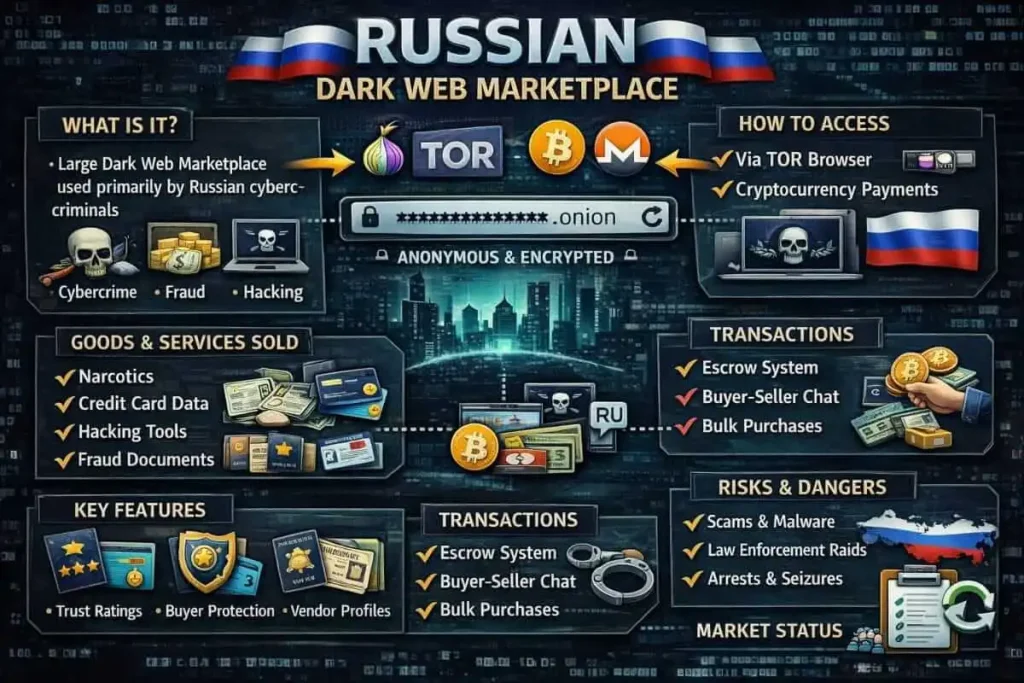
From a defensive lens, the Russian Market is most strongly associated with:
- Compromised credentials and accounts (email, consumer platforms, enterprise access paths)
- Remote access exposure (e.g., stolen/abused access to systems that can enable deeper intrusion)
- Stealer-log ecosystems (credential/cookie/session artifacts harvested by information-stealing malware)
- Payment and identity fraud data (card-related datasets and identity attributes used for fraud and social engineering)
- “Enablement” content that reduces friction for fraud workflows (the key point is the enablement, not the mechanics)
Exact size is hard to verify publicly, but the Russian Market is consistently discussed as a high-volume, high-churn venue where new datasets and access artifacts appear frequently. In 2026, that “freshness” is one of the reasons it remains relevant to defenders, markets with rapid turnover tend to be early indicators of new campaigns and newly circulating breach material.
Russian Market’s “security posture” is best described as anti-observation and anti-scraping, not “secure” in any legitimate sense. Data markets typically implement friction designed to limit casual visibility and automated collection while preserving a smooth experience for paying users. For defenders, the important takeaway is that these design choices can make stolen-data trafficking more sustainable and repeatable, which increases downstream risk.
Russian Market Status (2026)
In 2026, the Russian Market should be treated as a continuing exposure and fraud signal source (i.e., relevant for monitoring and assessment). Because marketplace status can change quickly (seizures, exit events, rebrands, disruption), the safest language for 2026 is to describe it as actively referenced and monitored rather than making absolute uptime claims.
Russian Market matters in 2026 because it directly supports the most common high-impact attack paths:
- Account takeover via credentials, sessions, and stealer-derived artifacts
- Initial access that can lead to business email compromise, internal system abuse, or ransomware staging
- Fraud at scale using payment and identity datasets
- Exposure assessment for brands: employee/customer credentials and domain-linked artifacts can appear soon after compromise
Defensive implication: If you conduct dark web exposure assessments in 2026, prioritize detection for credentials, stealer logs, and access artifacts; these typically result in the fastest real-world incidents.
BidenCash
BidenCash was a carding-focused cybercrime marketplace launched in March 2022 and became widely known for pairing sales of stolen payment data with attention-grabbing “free dump” promotions. In June 2025, U.S. authorities announced the seizure of infrastructure tied to the marketplace, disrupting its operations.
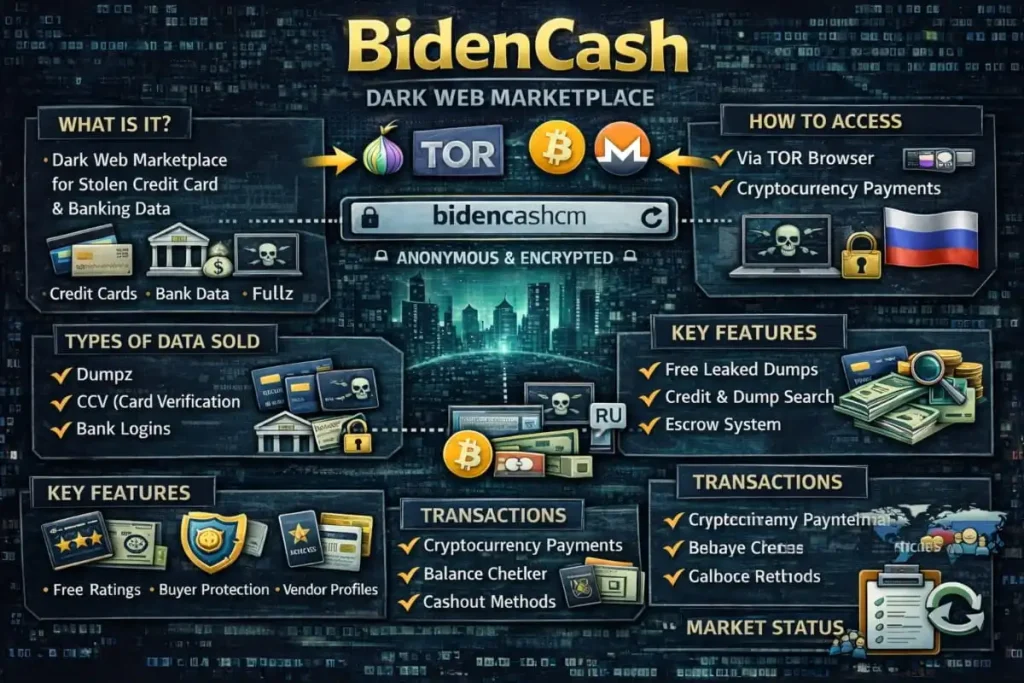
From a defender’s perspective, BidenCash primarily enabled:
- Stolen payment card data and associated personal information were used for fraud.
- Compromised credentials that could be used to access systems “without authorization,” as described in the U.S. seizure announcement.
- “Promotion dumps” of stolen card data were publicly released on the Market platform (as documented by multiple security reports).
Law enforcement stated the marketplace:
- Supported 117,000+ customers
- Facilitated trafficking of 15+ million payment card numbers
- Generated $17+ million in criminal revenue (transaction fees)
BidenCash’s “security” was less about protecting users and more about staying online and reducing friction for repeat fraud. The same seizure announcement notes that authorities took action against both darknet and traditional internet domains, indicating that the marketplace relied on a broad domain footprint rather than a single, stable presence.
Its promotional leaks, while effective marketing, also increased visibility and likely elevated enforcement priority.
BidenCash Status (2026)
Inactive/disrupted. In June 2025, U.S. authorities announced they seized ~145 domains and associated cryptocurrency tied to BidenCash, effectively dismantling its public-facing infrastructure.
BidenCash is a 2026 case study in how high-velocity payment fraud ecosystems operate:
- Large-scale carding marketplaces can rapidly amplify card-not-present fraud, identity misuse, and downstream account abuse.
- Public “free dumps” can prompt rapid defensive measures (re-issuance, monitoring spikes) and broaden the impact on victims beyond typical underground buyers.
- Even when a central platform is seized, activity tends to migrate, so monitoring should focus on signals of exposure and reposting rather than assuming demand disappears.
Omicron (Hacked, July 2022)
Omicron was a short-lived darknet marketplace that operated in 2022 and was reported to have been hacked in July of that year. The EUDA (European Union Drugs Agency) dataset lists Omicron with a start date of 30/03/2022 and an end date of 23/07/2022, with the closure reason marked Hacked.
As with many general darknet marketplaces tracked in this period, Omicron is best understood (from a defender’s perspective) as part of the broader illicit-market ecosystem, where contraband trade and cybercrime-adjacent activity can overlap, especially around fraud, compromised accounts, and data-exposure signals.
Omicron’s lifecycle was very short (roughly four months), which typically limits long-term market depth and stability compared to major, multi-year markets. Its “hacked” classification of closure is a valuable reminder that marketplace operators and users face persistent compromise risk (platform vulnerabilities, insider risk, and operational failures). For defenders, this volatility often triggers migration of vendors/data to other venues and can temporarily increase reposting of datasets elsewhere.
Inactive. Omicron is recorded as ending on 23 July 2022 due to being hacked, so it should not be treated as an active marketplace in 2026. Omicron matters mainly as a market-churn case study: hacks and sudden shutdowns don’t end the underlying activity; they redistribute it. For 2026 monitoring, the practical takeaway is to track where communities and datasets move after disruptions, and to treat “market lists” as dynamic rather than static.
AlphaBay ( Dec 2022)
AlphaBay was one of the most significant darknet marketplaces of the 2010s. The original AlphaBay is recorded as operating from 22 December 2014 → 28 June 2017 and ending due to a law-enforcement takedown (“Raided”), not an exit scam.
A separate relaunch attempt was publicly discussed in 2021, attributed to a former administrator (“DeSnake”), and tracked by multiple threat-intel/commentary sources as a “return.”
During the 2017-era takedown, authorities described AlphaBay as facilitating sales of illegal drugs, malware, counterfeit identification documents, and other illegal services. (For a 2026 defensive write-up, this is enough; no access or operational detail is needed.)
AlphaBay was widely characterized as a significant global marketplace before its 2017 takedown, and Europol described the 20 July 2017 operation as targeting “two of the largest” markets (AlphaBay and Hansa).
The AlphaBay/Hansa operation is often cited as a reminder that “marketplace security” is fragile: enforcement can seize infrastructure and gather user data through coordinated, cross-border investigations.
The 2021-era “AlphaBay return” discussions also emphasized upgraded security claims (e.g., stronger operational security and a safer payment posture). However, these were claims made by operators/observers rather than independently verifiable guarantees.
Inactive/defunct as a reliable market brand. The original AlphaBay ended with the 2017 raid. Separately, “AlphaBay’s return” (2021) is best treated in 2026 as unstable and historically volatile, not a dependable “active market” reference point.
AlphaBay matters less as an “active venue” and more as a template for how the ecosystem behaves: takedowns don’t remove demand, they trigger migration, rebranding, and rapid vendor relocation. That churn is precisely why modern programs focus on exposure monitoring and early warning signals (credentials, stealer logs, fraud enablement) rather than chasing static “top market” lists.
World Market (Exit scam, March 2022)
World Market was a darknet marketplace that operated from 09 November 2020 until 08 March 2022, when it was classified as an exit scam (operators disappearing with funds).
As a mainstream “multi-category” market of its era, World Market fit the broader darknet market pattern, in which illicit listings commonly include drugs and other contraband, alongside fraud- and cybercrime-adjacent activity that can spill into credential abuse and financial crime.
Specific verified user/vendor counts are difficult to validate publicly. Still, its ~16-month lifespan indicates it was more established than many short-lived markets, long enough to build repeat vendor/buyer activity before collapsing.
The key security takeaway is structural: exit scams are a recurring failure mode in darknet markets, reflecting fragile trust, centralized control points, and persistent pressure from fraud, disruption, and enforcement dynamics across the ecosystem.
Inactive. World Market is recorded as ending on 08 March 2022 due to an exit scam, so it should not be treated as active in 2026.
World Market is useful as a 2026 case study in market churn: when a market collapses (exit scam vs. takedown), the underlying activity typically migrates, vendors re-list elsewhere, and stolen data/fraud goods can be reposted across new venues. That’s why modern defenders prioritize continuous monitoring and exposure assessment over static “top market” lists.
Kraken Darknet Market
Kraken Market is a Russian-language darknet marketplace that has operated since approximately 2019 and ranks among the most active platforms in the ecosystem as of 2026. It is distinct from the defunct American cryptocurrency exchange of the same name and unrelated to it in any way. In darknet intelligence reporting, “Kraken” refers specifically to this Tor-based marketplace, which caters primarily to a Russian-speaking user base and has expanded its reach into broader European and Central Asian markets over the past two years.
Kraken’s primary categories are narcotics and controlled substances, with a particularly strong vendor base for stimulants and synthetic drugs distributed through dead-drop delivery methods common in Russian-language darknet commerce. Unlike Western generalist markets, where drug listings share space with stolen data and cybercrime tooling, Kraken operates more like a specialized drug marketplace. However, credential and financial fraud listings are present and have grown as the platform has absorbed users displaced from other Russian-language markets.
For Western security teams, Kraken is less directly relevant than Russian Market or STYX for monitoring credential exposure. Its primary risk profile is indirect: it is a revenue-generating platform for the same threat actor communities that operate across Russian Market, and vendor overlap between the two platforms is documented in threat intelligence reporting. Organizations with operations, employees, or customers in Russia, Eastern Europe, or Central Asia should treat Kraken as a relevant source of exposure signals.
Kraken Darknet Market 2026 Status
As of mid-2026, Kraken is assessed as active. No confirmed law enforcement seizure or documented exit scam has been reported against the platform. It has maintained operational continuity during a period when several competing Russian-language markets have collapsed or been disrupted, likely contributing to its consolidation of the Russian-speaking darknet user base alongside Mega Market.
Kraken operates across multiple onion addresses and has demonstrated resilience against DDoS campaigns that have temporarily disrupted other markets in the same ecosystem. For defenders, operational continuity of this kind typically signals a more mature operational security posture and a platform likely to remain a relevant monitoring target through the remainder of 2026.
Kingdom Market
Kingdom Market was a mid-sized English-language darknet marketplace that operated from approximately 2021 until its seizure in December 2023 as part of a coordinated international law enforcement operation involving agencies from the United States, Germany, Switzerland, Moldova, and Ukraine. The takedown was notable both for its cross-jurisdictional scope and for the speed with which it was executed; Kingdom’s infrastructure was seized and its domains replaced with law enforcement notices within a single operation window.
At its peak, Kingdom offered listings across narcotics, malware and cybercrime tooling, forged identity documents, and counterfeit currency. Its vendor base was smaller than contemporaries like Abacus or AlphaBay, but it maintained a reputation for reliable escrow and lower exit-scam risk than many markets of comparable size. This reputation made its sudden seizure particularly disruptive for its active user community.
Kingdom Market 2026 Status: Seized
Kingdom Market has been offline since December 2023 and should be treated as permanently defunct. No credible successor or rebranded continuation of the platform has been documented in threat intelligence reporting. Vendors and buyers displaced by the seizure migrated primarily to Abacus Market in early 2024, and then again to TorZon and WeTheNorth following Abacus’s exit scam in July 2025.
Kingdom’s seizure is worth understanding for two reasons. First, it demonstrated that mid-sized markets with strong operational security are not immune to coordinated international enforcement, a pattern that has accelerated since 2023. Second, the vendor migration that followed Kingdom’s takedown contributed directly to Abacus’s dominance through 2024, illustrating how enforcement actions against one platform concentrate activity and risk on its successors.
For security teams reviewing historical exposure, any organizational data that appeared on Kingdom Market before December 2023 should be assumed to have migrated to subsequent platforms. Seized market data is routinely reposted by vendors re-establishing on new storefronts, and the December 2023 seizure timeline aligns with a documented spike in credential reposting activity on Abacus in early 2024.
Tor2door Market (Exit scam, September 2023)
Tor2door Market was a darknet marketplace tracked in the EUDA dataset from 03 July 2020 until 14 September 2023, with its closure recorded as an exit scam.
As a multi-vendor darknet market, Tor2door fits the common “general marketplace” pattern seen across the ecosystem (often spanning contraband plus fraud/cybercrime-adjacent offerings). For a 2026 defensive write-up, the key point is that such venues can serve as distribution points for compromised data, facilitate fraud, and support related illicit supply chains.
Public, verifiable scale metrics (exact users/listings/revenue) are limited; however, operating for over three years suggests Tor2door reached meaningful traction before its collapse, long enough to develop repeat vendor/buyer activity.
Its end state (exit scam) reflects a recurring structural risk in darknet markets: trust can fail abruptly, and “market stability” can disappear without warning, often leading to sudden community migration and reposting of goods/data elsewhere.
Inactive. Tor2door is recorded as ending on 14 September 2023 due to an exit scam, so it should not be treated as an active marketplace in 2026.
Tor2door is a proper 2026 case study in ecosystem churn: when a market exits, scammers, vendors, and datasets typically move rather than vanish. For defenders, the practical takeaway is to monitor for migration waves (new venues, rebranded vendor identities, and fresh reposting of stolen data) as part of ongoing exposure assessment and threat intelligence.
Aurora Market (Exit scam, May 2021)
Aurora Market was a darknet marketplace tracked from 02 November 2020 to 04 May 2021, with its closure reason recorded as an exit scam in the EUDA dataset.
Aurora Market fit the typical “general darknet market” pattern of its era, where listings commonly span contraband and fraud/cybercrime-adjacent categories. For a 2026 defensive write-up, the most relevant angle is that markets like this can contribute to credential exposure, fraud enablement, and downstream account takeover risk.
Publicly verifiable scale metrics are limited, but its roughly six-month lifespan suggests it was relatively short-lived compared to multi-year markets, consistent with the high churn rate reflected in the EUDA market-lifecycle data.
Aurora’s end state (an exit scam) illustrates a recurring ecosystem risk: even when markets tout “trust” or “security,” structural incentives and pressures often lead to abrupt failure. For defenders, these failures typically trigger vendor migration and the reposting of data across other venues.
Inactive. Aurora Market is recorded as ending on 04 May 2021 due to an exit scam, so it should not be treated as active in 2026.
Aurora Market is useful in 2026 as a case study in market churn and trust collapse: when a market exits, scams and the underlying activity rarely disappear; they relocate. That’s why modern programs emphasize continuous dark web monitoring, exposure assessment, and migration tracking rather than static “top markets” lists.
ToRReZ Market ( December 2021)
ToRReZ Market was a darknet marketplace active from 28 February 2020 until 17 December 2021, when it voluntarily shut down. The operator announcement and reporting at the time framed the shutdown as a deliberate closure rather than an exit scam.
As a general darknet market, ToRReZ followed the typical multi-category pattern seen across the ecosystem (often including drugs and other contraband, alongside fraud- and cybercrime-adjacent offerings). For 2026 defensive coverage, the key relevance is its role as a venue where illicit supply chains and data/fraud ecosystems can overlap.
Contemporary reporting described ToRReZ as one of the larger markets at the time of its shutdown (including claims of being among the “second largest” by listings in late 2021).
The most critical “security” lesson is structural: even when a market appears stable, it can still disappear quickly due to operator decisions. That sudden shutdown dynamic creates migration waves (vendors and datasets moving elsewhere), which is often more important for defenders than the Market’s internal mechanics.
Inactive. ToRReZ is recorded as ending on 17 December 2021 via voluntary exit, so it should not be treated as active in 2026.
ToRReZ is a practical 2026 example of market churn without law-enforcement seizure: voluntary closures still redistribute activity across other venues. For monitoring programs, the takeaway is to track post-closure migration and reposting of compromised data/fraud listings rather than relying on static “top market” lists.
Genesis (Exit scam, August 2019)
Genesis was a darknet marketplace tracked by the EUDA dataset from 01 May 2019 until 24 August 2019, ending as an exit scam.
The EUDA dataset categorizes entries as darknet markets offering drugs, so Genesis should be treated (in a 2026 write-up) as part of the drug-market ecosystem that can also overlap with fraud and other illicit trade patterns.
Genesis had a short lifecycle (under 4 months), which typically limits long-term depth and stability compared with multi-year markets.
Its closure type, exit scam, highlights a recurring ecosystem failure mode: markets can collapse without warning due to operator misconduct, triggering sudden loss of trust and rapid migration elsewhere.
Inactive. Genesis is recorded as ending on 24 August 2019 due to an exit scam, so it is not active in 2026.
Genesis is a helpful example of market churn in 2026: when an exit scam occurs, activity doesn’t vanish; it relocates, often causing short-term spikes in re-listing, reposting, and fragmentation across other venues, which are relevant for exposure assessment and threat-intel tracking.
History of Dark Web Marketplaces
Dark web marketplaces entered public consciousness with Silk Road, launched in 2011 by Ross Ulbricht. It was the first platform to demonstrate that anonymous commerce was operationally viable at scale; Bitcoin handled payments, Tor handled anonymity, and escrow handled enough of the trust problem to attract a genuine vendor ecosystem. The FBI shut it down in October 2013 and arrested Ulbricht, but the infrastructure concept had already been proven. Within months, successors were live.
What followed was a fifteen-year cycle that has never meaningfully broken: a dominant market emerges, builds critical mass, and then collapses through seizure, an exit scam, or internal failure, triggering a migration wave that consolidates activity on whatever platform absorbs its vendors the fastest. AlphaBay became the post-Silk Road standard until a joint FBI and Europol operation dismantled it in 2017, simultaneously taking down Hansa Market in a sting that caught thousands of displaced AlphaBay users mid-migration. Dream Market filled the vacuum, then quietly shut down in 2019 before law enforcement could move. Empire Market ran from 2018 to 2020 before its operators executed one of the largest exit scams in darknet history, vanishing with an estimated $30 million in escrow funds.
Each iteration has followed the same adaptive logic. Operators study what caught their predecessors and build in countermeasures, stronger operational security, decentralized infrastructure, and more cautious vendor vetting. Authorities study the new architecture and develop new tactics. The result is an arms race with no finish line, producing an ecosystem defined not by stable dominant platforms but by constant churn, migration, and reconsolidation.
By 2024, that cycle had produced Abacus Market as the clear Western frontrunner, holding an estimated 70% of English-language darknet Bitcoin transaction volume at its peak. By mid-2025, Abacus was gone, its operators having executed an exit scam that redistributed its entire vendor base across TorZon, WeTheNorth, and Russian Market within days. The platforms active in 2026 are the current iteration of a succession that stretches back to 2013. They will not be the last.
Why Dark Web Markets Keep Coming Back
Every major darknet market shutdown follows the same pattern: displaced vendors migrate within days, listings reappear on surviving platforms, and, within weeks, a new market emerges to fill the gap. The ecosystem doesn’t collapse when a market goes offline; it reorganizes.
This persistence is structural, not accidental. Darknet markets operate across decentralized infrastructure, with no single point of failure that law enforcement can permanently eliminate. When authorities seized AlphaBay in 2017, Hansa absorbed its users. When Hansa fell in the same operation, Dream Market filled the void. When Archetyp was taken down in December 2024, TorZon and WeTheNorth saw immediate spikes in vendor registrations. The supply chain for stolen data, compromised credentials, and fraud-enabling tools doesn’t disappear; it reroutes.
Exit scams follow the same logic in reverse. When Abacus Market vanished in July 2025, leaving funds in escrow, the reaction wasn’t a contraction of the ecosystem. It was fragmentation: buyers were redistributed across TorZon, the Russian Market, and the STYX Market within the same news cycle. Markets that absorb displaced users during a vacuum period tend to consolidate rapidly, often emerging more dominant than the platform that collapsed.
Several factors explain why new markets consistently replace seized ones:
Low barrier to entry. The technical infrastructure for a darknet marketplace- Tor hosting, escrow scripting, vendor onboarding- is widely documented and reproducible. A new platform can reach operational status in a matter of weeks.
Demand-side continuity. Buyers don’t stop purchasing because a market was seized. They look for alternatives immediately, which creates a ready audience for any replacement that establishes trust quickly.
Decentralized trust mechanisms. Vendor reputation, PGP verification, and community forums like Dread allow established sellers to carry their credibility to new platforms. The trust layer migrates with the vendors, not with the market.
Jurisdictional fragmentation. Coordinated international takedowns, like the 2017 AlphaBay/Hansa operation or the 2025 BidenCash seizure, require significant cross-agency effort. Most markets operate long enough to generate substantial criminal revenue before enforcement catches up.
For security teams, this persistence has a direct operational implication: monitoring cannot be event-driven. A market seizure doesn’t mean your organization’s exposed data was destroyed; it means it moved. Credentials, stealer logs, and payment card data posted on a seized market are typically reposted on competing platforms within days, often at discounted prices as new vendors establish reputation. The data’s exposure window doesn’t close when the market does.
What Darknet Markets Mean for Your Organization in 2026
Most organizations have no direct interaction with darknet markets. No employee is browsing TorZon. No IT team is monitoring Russian Market listings. But that distance is deceptive, because the data being traded on these platforms almost certainly includes credentials, payment records, or access artifacts tied to your organization, your customers, or your vendors.
The connection isn’t theoretical. Stealer malware deployed against an employee’s personal device harvests saved browser credentials, session cookies, and autofill data, including work account logins, and routes them to markets like Russian Market or STYX within hours of infection. A third-party breach at a SaaS vendor your team uses exposes API keys and employee emails that surface on TorZon within days. A phishing campaign targeting your customers produces harvested payment data that lands on Brian’s Club before your fraud team gets the first chargeback alert.
By the time most organizations learn their data is circulating, it has already been purchased and used.
What Gets Traded That Affects You Directly
The categories that create the most direct organizational risk aren’t drugs or counterfeit documents; they’re the data-centric listings that fuel account takeover, fraud, and initial access:
Stealer logs and credential bundles. Packages of harvested usernames, passwords, session tokens, and browser-stored data sold in bulk. A single stealer log package can include dozens of employee credentials across corporate SSO, email, VPN, and cloud platforms. Russian Market and TorZon are the primary distribution points for this category in 2026.
Initial access listings. RDP credentials, VPN access points, and compromised admin accounts sold as standalone items. These are the entry points ransomware operators and BEC actors use to establish footholds before a major incident. Prices range from tens to thousands of dollars depending on network size and industry.
Payment card data. Bulk card dumps and card-not-present datasets tied to your customers’ transactions. A single POS compromise or third-party payment processor breach can result in thousands of records appearing on Brian’s Club or its mirrors before your acquirer flags the pattern. The fraud window, the period between listing and card replacement, averages days to weeks.
Identity fraud enablement. Synthetic identity packages combining real and fabricated data used to open fraudulent accounts, bypass KYC checks, and conduct social engineering against your staff or customers. WeTheNorth and STYX Market are the primary sources for this category.
Why One-Time Checks Miss the Point
Dark web exposure isn’t a static state. A credential that wasn’t listed last month may be listed today. A dataset posted six months ago gets reposted on a different platform after the original market goes offline. An employee who changed their password after a known breach may have had their new credentials harvested by a subsequent infostealer infection.
Point-in-time scans, including free breach checkers, reflect a single moment. They don’t detect freshly posted stealer logs, newly listed access artifacts, or datasets migrating between platforms after a market seizure. For organizations managing real exposure risk, the relevant question isn’t “was our data ever breached, it’s “is our data circulating right now, and on which platform?”
Continuous dark web monitoring maps your organization’s exposure across active markets, stealer log sources, and Telegram channels in real time, so your security team gets the signal before an attacker acts on it. Run a free dark web exposure report to see what’s currently associated with your domain.
What Do Dark Web Markets Actually Sell?
The popular image of darknet markets as drug bazaars is accurate but incomplete. Narcotics remain the highest-volume category by listing count across most general-purpose markets. But for organizations assessing cyber risk, the more consequential categories are the ones that don’t make headlines: the data-centric listings that feed directly into account takeover, payment fraud, ransomware staging, and business email compromise.
Here is what is actively traded across the major darknet markets in 2026, and what each category means for organizational security:
Stolen credentials and stealer logs. Username and password combinations harvested by infostealer malware, sold in bulk packages organized by geography, industry, or platform. A single stealer log bundle can contain hundreds of credential pairs across corporate email, VPN access, cloud platforms, and SaaS tools, often including session cookies that bypass multi-factor authentication entirely. Russian Market and TorZon are the primary distribution points for this category.
Initial access listings. Remote desktop protocol credentials, VPN access points, and compromised administrator accounts sold as standalone items to buyers looking for an established foothold in a specific network. These listings are the direct precursor to ransomware deployment and BEC campaigns. Prices scale with network size, industry, and the level of access on offer; a domain admin credential at a mid-market financial services firm commands substantially more than a standard employee login.
Payment card data. Stolen card numbers, expiration dates, CVVs, and associated identity data harvested from point-of-sale skimmers, e-commerce platform breaches, and third-party payment processor compromises. Sold as “dumps” for in-person fraud or “fullz” packages for card-not-present transactions. Brian’s Club is the primary carding marketplace in 2026 following the June 2025 seizure of BidenCash.
Identity fraud packages. Combinations of real and synthetic identity data, names, addresses, government ID numbers, utility records, assembled for account opening fraud, KYC bypass, and social engineering. These packages are frequently paired with matching document forgeries and are particularly relevant for financial institutions, insurers, and any organization with identity-verification workflows.
Malware and cybercrime tooling. Ready-to-deploy ransomware variants, phishing kits, exploit frameworks, and remote access trojans sold to actors who lack the technical capability to develop their own. This category significantly lowers the barrier to entry for cybercrime: a moderately sophisticated actor can purchase a fully operational phishing kit targeting a specific bank or SaaS platform for under a hundred dollars.
Cash-out and fraud enablement services. Money laundering services, fraudulent bank account opening, SIM swap facilitation, and cryptocurrency mixing. These are the downstream services that convert stolen data and initial access into liquid criminal revenue. STYX Market is the dominant platform for this category in 2026.
Counterfeit and forged documents. Passports, driver’s licenses, utility bills, and supporting identity documents used to open fraudulent accounts, bypass verification checks, and support physical fraud operations. WeTheNorth is a significant source for Canadian-market document fraud; broader English-language supply comes through TorZon and generalist markets.
The common thread across all of these categories is that none of them require an organization to have been directly breached to be affected. A credential harvested from an employee’s personal device, a card skimmed at a third-party point of sale, or an identity package assembled from public records and a prior unrelated breach can all create direct organizational exposure, without any attacker ever touching your infrastructure directly.
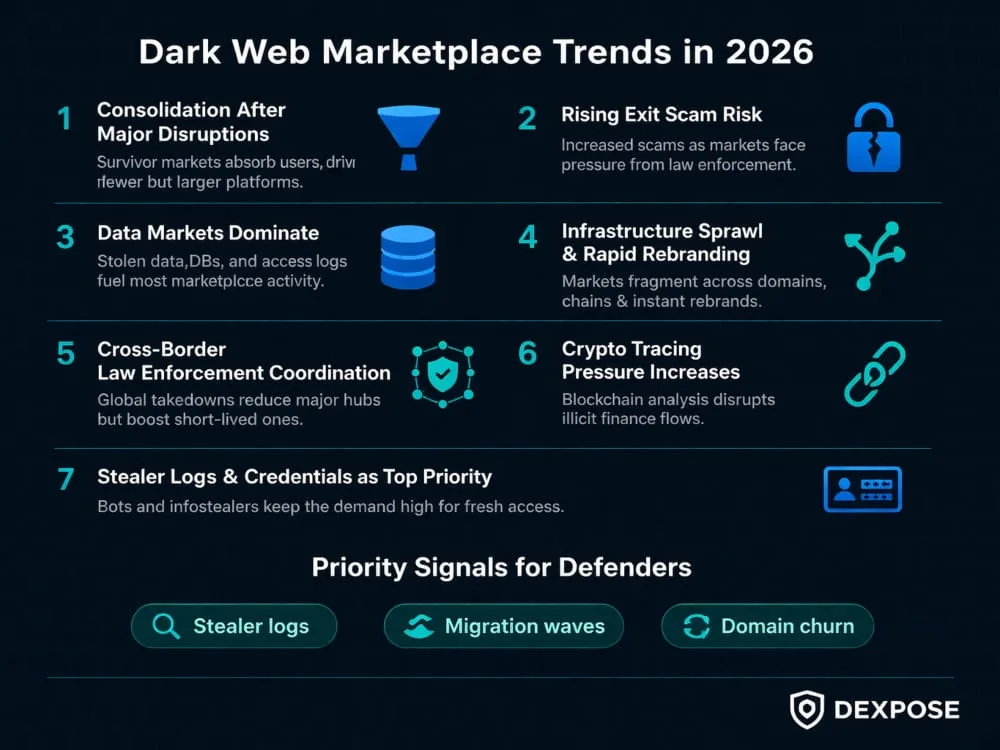
Dark Web Marketplace Trends in 2026
1) Consolidation after significant disruptions
The ecosystem keeps shrinking and reshaping around fewer “survivor” markets after major takedowns and shutdowns. The 2025 dismantling of Archetyp Market is a good example of how a single operation can force rapid vendor/buyer migration and reshuffle the leaderboard.
2) More exit risk than ever
In 2026, operator trust is still the weakest link. Large markets keep disappearing via likely exit scams, often right after ecosystem turbulence increases user inflows and wallet balances. TRM Labs’ assessment of Abacus going offline as a possible exit scam illustrates this pattern.
3) Data markets keep growing because they monetize cybercrime directly
Marketplaces focused on credentials, stealer logs, and access remain central because they map cleanly to account takeover, fraud, and ransomware staging. This is why BidenCash mattered: it industrialized carding at scale until its 2025 infrastructure seizure.
4) Infrastructure “sprawl” and rapid rebranding
A clear 2026 trend is many domains/entry points, with fast rotation, to withstand disruption. The BidenCash case is a concrete data point: the U.S. announced seizure of ~145 domains tied to the marketplace.
5) Cross-border enforcement is increasingly coordinated
Instead of single-country actions, the pattern is multi-country, multi-agency operations aimed at administrators, top vendors, and infrastructure. Europol’s Archetyp operation highlights this approach.
Related enforcement campaigns also target broader drug networks and darknet-linked supply chains (e.g., Operation RapTOR announcements).
6) Crypto remains the payment rail, but tracing pressure rises
Markets still rely on cryptocurrency, but enforcement and blockchain intelligence pressure continuecontinue to increase, which contributes to shorter market lifecycles and more sudden exits (scams or seizures). The DOJ statements around seizures (domains + crypto) reinforce that this is a core disruption lever in 2026.
7) What defenders should prioritize in 2026
If your goal is monitoring and exposure assessment (Dexpose-style positioning), the highest-signal trends are:
- Stealer-log + credential circulation (fastest path to ATO and initial access)
- Market migration waves after a seizure/exit (reposting spikes and new “brand” emergence)
- Domain/infrastructure churn (many domains, short-lived mirrors, frequent impersonation)
How Dark Web Marketplaces Operate in 2026
In 2026, dark net marketplaces function as semi-structured criminal platforms rather than anonymous forums. Most rely on escrow systems to manage transactions, vendor reputation scores to establish trust, and layered operational security to reduce exposure. Payments increasingly favor privacy-focused cryptocurrencies, while multisignature wallets help limit direct theft by marketplace operators.
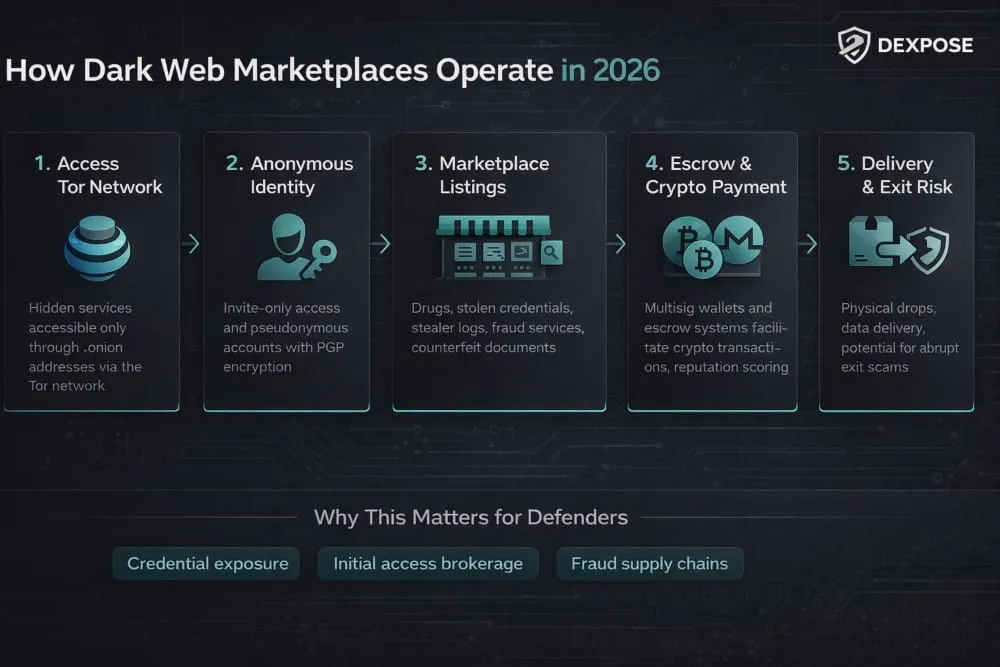
A key shift is the decentralization of activity. Marketplaces are no longer the sole hub for communication. Vendors and administrators routinely use Telegram for announcements, dispute handling, and migration during outages or takedowns. This hybrid model reduces reliance on any single platform and makes the ecosystem more resilient to disruption.
Dark Web Marketplaces in 2026: Structure, Risks, and Intelligence Signals
The internal structure of most marketplaces is built around categories such as digital fraud, stolen credentials, access brokerage, and illicit services. While the surface structure appears organized, underlying risks are high for both users and operators.
From an intelligence perspective, marketplaces generate valuable signals before threats become visible elsewhere. Early indicators often include sample data releases, changes in vendor behavior, sudden increases in specific listing types, or discussions about breached organizations. These signals frequently precede phishing campaigns, account takeovers, or ransomware activity observed on the open web.
What to Monitor Instead of Visiting Marketplaces
Effective monitoring does not require direct access to the marketplace. More actionable intelligence comes from observing surrounding activity across forums, chat platforms, and leak channels. This includes discussions referencing new data breaches, credential samples posted as proof, and migration announcements when marketplaces experience disruption.
Tracking patterns, such as repeated mentions of a company name, reused wallet addresses, or consistent vendor aliases, helps validate threats and assess risk without unnecessary exposure. Correlating these signals across Tor-based forums and Telegram channels provides a clearer picture of emerging threats than marketplace visibility alone.
How Dexpose Approaches Dark Web Marketplace Intelligence
Dexpose approaches dark web marketplace intelligence with a focus on monitoring and analysis rather than direct browsing. Instead of accessing marketplaces, Dexpose tracks activity across relevant Tor-based forums and associated Telegram channels to identify risk signals tied to fraud, data exposure, and emerging criminal campaigns.
By correlating signals across multiple surfaces, such as marketplace-related discussions, leak announcements, and off-platform coordination, Dexpose helps security teams detect threats earlier and with greater confidence. This cross-source correlation reduces false positives and provides context that single-channel monitoring often misses.
Dexpose also emphasizes early-warning alerts and evidence capture to support investigation and response. When indicators such as credential samples, brand impersonation, or access brokerage activity appear, security teams receive timely, actionable insights for validation, internal escalation, and remediation, without unnecessary exposure to illicit platforms.
Dark Web Market Takedowns and Seizures: 2024–2026
Law enforcement action against darknet markets has accelerated significantly since 2023, with coordinated international operations dismantling several of the ecosystem’s most prominent platforms in rapid succession. Understanding the timeline of these takedowns matters for security teams because each seizure event triggers predictable migration patterns, and migration events are when previously contained datasets resurface, get reposted at scale, and become newly actionable for threat actors on competing platforms.
Major Takedowns: December 2023 – June 2025
Kingdom Market, December 2023. A joint operation involving U.S., German, Swiss, Moldovan, and Ukrainian authorities seized Kingdom Market’s infrastructure and arrested several individuals connected to its operation. Kingdom had been active since approximately 2021 and offered narcotics, malware, forged documents, and cybercrime tooling. Vendor migration following the seizure concentrated primarily on Abacus Market through early 2024.
Archetyp Market, December 2024. One of the largest English-language drug markets at the time of its seizure, Archetyp had built a substantial vendor base and reputation for operational reliability over its roughly two-year run. Its December 2024 takedown reshaped the active market landscape heading into 2025, accelerating TorZon’s rise as the primary English-language generalist market and driving a measurable increase in WeTheNorth’s vendor registrations.
Abacus Market, July 2025 (exit scam). Not a law enforcement action, but operationally equivalent in its impact. Abacus, which held an estimated 70% share of Western darknet Bitcoin transaction volume at its peak, went dark in early July 2025 with escrow funds unrecoverable. The exit scam triggered the largest single migration event in the English-language darknet ecosystem since AlphaBay’s 2017 seizure, with vendors and buyers redistributing across TorZon, Russian Market, and STYX within days.
BidenCash, June 2025. U.S. authorities announced the seizure of approximately 145 domains associated with BidenCash. This carding marketplace had become the dominant platform for stolen payment card data following the 2023 collapse of several competing carding shops. The seizure disrupted a platform that had facilitated the trafficking of over 15 million payment card numbers and generated an estimated $17 million in criminal revenue since its 2022 launch. Carding activity following the seizure migrated primarily to Brian’s Club and its associated mirrors.
What Takedowns Mean for Your Exposure Window
A common misconception is that a market seizure closes the exposure window for data listed on that platform. It does not. Law enforcement seizures typically result in domain replacement and infrastructure disruption; they do not systematically destroy the datasets listed for sale. Vendors operating on seized markets routinely relist their inventory on surviving platforms within days, often at reduced prices as they reestablish their reputation with a new buyer base.
The practical implication: if your organization’s data appeared on any of the markets listed above before their respective takedown dates, the working assumption should be that it remains in circulation. The seizure changed where that data is accessible, not whether it is accessible.
For security teams, the most reliable signal is not which markets are currently online; it is whether your organization’s domains, credentials, or customer data are appearing anywhere across the active ecosystem. Dark web monitoring covers migration events. Cross-platform reposting catches this exposure regardless of which platform currently hosts it.
How to Monitor Dark Web Marketplaces (Without Visiting Them)
Effective dark web monitoring doesn’t require direct access to any marketplace. Security teams that attempt to browse these platforms expose themselves to legal risk, operational security failures, and unreliable intelligence. The more defensible and scalable approach is to monitor the signals generated by marketplaces across the surrounding infrastructure.
What to track instead of the marketplace itself
When a marketplace lists stolen data, that activity rarely stays contained. Vendors advertise on Tor-based forums like Dread. Sample data gets posted to Telegram channels to attract buyers. Breach announcements reference company names, domains, and employee email patterns. These surrounding signals are often more timely and more actionable than anything visible on the marketplace itself.
The highest-value signals to track in 2026 are:
- Credential samples, partial dumps posted as proof-of-breach, often containing email addresses, hashed passwords, or session tokens tied to your domain
- Stealer log references, mentions of your organization’s name, domain, or IP ranges in stealer log marketplaces like Russian Market or STYX
- Vendor migration announcements, when a marketplace collapses, vendors announce their new location; these announcements often reference which datasets they’re carrying over
- Brand mentions in fraud channels, impersonation kits, phishing templates, and forged documents referencing your brand circulate before attacks reach your customers
- Access broker listings, initial access to corporate networks is sold before ransomware deployment; catching these listings early is one of the highest-leverage intervention points
The monitoring workflow that actually works
Single-channel monitoring, watching only one marketplace or one forum, consistently misses the most dangerous threats. The most actionable intelligence comes from correlating signals across multiple surfaces simultaneously: Tor forums, Telegram channels, paste sites, and leak announcement boards.
The workflow that security teams increasingly rely on in 2026 follows three stages. First, continuous signal collection across dark web surfaces, without requiring direct marketplace access. Second, cross-source correlation that connects a credential sample on one forum to a vendor alias seen on another, or ties a domain mention to a known stealer malware family. Third, validated alerts with enough evidence to act, not a raw list of mentions, but contextualized findings that tell you what was exposed, where it appeared, and what the likely attack path is.
Why one-time checks aren’t enough
Dark web exposure is not a static condition. Data posted today may be scraped, reposted on a different market, or bundled into a larger dataset within 48 hours. A domain that appeared clean in a quarterly scan can surface in a credential dump the following week. When marketplaces collapse, as Abacus did in mid-2025, the datasets don’t disappear. They migrate, get repackaged, and resurface across competing platforms.
This is why continuous monitoring has replaced point-in-time assessments as the standard for organizations that take credential exposure seriously.
Find out if your domain is revealed on the dark web, right now
Dexpose scans dark web markets, stealer log marketplaces, and breach databases for your domain, employee credentials, and customer data. Your free exposure report is ready in minutes.
Dark web markets: Detects mentions across active marketplaces, including TorZon, STYX, Russian Market, and Brian’s Club.
Stealer log scanning: Identifies credentials harvested by infostealer malware before they’re used for account takeover
Breach database coverage: Cross-references public and non-public breach data tied to your domain and employee emails
Get your free exposure report.
Conclusion
Dark web marketplaces in 2026 are defined by instability, fragmentation, and constant change. While individual platforms come and go, the underlying threat patterns remain consistent. For defenders, understanding how these marketplaces operate and which signals matter is far more valuable than tracking rankings or attempting to access them.
Organizations concerned about data exposure, fraud, or credential abuse should prioritize monitoring, correlation, and response over visibility alone.
Cybercrime Laws Around the World | A Complete Investigator’s Reference Guide
Cybercrime laws are the country-specific and international legal frameworks that define which online acts- unauthorized access, data theft, fraud, harassment- count as crimes and what penalties…
Read more
Lesser-Known Ransomware Groups Still Targeting Businesses in 2026
Groups like Monti, Vice Society, Royal (now rebranded as BlackSuit), Cuba, Nokoyawa, Yanluowang, and Lorenz rarely make national headlines like LockBit or Qilin, but they’re still…
Read more
New & Emerging Ransomware Groups 2025-2026 | How to Respond
Newer/emerging ransomware groups are ransomware-as-a-service operations that surfaced in 2025 and 2026; among them are Interlock, BlackSuit, SafePay, Fog, Cactus, Lynx, 8Base, El Dorado, and Cicada3301,…
Read more