
Cyber Incident Response Plan: The Complete Guide (Steps, Templates & Team Roles)
A cyber incident response plan is a documented, step-by-step procedure that tells your organisation exactly what to do the moment a security incident is detected, who gets alerted, what gets contained first, and how operations recover with minimal damage. Without one, even a skilled security team ends up improvising during the worst possible moment.
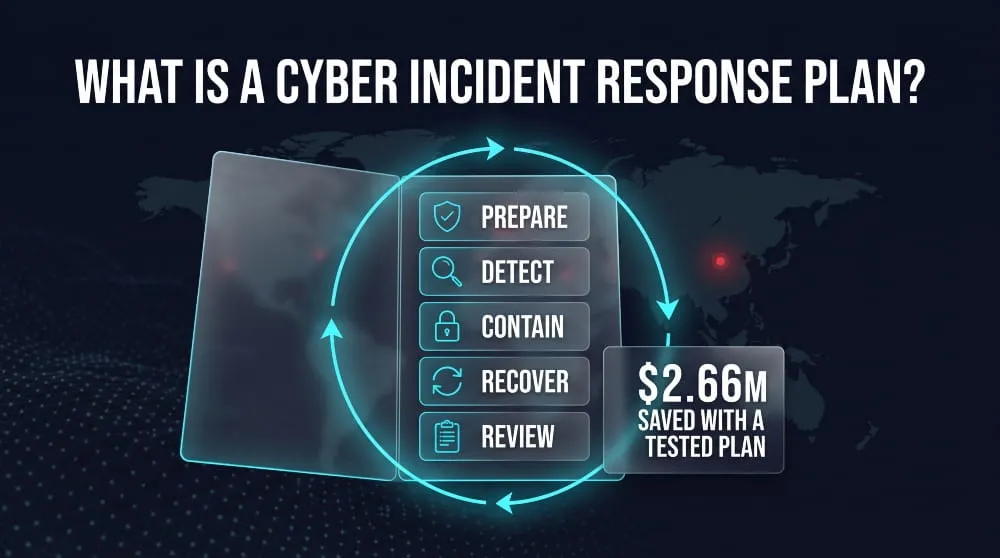
That gap shows up directly in the numbers. According to IBM’s 2025 Cost of a Data Breach Report, organisations with a tested incident response plan cut breach costs by an average of $2.66 million compared to those without one, making it one of the single biggest cost-reduction levers available to any security team, ahead of most individual security tools.
This guide walks through everything that a plan needs to include: the core response lifecycle, how to structure your response team, ready-to-use templates and checklists, the tools that speed up detection and containment, and the compliance requirements (HIPAA, SEC, GDPR) that shape how fast you’re required to act. Whether you’re building a plan from scratch or stress-testing one that already exists, you’ll find the full framework below.
What Is a Cyber Incident?
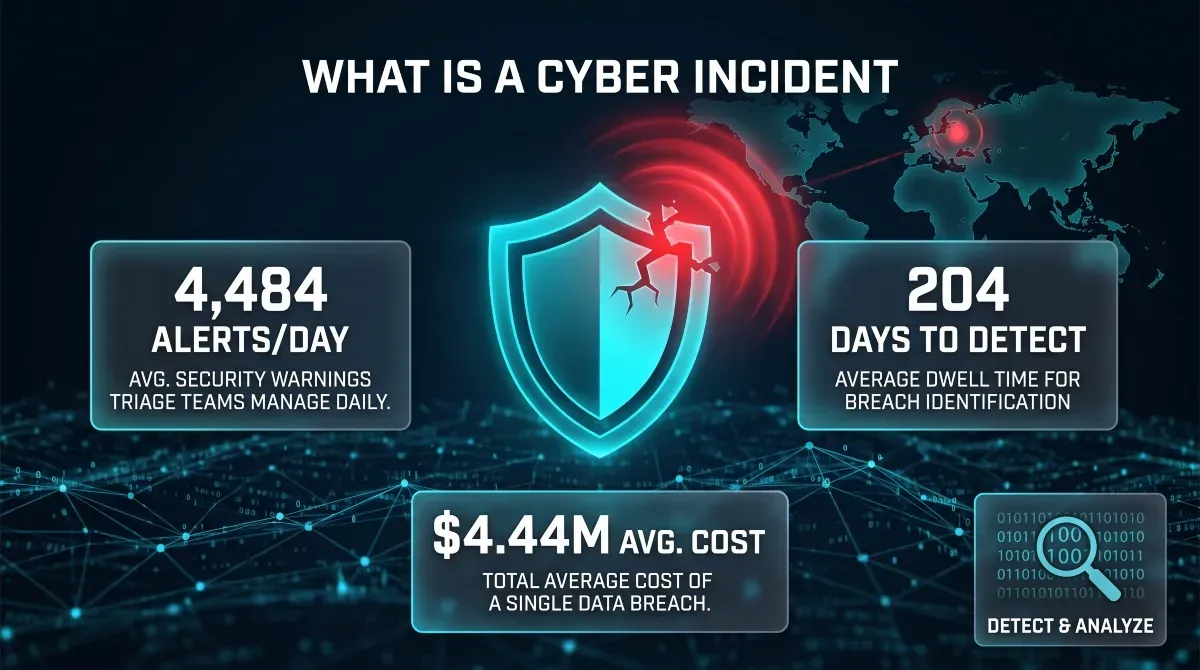
A cyber incident is any observed occurrence that actually violates or poses an imminent threat to an organization’s security policies, data, or systems- think unauthorized access, malware execution, or data exfiltration, not just a suspicious login attempt that turns out to be nothing. It’s the point where a security signal has been confirmed as something real that requires a response, not just monitoring.
That confirmation step matters because most organizations are drowning in raw signals long before anything qualifies as an incident. Security operations teams field an average of 4,484 alerts per day, and analysts are unable to act on 67% of them due to sheer volume. A cyber incident response plan exists precisely to separate the noise from the small fraction of alerts that represent genuine, actionable threats.
Cyber Incident vs. Cyber Security Breach, What’s the Difference?
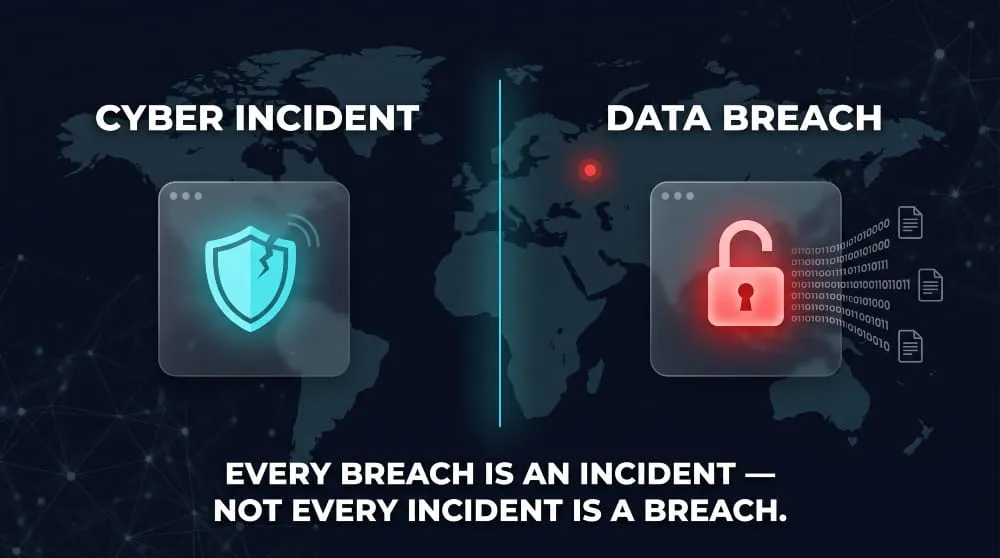
A cyber incident and a data breach are related but not interchangeable. Every breach starts as an incident, but not every incident becomes a breach. A breach specifically means confirmed unauthorized access to, or disclosure of, sensitive data, customer records, credentials, or financial information. An incident is broader: it covers anything from a blocked phishing attempt to a full-scale ransomware attack, whether or not any data actually left the environment. In practice, this distinction shapes your response: an incident triggers your response plan, while a confirmed breach typically triggers additional obligations, customer notification, regulatory disclosure, and legal review.
Cyber Incident vs. Security Event, Where’s the Line?
A security event is any observable occurrence in a system or network: a failed login, a firewall rule triggering, a file being modified. Most events are entirely routine and carry no security significance. A cyber incident is what an event becomes once it’s been triaged and confirmed to represent a genuine violation of security policy or an active threat. The line between the two is drawn by investigation, not by the alert itself: a spike in outbound traffic is just an event until analysis confirms it’s data exfiltration. At this point, it becomes an incident requiring your response plan.
Types and Categories of Cyber Incidents
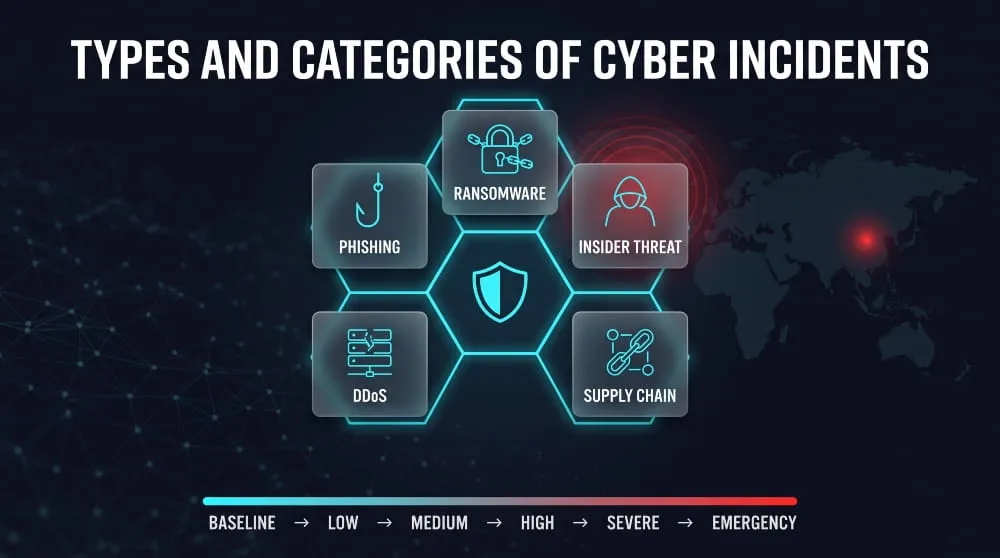
Cyber incidents fall into a handful of recurring categories based on how the attacker gains access and what they’re after: phishing and social engineering, malware and ransomware, unauthorized access, denial-of-service attacks, and insider threats. Classifying an incident correctly the moment it’s detected determines which playbook your response team follows and how quickly containment can begin.
Common Cyber Incident Examples
Phishing remains the most common starting point for a cyber incident; it overtook stolen credentials as the leading initial attack vector in 2025, responsible for 16% of breaches at an average cost of $4.8 million each. From there, incidents typically branch into a few recognizable patterns: ransomware, where attackers encrypt systems and demand payment; business email compromise, where a spoofed or hijacked account is used to redirect payments or extract data; distributed denial-of-service (DDoS) attacks that knock services offline; and insider incidents, where access is misused by someone already inside the organization. Supply chain incidents, where a vendor or third-party tool is compromised and used as an entry point, have also become one of the costliest and slowest categories to resolve.
How Severity Is Classified (Severity Matrix)
Severity classification determines how urgently an incident needs to be escalated, and most response plans borrow from CISA’s National Cyber Incident Scoring System, which sorts incidents into six tiers: Baseline, Low, Medium, High, Severe, and Emergency. A Baseline or Low incident is unlikely to affect operations or safety in any meaningful way. In contrast, a High or Severe incident is likely to cause a demonstrable impact on security, operations, or public trust. An Emergency-level incident sits at the top of the scale, one that threatens critical infrastructure or poses an immediate risk to life or national stability. Mapping incidents to a severity matrix like this lets a response team apply consistent, repeatable judgment under pressure instead of deciding urgency case by case.
What Is a Cyber Incident Response Plan?
A cyber incident response plan is a documented set of procedures that defines exactly how an organization detects, contains, and recovers from a security incident, including who’s responsible for each step and how decisions get made under pressure. It turns incident response from a scramble into a rehearsed process, so the first hour of an attack is spent executing a plan rather than debating one.
Why Every Organization Needs One
The gap between having a plan and not having one shows up directly in breach costs and recovery time. Organizations with a tested incident response plan save an average of $2.66 million per breach compared to those without one, according to IBM’s 2025 Cost of a Data Breach Report, yet an estimated 75% of small and mid-sized businesses still have no formal plan in place. That gap matters because the cost of an incident is driven largely by how long it takes to detect and contain; every day without a plan is a day spent deciding what to do instead of doing it.
Key Components of an Effective Plan
An effective cyber incident response plan is built around the same core structure regardless of company size or industry, closely mirroring the phases outlined in NIST SP 800-61: preparation, detection and analysis, containment, eradication, recovery, and post-incident review. Beyond these phases, a complete plan also defines clear roles and escalation paths so there’s no ambiguity about who makes the call to shut down a system or notify customers; a communication plan covering internal stakeholders, customers, and regulators; and documented recovery procedures for restoring systems and data. The strongest plans are also living documents, reviewed and stress-tested on a regular cadence rather than written once and left untouched until the day they’re needed.
The Cyber Incident Response Lifecycle (Step-by-Step)
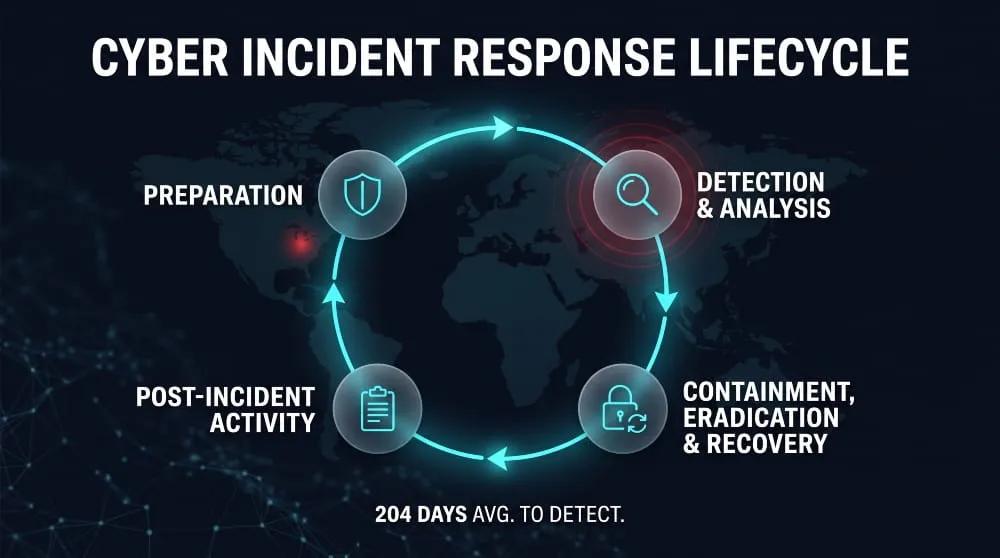
The cyber incident response lifecycle follows four main stages: preparation, detection and analysis, containment/eradication/recovery, and post-incident review- a structure defined by NIST SP 800-61 and adopted as the industry standard. Each phase feeds into the next, and skipping or rushing any one of them is usually where response plans break down in a real incident.
Preparation
Preparation is the work done before an incident ever happens: building the response team, defining roles and escalation paths, deploying detection tools, and documenting procedures so nobody is figuring things out for the first time mid-crisis. This phase also includes running tabletop exercises and simulations to test whether the plan actually holds up under pressure. Security leaders widely regard preparation as the phase that determines most of a response’s success, since the speed and accuracy of every later stage depends on decisions made here in advance.
Detection & Analysis
Detection and analysis is where a security event gets confirmed as a genuine incident, its scope assessed, and its severity classified. This phase is consistently the slowest part of the entire lifecycle; organizations take an average of 204 days to detect a breach and another 54 days to contain it once found, meaning most incidents go unresolved for close to eight months. Fast, accurate detection determines whether an incident stays small or escalates into a full-blown breach.
Containment, Eradication & Recovery
Once an incident is confirmed, containment stops it from spreading further, isolating affected systems, deactivating compromised accounts, or blocking malicious traffic. Eradication removes the root cause, whether that’s malware, an unauthorized account, or a vulnerability the attacker exploited. Recovery then restores affected systems and data to normal operation, typically with heightened monitoring in place to confirm the threat is fully gone before systems are trusted again. These three steps are often treated as one continuous phase because they overlap in practice; containment and eradication frequently happen in parallel rather than as a strict sequence.
Post-Incident Activity & Lessons Learned
The final phase turns a resolved incident into institutional knowledge: documenting exactly what happened, how it was handled, and what should change going forward. This includes updating the response plan itself, patching whatever gap allowed the incident to occur, and briefing leadership and any relevant regulators. Skipping this step is one of the most common reasons organizations experience repeat incidents of the same type. Without a formal lessons-learned process, the same gap that caused one incident is left open for the next.
Building Your Cyber Incident Response Team
A cyber incident response team is the group of people responsible for executing your response plan the moment an incident is confirmed, detecting it, containing it, communicating about it, and driving recovery. Whether that team lives entirely in-house, is fully outsourced, or blends both, having clearly assigned people ready to act is what turns a written plan into an actual response.
Key Roles and Responsibilities
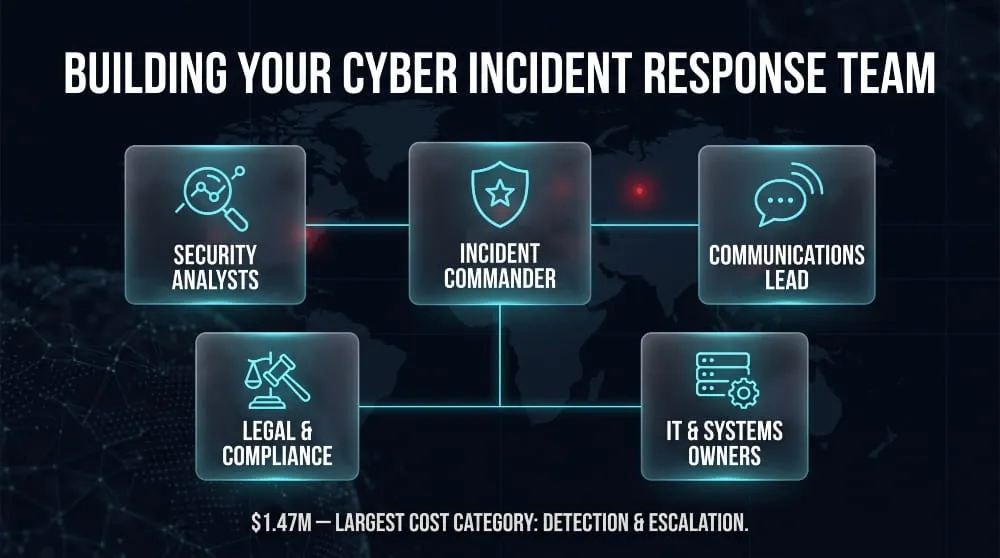
An effective response team is built around a small set of core roles rather than a large, loosely defined group. An incident commander leads the overall response and makes the final call on major decisions, such as taking systems offline. Security analysts handle detection, investigation, and technical containment. A communications lead manages messaging to employees, customers, and regulators, while legal and compliance representatives determine notification obligations under laws like HIPAA or the SEC’s disclosure rules. IT and systems owners execute the actual technical recovery, restoring affected infrastructure once the threat has been eradicated. Detection and escalation remain the costliest part of a breach in practice, averaging $1.47 million globally, more than any other cost category, which is exactly why clearly defined analyst roles matter as much as the plan itself.
In-House vs. Managed Incident Response
Building a fully in-house response team gives an organization direct control and institutional knowledge of its own systems. Still, it requires sustained investment in staffing, tooling, and ongoing training that many mid-sized organizations struggle to justify. Managed incident response, outsourcing some or all of detection and response to a specialized provider, gives smaller teams access to 24/7 monitoring and experienced responders without building that capability from scratch. Many organizations land on a hybrid model: an internal incident commander and IT staff who know the environment best, paired with a managed detection and response partner who provides round-the-clock monitoring and surge capacity when a major incident hits.
Cyber Incident Response Plan Template & Checklist
A cyber incident response plan template is a pre-structured framework covering every phase of response, preparation, detection, containment, recovery, and post-incident review that an organization customizes with its own systems, contacts, and escalation paths rather than building from a blank page. Starting from a proven template shortens the time it takes to get a workable plan in place and reduces the odds of missing a critical step.
Downloadable Framework Elements
A usable template needs to cover a specific set of elements, not just general guidance. That includes an incident classification and severity matrix, a contact tree with escalation paths and after-hours reach numbers, defined roles for each team member, step-by-step containment and eradication procedures by incident type, a communications plan for internal staff, customers, and regulators, and a post-incident review template to document root cause and lessons learned. Templates that skip the classification matrix or contact tree tend to fail exactly when they’re needed most, since those are the first two things a team reaches for in the opening minutes of an incident.
NIST-Based vs. Custom Frameworks
Most organizations build their plan on NIST SP 800-61, which structures response around preparation, detection and analysis, containment/eradication/recovery, and post-incident activity, a framework widely adopted because it’s vendor-neutral, well-documented, and maps cleanly to compliance requirements like HIPAA and SEC disclosure rules. A fully custom framework can be built from scratch instead, which offers more flexibility for unusual environments like industrial control systems or highly regulated sectors. Still, it takes considerably more effort to validate and tends to leave gaps a proven framework already accounts for. In practice, most effective plans start from NIST’s structure and customize the specifics, contacts, tools, and escalation thresholds, rather than reinventing the phases themselves. That customization only pays off if it’s tested: an estimated 70% of organizations rarely or never test their incident response plans, which means even a well-built template can fail silently until the day it’s actually needed.
Tools and Technology for Incident Response
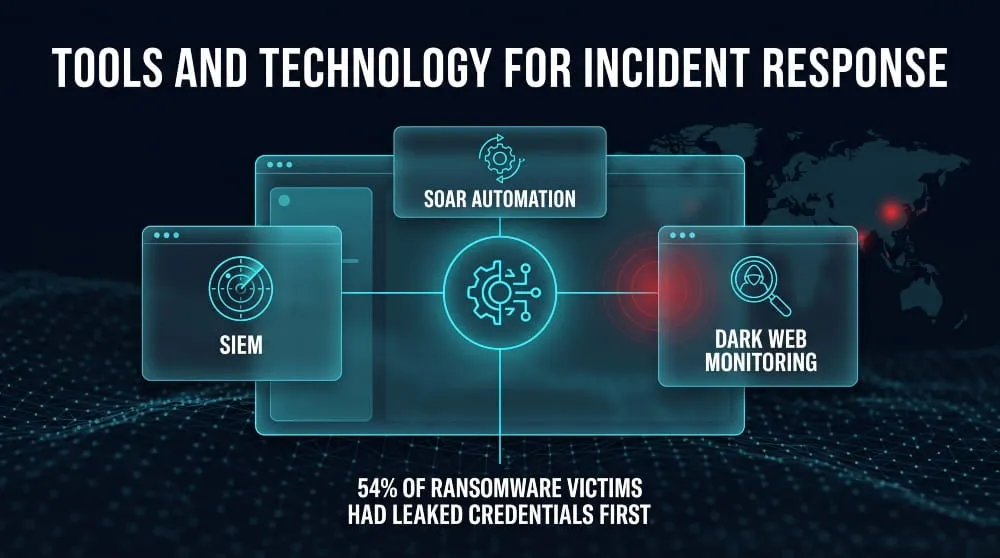
Modern incident response relies on a stack of purpose-built tools, SOAR platforms, SIEM systems, and monitoring feeds that let a small team detect, triage, and act on threats faster than manual investigation ever could. The right toolset doesn’t replace a response plan, but it’s what makes the plan executable at the speed a real incident demands.
SOAR Platforms and Automation
Security orchestration, automation, and response (SOAR) platforms connect an organization’s existing security tools and automate the repetitive parts of triage and containment, enriching alerts with context, running playbooks automatically, and escalating only what genuinely needs human judgment. This matters because manual triage simply can’t keep pace with modern alert volume, and the payoff is measurable: organizations that use AI and automation extensively in their security operations cut their breach lifecycle by 80 days and save nearly $1.9 million per breach on average compared to those that don’t. For most teams, automation isn’t about replacing analysts; it’s about making sure their time goes to the alerts that actually matter.
How Dark Web Monitoring Fits Into Early Detection
Dark web monitoring extends detection outside the corporate perimeter, tracking whether an organization’s credentials, employee data, or internal information have surfaced on criminal marketplaces, infostealer logs, or breach forums, often before that exposure is ever used in an attack. This closes a blind spot that traditional perimeter tools can’t see: stolen credentials are frequently harvested from personal devices or third-party breaches that never touch a monitored corporate asset. The stakes are significant; in Verizon’s 2025 Data Breach Investigations Report, 54% of ransomware victims had their domain credentials already circulating in stealer log marketplaces before the attack occurred, meaning the exposure was detectable well in advance. Feeding dark web monitoring alerts directly into an incident response plan turns a credential leak into an early warning rather than a discovery made after the fact, giving a response team the chance to force a reset or revoke access before an attacker ever logs in.
Compliance and Regulatory Requirements
Regulatory requirements shape how fast an organization must act after a cyber incident and who it’s legally required to tell, and these obligations vary significantly by industry and jurisdiction. A response plan that doesn’t account for these deadlines risks compliance violations layered on top of the incident itself.
HIPAA Incident Response Requirements
HIPAA requires healthcare organizations and their business associates to notify affected individuals within 60 days of discovering a breach of unsecured protected health information, and breaches affecting 500 or more individuals must also be reported to the Department of Health and Human Services within that same window. Smaller breaches can be reported to HHS annually rather than immediately, but the individual notification deadline still applies regardless of breach size. Given that healthcare remains the costliest industry for data breaches, averaging $7.42 million per incident, building HIPAA’s notification timeline directly into a response plan isn’t optional; it’s often the difference between a compliant response and a separate regulatory penalty layered on top of the breach itself.
SEC’s 4-Business-Day Disclosure Rule
Public companies in the United States must disclose material cybersecurity incidents within four business days of determining the incident is material, under Item 1.05 of Form 8-K. The clock starts at the materiality determination, not at the moment the incident is discovered, which makes that determination one of the most time-sensitive decisions in the entire response process. The disclosure must describe the incident’s nature, scope, and timing, along with its material impact or likely impact on the company’s financial condition, meaning legal and executive stakeholders need a seat in the response process from the earliest stages, not just after technical containment is complete.
GDPR and International Frameworks
Under GDPR, organizations operating in or serving the EU must notify their relevant data protection authority within 72 hours of becoming aware of a breach involving personal data. In cases of high risk to individuals, those individuals must be notified as well. Other jurisdictions layer on their own requirements; the UK’s NCSC and various national CERTs maintain separate reporting expectations for critical infrastructure operators. For organizations operating across borders, the practical takeaway is that a single response plan needs to account for the shortest deadline in play, since GDPR’s 72-hour window is considerably tighter than HIPAA’s 60 days or the SEC’s four business days.
The True Cost of a Cyber Incident
The cost of a cyber incident extends well beyond ransom payments or immediate cleanup; it includes lost business, regulatory fines, customer notification, and months of recovery work, and the total varies significantly by incident type and industry. Understanding where those costs concentrate is what makes a business case for investing in prevention and response capability.
Average Cost by Incident Type
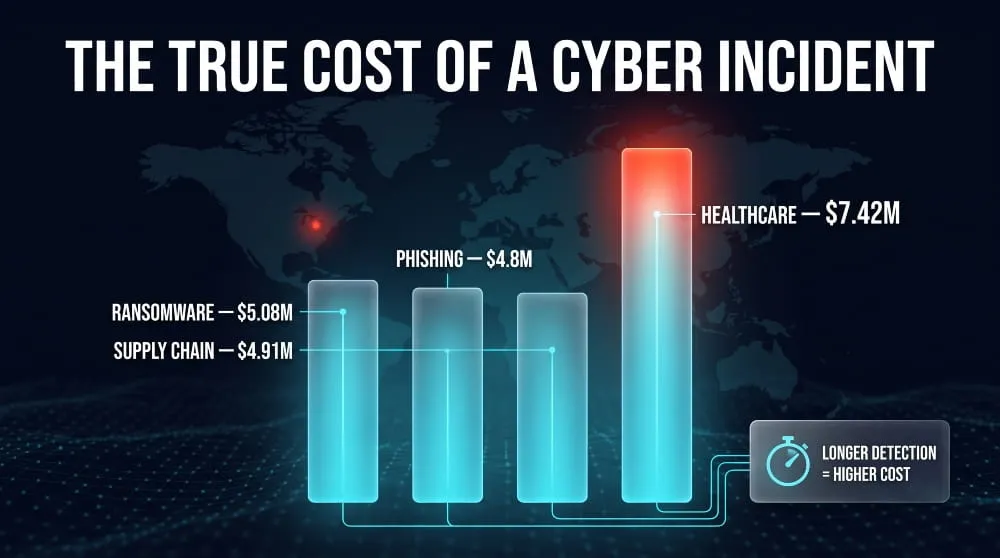
Ransomware and extortion incidents remain among the costliest, averaging $5.08 million globally, while supply chain compromises average $4.91 million and take the longest to resolve at 267 days. Phishing-originated breaches average $4.8 million, and breaches involving stolen or compromised credentials tend to run close behind while taking the longest to detect and contain of any category. Healthcare carries the highest overall average at $7.42 million per breach, driven by the sensitivity of patient data and long detection times. Across nearly every category, the pattern holds: incidents that take longer to detect and contain cost substantially more, which is exactly why detection speed is treated as the single biggest lever an organization can pull.
Business Impact Analysis Basics
A business impact analysis identifies which systems, processes, and data are critical to operations. It estimates the cost of losing access to each one for a given period of time, hours, days, or weeks. This analysis feeds directly into incident response prioritization: it tells a team which systems must be restored first during recovery. It justifies the resourcing needed for faster detection and response capability. Detection and escalation alone represent the largest single cost category in a breach, averaging $1.47 million globally, which is often the clearest evidence a business impact analysis can point to when making the case for additional monitoring investment.
Sector-Specific Considerations
While the core structure of incident response stays consistent across industries, the resources, threats, and stakes involved shift considerably depending on an organization’s size and sector.
Small Business Incident Response
Small and mid-sized businesses face the same threat landscape as large enterprises. Still, with a fraction of the resources to respond, it shows: an estimated 75% of SMBs have no formal cybersecurity incident response plan in place. Without dedicated security staff, most small businesses lean on a lightweight plan built around a few essentials: a designated point person, a short list of trusted external contacts (IT provider, legal counsel, cyber insurance carrier), and a managed detection service to cover monitoring around the clock. The absence of a large security team makes preparation and clear escalation contacts even more important, since there’s little room to improvise once an incident is underway.
Manufacturing, Higher Ed, and Critical Infrastructure
Manufacturing, higher education, and critical infrastructure operators face incident response challenges that go beyond standard IT systems. Manufacturing environments often mix modern IT with older operational technology (OT) and industrial control systems that weren’t designed with cybersecurity in mind, meaning containment decisions have to account for physical safety and production downtime, not just data. Higher education institutions manage large, decentralized networks with thousands of individually managed devices and limited centralized control, widening the attack surface considerably. Critical infrastructure operators, utilities, water systems, and transportation face the added weight of national security-level severity classifications and regulatory oversight, where an incident’s impact can extend well beyond the organization itself into public safety.
Frequently Asked Questions (FAQ’s)
What triggers an incident response drill?
An incident response drill is typically triggered on a scheduled basis; most security teams run tabletop exercises at least once or twice a year, rather than waiting for a real incident to test the plan. Some organizations also run a drill after a significant change, such as a new system deployment, an organizational restructuring, or a near-miss that revealed a gap in the existing plan.
How is an incident different from an alert?
An alert is a raw signal from a security tool- a login anomaly, a flagged file, or unusual network traffic- that hasn’t yet been confirmed as a genuine threat. An incident is what that alert becomes once investigation confirms it represents an actual security violation. The vast majority of alerts never become incidents; security teams field thousands of alerts a day, but only a small fraction require an incident response.
What’s the fastest way to detect an incident early?
The fastest path to early detection combines automated monitoring across an organization’s own environment with visibility into external exposure, such as dark web monitoring for leaked credentials or company data. Since more than half of ransomware victims had their credentials already circulating on criminal marketplaces before the attack occurred, monitoring outside the perimeter, not just inside it, is often what catches an incident before it escalates into a full breach.
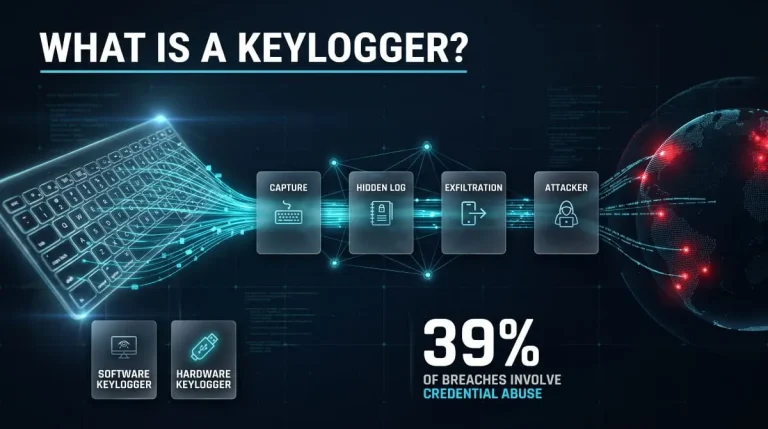
What Is a Keylogger? Definition, Types, Detection and Removal (Complete 2026 Guide)
A keylogger is software or hardware that records every keystroke typed on a device, usually without the user knowing. Attackers use keyloggers to steal passwords, card…
Read more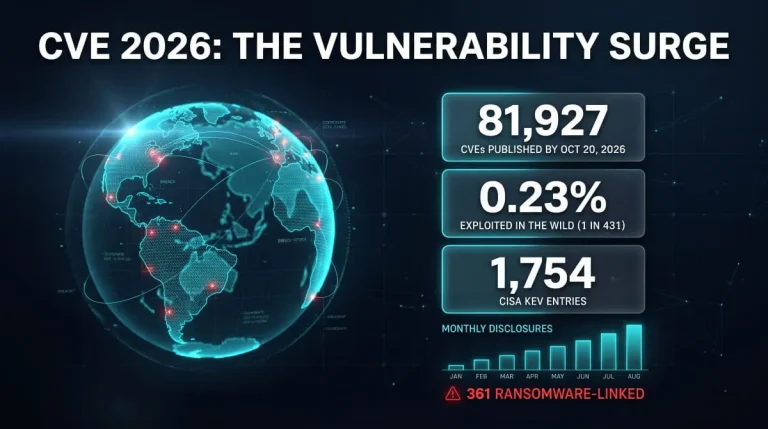
CVE 2026 | The Complete Guide to New, Critical & Actively Exploited Vulnerabilities (Updated Weekly)
CVE 2026 covers every publicly disclosed software flaw assigned a CVE-2026-NNNNN identifier this year, and it is already the largest annual list on record. This guide…
Read more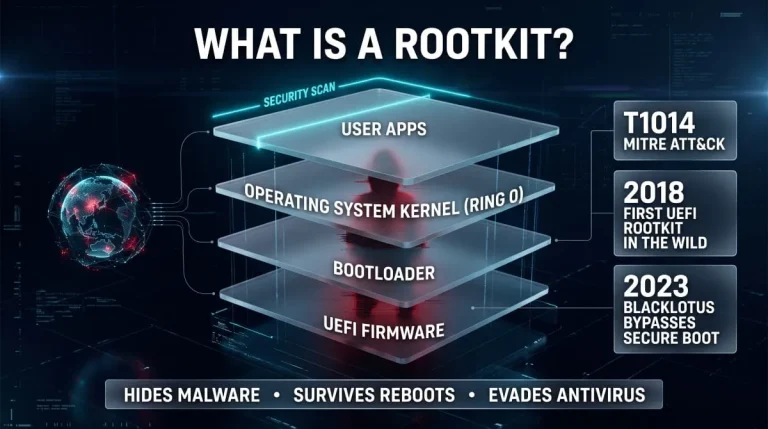
What Is a Rootkit? Definition, Types, Examples, Detection and Removal (Complete Guide)
A rootkit is malicious software that hides itself and the malware it protects by running with the highest privileges and tampering with what the operating system…
Read more