
Data Breach Information | What It Means, How It Happens, and What to Do Next
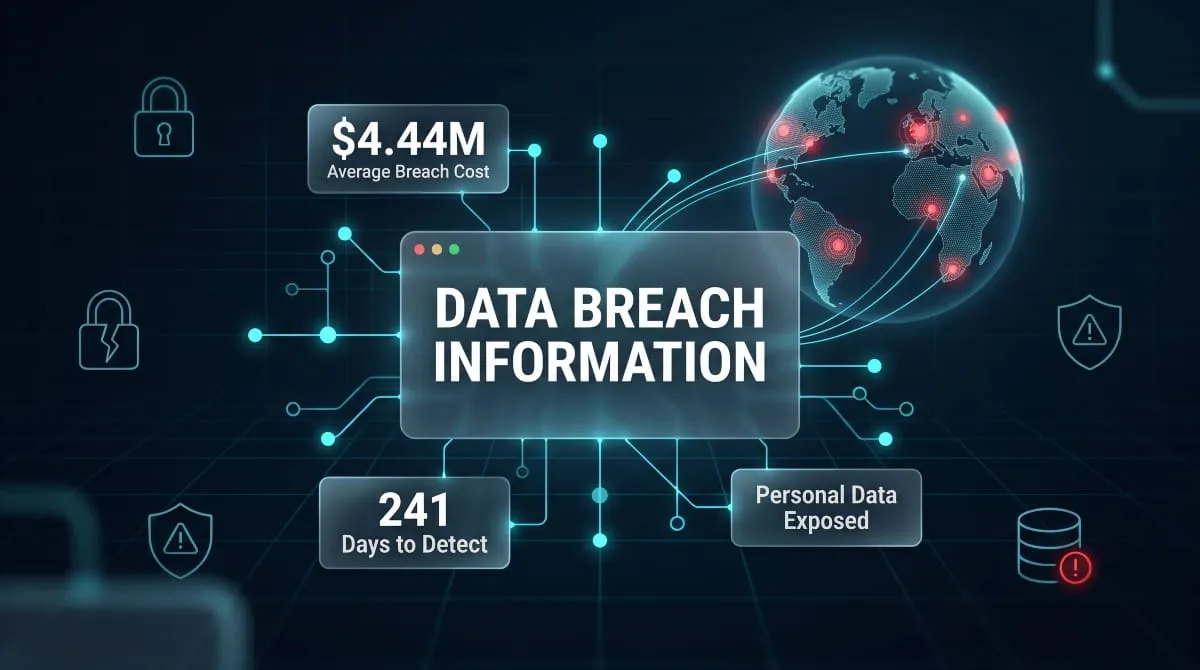
A data breach happens when unauthorized parties access, steal, or expose personal, financial, or medical information that was meant to stay private, whether through hacking, malware, human error, or a stolen device. When this kind of data breach occurs, the people whose data is exposed are often the last to find out, sometimes months after the incident.
Data breach information matters because breaches have become a routine part of digital life rather than a rare event. The global average cost of a data breach reached $4.44 million in 2025, and it typically takes organizations well over 200 days to even detect and contain one, which means your personal information can circulate on the dark web long before you’re notified. Understanding what an information security breach actually involves, how personal information data breaches happen, and what to do when your information has been breached is the difference between catching exposure early and dealing with the fallout of identity theft, fraud, or a compromised account down the line.
This guide breaks down data breach information in plain terms: what counts as a breach, the different types of information security breaches you’re likely to encounter, how to check whether your own data was exposed, and the concrete steps to take the moment you find out it was.
What Is a Data Breach?
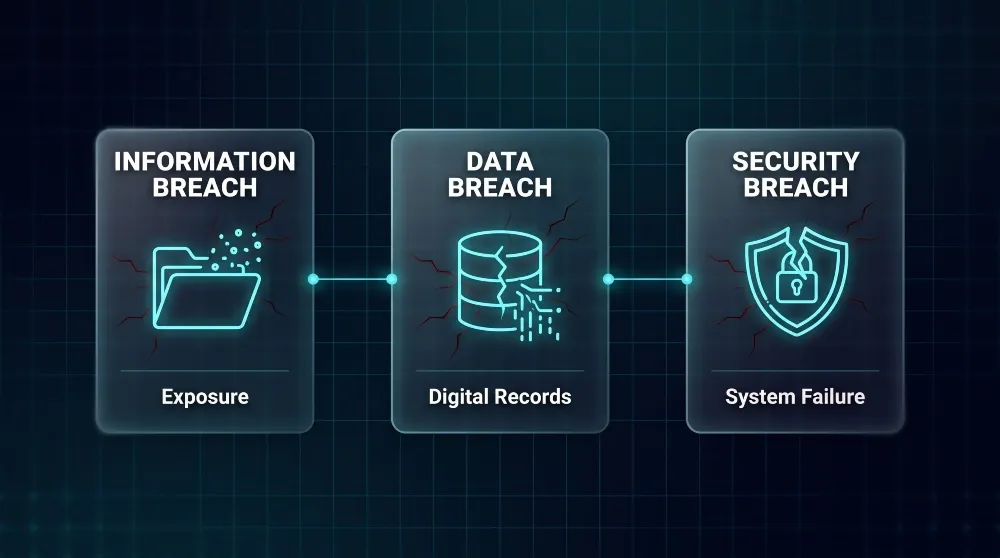
A data breach is any incident where information that should have been protected, personal, financial, medical, or corporate, is accessed, disclosed, or stolen by someone who wasn’t authorized to see it. The terms information breach, data breach, and security breach are often used interchangeably, but they describe slightly different angles of the same underlying event.
Information Breach vs. Data Breach vs. Security Breach
An information breach refers broadly to any unauthorized exposure of protected information, regardless of format or cause. A data breach is the more specific, commonly used term for this same event when it involves digital records, customer databases, cloud storage, email systems, or internal files. A security breach is broader still: it describes any failure of a security control, which may or may not result in information breaches. In practice, a security breach is the “how” (a firewall failure, a stolen password, a phishing click), while a data breach or personal information breach is the “what”, the actual information exposed as a result. Most people searching for data breach information are really asking about the same thing: has protected data left the organization’s control and ended up somewhere it shouldn’t be?
What Counts as “Personal Information” in a Breach
Personal information in a data breach context includes anything that can identify a specific person or be used to impersonate, defraud, or harm them. This typically covers full names, Social Security or national ID numbers, dates of birth, home addresses, phone numbers, login credentials, and financial account details. It also extends further than most people expect: medical records, insurance details, biometric data, and even browsing or location history can qualify as personal information in a data breach if exposed. When companies disclose that personal information was compromised, the specific categories matter: a breach involving only email addresses carries a very different risk than one involving Social Security numbers or medical history, which is why breach notifications typically spell out exactly what data was involved rather than describing the incident in vague terms.
How Information Technology Security Breaches Occur
Information technology security breaches stem from a mix of technical failures and human error, and the human side is far larger than most people assume. Verizon’s Data Breach Investigations Report has repeatedly found that the majority of confirmed breaches involve a human element, phishing emails, stolen or reused credentials, misconfigured cloud storage, or an employee mistakenly sending sensitive data to the wrong recipient. On the technical side, breaches through occurred software vulnerabilities, malware and ransomware infections, weak or missing encryption, and third-party vendors who had access to a company’s systems and were breached themscause so m breachedany breach information incidents trace back to a single compromised login or an overlooked update, security teams increasingly treat monitoring for exposed credentials on the dark web as a frontline defense rather than an afterthought.
Types of Data Breaches
Data breaches vary widely depending on what information is exposed and who it belongs to, and the type of breach largely determines both the risk to the people affected and the obligations placed on the organization involved. Below are the categories that most often arise in information security breaches today.
Medical & Patient Information Breaches
A medical information breach occurs when protected health information, diagnoses, treatment records, insurance details, or prescription history is accessed or disclosed without authorization. Breach of patient information is treated with particular severity because health data can’t be changed the way a password or credit card number can, and it’s frequently combined with identifiers like Social Security numbers, making it valuable for both identity theft and insurance fraud. This is reflected in the numbers: healthcare consistently ranks as the most expensive industry for data breaches, with IBM’s most recent Cost of a Data Breach Report putting the average healthcare breach at $7.42 million, well above the cross-industry average. A patient information breach typically also triggers HIPAA notification requirements in the US, meaning affected individuals and regulators must be notified within a defined timeframe once the breach is discovered.
Financial Information Breaches
A shared financial information data breach exposes data like bank account numbers, credit card details, transaction histories, or investment account credentials, information that can be used almost immediately for fraud. Unlike some other categories, financial information breaches are often detected quickly because unauthorized transactions tend to surface fast, but the exposed data itself frequently ends up for sale on dark web marketplaces well before the breached organization issues a public notification. Financial institutions are also subject to some of the strictest regulatory reporting timelines of any industry, given how directly this category of breach translates into monetary loss for consumers.
Employee & Workplace Data Breaches
A data breach of employee information exposes details that organizations hold about their own workforce rather than their customers, payroll records, Social Security numbers, direct deposit information, benefits enrollment data, and sometimes performance or disciplinary information. These breaches are particularly damaging because they often go undetected for longer; internal HR and payroll systems typically receive less security monitoring than customer-facing databases, even though they hold equally sensitive data. Employees affected by this type of breach face the same identity theft and fraud risks as customers, but with less visibility into when or how the exposure happened.
Student Information Breaches
Student information data breaches expose records held by schools, universities, or the education technology platforms they use, including names, dates of birth, grades, disciplinary records, and, in some cases, health or special education information. Because students are frequently minors and their information can be used for years without detection (a stolen child identity may go unnoticed until they apply for credit as an adult), this category of breach carries long-tail risk that isn’t always reflected in the immediate response. Education-sector data breaches have also become more frequent as schools rely more heavily on third-party platforms, each of which represents an additional point of potential exposure.
7 Common Causes of Information Security Breaches
Most information security breaches stem from a small, recurring set of causes rather than novel attack methods. The most common include: phishing and social engineering, where employees are tricked into handing over credentials; stolen, weak, or reused passwords; unpatched software and systems left vulnerable to known exploits; misconfigured cloud storage or databases left accidentally public; malware and ransomware infections; insider threats, whether malicious or accidental; and third-party or vendor breaches, where an attacker compromises a company by first breaching one of its suppliers. Major information security breaches in recent years have typically involved more than one of these causes at once, a phishing email that leads to stolen credentials, for example, which are then used to exploit an unpatched system. Current information security breach statistics consistently show that the majority of incidents trace back to the same handful of preventable causes, which is why monitoring for early warning signs, such as credentials appearing on the dark web, remains one of the most effective ways to catch a breach before it escalates.
How to Know If Your Information Was Breached
You can find out if your information was breached by watching for specific warning signs, checking official breach notification sources, or running your email and personal details through a dedicated scanning tool. Doing all three gives the most reliable picture, since companies don’t always notify victims quickly.
Signs Your Personal Information May Be Exposed
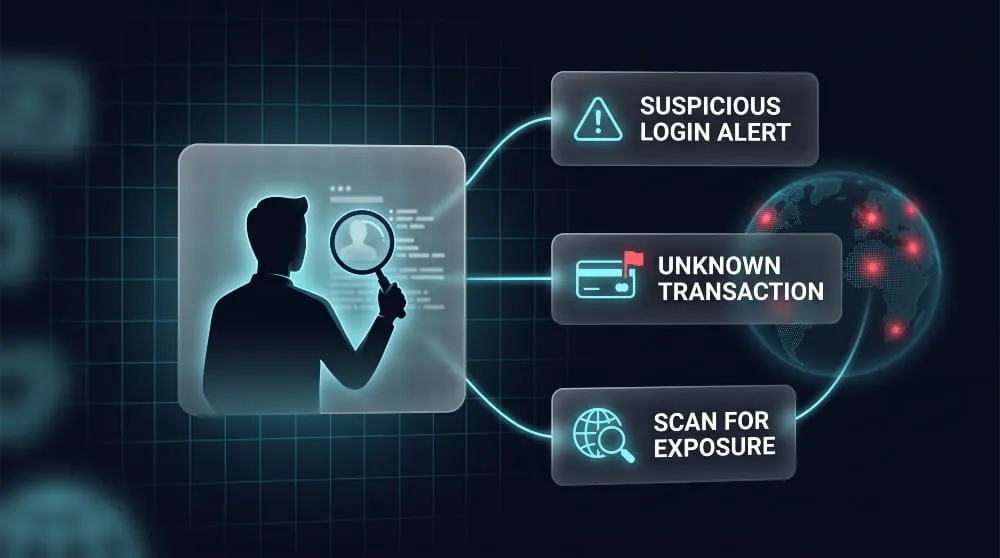
The clearest sign that your personal information was exposed is an unexpected security breach or notification email, but many people find out through indirect clues first. These include unfamiliar charges on a bank or credit card statement, login alerts for accounts you didn’t access, password reset emails you didn’t request, or a sudden increase in targeted phishing attempts that reference real details about you. A spike in spam calls or texts to a number you rarely share can also indicate that your data was exposed in a breach and later sold or circulated. Because breached information often surfaces on the dark web before an official notification goes out, these early behavioral signs can appear weeks or months before a company publicly confirms anything.
How to Check If You’ve Been in a Data Breach
To check if you’ve been in a data breach, start with the notification letters or emails companies are legally required to send when your data breach personal information was involved, then cross-reference your accounts against known breach databases. Was your information in the data breach headlines from the past year? It’s worth checking directly rather than assuming breach disclosures don’t always reach every affected person, especially if contact details on file were outdated. The most reliable method is running your email address and key identifiers through a dedicated breach-checking tool rather than searching your name and hoping for news coverage, since most breached data circulates privately on dark web forums and marketplaces long before it becomes public knowledge.
Free Tools to Scan for Your Exposed Data
The fastest way to find out if your information was breached is a free, purpose-built scan rather than manual searching. DeXpose’s Email Data Breach Scan checks whether your email address appears in known data breaches and dark web sources, giving you a direct answer instead of a guess. For a broader picture, the Free Darkweb Report scans dark web markets, malware logs, and public breach data to show your full exposure footprint in one pass. Both tools are built specifically to answer the question at the center of this section: has my information been breached, without requiring any technical knowledge to interpret the results.
What to Do When Your Information Has Been Breached
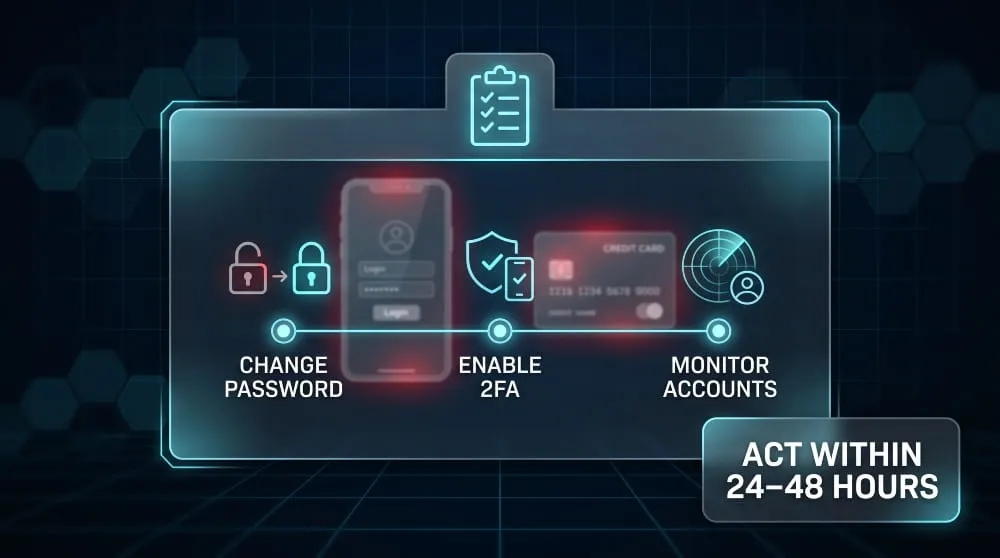
When your information has been breached, the priority is to act within the first 24–48 hours: change affected passwords, check for unauthorized activity, and determine exactly what type of data was exposed, since that determines every step after it. Waiting for more details before taking action is the most common mistake people make after a breach.
Immediate Steps After a Breach Notification
The first move after a breach notification is to read it carefully rather than skim it. It will typically specify what personal information breach occurred, whether it involved passwords, financial details, medical records, or identifiers like a Social Security number, and that detail should shape your response. Change the password on the affected account immediately, and on any other account where you reused the same password, since credential reuse is one of the most common ways a single information breach can cascade into multiple compromised accounts. Enable two-factor authentication wherever it’s available, and log out of all active sessions on the affected account if that option exists. If the notification mentions your information was exposed in a data breach involving a password manager, financial app, or primary email, treat that account as the highest priority, since it often serves as the recovery method for everything else.
Protecting Financial and Medical Accounts
If a data breach personal information notice involves financial details, contact your bank or card issuer directly to flag the account, request a new card number if needed, and set up transaction alerts so unauthorized charges surface immediately rather than at the end of a billing cycle. For breaches involving Social Security numbers or other government identifiers, placing a fraud alert or credit freeze with the major credit bureaus prevents new accounts from being opened in your name, which is typically more damaging than a single fraudulent charge. When a patient information breach or breach of medical information is involved, request your medical records and insurance statements for unfamiliar entries, since medical identity theft often shows up as claims for treatment you never received. The consequences of information security breaches compound quickly when financial and medical exposure overlap, so addressing both channels at once rather than sequentially reduces the window an attacker has to act.
Long-Term Monitoring and Prevention
A single breach response isn’t the end of the process, since breached information often resurfaces on the dark web months or years after the original incident, sometimes bundled with data from unrelated breaches to build a more complete profile. Ongoing dark web monitoring flags your information if it reappears in a new breach, a credential dump, or a marketplace listing, giving you a chance to act before it’s used against you rather than after. Pairing that with basic prevention habits, unique passwords per account, a password manager, and caution around unsolicited requests for personal details closes off the most common paths that turn one information breach into a repeated pattern. Given that most information security breaches stem from a small set of recurring causes, this combination of monitoring and prevention addresses the mechanics of how breaches occur, not just their aftermath.
Who Investigates a Data Breach
Who investigates a potential information breach depends on the type of data involved and where the affected organization operates. Still, it typically involves some combination of internal security teams, industry regulators, and, in serious cases, law enforcement. There’s rarely a single investigator; most breaches trigger parallel investigations from different bodies with different priorities.
Regulatory Bodies and Reporting Requirements
The regulatory body that investigates a data breach depends on the sector and jurisdiction: healthcare breaches in the US fall under the Department of Health and Human Services’ Office for Civil Rights, financial breaches often involve the FTC or state attorneys general, and breaches affecting EU residents fall under national data protection authorities. Most jurisdictions now impose strict reporting requirements once a breach is identified, since regulators need timely visibility to assess risk to affected individuals and to check whether the organization met its security obligations in the first place. Consequences of information security breaches at the regulatory level can include fines, mandated audits, and public enforcement actions, separate from any lawsuits or damages claims individuals pursue on their own.
Data Controller Obligations (ICO & Compliance Timelines)
Under UK and EU data protection law, data controllers must inform the ICO of a data breach within 72 hours of becoming aware of it, unless the breach is unlikely to result in risk to individuals’ rights and freedoms. This 72-hour clock is one of the tightest breach-reporting timelines in any major regulatory framework, and it applies regardless of how the breach happened, whether through a security breach, an employee error, or a third-party vendor compromise. Missing that window, or failing to notify affected individuals when the risk is deemed high, is itself treated as a separate compliance failure on top of the underlying data breach, which is why organizations increasingly build breach-detection monitoring directly into their incident-response planning rather than waiting to be notified by a third party.
Information Governance and Internal Investigations
Before any external regulator gets involved, most organizations run their own internal investigation, and this is where information governance frameworks matter most. A breach of information governance, gaps in how data was classified, access-controlled, or retained, is frequently what an internal investigation uncovers as the root cause, even when the immediate trigger was a phishing email or stolen credential. Internal teams typically work to contain the breach, determine exactly which data was affected, and document the timeline before any public or regulatory disclosure goes out, since that documentation shapes both the notification process and any later regulatory review. Strong information governance doesn’t prevent every breach, but it significantly shortens the investigation and reduces the odds that the same breach occurs again through the same gap.
World’s Biggest Data Breaches (Notable Examples)
The world’s biggest data breaches share a common thread: they involve hundreds of millions of exposed records, take months to fully investigate, and end up reshaping how entire industries handle data security afterward. Looking at these cases is less about any one company and more about understanding how large-scale exposure actually unfolds.
What These Breaches Have in Common
Nearly every mega-breach on record started with a single overlooked weakness rather than a sophisticated, unstoppable attack. An unpatched web application vulnerability, a compromised third-party vendor, or stolen employee credentials have each been the root cause behind breaches affecting well over 100 million people at a time. Detection lag is another recurring pattern: some of the largest breaches in history went undiscovered for months after the initial intrusion, giving attackers extended access before anyone noticed. The information exposed also tends to follow a pattern: names, Social Security numbers, financial account details, and login credentials appear across nearly every major incident, since that combination is what makes stolen data valuable on dark web markets in the first place.
Lessons for Individuals and Businesses
For individuals, the biggest takeaway from major information security breaches is that scale doesn’t equal risk to any one person; someone in a 3-billion-record breach faces the same practical exposure as someone in a smaller, more targeted one, and the response is identical either way: check whether your information was involved, change reused passwords, and monitor for signs of misuse. For businesses, the lesson is that the largest breaches on record were almost always preventable with existing security practices, patching known vulnerabilities, monitoring third-party vendor access, and catching exposed credentials before attackers use them. That last point is increasingly why organizations treat dark web monitoring as a standing security control rather than a reactive measure: most major information security breaches, in hindsight, showed early warning signs, stolen credentials or internal data appearing on dark web forums, well before the full scope of the breach became public.
Frequently Asked Questions
What is an information security breach?
An information security breach is any incident where protected data, personal, financial, medical, or corporate, is accessed, disclosed, or stolen without authorization, typically as the result of a failed or bypassed security control. It refers to information technology security breaches ranging from a single stolen password to a large-scale intrusion affecting millions of records, and the term covers both the security failure itself and the resulting information breach.
How do I know if my data was part of a breach?
The most reliable way to know if your information was breached is to check directly rather than wait for a notification, since companies can take months to identify and disclose an incident. Look for breach notification emails or letters first, then run your email address through a dedicated scanning tool, like DeXpose’s Free Darkweb Report or Email Data Breach Scan, to check whether your data has been exposed on the dark web, in a public breach, or in stolen credential logs, even from incidents that were never publicly reported.
What should I do first after a breach?
The first step after any breach notification is to change the password on the affected account and on any other account where you reused it, since credential reuse is one of the most common ways a single breach can lead to multiple compromised accounts. From there, enable two-factor authentication, check for unauthorized activity on financial or medical accounts tied to the exposed information, and set up ongoing monitoring so you’re alerted if the same data resurfaces in a future breach rather than finding out after the fact.
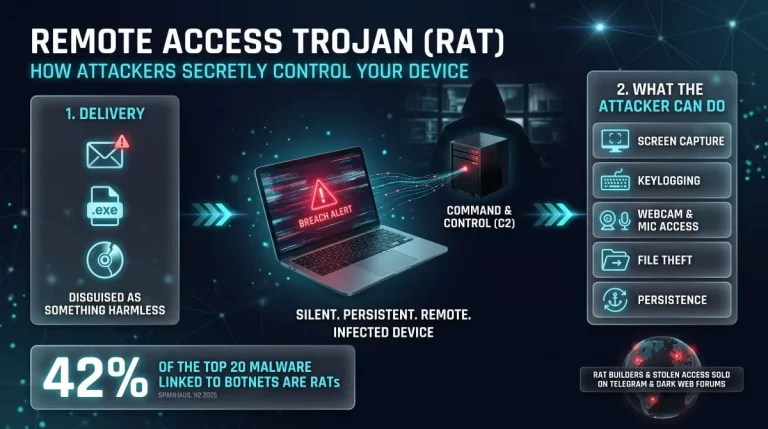
Remote Access Trojans (RATs) | Major RAT Families, How They Work and How to Detect Them
What Is a Remote Access Trojan (RAT)? A remote access trojan (RAT) is malware that gives an attacker hidden, interactive control over someone else’s computer. Once…
Read more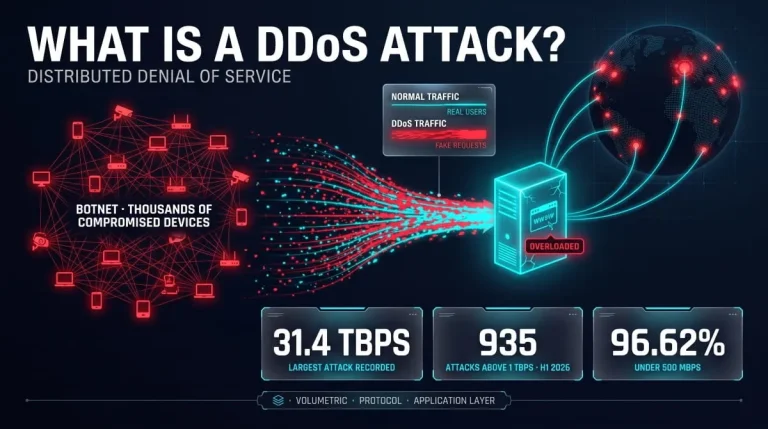
What Is a DDoS Attack? The Complete Guide to Types, Prevention, Detection & Recovery
A DDoS attack (distributed denial-of-service attack) floods a server, website, or network with traffic from many compromised devices at once, overwhelming it so legitimate users can’t…
Read more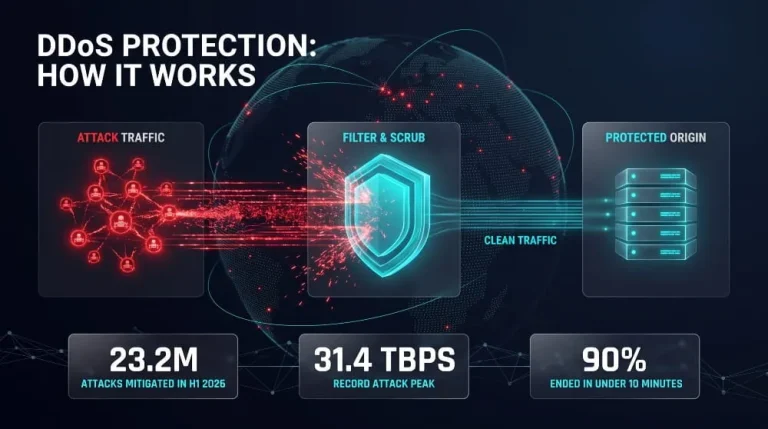
DDoS Protection | How It Works and How to Protect Against DDoS Attacks
DDoS protection combines tools and techniques to detect and filter malicious traffic from a distributed denial-of-service (DDoS) attack before it overwhelms a website, server, or network.…
Read more