Every day, billions of people use the internet to search for information, watch videos, shop online, and connect with others. But most people only ever see a tiny fraction of what the internet actually contains.
The part you use daily, Google, YouTube, news websites, and social media, is called the surface web. It is the visible, searchable layer of the internet. However, beneath it lies a much larger and largely hidden portion known as the deep web.
The deep web is not a secret club, a criminal marketplace, or a place built for hackers. In reality, most of the deep web is completely ordinary. It includes your email inbox, your online banking portal, private company databases, academic research archives, and medical records. These pages exist on the internet but are simply not indexed by search engines like Google.
Yet the term “deep web” is frequently misunderstood, misused, and sensationalized, often conflated with the dark web, which is entirely different.
This guide is designed to give you a clear, honest, and complete understanding of the deep web. Whether you are curious about what it is, how it compares to the dark web, what it actually contains, or whether it is safe or legal to access, you will find straightforward answers here.
By the end of this guide, you will know:
- What the deep web really is and how it is defined
- How it differs from the surface web and the dark web
- What kinds of content actually exist on it
- How people access it, and what the risks are
- Whether browsing the deep web is legal or illegal
- How researchers, businesses, and investigators use it professionally
There is a lot of myth surrounding this topic. This guide cuts through all of it.
What Most People Get Wrong About the Deep Web
The biggest misconception is that the deep web and the dark web are the same thing. They are not.
The deep web is simply any part of the internet that search engines cannot index. That includes millions of completely legitimate, private, and protected web pages. The dark web, on the other hand, is a small, intentionally hidden network that requires special software to access and is associated with both privacy tools and illegal activity.
Think of it this way:
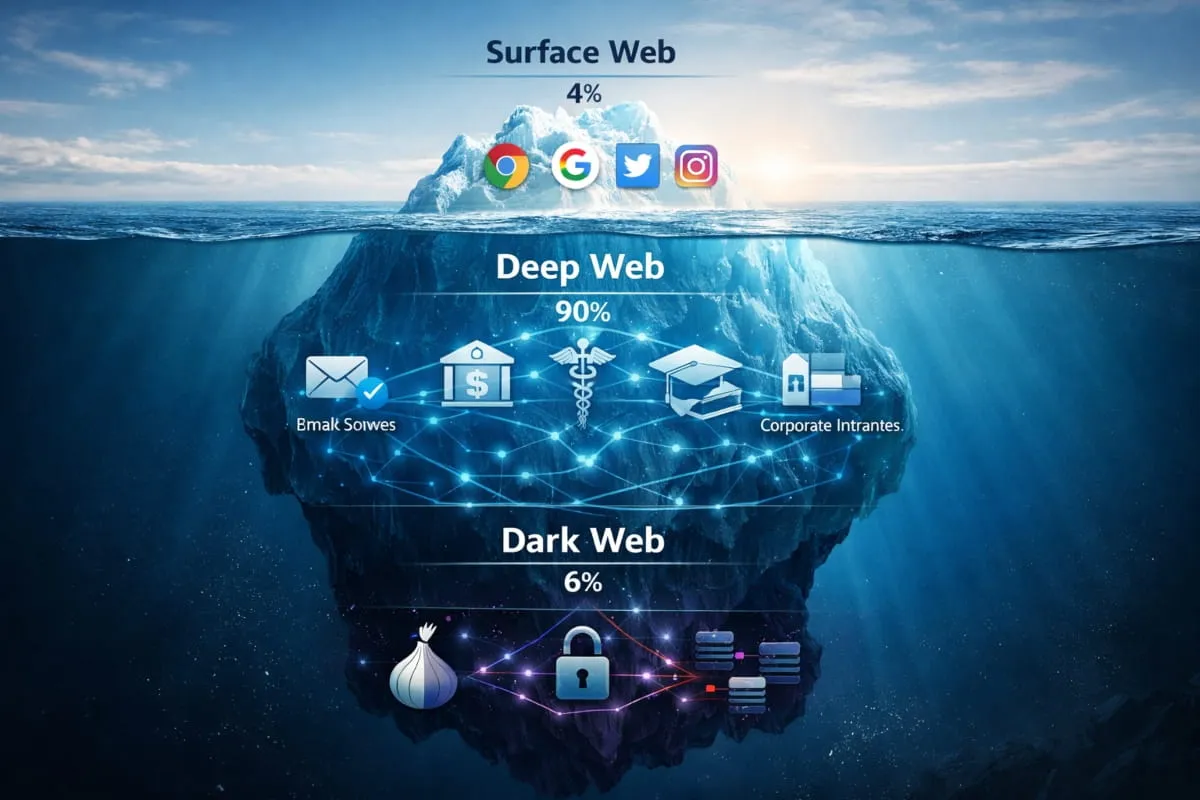
- The surface web is like the visible part of an iceberg above the water.
- The deep web is the massive portion hidden below the surface, most of which is entirely harmless.
- The dark web is a very small, locked section deep inside that iceberg, deliberately concealed and accessible only with special tools.
Confusing the deep web with the dark web is like confusing your private Gmail inbox with an underground black market. Both are “hidden” from public search, but they are not remotely the same.
Why This Topic Matters
Understanding the deep web is not just useful for curious minds. It matters for:
- Everyday users who want to know what the internet actually looks like beyond Google
- Students and researchers who use academic databases that live on the deep web
- Business professionals who need to understand deep web monitoring and data protection
- Journalists and investigators who use the deep web for OSINT research
- Anyone concerned about privacy, data leaks, or cybersecurity
The internet is far bigger and more layered than most people realize. Knowing how it is structured gives you a clearer, more informed picture of the digital world you navigate every day.
What Is the Deep Web?
Most people assume the internet is what they see: Google search results, social media pages, news articles, and online stores. But that visible layer is only a small portion of what actually exists online. The deep web refers to all the parts of the internet that search engines cannot find, index, or display in search results.
In the simplest terms, the deep web is the unindexed part of the internet. If a webpage requires a login, a password, or a direct link to access, it does not appear in Google or any other search engine. That makes it part of the deep web, not because it is hidden suspiciously, but because it was never meant to be publicly searchable.
Deep Web Definition in Simple Terms
The deep web is any content on the internet that is accessible only behind a barrier, such as a login page, paywall, authentication system, or private network. Search engine bots cannot crawl past these barriers, so the content inside never gets indexed.
Your email inbox is part of the deep web. So is your online banking dashboard, your Netflix account page, your company’s internal HR portal, your university’s student records system, and a hospital’s patient database. None of these pages appear in Google search results, and none of them are supposed to. They are private by design.
So when people ask what the deep web means, the most accurate answer is this: it’s the non-indexed, non-public portion of the internet, most of which is completely legitimate and used by ordinary people every single day without realizing it.

How Much of the Internet Is the Deep Web?
This is where the numbers become striking. The surface web, everything Google and other search engines can actually index, represents roughly 4 to 5 percent of the total internet. The remaining 95 percent or more is the deep web.
That statistic surprises most people, but it makes sense once you understand what the deep web contains. Every private database, every password-protected account, every internal business network, every academic research archive, every government record system, all of it sits in this vast, unindexed layer.
The concept was formally described by researcher Michael Bergman in 2001, who estimated the deep web was several hundred to several thousand times larger than the surface web. Since then, the internet has grown enormously, and so has the deep web.
The deep web is not a place you visit in one go. It has no single entrance, no homepage, and no map. It is simply the collective term for all the content that the open internet cannot reach.
What Does the Deep Web Look Like?
Visually and functionally, the deep web looks exactly like the rest of the internet. There is nothing mysterious about its appearance. When you log into your Gmail account, you are looking at the deep web. When you check your bank balance online, you are using the deep web. When a doctor pulls up your health records through a hospital portal, that too is the deep web.
It does not have a special design, a different browser requirement, or an unusual interface. The only thing that makes a page part of the deep web is that it requires some form of access control and, therefore, cannot be crawled by search engines.
The portion of the deep web that involves anonymized, encrypted networks like Tor looks and feels different from the regular web. Websites on those networks use .onion addresses instead of standard URLs, which can make them slower and more difficult to navigate. But that layer, often called the dark web, is only a fraction of the total deep web. The vast majority of the deep web is invisible to search engines simply because it is private, not because it is encrypted or concealed.
Common Misconceptions About the Deep Web
The deep web is one of the most misunderstood topics on the internet. Most of the confusion comes from media coverage that treats it as entirely dangerous or criminal. Here is what is actually true.
Misconception 1: The deep web and the dark web are the same thing. This is the most common error. The dark web is a small, specific part of the deep web that uses encrypted, anonymized networks. The deep web as a whole is enormous and mostly harmless. Conflating the two is like saying every back room in every building is a crime scene.
Misconception 2: Accessing the deep web is illegal. Simply accessing the deep web is not illegal. You do it every time you log into any private account online. Even accessing the Tor network, which is used to reach the dark web, is legal in most countries. What can be illegal is the content accessed or the actions taken, not the act of browsing itself.
Misconception 3: The deep web is full of disturbing content. The overwhelming majority of the deep web is mundane. Databases, private emails, academic journals, cloud storage, and corporate intranets make up most of it. Sensational content exists in specific corners of the dark web, but it does not define the deep web as a whole.
Misconception 4: You need special software to access the deep web. For most of the deep web, you need nothing more than a username and a password. Special tools like the Tor browser are only needed to access the dark web layer, which is a narrow subset of the broader deep web.
Understanding what the deep web actually is, and separating it from myth, is the first step toward navigating the internet with a clearer, more accurate picture of how it truly works.
The Layers of the Deep Web
The deep web is not a single, uniform space. It exists in layers, each one progressively more restricted, more private, and less accessible to the average internet user. Understanding these layers helps separate what is real from what is exaggerated, and gives you a much clearer picture of how the internet is actually structured beneath the surface.

Level 1, Standard Unindexed Content
The first and largest layer of the deep web is one that almost everyone uses daily without ever thinking about it. This level contains all the web pages and content that exist online but are simply not indexed by search engines, not because they are hidden in any meaningful way, but because they were never intended for public search.
This includes dynamically generated search results pages, content behind registration walls, academic databases, subscription-based news archives, private social media profiles, and cloud-stored documents. Google does not index these pages because either the website has instructed search engines not to, or the content only exists after a user takes an action, like running a search or logging in.
There is nothing suspicious about Level 1. It is the internet’s private infrastructure. The content here is protected by design, and the people accessing it are doing so in a normal way.
Level 2, Password-Protected & Private Networks
The second layer goes a step further. This is where access is not just unindexed but actively restricted through authentication. You need specific credentials, a username, a password, and sometimes multi-factor verification to enter.
Your online banking portal lives here. So do corporate intranets, hospital patient management systems, government record databases, university student portals, and private research networks. These systems hold some of the most sensitive data in the world, including financial records, medical histories, legal documents, and classified research, and they are deliberately kept away from public access.
This layer also includes private communication platforms, encrypted email services, and internal business tools. Large organizations rely on this layer to operate securely. A company’s internal project management system, its HR software, its client database, all of this is deep web content at Level 2.
For most people, this layer represents the deepest part of the deep web they will ever interact with. It is routine, essential, and entirely legal.
Level 3, Encrypted & Anonymized Networks (Tor)
The third layer is where the deep web becomes less familiar to the general public. This is the layer that requires specialized software to access, most commonly the Tor browser, which routes your connection through a series of encrypted relays to anonymize your identity and location.
Websites on this layer use .onion addresses, which are not accessible through a regular browser and do not appear in any standard search engine. This network, commonly referred to as the dark web, was originally developed by the U.S. Naval Research Laboratory to protect intelligence communications online. Today, it serves a wide range of users, from journalists and activists in restrictive countries who need anonymous communication to privacy-conscious individuals, researchers, and, unfortunately, those engaged in illegal activity as well.
It is important to be precise here: the dark web is a subset of the deep web, not a synonym for it. The Tor network and its .onion sites represent a relatively small fraction of the total deep web. Most of the deep web, as covered in Levels 1 and 2, has nothing to do with Tor or anonymized browsing.
The existence of illegal marketplaces and disturbing content on parts of the dark web is real, but it does not define the entire layer. Tor is also used by whistleblowers, human rights workers, journalists communicating with sources, and citizens living under authoritarian governments who need unrestricted access to information.
What Are the Marianas of the Deep Web? (Myth vs Reality)
You may have come across references to extreme “levels” of the deep web, sometimes called the Mariana’s Web, the Challenger Deep, or even more dramatic names, suggesting there are secret layers containing government conspiracies, artificial intelligence, and classified information so sensitive that almost no one can reach it.
This is almost entirely myth.
The “Marianas Web” concept, named after the Mariana Trench, the deepest point in the ocean, originated as internet folklore, mostly spread through forums and viral posts. It describes supposed ultra-secret layers of the internet that are inaccessible to all but the most elite hackers, containing world-altering secrets, ancient knowledge, or mysterious entities. None of this has any credible basis in reality.
The internet, including its deepest and most private layers, is built on known protocols and technologies. There is no verified evidence of secret tiers beyond what is technically understood. What does exist at the deepest and most restricted levels are things like classified government intranets, private research systems, and heavily encrypted private networks, none of which resemble the dramatic mythology that surrounds the Marianas Web concept.
The layers of the deep web are real. The conspiracy-level mythology around them is not. Understanding the difference protects you from misinformation and gives you a far more accurate view of how the internet actually works at every level.
Who Created the Deep Web and Why?
No single person built the deep web, launched it on a specific date, or designed it with any secretive purpose in mind. It emerged naturally as the internet grew, and understanding its origins helps explain why it is so vast, so essential, and so frequently misunderstood.

The History and Origin of the Deep Web
The internet was originally designed as an open, publicly accessible network. In its early days, most of what existed online was meant to be found: websites, documents, and pages that anyone could reach through a browser or a search engine.
But as the internet expanded through the 1990s, something inevitable happened. Organizations began moving sensitive information online. Banks built secure portals. Universities created private academic databases. Governments digitized records. Hospitals shifted patient data to online systems. None of this information was meant to be publicly searchable, and so it naturally fell outside the reach of search engines.
The term “deep web” was formally introduced and defined by researcher Michael Bergman in a landmark 2001 paper titled “The Deep Web: Surfacing Hidden Value.” Bergman was the first to systematically describe and estimate the size of this unindexed portion of the internet, and his research brought the concept into mainstream academic and technical discussion. He estimated that the deep web was hundreds of times larger than the surface web, a finding that drew significant attention at the time and has only grown more relevant since.
Before Bergman gave it a name, the concept was sometimes referred to as the “invisible web” or the “hidden web”, terms that captured the same idea but never gained the same traction. The term “deep web” stuck because it accurately described something that had always been there but was rarely acknowledged.
Why Does the Deep Web Exist?
The deep web exists because privacy, security, and access control are fundamental requirements of how the modern internet functions. Not every piece of information that lives online should be publicly available, and the deep web is the natural result of that reality.
Consider what would happen if there were no deep web. Every email you have ever sent would be searchable on Google. Your bank statements would appear in search results. Your medical records would be publicly indexed. Private company data, government intelligence, academic research behind paywalls, legal documents, all of it would be exposed to anyone with a search engine.
The deep web exists to prevent exactly that. It is the internet’s way of maintaining privacy at scale. When a website requires a login, when a database requires authentication, or when a system is built for internal use only, all of that content moves into the deep web by default, simply because search engines cannot and should not access it.
There is also a technical reason. Search engines work by sending automated bots to crawl web pages and follow links. These bots cannot fill out login forms, complete authentication steps, or access dynamically generated content that appears only in response to a specific user action. This technical limitation is not a flaw; it is a feature. It ensures that private data stays private.
The deep web was not created with a manifesto or a mission. It emerged because the internet grew to serve real human needs, privacy, security, and restricted access, and those needs required parts of the internet to remain out of public view.
Who Uses the Deep Web and For What?
The answer is straightforward: almost everyone uses the deep web, most of the time without knowing it.
Every person who checks their email, logs into online banking, accesses a work system remotely, or uses a subscription service is interacting with the deep web. In that sense, the deep web’s largest user base is simply the global population of internet users going about their ordinary lives.
Beyond everyday use, the deep web serves a wide range of specific and legitimate purposes across different fields.
Academic and research institutions rely on the deep web to host journals, datasets, and research archives that are accessible only to subscribers or verified members. Platforms like JSTOR, PubMed, and university library systems are prime examples, enormous repositories of knowledge that live entirely within the deep web.
Healthcare organizations store patient records, diagnostic data, and clinical systems on private, authenticated networks. This data must remain inaccessible to the public, and the deep web architecture enables that.
Government and legal systems maintain vast databases of records, case files, and internal communications that are not meant for public search indexing. These systems require controlled access for operational and legal reasons.
Businesses of all sizes use internal intranets, private project management tools, client databases, and secure communication systems, all of which exist in the deep web layer.
Journalists, activists, and privacy-conscious individuals use encrypted and anonymized parts of the deep web, specifically the Tor network, to communicate securely, protect sources, and access information without surveillance. In countries where press freedom is restricted or internet access is censored, these tools are not optional; they are essential.
The deep web, at its core, is infrastructure. It was shaped by necessity, named by a researcher, and used every day by billions of people for entirely routine purposes. The version that appears in headlines is a narrow, often distorted slice of something far larger and far more ordinary than it is typically portrayed.
How to Access the Deep Web Safely
Accessing the deep web is not as complicated or as dangerous as it is often portrayed. For the everyday layer, private accounts, subscription services, and authenticated portals, you already access them constantly through a normal browser. But when people ask how to access the deep web, they are usually referring to the deeper, anonymized layer: the Tor network and the encrypted websites that live within it.

This section covers exactly how that works, what you need, and how to do it responsibly.
What You Need Before You Access the Deep Web
Before you access the deep web through Tor, a few things are worth understanding clearly.
First, your mindset matters. The deep web through Tor is not a spectacle or an entertainment destination. It is a network built for privacy and anonymous communication. Approaching it with curiosity is fine; approaching it recklessly is not.
Second, your device and connection need some basic preparation. You should ensure your operating system is fully updated, your regular browser is closed, and you are not logged into any personal accounts during your session. Using a VPN before launching Tor adds an extra layer of protection by masking that you are connecting to the Tor network at all, something worth considering depending on your location and privacy needs.
Third, understand what you are and are not protected from. Tor anonymizes your network traffic, but it does not make you invincible. Downloading files, enabling browser plugins, or logging into personal accounts while using Tor can all compromise your anonymity. Going in with a clear understanding of these limits is the most important preparation you can make.
How to Download and Use the Tor Browser
The Tor browser is the primary tool for accessing the deep web’s anonymized layer. It is a modified version of Firefox, built and maintained by the non-profit Tor Project, and it is available for free on Windows, macOS, Linux, and Android.
To get started, visit the official Tor Project website at torproject.org and download the browser directly from there. Never download Tor from a third-party source; only the official website guarantees you are getting the legitimate, unmodified version.
Once installed, the Tor browser works like any other browser in terms of its interface. The key difference is how it routes your connection. Instead of connecting directly to a website, your traffic passes through a series of volunteer-operated servers called relays, typically three of them, each one knowing only the step before and after it. By the time your request reaches its destination, your original IP address is effectively untraceable.
Through the Tor browser, you can access both regular websites and .onion sites, the special addresses used by websites hosted within the Tor network. These .onion addresses are long strings of characters and cannot be accessed through any standard browser.
One thing to keep in mind: Tor is slower than a regular browser by design because your traffic is routed through multiple relays around the world. This is normal. Do not attempt to maximize browser window size, install extensions, or enable JavaScript on unknown sites, as these actions can reduce your anonymity.
Using Tails OS for Maximum Anonymity
For users seeking the highest level of privacy when accessing the deep web, Tails OS is the most respected option. Tails is a live operating system, meaning it runs entirely from a USB drive and leaves no trace on the computer it is used on.
When you boot a computer running Tails, you are running a clean, isolated environment that automatically routes all internet traffic through Tor. When you shut it down and remove the USB drive, no data, history, or activity is stored on the machine. Everything disappears.
Tails is used by journalists, whistleblowers, and security professionals who need airtight anonymity. Edward Snowden famously used Tails OS during his communications with journalists. The fact that it requires no installation and leaves no footprint makes it the gold standard for private deep web access.
Setting it up requires downloading the Tails image from the official website at tails.boum.org, verifying the download, and writing it to a USB drive using a tool like Balena Etcher. The process is well documented on their official site and manageable even for users without advanced technical knowledge.
Safest Ways to Browse the Deep Web
Safety on the deep web comes down to discipline and awareness. The following principles are not optional extras; they are the baseline for browsing responsibly.
Always use Tor or Tails as your access method, never a standard browser. Keep the Tor browser up to date at all times, as updates often fix security vulnerabilities. Use a reputable VPN before connecting to Tor if your location or situation warrants extra protection; this is sometimes referred to as the “VPN over Tor” or “Tor over VPN” configuration.
Do not log in to any personal accounts, email, social media, or banking services while using Tor. Doing so immediately ties your real identity to your anonymous session, defeating the purpose entirely. Do not share any personal information, and avoid downloading files from unknown .onion sites, as they may contain malware.
Stick to well-documented, reputable .onion resources, particularly if you are accessing the deep web for research or legitimate information-gathering. The Hidden Wiki, for example, is a commonly referenced starting point that indexes links to various .onion sites, though even there, careful judgment is required about where you click.
What to Avoid When Accessing the Deep Web
Knowing what not to do is just as important as knowing what to do. The risks on the anonymized deep web are real, and most of them are avoidable through simple caution.
Avoid any site or service that asks for personal identification, payment details, or credentials you use elsewhere online. Legitimate .onion services do not need your real-world identity. If a site is requesting it, that is a red flag.
Do not engage with, download, or seek out illegal content of any kind. This should go without saying, but it bears stating clearly: the fact that Tor provides anonymity does not make illegal activity consequence-free. Law enforcement agencies actively monitor illegal activity on the dark web, and numerous high-profile arrests have resulted from exactly this kind of overconfidence in anonymity.
Avoid clicking on unknown links indiscriminately. The deep web has no Google to filter out dangerous or malicious sites. Phishing sites, scam pages, and malware-laden links are widespread on the Tor network. Trust is earned slowly here, not assumed.
Finally, be skeptical of anything that seems designed to shock, provoke, or lure you further in. Much of the deep web’s dangerous reputation is fueled by exaggerated stories and fabricated content designed to manipulate curiosity. Critical thinking is your most reliable protection.
Accessing the deep web is legal. Browsing it safely is entirely possible. The key is approaching it with the same combination of awareness and caution you would apply to any unfamiliar environment.
Best Deep Web Search Engines
One of the first things people discover when they access the Tor network is that Google does not work there. Standard search engines are built to index the surface web; they cannot crawl .onion sites or reach content within anonymized networks. To navigate the deep web effectively, you need search engines built specifically for it.
These tools function as deep web crawlers, indexing .onion addresses and hidden content that standard search engines cannot reach. Some are broad, others are filtered and safety-conscious, and a few occupy a middle ground. Here is a clear overview of the most reliable options available.

Torch, The Original Deep Web Search Engine
Torch is widely regarded as the oldest and most well-known search engine for the deep web. It has been operating since the mid-1990s and has indexed a substantial number of .onion sites, making it one of the most comprehensive deep web search engines.
Its interface is simple and functional, deliberately minimal, in keeping with the no-frills nature of much of the Tor network. Torch does not filter its results, which means searches can return a wide range of content, including both legal and legitimate material and material that is not. This makes it a powerful tool for researchers and experienced users, but it also means you need to approach results with caution and judgment.
Torch is accessible through its .onion address within the Tor browser and is entirely free to use. For anyone looking to explore the deep web’s search landscape, Torch is typically the first point of reference, partly because of its history and partly because of the volume of indexed links it maintains.
Ahmia, The Safe Deep Web Search Engine
Ahmia is a different kind of deep web search engine, and in many respects, it is the most responsible one available. Unlike Torch, Ahmia actively filters its index to remove illegal content, particularly content that exploits or harms children. This makes it one of the few deep web search engines that has a clear ethical framework built into its operations.
What makes Ahmia particularly notable is that it is accessible both through the Tor browser via its .onion address and through a regular browser on the surface web. This dual accessibility makes it a practical entry point for researchers, journalists, and professionals who want to explore or study deep web content without fully immersing themselves in the Tor environment.
Ahmia is also open source and has been recognized by cybersecurity and privacy communities as a legitimate and trustworthy tool. For anyone approaching the deep web for educational, research, or professional purposes, Ahmia is generally the recommended starting point. It provides genuine deep web search functionality with a layer of safety filtering that other engines lack.
DuckDuckGo on Tor
DuckDuckGo is a privacy-focused search engine on the surface web that many users are already familiar with. What fewer people know is that DuckDuckGo has an official .onion version accessible through the Tor browser, making it one of the most user-friendly options for navigating the deep web.
The key distinction is that DuckDuckGo on Tor does not track your searches, store your IP address, or build a profile of you. It brings the familiar DuckDuckGo search experience into the Tor environment, with the added protection of full anonymization through the Tor network.
However, it is worth being precise about what DuckDuckGo on Tor actually searches. It primarily indexes surface web content; it does not crawl .onion sites the way Torch or Ahmia do. Its value within the Tor browser is less about finding hidden .onion content and more about searching the regular internet with complete privacy. For users who want to browse the open web without tracking while connected via Tor, DuckDuckGo is the cleanest and most reliable option.
Not Evil, Haystak, and Other Alternatives
Beyond the three primary options, there are several other deep web search engines worth knowing about, each with its own strengths and limitations.
Not Evil is a Tor-based search engine that takes a stance similar to Ahmia; it refuses to index illegal content and focuses on providing cleaner, more navigable results. The name is a deliberate nod to Google’s former motto, and the engine has built a modest but respected reputation within the Tor community for its filtering approach.
Haystak is one of the larger deep web search engines by index size, claiming to have crawled billions of pages across the Tor network. It offers both a free version and a premium version with additional features, such as more refined search filtering and advanced query options. For users doing serious research into deep web content, Haystak’s larger index can surface results that smaller engines miss.
Other engines like Candle, Torch2, and various regional or specialized .onion search tools also exist, though they tend to be less consistent in uptime and index quality. The deep web search engine landscape is less stable than the surface web; sites go offline, addresses change, and index quality varies considerably. Maintaining an updated list of working deep web search engine links is something researchers and privacy communities actively do, often shared through trusted sources like the Hidden Wiki or Reddit’s privacy-focused communities.
How to Use Deep Web Search Engines Effectively
Using a deep web search engine is not quite the same as using Google, and approaching it with the same expectations will lead to frustration. A few principles make the experience significantly more productive.
Be specific with your queries. Deep web search engines lack the same semantic intelligence as Google. Vague searches return poor results. The more precise your search terms, the more useful the results you will find.
Cross-reference across multiple engines. No single deep web search engine indexes everything. A search on Torch may return different results from the same search on Ahmia or Haystak. For thorough research, running the same query across two or three engines gives you a more complete picture.
Verify links before clicking. Unlike surface web search results, deep web search engine links do not come with the same level of vetting. Before visiting an unfamiliar .onion address, look for references to it from trusted sources, forums, privacy communities, or documented resources, to confirm it is what it claims to be.
Understand that results can be outdated. The deep web is not as consistently crawled as the surface web. Search engine indexes can include links to sites that no longer exist or have moved to different .onion addresses. Dead links are common, and patience is necessary.
Finally, remember that search engines are a starting point, not a complete map. Much of the most valuable content on the deep web, academic resources, private communities, and legitimate services is not found through search engines at all, but through curated directories, Word of mouth within trusted communities, and resources like the Hidden Wiki. The search engine is a tool, not the entire territory.
What’s Actually on the Deep Web?
If you have read anything sensational about the deep web, you might expect it to be wall-to-wall with disturbing content and criminal activity. The reality is far less dramatic and far more interesting. The deep web contains an enormous range of content, most of it entirely legitimate, some genuinely useful, and only a small fraction illegal or harmful. Understanding what is actually there requires separating verified fact from internet mythology.

Legitimate Uses, Academic Databases, Private Networks, Government Systems
The single largest category of content on the deep web is also the most boring: private, authenticated, institutional data that was never meant to be publicly searchable.
Academic institutions host vast repositories of knowledge on the deep web. Platforms like JSTOR, PubMed, IEEE Xplore, and university library systems contain millions of research papers, scientific studies, medical journals, and academic datasets. These resources are accessible only to subscribers or verified institutional members, which places them firmly within the deep web. For researchers, students, and professionals, these databases represent some of the most valuable content on the entire internet, hidden from Google not for any secretive reason, but simply because access requires authentication.
Government systems represent another enormous portion of the deep web. Tax records, court filings, law enforcement databases, intelligence networks, and public service portals all operate within private, authenticated environments. The same is true for healthcare, hospital record systems, electronic health databases, and clinical management platforms, which hold some of the most sensitive personal data in existence, all of it necessarily outside the reach of public search engines.
Corporate networks add yet another layer. Every company that maintains an internal intranet, a private client database, a secure communication system, or a proprietary research archive is contributing to the deep web simply by keeping that content behind a login. Multiply this across millions of organizations worldwide, and the scale of legitimate deep web content becomes clear.
Deep Web Forums and Communities
Within the Tor network, forums are among the most active categories of community-driven content. These range widely in subject matter, from cybersecurity and privacy technology to politics, philosophy, journalism, and literature. Many deep web forums exist specifically because their participants value anonymity, either for personal privacy reasons or because they operate in environments where open discussion carries real risk.
Privacy-focused technology communities have long used Tor-based forums to discuss security research, vulnerabilities, encryption tools, and digital rights. Political dissidents in authoritarian countries use these spaces to communicate and organize without government surveillance. Journalists and researchers use them to exchange information securely.
It is also true that forums covering illegal topics exist within the deep web. Drug-related communities, hacking forums, and counterfeit goods discussions have all been documented. Law enforcement agencies actively monitor and infiltrate these spaces, and numerous forum operators and participants have been prosecuted. The existence of illegal forums does not define the deep web’s forum landscape any more than illegal activity on Reddit defines the surface web.
Deep Web Chat Rooms and Communication Tools
Anonymous communication tools are among the most practically significant things found on the deep web. Encrypted messaging services, anonymous chat rooms, and secure email platforms serve a genuine and important purpose for a wide range of users.
SecureDrop, for example, operates a Tor-based system that allows sources to communicate with journalists completely anonymously. Major news organizations, including The New York Times, The Washington Post, and The Guardian, maintain SecureDrop instances precisely because the deep web’s anonymization tools enable truly confidential source communication in a way that surface web tools cannot.
Beyond journalism, encrypted chat platforms and anonymous communication tools on the deep web are used by activists, human rights workers, legal professionals, and individuals in countries where private communication is monitored or criminalized. The deep web chat infrastructure is not an edge case; for many people around the world, it is a necessity.
Whistleblowing Platforms (WikiLeaks, SecureDrop)
Whistleblowing is one of the most significant and socially important uses of the deep web. Platforms built for anonymous document submission and source protection depend on the same anonymization infrastructure that defines the deep web’s encrypted layer.
WikiLeaks, which became globally known for publishing classified government and military documents, used Tor-based submission systems to receive materials from anonymous sources. The technical architecture of the deep web enabled individuals with sensitive information to submit documents without revealing their identities.
SecureDrop, developed by the Freedom of the Press Foundation, is now the gold standard for secure whistleblowing. It is an open-source platform hosted on the Tor network, used by dozens of major media organizations worldwide. Sources upload documents, journalists receive them, and neither party’s identity nor location is exposed in the process. This is the deep web functioning exactly as its most principled proponents envision, as infrastructure for accountability, transparency, and press freedom.
Deep Web Libraries and Archives
One of the lesser-known but genuinely valuable corners of the deep web is its collection of libraries and archives. These range from legitimate academic repositories to more controversial collections of books, documents, and historical records.
The Imperial Library of Trantor, for example, is a well-known .onion site that hosts a large collection of e-books, millions of titles across every genre and subject. There are debates about the copyright implications of such archives. Still, their existence reflects a real demand for unrestricted access to knowledge, particularly from users in regions where books and educational materials are expensive or censored.
Other deep web archives preserve historical documents, leaked government files, out-of-print academic texts, and digitized rare materials. For researchers and historians, these collections can contain genuinely irreplaceable content. The deep web, in this sense, functions as a kind of shadow library, imperfect and legally complicated in places, but undeniably rich in material that is difficult or impossible to find on the surface web.
Deep Web Black Markets, A Historical Overview (Silk Road)
No honest account of the deep web’s content would be complete without addressing its black markets, not to sensationalize them, but to explain what they are, where they came from, and what happened to them.
The most famous deep web black market in history was Silk Road, launched in 2011 by Ross Ulbricht, who operated under the pseudonym “Dread Pirate Roberts.” Silk Road was a Tor-based marketplace that used Bitcoin for transactions and allowed vendors to sell illegal goods, primarily drugs, to buyers around the world. At its peak, it was generating millions of dollars in monthly transactions.
The FBI shut down Silk Road in October 2013 and arrested Ulbricht, who was subsequently convicted on multiple charges, including drug trafficking and money laundering, and sentenced to life in prison without the possibility of parole. The takedown was a landmark moment in both internet history and law enforcement’s approach to the dark web.
Silk Road’s closure did not end deep web black markets; several successors emerged in the years that followed, including AlphaBay and Hansa Market, both of which were also shut down in 2017 in a coordinated international law enforcement operation. The Wall Street Market followed a similar trajectory, collapsing in 2019 after its administrators attempted an exit scam.
The pattern has been consistent: deep web black markets emerge, grow, attract law enforcement attention, and are eventually dismantled. The deep web’s anonymization tools provide some protection, but they do not make criminal operations permanently invisible. Forensic techniques, undercover operations, and blockchain analysis have proven effective at identifying and prosecuting operators and users of these platforms.
Myths vs Reality, Red Rooms, Human Experimentation, Scary Content
This is where the deep web’s reputation diverges most sharply from verifiable reality, and it is worth addressing directly.
Red rooms, the idea that live-streamed torture or murder can be watched in real time on the deep web, typically for cryptocurrency payments, are almost certainly fictional. Despite years of claims and viral posts, no credible evidence of a functioning red room has ever been verified by journalists, law enforcement, or cybersecurity researchers. The concept originates from internet folklore and has been amplified by horror fiction, YouTube videos, and forum mythology. It makes for compelling content, but it has no documented basis in fact.
Human experimentation sites, deeply disturbing marketplaces for implausible services, and access to world-ending classified information are similarly rooted in fiction rather than evidence. These stories spread because they are designed to be shared; they provoke the exact combination of fear and curiosity that makes something go viral. They are not reliable accounts of what the deep web contains.
What is real is that genuinely disturbing illegal content does exist in parts of the dark web, most notably child sexual abuse material, which law enforcement agencies invest significant resources in identifying and prosecuting. This content is not a myth, and its existence is one of the most serious ongoing challenges in internet law enforcement globally. But it is categorically different from the elaborate mythology of red rooms and secret government experiments.
The honest picture of the deep web is this: it is overwhelmingly ordinary, significantly useful, occasionally illegal in documented and prosecutable ways, and far less theatrically terrifying than its reputation suggests. The secrets of the deep web are less about horror and more about the genuine complexity of a vast, layered internet that most people never think to look beneath.
Is the Deep Web Illegal?
This is one of the most commonly asked questions about the deep web, and it deserves a clear, direct answer: accessing the deep web is not illegal. The confusion around this question stems largely from conflating the deep web with the dark web and from media coverage that treats the entire hidden internet as a criminal space. The reality is considerably more nuanced.

Legality on the deep web is not determined by where you are browsing; it is determined by what you do and what content you access while there.
What Is Legal on the Deep Web
The vast majority of deep web activity is not only legal but entirely routine. Every time you log into your email, access your bank account, use a private work network, or retrieve a document from a cloud storage service, you are using the deep web legally, as billions of people do every single day.
Within the Tor network specifically, a wide range of legal activity takes place. Using the Tor browser to browse the internet anonymously is legal in most countries. Accessing privacy-focused news platforms, encrypted communication tools, anonymous forums, whistleblowing platforms, and digital libraries through Tor is legal. Journalists using SecureDrop to communicate with sources, activists using Tor to avoid government surveillance, and researchers studying the structure of the dark web all fall within the law.
Privacy itself is not a crime. The desire to browse the internet without being tracked, to communicate without being monitored, or to access information without leaving a digital footprint is a legitimate and legally protected interest in most democratic countries. The tools that make the deep web’s anonymous layer possible, Tor, Tails, and encrypted messaging, are legal to download, install, and use.
What Is Illegal on the Deep Web
Where legality ends on the deep web is the same place it ends anywhere else: when the activity itself is a crime, regardless of where or how it is conducted.
Purchasing illegal drugs through a dark web marketplace is illegal, not because the transaction happened on the dark web, but because drug trafficking is illegal. Buying or selling stolen financial data, counterfeit currency, or forged documents is illegal for the same reason. Accessing, distributing, or possessing child sexual abuse material is a serious criminal offense in virtually every jurisdiction in the world, and the fact that it is accessed through Tor does not change that in any way.
Hiring services for illegal purposes, whether that involves hacking, fraud, or anything else, is illegal regardless of the platform used to arrange it. Attempting to purchase weapons through dark web channels in violation of local laws is illegal. Engaging in financial fraud, identity theft, or money laundering through cryptocurrency on dark web platforms is illegal and actively prosecuted.
The principle is consistent: the deep web does not create a legal exception. It is not a jurisdiction-free zone, and anonymization tools do not provide immunity from prosecution. Law enforcement agencies in the United States, Europe, and beyond have repeatedly demonstrated their ability to identify, track, and prosecute individuals engaged in illegal activity on the dark web, even when those individuals believed they were protected by anonymity.
Legal Risks of Accessing the Deep Web
Even for users with entirely lawful intentions, there are legal considerations worth understanding before accessing the deeper layers of the internet.
In most Western democracies, simply using the Tor browser carries no legal risk. However, in certain countries, including China, Russia, Belarus, Iran, and North Korea, the use of Tor or VPNs is restricted or outright banned. In these environments, accessing the deep web using anonymization tools can itself be a legal violation, regardless of the content accessed. If you are in a country with restrictive internet laws, understanding your local legal environment is essential before using these tools.
There is also the risk of inadvertent exposure. The deep web lacks the same filtering mechanisms as the surface web. Clicking an unfamiliar link can lead to illegal content without any prior warning. While stumbling upon something accidentally is generally treated differently from intentionally seeking it out, the safest approach is to be deliberate about where you go and to exit immediately if you find yourself somewhere you should not be.
Finally, downloading files from the deep web carries its own set of risks, both legal and technical. Files can contain malware, and in certain cases, downloaded content may itself constitute illegal possession depending on its nature. Caution around downloads is not optional; it is a fundamental rule of responsible deep web use.
Is Simply Browsing the Deep Web a Crime?
No. In the overwhelming majority of countries, simply browsing the deep web, including the Tor network, is not a crime. Installing the Tor browser, connecting to the Tor network, and visiting .onion websites that contain legal content are protected activities in most legal systems.
What matters under the law is not the tool you use or the network you connect to, but the nature of your actions and the content you engage with. A person using Tor to read a privacy-focused news site is doing nothing illegal. A person using Tor to purchase illegal goods or access criminal content is committing a crime, and the use of Tor does not shield them from the legal consequences of that crime.
This distinction is important because it prevents a false equivalence between the deep web itself and the illegal activity that exists within a portion of it. The internet has always contained illegal content, on the surface web, in private emails, on social media platforms, and everywhere else. The existence of crime in a space does not make the space itself criminal.
Browse legally, act responsibly, understand the tools you are using, and the deep web is no more illegal to access than any other part of the internet. The law follows behavior, not browsers.
Is the Deep Web Safe?
Safety on the deep web is not a yes-or-no question. Like most things online, it depends entirely on where you go, what you do, and how prepared you are. The everyday layer of the deep web, private accounts, authenticated portals, and institutional networks, is as safe as any other part of the internet you use regularly. The deeper, anonymized layer accessed through Tor carries more variables, and understanding them honestly is the most useful thing you can do before venturing there.

Real Dangers of the Deep Web
The dangers of the deep web are real, but they are also specific. They do not come from the network itself; Tor is a tool, not a threat. They come from the environment that anonymity creates and the behavior it can enable.
The most immediate danger for most users is malware. The deep web has no equivalent to Google’s Safe Browsing filters or the vetting mechanisms that surface web platforms use for links and downloads. Malicious sites designed to infect devices, steal credentials, or install ransomware are widespread within the Tor network. A single careless click or download can compromise your device in ways that are difficult to reverse.
Scams are equally prevalent. The deep web is full of fraudulent services, fake marketplaces, counterfeit vendors, and confidence schemes that take cryptocurrency payments and deliver nothing. Because transactions on the deep web are typically irreversible and conducted anonymously, there is no recourse once money has been sent. The combination of anonymity and irreversibility makes the deep web a particularly fertile environment for financial fraud.
Exposure to illegal or disturbing content is a genuine risk, particularly for users who explore without direction. Unlike the surface web, the deep web lacks robust content filtering. Material that would be immediately removed from any mainstream platform can exist on .onion sites indefinitely. Users who navigate carelessly can encounter content that is not only disturbing but also potentially illegal to access or download.
There is also a more psychological danger worth acknowledging. The deep web’s reputation for extreme content draws a certain kind of curiosity-driven exploration that can lead users progressively further into harmful territory. Awareness of this dynamic is itself a form of protection.
Cybersecurity Risks and How to Avoid Them
The cybersecurity risks of the deep web are manageable with the right approach, but they require more active attention than everyday surface web browsing.
The Tor browser provides anonymity at the network level, but it does not protect your device from malware delivered through the browser itself. Keeping the Tor browser fully updated is essential, as security patches are released regularly and address known vulnerabilities. Running Tor on an outdated version is one of the most common and avoidable mistakes users make.
JavaScript is a significant attack vector on the deep web. Many malicious .onion sites use JavaScript exploits to de-anonymize users or deliver malware. Setting the Tor browser’s security level to “Safest”, which disables JavaScript by default, substantially reduces this risk. For most deep web browsing purposes, JavaScript is unnecessary anyway.
Using a VPN in conjunction with Tor adds a meaningful layer of protection. If the Tor network itself is compromised at any point, a VPN ensures that your real IP address is not exposed. The order matters: connecting to your VPN first, then launching Tor, is the recommended configuration for most users.
Never download files from unknown or unverified sources on the deep web. PDFs, executable files, and even images can carry malicious payloads. If you must open a downloaded file, do so in an isolated environment, such as a virtual machine or the Tails OS environment, which is disconnected from your main system and personal data.
Finally, compartmentalization is a core cybersecurity principle for the deep web. Keep your deep web browsing session entirely separate from your regular digital life. Do not mix accounts, do not use the same device for both without proper isolation, and never let your real identity intersect with your anonymous session in any way.
Who Is Monitoring the Deep Web?
A common misconception about the deep web, and the Tor network in particular, is that it operates in a surveillance-free vacuum. It does not. Multiple categories of organizations actively monitor deep web activity, and their capabilities are more sophisticated than many users realize.
Law enforcement agencies are the most significant presence. The FBI, Europol, the UK’s National Crime Agency, and numerous other national and international bodies have dedicated units focused on deep- and dark-web investigations. High-profile operations, including the takedowns of Silk Road, AlphaBay, Hansa Market, and dozens of other platforms, demonstrate that these agencies have developed effective methods for identifying and prosecuting individuals who believe anonymity makes them untouchable. Techniques include undercover operations, server seizures, traffic analysis, and cryptocurrency tracing.
Intelligence agencies in various countries monitor the deep web for national security threats, including terrorism-related communications, weapons trafficking, and state-sponsored hacking activity. The scale and methods of this monitoring are largely classified, but its existence is well-documented through public reporting and declassified materials.
Cybersecurity firms monitor the deep web on behalf of corporate and government clients, scanning for leaked data, stolen credentials, and emerging threats. This commercial monitoring industry has grown significantly as organizations have recognized that threats originating on the deep web can have serious real-world consequences.
Academic researchers also monitor and study the deep web, analyzing its structure, content, and ecosystem for scholarly purposes. Their work contributes to the broader understanding of how the deep web functions and evolves.
The picture that emerges is clear: the deep web is not unmonitored. Anonymity tools reduce the ease of surveillance, but they do not eliminate it. Anyone who behaves as though the deep web is a consequence-free space is operating on a dangerous misunderstanding.
Deep Web Monitoring Services (for Businesses)
For organizations rather than individuals, the deep web presents a specific and growing category of risk: the exposure of sensitive business data in places where it was never supposed to appear.
Stolen corporate credentials, leaked customer databases, compromised financial records, and proprietary business information regularly surface on deep web forums and dark web marketplaces. By the time this data appears on the surface web or in public breach notifications, it has often already been circulating in deep web environments for weeks or months. Organizations that wait for public breach alerts are always responding too late.
Deep web monitoring services address this problem by continuously scanning deep web forums, dark web marketplaces, paste sites, and encrypted channels for mentions of a client’s data, employee credentials, customer records, intellectual property, brand assets, and financial information. When a match is found, the organization is alerted immediately, allowing them to respond before the exposure causes maximum damage.
These services are now a standard component of enterprise cybersecurity strategy. Providers range from large security firms offering deep web monitoring as part of broader threat intelligence packages to specialized platforms focused exclusively on dark web surveillance. For businesses handling sensitive customer data, financial information, or proprietary research, this kind of monitoring is not a luxury; it is a practical necessity in an environment where data breaches are routine, and early detection makes a measurable difference in outcomes.
The deep web’s safety profile, in summary, is one of managed risk rather than inherent danger. The network itself is neutral. What determines safety is the combination of how you access it, what you engage with while there, and whether you maintain the awareness and discipline to navigate it without exposing yourself or your organization to the threats that genuinely exist within it.
Deep Web for Research and OSINT Investigations
Beyond privacy tools and anonymous browsing, the deep web serves a serious and growing professional purpose: research and investigation. Journalists, security analysts, law enforcement officers, corporate risk teams, and independent investigators all use the deep web as a source of intelligence that cannot be gathered solely through surface web searches. Understanding how this works, and what tools make it possible, reveals one of the most legitimate and valuable dimensions of the deep web.

Using the Deep Web for People Search
Standard people search engines on the surface web, the kind that pull together public records, social media profiles, and contact information, are useful. Still, they are fundamentally limited to what is publicly indexed. The deep web extends this considerably.
Deep web people search goes beyond what Google can surface. It reaches into databases that are not publicly indexed: court records, property filings, business registration documents, voter rolls in jurisdictions where they are accessible, professional licensing databases, and archived public records that predate widespread internet indexing. These sources exist online but are locked behind authentication layers or exist in database formats that search engine crawlers cannot process.
For investigators and researchers, this matters enormously. A subject who appears to have a minimal surface web footprint may have a substantial record trail within deep web databases. Reconnecting disconnected pieces of public record information, addresses, associates, business relationships, and legal history is often only possible by reaching into these unindexed layers.
It is important to draw a clear ethical and legal line here. Deep web people search for legitimate investigative purposes, journalism, legal research, background verification, missing persons cases, is very different from using the same tools to stalk, harass, or surveil individuals without authorization. The tools are neutral; the intent and application determine whether their use is responsible or harmful.
Deep Web Background Checks
Traditional background check services pull from a defined set of databases, criminal records, credit history, employment verification, and similar sources. Deep web background checks supplement this with a broader sweep of unindexed information that standard services do not reach.
In professional contexts, this kind of enhanced background verification is used by law firms conducting due diligence on potential partners or clients, financial institutions assessing counterparty risk, corporate security teams vetting executive hires, and journalists investigating public figures or organizations. The goal is to build the most complete picture possible of a person or entity, and that picture is almost always more complete when deep web sources are included alongside surface web ones.
What distinguishes a deep web background check from a standard one is the inclusion of sources like leaked database archives, deep web forum activity, dark web marketplace mentions, and unindexed public record compilations. If a person’s credentials or personal data have been compromised in a data breach, that information is far more likely to surface in a deep web scan than in a conventional background check service. For risk management purposes, this distinction can be significant.
Specialized services now offer this kind of comprehensive deep web background research as a professional product. Organizations, rather than individuals, primarily use them, and they operate within legal frameworks governing the use of personal data for investigative and verification purposes.
OSINT Tools and Deep Web Intelligence
OSINT (Open Source Intelligence) is the practice of gathering information from publicly available sources to produce actionable intelligence. The deep web has become an increasingly important component of OSINT work because it contains information that is technically public but practically inaccessible through conventional surface web research.
Deep web OSINT involves using specialized tools and techniques to access, aggregate, and analyze information from sources that standard search engines cannot reach. This includes unindexed government databases, academic archives, archived web content, deep web forums, and, in some cases, monitored dark web channels.
Tools like Maltego allow investigators to map relationships among entities, people, organizations, domains, and IP addresses by pulling data from a wide range of sources, including deep web repositories. Shodan, sometimes called the search engine for internet-connected devices, indexes information about servers, webcams, industrial systems, and other networked infrastructure that is invisible to conventional search engines. SpiderFoot automates OSINT data collection across dozens of sources simultaneously, including deep-web databases and dark-web mentions.
For cybersecurity professionals, deep web intelligence gathering is an essential part of threat assessment. Understanding what information about a target organization is circulating on deep web forums, whether that is leaked credentials, details of planned attacks, or discussions among threat actors, provides a significant advantage in building a defensive posture before an incident occurs rather than responding after one.
The quality of deep web intelligence work depends heavily on the analyst’s ability to verify, contextualize, and ethically use the information gathered. Raw data from the deep web is rarely self-explanatory; it requires judgment, cross-referencing, and a clear understanding of its limitations to be translated into reliable intelligence.
Threat Intelligence and Brand Monitoring on the Deep Web
For businesses, the deep web is not just a research tool; it is an active threat environment that requires continuous monitoring. The intersection of deep web intelligence and corporate risk management has given rise to a dedicated category of professional services focused on exactly this challenge.
Threat intelligence derived from the deep web involves monitoring dark web forums, encrypted channels, and underground marketplaces for early indicators of threats targeting a specific organization. This can include discussions among cybercriminals planning an attack, offers to sell access to a company’s internal systems, leaked employee credentials being traded on dark web platforms, or reconnaissance activity suggesting a target has been identified. Organizations that detect these signals early have a meaningful window to respond, patch vulnerabilities, reset compromised credentials, and alert relevant teams before an attack materializes.
Brand monitoring on the deep web addresses a different but related concern. Counterfeit products, unauthorized use of brand assets, fake customer service schemes, and brand impersonation scams frequently originate in or are coordinated on the deep web before surfacing publicly. Monitoring these spaces for unauthorized brand mentions, phishing kit distribution, and fraudulent schemes enables organizations to take action earlier and more effectively than if they waited for the problem to surface on the surface web.
Digital risk protection services have emerged as a professional category specifically to address this need. These services combine automated deep web crawling with human analyst oversight to provide organizations with a continuous, curated intelligence feed about threats relevant to their specific assets, data, and reputation.
The value of deep web intelligence for businesses ultimately comes down to timing. Threats identified early, while they are still being planned or assembled in deep web environments, are far less costly and damaging than those discovered only after execution. In this sense, the deep web is not just a risk environment for businesses. Approached correctly, it is also one of the most valuable early warning systems available.
Famous Deep Web Cases and History
The deep web remained largely unknown to the general public for most of its existence. It was the emergence of high-profile criminal cases and the dramatic law enforcement operations that followed that brought it into mainstream awareness. These cases are significant not just as crime stories, but as defining moments that shaped how governments, law enforcement agencies, and the public understand the relationship between anonymity, technology, and accountability.

Silk Road and Ross Ulbricht
No case in deep web history has been more consequential or more widely discussed than Silk Road. Launched in January 2011 by a then-unknown individual operating under the pseudonym “Dread Pirate Roberts,” Silk Road was a Tor-based marketplace that operated like an eBay for illegal goods, primarily drugs, using Bitcoin as its currency and user-reputation systems borrowed from legitimate e-commerce platforms.
The man behind the pseudonym was Ross Ulbricht, a 26-year-old physics graduate from Texas with libertarian philosophical convictions and a belief that Silk Road represented a form of victimless free-market enterprise. At its operational peak, Silk Road hosted thousands of vendors, served hundreds of thousands of buyers, and processed an estimated $1.2 billion in transactions across its two and a half years of operation.
The FBI’s investigation into Silk Road was painstaking and took years. Investigators used a combination of undercover operations, financial forensics, and, critically, a technical error in Silk Road’s login page that inadvertently leaked the server’s real IP address. This mistake allowed agents to locate the platform’s physical infrastructure in Iceland. Ulbricht himself was identified through a series of operational security failures, including early forum posts in which he used his real email address to promote Silk Road before its launch.
On October 1, 2013, FBI agents arrested Ulbricht in a San Francisco public library, seizing his laptop while it was open and logged in, a deliberate tactic to preserve access to encrypted files before they could be locked. Silk Road was shut down the same day. In 2015, Ulbricht was convicted on seven counts, including drug trafficking, continuing a criminal enterprise, and money laundering. He was sentenced to life in prison without the possibility of parole. This sentence remains deeply controversial among digital rights advocates who viewed it as disproportionate, and widely supported by those who saw Silk Road as directly responsible for drug-related harm and death.
Silk Road’s closure did not end dark web markets. AlphaBay, Dream Market, Hansa, and numerous successors emerged in the years that followed, each learning from Silk Road’s operational security failures and each eventually meeting a similar fate. But Silk Road established the template, and its story remains the single most important case study in understanding how the deep web intersects with criminal enterprise, law enforcement capability, and questions of digital freedom.
Operation Playpen
If Silk Road defined the deep web’s association with drug markets, Operation Playpen defined its darkest dimension: the sexual exploitation of children. It also produced one of the most legally and ethically contested law enforcement operations in internet history.
Playpen was a Tor-based website dedicated to the distribution of child sexual abuse material. At its peak, it had over 150,000 registered users, making it one of the largest such platforms ever discovered. The FBI seized the site’s server in February 2015, but rather than immediately shutting it down, agents made a decision that would generate significant legal controversy: they kept Playpen running for approximately two weeks, operating it from a government facility while deploying a Network Investigative Technique (NIT), essentially a piece of malware, to de-anonymize visitors and identify their real IP addresses.
The operation ultimately led to the identification and prosecution of over 900 individuals across multiple countries. Charges included possession, distribution, and production of child sexual abuse material, with convictions resulting in substantial prison sentences for many of those identified.
The legal controversy centered on the methods used. Defense attorneys challenged whether a single search warrant issued in Virginia could authorize the hacking of computers located across the United States and in foreign countries. Some cases were dismissed or evidence suppressed on these grounds, while others proceeded to conviction. The operation prompted changes to the Federal Rules of Criminal Procedure, specifically Rule 41, to clarify the legal basis for such cross-jurisdictional hacking in future investigations.
Operation Playpen demonstrated two things simultaneously: that law enforcement has the technical capability to penetrate even well-established Tor-based operations, and that the legal frameworks governing those capabilities are still catching up with the technical realities of deep web investigation.
How Law Enforcement Operates on the Deep Web
Law enforcement operations have systematically dismantled the widespread assumption that the deep web is a crime-free environment over the past decade. Understanding how these agencies actually work on the deep web is instructive, both for appreciating the sophistication of modern digital law enforcement and for understanding the real limits of anonymity.
Law enforcement approaches to the deep web operate across several interconnected methods. Undercover operations remain one of the most effective. Agents create personas, infiltrate dark web communities and marketplaces, build trust over extended periods, and gather evidence from the inside. The takedown of Hansa Market in 2017 is a particularly striking example. Dutch police secretly took over and operated the platform for a month, collecting identifying information on thousands of users before shutting it down simultaneously with AlphaBay, in a coordinated operation with the FBI and Europol.
Server identification and seizure is another primary method. Despite Tor’s design to obscure server locations, operational security failures, misconfigured servers, inadvertent IP leaks, and hosting provider subpoenas have repeatedly allowed investigators to locate and seize the physical infrastructure behind dark web platforms. Once a server is seized, its data can be forensically analyzed to identify operators, vendors, and, in some cases, buyers.
Cryptocurrency tracing has become an increasingly powerful tool. Bitcoin and other cryptocurrencies are pseudonymous rather than truly anonymous; every transaction is recorded on a public blockchain. Blockchain analysis firms like Chainalysis work with law enforcement to trace the flow of funds across wallets, connecting cryptocurrency transactions to identifiable individuals through exchange records, withdrawal patterns, and points where digital currency intersects with the conventional financial system.
Human intelligence and informants also play a role. Individuals arrested in connection with deep web activity frequently cooperate with investigators in exchange for reduced sentences, providing information about platforms, operators, and networks that technical methods alone cannot surface.
What emerges from examining these operations collectively is a clear and consistent picture: the deep web is not beyond the reach of law enforcement, and the confidence that anonymity tools provide absolute protection has repeatedly proven to be misplaced. The agencies investigating deep web crime have grown significantly more sophisticated over the past decade, and the gap between criminal operational security and law enforcement capability continues to narrow.
The cases that have defined the history of the deep web are not just crime stories. They are a record of how technology, law, ethics, and accountability interact in a space that most of the world did not know existed until it became impossible to ignore.
Conclusion
The deep web is one of the most talked-about and least understood corners of the internet. It has been portrayed as a lawless underworld, a hacker’s paradise, and a repository of the internet’s darkest secrets. The reality, as this guide has shown, is far more grounded and far more relevant to ordinary life than most people expect.
The deep web is not a place you visit. It is a layer of the internet you already use every single day. Your email, your bank account, your workplace systems, your medical records, all of it lives in the deep web, protected from public search by design. The vast majority of what the deep web contains is institutional, private, and entirely routine.
The dark web, the small, encrypted slice of the deep web accessible through Tor, is where things become more complex. It is a space that serves genuinely important purposes: protecting journalists and their sources, enabling communication under authoritarian regimes, supporting whistleblowers, and preserving privacy in an increasingly surveilled digital world. It is also a space where illegal activity exists, is actively prosecuted, and carries real consequences for those who engage in it.
What this guide has tried to make clear throughout is that the deep web is not defined by its worst corners. It is defined by its scale, its function, and its role as the internet’s essential private infrastructure. Understanding it accurately, separating verified fact from mythology, legitimate use from criminal misuse, gives you a more honest and more useful picture of how the internet actually works beneath the surface.
A few things are worth carrying forward from everything covered here. Anonymity online is never absolute. Legal activity on the deep web is protected in most countries; illegal activity is not, regardless of the tools used. The dangers of the deep web are real but specific and largely avoidable with awareness and discipline. And the deep web, approached with the right knowledge and the right intentions, is a space that serves researchers, professionals, privacy advocates, and curious minds in ways that have genuine value.
The internet is deeper than most people realize. Now you know what that actually means.
Frequently Asked Questions (FAQ’s)
What percentage of the internet is the deep web?
The deep web makes up an estimated 90 to 95 percent of the entire internet. The surface web, everything Google and other search engines can index, accounts for only 4-5% of total online content. The rest exists in unindexed, authenticated, or privately held databases that search engines simply cannot reach.
Is Tor the deep web or the dark web?
Tor is the primary tool for accessing the dark web, a small, encrypted subset of the broader deep web. The deep web itself is much larger and includes all unindexed internet content, most of which requires nothing more than a login to access. Tor is not the deep web; it is the gateway to its most anonymized layer.
Can you access the deep web on Android or mobile?
Yes. The Tor Project offers an official Tor browser for Android, available through the Google Play Store and directly from the Tor Project website. It provides the same anonymized browsing experience as the desktop version, though performance may be slower on mobile networks. iOS users can use the Onion Browser, a Tor-compatible app available on the App Store.
Does the deep web show up on Google?
No. By definition, the deep web consists of content that search engines like Google cannot index or display. Pages behind login screens, private databases, and authenticated networks are all invisible to Google’s crawlers. Only surface web content, publicly accessible, unprotected pages, appear in standard search engine results.
What is the Hidden Wiki?
The Hidden Wiki is a community-maintained directory of .onion links, accessible through the Tor browser. It functions as a rough starting point for navigating the dark web, listing links to various Tor-based sites across different categories. It is not curated or verified, so caution and judgment are essential when using it as a reference.
Is the deep web the same as the dark web?
No, this is the most common misconception about both terms. The deep web refers to all unindexed internet content, the vast majority of which is completely legitimate. The dark web is a specific, small portion of the deep web that uses encrypted, anonymizing networks like Tor and requires specialized software to access. Every dark website is part of the deep web, but most of the deep web has nothing to do with the dark web.
What is deeper than the dark web?
In technical reality, nothing verified exists “deeper” than the dark web in any meaningful sense. Concepts like “Mariana’s Web” or ultra-secret internet layers are internet mythology with no credible basis. What exists beyond the publicly known dark web are classified government intranets and heavily encrypted private networks, but these are not accessible tiers of a deeper internet; they are simply private systems like any other.
Why is the deep web so big?
The deep web is large because the vast majority of information that exists online was never intended to be publicly searchable. Every private email, every bank record, every medical database, every corporate intranet, every authenticated academic archive, all of it sits in the deep web by default. As the internet has come to underpin nearly every aspect of modern life, the volume of private, authenticated, and unindexed content has grown proportionally.