Deep Web: What It Means (and Why You Use It Daily)
The deep web is a considerable portion of the internet that search engines don’t list. Think of content that sits behind a login, subscription, or private access.
Common examples include your email inbox, online banking portals, medical records, member-only dashboards, and paid research databases. In many estimates, it represents the majority of online content.
Dark Web: A Hidden Slice of the Internet
The dark web is a much smaller part of the deep web, often described as far less than 1% of the internet. It runs on privacy-focused, encrypted networks designed to keep user identities hidden.
This anonymity can support legitimate privacy needs (like whistleblowing or anonymous reporting). Still, it’s also why the dark web is linked to illegal marketplaces and cybercrime communities.
Deep Web vs Dark Web: Access Differences
You can reach many deep web pages with a standard browser once you have the correct URL and credentials; these pages aren’t discoverable through Google.
The dark net internet works differently. Many dark web pages use .onion addresses (onion sites) and typically require anonymizing tools to access because they don’t operate like standard websites.
Key access difference:
- Deep web: Regular browser + login/URL (not searchable)
- Dark web: Special network access + non-standard addresses (like .onion)
Is the Dark Web Illegal? (Access vs Actions)
Using the deep web is legal; most people interact with it constantly without realizing it.
In many places, simply visiting the dark web (or using privacy tools) is also legal. The legal issues usually come from what someone does there, not the network itself, primarily actions like purchasing drugs, trading stolen data, or accessing prohibited material.
Is the Dark Web Dangerous? Key Security Risks
The deep web isn’t automatically unsafe. Its biggest dangers usually involve common internet threats such as compromised passwords, phishing, and data breaches.
The dark internet, the deep web space, is riskier because bad actors can hide behind anonymity. Users may encounter malware, scams, fake links, disturbing content, or law enforcement monitoring.
Common risks on dark web spaces:
- Malware and infected downloads
- Scam marketplaces and fraud traps
- Phishing attempts and fake onion links
- Disturbing or harmful content
- Possible law-enforcement stings in criminal forums
In simple terms, the deep web is primarily private, everyday content. In contrast, the dark web attracts both privacy-seekers and criminals.
Deep Web vs Dark Web: Privacy vs Anonymity
The deep web vs dark web debate is really about privacy versus anonymity. The deep web includes anything online that search engines can’t crawl, usually because it’s behind logins or paywalls, or is blocked from indexing.
If you’ve ever signed into Gmail, checked online banking, or used a company portal, you’ve used the deep web. It’s not hidden in a spooky way; it’s simply not searchable.
The Dark Web: A Hidden Corner Inside the Deep Web
The dark web is a small portion of the deep web that’s intentionally concealed. It’s typically accessed through specialized tools such as the Tor Browser and uses unique addresses, such as .onion addresses.
That’s why the distinction between the deep web and the dark web is essential: deep web content is private by design, while the dark web is built to make identities hard to trace.
Why This Matters More Than Ever (2026 and Beyond)
Today’s cyber landscape makes the difference between the deep and dark web more practical than academic. Significant data breaches often feed dark web marketplaces with leaked credentials, personal details, and corporate access information.
At the same time, privacy concerns and censorship push some legitimate users toward anonymity tools. Mixing up the deep web with the dark web can create needless fear, or worse, a false sense of safety about where real threats show up.
Is the Dark Web Real?
Yes, is the dark web real? It is a common question, and the answer is simple: it exists, but it’s often exaggerated online. Terms like shadow web or black web are usually informal labels, not official internet layers.
The Iceberg View of the Internet
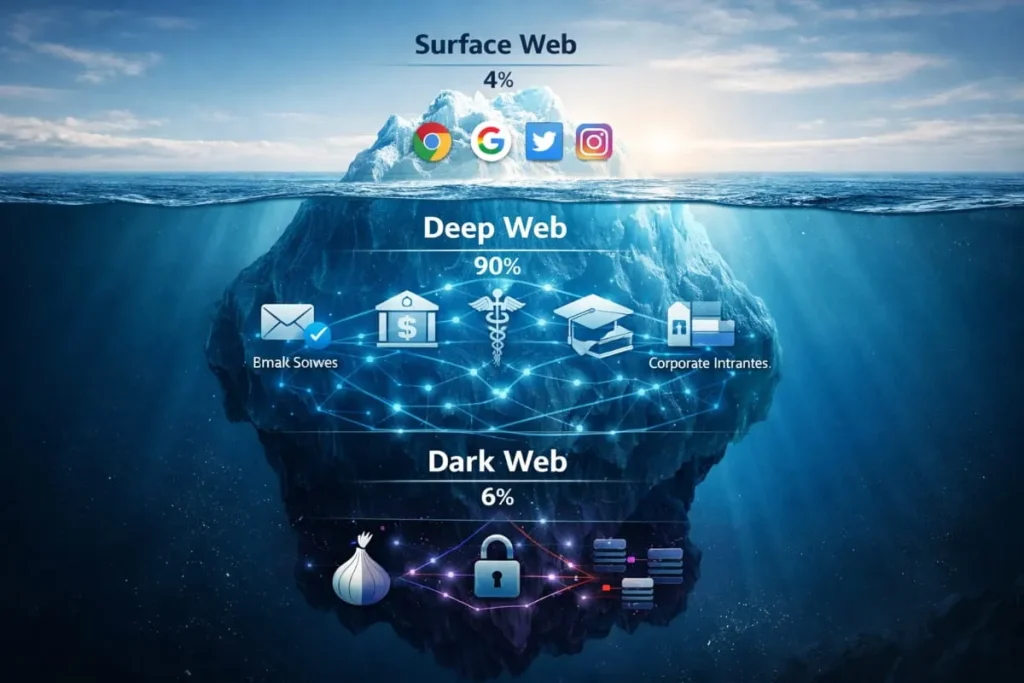
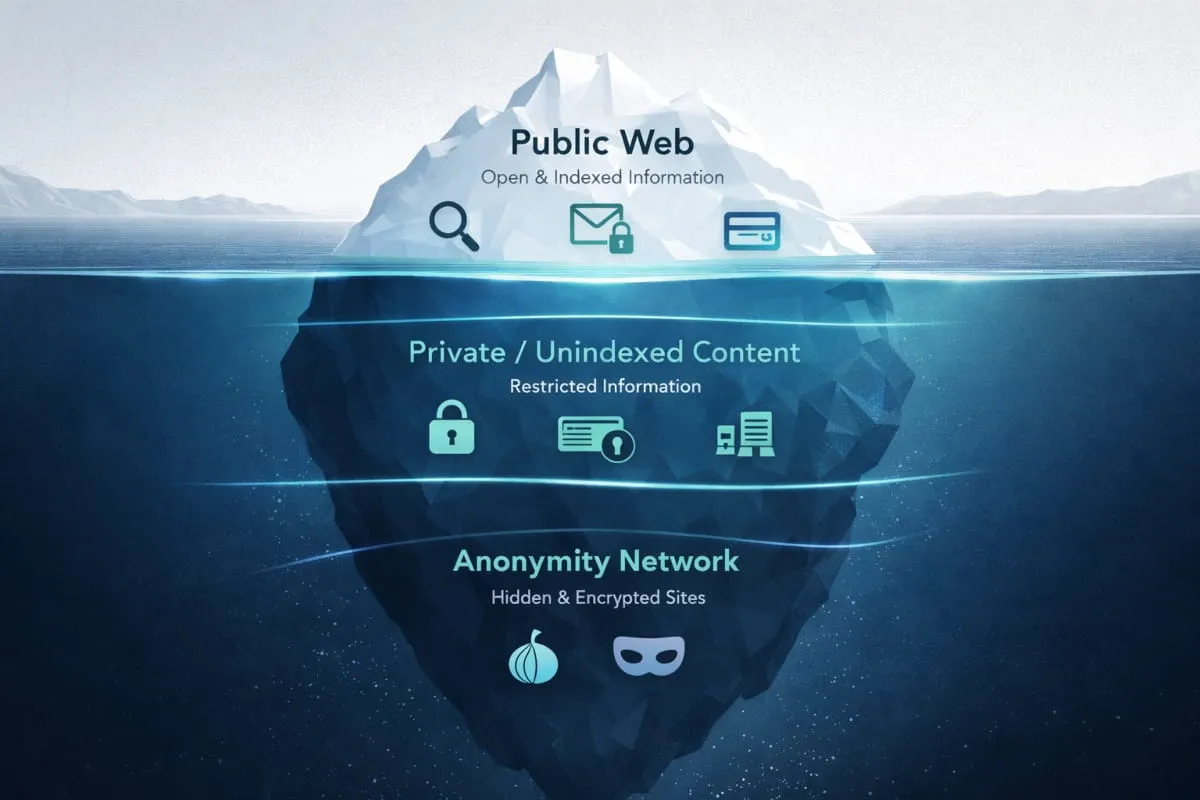
A helpful way to understand deep web and dark internet concepts is the iceberg model: the surface web is the visible top, indexed by Google; the deep web is the massive hidden middle behind access controls; and the dark web is the tiny bottom tip that requires special access methods.
What Is the Deep Web?
The deep web is everything online that search engines don’t index. Put simply: if a page can’t be discovered through Google or Bing results, it likely sits in the deep web.
This usually includes content behind logins, subscriptions, or access restrictions, private by design, not mysterious.

Everyday Examples of Deep Web Content
Most people use the deep web constantly without noticing. It covers normal private areas of the internet that shouldn’t be publicly searchable.
- Personal accounts: Email inboxes, cloud storage folders, private social profiles, and online banking statements. These pages exist online, but they aren’t meant to be searchable (and that’s a good thing).
- Databases and archives: Academic research libraries, medical record systems, member portals, and company intranets, often gated by forms or credentials.
- Sites blocked from indexing: Some websites intentionally prevent bots from crawling certain pages (such as paywalled articles or internal content), which also makes them part of the deep web.
How to Access the Deep Web
Accessing the deep web is usually simple: you use a standard browser and sign in.
You don’t need any special tools, just the correct URL and permission to enter, such as a login, membership, or subscription.
Typical ways people enter the deep web:
- Logging in to view a bank statement
- Signing into an email or a work dashboard
- Opening a private file in cloud storage
- Accessing a subscription-only article or database
Is the Deep Web Safe?
Yes, is the deep web illegal and dangerous? These are typical worries, but the deep web is a normal and necessary part of the internet. It exists to protect private information and prevent personal data from appearing in public search results.
The main risk isn’t the deep web itself; it’s weak security. If a legitimate deep website is breached or passwords are stolen, that exposed data can later appear in dark web markets.
Smart safety basics:
- Use strong, unique passwords (and a password manager if possible)
- Enable two-factor authentication
- Check for HTTPS on sensitive logins
- Avoid suspicious login pages and phishing links
In short, the deep web is routine, legal, and used every day for email, banking, and business, as well as for private content that isn’t indexed by search engines.
Why Deep Web Size Stats Conflict
If you’ve searched deep web vs dark web, you’ve seen wildly different numbers, 90%, 95%, 96%, and even claims like only 4% of the web is indexed. These stats can’t all be perfectly true because they’re usually measuring different things.
A lot of confusion happens when people mix up the indexed web (what search engines can crawl) with the total web (everything that exists online), including private, dynamic, and credentialed content.

What those numbers usually mean
Different sources count different units, so the final percentage shifts.
- Pages vs data: One private database can generate millions of pages (deep web) even though it’s one site.
- Indexed vs accessible: A page can be reachable with a standard browser and still be invisible to Google (deep web).
- Static vs dynamic: Content created on demand (filters, searches, dashboards) often isn’t crawlable at scale.
- Blocked by design: Paywalls, logins, robots.txt rules, and noindex tags can keep content off search results.
- Duplicates and variations: Session IDs, tracking parameters, and personalized pages inflate counts in different studies.
Why this matters for the deep web vs dark web conversation
Because the deep web is so large, people sometimes assume hidden means dangerous. That’s the core misunderstanding behind the difference between the deep web and dark web.
The deep web is mostly normal private content, email, banking, and internal portals. In contrast, the dark web is a much smaller, intentionally concealed subset accessed through specialized networks (such as an onion site ecosystem).
When you see significant percentages, treat them as rough ways to say: most of the internet isn’t searchable, and that’s mainly for privacy and functionality, not crime. The honest risk discussion belongs to the dark web, not the deep web’s size.
What Technically Makes Content Deep Web (Not Just Behind a Login)
In the deep web vs dark web discussion, the deep web is often simplified as anything behind a password. That’s partly true, but technically, deep web content is anything search engines can’t reliably index, even if it’s reachable in a standard browser.
So the key idea is this: deep web = not indexed, not hidden network. That’s the difference between the deep web and dark web in one line.

1) Paywalls and Subscriber-Only Pages
Some content is visible only after payment or account access. Search bots can’t bypass paywalls like real users can, so those pages stay out of the index.
Examples: premium news articles, paid courses, member-only communities.
2) Session-Based and Personalized Pages
Many pages change depending on who you are and what you’re doing. If the URL is tied to a session token or personalized account state, search engines either can’t access it or avoid indexing it to prevent duplicates and privacy leaks.
Examples: shopping carts, account settings, recent orders, private dashboards.
3) Internal Search Results and Form-Generated Pages
A lot of content lives behind search boxes and filters. If a crawler can’t submit the form meaningfully, or if the results change constantly, those pages stay unindexed.
Examples: job portals, product catalogs with filters, library databases, and court record lookups.
4) Dynamic JavaScript Content (Hard to Crawl at Scale)
Modern sites often load content via JavaScript after the page renders. Search engines can crawl some JS, but not always reliably, mainly when content depends on user actions, API calls, or infinite scroll.
Examples: apps with dashboards, interactive tools, and pages that only populate after clicking filters
5) Blocked Crawling (robots.txt, noindex, or paywall rules)
Some pages are excluded on purpose. Site owners can tell bots not to crawl or index certain sections, even if the pages are publicly accessible.
Examples: staging pages, internal documentation, private category pages, subscriber-only sections.
6) Draft or Unpublished CMS Pages
Content that exists inside a CMS but isn’t published (or is set to private) is still online in a technical sense. Still, it’s not meant for public discovery and usually isn’t indexable.
Examples: draft blog posts, private landing pages, preview links, internal campaign pages.
The deep web isn’t a secret internet. It’s mostly normal web content that search engines can’t, or shouldn’t, index. That’s why the deep web can include both private pages and public pages that are blocked from indexing.
And that’s also why dark internet deep web terms get mixed up: the dark web is a separate, intentionally hidden layer (like onion site networks), while the deep web is mostly just not searchable.
What Is the Dark Web?
The dark web is a hidden slice of the deep web that runs on encrypted overlay networks (often called a darknet). It isn’t accessible via normal browsing, and it doesn’t appear in Google results.
Most dark web activity happens on the Tor network (short for The Onion Router), where websites use .onion addresses. Each onion site is designed to make it harder for users and servers to be identified.

Key Characteristics of the Dark Web
The dark internet has a few defining traits that separate it from regular online spaces:
- Anonymity by design: Traffic is routed through multiple relays and encrypted in layers, making tracking far more difficult than on the surface web.
- Not indexed like the regular web: Dark web pages aren’t listed on Google. Some limited underground internet search engine tools may catalog portions of it, but coverage is incomplete and constantly changing.
- Small, but high-risk: The dark web is tiny compared to the rest of the internet, yet it’s known for a higher concentration of scams, illegal listings, and unsafe content.
- Harder to verify what’s real: Impersonation and fake lookalike internet dark sites are common, which is why trust and verification matter.
How Do You Access the Dark Web?
You can’t open dark web addresses in a standard browser. Access usually requires privacy-focused software that connects you to the anonymizing network and can resolve .onion links.
You also don’t accidentally end up on the dark net; it takes deliberate steps and a destination. If you’re casually shopping or reading the news, you’re not going to stumble into the dark web.
Safety note: Avoid random links, downloads, and unknown pages; fake onion links; and malware traps that target curious beginners.
Is the Dark Web Illegal?
A common question is whether the dark web is illegal or whether accessing it is unlawful. In many countries, simply using anonymity networks is legal, and people use them for privacy, security, and anti-censorship reasons.
Actions, not access, usually cross the legal line; illegal buying/selling, stolen data, prohibited material, or cybercrime services are still crimes, regardless of where they happen online.
Legitimate Uses (Yes, It’s Real)
If you’re wondering, “Is the dark web real?“ the answer is yes. It’s often sensationalized, but it also supports legitimate needs, such as:
- Journalists receiving anonymous tips
- Whistleblowers sharing evidence safely
- People bypassing censorship in restrictive regions
- Researchers studying fraud trends and data leaks
- Individuals seeking privacy from stalking or surveillance
Is the Dark Web Dangerous?
The dark web can be risky because anonymity attracts both privacy-seekers and bad actors. Is the dark web dangerous? It can be, primarily if you treat it like normal browsing.
Common dangers include:
- Malware and infected files
- Scams and fake marketplaces
- Phishing traps and impersonation pages
- Disturbing or illegal content
- Increased chance of law enforcement monitoring around criminal hubs
Also, anonymity isn’t invincible. People have been identified through mistakes, scams, malicious software, and undercover investigations, so illegal activity remains high-risk.
If Your Data Shows Up on the Dark Web: A 15-Minute Action Checklist
If you’re researching deep web vs dark web because you suspect exposure, act fast. Whether the leak came from the deep web (accounts, portals, databases) or elsewhere, speed matters.
Use this quick checklist to reduce damage immediately.

Minute 0–3: Confirm What’s Actually Exposed
Before you panic, verify the basics to avoid wasting time fixing the wrong account.
- Identify what leaked: email, password, phone, address, card data, ID info
- Confirm which account/provider it’s tied to
- Check whether the password is current or old
- Look for signs of active account access (new devices, logins, alerts)
Minutes 3–7: Rotate Passwords (Start With the Most Dangerous Accounts)
Password reuse is how one leak turns into ten compromises.
Change passwords in this order:
- Email (primary inbox first)
- Banking + payments
- Apple/Google/Microsoft accounts
- Work accounts (SSO, VPN, admin tools)
- Social + shopping accounts
Do this while changing passwords:
- Use a new, unique password per account
- Replace any reused passwords everywhere
- Store the new passwords in a password manager if possible
Minute 7–10: Kill Sessions + Revoke Access
Even after a password change, active sessions can stay alive.
- Sign out of all devices (look for log out everywhere)
- Revoke suspicious connected apps and third-party access
- Reset or rotate API keys/tokens if you manage any services
- For work accounts: notify your admin if you can’t revoke sessions yourself
Minute 10–12: Enable MFA (and Upgrade It If You Already Have It)
MFA blocks many takeover attempts even if credentials are circulating.
- Turn on MFA for email, banking, and cloud accounts
- Prefer authenticator apps or security keys over SMS when possible
- Save backup codes somewhere safe (not in your inbox)
Minutes 12–14: Check for Account Takeover Persistence
Attackers often set up hidden rules so they keep access.
Email checks (critical):
- Look for forwarding rules you didn’t create
- Review filters that auto-archive, delete, or redirect mail
- Check recovery email/phone numbers for changes
- Review recent sign-ins and trusted devices
Minute 14–15: Monitor and Escalate
Now shift to preventing financial damage and catching follow-on attacks.
- Set fraud alerts or monitor transactions on financial accounts
- Watch for password reset emails you didn’t request
- If you’re an employee: notify IT/SOC immediately with details
- If sensitive business data is involved, trigger incident response
IR triggers (escalate fast if true):
- You see unknown logins or new devices
- Password resets are being requested repeatedly
- MFA was disabled, or recovery info changed
- Work SSO/VPN/admin access may be exposed
- Financial transactions appear that you don’t recognize
Quick Reminder
The difference between the deep web and the dark web matters here: the deep web is where your private accounts live, while the dark web is often where stolen access is traded. If credentials are exposed, assume they have been reused and move quickly.
Common Uses of the Dark Web (Good and Bad)
The dark web is a hidden part of the deep web and dark internet landscape built around anonymity. That design supports real privacy needs, but it also attracts crime, which is why people ask whether the dark web is dangerous and whether it even exists in the first place.

Below are the most common lawful and unlawful uses, without the hype.
Legitimate Uses of the Dark Web
Not everything on the dark net is criminal. Many users turn to it for safety, privacy, or research, especially where free expression is risky.
Privacy, Censorship Circumvention, and Free Speech
In high-surveillance environments, anonymous browsing can help people access news, communicate safely, or avoid retaliation. For journalists, activists, and vulnerable communities, anonymity can be protective rather than suspicious.
You’ll also find mirror versions of public services on onion site addresses so people can access information when the open web is filtered or monitored.
Anonymous Tip Lines and Leak Submissions
Some organizations operate secure drop boxes that allow sources to share documents without revealing their identities. These systems are designed to protect whistleblowers and reduce traceability while submitting sensitive material.
This is one reason the answer to the question “Is it illegal to access the dark web?” is often no: privacy tools can be used for lawful communication.
Privacy-Focused Services
Some privacy-first services offer optional dark web access, allowing users to connect without exposing their location data. This can be helpful for people facing stalking, targeted harassment, or intrusive monitoring.
It’s also used by people who want more control over personal data than the surface web typically offers.
Cybersecurity and Threat Intelligence
Security teams and researchers may monitor dark web chatter to spot leaked credentials, stolen company data, or emerging scam patterns. This can support incident response, fraud prevention, and executive risk monitoring.
In practical terms, it’s part of understanding the risk flow between the deep web and dark web: private systems may hold data, and criminal spaces may later try to trade it.
Illicit Uses of the Dark Web
The dark web’s reputation stems from illegal marketplaces and cybercrime communities that exploit anonymity. This is where the difference between the deep web and dark web becomes most apparent.
Illegal Marketplaces
Some marketplaces operate like shadow versions of e-commerce, offering prohibited goods and services. Anonymous payments, escrow-like systems, and seller reputations can appear without making the activity legal.
This is also where many internet dark sites try to impersonate trusted listings, making scams common even among criminals.
Cybercrime as a Service
You may encounter forums advertising tools, stolen access, or attack services for hire. This fuels ransomware campaigns, phishing operations, and other forms of online extortion.
Even without technical skill, criminals can outsource parts of an attack, which is one reason the dark web can feel like an underground economy.
Stolen Data and Compromised Accounts
A significant chunk of dark web activity involves trading stolen information from breaches, logins, payment details, identity records, and corporate access credentials. These listings can enable account takeovers and large-scale fraud.
This is why businesses monitor exposure, and many people worry that the dark web is illegal: the access tool may be lawful, but the trade is not.
Exploitation, Abuse, and Other Harmful Content
Some of the most harmful content online has surfaced in hidden networks, and international investigators are actively working to dismantle them. This is one of the strongest reasons many people conclude the dark web can be dangerous.
Extremist Propaganda and Criminal Networking
Hidden forums have also been used to spread propaganda, coordinate fraud rings, and recruit participants. Some services advertised (like hired violence) are often scams, but the intent and threat environment can still be serious.
Quick Clarity on Legality and Risk
In many places, using anonymity networks isn’t automatically a crime, so accessing the dark web isn’t illegal by itself. What determines legality is the activity: buying, selling, distributing, or participating in crimes is illegal anywhere.
And yes, the dark web can be dangerous, as scams, malware, and harmful content are more likely in anonymous spaces than in everyday deep web services.
Deep Web vs Dark Web: Key Differences
A lot of confusion around the deep web vs. dark web stems from the fact that they overlap but aren’t the same thing. The dark web sits within the deep web, yet the goals and behaviors of the two layers differ significantly.

Below is a clear breakdown of the difference between the deep web and the dark web, without the hype.
Scope and Visibility
The deep web is massive. It includes pages and systems that search engines can’t index, private dashboards, databases, inboxes, and restricted content.
The dark web is tiny by comparison. It’s a small pocket of the deep web and dark internet that intentionally stays hidden, often operating on anonymizing networks rather than the regular web.
In short:
- Deep web: not indexed for privacy or technical reasons
- Dark web: not indexed by design (built to stay concealed)
Accessibility
Most deep web content is easily accessible with a standard browser. If you have the correct URL and credentials, you can access it through Chrome, Safari, or Firefox like any other site.
The dark web requires specialized access tools, and many pages use .onion domains (also called onion sites). These addresses won’t open in standard browsers, because they don’t work on the public internet the same way.
Key access difference:
- Deep web: standard browser + login or direct link
- Dark web: anonymizing network access + non-standard addresses
Privacy vs Anonymity
The deep web is private because it’s gated; many services require you to identify yourself, such as signing in to a bank account or an employee portal. It’s private from the public, but not necessarily anonymous.
The dark net is built around anonymity. Users and site operators often remain hidden or pseudonymous, which can help people communicate safely, but it can also shield bad actors.
Think of it like this:
- Deep web: privacy through access control
- Dark web: privacy through anonymity
Content and Use Cases
Most deep web content is normal and legitimate: email, cloud files, internal company tools, paid academic resources, and membership platforms.
The dark web has a broader range, from privacy-focused communities and whistleblower channels to scam-heavy spaces and criminal marketplaces. You might find forums, private networks, and mirror services, but you’ll also encounter areas where illegal activity is more common.
Examples:
- Deep web: banking portals, medical records, paid research archives
- Dark web: anonymous forums, illicit listings, cybercrime communities, and hidden marketplaces
Legality
There’s nothing inherently illegal about the deep web. It’s simply the part of the internet that isn’t publicly searchable.
When it comes to the dark web, the question is usually: Is it illegal? In many places, access itself may be legal, but illicit transactions and harmful behavior are not. That’s why it is unlawful to access the dark web, which depends heavily on local laws and what you do after entering.
A simple way to remember it:
- Deep web: everyday private internet use (routine and legal)
- Dark web: mixed environment, privacy tools may be legal, but crimes remain crimes
Deep Web vs Dark Web Comparison Table
| Aspect | Deep Web | Dark Web |
|---|---|---|
| Size of the Internet | Often described as most online content because it’s unindexed (private pages, databases, gated content). It’s large, but still part of the normal internet. |
A tiny slice of the internet and a smaller piece inside the deep web, commonly described as well under 1% of total content. |
| Accessibility | Reachable with standard browsers (Chrome, Firefox, Safari). Usually requires a direct link and/or login credentials. |
Requires special access tools on anonymizing networks. Many sites use .onion links and won’t open in normal browsers. |
| Content | Private & everyday content like email inboxes, cloud files, banking dashboards, medical portals, internal company systems, and subscription databases. |
Anonymous & higher-risk content such as hidden forums, marketplaces, leaked data dumps, cybercrime communities, and some lawful privacy-focused uses. |
| Anonymity | Not designed for anonymity. Sites typically know who you are through accounts, sessions, and logs. |
Built for anonymity. Identities and hosting details are harder to trace using encryption and routing. |
| Legality | Accessing your own accounts is legal and routine. Illegal actions remain illegal regardless of labeling. |
Access tools may be legal in many regions, but illegal activities are still illegal and often targeted by law enforcement. |
| Examples | Webmail, online banking, work intranets, university libraries, paid journals, subscriber-only news, private profiles. |
Dark web marketplaces, ransomware leak pages, illicit forums, anonymous drop sites, and privacy-oriented .onion mirrors. |
Why This Matters
Confusing the deep web with the dark web creates the wrong kind of fear. The deep web is mostly normal private content, while the dark internet deep web corner is much smaller and tends to carry a higher risk.
Knowing the difference between the deep web and the dark web helps you focus on real threats, like data leaks, account takeovers, and credential exposure, rather than assuming that unindexed content is automatically dangerous.
Dark Web Monitoring: What It Can Detect vs What It Can’t
Dark web monitoring helps you spot signs that stolen data is circulating on the dark web. It’s beneficial to understand the connection between the deep web and the dark web: private accounts and databases are breached, and stolen access is traded on underground markets.
Think of it as a visibility layer, not a guarantee that you’ll see everything.
What Dark Web Monitoring Can Detect
Most services focus on places where stolen data is publicly posted, indexed, or resold at scale.
Familiar sources it can cover:
- Breach dumps: leaked databases and data drops shared publicly or semi-publicly
- Credential shops: bundles of usernames/passwords sold or traded
- Ransomware leak pages: extortion sites where stolen files are posted to pressure victims
- Forums and marketplaces: chatter about new leaks, access sales, and proof samples
- Paste-style leaks: quick credential lists that spread before getting re-hosted elsewhere
- Brand/domain mentions: your company name, exec names, product terms, or internal project keywords
This can help you react faster, reset passwords, rotate keys, force MFA, and investigate whether an incident is active.
What It Can’t Reliably Detect
Monitoring has real blind spots, even with good coverage.
Limitations to expect:
- Invite-only or private groups: closed communities, private chats, and encrypted channels
- Short-lived listings: posts that appear briefly, then vanish or move elsewhere
- Non-text leaks: screenshots, images, or compressed files that aren’t easily searchable
- Data that isn’t shared publicly: some attackers monetize privately to a small buyer list
- Attribution uncertainty: your brand name might be used as bait, impersonation, or rumor
- Coverage gaps: not every onion site or hidden forum is monitored consistently
- Delays: detection often happens after data has already spread across multiple places
So while monitoring can warn you, it won’t always catch the very first leak or prove how the breach happened.
False Positives and Noise (Why Alerts Need Triage)
You’ll often see alerts that look scary but don’t reflect real risk.
Common examples include old passwords resurfacing, recycled breach data, typo domains, and partial matches that only appear to be your organization. That’s why alerts need verification before you trigger significant response actions.
Buyer Checklist: What to Ask Before You Pay
If you’re evaluating a service, these questions quickly separate strong tools from marketing fluff.
- Source coverage: Which forums/markets/leak pages are included, and how often are they checked?
- Freshness: How quickly do you alert after new exposure is found?
- Validation: Do you show evidence (samples, hashes, timestamps) without exposing sensitive data?
- False-positive controls: Do you support exact domain matching and context-based filtering?
- Response guidance: Do alerts map to actions (reset, revoke sessions, rotate keys, IR triggers)?
- Privacy and legality: Is the collection done ethically and within legal boundaries?
Dark web monitoring is best used as an early-warning system, not your only defense. It complements security controls that protect deep web assets (identity, access control, patching, detection), while giving you visibility into how exposure may spread across internet dark sites.
In short, it can tell you when your data is showing up, but it can’t promise you’ll see everything, everywhere, instantly.
Risks and Dangers of the Dark Web
By definition, the dark net carries more risk than the surface web or the deep web. The anonymity that protects privacy can also hide scammers, malware operators, and criminal networks.
If you’re wondering whether the dark web is dangerous, here are the main reasons.

Malware and Scams
A significant threat on dark web sites is malicious content disguised as something valuable. Fake downloads, impersonation pages, and too-good-to-be-true offers are common because there’s less visibility and fewer trust signals than on the open web.
Common traps include:
- Infected files disguised as tools or documents
- Phishing pages that mimic login portals
- Fake marketplaces designed to steal payments
- Links that redirect to scam clones of an onion site
The lack of familiar branding and trustworthy search results makes it easier to walk into a setup without realizing it.
Disturbing or Illegal Content
Browsing without a clear purpose can expose people to material that’s upsetting, harmful, or outright illegal. Even accidental exposure can carry consequences, depending on local laws and what is accessed.
This is one reason the curiosity click approach is a bad idea; random exploration isn’t like normal browsing.
Deanonymization and Tracking Risks
The dark web is built for anonymity, but it’s not invincible. Mistakes can quickly compromise privacy, especially when people reuse identities, share personal details, or trust the wrong services.
Ways anonymity can be weakened:
- Reusing personal usernames or emails across platforms
- Logging into accounts tied to a real identity
- Clicking on unknown links that attempt tracking or exploitation
- Interacting with compromised or monitored services
The safer mindset is to assume anonymity can fail, then act accordingly.
Legal Consequences
Access alone may be legal in many places, but illegal behavior remains illegal everywhere. Some areas also have strict laws about specific types of content, and investigations often involve undercover monitoring of criminal communities.
So the idea that the dark web is a lawless zone is misleading. People can and do get caught.
No Consumer Protection (No Safety Net)
On the regular web, you can dispute a payment, report fraud, or rely on platforms to intervene. On the dark web, if money is sent to the wrong person or a site disappears, there’s usually no recovery path.
It’s a high-trust environment with low trustworthiness, meaning users often have less protection when things go wrong.
Deep Web Risks (By Comparison)
The deep web is usually safe because it consists of ordinary private services like email, banking, and internal portals. But it can still be targeted because it holds valuable data.
The biggest deep web threats are:
- Phishing that steals logins
- Weak passwords or reused credentials
- Data breaches exposing private records
And when those accounts or databases are compromised, stolen information may later circulate in dark web communities, linking the deep web vs dark web risk chain.
Most people don’t need the dark web at all. You can do nearly everything online through the surface web and deep web without ever touching it.
And if you’re researching the difference between deep web and dark web, remember this: anonymity cuts both ways, you can’t easily verify who you’re dealing with, and that uncertainty is the core risk.
Pen Test vs Dark Web Monitoring vs Attack Surface Management (ASM): Which Reduces Risk Fastest?
If you’re comparing options after learning the deep web vs dark web difference, here’s the practical truth: these aren’t interchangeable tools. They reduce risk in different ways; some prevent breaches, others detect exposure after it happens.

Below is a buyer-friendly breakdown to help you choose based on what you need right now.
1) Penetration Testing (Pen Test)
Best for: Finding real-world weaknesses before attackers do.
A pen test simulates how an attacker could breach your systems, especially deep-web assets such as internal apps, APIs, portals, and admin panels.
What it reduces fastest:
- Exploitable vulnerabilities that could lead to a breach
- Broken access control, injection flaws, and misconfigurations
- Weak authentication flows that expose sensitive data
You’ll see quick wins if:
- You have new apps, significant changes, or legacy systems
- You suspect hidden flaws in private systems
- You need proof of risk + clear remediation steps
2) Dark Web Monitoring
Best for: Detecting exposure after data is stolen or traded.
This is the alarm system for when credentials, customer info, or internal data appear in underground channels.
What it reduces fastest:
- Time-to-detection for leaked credentials and breach fallout
- Secondary attacks like credential stuffing and account takeover
- Blind spots where breaches go unnoticed for weeks
You’ll see quick wins if:
- You’ve had past breaches or credential leaks
- Your workforce uses many SaaS tools and SSO accounts
- You want an early warning when data shows up on the dark internet sites
3) Attack Surface Management (ASM)
Best for: Closing external exposure and unknown entry points.
ASM continuously discovers and monitors public-facing assets, domains, subdomains, exposed services, cloud misconfigs, and forgotten systems, so attackers can’t exploit what you didn’t even know existed.
What it reduces fastest:
- Risk from shadow IT and unmanaged external assets
- Exposure from open ports, misconfigured cloud storage, leaked keys
- Easy wins attackers love (forgotten apps, stale DNS, misrouted services)
You’ll see quick wins if:
- Your org has many teams launching tools and apps
- You’ve merged/acquired companies or changed infrastructure
- You don’t have a clean inventory of public-facing assets
Which One Reduces Risk Fastest? (Choose by Goal)
If you need the fastest prevention: Pen Test
- Because it identifies exploitable paths into deep web data before it becomes dark web inventory.
If you need the fastest detection of exposure: Dark Web Monitoring
- Because it can alert you when stolen credentials/data appear, and you need to respond quickly.
If you need the fastest reduction of unknown exposure: ASM
- Because it finds and shrinks the unknown unknowns that attackers commonly exploit first.
The Best Combo (Most Realistic Answer)
These tools work best together; each covers a different stage of the risk chain:
- ASM reduces entry points (what attackers can see)
- Pen testing validates absolute exploit paths (what attackers can do)
- Dark web monitoring detects monetization/exposure (what attackers sold)
That’s also why the distinction between the deep web and the dark web matters: deep web systems store valuable data, and dark web channels may reveal when it’s been stolen.
Why Deep Web vs Dark Web Matters for Cybersecurity in 2026
The distinction between the deep web and the dark web isn’t just internet trivia anymore. In 2026, it directly affect how organizations manage breaches, respond to threats, and protect private systems.
If you understand the difference between the deep web and dark web, you’ll know where sensitive data lives, and where attackers try to sell or weaponize it.

Breaches Fuel the Dark Web Economy
Most stolen data starts in the deep web: customer databases, internal tools, employee portals, and private cloud systems. When attackers break in through phishing, weak access controls, or exposed apps, that data is often advertised on underground channels.
Once information is traded widely, it becomes a force multiplier. Leaked passwords and session details can lead to credential stuffing, account takeovers, identity fraud, and follow-on intrusions across multiple platforms.
What this means for businesses:
- A breach rarely stays contained for long
- Stolen data tends to spread quickly among threat actors
- The cost rises when your leaked data enables new attacks
Threat Intelligence: Why Teams Watch Dark Web Signals
Because criminal coordination often happens off the public web, many security programs include dark-web intelligence as an early-warning layer. The goal isn’t curiosity, it’s faster detection.
If employee logins, customer records, or internal documents surface in underground communities, teams can rotate credentials, tighten access, and investigate before damage spreads.
Practical use cases:
- Finding exposed company credentials tied to your domain
- Spotting mentions of your org in breach chatter
- Detecting leaked customer data before regulators or media do
This is also why guidance from security standards commonly emphasizes monitoring for compromised credentials and suspicious exposure trends.
Emerging Threats Show Up There First
Dark web discussions can serve as a preview of what’s coming next. New malware variants, phishing kits, and ransomware tactics often circulate in closed communities before they reach the mainstream.
Ransomware groups also use leak pages to pressure victims by publishing stolen files. Watching those patterns can help companies in the same industry adjust defenses and raise alerts early.
In 2026, this matters because:
- Extortion tactics evolve quickly
- Attack methods get packaged and resold
- One breach trend can spread across an entire sector
Protecting Deep Web Assets Keeps Data Off the Dark Web
The deep web itself isn’t the threat; it’s where your most valuable data sits. Private apps, admin panels, APIs, intranets, and cloud storage are prime targets because compromising them creates profit elsewhere.
That’s why practices like vulnerability management, access reviews, and penetration testing matter. If an internal system has broken access control, weak authentication, or injection flaws, it can turn your private deep web data into dark web inventory.
High-impact safeguards:
- Strong identity controls (MFA, least privilege, conditional access)
- Secure app testing and patching cycles
- Monitoring for unusual logins and data exfiltration signals
- Rapid credential resets when exposure is detected
Is the Dark Web Dangerous? The Real Answer for 2026
For most people, the deep web is routine and safe, including email, banking, and work dashboards. The dark web is different: it’s a higher-risk environment where anonymity can shield scams and criminal trade.
Also, whether the dark web is illegal is the wrong first question; in many places, accessing the dark web can be legal, but illicit actions remain unlawful anywhere. For cybersecurity teams, the key point is risk visibility, not exploration.
Understanding deep web and dark internet dynamics helps you focus your defenses correctly: secure the private systems where data lives, and monitor the threat economy where stolen data is monetized.
In 2026, the dark web isn’t just another part of the internet; it’s a source of signals for real-world attacks, and ignoring it can leave organizations blind to early warnings.
Tor ≠ Dark Web: Tor Can Be Used for Normal Websites Too
A common misunderstanding in the deep web vs dark web conversation is assuming that Tor automatically means dark web. It doesn’t. Tor is a privacy tool that can be used to browse regular websites as well.
So if you’re asking whether the dark web is real or illegal, it helps to separate the technology from how people use it.
Tor Can Access the Regular Internet
Tor can load standard sites you already know, the same ones that end in .com, .org, or .edu. In that case, you’re not visiting the dark web at all; you’re simply viewing the normal web through an anonymized connection.
This is one reason using Tor shouldn’t be treated as proof of wrongdoing.
The Dark Web is the .onion Part
The dark web is the hidden-services side of the network, sites that use .onion addresses (onion sites) and aren’t reachable through standard browsers.
That’s the difference:
- Tor (tool): a way to route traffic for privacy
- Dark web (destination): hidden sites running on anonymized networks
Why People Use Tor for Legit Reasons
Many users rely on Tor for privacy, safety, or access, not crime. Examples include people trying to avoid tracking, protect sensitive research, or communicate safely in high-surveillance environments.
Even in everyday use, some people prefer Tor to reduce profiling and targeted tracking.
Tor is not the same thing as the dark web. You can use Tor to browse regular sites, and you can access the dark web only when you intentionally visit dark web sites like .onion pages.
This clarification helps reduce fear around the deep web. It keeps the honest risk discussion focused where it belongs: on behavior, not tools.
The Modern Cybercrime Pipeline: Phishing/Infostealer → Credentials → Resale → Ransomware
To understand why deep web vs dark web matters for cybersecurity in 2026, it helps to see how attacks actually flow today. Most incidents aren’t random hacks; they follow a repeatable pipeline designed to steal access, monetize it, and scale damage fast.
This is also why the distinction between the deep web and the dark web isn’t academic: deep web systems hold accounts and data, and dark web channels often enable the resale economy.

Step 1: Phishing or Infostealer Infection
Many attacks start with either a phishing lure (fake login pages, urgent emails) or malware designed to steal data silently.
The goal is simple: capture logins, session tokens, or saved passwords, especially for email, VPN, cloud apps, and finance accounts.
Step 2: Credential Capture (Passwords + Session Tokens)
Once a victim is hit, attackers collect access details that unlock deep web accounts: inboxes, SaaS dashboards, internal portals, and cloud storage.
This is where deep web exposure begins, because private systems are exactly what criminals want.
Step 3: Resale and Access Trading
Not every attacker runs ransomware. Many specialize in selling what they stole.
Credentials and network access are packaged and sold to other criminals through underground markets and forums. This is where dark web sites may come into play, as they can help buyers and sellers trade access more anonymously.
Step 4: Initial Access Becomes an Attack
Once someone buys access, they often escalate: move laterally, steal more data, and search for high-value systems.
This stage is where weak identities, poor segmentation, and over-permissioned accounts turn a compromised login into a whole incident.
Step 5: Ransomware + Data Extortion
Ransomware groups frequently combine encryption with extortion: they steal sensitive files, then threaten to leak them if payment isn’t made.
Leak pages and name-and-shame tactics pressure victims and create a public signal to other criminals that the group is active.
Why This Pipeline Matters in 2026
This pipeline explains why stolen passwords are more than just passwords. A single credential leak can trigger a chain reaction: account takeover → internal access → data theft → ransomware.
It also shows how the deep web and dark web interact:
- Deep web: where valuable accounts, portals, and data live
- Dark web: where stolen access and data may be traded or advertised
- Result: more attacks become repeatable, scalable, and profitable
Before You Go: Safety Checklist
Most people don’t need to explore the dark net at all. If you ever consider it, have a clear purpose; curiosity alone usually isn’t worth the risk when safer learning options exist.
You can get the what and why from guides, documentaries, and research summaries without putting yourself in a high-risk environment.
Keep Your Deep Web Accounts Locked Down
Your most sensitive information lives in the deep web, email, banking, cloud storage, and private portals. Protecting those accounts reduces the risk that your data will end up circulating on dark web markets.
Simple, high-impact steps:
- Use strong, unique passwords (avoid reuse)
- Turn on two-factor authentication for email and financial accounts
- Watch for phishing attempts and fake login pages
- Review recovery emails/phone numbers and keep them updated
For Businesses: Treat the Dark Web Like an Early-Warning Signal
For organizations, the distinction between the deep web and the dark web is practical: deep web systems store data, and dark web channels may expose it after a breach.
Consider using threat-intel solutions that alert you when:
- Employee credentials tied to your domain appear in dumps
- Leaked customer data surfaces in underground marketplaces
- Your brand or systems are mentioned in attack planning chatter
Think of it like a radar system for risks that aren’t visible through regular monitoring.
Help Others Get the Terms Right
People often misunderstand the difference between deep web and dark web. Some panic at the phrase deep web, while others assume anonymity equals safety.
A more precise framing helps:
- The deep web is mostly normal private content
- The dark web is anonymity-focused and higher risk
- Hidden doesn’t automatically mean harmful, and anonymous doesn’t automatically mean safe
The Iceberg Model (A Simple Way to Remember It)
The internet is often described as an iceberg: the surface web is the visible tip, indexed by search engines; the deep web is the vast, private layer beneath; and the dark web is a small, hidden zone that requires special access.
This mental model helps explain why confusion between the deep web and the dark web is so common, and why the risk levels are very different.
The deep web is a beneficial part of the internet because it protects private data and enables secure online services. The dark web can support privacy and free speech. Still, it also carries a higher risk and is often associated with criminal activity.
In 2026, cyber threats increasingly connect back to dark web trade in stolen data and attack tools. Understanding these terms is part of basic cyber awareness, especially if you want to protect accounts and reduce exposure.
Ready to Strengthen Your Defenses?
Awareness helps, but readiness matters more. If you want to validate your security posture, uncover hidden weaknesses, or build a stronger defense strategy, our team can help.
We provide professional penetration testing to simulate real-world attacks, identify vulnerabilities, and deliver clear, actionable remediation guidance. We also incorporate threat intelligence insights so your defenses align with what attackers are actively using.
Explore our Penetration Testing Services and reach out. Proactive testing today is far better than discovering your data in a dark web forum after a breach.
Conclusion
The deep web vs dark web debate is simpler than it sounds once you separate privacy from anonymity. The deep web is the normal, private side of the internet: email, banking, cloud storage, internal portals, and content that shouldn’t be public.
The dark web is different. It’s a much smaller, intentionally hidden layer where anonymity is central, often accessed through an onion site address. That anonymity can support free speech and research. Still, it also creates space for scams, malware, and criminal trade. One. One reason people ask is whether the dark web is dangerous and illegal.
For individuals, the most effective move is to secure the deep web accounts you rely on every day: use strong, unique passwords, enable MFA, and stay alert to phishing attempts. For businesses, the 2026 reality is that breaches don’t end at the breach; stolen data can enter a resale pipeline, where credentials and access get traded and reused. That’s why a layered approach matters: protect deep web assets, reduce external exposure, and use threat intelligence to spot leaks early.
Ultimately, understanding the difference between deep web and dark web helps you focus on the real risks without panic. The deep web is essential for privacy. The dark net can be helpful, but it demands caution, because anonymity doesn’t guarantee safety, and online threats now move faster than ever.
Frequently Asked Questions (FAQ’s)
What is the Deep Web?
The deep web is online content that search engines don’t index. It includes private pages like email inboxes, online banking, cloud files, and internal company portals.
What is the Dark Web?
The dark web is a small, hidden subset of the deep web that runs on anonymizing networks. Many dark web sites use .onion links (onion sites) and aren’t accessible like regular websites.
Deep Web vs Dark Web: what’s the difference?
The difference between the deep web and the dark web lies in their purpose and access. The deep web contains unindexed private content, while the dark web is intentionally hidden and built around anonymity.
Is the deep web the same as the dark web?
No. People often mix them up, but they aren’t the same. The deep web primarily contains everyday private content, while the dark web is a smaller, riskier area designed for anonymity.
Is the Deep Web illegal?
No, the deep web is a common myth. Using the deep web is normal and legal (email, banking, work tools); illegal activity depends on what you do, not where the content sits.
Is the Dark Web real?
Yes, the question “Is the dark web real?” is often asked, and the answer is simple: it exists. It’s usually exaggerated online, but it’s a real part of the internet that people access intentionally.
Is the dark web illegal?
The technology itself isn’t automatically illegal in many places, so whether the dark web is illegal usually depends on the context. Illegal actions (buying stolen data, providing cybercrime services, engaging in contraband) are unlawful everywhere.
Is it illegal to access the dark web?
Whether accessing the dark web is illegal depends on your country’s laws and regulations. In many regions, access alone may be legal, but accessing illegal content or committing crimes is not.
Is accessing the dark web a crime?
Not necessarily. Whether accessing the dark web is a crime depends on jurisdiction and the behavior involved. Many laws focus on illegal activity (fraud, exploitation, hacking), not simply visiting anonymous networks.
Is the dark web dangerous?
The dark web is dangerous because scams, malware, fake links, and harmful content are more common there. It’s a higher-risk environment than the deep web or surface web.
Can you accidentally end up on the dark web?
It’s doubtful. The dark net typically requires intentional steps and non-standard addresses (like .onion), so you don’t usually stumble into it while normal browsing.
What is an onion site?
An onion site is a website that uses a .onion address and is hosted on an anonymity network. These sites aren’t indexed like standard pages and are designed to reduce traceability.
What does dark internet mean?
The dark internet is an informal term for hidden or anonymous online spaces. In most contexts, it refers to the dark web and related privacy networks, not the deep web in general.
What is the black web or shadow web?
Terms like “black web” or “shadow web” are usually slang, not technical categories. Most of the time, people mean the dark web, but the wording is often used to sensationalize it.
Are there dark web search engines?
Some limited tools exist, but they don’t work like Google. An underground internet search engine may index a portion of onion sites. Still, coverage is incomplete, and many pages stay private or change frequently.
Why do people use the dark web for legitimate reasons?
Some people use it for privacy, anti-censorship access, secure communication, or research. Anonymity can protect journalists, whistleblowers, and people in high-surveillance environments.
If my data shows up on the dark web, what should I do first?
Start with your email and financial accounts: change passwords, enable MFA, and review security settings. Then monitor for suspicious activity and notify your IT/SOC team if work accounts are involved.
How big is the dark web compared to the deep web?
The dark web is tiny compared to the deep web. The deep web includes vast amounts of private, unindexed content, while the dark web is a much smaller, hidden slice within it.