
How to Prevent Data Breaches | Guide to Breach Prevention Best Practices (2026)
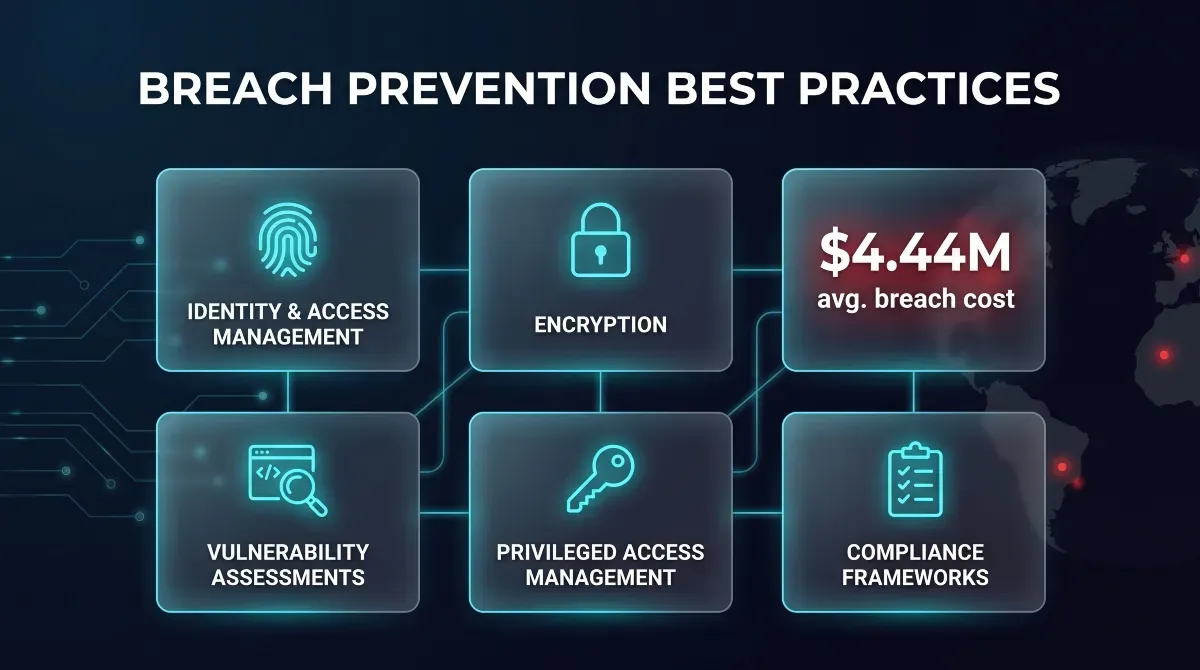
You prevent a data breach by combining layered technical controls, strong identity and access management, encryption, and continuous monitoring with employee training and a tested incident response plan, so that no single point of failure can expose your data. This is the core discipline behind breach prevention: reducing your attack surface at every layer, from human behavior to cloud infrastructure, before an attacker finds the gap.
The stakes for getting this wrong keep rising. IBM’s 2025 Cost of a Data Breach Report puts the global average cost of a breach at $4.44 million, and breaches involving stolen or compromised credentials take the longest to identify and contain of any category, often well over 250 days. That gap between compromise and detection is exactly where prevention earns its value: every control covered in this guide is designed to close that window, whether by stopping the initial access attempt or catching it fast enough to limit the damage.
This guide walks through the full picture of modern breach prevention, the root causes still driving most incidents, the core best practices every organization should have in place, cloud- and AI-specific risks unique to 2026, and how prevention priorities shift depending on your industry or company stage. Whether you’re a startup founder locking down your first cloud environment or a CTO auditing an enterprise security stack, the goal is the same: make your organization a harder, less rewarding target.
What Is Data Breach Prevention?
Data breach prevention is the combined set of technical, administrative, and behavioral safeguards an organization uses to stop unauthorized parties from accessing, stealing, or exposing sensitive data. It covers everything upstream of an incident, access controls, encryption, employee training, monitoring, and policy, rather than the cleanup that happens after data has already been exposed. In practice, prevention is less a single tool and more a discipline. Every layer of your systems and every person who touches your data is a potential point of failure, and prevention means closing those gaps before an attacker finds them.
Data Breach vs. Security Incident: Key Differences
A security incident is any event that threatens the confidentiality, integrity, or availability of a system, such as a blocked phishing email, a failed login attempt, or a detected malware probe. A data breach is a specific, more serious outcome: it means sensitive data was actually accessed, stolen, or exposed by an unauthorized party. Every data breach starts as a security incident, but most security incidents never become breaches because prevention controls catch and contain them first. This distinction matters practically, too: breach notification laws and compliance obligations are usually triggered by confirmed data exposure, not by every flagged incident, which is why strong prevention not only reduces risk but also reduces regulatory and legal exposure.
Why Breach Prevention Matters More Than Ever
The cost of getting prevention wrong has never been higher. According to IBM’s 2025 Cost of a Data Breach Report, the global average cost of a single breach now stands at $4.44 million, and breaches caused by stolen or compromised credentials take longer to identify and contain than almost any other attack vector. Several forces are pushing that cost upward: sprawling cloud and SaaS environments have multiplied the number of entry points into a typical organization, AI-driven attacks and autonomous agents are lowering the skill bar for attackers, and remote and hybrid work have pushed sensitive data further outside the traditional network perimeter. Prevention matters more now, not because the fundamentals have changed, but because the number of places those fundamentals have to hold has grown so much larger.
The Root Causes of Data Breaches
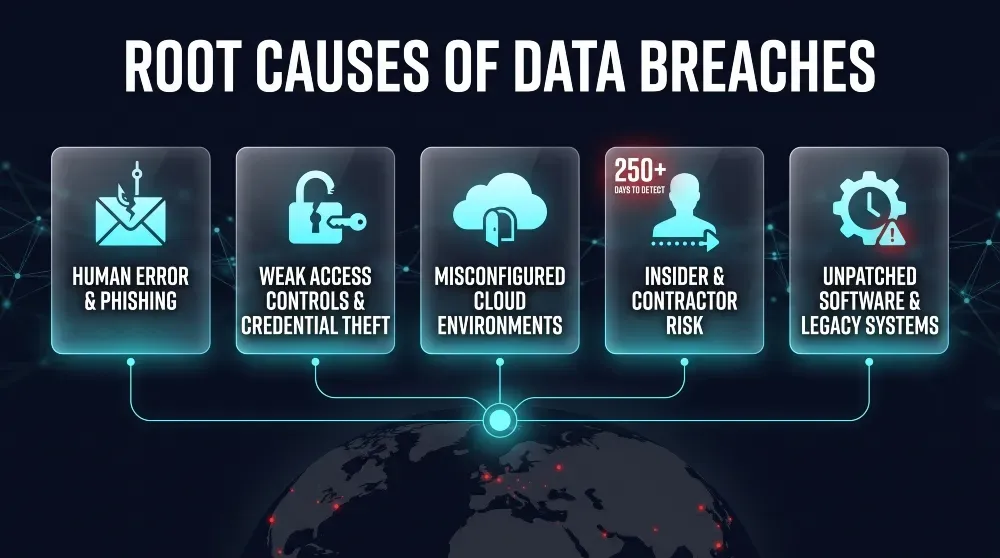
Most data breaches trace back to one of five root causes: human error, weak access controls, cloud misconfigurations, insider or contractor risk, and unpatched software. Understanding which of these is most likely to affect your organization is the starting point for any effective prevention strategy, because the right controls look very different depending on whether your biggest exposure is a careless click or a forgotten server patch.
Human Error & Phishing
People remain the single biggest factor in data breaches, not because employees are inherently careless, but because phishing and social engineering are specifically designed to exploit normal human behavior, urgency, trust, and the desire to be helpful. A convincing email impersonating a vendor or executive can bypass millions of dollars in technical defenses with a single click, which is why phishing consistently ranks among the top initial access methods in breach investigations year after year. Training reduces this risk, but it works best as one layer among several, since even well-trained employees will eventually encounter a phishing attempt sophisticated enough to fool them.
Weak Access Controls & Credential Theft
When access controls are too permissive, a single stolen password can unlock far more than it should. Breaches caused by compromised credentials are consistently among the most expensive and slowest to detect, according to IBM’s 2025 Cost of a Data Breach Report. They often take well over 250 days to identify and contain, largely because a valid login looks identical to legitimate activity until the damage is already done. Weak passwords, reused credentials across systems, and excessive standing access (employees retaining permissions they no longer need) all compound this risk, turning a single compromised account into an organization-wide exposure.
Misconfigured Cloud Environments
As organizations move more infrastructure to the cloud, misconfiguration has become one of the fastest-growing causes of breaches: a storage bucket left public, an API left unauthenticated, or overly broad permissions granted during a rushed deployment. Unlike an on-premise server behind a firewall, a misconfigured cloud resource can be discovered and exploited by automated scanning tools within minutes of going live. The shared responsibility model is often where this breaks down: cloud providers secure the underlying infrastructure, but configuring access, encryption, and permissions correctly is still the customer’s job, and that handoff is where gaps most often appear.
Insider Threats & Contractor Risk
Not every breach comes from outside the organization. Insider threats, whether malicious, negligent, or simply the result of a departing employee’s access not being revoked in time, account for a meaningful share of confirmed breaches, and contractors and third-party vendors extend that risk further by granting outside parties access to internal systems. These cases are often harder to prevent with technical controls alone, because the access itself is legitimate; the safeguard is in limiting what any single person or vendor can reach, and revoking that access promptly the moment it’s no longer needed.
Unpatched Software & Legacy Systems
Attackers routinely exploit vulnerabilities that already have a published fix; the breach isn’t caused by a novel attack technique but by a patch that was never applied. Legacy systems compound this problem, since older software may no longer receive security updates, leaving a permanent, unpatchable gap in the environment. Consistent patch management isn’t a glamorous part of breach prevention, but it closes off one of the most reliable and well-documented paths attackers use to get in.
Core Data Breach Prevention Best Practices
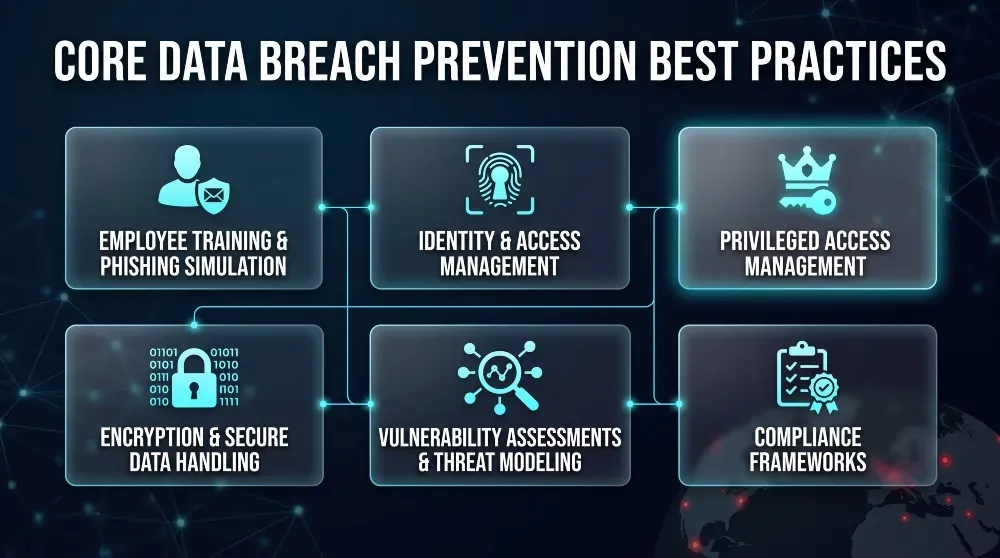
The most effective data breach prevention strategies combine six core practices: employee training, identity and access management, privileged access management, encryption, regular vulnerability assessments, and alignment with recognized compliance frameworks. None of these controls works well in isolation; each one closes a different gap the others leave open, which is why layering them together is what actually keeps organizations out of breach statistics rather than adding to them.
Employee Training & Phishing Simulation
Since phishing remains one of the most common ways attackers gain initial access, training employees to recognize suspicious emails, links, and requests is one of the highest-leverage prevention investments an organization can make. The most effective programs go beyond a one-time onboarding session, using periodic phishing simulations that test real behavior and give employees low-stakes practice spotting an attack before a real one arrives. Over time, this shifts an organization’s biggest vulnerability, its people, into one of its stronger lines of defense.
Identity & Access Management (IAM)
IAM governs who can access what within an organization’s systems, and getting it right means enforcing the principle of least privilege: every account should have exactly the access it needs to do its job, and no more. Strong IAM also means multi-factor authentication on every account that can reach sensitive data, automated deprovisioning when someone leaves the organization, and regular access reviews to catch permissions that have quietly accumulated over time. Because a large share of breaches begin with a compromised or overprivileged account, IAM is often the single control that most effectively shrinks an organization’s attack surface.
Privileged Access Management (PAM)
Privileged accounts, admin credentials, service accounts, and any login with elevated permissions are the accounts attackers want most, because compromising one gives far more reach than a standard user account. PAM adds a dedicated layer of control on top of standard IAM: privileged credentials are vaulted rather than memorized or shared, sessions are monitored and time-limited rather than standing indefinitely, and elevated access is granted just-in-time for a specific task rather than left active by default. Treating privileged accounts as a distinct, higher-risk category, rather than lumping them in with everyday user access, closes one of the most damaging gaps attackers look to exploit.
Encryption & Secure Data Handling
Encryption ensures that even if data is accessed without authorization, it remains unreadable and unusable without the correct decryption key. Effective encryption covers data in two states: at rest, where it’s stored on servers or devices, and in transit, as it moves between systems or across networks. Secure data handling extends this further with data classification, so sensitive information gets stronger protections than routine data, and clear retention policies, since data that’s no longer needed but still sitting on a server is pure, unnecessary risk.
Vulnerability Assessments & Threat Modeling
Regular vulnerability assessments scan systems, applications, and networks for known weaknesses before an attacker discovers them. At the same time, threat modeling takes a more strategic view, mapping out how an attacker would realistically try to breach a specific environment and shoring up those exact paths in advance. Used together, these practices shift prevention from reactive to proactive: rather than waiting for an incident to reveal a weakness, they surface and close gaps on a regular, ongoing schedule. Organizations that run these assessments quarterly or more often typically catch and fix vulnerabilities long before they’re exploited in the wild.
Compliance Frameworks (ISO 27001 and Beyond)
Frameworks like ISO 27001 provide a structured, independently auditable baseline for information security management, covering everything from risk assessment to access control to incident response within a single coherent system. Compliance isn’t a substitute for genuine security. An organization can pass an audit and still have real gaps, but frameworks give teams a comprehensive checklist that helps them avoid overlooking pieces when building a program from scratch. They create accountability through regular external review. For organizations handling regulated data, alignment with a recognized framework is often the difference between a defensible security program and one built on guesswork.
Cloud & Infrastructure Breach Prevention
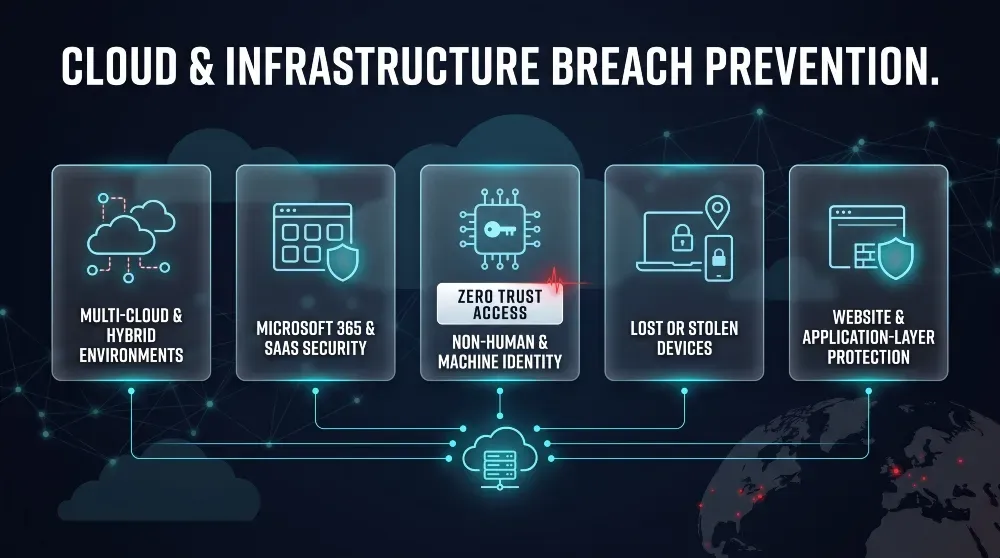
Preventing breaches in cloud and hybrid infrastructure means securing five distinct surfaces: multi-cloud environments, SaaS platforms like Microsoft 365, machine and non-human identities, endpoint devices, and public-facing websites and applications. Each of these surfaces has its own attack patterns and blind spots, which is why cloud breach prevention can’t rely on a single tool or policy; it requires securing every environment where data actually lives, not just the ones that are easiest to monitor.
Securing Multi-Cloud and Hybrid Environments
Organizations running infrastructure across multiple cloud providers, or split between cloud and on-premises systems, face a specific challenge: security settings, permissions, and monitoring tools rarely work identically across every environment. A configuration that’s secure by default on one platform may need to be manually set on another, and gaps tend to open up exactly at these seams, where visibility drops as data or workloads move between environments. Centralized monitoring across all environments, combined with consistent security baselines applied regardless of which provider is in use, closes most of the exposure that multi-cloud and hybrid setups otherwise create.
Microsoft 365 & SaaS-Specific Prevention Tactics
Microsoft 365 and similar SaaS platforms host enormous volumes of sensitive data, but their default settings are rarely configured for maximum security out of the box. Practical prevention here means enabling organization-wide multi-factor authentication, configuring conditional access policies that restrict logins based on location or device risk, using data loss prevention (DLP) rules to prevent sensitive information from being shared externally, and regularly auditing which third-party apps have been granted access to company data. Because SaaS platforms update frequently and permissions can drift over time, these settings need periodic review rather than a one-time setup.
Non-Human & Machine Identity Security
Every organization now has far more machine identities than human ones, API keys, service accounts, and increasingly, autonomous AI agents that authenticate and act on their own. These identities are often provisioned quickly, granted broad permissions for convenience, and then forgotten, which makes them an attractive and frequently overlooked target. Securing them requires the same discipline applied to human accounts: least-privilege permissions, regular credential rotation, and an accurate, up-to-date inventory of every machine identity that has access to sensitive systems, since an identity nobody remembers creating is one nobody is watching.
Preventing Breaches from Lost or Stolen Devices
A lost laptop or stolen phone shouldn’t automatically mean a data breach, but it often does when devices aren’t properly secured. Full-disk encryption ensures data on a device is unreadable without the correct credentials, even if the hardware itself is physically compromised. At the same time, remote wipe capability lets an organization erase sensitive data the moment a device is reported missing. Combined with mandatory device passcodes or biometric locks and automatic session timeouts, these controls mean a lost device becomes an inconvenience rather than an incident.
Website & Application-Layer Protection
Public-facing websites and applications are directly exposed to the internet, making them a constant target for automated scanning and exploitation attempts. Effective protection starts with a web application firewall to filter malicious traffic, regular security testing to catch vulnerabilities like injection flaws before attackers do, and strict input validation to prevent malicious data from being processed by backend systems. Because websites and applications are updated frequently, security testing needs to be built into the development process itself rather than treated as a final check before launch.
Preventing Breaches in the Age of AI
Preventing breaches in an AI-driven environment means treating AI agents as a new category of identity, one with its own risks, its own permissions, and its own attack surface, separate from human users. As organizations increasingly deploy AI agents to handle tasks autonomously, from customer service to internal automation, the traditional model of securing “people” and “systems” no longer covers the full picture, because these agents can access data, make decisions, and take actions largely without a human directly in the loop.
Risks of Autonomous AI Agents
Autonomous AI agents introduce a risk profile that’s genuinely different from traditional software: they can interpret ambiguous instructions, chain multiple actions together, and access systems dynamically based on the task at hand, rather than following a fixed, predictable code path. This flexibility is exactly what makes them useful. Still, it also means an agent can be manipulated through crafted inputs, a technique often called prompt injection, into taking actions or revealing data it was never intended to expose. Because organizations are still early in understanding how these systems fail, many AI agents are deployed with far broader access than their tasks require, simply because it’s easier than precisely scoping permissions.
Limiting AI Agent Permissions and Actions
The most reliable safeguard against AI agent risk is the same principle that governs human access: give the agent exactly the permissions its task requires, and nothing more. In practice, this means scoping an agent’s access to specific data sources and actions rather than granting broad system-wide permissions, requiring human approval for any irreversible action or any action that touches sensitive data, and logging every action an agent takes so that unusual behavior can be caught quickly. Treating an AI agent’s permissions as a security decision, not just a configuration convenience, is what keeps a useful automation tool from becoming an unmonitored path into sensitive systems.
Securing Non-Human Identities in AI Workflows
Every AI agent operates through some form of identity, an API key, a service account, or an authentication token, and these non-human identities are multiplying far faster than organizations’ ability to track them. Left unmanaged, they tend to accumulate standing access that nobody is actively monitoring, which is precisely the kind of forgotten entry point attackers look for. Securing them requires the same fundamentals as any other identity: a current inventory of every AI-related credential in use, regular rotation of keys and tokens, and least-privilege access, tightly scoped to what each specific agent actually needs to do its job.
Data Breach Prevention by Industry & Business Stage
Data breach prevention priorities shift significantly depending on an organization’s industry and stage of growth, since a pre-Series A startup and a hospital system face very different risks, data types, and resource constraints. What stays constant is the underlying goal: protecting sensitive data in proportion to its sensitivity, but the specific controls that matter most vary by context.
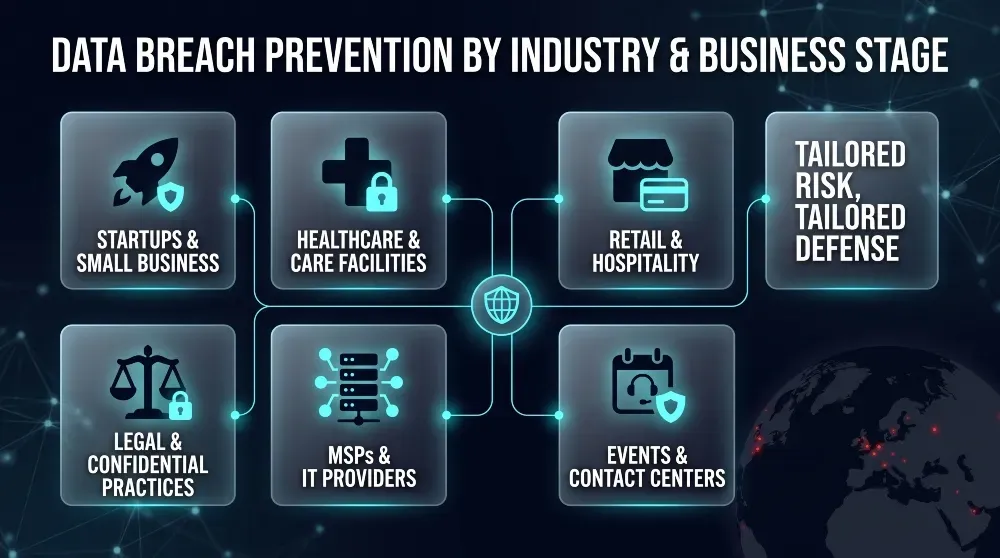
Small Businesses & Startups (Pre-Series A)
Early-stage startups often assume they’re too small to be targets. Still, attackers frequently see them as easier entry points precisely because their security infrastructure is thin and budgets are tight. At this stage, prevention should focus on the highest-leverage, lowest-cost controls: multi-factor authentication on every account, a password manager instead of reusing credentials, and a basic cloud configuration review before scaling the infrastructure further. Investors increasingly factor security posture into due diligence, which means the habits built pre-Series A often determine how defensible and fundable the company remains as it grows.
Healthcare & Care Facilities
Healthcare organizations and care facilities handle some of the most sensitive data, including medical records, treatment histories, and personal identifiers, which are protected by regulations like HIPAA, making them consistently high-value targets. Prevention here requires strict access controls that limit who can view patient records, encryption of data at rest and in transit, and detailed audit logs that show exactly who accessed what and when, since regulatory compliance depends on demonstrating this after the fact. Staff training carries particular weight in this sector, since care facilities often have high staff turnover and a wide range of personnel touching sensitive systems.
Retail & Hospitality
Retail and hospitality businesses process large volumes of payment card data, often across multiple locations and point-of-sale systems, creating a wide, distributed attack surface. Prevention priorities include PCI DSS compliance for payment processing, network segmentation so that a breach in one system, such as a guest WiFi network, can’t reach the payment infrastructure, and regular monitoring of point-of-sale systems for tampering or malware. Because these businesses often rely on seasonal or high-turnover staff, building basic security awareness into onboarding is especially important.
Legal, Therapy & Client-Confidential Practices
Legal and therapy practices hold information that clients expect to remain strictly confidential, such as case files, privileged communications, and therapy records, and a breach of this trust is difficult to repair. Prevention in these settings centers on encrypted communication and file storage, strict limits on who within the practice can access specific client files, and secure client portals for sharing sensitive documents rather than email. Because these practices are often smaller operations without dedicated IT staff, choosing tools with built-in security-by-default matters more than in larger organizations with in-house security teams.
MSPs & IT Service Providers
Managed service providers occupy a uniquely high-risk position: a single compromised MSP can give an attacker access to every client environment that provider manages, making MSPs an efficient target for reaching many organizations through one breach. Prevention requires strict segmentation between client environments so a compromise in one doesn’t cascade to others, rigorous access controls on the tools used to manage client systems remotely, and close monitoring for unusual activity across every environment under management. Clients increasingly ask about these safeguards directly, making an MSP’s own security posture a competitive differentiator.
Events, Contact Centers & Childcare Platforms
Event platforms, contact centers, and childcare management systems share a common risk profile: they collect sensitive personal data, often including information about children or vulnerable individuals, through forms, registrations, and ongoing communication, which isn’t always treated with the same rigor as core business systems. Prevention means encrypting data collected through registration and intake forms, limiting staff access to records relevant to their roles, and applying the same vendor security scrutiny to these platforms as to any system handling sensitive data. Because these tools are often adopted quickly to solve an operational need, security review can get skipped in the process; closing that gap is usually the biggest single improvement available.
A CTO’s Framework for Breach Prevention
For a CTO, breach prevention is less about any single control and more about building a repeatable framework: mapping where sensitive data lives across the organization, assigning clear ownership for each system’s security, and establishing a cadence of regular vulnerability assessments rather than one-time audits. Budget and headcount are always finite, so prioritization matters: focus first on controls that address the organization’s most likely attack vectors, based on its specific data, industry, and infrastructure, rather than implementing every possible safeguard evenly. A strong framework also builds in measurement, tracking metrics such as patch response time and access review completion, so prevention becomes something the organization can actually verify, not just assume.
Lessons from Real-World Data Breaches
Some of the clearest lessons in data breach prevention come from studying major breaches after the fact, since post-incident investigations often reveal exactly which control, if it had been in place, would have stopped the attack. The Target and Yahoo breaches remain two of the most instructive examples, not because they were unusually sophisticated, but because they exposed gaps that remain common in organizations today.
What the Target Breach Teaches About Prevention
Target’s 2013 breach, which exposed roughly 40 million payment card records, didn’t begin with an attack on Target’s own systems; it began with stolen credentials from a third-party HVAC vendor that had network access for billing purposes. Once inside, attackers were able to move from that vendor connection into Target’s payment systems, largely because the network wasn’t segmented enough to contain access at the point where a vendor’s legitimate connection ended. The clearest lesson here is that third-party and vendor access needs the same scrutiny as internal access. That network segmentation should prevent a single compromised connection from reaching sensitive systems it has no real reason to touch.
What the Yahoo Breach Teaches About Prevention
Yahoo disclosed in 2016 that breaches dating back to 2013 and 2014 had ultimately affected all three billion of its user accounts, making it one of the largest breaches ever recorded. Notably, the full scale wasn’t discovered or disclosed until years after the initial compromise. That delay is the central lesson: prolonged, undetected access allowed attackers far more time to extract data than a faster detection process would have permitted. Continuous monitoring and proactive threat hunting exist precisely to close this kind of gap, catching unauthorized access within days or weeks rather than allowing it to persist unnoticed for years.
Common Threads Across Major Breaches
Across most major, well-documented breaches, a small set of failures recur: excessive trust in third parties, insufficient network segmentation, and detection gaps that allow attackers to operate undetected for far longer than necessary. Few of these breaches trace back to a single dramatic failure; instead, they usually reflect several smaller, ordinary gaps compounding together, each individually survivable but collectively severe. That pattern is, in a sense, reassuring: it means the core prevention practices covered throughout this guide- access controls, segmentation, monitoring, and vendor scrutiny- directly address the same root causes behind the largest breaches on record.
Building a Data Breach Prevention Plan
A data breach prevention plan turns individual best practices into a coordinated strategy, with clear steps, measurable outcomes, and ongoing review, rather than a scattered set of tools implemented without a unifying framework. Organizations that treat prevention as a documented, repeatable plan consistently catch more gaps than those relying on ad hoc fixes applied only after something goes wrong.
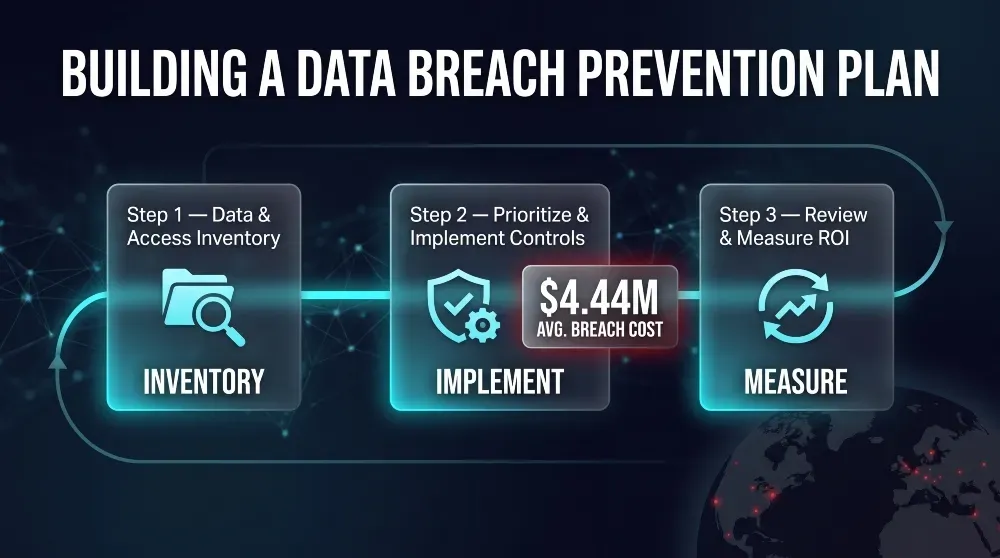
Step-by-Step Prevention Framework
An effective prevention plan starts with an inventory: identifying exactly where sensitive data lives, who has access to it, and which systems touch it, since it’s impossible to protect what hasn’t been mapped. From there, the plan should prioritize the highest-risk gaps first, typically access controls and encryption, before layering in monitoring, employee training, and vendor review. The final and most often skipped step is establishing a regular review cycle, since a prevention plan built once and never revisited tends to drift out of date as systems, staff, and vendors change.
Measuring ROI on Prevention Investments
Prevention spending can be hard to justify internally because its success looks like nothing happening, no breach, no headline, no incident to point to. A more useful framing is to compare prevention costs against the documented cost of a breach: IBM’s 2025 Cost of a Data Breach Report puts the global average breach cost at $4.44 million, which makes even a substantial prevention budget look modest by comparison. Beyond avoided breach costs, organizations can track more immediate indicators of ROI, such as reduced incident response time, fewer flagged phishing clicks after training, and faster patch deployment across systems.
Common Gaps Most Strategies Miss
Even organizations with a formal prevention plan tend to overlook the same few areas: non-human and machine identities that were never inventoried, third-party vendor access that isn’t reviewed as rigorously as internal access, and offboarding processes that leave former employees’ credentials active longer than they should be. These gaps persist not because they’re unknown, but because they fall outside the usual scope of a security review; nobody owns them specifically, so they don’t get checked. Closing them usually requires deliberately assigning ownership over these overlooked categories, rather than assuming existing access reviews cover them.
Frequently Asked Questions (FAQ’s)
Which of the Following Are Breach Prevention Best Practices?
The core breach prevention best practices are multi-factor authentication, least-privilege access, encryption of data at rest and in transit, regular vulnerability assessments, employee phishing training, and timely patch management. These practices work together rather than independently: access controls limit who can reach sensitive data, encryption protects it if access controls fail, and monitoring catches what slips through both. Any list of “best practices” that includes only one or two of these is incomplete, since breach prevention depends on layered controls rather than relying on a single safeguard.
What Can Individuals Do to Prevent Security Breaches?
Individuals can meaningfully reduce their own breach risk with a small set of consistent habits: using a password manager to generate and store unique passwords for every account, enabling multi-factor authentication wherever it’s available, and staying alert to phishing attempts that create urgency or impersonate a trusted contact. Keeping devices and software updated closes another common entry point, since many attacks exploit vulnerabilities that a pending update would already have fixed. None of these steps require technical expertise; they’re habits, not tools, which is exactly what makes them sustainable in the long term.
How Often Should Prevention Strategies Be Reviewed?
Most organizations should formally review their breach prevention strategy at least quarterly, with certain elements, such as access permissions and third-party vendor connections, reviewed more frequently because they tend to drift out of date quickly. Significant changes, such as adopting a new cloud platform, onboarding a new vendor, or rapidly scaling headcount, should trigger an off-cycle review rather than waiting for the next scheduled check-in. Prevention strategies that are only revisited after an incident has occurred are, by definition, reactive rather than preventive; the cadence of review itself is part of what keeps a strategy effective.
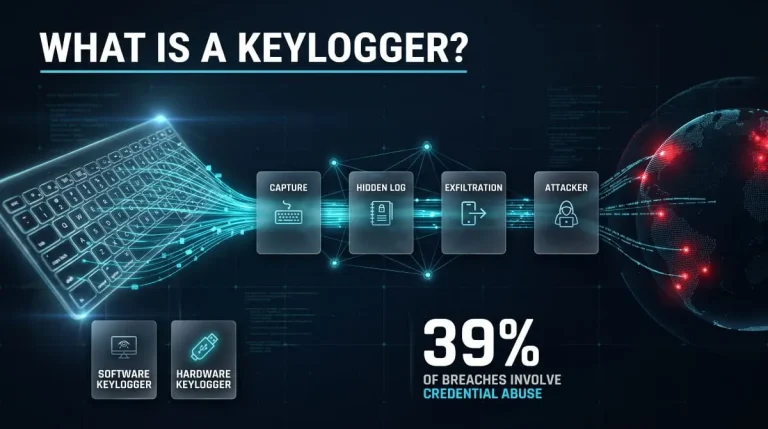
What Is a Keylogger? Definition, Types, Detection and Removal (Complete 2026 Guide)
A keylogger is software or hardware that records every keystroke typed on a device, usually without the user knowing. Attackers use keyloggers to steal passwords, card…
Read more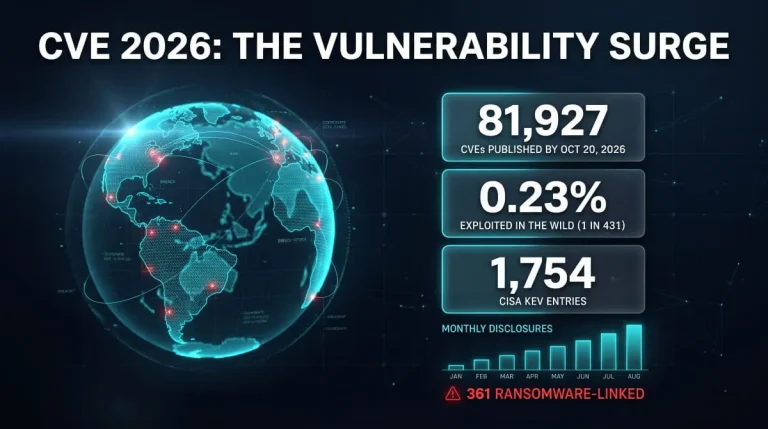
CVE 2026 | The Complete Guide to New, Critical & Actively Exploited Vulnerabilities (Updated Weekly)
CVE 2026 covers every publicly disclosed software flaw assigned a CVE-2026-NNNNN identifier this year, and it is already the largest annual list on record. This guide…
Read more
What Is a Rootkit? Definition, Types, Examples, Detection and Removal (Complete Guide)
A rootkit is malicious software that hides itself and the malware it protects by running with the highest privileges and tampering with what the operating system…
Read more