
Is My Information on the Dark Web? How to Check, What It Means & What to Do Right Now
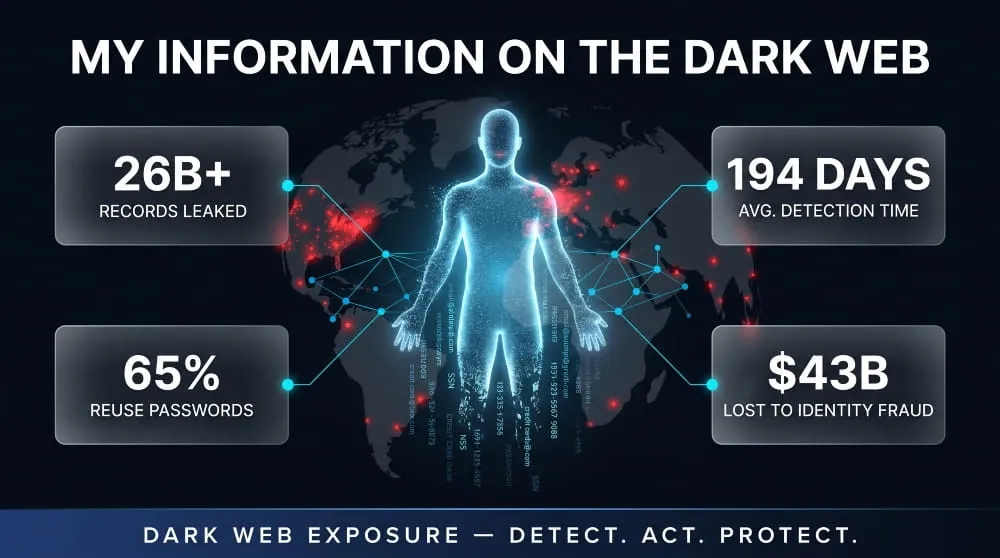
If you’ve received a dark web alert or are simply wondering whether your personal information has been exposed, the answer is probably yes, at least in part. Over 22 billion records were leaked and circulated on the dark web in 2023 alone, which means the odds that at least one piece of your data has appeared somewhere in that ecosystem are higher than most people want to believe.
That doesn’t mean your identity has been stolen or that disaster is inevitable. What it does mean is that you need to know what’s out there, understand what it actually puts at risk, and take the right steps quickly, because exposed data doesn’t sit still. It gets traded, combined with other records, and weaponized over time.
This guide will walk you through exactly what it means when your information is on the dark web, how to check for yourself right now, what to do if something turns up, and whether any of it can actually be removed. No filler, no false reassurance, just a clear picture of where you stand and what you can do about it.
What Does It Mean When Your Information Is on the Dark Web?
When your information is on the dark web, it means data tied to your identity, your email address, passwords, financial details, or personal records has been stolen from a company or service you used and is now circulating in a hidden part of the internet where criminals buy, sell, and trade it. It doesn’t mean someone is actively targeting you right now, but it does mean your data is accessible to people with the intent and tools to exploit it.
What Is the Dark Web and How Does Personal Data End Up There?
The dark web is a section of the internet that isn’t indexed by search engines and cannot be accessed through a regular browser. It requires specialized software, most commonly the Tor browser, to reach, which routes traffic through multiple layers of encryption to conceal the user’s identity and location. While the dark web has legitimate uses, including secure communication for journalists and activists, a significant portion of its activity involves illegal marketplaces where stolen data is a primary commodity.
Personal data typically ends up there through one of two paths. The first is a data breach, a cyberattack against a company that stores your information, where hackers extract large volumes of records and either sell them directly or publish them publicly. The second is infostealer malware, a type of software that silently infects a device and harvests saved passwords, session cookies, and autofill data before uploading it to criminal networks. Either way, the data moves fast: breached records often appear on dark web forums within 24 to 48 hours of an attack.
What Types of Personal Information Are Sold on the Dark Web?
Almost any data point that can be used to impersonate you, access your accounts, or commit financial fraud has value on the dark web. Email addresses and passwords are the most common, often sold in bulk as part of “combo lists” containing millions of credentials. Beyond that, Social Security numbers, dates of birth, home addresses, and full name and identity packages, known as “fullz”, are traded for use in identity theft and account takeover fraud.
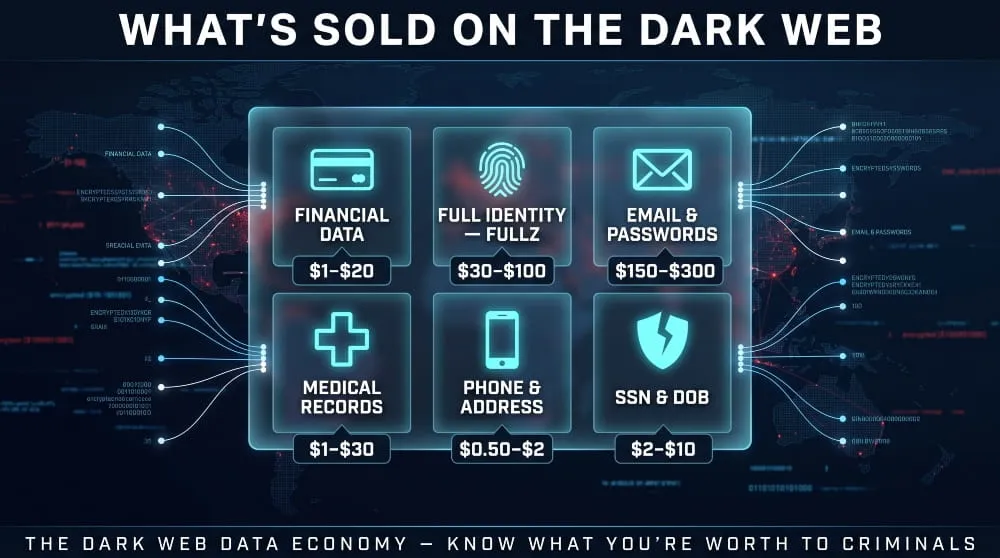
Financial data commands higher prices. Credit card numbers with their CVVs and billing addresses, bank account credentials, and even active session cookies that let an attacker bypass login entirely are all actively sold. Medical records and insurance information have also grown in value, as they can be used to commit healthcare fraud or obtain prescriptions. The more complete the profile, the more it’s worth, which is why criminals often aggregate data from multiple breaches to build richer records on individual targets.
How Much Information About People Is Already on the Dark Web?
The scale is larger than most people realize. According to a 2024 analysis, more than 26 billion records, spanning accounts from LinkedIn, Twitter, Adobe, Canva, and thousands of other platforms, were exposed in a single aggregated leak dubbed the “Mother of All Breaches.” That figure represents years of accumulated breach data compiled into a single searchable database. Independent research from cybersecurity firms consistently finds that the majority of active internet users have at least one credential set circulating on dark web markets or paste sites, often without their knowledge.
The problem compounds over time. Data from a breach five years ago doesn’t expire; it gets recycled, repackaged, and resold as new threat actors discover it or as other leaked data is merged with it to create more complete profiles. Age does not make exposed data safe.
How Does a Data Breach Lead to Dark Web Exposure?
A data breach is the most common entry point for personal information reaching the dark web. When a company’s systems are compromised through a software vulnerability, a phishing attack on an employee, or brute-force access to a misconfigured database, attackers extract user records: email addresses, hashed or plaintext passwords, payment information, and personal identifiers.
From there, the data typically follows one of three routes. High-value datasets are auctioned privately to the highest bidder within criminal networks. Mid-tier data is listed on dark web marketplaces where anyone with cryptocurrency can purchase it. And some datasets are simply dumped publicly on dark web forums or paste sites, either as a form of reputational attack against the breached company or because the attacker has already extracted maximum value and wants to build notoriety. Once data is publicly dumped, it spreads rapidly and becomes nearly impossible to contain. That’s the moment when individual exposure shifts from a risk to a near-certainty.
Signs Your Information May Be on the Dark Web
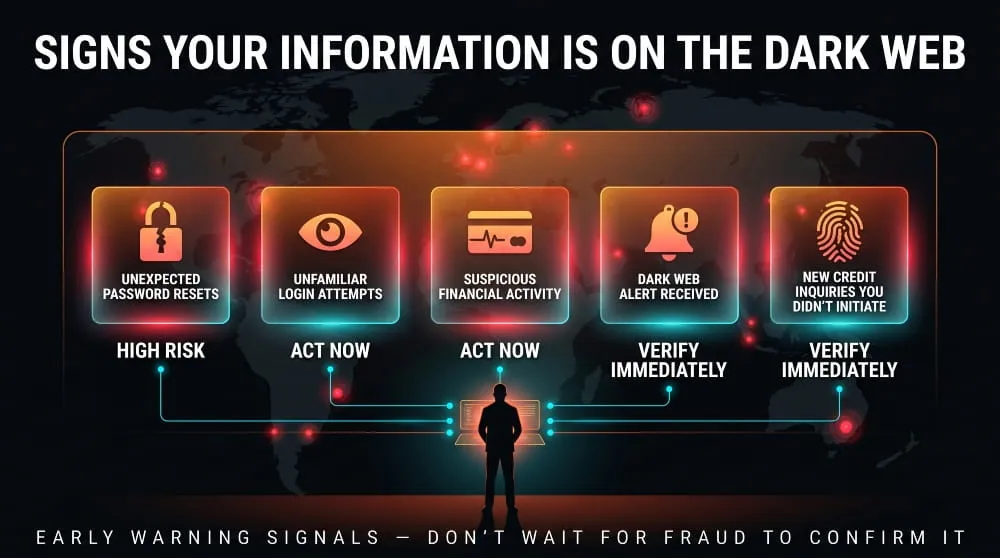
The most obvious sign that your information is on the dark web is an alert from a monitoring service. Still, several other signals can indicate exposure even if you’ve never signed up for monitoring. Unexpected password reset emails, unfamiliar login attempts on your accounts, new credit inquiries you didn’t initiate, or strange activity on financial statements can all point to data that has already been harvested and is being tested or used by someone else.
You Received a Dark Web Alert from Google, McAfee, Norton, LifeLock, or Experian. What Does It Mean?
A dark web alert from any of these services indicates that their monitoring system detected data associated with your email address, phone number, or other tracked identifiers in a known breach dataset or a dark web source. Google’s dark web report, McAfee’s identity monitoring, Norton LifeLock, and Experian’s dark web scan all work by comparing your personal details against databases of known leaked records. When there’s a match, they notify you.
What the alert does not tell you is how serious the exposure is, how recently the data was active, or whether a threat actor has already accessed it. These platforms typically surface the type of data found, such as passwords, emails, SSNs, and credit cards, without showing you the actual record or its source. That’s an important limitation. An alert is a starting point, not a full picture. Treat it as confirmation that something was exposed, not as a complete damage assessment.
We Found Your Information on the Dark Web. What Happens Next?
When a service tells you your information was found on the dark web, the immediate priority is to identify what was exposed and act on that specific data type, not to panic about everything at once. If a password was found, change it on every account you used it on, starting with your email and any financial accounts. If a credit card number was found, contact your bank to flag it and request a replacement. If your Social Security number or address appeared, consider placing a credit freeze with all three major bureaus.
The notification itself doesn’t mean someone has already used the data; it means the window is open. Speed matters here because exposed credentials are often tested in automated attacks within hours of going live on criminal marketplaces. The faster you rotate credentials and lock down sensitive accounts, the smaller the window an attacker has to act.
Dark Web Alerts vs. Confirmed Breaches: Understanding the Difference
A dark web alert and a confirmed data breach are not the same thing, and conflating them leads people to either overreact or underreact. A confirmed breach is a documented security incident in which a specific company acknowledges that its systems were compromised and that user data was taken. These are often reported publicly, disclosed to regulators, and covered in the news. A dark web alert, by contrast, is triggered when monitoring software finds your data somewhere in a dark web source, without necessarily knowing which breach it originated from or when.
This distinction matters for two reasons. First, you may receive a dark web alert for a breach that happened years ago, and the data may have been circulating since then without anyone targeting you specifically. Second, you can receive confirmed breach notifications without ever receiving a dark web alert, because not all breached data reaches indexed dark web sources that monitoring tools can access. Neither signal is more trustworthy than the other. Used together, they give a more complete picture of your actual exposure.
Why Does Past Identity Information Keep Appearing on Dark Web Alerts?
If you keep receiving alerts about “past identity information detected on the dark web,” it’s not a glitch; it’s how stolen data behaves over time. Once a dataset is leaked, it enters a recycling cycle in which it is aggregated with other breach data, repackaged, and redistributed across new dark web forums and marketplaces. A record from a 2019 breach can resurface in a 2024 compiled dump and trigger a new alert.
Monitoring services also expand their data sources over time. A platform that didn’t have access to a particular dark web forum in 2021 might index it in 2024, which causes older records to surface as new detections. This is why receiving repeated alerts about the same data, an old email address, a previous home address, or a phone number you no longer use doesn’t necessarily mean you were breached again. It means that data is still in circulation and still being catalogued. Old exposure is not resolved exposure.
How to Check If Your Information Is on the Dark Web
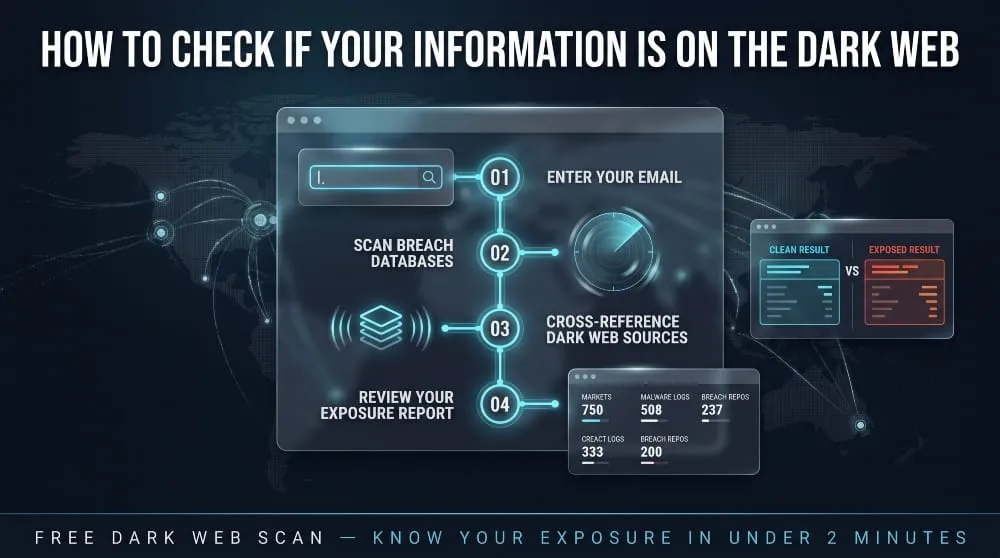
You can check if your information is on the dark web right now using free tools, and it takes less than two minutes. The process involves scanning known breach databases and dark web sources against your email address or other personal identifiers to surface any matches found in leaked datasets.
Free Methods to Check If Your Data Has Been Leaked
The most accessible starting point is Have I Been Pwned (HIBP), a widely trusted breach notification database that lets you enter your email address and instantly see which documented breaches it appears in. It’s free, requires no account, and covers billions of records across hundreds of known breach events. It won’t show you dark web marketplace listings or infostealer logs, but for documented breaches, it remains one of the most reliable free resources available.
Google’s dark web report, available to Google One subscribers and increasingly rolled out to standard Gmail users, automatically monitors your Gmail address and alerts you when it appears in known dark web sources. Experian offers a similar one-time free dark web scan tied to your email, and Mozilla Monitor (formerly Firefox Monitor) provides breach alerts built on top of the HIBP dataset. Each of these tools has a different data coverage footprint, so running multiple checks gives you a more complete picture. No single free tool indexes everything; dark web data is fragmented across thousands of forums, marketplaces, paste sites, and private channels that no public tool can reach.
How to Use DeXpose to Check Your Email and Personal Data Exposure
DeXpose goes beyond what standard breach notification tools cover. While most free checkers match your email against a static database of documented breaches, DeXpose actively monitors dark web markets, infostealer malware logs, ransomware leak sites, and breach repositories, surfacing exposure that hasn’t yet made it into public databases.
To run a free check, go to dexpose.io/free-darkweb-report. Enter your email address, and DeXpose generates an instant exposure report showing whether your data appears in dark web markets, malware logs, or known breach sources. The report breaks down what type of data was found, where it was detected, and how recently, giving you actionable context rather than a simple yes or no. For anyone who has received a monitoring alert from Google, McAfee, or Experian and wants to understand the full scope of their exposure, a DeXpose scan is the logical next step.
What Ran Info Against the Dark Web Actually Means (Experian, Google, Others Explained)
When Experian, Google, or another monitoring service says it “ran your info against the dark web,” it means their system compared your personal identifiers, typically your email address, phone number, name, date of birth, or SSN, against a proprietary dataset of known leaked records compiled from dark web sources. It is not a live search of the dark web in real time. These platforms maintain and regularly update internal databases built from indexed breach dumps, paste site scrapes, and dark web forum monitoring, and your data is checked against that compiled index.
The practical implication is that coverage varies significantly between providers. A service with a larger, more frequently updated index will surface more matches. A service with limited dark web reach may return a clean result even when your data is actively circulating. This is why “no results found” from one platform doesn’t mean you’re in the clear; it may simply mean that particular service doesn’t have visibility into the sources where your data appears. Independent monitoring tools like DeXpose maintain dedicated dark web intelligence pipelines specifically to close these coverage gaps.
How to Check for Data Breaches Step by Step
Properly checking your exposure means going beyond a single search. Start with your primary email address on Have I Been Pwned to get a baseline view of documented breaches. Then run a free DeXpose report at dexpose.io/free-darkweb-report to check for dark web marketplace and infostealer log exposure that breach databases won’t capture.
From there, check any secondary email addresses you use, especially older ones tied to accounts you haven’t actively managed in years, since those are frequently harvested in large-scale aggregated leaks. If you use a password manager, review its breach-monitoring feature, if available. Finally, pull your credit report from all three bureaus to look for unfamiliar accounts or inquiries, which can indicate that identity data, not just credentials, has already been acted upon. According to the Identity Theft Resource Center, the average data breach victim doesn’t discover the misuse of their information until 12 to 18 months after the initial exposure, making proactive checking the only reliable way to stay ahead of it.
What to Do If Your Information Is Found on the Dark Web
If your information has been found on the dark web, the most important thing to understand is that you still have significant control over what happens next. Exposure creates risk; it doesn’t guarantee harm. What you do in the hours and days following discovery determines whether that exposed data gets used against you or becomes a dead end for whoever holds it.
Immediate Steps to Take After a Dark Web Alert
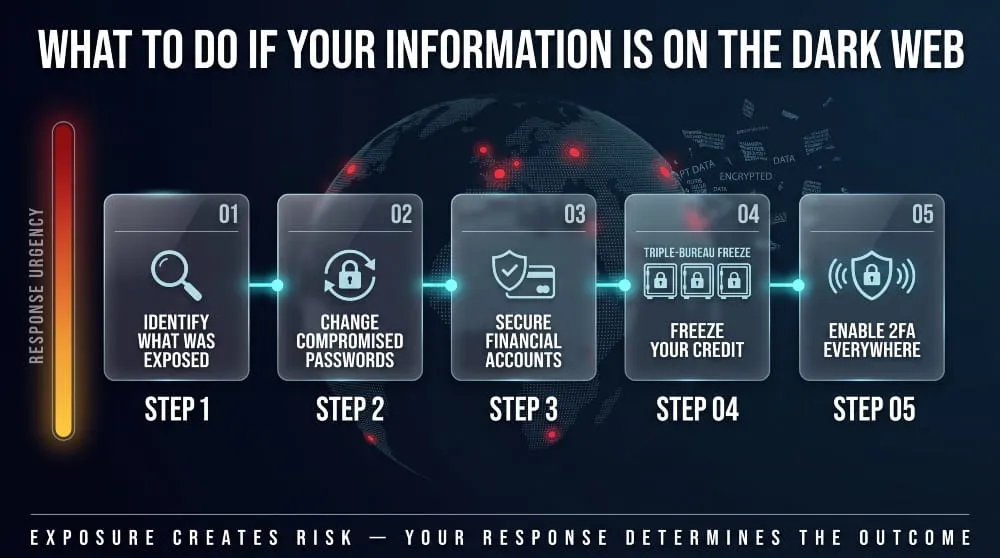
The first step is to identify exactly what was exposed. The type of data found determines everything about how you respond. A leaked password requires a different response than a leaked Social Security number, and treating every alert with the same generic reaction wastes time and leaves real vulnerabilities open.
If credentials were exposed, change the affected password immediately, and change it on every other account where you reused it. Password reuse is the primary mechanism through which a single breach cascades into a full account takeover across multiple platforms. If your email password was among the exposed credentials, treat that as the highest priority: your email inbox is the recovery key to virtually every other account you own.
If financial information was found, a credit card number, bank account detail, or routing number, contact your financial institution directly and request a card replacement or account flag before any unauthorized transaction occurs. Don’t wait for fraud to appear on your statement—act on the alert, not on the damage.
How to Secure Your Accounts When Personal Data Is Exposed
After addressing the immediate threat, the next priority is to harden every account that could be accessed via the exposed data. Enable two-factor authentication (2FA) on your email, banking, and any platform that holds payment information or sensitive personal data. Authenticator app-based 2FA is significantly more secure than SMS-based codes, which can be intercepted through SIM-swapping attacks, a method that has become increasingly common when phone numbers are part of a leaked record set.
Conduct a full audit of where you’ve reused passwords. Most password managers now include a built-in breach-and-reuse report that surfaces duplicate credentials across your saved accounts. If you don’t use a password manager, this is the moment to start. The alternative, manually maintaining unique, strong passwords across dozens of accounts, is not realistic for most people, which is exactly why credential reuse remains one of the most exploited vulnerabilities in consumer cybersecurity. According to Google, 65 percent of people reuse the same password across multiple accounts, making a single breach record exponentially more valuable to an attacker than it might appear.
Should You Freeze Your Credit After Dark Web Exposure?
If your Social Security number, date of birth, or full identity information was part of the exposed data, placing a credit freeze is one of the most effective protective steps you can take, and it’s free. A credit freeze instructs the three major credit bureaus, Equifax, Experian, and TransUnion, to block any new credit applications made in your name until you explicitly lift the freeze. It does not affect your existing credit accounts, your credit score, or your ability to use cards you already have.
The freeze needs to be placed with all three bureaus individually, not just one. A freeze at Experian does nothing to stop a fraudulent application processed through TransUnion. The process takes less than ten minutes per bureau and can be done online. If your data exposure included a driver’s license number or passport details, also consider filing an identity theft report with the FTC at IdentityTheft.gov, which generates a personalized recovery plan and provides documentation you may need if fraud does occur.
For lower-severity exposures, a leaked email address or an old hashed password from a years-old breach, a full credit freeze may be disproportionate. In those cases, a fraud alert is a lighter-touch alternative that flags your file for additional verification without locking it entirely.
How to Protect Your Identity in the Future
Recovering from one exposure event is only half the equation. The other half is making sure future leaks, and there will be future leaks, because data breaches are now a structural feature of the digital landscape, are caught early and limited in impact.
Ongoing dark web monitoring is the most direct line of defense. Rather than discovering exposure months after the fact, continuous monitoring services scan dark web markets, infostealer logs, and breach repositories in real time and alert you the moment your data surfaces. DeXpose provides this at the organizational and personal level, with monitoring across dark web sources that consumer-facing tools don’t reach. You can start with a free exposure report at dexpose.io/free-darkweb-report to see what’s already out there before setting up continuous monitoring.
Beyond monitoring, reduce your attack surface over time by deleting accounts you no longer use, opting out of data broker sites that aggregate and sell personal information, and being deliberate about what personal data you share with services that don’t have a genuine need for it. The goal isn’t to achieve perfect privacy; that’s not realistic in 2026. The goal is to make your data profile a harder, less valuable target than the next person’s.
Can You Remove Your Information from the Dark Web?
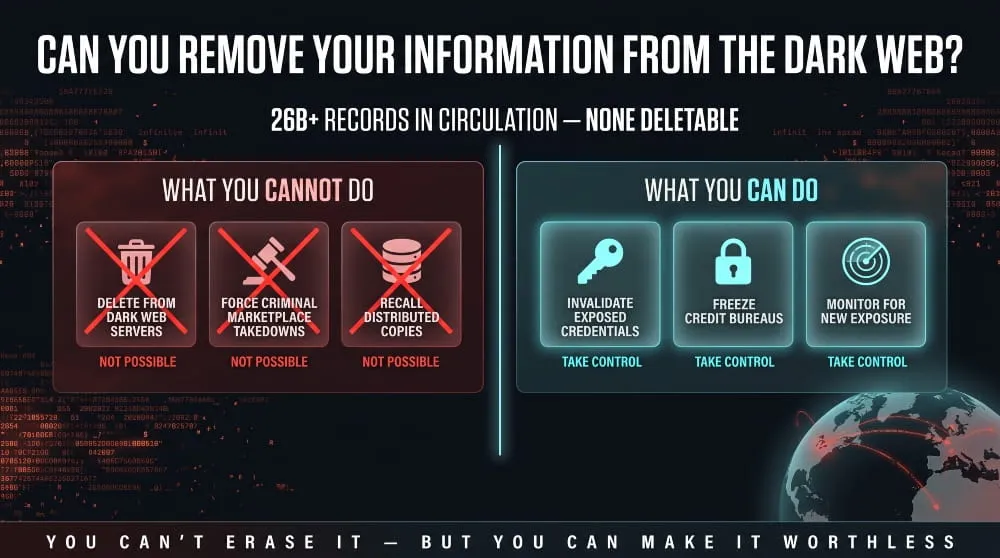
The straightforward answer is no, you cannot remove your information from the dark web once it’s there. Unlike a social media post or a public web page, dark web listings exist on infrastructure deliberately designed to resist takedowns, operate outside legal jurisdiction in most cases, and be replicated across dozens of servers and forums simultaneously. What you can do is limit the damage, reduce your ongoing exposure, and make the data that exists about you harder to weaponize.
The Hard Truth: What Can and Cannot Be Deleted
Once a piece of data enters dark web circulation, you have no technical mechanism to delete it. You don’t know who holds it, how many copies exist, or which forums and marketplaces it has already spread to. Even if the original breach source were taken offline tomorrow, which rarely happens, the data would continue circulating in the hands of every buyer, trader, and aggregator who touched it in the interim.
What can sometimes be addressed is the source exposure upstream of the dark web. If your data appears on a public paste site like Pastebin, a takedown request to the platform operator occasionally succeeds. If a data broker site is aggregating and publishing your personal information on the surface web, most jurisdictions now give you some right to request removal, and services exist to automate those requests. But these actions address the publicly accessible portions of a data trail, not the dark web itself. The distinction matters: cleaning up surface web exposure is meaningful and worth doing, but it should not be confused with removing anything from the dark web.
Dark Web Data Removal Services: Do They Actually Work?
Some services market themselves as dark web data removal tools, and the honest assessment is that the category is largely misleading. No legitimate service can reach into dark web marketplaces, forums, or criminal databases and delete records on your behalf. What these services typically do, and the better ones do it genuinely well, is monitor for your data, alert you when it appears, and help you take downstream protective action like credential rotation, credit freezes, and account hardening.
The value in dark web monitoring isn’t removal; it’s speed. Knowing that your data has surfaced within hours of a breach, rather than months later when fraud appears on your accounts, dramatically changes your ability to respond effectively. That’s a real and significant benefit. But any service that claims to “scrub” or “erase” your information from the dark web is overstating what’s technically possible. Evaluate these services on the quality of their monitoring coverage and alerting speed, not on removal claims that cannot be fulfilled.
What “Removing” Information from the Dark Web Really Means
When security companies or monitoring services use the language of “removal,” what they typically mean in practice is a combination of three things: removing your data from data broker and people-search sites on the surface web, helping you invalidate the usefulness of exposed credentials through password changes and account closures, and reducing the footprint of active, usable data tied to your identity.
This reframing is important because it shifts the goal from the impossible, deleting data from systems you don’t control, to the achievable: making the data that exists about you less actionable. A leaked password that has been changed is worthless. A leaked credit card number that has been cancelled cannot be charged. A leaked email address attached to accounts that now use unique, strong passwords and 2FA offers minimal leverage to an attacker. In this sense, “removing” dark web information is really about systematic invalidation, stripping value from exposed records rather than erasing them.
How to Reduce Your Exposure and Limit Future Leaks
While you can’t undo past exposure, you have real leverage over how much new data enters circulation and how damaging existing exposure becomes over time. The most impactful habit change is eliminating password reuse, because reuse is the mechanism that turns one leaked credential into access to ten accounts. A password manager makes this frictionless, and the investment pays off immediately.
Beyond credentials, reducing your data broker footprint limits the amount of personal information that gets swept up in future aggregated leaks. Services like DeleteMe or Kanary automate opt-out requests to the major people-search and data broker sites that compile and resell personal profiles. These sites are frequent sources of the address, phone number, and family relationship data that enriches dark web records beyond what any single breach captures.
Finally, treat dark web monitoring as an ongoing utility rather than a one-time check. Breaches happen continuously. IBM’s Cost of a Data Breach Report found that the average organization takes 194 days to identify a breach, indicating a long gap between exposure and discovery that can allow significant damage to occur without monitoring in place. Running a free scan at dexpose.io/free-darkweb-report takes two minutes and tells you what’s already out there, and continuous monitoring through dexpose.io/darkweb-breaches-monitoring ensures you’re not the last to know when something new surfaces.
Personal Information on the Dark Web: The Most Common Scenarios
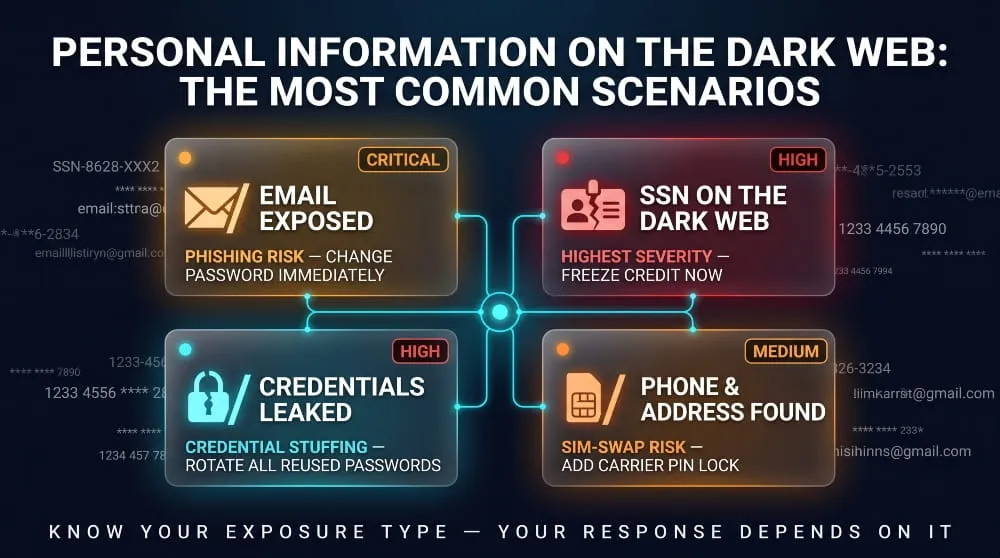
Not all dark web exposure carries the same level of risk, and knowing which type of data was found determines exactly how urgently and in what direction you need to respond. These are the four most common scenarios people face after receiving a dark web alert, and what to do about each one.
My Email Was Found on the Dark Web. What Should I Do?
An email address appearing on the dark web is the most common dark web alert by a significant margin, and on its own, it sits at the lower end of the severity spectrum. Email addresses are public-facing identifiers; you routinely share them, so their presence in a leaked dataset doesn’t automatically mean your accounts have been compromised. What matters is what accompanied it.
If the alert shows only your email address with no associated password or personal data, the primary risk is targeted phishing. Criminals use verified, active email addresses to craft convincing fraud attempts, fake invoices, account suspension notices, and impersonation of services you use. Be more skeptical than usual of unsolicited emails in the weeks following an alert, particularly any that ask you to click a link or verify credentials.
If the alert shows your email alongside a password, even an old one, treat it as urgent regardless of whether you still use that password. Change it everywhere it was used, starting with your email account itself, and enable 2FA immediately. Your inbox is the master key to your digital life, and an attacker with access to it can reset passwords across every service linked to that address.
My Social Security Number Is on the Dark Web, Now What?
A Social Security number appearing on the dark web is the highest-severity personal data exposure scenario for most individuals, and it requires an immediate, structured response. Unlike a password, your SSN cannot be changed. Once it’s circulating in criminal networks, it remains a usable identity asset indefinitely, which is why identity theft cases involving SSNs often surface years after the original breach.
The first action is to place a credit freeze with all three major bureaus, Equifax, Experian, and TransUnion, individually. This prevents anyone from opening new credit accounts in your name, which is the primary way SSN exposure translates into financial fraud. Do this before anything else. Next, file an identity theft report at IdentityTheft.gov to create an official record and generate a personalized recovery checklist. If you haven’t already, set up an E-Verify Self Lock through the Social Security Administration’s mySSA portal, which blocks your SSN from being used in employment eligibility verification, a common vector for SSN misuse that most people overlook.
According to Javelin Strategy & Research, identity fraud cost Americans $43 billion in 2023, with SSN-based new account fraud among the fastest-growing categories. Speed and completeness of response are the two variables you control.
My Password or Login Credentials Were Leaked
Leaked login credentials, a username and password combination tied to a specific service, are the dark web’s most traded commodity, and for good reason. They provide direct, immediate access to accounts without requiring any additional attack steps. When your credentials appear in a dark web alert, the clock starts immediately.
Change the exposed password first, then audit every account where you used the same or a similar password. Credential stuffing, the automated process of testing leaked username and password pairs across hundreds of platforms, is fully industrialized, meaning within hours of a credential set going live on a dark web marketplace, bots are already testing it against major services. If you’ve reused that password on your email, banking platform, or any account with stored payment information, those are your immediate priorities.
Once you’ve rotated credentials, review the account activity logs on your most sensitive platforms. Many services, such as Google, Microsoft, Apple, and major banks, show recent login history, including device type and location. An unfamiliar login before you changed the password is confirmation that the credential was used, not just listed for sale, and warrants escalating your response to include contacting the platform’s fraud team directly.
My Phone Number or Address Appeared in a Dark Web Alert
A phone number or physical address appearing in a dark web alert typically signals exposure through a data broker aggregation leak or a large-scale identity database breach rather than a targeted attack on a specific account. These data types are less immediately actionable for an attacker than credentials or financial data. Still, they’re valuable as enrichment data, making other fraud attempts more convincing and dangerous.
A verified phone number enables SIM-swapping attacks, where a criminal convinces your mobile carrier to transfer your number to a SIM card they control, instantly redirecting any SMS-based two-factor authentication codes to themselves. If your phone number was exposed, contact your carrier and add a SIM lock or port freeze, a PIN-based protection that prevents your number from being transferred without in-person or secondary verification. Most major carriers offer this at no cost, and it takes minutes to set up.
An exposed home address, particularly when combined with your full name and date of birth, creates risk around physical mail fraud, fraudulent change-of-address filings, and the construction of fuller identity profiles that support synthetic identity fraud. Check your mail delivery settings through the USPS Informed Delivery service to catch any unauthorized address change requests, and consider opting out of the major data broker sites that likely served as the source of the aggregated record.
Frequently Asked Questions (FAQ’s)
Is everyone’s information on the dark web?
Not everyone, but a significant majority of active internet users have at least one piece of personal data circulating on the dark web. With billions of records exposed over years of accumulated breaches, the realistic assumption for most adults is partial exposure rather than none at all. The question is what type of data is exposed and how actionable it is.
Why is my information on the dark web if I haven’t been hacked?
You don’t have to be hacked personally for your data to end up on the dark web. When a company you’ve used, a retailer, healthcare provider, subscription service, or data broker, suffers a breach, your information goes with it, regardless of anything you did or didn’t do.
Can my personal data be permanently removed from the dark web?
No. Once data enters the dark web, it cannot be deleted because you have no access to or control over the systems that hold it. The practical alternative is to invalidate its usefulness, change exposed passwords, cancel compromised cards, and freeze credit, so the data exists but can’t be acted upon.
What happens when your info is on the dark web?
Your data gets listed for sale or traded among cybercriminals who use it for credential stuffing, identity theft, phishing, or financial fraud. The severity depends entirely on what type of data was exposed; a leaked email address carries far less immediate risk than a leaked SSN paired with a date of birth.
Is it safe to ignore a dark web alert?
No. Even if the exposed data seems minor, ignoring an alert leaves you without the context to know whether something more serious is attached to it. Acting quickly, even just reviewing what was found and changing the relevant password, costs minutes and closes a window that staying passive leaves permanently open.
How does data end up on the dark web without a breach?
Infostealer malware is the most common non-breach pathway. This software silently infects devices and harvests saved passwords, session cookies, and autofill data, uploading them to criminal networks without compromising any company. Data broker aggregation leaks and phishing campaigns that collect credentials directly are also significant sources.
What is the difference between a data leak and a data breach?
A data breach is an active attack where a criminal deliberately infiltrates a system to steal data. A data leak is typically an accidental exposure, a misconfigured database, an unsecured cloud storage bucket, or an improperly shared file, where data becomes accessible without a direct attack. Both result in personal information ending up in the wrong hands and potentially on the dark web.
How do I know if a dark web alert is legitimate?
A legitimate dark web alert will come from a service you actively enrolled in, Google, Experian, Norton, McAfee, or a dedicated monitoring platform like DeXpose, and will never ask you to click a link to “view your exposed data” or enter personal information to unlock results. If you receive an unsolicited email alert from a service you don’t recognize, treat it as a phishing attempt and go directly to the provider’s official website rather than engaging with the message.
Akira Ransomware | Guide to the Group, TTPs, SonicWall/Cisco Attacks, CISA & FBI Advisories, and Recovery
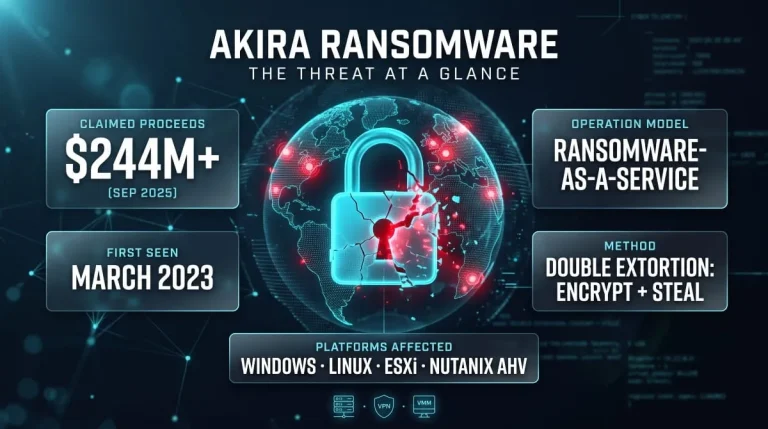
What Is Akira Ransomware? Akira ransomware is a ransomware-as-a-service (RaaS) operation active since March 2023 that steals a victim’s data and then encrypts their systems to…
Read more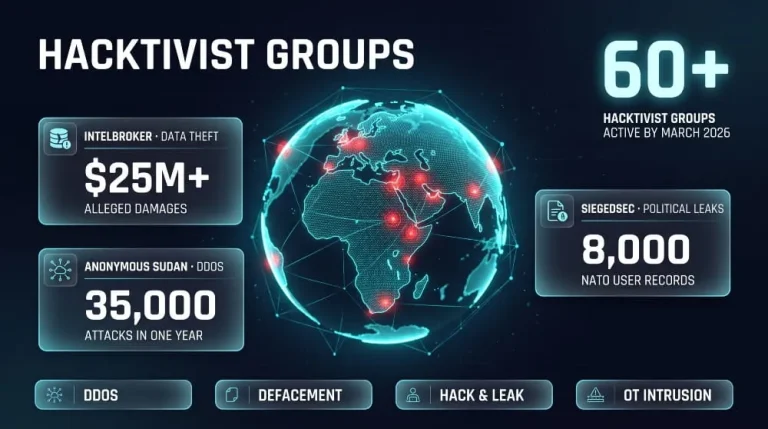
Hacktivist Groups to Watch | IntelBroker, Anonymous Sudan & SiegedSec (Threat Intelligence Guide)
IntelBroker, Anonymous Sudan and SiegedSec are three of the most closely tracked hacktivist and data-leak actors of recent years, and all three have drawn law-enforcement action.…
Read more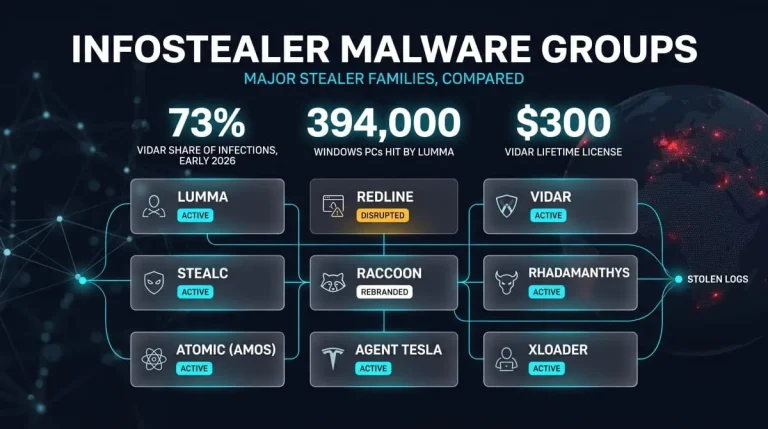
Infostealer Malware Groups | How Lumma, RedLine, Vidar, StealC, Raccoon and Other Stealers Work (and How to Detect and Remove Them)
Infostealer malware groups are distinct malware families, such as Lumma, RedLine, Vidar, StealC, and Raccoon, that steal saved passwords, session cookies, and crypto wallets from infected…
Read more