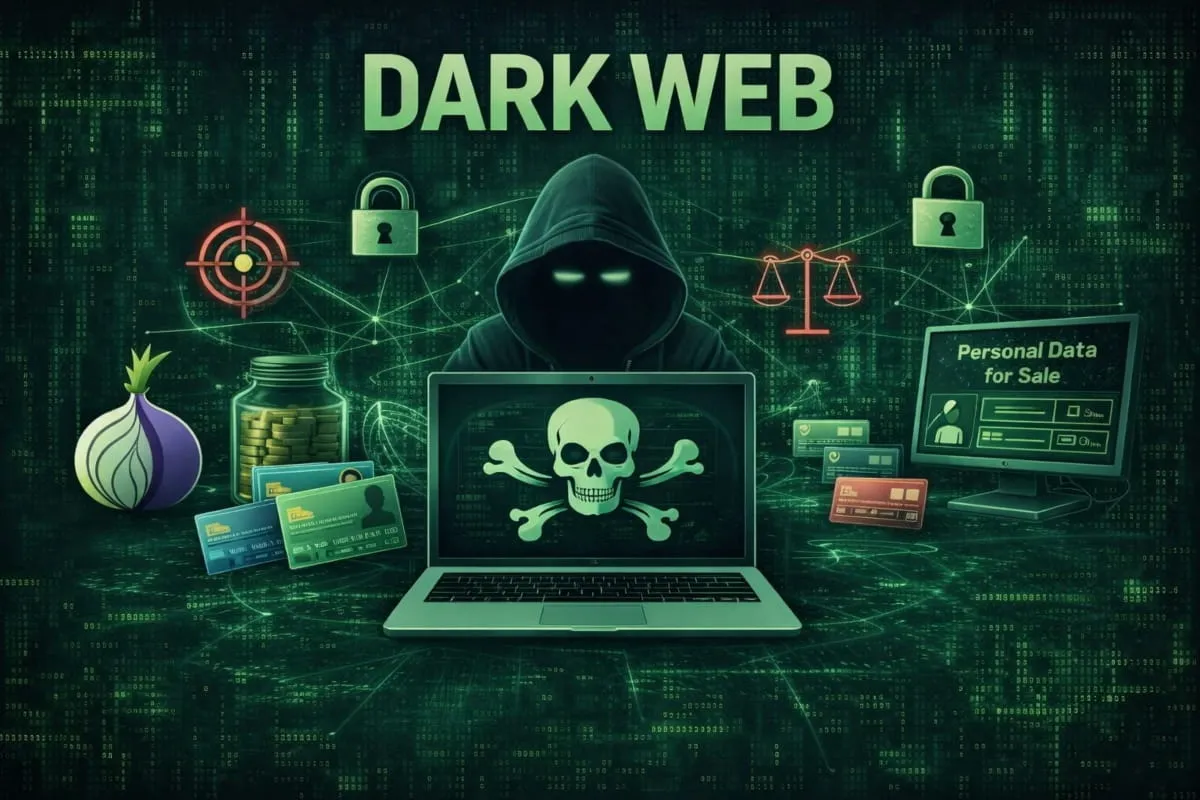
When people ask what the dark web is, they’re referring to the hidden part of the internet that can only be accessed using special software like the Tor browser. Designed for anonymity, it enables private communication but also supports a growing underground economy.
Despite its reputation, the dark web represents only a tiny fraction of the internet. Compared to the surface web and deep web, its size is small, but its impact on cybercrime and security is outsized.
In this article, we break down Dark Web Statistics 2026 in clear, practical terms: how big the dark web really is, who uses it, what’s being bought and sold, and why it matters for cybersecurity in 2026. We’ll compare the dark web with the surface and deep web, highlight eye-opening figures like credential leaks and ransomware growth, and share key takeaways for protecting your data.
What Is the Dark Web and How Does It Work? (2026)
The dark web is a hidden part of the internet that standard search engines like Google cannot index and regular browsers cannot access. It operates on encrypted networks called darknets, where both users and website operators remain deliberately anonymous. Most dark web sites use special addresses ending in .onion rather than .com or .org.
To understand where the dark web fits, think of the internet as three distinct layers:
- Surface Web the everyday internet you use through Google, YouTube, or news sites. It accounts for roughly 5–10% of total internet content.
- Deep Web: private, login-protected content such as email inboxes, banking portals, and corporate databases. This makes up the vast majority of the internet, around 90%.
- Dark Web a small, intentionally hidden subset of the deep web that requires special software to reach. It represents less than 1% of the internet by volume.

How the Dark Web Works
Access requires a specialized browser, most commonly Tor (The Onion Router). Here is what happens when you connect:
- Your traffic is encrypted in multiple layers, like the layers of an onion
- It passes through a series of volunteer-run servers called relays or nodes
- Each relay only knows the step before and after it, never the full route
- By the time your request reaches its destination, your identity and location are effectively hidden
This layered routing is why tracking a dark web user is extremely difficult, though not impossible. Law enforcement agencies have repeatedly demonstrated their ability to de-anonymize users when operational mistakes occur.
Why Was the Dark Web Created?
The dark web was not built for criminal purposes. It was originally designed to enable secure, anonymous communication, particularly useful for:
- Journalists and whistleblowers sharing sensitive information
- Activists operating under authoritarian governments
- Researchers and cybersecurity professionals monitoring threats
- Anyone bypassing surveillance or internet censorship
The same anonymity that protects these users, however, also attracts criminal activity. That dual nature is what makes the dark web genuinely complex, it is a technology with legitimate foundations that has also become a significant platform for cybercrime.

What’s Actually on the Dark Web in 2026?
Most people assume the dark web is exclusively criminal. The reality is more layered. It hosts a wide range of content from privacy tools used by journalists to underground markets selling stolen data and understanding the full picture is essential for accurate risk assessment.
Legitimate Content
A meaningful portion of dark web activity serves genuine privacy and free speech purposes:
- Whistleblower platforms SecureDrop and similar tools allow journalists and sources to exchange sensitive information anonymously
- Censorship bypass tools major outlets including the BBC and The New York Times operate .onion versions of their sites so readers in restricted countries can access independent news
- Private communication forums communities where identity protection is the primary need, not criminal intent
- Cybersecurity research security teams monitor dark web forums to detect leaked credentials and emerging threats before they become active attacks
Criminal and Illicit Content
Despite legitimate uses, criminal activity dominates the dark web ecosystem. Research consistently shows that more than half of active dark web sites are linked to illegal activity. The most common categories include:
- Stolen credentials and data dumps usernames, passwords, financial records, and identity documents harvested from breaches
- Cybercrime services malware kits, ransomware tools, phishing templates, and DDoS-for-hire offerings
- Drug marketplaces narcotics traded using cryptocurrency, typically shipped through postal networks
- Financial fraud stolen credit card data, bank login credentials, and counterfeit documents
- Initial access listings compromised corporate VPN or RDP credentials sold to ransomware groups
- Underground forums communities sharing hacking techniques, exploit code, and vulnerability intelligence
What Is Most Commonly Sold
Transactions on dark web marketplaces almost exclusively use cryptocurrency, primarily Monero for anonymity and Bitcoin for broader acceptance. The most frequently traded items in 2026 are:
| Item | Typical Price Range | Security Impact |
|---|---|---|
| Single Social Security Number | ~$1–$3 | Identity theft and tax fraud. |
| Full Identity Profile (Fullz) | $10–$100+ | Complete takeover for loans or bank accounts. |
| Stolen Credit Card Data | $5–$20 per card | Fraudulent online transactions and cloning. |
| Corporate Network Access | $1,000–$50,000+ | Initial access for large-scale ransomware attacks. |
| Ransomware Kit (Entry Level) | $50–$200 | Allows low-skill attackers to launch encryption attacks. |
The dark web is not a single thing. It spans from legitimate privacy infrastructure at one end to a well-organized criminal marketplace at the other. For cybersecurity professionals, the important takeaway is that criminal content vastly outnumbers legitimate use, making dark web monitoring a practical necessity rather than an optional security measure.
Dark Web Current Status (2026): Explanation and Trends
The dark web in 2026 is no longer the mysterious corner of the internet that it once seemed. Instead, it has evolved into a complex ecosystem that includes privacy tools, underground marketplaces, cybercrime services, and legitimate anonymity platforms. Understanding the current status of the dark web in 2026 requires examining three main aspects: the Tor network infrastructure, darknet markets, and the myths versus the reality of how the hidden internet operates today.

Dark Web Current Status 2026
In 2026, the dark web remains a small but active part of the internet, operating mainly through anonymity networks like Tor (The Onion Router). Millions of users still rely on Tor to access hidden services and maintain online privacy.
Recent data shows that over 2.5–3 million users access the Tor network daily, demonstrating that the hidden internet is not shrinking but steadily evolving.
At the same time, the dark web economy continues to grow. Reports indicate that darknet markets handled billions of dollars in cryptocurrency transactions in recent years, proving that underground digital commerce remains resilient even after law-enforcement crackdowns.
However, the structure of the dark web in 2026 looks very different from earlier years. Large centralised markets are becoming less stable, and the ecosystem is shifting toward smaller communities, encrypted forums, and invite-only marketplaces.
Current Status of the Dark Web Tor Network (2026)
The Tor network remains the backbone of the dark web. It provides layered encryption that hides user identity and routing paths by sending traffic through multiple volunteer-run relays.
In 2026, several important trends define the Tor network:
- Growing global usage: Millions of users rely on Tor daily, not only to access the dark web but also to browse the regular internet privately.
- Large infrastructure: The Tor network operates through thousands of relays and hosts tens of thousands of .onion services across the hidden web.
- Privacy-driven adoption: Many users access Tor primarily for privacy protection, censorship bypass, or anonymous communication rather than criminal activity.
This means the Tor network is not exclusively a criminal tool; it also supports journalists, activists, and researchers who require secure communication.
The dark web in 2026 is not disappearing; it is evolving. The Tor network continues to support millions of users worldwide, while darknet markets adapt to enforcement pressure by becoming more decentralised and private.
Rather than being a single hidden world, the modern dark web is best understood as a dynamic ecosystem of anonymity technologies, underground economies, and privacy communities.
Its future will likely be shaped by three forces: stronger cybersecurity monitoring, evolving cryptocurrency systems, and the ongoing global demand for digital anonymity.
Who Uses the Dark Web and Why?
The dark web is not inherently good or bad; it is a technology, and, like any technology, its impact depends entirely on who uses it and for what purpose. In 2026, it serves two very different communities simultaneously.
Legitimate Users
The dark web was originally built to enable secure, anonymous communication, and that purpose still holds for a significant portion of its users today:
- Journalists and whistleblowers use encrypted platforms to share sensitive information without exposing their identities or sources.
- Activists and dissidents in authoritarian countries rely on anonymity networks to organize, communicate, and access uncensored information.
- Privacy-conscious individuals use it to avoid tracking, profiling, and mass surveillance.
- Cybersecurity teams monitor dark web forums to detect stolen credentials, leaked company data, emerging malware tools, and planned attacks before they escalate.
That last use case, dark web intelligence, has become a core component of modern threat detection. By scanning underground forums and marketplaces, security teams gain early warning of breaches and can respond before attackers act on stolen data.
Criminal Users
The same anonymity that protects legitimate users makes the dark web attractive to criminal networks. In practice, illicit activity dominates the ecosystem:
- Running drug marketplaces and fraud operations behind untraceable .onion addresses
- Selling stolen credentials, corporate access, and personal identity records
- Distributing malware, ransomware kits, and hacking tools as commercial services
- Coordinating cyberattacks and publishing stolen data on leak sites
The Honest Reality
The dark web is a genuine dual-use technology. Its anonymity protects both the journalist hiding from a hostile government and the criminal selling stolen credit cards. Both exist on the same network and often use the same tools.
For cybersecurity professionals, this distinction matters. Treating the dark web as purely criminal oversimplifies the threat. Ignoring its criminal dominance understates the risk. The accurate position is that legitimate use exists. Still, criminal activity vastly outweighs it, which is precisely why continuous monitoring of the dark web is now a baseline security expectation, not an advanced capability.
Dark Web Statistics 2026
The dark web may sound like a shadowy hacker myth, but the data proves it’s a real and expanding part of the internet. Accessible through tools like Tor or I2P, this hidden layer supports millions of daily users and a well-organized underground economy.
By 2026, tracking dark web statistics is critical for cybersecurity teams. Stolen credentials, drugs, malware, and hacking tools circulate freely, and data leaked there often fuels major breaches, ransomware attacks, and fraud campaigns.
Public awareness has also increased. Around half of U.S. adults now say they’re familiar with the dark web, reflecting how mainstream the topic has become. Global events accelerated this growth. During early COVID-19 lockdowns, dark web forum activity surged by more than 40%, driven by increased online activity and economic uncertainty.
At the same time, law enforcement pressure has intensified. Large-scale international takedowns have disrupted major marketplaces, highlighting both the scale of dark web crime and the ecosystem’s ability to adapt and re-emerge.
Key Trends & Statistics (2026)
The dark web remains small in scale, but its activity continues to grow year over year.
- Tiny but expanding footprint: The dark web accounts for roughly 0.01% of the internet, yet its usage and content continue to grow.
- Daily users rising: Millions of people now access Tor and similar networks each day to reach encrypted services and hidden platforms.
- Dominant underground markets: Drug sales, stolen credentials, and illicit digital services continue to drive most dark web commerce.
Surface Web vs Deep Web vs Dark Web
The surface web is the part of the internet most people use every day. It includes publicly accessible websites such as news platforms, social media, and e-commerce pages, and accounts for roughly 5–10% of the total internet.

The deep web makes up the vast majority of online content, estimated at around 90% of the internet. This layer contains private or restricted data, such as banking systems, medical records, academic databases, and corporate tools.
The dark web sits beneath both layers. By comparison, it is tiny, accounting for roughly 0.01% of the internet by volume, yet it remains one of the most discussed and monitored areas due to its risk profile.
How the Dark Web Is Accessed
Unlike the surface web, the dark web cannot be reached using standard browsers like Chrome or Safari. Access requires anonymizing software such as Tor or I2P, which masks IP addresses and routes traffic through encrypted networks.
Most dark websites use “.onion” addresses and are intentionally difficult to discover, reinforcing anonymity for both site operators and visitors.
Why the Dark Web Matters
Despite its small size, the dark web carries outsized importance in cybersecurity and law enforcement. A significant portion of its content is illicit, ranging from drug marketplaces and hacking forums to stolen data exchanges.
Research indicates that more than half of dark web sites are linked to illegal activity, including drugs, exploitation material, and cybercrime tools. While legitimate use cases do exist, such as whistleblowing platforms and privacy-focused communities, criminal activity dominates overall usage.
Understanding what the dark web is, how it differs from the surface and deep web, and why it matters is essential for accurately assessing modern digital risk.
How Big Is the Dark Web? Size, Scale, and Comparison with the Internet (2026)
The question “how big is the dark web?” is often surrounded by myths and exaggerated claims. Many people imagine it as a massive hidden internet larger than the public web. In reality, the dark web is relatively small compared to the overall internet, although it plays a significant role in cybersecurity, privacy technologies, and underground digital economies.

To understand the true scale, it is important to examine how the internet is structured and how the surface web, deep web, and dark web compare.
How Big Is the Dark Web Compared to the Internet?
The internet can be divided into three major layers:
- Surface Web – Websites indexed by search engines like Google.
- Deep Web – Content not indexed by search engines, such as databases, private accounts, and internal networks.
- Dark Web – A hidden portion of the deep web that requires special tools like the Tor browser to access.
Studies show that the deep web accounts for roughly 90% of internet content, while the dark web represents only a small fraction of that hidden layer.
Estimates suggest the dark web accounts for around 5–6% of the internet’s total content, though exact figures are difficult to determine due to its anonymous nature.
This means the dark web is much smaller than the deep web, but still large enough to host thousands of hidden services and communities.
How Big Is the Dark Web in Terms of Websites?
The dark web operates primarily through encrypted networks such as the Tor network. At any given time, researchers estimate that between 7,000 and 30,000 dark web websites (known as .onion services) are active.
These sites can include:
- Anonymous forums
- Whistleblower platforms
- Cryptocurrency marketplaces
- Cybercrime services
- Private communication tools
However, dark websites are often unstable. Many disappear quickly due to law enforcement action, hacking, or administrators shutting them down.
How Big Is the Deep Web?
To truly understand the size of the dark web, you must compare it to the deep web, which is far larger.
The deep web includes all internet content that is not indexed by search engines, such as:
- Email accounts
- Online banking systems
- Academic databases
- Government records
- Corporate intranets
Researchers estimate that the deep web may be hundreds of times larger than the surface web, containing the majority of the internet’s data.
This means the dark web is only a tiny subsection of the deep web, rather than the massive hidden internet often portrayed in the media.
Biggest Dark Web Markets and Their Size
Another way to measure the size of the dark web is by looking at its marketplaces.
Darknet markets function similarly to e-commerce platforms, where users buy and sell products using cryptocurrencies. Some of the largest dark web markets have historically processed millions of dollars in transactions before being shut down.
While these markets constantly appear and disappear, the underground economy remains active. Law-enforcement agencies frequently dismantle large platforms, but new marketplaces usually emerge to replace them.
Why the Dark Web Seems Bigger Than It Is
The dark web often appears larger than it actually is for several reasons.
First, the network’s hidden nature makes precise measurement difficult. Second, many dark websites are mirrored or duplicated across multiple domains, creating the illusion of a larger ecosystem. Research has shown that a large percentage of dark web content consists of replicated pages rather than unique websites.
Additionally, media coverage tends to focus on illegal markets and cybercrime activity, which can exaggerate the perceived scale of the dark web.
How Big the Dark Web Really Is
When people ask, “How big is the dark web compared to the internet?”, the answer is clearer when the internet’s layers are understood.
- Surface web: the visible internet people use daily
- Deep web: the vast majority of private and unindexed online content
- Dark web: a small encrypted portion designed for anonymity
Although the dark web accounts for only a small percentage of the internet, it continues to attract global attention for its role in privacy protection, anonymous communication, and underground digital marketplaces.
Understanding its true size helps separate technical reality from internet myths, revealing that the dark web is not the largest part of the internet. Still, it remains one of the most intriguing and controversial parts.
Risks of Accessing the Dark Web (2026): Legality, Dangers, and Legitimate Uses
The dark web in 2026 continues to attract curiosity because of its secrecy and reputation. Many people ask whether accessing the dark web is illegal, what the risks are, and whether it has legitimate uses. Understanding the current risks of accessing the dark web in 2026 requires separating legal facts from cybersecurity realities.
While the technology behind the dark web is not inherently illegal, the environment carries several risks. These risks range from exposure to cybercrime and malware to legal consequences for participating in illegal activities.

Is Accessing the Dark Web Illegal in 2026?
One of the most common questions is: “Is accessing the dark web illegal in 2026?”
In most countries, simply accessing the dark web is not illegal. Tools such as the Tor browser are legitimate privacy technologies used by millions of people worldwide.
The key legal point is that legality depends on what a person does on the dark web. Browsing hidden websites or researching cybersecurity topics is generally legal, but participating in criminal activity can lead to serious legal consequences.
For example, purchasing illegal goods, engaging in fraud, or trading stolen data on darknet marketplaces may result in criminal charges such as identity theft, drug trafficking, or money laundering.
Because laws vary by country, users should always understand their local regulations before accessing hidden networks.
Dark Web Access Risks (2026)
Although accessing the dark web may be legal, it carries several technical and security risks.
Malware and Cybersecurity Threats
Dark web websites often host malicious software, ransomware, or infected files. Visiting the wrong page or downloading unknown content can expose a device to serious security threats.
Exposure to Illegal Content
Some dark web platforms contain illegal material or services. Even accidental interaction with such content can create legal complications in certain jurisdictions.
Fraud and Scams
Because users operate anonymously, scams are extremely common on the dark web. Fake marketplaces, phishing pages, and fraudulent vendors frequently target inexperienced users.
Identity and Data Risks
Users who access the dark web without proper security measures may expose their IP address or personal information, which hackers or cybercriminal groups can exploit.
These risks make the dark web a challenging environment, especially for users unfamiliar with cybersecurity practices.
Current Risks of Accessing the Dark Web (2026)
The growth of cybercrime networks and underground marketplaces influences the current risks of accessing the dark web in 2026. Several trends define the modern threat landscape:
Professional cybercrime marketplaces: Illegal platforms selling malware, hacking services, and stolen data continue to operate across hidden networks.
Cryptocurrency-based fraud: Darknet markets often use cryptocurrencies for anonymous transactions, making it harder for victims to recover stolen funds.
Data breach trading: Large databases of stolen passwords, credit card numbers, and personal records are frequently sold on dark web forums.
These activities are why cybersecurity organizations closely monitor dark web forums as part of threat intelligence programs.
Dark Web Access Risks and Legality (2026 Overview)
The dark web is a privacy-focused network with both legitimate and illegal uses.
From a legal perspective:
- Accessing the dark web is usually legal.
- Using anonymity tools like Tor is allowed in most countries.
- Illegal activities conducted on the dark web are punishable by law.
From a security perspective, the main risks include exposure to malware, scams, and interactions with illegal marketplaces.
Dark Web Risks and Reality in 2026
The dark web in 2026 remains a double-edged technology. It enables privacy, free expression, and secure communication, but it also provides a platform for cybercrime and illegal trade.
Understanding the risks of accessing the dark web is essential before exploring it. Responsible users, cybersecurity researchers, and journalists can benefit from the technology, but uninformed users may face serious legal and security dangers.
Ultimately, the dark web is not inherently illegal, but navigating it safely requires awareness, caution, and a clear understanding of the law.
Size and Usage of the Dark Web
Despite representing only a tiny share of the overall internet, the dark web maintains a large and active global user base. Its primary access point, the Tor network, consistently records millions of daily users, underscoring steady and sustained engagement.

By early 2026, Tor usage had grown from roughly 2 million daily users to more than 3 million, reflecting increased reliance on anonymized networks. Over the course of a month, this translates into tens of millions of unique users accessing dark web services. Network bandwidth data supports this trend, showing continued growth rather than short-term spikes.
Global Distribution of Users
Dark web usage spans the globe, though activity is more concentrated in certain regions. The United States accounts for the largest share of Tor traffic, followed closely by Germany. Other countries with consistently high usage include India, Finland, the Netherlands, the United Kingdom, France, Indonesia, Spain, and South Korea.
Even smaller countries show meaningful participation. Italy, for example, records more than 76,000 Tor users per day, highlighting that dark web access is not limited to major tech hubs or a single region. This geographic spread reflects broad international interest rather than isolated pockets of activity.
Rising Public Awareness
Public familiarity with the dark web has increased significantly over the past few years. Surveys indicate that nearly half of U.S. adults now report some level of awareness, a sharp rise compared to earlier periods when the dark web remained largely obscure.
This shift has been driven in part by widespread media coverage of data breaches, ransomware attacks, and cybercrime investigations. As these incidents became more visible, the dark web entered mainstream discussion rather than remaining a niche topic.

Impact of Global Events
Global disruptions have also influenced dark web usage. During the early stages of the COVID-19 pandemic, underground forums experienced a dramatic surge in activity. Analysts observed a 44% increase in forum participation during lockdown periods, as more people spent time online and explored alternative digital spaces.
The combination of increased internet usage and a rise in large-scale data breaches contributed to heightened visibility and engagement across dark web platforms.
Scale of Dark Web Infrastructure
The dark web ecosystem itself is extensive. As of 2026, estimates suggest there are roughly 30,000 active dark web sites, commonly referred to as hidden or “.onion” services. While this number fluctuates, it reflects a sizable and dynamic infrastructure.
Importantly, a majority of these sites are linked to illicit activity. Research indicates that over half of dark web services facilitate or support criminal trade or communications. At the same time, a smaller portion serves legitimate purposes, such as privacy-focused publishing or anonymous information sharing.
Together, these factors show that while the dark web remains small in size, its usage, reach, and influence continue to expand, making it a critical area for cybersecurity monitoring and risk assessment.
Dark Web Marketplaces and Economy
The underground economy operating on the dark web is large, complex, and highly active despite remaining largely hidden from public view. Analysts estimate that billions of dollars move through dark web marketplaces each year, making them a core pillar of global cybercrime.
Accessible only through anonymizing networks like Tor or I2P, these marketplaces function much like mainstream e-commerce platforms. Vendors list products, buyers leave reviews, and transactions are handled through escrow systems, except that the goods being sold are illegal.

Scale of the Dark Web Economy
Even today, the financial scale of dark web commerce is significant. Forecasts suggest that the market for illegal digital goods and services could reach nearly $3 billion by the early 2030s, but current revenues are already substantial.
By volume, a large share of dark web activity centers on leaked data, credential dumps, and fraud-related content, followed by forums, illicit services, and drug marketplaces. This distribution reflects how closely the dark web economy is tied to data breaches and cybercrime.
Illicit Drug Markets
Drug trafficking remains one of the most profitable segments of the dark web economy. Before 2022, major darknet drug markets generated an estimated $315 million annually. After the takedown of Hydra Market in 2022, activity did not decline; instead, new marketplaces quickly emerged.
That same year, darknet drug revenues surged to approximately $470 million, driven by pandemic-related disruption and increased reliance on online distribution. By 2024, global darknet drug sales exceeded $1.7 billion in cryptocurrency, with year-over-year growth continuing above 20%.
Commonly traded substances include cocaine, fentanyl, heroin, methamphetamine, and prescription drugs, often shipped through postal services to minimize detection.
Stolen Data and Credentials
Stolen data is one of the most heavily traded commodities on the dark web. By 2022, more than 15 billion compromised credentials were circulating on underground forums, an increase of over 80% from the previous year.
Identity-related listings dominate the ecosystem. Complete identity profiles, login credentials, and government-issued identifiers account for roughly two-thirds of all illicit listings. Payment card data is also widespread, with hundreds of millions of stolen credit card records offered for sale across multiple platforms.
This constant flow of leaked data directly fuels account takeovers, financial fraud, and ransomware attacks across the wider internet.
Cybercrime-as-a-Service Economy
Beyond drugs and data, the dark web supports a mature cybercrime-as-a-service (CaaS) model. Malware kits, ransomware tools, exploit frameworks, and DDoS-for-hire services are routinely bought and sold.
Ransomware groups use the dark web to lease tools, recruit affiliates, and publish stolen data on leak sites. Hacking forums facilitate the sale of zero-day exploits and access credentials, lowering the barrier to entry for less-skilled attackers.
One of the most lucrative offerings is unauthorized corporate access. Initial Access Brokers sell compromised VPN, RDP, or administrator credentials, enabling other criminals to launch large-scale attacks. By 2026, high-value enterprise access could sell for tens of thousands of dollars.
Cryptocurrency and Dark Web Payments
Cryptocurrency underpins nearly all dark web transactions. While Bitcoin was once dominant, privacy-focused coins like Monero have become increasingly popular due to stronger anonymity protections.
By 2022, an estimated $20–25 billion in cryptocurrency had flowed through dark web markets and related illicit activity. By 2026, Monero accounted for the majority of dark web payments, while Bitcoin remained used for roughly one-third of transactions.
Although crypto offers pseudonymity, improved blockchain analysis has made tracing Bitcoin transactions easier, pushing criminals toward privacy coins and mixing services.
Pricing on the Dark Web
Dark web pricing reveals how attackers value different types of data and access. Basic personal information can be extremely cheap, while higher-risk access commands far higher prices.
A single Social Security number may sell for as little as a dollar, while complete identity profiles cost significantly more. Bank logins, cryptocurrency exchange access, and corporate network credentials are worth much more depending on their privilege level and potential payout.
These prices act as a real-time threat indicator, signaling which assets are most attractive to attackers at any given moment.
Professionalization and Market Resilience
Despite years of law enforcement takedowns, dark web marketplaces remain highly resilient. While individual markets frequently shut down, new platforms quickly replace them.
By mid 2026, there were dozens of active dark web marketplaces, representing a steady year-over-year increase. Many now resemble legitimate online retailers, offering escrow services, dispute resolution, vendor verification, and user ratings.
Most platforms require sellers to pay entry fees or post bonds, improving trust among buyers and reducing scams. Invitation-only access, multi-factor authentication, and customer support have become standard features.
This level of professionalization shows that the dark web economy is no longer chaotic or amateur; it is organized, adaptive, and built to persist despite ongoing enforcement pressure.
Dark Web Crime Trends in 2026
Nearly every primary form of cybercrime is present on the dark web, but several trends clearly defined the threat landscape in 2026. These patterns show how closely underground markets are linked to real-world breaches, fraud, and ransomware activity.

Credential Theft and Fraud
Stolen login credentials remain one of the most valuable resources on the dark web. Vast collections of usernames, passwords, and personal data are continuously traded, driving account takeovers, identity theft, and large-scale phishing campaigns.
Research indicates that close to 80% of compromised email accounts eventually appear for sale on dark web marketplaces. Organizations with employee credentials exposed in these forums are significantly more likely to experience a breach, as attackers reuse leaked access to move deeper into corporate networks.
For cybercriminals, the dark web functions as a breach marketplace. Leaked identities are reused for credential stuffing, targeted social engineering, and fraudulent account creation, making stolen data a core fuel for downstream attacks.
Ransomware and Cyber Extortion
Ransomware operations are deeply intertwined with the dark web ecosystem. Most major ransomware groups maintain dedicated dark web leak sites where they publicly release stolen data if victims refuse to pay, transforming breaches into high-pressure extortion campaigns.
Activity linked to ransomware continued to rise in 2026, with underground data showing a sharp increase in the number of victims listed on leak sites. The financial impact remains severe, with ransom demands frequently reaching six figures and specific sectors, particularly healthcare, absorbing disproportionate damage.
The dark web also supports ransomware supply chains. Affiliates trade stolen network access, developers sell ransomware kits, and forums enable collaboration, turning ransomware into a scalable criminal business model.
Increasing Market Sophistication
Dark web marketplaces have become more structured and professional over time. Many platforms now resemble legitimate online businesses, complete with escrow systems, dispute resolution, vendor verification, and reputation scoring.
To reduce risk and avoid law enforcement scrutiny, some marketplaces have shifted toward invite-only access or specialized offerings. Instead of selling everything, platforms increasingly focus on narrow categories such as stolen identities, malware, or ransomware services. This fragmentation makes enforcement more complex and helps markets survive takedowns.
Other Illicit Activities
Beyond fraud and ransomware, the dark web continues to host some of the most severe forms of criminal activity. Hidden forums facilitate the trade of child exploitation material and remain a high priority for international law enforcement.
Weapons trafficking also persists, with thousands of listings observed across marketplaces. Malware and hacking tools are widely available, ranging from simple keyloggers to advanced exploit kits sold in bulk. Criminals can even purchase pre-infected systems or botnet access at scale.
Alongside these, fraud guides, phishing templates, counterfeit documents, and scam infrastructure circulate freely, lowering the barrier to entry for new cybercriminals.
Why These Trends Matter
By 2026, the dark web had evolved into a highly organized black-market ecosystem. While drug trafficking remains a significant revenue source, fraud, stolen data, and cybercrime services now play an equally central role.
The professionalization of these markets means attackers no longer need advanced technical skills to launch severe attacks. Access, tools, and guidance are readily available, posing ongoing challenges for cybersecurity teams tasked with defending against an increasingly connected underground economy.
Impact on Cybersecurity and Data Breaches
Dark web activity directly translates into real-world risk for both organizations and individuals. When stolen data appears on underground forums or marketplaces, it rarely stays there; it is reused, resold, and weaponized in future attacks.

Breaches Feed the Dark Web Cycle
Data breaches often act as the starting point of a larger attack chain. Once credentials or sensitive records are leaked, they are quickly traded on the dark web and reused to launch new intrusions. In 2023, the average cost of a data breach in the United States reached $4.88 million, and stolen credentials were involved in roughly one in five breaches.
This creates a self-reinforcing cycle. Breaches generate fresh data, which fuels new attacks, and those attacks result in additional violations across industries.
Rising Global Cybercrime Losses
Cybercrime losses continue to climb worldwide, with the dark web playing a central role. Analysts estimate that global cybercrime damage could reach $12 trillion in 2026, driven by ransomware, fraud, intellectual property theft, and business disruption.
Much of this activity traces back to dark web ecosystems where stolen data is sold, ransomware operations are coordinated, and phishing kits and malware tools are exchanged. As underground commerce grows, the financial impact on the broader digital economy grows with it.
Early Warning Signals for Organizations
For businesses, exposure to the dark web is often an early indicator of impending risk. Research shows that organizations whose employee credentials or internal access data appear on the dark web are significantly more likely to experience a successful cyberattack shortly afterward.
Even indirect exposure matters. Mentions of a company on hacker forums or connected Telegram channels are strongly correlated with increased breach risk. Once attackers identify leaked access or exploitable weaknesses, targeted attacks often follow.
Consumer-Level Consequences
Individuals are not immune to these risks. When personal information such as email addresses, passwords, or government identifiers is leaked and sold, identity theft and account takeovers frequently follow.
In 2023, more than half of online users in some regions were notified of data breaches, with a majority of those incidents involving data discovered on the dark web. This highlights how often personal data circulates in underground markets.
Defenders Are Watching Too
Criminals do not exclusively control the dark web. Law enforcement agencies, cybersecurity teams, and threat researchers actively monitor forums and marketplaces to track emerging threats and identify compromised data.
This has created a constant cat-and-mouse dynamic. As defenders improve monitoring and intelligence gathering, criminals respond with tighter controls, encryption, and private communities. Still, repeated high-profile takedowns show that anonymity on the dark web is not absolute, and underground activity can be disrupted.
Ultimately, the dark web acts as both a threat amplifier and an early warning system. Understanding its role is critical for reducing breach impact and staying ahead of evolving cyber risks.
Law Enforcement Takedowns The Dark Web Fights Back
Despite its reputation, the dark web is not beyond the reach of law enforcement. Over the past several years, coordinated international operations have demonstrated that darknet criminal networks can be disrupted, infiltrated, and dismantled.
These actions highlight both the scale of dark web crime and the growing capability of global agencies to pursue it across borders.

Early Coordinated Operations
One of the earlier signals of this shift was Operation DisrupTor in 2020. Led jointly by U.S. and European authorities, the operation targeted opioid trafficking on the dark web and resulted in nearly 180 arrests worldwide.
Beyond arrests, the operation seized large quantities of drugs and millions in cash and cryptocurrency. It also showed that law enforcement was no longer focused only on marketplace operators, but also on individual vendors and buyers.
The Hydra Market Collapse
A significant turning point came in 2022 with the takedown of Hydra Market, once the largest darknet marketplace in the world. Active for years and primarily serving Russian-speaking users, Hydra had processed more than $5 billion in cryptocurrency transactions over its lifetime.
German federal police, supported by U.S. agencies, shut down Hydra’s infrastructure and seized its servers. While the takedown temporarily disrupted the dark web drug trade in Eastern Europe, the gap did not last long. Smaller markets quickly emerged to absorb displaced users and vendors.
Operation RapTor and Global Scale
In May 2026, law enforcement launched Operation RapTor, one of the largest coordinated darknet crackdowns to date. Agencies from multiple continents worked together to target fentanyl and opioid trafficking linked to dark web markets.
The operation resulted in hundreds of arrests, massive seizures of drugs and cryptocurrency, and the confiscation of firearms. It demonstrated that even mid-level vendors and buyers could be identified and tracked, challenging the assumption that participation in the dark web guarantees anonymity.
Operation Deep Sentinel
Just weeks later, European authorities led Operation Deep Sentinel, dismantling Archetyp Market, the longest-running dark web drug marketplace at the time. Archetyp had operated for more than five years, supported hundreds of thousands of users, and facilitated hundreds of millions in illegal transactions.
The takedown removed a significant hub for synthetic opioids and resulted in arrests of key operators. As seen repeatedly, users and vendors rapidly migrated elsewhere, reinforcing the persistent “whack-a-mole” dynamic of dark web enforcement.
Resilience and Market Adaptation
These large-scale busts make one thing clear: criminals cannot assume the dark web provides total protection. Marketplaces are infiltrated, operational mistakes expose users, and blockchain transactions can be traced when anonymity breaks down.
At the same time, the ecosystem remains resilient. When a central platform disappears, traffic often shifts to competing markets or newly launched services. Demand for illicit goods and the availability of anonymity tools ensure that new marketplaces continue to emerge.
Intelligence Gains and Deterrence
Each takedown produces valuable intelligence. Seized servers, vendor databases, and transaction logs allow investigators to identify delivery routes, communication networks, and cryptocurrency wallets. These insights often lead to follow-up arrests long after a marketplace is shut down.
There is also a psychological effect. The knowledge that undercover agents operate within dark web communities, and that arrests can follow years later, has introduced a level of uncertainty for criminals who once viewed the space as untouchable.
A Contested Digital Battlefield
By 2026, the dark web had become contested territory. Criminals continue to rely on it for illegal trade, coordination, and monetization, while law enforcement increasingly uses advanced tools such as blockchain analytics and AI-driven investigations to counter them.
The result is an ongoing cat-and-mouse struggle. As authorities improve their capabilities, criminals adapt with tighter security, private forums, and more cautious operational behavior. This dynamic ensures that the dark web remains a constantly evolving threat landscape rather than a static one.
Defending Your Data and Organization
As dark web activity continues to expand, both organizations and individuals need to adapt their security strategies. The goal is not just prevention, but early detection and rapid response when exposure occurs.

Monitor the Dark Web for Early Signals
Early visibility is critical. Continuous dark web monitoring helps identify leaked credentials, exposed customer data, or mentions of your organization before attackers can act on them. Many modern security frameworks now emphasize monitoring external threat environments, including underground forums and leak sites.
When compromised data is detected early, teams can respond quickly by resetting credentials, alerting affected users, and limiting further damage. Dark web exposure often appears before an attack, making it a valuable early warning signal rather than just a post-breach concern.
Strengthen Password and Account Security
Because stolen credentials are among the most traded assets on the dark web, reducing their value is essential. Strong, unique passwords combined with multi-factor authentication dramatically limit the value of leaked login data.
Applying least-privilege access and rotating credentials for sensitive systems further reduces risk. For individuals, avoiding password reuse across services is critical, as credential stuffing attacks rely almost entirely on reused passwords from previous breaches.
Invest in Security Awareness and Phishing Defense
A large portion of leaked credentials originates from phishing and social engineering rather than technical exploits. Regular security awareness training helps employees recognize suspicious emails, fake login pages, and impersonation attempts before damage occurs.
Encouraging better privacy habits also matters. Overshared personal information can be used to bypass security questions or craft highly targeted phishing attacks, increasing the chance of compromise.
Integrate Dark Web Threat Intelligence
Dark web intelligence should be part of a broader threat intelligence strategy. Monitoring underground discussions can reveal emerging attack methods, newly leaked datasets, or active exploitation of vulnerabilities affecting your industry.
Security teams that track these signals gain valuable context. Seeing attackers discuss a weakness or actively trade access related to your environment can prompt faster patching, investigation, or defensive action before an incident escalates.
Test Defenses Through Realistic Attack Scenarios
Regular penetration testing and red team exercises help identify weaknesses before attackers do. Simulating scenarios that assume leaked credentials already exist mirrors real-world attack conditions and tests how well defenses hold up under pressure.
These exercises also evaluate detection and response capabilities, such as whether alerts trigger when stolen VPN credentials or privileged accounts are abused.
Protect Data to Limit Breach Impact
Preventing breaches remains essential, but limiting their impact is equally important. Strong access controls, endpoint detection tools, network monitoring, and encryption reduce the value of stolen data even when attackers gain access.
Segmenting networks and isolating critical systems helps contain incidents. If one account is compromised, segmentation can prevent attackers from moving laterally and accessing more valuable assets.
Prepare for Incident Response in Advance
Assuming that some data will eventually be exposed is a practical mindset. Organizations should have a clear incident response plan that outlines technical containment, legal obligations, customer communication, and coordination with law enforcement.
Established relationships with forensic and threat intelligence teams can speed investigations and reduce uncertainty during a crisis. Increasingly, cyber insurance providers also expect evidence of proactive testing, monitoring, and response planning.
Staying Ahead of Dark Web Threats
The dark web will continue to evolve as a marketplace for cybercrime, but proactive defense significantly reduces risk. Monitoring underground activity, hardening authentication, training users, and preparing for incidents all help shift organizations from reactive to resilient.
In practice, defending against dark web threats is about awareness and readiness. Knowing where attackers operate, limiting what they can exploit, and responding quickly when exposure occurs can make the difference between a contained incident and a significant breach.
How Data Actually Moves From the Dark Web Into Real Attacks
When people hear that data is “sold on the dark web,” it often sounds abstract. In reality, stolen data follows a repeatable, well-organized path that turns breaches into real-world attacks against individuals and organizations.
Understanding this lifecycle helps explain why dark web exposure so often precedes ransomware, fraud, and account takeovers.

From Breach to Data Dump
Most dark web activity starts with a breach. Attackers gain access through phishing, malware, misconfigured systems, or stolen credentials, and then extract large volumes of data. This information is rarely used immediately.
Instead, the data is packaged into “dumps” and shared or advertised on underground forums. At this stage, attackers are focused on proving volume and freshness rather than launching attacks.
Forum Validation and Reputation Building
Before data spreads widely, it is often validated within closed forums. Other criminals test samples to confirm that credentials work or that personal data is legitimate. Successful validation boosts the seller’s reputation and increases demand.
This trust-building step is critical. Without it, buyers risk paying for recycled or fake data, which is why established forums and vendors play such a central role.
Resale and Distribution Across Platforms
Once validated, stolen data is resold repeatedly. Credentials and identity records move through dark web marketplaces, private forums, and broker networks. Prices vary based on freshness, access level, and target industry.
At this point, distribution often shifts beyond the dark web. Telegram channels and private chats are used to advertise dumps, negotiate prices, and move data faster. Telegram serves as a distribution layer, while the dark web serves as the storage and trust layer.
Weaponization Into Attacks
The final stage is weaponization. Credentials are fed into automated credential-stuffing tools, phishing kits are customized using leaked personal details, and ransomware groups purchase initial access to corporate networks.
What began as a single breach now enables multiple attack paths. The same credentials may power account takeovers, financial fraud, business email compromise, or full-scale ransomware intrusions.
Why This Lifecycle Matters
This process explains why exposure to the dark web is such a strong predictor of future attacks. Data does not sit idle; it is tested, refined, redistributed, and actively exploited across platforms.
By understanding how information flows from breach to weaponization, defenders can better identify early warning signs and intervene before stolen data turns into real damage.
How Long Does Stolen Data Stay Valuable on the Dark Web
Not all stolen data has the same lifespan. While breach statistics often focus on volume, the more critical question for defenders is how long that data remains helpful to attackers. The value of stolen information on the dark web changes over time, driven by freshness, access level, and the demand of attackers.
Fresh Credentials vs. Aged Dumps
Freshly stolen credentials are worth the most. Login details that still work, especially those tied to corporate networks, cloud platforms, or financial accounts, are quickly bought and weaponized. These credentials are often used within days or weeks of appearing on underground forums.
Over time, value declines. As passwords are reset, accounts are locked, or breaches become public, older credential dumps become less reliable. Aged datasets are still sold, but typically at lower prices and used for low-effort attacks like broad credential stuffing.
Price Decay and Data Lifecycles
Most stolen data follows a predictable price decay. Immediately after a breach, prices peak due to scarcity and uncertainty on the defender side. Within weeks, resale increases, prices drop, and data spreads across multiple forums and channels.
However, decay is not uniform. Some data retains value for months or even years, particularly when it involves long-lived access, outdated systems, or environments with poor security hygiene.
Why Some Data Becomes More Valuable Over Time
In some cases, stolen data actually gains value after initial exposure. Corporate credentials overlooked during incident response may remain active, making them attractive targets for delayed attacks. Initial Access Brokers often resurface older credentials once defenders become complacent.
Seasonal demand also plays a role. Tax accounts, healthcare access, or retail logins may spike in value at specific times of year. Similarly, credentials linked to newly exploited software vulnerabilities can suddenly become highly valuable long after the original breach.
What This Means for Defenders
Understanding data lifespan changes how security teams respond to exposure. A breach is not a one-time event; it creates a long tail of risk. Monitoring only for newly leaked data is not enough.
Effective defense requires tracking both fresh and aged datasets, prioritizing credentials that still enable access, and reassessing old breaches when new attack trends emerge. By viewing stolen data as a living asset rather than a static leak, organizations can better anticipate when and how it may be used against them.
Dark Web Myths vs Reality (2026): Facts and Misconceptions
The dark web myths vs reality in 2026 remains one of the most misunderstood topics on the internet. Movies, social media, and sensational headlines often portray the dark web as a dangerous digital underworld where almost everything is illegal. In reality, the situation is far more complex.
Understanding the dark web myths vs facts 2026 requires separating exaggeration from evidence. While illegal marketplaces and cybercrime networks do exist, the dark web is primarily a technology designed for anonymity and privacy. Many journalists, researchers, and activists use it for legitimate purposes such as secure communication and bypassing censorship.

To understand the current status of the dark web in 2026, it is important to explore the most common misconceptions and compare them with factual insights.
Dark Web Myths vs Facts (2026)
Myth 1: The Dark Web Is the Majority of the Internet
One of the most common misconceptions is that the dark web makes up most of the internet. Viral “internet iceberg” graphics often claim that the dark web represents 90% or more of the web.
Reality:
The dark web is actually a very small portion of the internet, representing less than 1% of total online content. Most internet content exists on the surface web or the deep web, which includes private databases, emails, and password-protected services.
This means the dark web is not the massive hidden network people imagine. Instead, it is a relatively small ecosystem of hidden services.
Myth 2: Everything on the Dark Web Is Illegal
The popular narrative suggests that the dark web is entirely dominated by criminals, hackers, and illegal markets.
Reality:
Although illicit marketplaces and cybercrime forums exist, not all dark web activity is illegal. Privacy advocates, journalists, whistleblowers, and researchers rely on anonymity networks such as Tor to communicate securely or bypass censorship.
Many organizations also use the dark web for cybersecurity monitoring, scanning underground forums for leaked credentials or stolen company data.
Myth 3: Accessing the Dark Web Is Illegal
Another common belief in the dark web myths vs reality 2025–2026 debate is that simply opening the dark web will immediately lead to legal trouble.
Reality:
In most countries, accessing the dark web itself is not illegal. The Tor browser, the most common tool for accessing dark websites, is legitimate privacy software. Illegal activity only occurs when users engage in crimes such as buying drugs or stolen data.
In fact, millions of users worldwide access Tor every day for legal privacy purposes.
Myth 4: The Dark Web Is Impossible to Monitor
Because of encryption and anonymous routing, many people believe that law enforcement cannot track activities on the dark web.
Reality:
While anonymity networks make tracking more difficult, the dark web is not completely invisible to investigators. Law-enforcement agencies regularly dismantle illegal marketplaces and arrest administrators through cyber investigations and blockchain analysis.
Organizations also use dark web intelligence tools to monitor underground forums and identify emerging cyber threats.
Deep Web Myths vs Reality (2026)
Another misunderstanding comes from confusion between the deep web and the dark web.
The deep web refers to all online content that is not indexed by search engines. This includes private email accounts, academic databases, banking systems, and corporate intranets. The deep web actually represents the majority of the internet and is mostly harmless.
The dark web, by contrast, is a small subset of the deep web that intentionally hides websites using encryption and anonymity networks such as Tor.
Understanding this distinction is essential when discussing deep web myths vs reality in 2026, because many people incorrectly assume both terms refer to the same thing.
Dark Web Myths and Facts: The Bigger Picture
The truth about the dark web lies somewhere between extreme fear and unrealistic curiosity. It is neither a secret criminal empire controlling the internet nor a harmless curiosity with no risks.
Instead, the dark web is a privacy-focused network that contains both legitimate services and illegal activity. Understanding its reality helps individuals, businesses, and cybersecurity professionals make informed decisions about online security and digital privacy.
Conclusion
Dark web statistics in 2026 make one thing clear: while the dark web represents only a tiny fraction of the internet, its impact is disproportionately large. Roughly 0.01% of web content exists on the dark web. Yet, millions of users access it daily, and its underground economy, spanning drugs, stolen data, and cybercrime services, generates billions of dollars each year. Record-setting data breaches and the continued rise of ransomware reinforce its role as a persistent threat surface.
The most important lessons are awareness and action. Ignoring the dark web is no longer an option for individuals or organizations. It is increasingly realistic to assume that some personal or corporate data may already be circulating in underground spaces. Asking whether credentials, internal access, or customer records are being discussed or sold is not alarmist; it is a practical security mindset in 2026.
There is also a defensive opportunity. Defenders can leverage the same openness that allows criminals to trade data. Dark web monitoring and threat intelligence provide visibility into emerging risks, often before attacks occur. Used correctly, this insight turns the dark web from a blind spot into an early warning system.
Finally, the dark web is not invincible. Law enforcement takedowns and investigative successes show that anonymity on these networks has limits. For cybersecurity teams, the dark web should be treated neither as a mythical threat nor as background noise, but as a real, measurable risk environment. With proactive monitoring, stronger defenses, and prepared response plans, organizations can reduce exposure and stay ahead of evolving dark web threats, now and beyond 2026.