Your credit card number is worth more than you might think, not to you, but to the criminals selling it.
Every year, hundreds of millions of credit card details are exposed through data breaches at retailers, banks, healthcare providers, and the very credit agencies that are supposed to protect your financial identity. Most people only find out months later, if at all, usually after a fraudulent charge appears on their statement or their credit score drops without explanation.
A credit card data breach occurs when unauthorized parties gain access to stored cardholder data, including account numbers, expiration dates, CVV codes, billing addresses, and, in some cases, Social Security numbers attached to credit applications. That data doesn’t disappear. It gets packaged and sold on dark web markets within hours of a breach, often long before the affected company even knows it happened.
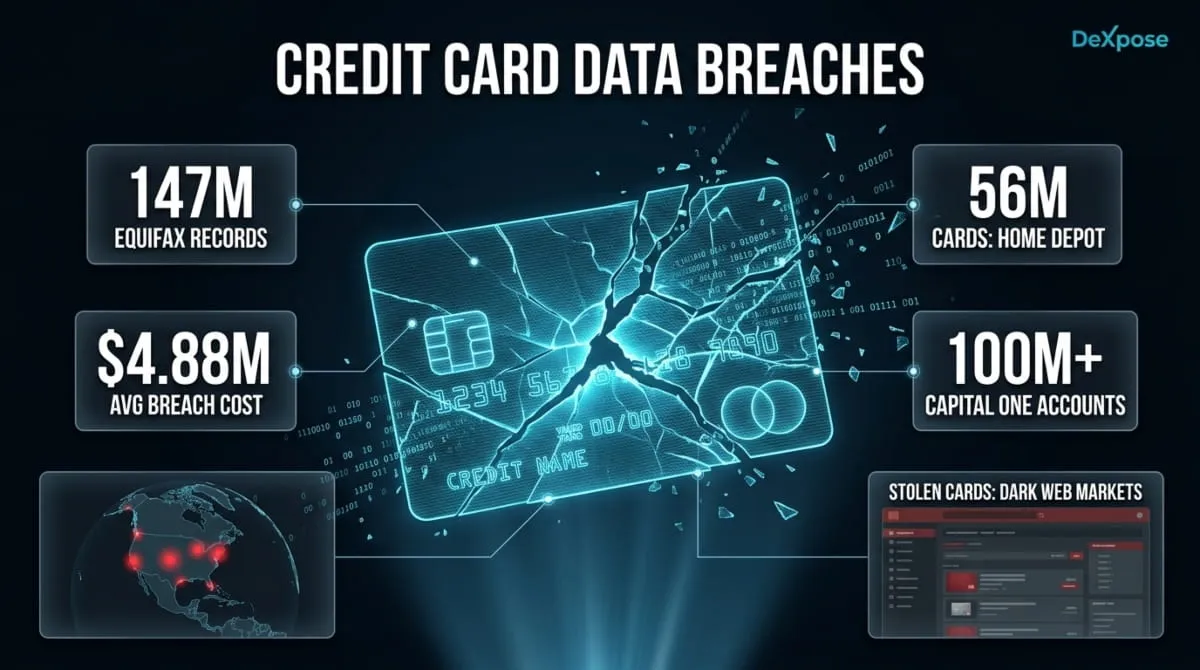
The scale is hard to ignore. The Target breach exposed over 40 million cards. The Capital One breach compromised more than 100 million accounts. The Equifax breach, involving the agency responsible for monitoring your credit, leaked the financial data of nearly 148 million Americans. These aren’t edge cases. They’re the norm.
What makes credit breaches particularly damaging is the lag. Fraudsters are patient. A stolen card may sit dormant for weeks before it’s used, which means the window between exposure and discovery is wide and expensive.
This page covers everything you need to know: how credit card breaches happen, which major breaches have affected the most people, how to check whether your data was exposed, and exactly what steps to take to protect your credit before the damage compounds.
What Is a Credit Card Data Breach?
A credit card data breach is a security incident in which sensitive cardholder information is accessed, stolen, or exposed without authorization. This can involve a single account or, in headline cases, tens of millions of records compromised in a single attack.
The exposed data typically includes card numbers, expiration dates, CVV codes, and the cardholder’s name and billing address. In more serious breaches, Social Security numbers, login credentials, and full financial profiles are exposed alongside payment data. Once that information leaves a secure system, it rarely stays private for long.
What separates a credit breach from a general data breach is specificity. The stolen data has direct, immediate monetary value. A breached credit card can be cloned, sold, or used for online fraud within hours. That urgency is what makes credit card security breaches particularly destructive compared to other types of data exposure.
How Credit Card Data Is Stolen
Most credit card breaches don’t involve a dramatic hack of a single vault. They exploit weak points across complex systems, and there are many of them.
The most common method is malware planted on point-of-sale (POS) systems at retailers, restaurants, and hotels. This type of attack, used in the Target and Home Depot breaches, silently captures card data as customers swipe or tap, sending it to attackers in real time.

Third-party processor breaches are equally common and harder to trace. When a payment processor that handles transactions for dozens of merchants is compromised, the breach ripples across all the businesses it serves. The Heartland Payment Systems breach worked exactly this way, exposing over 130 million cards from a single point of failure.
Phishing attacks and credential theft target employees with access to cardholder databases. One compromised login can open an entire customer record system. And increasingly, breaches originate from third-party vendors, software suppliers, logistics partners, or cloud services, where security standards may be weaker than at the primary target.
The Difference Between a Credit Breach and Identity Theft
These two terms are related but not interchangeable, and the distinction matters for how you respond.
A credit card breach is an event, a specific incident where your card data was exposed as part of a larger compromise. It may or may not result in fraud against you personally, depending on whether your specific record was accessed and used.
Identity theft is the outcome when someone actively uses your personal or financial information to open accounts, take out loans, or commit fraud in your name. A credit breach is often the starting point, but identity theft requires an additional step: a criminal acting on the stolen data.
This matters because your response should account for both possibilities. Canceling a breached card addresses the immediate risk, but monitoring your credit for new account openings protects against the longer-term identity theft exposure that the same breach may have enabled.
How Credit Card Breaches Affect Your Credit Score
A breach doesn’t directly lower your credit score, but what follows can.
If a stolen card is used to rack up charges you don’t catch quickly, high utilization on that account can pull your score down. More significantly, if a fraudster uses breached data to open new credit accounts in your name, those hard inquiries and new accounts will appear on your credit report and affect your score, sometimes for years.
The credit score impact of identity theft stemming from a breach is often more severe and longer-lasting than the fraudulent charges themselves. Disputing unauthorized accounts, correcting credit report errors, and recovering your credit standing is a process that can take months, which is why early detection is the single most important factor in limiting the damage.
How Credit Card Breaches Happen: The Most Common Attack Methods
Understanding how credit card breaches happen isn’t just a technical matter; it’s why certain breaches affect millions of people at once, why you can do everything right as a consumer and still end up exposed, and why monitoring your credit after any major breach is no longer optional.
Most credit card security breaches don’t start with a frontal attack on a bank. They target the broader ecosystem around your card, the retailers, processors, and service providers that handle your data every time you make a purchase.

Point-of-Sale Malware and Skimming
The most widespread method of credit card data theft is malware installed on point-of-sale systems, the terminals you swipe or tap your card on at checkout. Once embedded, this malware captures card data in real time, before it’s even encrypted, and transmits it to attackers.
This is exactly how the Target credit card breach happened in 2013. Attackers gained access to Target’s internal network through a third-party HVAC vendor, then deployed malware across nearly 1,800 in-store POS terminals. Over several weeks during the holiday shopping season, more than 40 million credit and debit cards were silently compromised. Customers had no idea until fraudulent charges began appearing.
Physical skimming devices, hardware attached to ATMs or payment terminals, operate on the same principle: they capture magnetic stripe data from cards as they’re inserted. These are harder to scale but are frequently used at gas stations, parking meters, and standalone ATMs.
Third-Party Processor Breaches
Every time you use a credit card, your transaction passes through multiple systems before it’s approved. Payment processors, gateway providers, and acquiring banks all handle your card data at various points in that chain, and any one of them can be the weak link.
The Heartland Payment Systems breach demonstrated the scale of this vulnerability. Heartland processed transactions for over 250,000 businesses. When attackers breached their network in 2008, they didn’t need to target individual retailers; they captured data from all of them simultaneously. The result was one of the largest credit card data breaches in history, with an estimated 130 million cards compromised from a single point of failure.
When a processor is breached, the companies it serves often don’t know their customers were affected until the investigation concludes, sometimes months later.
Phishing and Credential-Based Attacks
Not all credit card breaches involve sophisticated technical exploits. Many start with a single employee clicking a malicious link or entering credentials into a fake login page.
Once attackers have valid employee credentials, they can move through internal systems, escalating access until they reach customer databases containing full credit card information. The Capital One breach in 2019, which exposed over 100 million accounts, originated from a misconfigured firewall exploited by a former cloud services employee who understood exactly how the system was structured.
Phishing remains one of the most cost-effective attack methods precisely because it bypasses technical defenses entirely. Human error is harder to fix than software bugs.
Supply Chain and Vendor Vulnerabilities
Modern businesses rely on dozens of third-party vendors, software providers, analytics platforms, cloud services, and logistics partners. Each integration is a potential entry point, and attackers increasingly target smaller vendors specifically because they connect to larger, more valuable systems.
The 2024 Change Healthcare breach illustrated this at scale. As a major healthcare payment processor, Change Healthcare handled billing and payment data for a significant portion of the US healthcare system. When attackers encrypted their systems and extracted data, the breach triggered free credit monitoring offers across multiple industries, not because it was purely a credit card breach, but because the financial and personal data involved was broad enough to create serious fraud exposure for millions of people.
Supply chain attacks are particularly difficult to defend against because the vulnerability exists outside the organization that ultimately takes responsibility for the breach.
Dark Web Markets and the Breach Economy
What happens to your credit card data after a breach is a structured, commercialized process. Stolen card data is sorted, graded by validity and card type, bundled into packages, and listed for sale on dark web carding markets, often within 24 to 48 hours of a breach.
Prices vary based on card type, available balance, country of origin, and whether the CVV is included. A basic card number with CVV might sell for a few dollars. A premium rewards card with full billing details commands a significantly higher price. The buyers are typically fraudsters who use the cards for online purchases, gift card schemes, or resale.
This is why the window between a breach occurring and fraud appearing on your account can be unpredictably short, and why waiting for an official breach notification before taking action is a risk you shouldn’t take.
The Biggest Credit Card Breaches in History
Some breaches are footnotes. Others reshape how entire industries handle security. The incidents below fall into the second category: each exposed millions of people, triggered regulatory scrutiny, and, in several cases, permanently changed how financial data is protected. If you’ve ever wondered whether your information was caught up in one of these events, the scale alone suggests the odds are higher than most people realize.

Target (2013), How It Happened and What Changed
The Target credit card breach remains one of the most studied security incidents in retail history, not because of its size alone, but because of how preventable it was.
Attackers first gained access to Target’s network using stolen credentials from a third-party HVAC contractor. From there, they moved laterally through internal systems until they reached the point-of-sale network, an area that should have been isolated but wasn’t. Malware was deployed across approximately 1,800 in-store terminals, and over roughly three weeks during the 2013 holiday season, the card data of more than 40 million customers was silently harvested.
What made the Target credit card data breach particularly damaging was the timing and the scale of the blind spot. Target’s security systems actually flagged the malware, alerts were generated, and largely went unacted upon. By the time the breach was publicly disclosed in December 2013, the stolen data was already circulating on dark web markets.
The fallout was substantial. Target ultimately paid $18.5 million in a multistate settlement and overhauled its entire security infrastructure. The breach also accelerated the US transition toward EMV chip card technology, which is significantly harder to clone than magnetic stripe data.
Home Depot (2014)
The Home Depot credit card data breach followed a similar pattern to Target and struck just months after the retail industry had been put on notice. Attackers used stolen vendor credentials to access Home Depot’s network, then deployed a custom variant of the BlackPOS malware used at Target, modified to evade Home Depot’s security tools.
The breach ran undetected for approximately five months, from April through September 2014, affecting self-checkout terminals across US and Canadian stores. By the time it was contained, roughly 56 million credit and debit cards had been compromised, surpassing Target’s total.
Home Depot reached a settlement of over $17 million with affected customers and separately agreed to a $25 million settlement with financial institutions that had to reissue cards. Like Target, the breach pushed the company to accelerate chip-and-PIN adoption across all its payment terminals.
Equifax, Experian, and TransUnion: When the Credit Bureaus Got Breached
The credit bureau breaches represent a uniquely serious category of exposure because the organizations involved exist specifically to hold your most sensitive financial data. When they’re compromised, the damage extends well beyond a single card or account.
The Equifax breach of 2017 is the defining example. Attackers exploited a known vulnerability in a web application framework that Equifax had failed to patch for months. The result was access to the personal and financial records of approximately 147 million Americans, including Social Security numbers, birth dates, addresses, and in many cases, credit card numbers and dispute documents. Equifax ultimately paid $575 million in a settlement with the FTC, with up to $425 million directed toward consumer relief, including free credit monitoring.
Experian has faced multiple breach incidents of its own, including a 2015 breach affecting 15 million T-Mobile customers whose data was processed through Experian’s systems, blurring the line between a credit bureau breach and a telecom breach. TransUnion has similarly disclosed unauthorized access incidents affecting consumer credit data in various markets.
The significance of credit bureau breaches isn’t just the volume of records. It’s that the data stolen is permanent. You can cancel a credit card. You cannot change your Social Security number.
Capital One, Chase, Marriott, and Ticketmaster
Capital One, The 2019 Capital One credit card data breach was one of the largest financial breaches in US history, exposing over 100 million credit card applications and accounts across the US and Canada. The attacker, a former employee of a cloud infrastructure provider, exploited a misconfigured firewall to access Capital One’s cloud environment. The breach resulted in a $190 million class action settlement and an $80 million regulatory fine. The Capital One credit card data breach class action remains one of the largest consumer financial breach settlements on record.
Chase, JPMorgan Chase, experienced a significant breach in 2014 that compromised the contact information of approximately 76 million households and 7 million small businesses. While full credit card numbers were not confirmed as stolen in that incident, Chase credit card data breach concerns have continued to surface in subsequent years, as customer notification emails about potential exposure have circulated, some legitimate, some phishing attempts mimicking official communications.
Marriott, The Marriott credit card breach actually originated years before it was discovered. Attackers had been inside the Starwood guest reservation system since 2014, two years before Marriott acquired Starwood, and the breach wasn’t detected until 2018. By then, up to 500 million guest records had been accessed, including passport numbers, payment card details, and reservation histories. The extended dwell time made it one of the longest-running undetected breaches in hospitality history.
Ticketmaster, The Ticketmaster credit card breach disclosed in 2024 was part of a broader campaign targeting cloud data environments. A threat actor claiming affiliation with the ShinyHunters group alleged access to 560 million customer records, including partial payment card data, names, addresses, and order histories. Ticketmaster began offering affected customers access to credit monitoring services, though the full scope of financial data exposure remained under investigation at the time of disclosure.
AT&T, T-Mobile, and Change Healthcare, Telecom and Healthcare Crossover Breaches
Telecom and healthcare breaches fall into a different risk category than retail breaches because the data involved typically extends beyond payment card information, often including Social Security numbers, account credentials, and medical billing data that enable more sophisticated financial fraud.
The AT&T data breach disclosed in 2024 affected approximately 73 million current and former customers, with leaked data including Social Security numbers, account passcodes, and contact information. AT&T offered impacted customers free credit monitoring, though the breach prompted broader concerns given how much financial activity is tied to phone numbers through two-factor authentication.
T-Mobile has disclosed multiple significant breaches in recent years, including its 2021 incident that exposed data from over 50 million current, former, and prospective customers, including Social Security numbers and driver’s license information. The T-Mobile credit breach resulted in a $350 million class-action settlement and a commitment to invest $150 million in cybersecurity.
The 2024 Change Healthcare breach was categorically different in its scope. As the largest healthcare payment processing company in the US, Change Healthcare handled billing and payment transactions for a substantial portion of American healthcare providers. When the ALPHV/BlackCat ransomware group attacked their systems, the disruption cascaded across hospitals, pharmacies, and insurance networks nationwide. The personal and financial data of an estimated 100 million or more individuals was potentially exposed, making it one of the largest healthcare data breaches in US history and triggering free credit monitoring offers from multiple affected organizations.
National Public Data and the SSN Exposure Wave
The National Public Data breach, which surfaced publicly in 2024, represented a different kind of threat. Unlike breaches that target transaction data at the point of sale, this incident involved a data broker. This company aggregates personal information from public records, court filings, and other sources and sells access to it.
The breach allegedly exposed nearly 2.9 billion records containing Social Security numbers, names, addresses, and family relationships for a significant portion of the US population. Because data brokers compile information that individuals never directly provided, many people were unaware that National Public Data even held their information.
The implications for credit fraud were significant. With Social Security numbers, full names, and address histories available in bulk, criminals had everything needed to open new credit accounts, file fraudulent tax returns, or construct synthetic identities, all without ever obtaining a single credit card number. National Public Data subsequently filed for bankruptcy, leaving affected consumers with credit monitoring and credit freeze actions as their primary lines of defense.
Recent Credit Card Breaches (Updated 2026)
The breach landscape doesn’t pause between major headlines. While large-scale incidents like the National Public Data exposure and the Change Healthcare attack dominated 2024, the pattern heading into 2025 reflects an acceleration, more breaches, faster exploitation, and an expanding range of targets beyond traditional retail and banking.

What’s shifted most significantly in recent years is where the breaches originate. Cloud misconfigurations, third-party vendor compromises, and ransomware-driven data theft have largely replaced the POS malware attacks that defined the 2013–2018 era. The data stolen is often broader too, less focused on card numbers alone and more on comprehensive personal profiles that enable longer-term financial fraud.
What the Most Recent Confirmed Breaches Tell Us
Several significant breach disclosures have shaped the credit security landscape heading into 2025.
The Ticketmaster breach, confirmed in mid-2024, exposed partial payment card data alongside personal information for hundreds of millions of customers globally. The data appeared on dark web forums before formal notification reached affected users, a pattern that has become frustratingly common. By the time customers received breach notification emails, their data had already been accessible to buyers for weeks.
The AT&T breach disclosed in 2024 affected tens of millions of accounts across two separate incidents, one involving a 2019 dataset that surfaced publicly in 2024, and a second involving call and text metadata from nearly all AT&T wireless customers. While call records don’t contain credit card numbers directly, the combination of account data and Social Security numbers exposed in the first incident created substantial credit fraud risk that persisted well into 2025.
Bank of America credit card data was implicated through a third-party breach at Infosys McCamish Systems, a vendor that provided services to Bank of America’s deferred compensation plans. Over 57,000 customers had personal and financial data exposed, another example of how major financial institutions can be compromised not through a direct attack but through a vendor they rely on.
PowerSchool, a widely used education technology platform, disclosed a breach in early 2025 affecting student and staff records across thousands of school districts in the US and Canada. While not a credit card breach in the traditional sense, the exposure of Social Security numbers for millions of students and parents created downstream credit fraud risk, including for minors who wouldn’t discover fraudulent accounts opened in their names until they applied for credit years later.
Breaches Under Investigation and Emerging Threats
Not every breach becomes public knowledge immediately. Cybersecurity researchers and dark web monitoring services frequently identify stolen data being traded or advertised before any official disclosure. In several cases throughout 2024 and into 2025, threat actors publicly claimed access to databases from financial institutions and credit processors before investigations were completed or companies confirmed the incidents.
This gap between breach occurrence and public disclosure is one of the most significant risks consumers face. The average dwell time, the period between when an attacker gains access and when the breach is detected, has historically ranged from weeks to months. During that window, data is being sold and used while victims remain completely unaware.
How to Stay Updated on New Breaches
Waiting for a company to notify you is the least reliable way to stay informed about breaches. A patchwork of state laws governs notification timelines, and even in jurisdictions with strict requirements, companies have weeks to complete their investigation before disclosure is mandatory.
The more proactive approach combines several layers. Dark web monitoring services scan underground markets and data leak forums for your personal information, catching exposure that may never result in a formal breach notification. Credit monitoring services track changes to your credit file that could indicate fraudulent activity. And setting up transaction alerts on all your financial accounts creates a real-time layer that catches active fraud as it happens rather than after the fact.
DeXpose’s free dark web report scans dark web markets, malware logs, and breach databases for your personal and financial data, giving you a current picture of your exposure without waiting for a company to tell you your data was compromised. You can run a free scan at Free Dark Web Report.
How to Check If Your Credit Was Breached
Most people find out their credit was breached the wrong way: a declined card, an unfamiliar charge, or a credit score drop that finally prompts them to pull their report. By that point, the fraud has already happened. The goal is to find out before that.
The good news is that checking your exposure doesn’t require waiting for an official notification or paying for a premium service upfront. There are several reliable ways to get a clear picture of your current risk, and the most effective approach is to layer them together.

Signs Your Credit Card Data Was Compromised
Not every breach results in immediate fraud, but there are warning signs worth knowing. Unexplained charges, even small ones, are a common early indicator. Fraudsters frequently test stolen cards with low-value transactions before making larger purchases, so a $1 or $2 charge from an unfamiliar merchant shouldn’t be dismissed.
Other signals include receiving credit cards, statements, or collection notices for accounts you didn’t open; seeing hard inquiries on your credit report from lenders you never contacted; being denied credit unexpectedly; or getting IRS notices about a second tax return filed under your Social Security number. Any of these can trace back to a credit data breach that exposed more than just your card number.
How to Check Using Free Breach Monitoring Tools
Several free tools can tell you whether your email address or personal information has appeared in known data breaches. These tools cross-reference your details against databases of confirmed breach records and alert you to any matches.
DeXpose’s free dark web report goes a step further, scanning not just breach notification databases but also active dark web markets, malware-stealing logs, and paste sites where stolen data is shared. This matters because not all stolen data ends up in public breach records. Much of it circulates on closed forums and underground markets that standard breach checkers don’t access. You can run a free scan at Free Dark Web Report.
For your credit file specifically, you’re entitled to a free credit report from each of the three major bureaus, Equifax, Experian, and TransUnion, through AnnualCreditReport.com. Reviewing all three matters because not every creditor reports to all three bureaus, meaning a fraudulent account might appear on one report but not the others.
What Your Credit Monitoring Service Is Actually Telling You
Credit monitoring services watch your credit file and alert you when something changes, such as a new account opening, a hard inquiry, an address change, or a significant score movement. What they don’t do is tell you whether your data was stolen or is currently being sold. They can only report what is already on your credit file.
This is an important distinction. A credit monitoring alert means something has already happened. It’s a reactive signal, not a preventive one. For most breaches, the exposure occurs weeks or months before any credit file activity appears, which is why dark web monitoring, which operates upstream of your credit file, provides earlier warning.
The two tools serve different purposes and work best in combination: dark web monitoring to detect exposure before fraud occurs, credit monitoring to catch fraud if it does.
What Credit Karma’s Breach Alerts Mean, and Their Limitations
Credit Karma is one of the most widely used free credit monitoring platforms, and many users encounter its breach alert feature before any other form of breach notification. When Credit Karma says your data was breached, it’s drawing on breach databases, typically sourced from publicly disclosed incidents, and matching your email address or personal details against those records.
What this means practically: Credit Karma’s alerts are based on known, confirmed, and already-reported breaches. If your data was stolen in a breach that hasn’t been publicly disclosed yet, or if it’s circulating on dark web markets without a formal breach record attached, Credit Karma’s system won’t flag it. Similarly, Credit Karma’s dark web scan has coverage limitations compared to dedicated dark web monitoring platforms that actively crawl underground sources.
If Credit Karma has flagged a breach for your account, take it seriously, but don’t treat a clean alert as confirmation that your data is safe. It means your data wasn’t found in the specific sources Credit Karma monitors, which is a narrower scope than it sounds.
How DeXpose Scans the Dark Web for Your Exposed Data
DeXpose monitors the sources that most breach checkers don’t reach, active dark web markets, stealer malware logs, criminal forums, and data leak channels where stolen financial information is traded before it ever appears in public breach records.
When you run a free dark web report, DeXpose scans for your email addresses, phone numbers, and associated credentials across these sources and returns a current snapshot of your exposure. For businesses and individuals who want continuous monitoring rather than a one-time scan, DeXpose’s full dark web monitoring service provides ongoing alerts whenever new data tied to your identity surfaces in underground sources.
The practical difference between a one-time breach check and continuous dark web monitoring is the same as the difference between a single credit report and ongoing credit monitoring; one tells you where you stand today, the other tells you the moment something changes.
What to Do Immediately After a Credit Card Data Breach
Finding out your credit card data was exposed in a breach triggers an obvious first instinct: cancel the card, change the password, and move on. That response addresses the most immediate layer of risk but leaves most of the exposure untouched. A credit card breach rarely involves just one piece of information, and the fraud that follows rarely stops at one unauthorized charge.

The steps below are ordered deliberately. Each one closes a specific window of risk, and skipping ahead or doing them out of sequence reduces their effectiveness.
Step 1: Freeze Your Credit
A credit freeze is the single most effective action you can take after a data breach. It restricts access to your credit file, which means lenders cannot pull your report to approve new credit applications, including fraudulent ones opened in your name.
Freezing your credit is free and can be done directly with each of the three major bureaus: Equifax, Experian, and TransUnion. You need to freeze all three separately, because a freeze at one bureau doesn’t carry over to the others. Each will provide a PIN or account credentials you’ll need to lift the freeze when you apply for credit yourself temporarily.
The freeze doesn’t affect your existing accounts, your credit score, or your ability to use cards you already have. It specifically prevents new account openings, which is the primary fraud vector enabled by stolen breach data.
How long should you keep the freeze in place? For major breaches involving Social Security numbers, the honest answer is indefinitely, or at a minimum, until you’ve had several months of clean monitoring. Stolen SSN data doesn’t expire. Fraudsters have used breach data years after the original incident, waiting for consumer vigilance to drop.
Step 2: Set Up Fraud Alerts With All Three Credit Bureaus
A fraud alert is different from a freeze. Rather than blocking credit inquiries entirely, it instructs lenders to take additional verification steps before approving credit in your name. It’s a lighter layer of protection, but it has one advantage: placing an initial fraud alert with any one of the three bureaus requires that bureau to notify the other two, so one action covers all three.
An initial fraud alert lasts one year. If your Social Security number was confirmed as part of a breach, you may qualify for an extended fraud alert lasting seven years, which also entitles you to two free credit reports per year from each bureau on top of your standard annual access.
Fraud alerts and credit freezes can, and in serious breach situations, should be used simultaneously.
Step 3: Sign Up for Credit Monitoring
Once your credit file is frozen and fraud alerts are in place, ongoing monitoring ensures you’re notified the moment anything changes. This matters because some fraud doesn’t surface immediately, and a temporary lift of a freeze for a legitimate credit application creates a brief window of exposure.
If the company involved in the breach is offering free credit monitoring as part of their response, as AT&T, Change Healthcare, Ticketmaster, National Public Data, and others have done, enroll in it, but don’t treat it as sufficient on its own. Breach-specific monitoring typically runs for one to two years and covers a limited scope of data.
Supplement it with dark web monitoring, which operates upstream of your credit file and can detect your data circulating in underground markets before it translates into credit file activity. DeXpose’s monitoring service continuously scans dark web sources, stealer logs, and breach databases, alerting you when your information surfaces, giving you the earliest possible warning before fraud occurs rather than after.
Step 4: Review Your Credit Reports for Unauthorized Activity
Pull your full credit reports from all three bureaus immediately and review them line by line. You’re looking for accounts you didn’t open, hard inquiries from lenders you never contacted, addresses you’ve never lived at, and employers you’ve never worked for, all of which can indicate that someone is already using your information.
Dispute any unauthorized entries directly with the relevant bureau. Under the Fair Credit Reporting Act, bureaus are required to investigate disputes and remove unverifiable information. If fraudulent accounts have been opened, also contact the creditor directly to report the fraud. The bureau dispute and the creditor report are separate processes, and both are necessary.
Document everything. Keep records of every dispute filed, every response received, and every account you’ve flagged. If the fraud is extensive, this documentation becomes critical for identity theft affidavits and any potential legal action.
Step 5: Report Fraudulent Charges and Dispute Errors
For any unauthorized charges on existing accounts, contact your card issuer immediately. Federal law limits your liability for fraudulent credit card charges to $50 in most cases, and most major issuers have zero-liability policies that cover the full amount, but only if you report promptly. Waiting reduces your leverage and complicates the dispute process.
File an identity theft report at IdentityTheft.gov, the FTC’s official resource for breach victims. This report serves two functions: it creates an official record of the fraud, and it generates a personalized recovery plan with pre-filled dispute letters for creditors and bureaus. If the fraud extends to tax returns, contact the IRS directly and request an Identity Protection PIN.
For breaches that resulted in class action lawsuits, Capital One, Equifax, T-Mobile, and others, check whether you qualify for compensation through the settlement process. Eligibility windows have specific deadlines, and unclaimed settlement funds are not automatically distributed.
Free Credit Monitoring After a Data Breach, What’s Actually Worth Using
When a major breach is disclosed, the company responsible almost always offers the same thing: free credit monitoring for one or two years. It’s become so standard that it reads more like a legal formality than a genuine protective measure. That doesn’t mean you should decline it, but it does mean you should understand exactly what it covers, what it misses, and how to fill the gaps.

When Companies Offer Free Monitoring, and Why It’s Often Limited
Free credit monitoring offers following a breach are typically driven by settlement requirements, regulatory pressure, or reputational damage control rather than comprehensive consumer protection. The coverage period is usually fixed at 1 to 2 years, the scope is often limited to 1 bureau rather than all 3, and the service offered is credit file monitoring, not dark web monitoring, not fraud resolution support, and not SSN-level surveillance.
For breaches that exposed credit card numbers alone, one year of single-bureau monitoring may be adequate if you’ve already frozen your credit and reviewed your reports. For breaches that exposed Social Security numbers, full financial profiles, or healthcare data, which describes most of the major incidents from 2023 and 2024, one year of monitoring barely covers the initial high-risk window, let alone the years-long tail of potential fraud.
The practical limitation is this: free breach monitoring tells you when something changes on your credit file. It doesn’t tell you whether your data is currently being sold on the dark web, whether it’s sitting in a criminal’s database waiting to be used, or whether a fraudster opened an account at a bureau the service isn’t monitoring.
Breach-Specific Monitoring Offers Worth Knowing About
Several major breach responses have included monitoring offers that affected consumers should be aware of and actively claim if they haven’t already.
AT&T offered free identity theft and credit monitoring services to customers affected by its 2024 breach disclosures. Given that the exposed data included Social Security numbers and account credentials, not just contact information, the monitoring offer was warranted, though the enrollment window had specific deadlines attached.
Change Healthcare set up a dedicated support site for breach victims, offering two years of free credit monitoring and identity theft protection through IDX. The breadth of the Change Healthcare breach, spanning healthcare payment data, insurance information, and personal identifiers across potentially over 100 million individuals, made this one of the more substantial corporate monitoring responses in recent memory.
Ticketmaster offered affected customers identity monitoring services following its 2024 breach disclosure. However, the scope of the payment card data exposure led many security researchers to recommend treating the Ticketmaster breach as a financial fraud risk requiring credit bureau action beyond monitoring alone.
National Public Data offered limited remediation before filing for bankruptcy, underscoring one of the structural problems with data broker breaches. When the company holding your data no longer exists, the free monitoring offer often disappears with it, leaving consumers to arrange their own protection.
T-Mobile and Equifax, following their respective settlements, made credit monitoring available to affected consumers through the settlement process rather than a direct corporate offer. The Equifax settlement in particular included up to ten years of three-bureau credit monitoring for eligible claimants, a significantly more comprehensive offer than the standard one-year single-bureau alternative.
If you were affected by any of these breaches and haven’t claimed the associated monitoring offer, check the settlement or breach response website directly. Enrollment windows vary, and some have already closed.
What to Look for in a Credit Monitoring Service
Not all credit monitoring services are built the same, and the difference between a basic and a comprehensive service matters significantly in a post-breach environment.
Three-bureau coverage is the baseline requirement. A service that monitors only one bureau will miss fraudulent accounts reported to the others. Beyond that, the most useful services combine credit file monitoring with dark web surveillance, SSN monitoring, and new account alerts, covering both the credit file activity that has already occurred and the underground exposure that precedes it.
Alert speed matters too. A service that sends weekly digest emails is materially less useful than one that sends real-time alerts, particularly in the first weeks after a breach when fraud attempts are most concentrated.
Fraud resolution support, access to a dedicated specialist who can help dispute accounts, file reports, and manage the recovery process, separates premium services from basic monitoring tools and is worth prioritizing if your exposure includes Social Security numbers or full financial profiles.
Credit Freeze vs. Credit Monitoring: Which Do You Actually Need?
If you’ve been affected by a data breach, you’ve likely encountered both terms and may be wondering whether one replaces the other or which to prioritize. The confusion is understandable because both are marketed as protective measures against the same underlying threat. But they work in completely different ways, and treating them as interchangeable is one of the most common mistakes people make after a breach.

The short answer: you need both. The longer answer explains why neither one is sufficient on its own.
What a Credit Freeze Does, and Doesn’t Do
A credit freeze, also called a security freeze, locks your credit file at each bureau so that new lenders cannot access it. Since most credit approvals require a bureau inquiry, a freeze effectively blocks anyone, including fraudsters, from opening new accounts in your name.
It’s free, it’s powerful, and for breaches involving Social Security numbers or full identity profiles, it’s the most important single action you can take. The freeze remains in place until you lift it, which you control entirely through each bureau’s online portal or phone line.
Understanding what a credit freeze doesn’t do is equally important. It doesn’t protect existing accounts. If a fraudster already has your credit card number from a breach, a freeze won’t stop them from using it; your existing account remains fully active and accessible. It doesn’t alert you to anything. A freeze is silent and passive; it blocks access but generates no notifications and provides no visibility into attempted fraud. It also doesn’t cover every type of financial fraud. Medical identity theft, tax fraud, and government benefits fraud don’t require a credit bureau inquiry, so they proceed unaffected by a freeze.
What Credit Monitoring Catches That a Freeze Misses
Credit monitoring continuously monitors your credit file and alerts you to activity, such as new account applications, hard inquiries, balance changes, address updates, and score fluctuations. Where a freeze is a barrier, monitoring is a surveillance system.
This matters for several reasons. First, your freeze will occasionally need to be lifted when you apply for a mortgage, a car loan, a new credit card, or even certain jobs that require a credit check. During that window, your file is briefly accessible, and monitoring ensures you’re alerted to any inquiry that occurs during that period.
Second, credit monitoring catches fraud on your existing accounts that a freeze can never touch. Unauthorized charges, account takeovers, and changes to your existing credit lines all register as credit file activity that monitoring will flag, none of which a freeze addresses.
Third, monitoring provides documentation. A timestamped record of every alert and change to your credit file is valuable evidence if you need to dispute fraudulent accounts, file an identity theft report, or pursue legal action against a company whose breach caused the fraud.
Why You Need Both After a Major Breach
A credit freeze without monitoring is a locked door with no camera. You’ve blocked new account fraud, but you have no visibility into what’s happening on existing accounts, and no alert if the freeze is somehow bypassed or if fraud occurs through channels the freeze doesn’t cover.
Credit monitoring without a freeze is a camera pointed at an unlocked door. You’ll see the fraud happening in real time, but you haven’t done anything to prevent it.
Together, they create a layered defense that addresses both prevention and detection. The freeze stops new account fraud in its tracks. Monitoring catches everything the freeze can’t, existing account activity, inquiries during lifted-freeze windows, and the downstream credit file impact of identity theft that originated in a breach.
For breaches that exposed Social Security numbers, which now describes a significant portion of the major incidents from the past two years, add dark web monitoring as a third layer. Your SSN doesn’t expire and can’t be changed, which means the risk from a breach that exposed it doesn’t disappear after a year of monitoring. Dark web surveillance gives you the earliest possible warning when that data surfaces in criminal markets, before it translates into credit file activity that monitoring will detect too late to prevent.
DeXpose combines dark web monitoring with breach database surveillance, giving you visibility into the exposure layer that sits upstream of your credit file. Pair it with a credit freeze at all three bureaus and ongoing credit monitoring, and you’ve covered all three layers of post-breach protection.
Dark Web Monitoring vs. Credit Monitoring: What’s the Difference
This distinction is worth being explicit about because the two are frequently conflated in breach response communications, and they serve fundamentally different functions.
Credit monitoring watches your credit file, the record maintained by Equifax, Experian, and TransUnion, and alerts you when new accounts are opened, inquiries are made, or balances change significantly. It operates at the output end of fraud: by the time a credit monitoring alert fires, a fraudster has already attempted to use your data.
Dark web monitoring operates upstream. It scans underground markets, criminal forums, stealer malware logs, and data leak channels where stolen personal and financial information is bought and sold before it’s ever used. A dark web alert means your data has been found in these sources, which is an early warning that fraud may be coming, not a report that it has already happened.
The gap between these two layers is where most breaches occur. Data sits on the dark web for weeks or months before a fraudster acts on it. That window is your best opportunity to freeze your credit, change your credentials, and secure your accounts before any fraud appears on your credit file.
DeXpose monitors both layers, continuously scanning dark web sources for your exposed data while providing visibility into breach databases and stealer logs that standard credit monitoring doesn’t reach. For ongoing protection rather than a one-time check, DeXpose’s dark web monitoring service alerts you in real time whenever your information surfaces on underground marketplaces. You can start with a free exposure scan at Free Dark Web Report.
Credit Bureau Breaches: When the Monitors Get Breached
There’s an uncomfortable irony at the center of the credit monitoring industry. The organizations that sell protection against financial fraud, the agencies that hold your most sensitive financial data and profit from helping you guard it, have themselves been the targets of some of the most damaging data breaches in history. When a retailer gets breached, your card number is exposed. When a credit bureau gets breached, your entire financial identity is on the table.
Understanding what happened at Equifax, Experian, and TransUnion, and what it means for your ongoing exposure, is essential context for anyone managing their credit security in the aftermath of any breach.

The Equifax Breach, What Was Exposed, and the Long-Term Fallout
The Equifax breach of 2017 is the benchmark against which all other credit bureau breaches are measured, and for good reason. The scale, the sensitivity of the data, and the circumstances surrounding the breach combined to make it one of the most consequential data security failures in US history.
The vulnerability that enabled the breach was a known flaw in Apache Struts, a widely used web application framework. A patch had been available for months before attackers exploited it. Equifax’s failure to apply that patch promptly gave attackers access to a consumer dispute portal and, through it, to the personal and financial records of approximately 147 million Americans.
What was exposed went far beyond credit card numbers. Social Security numbers, birth dates, home addresses, driver’s license numbers, and, in some cases, credit card numbers and dispute documents were all compromised. For roughly half the US population, the breach created a permanent record of exposure that no credit card cancellation or password reset could address.
The regulatory and legal fallout was substantial. Equifax settled with the FTC, CFPB, and all 50 states for a total of $575 million, with up to $425 million directed toward consumer relief, including free credit monitoring, cash payments, and reimbursement for out-of-pocket losses. Eligible consumers were also entitled to up to ten years of three-bureau credit monitoring through the settlement, a significantly longer coverage window than most breach responses provide.
The long-term significance of the Equifax breach isn’t just the settlement figure. It’s the permanence of the exposure. The Social Security numbers stolen in 2017 are still valid today. They will be valid for ten years. Consumers who were affected by the Equifax breach carry that exposure indefinitely, which is why ongoing dark web monitoring, not just the finite credit monitoring offered through the settlement, remains relevant years after the incident.
Experian Breaches and Monitoring Obligations
Experian has faced multiple significant breach incidents that have tested its credibility as a provider of the very monitoring services it sells to breach victims.
The most notable involved T-Mobile customer data. In 2015, Experian disclosed that its Decision Analytics business unit, which processed credit applications on behalf of T-Mobile, had been breached, exposing the personal data of approximately 15 million T-Mobile customers who had applied for service. The data included Social Security numbers, passport numbers, and driver’s license information. Experian offered two years of free credit monitoring to affected individuals. However, the incident raised pointed questions about the security practices of a company whose core business is handling sensitive consumer data.
Experian has also faced scrutiny over its subsidiary operations in other markets, with separate breach disclosures affecting consumer data in South Africa and Brazil in subsequent years. Each incident reinforced a pattern that consumers should internalize: the credit bureaus themselves are high-value targets, and the data they hold makes a successful breach against them categorically more damaging than most other types of incidents.
For consumers, this means the credit bureau that might be monitoring your credit file for breach activity is itself an organization whose security posture warrants scrutiny. Supplementing bureau-provided monitoring with independent dark web surveillance from a provider whose business model doesn’t depend on the same data ecosystem adds a layer of oversight that bureau-provided services cannot offer themselves.
TransUnion Data Exposure Incidents
TransUnion has similarly disclosed unauthorized access incidents affecting consumer credit data across multiple markets. A significant breach in South Africa exposed the records of millions of consumers held in TransUnion’s regional database, with attackers demanding ransom and threatening to release the data publicly.
In the US market, TransUnion has faced regulatory scrutiny over data security practices and has been named in litigation related to the handling of consumer data. While TransUnion has not experienced a breach of the scale of the 2017 Equifax incident in the US market, its history of regional incidents reflects the systemic risk that applies to all three major bureaus: they are extraordinarily valuable targets holding extraordinarily sensitive data, and their breach history warrants treating them as potential points of failure rather than unconditional sources of protection.
What to Do When Your Credit Agency Is the One That Got Hacked
The standard post-breach advice, contact your bank, set up monitoring with the credit bureaus, becomes complicated when the breach originates at the bureau itself. You can’t ask Equifax to monitor your Equifax exposure. You can’t rely on Experian to catch fraud that resulted from an Experian breach.
The response in these cases requires stepping outside the bureau ecosystem. First, claim any settlement-based monitoring established as part of the breach response. The Equifax settlement monitoring, for example, is administered through a separate third-party provider rather than Equifax itself, specifically for this reason.
Second, place freezes at all three bureaus regardless of which one was breached. A breach at one bureau exposes data that can be used to create fraud detectable across all three, so limiting your freeze to the breached bureau leaves meaningful gaps.
Third, add independent dark web monitoring that operates entirely outside the credit bureau infrastructure. When the organizations responsible for protecting your credit data are compromised, the most reliable protection comes from sources outside the same system. DeXpose monitors dark web markets, stealer logs, and breach databases independently of the credit bureau ecosystem, providing early warning when your data surfaces in criminal channels, regardless of where the original breach occurred. Run a free scan at Free Dark Web Report.
Credit Card Breach Statistics (2013–2026)
Numbers give breaches their true scale. Individual incidents make headlines, but the aggregate data reveal something more unsettling: a sustained, accelerating pattern of financial data exposure that has touched virtually every corner of the consumer economy over the past decade. The statistics below don’t just quantify the problem; they also highlight its scale. They explain why reactive responses to individual breaches are no longer sufficient.

How Many Credit Cards Are Compromised Each Year
The volume of compromised payment card records has fluctuated year to year, shaped by shifts in attack methodology, the adoption of chip card technology, and the rise of e-commerce as a primary fraud vector.
Large-scale POS malware campaigns defined the early 2010s. The Target breach alone in 2013 exposed over 40 million cards. Home Depot added another 56 million in 2014. By some industry estimates, over 100 million payment card records were compromised in retail breaches between 2013 and 2015, a period that effectively forced the US financial industry to accelerate its transition away from magnetic stripe technology.
The widespread adoption of EMV chip cards between 2015 and 2017 significantly reduced in-person card fraud, as chip cards are substantially harder to clone than magnetic stripe cards. However, it produced a well-documented displacement effect: fraud shifted from physical point-of-sale environments to card-not-present transactions online. E-commerce fraud involving stolen card details surged as brick-and-mortar skimming became less viable.
By 2022 and 2023, cybersecurity researchers tracking dark web carding markets estimated that tens of millions of stolen card records were actively listed for sale at any given time, a figure that reflects not just new breaches but the accumulated inventory from years of incidents. The Nilson Report, which tracks payment card fraud globally, projected that card fraud losses would exceed $35 billion annually by the mid-2020s, with the United States accounting for the largest share by a significant margin despite representing a fraction of global card transactions.
The Financial Cost of a Credit Card Data Breach
The cost of a credit card data breach extends well beyond the immediate fraud losses. For the organizations responsible, the financial exposure includes regulatory fines, legal settlements, card reissuance costs charged back by banks, forensic investigation fees, customer notification expenses, and the longer-term cost of reputational damage and customer attrition.
IBM’s annual Cost of a Data Breach Report has consistently placed the average total cost of a data breach in the millions of dollars, with financial services and healthcare organizations facing the highest per-record costs due to regulatory requirements and the sensitivity of the data involved. The 2024 report placed the global average cost of a data breach at $4.88 million, the highest figure recorded since the report’s inception, with breaches involving customer financial data consistently exceeding that average.
For individual consumers, the financial cost is harder to quantify but equally real. Out-of-pocket losses from credit card fraud, unauthorized charges that aren’t fully reimbursed, fees associated with credit repair, time spent disputing accounts and filing reports, add up across millions of affected individuals. The Identity Theft Resource Center estimated that identity theft victims spend an average of 200 hours resolving the consequences of a serious breach. This figure reflects the administrative burden that falls disproportionately on individuals rather than the organizations responsible.
The indirect costs are less visible but often more significant. A damaged credit score resulting from undetected fraudulent accounts can affect mortgage rates, rental applications, and insurance premiums for years. A synthetic identity constructed from breach data can take even longer to unravel from a consumer’s credit file fully.
Industries Most Targeted by Credit Card Breaches
Retail has historically been the most frequently breached industry for payment card data, driven by the volume of card transactions processed across physical and online channels and the complexity of the third-party vendor networks that support them. The 2013–2015 wave of major retail breaches, including those at Target, Home Depot, Neiman Marcus, Michaels, and Staples, established retail as the primary battleground for POS-based card theft.
Hospitality and food service have been disproportionately targeted relative to their size. Hotels, restaurants, and casual dining chains process high volumes of card transactions through systems often managed by smaller IT teams with fewer security resources than those of major financial institutions. Breaches at Marriott, Hilton, Hyatt, Wendy’s, Sonic, and Chipotle collectively exposed tens of millions of cards over a decade.
Financial services, banks, credit card processors, and payment networks represent a higher-value but harder target. When breaches do occur in this sector, as with Capital One and Heartland Payment Systems, the scale tends to be larger because the databases involved are more concentrated. A single processor breach can expose card data from hundreds of client companies simultaneously.
Healthcare emerged as a major breach category in the 2020s, not primarily because of direct payment card theft but because healthcare payment processors handle both medical and financial data. The Change Healthcare breach demonstrated how a single attack on healthcare payment infrastructure could generate financial fraud exposure comparable to the largest retail breaches in history.
E-commerce and technology platforms have become increasingly prominent targets as card-not-present fraud has grown. Ticketmaster, various subscription platforms, and online marketplaces have faced breaches involving payment data extracted from cloud environments, reflecting the expansion of attack surfaces as digital commerce grows.
How Breach Frequency Has Changed With Dark Web Markets
The relationship between data breaches and dark web markets has evolved significantly since the early 2010s. In the initial wave of major retail breaches, stolen card data was sold through relatively centralized carding forums, some of which were eventually infiltrated or shut down by law enforcement. The infrastructure was visible enough that major takedowns, such as the seizure of AlphaBay and Hansa in 2017, disrupted significant portions of the stolen card trade.
What replaced those centralized markets was more resilient and more distributed. Dedicated carding shops, automated platforms selling stolen card data with searchable filters for card type, issuing bank, country, and validity, proliferated across the dark web and became the primary distribution channel for breach data. Joker’s Stash, one of the largest such markets, processed billions of dollars in stolen card sales before its voluntary closure in 2021. Its successors emerged quickly and continue to operate.
The effect on breach frequency has been indirect but significant. The existence of reliable, high-volume markets for stolen card data has sustained the economic incentive for breaches at every level, from small-scale skimming operations targeting individual ATMs to large-scale enterprise breaches targeting processor networks. As long as stolen card data commands a consistent market value, the financial motivation for conducting breaches remains stable regardless of law enforcement activity against individual markets.
Stealer malware has added another dimension to this ecosystem. Rather than targeting specific organizations, information-stealing malware infects individual devices and harvests saved card data, browser credentials, and session cookies, feeding a continuous stream of fresh data into dark web markets independent of large-scale organizational breaches. This shift has made the traditional breach notification model, which waits for a company to tell you your data was compromised, increasingly inadequate as a primary form of consumer protection.
The aggregate picture heading into 2026 is one of sustained high-volume exposure across multiple attack vectors, with dark web markets providing both the economic infrastructure that sustains criminal activity and the early-warning signal that consumers can monitor to detect their own exposure before fraud occurs. Checking whether your financial data is currently circulating in these markets is no longer a precautionary measure reserved for breach victims. It’s a routine part of managing your financial security.
Run a free dark web exposure scan at Free Dark Web Report. to see where your data currently stands.
Frequently Asked Questions (FAQ’s)
What is a credit card data breach?
A credit card data breach occurs when unauthorized parties gain access to stored cardholder information, including card numbers, expiration dates, CVV codes, and billing details, through an attack on a retailer, bank, processor, or other organization that handles payment data. The stolen information is typically sold on dark web markets and used for fraudulent purchases or identity theft.
How do I know if my credit card was in a data breach?
Check your statements for unfamiliar charges, review your credit reports for accounts you didn’t open, and use a dark web monitoring tool to scan for your data in breach databases and underground markets. Many people discover their card was compromised only after fraud has already occurred, which is why proactive monitoring matters more than waiting for an official notification.
Should I freeze my credit after a data breach?
Yes, especially if the breach exposed your Social Security number, full name, or financial account details. A credit freeze prevents new accounts from being opened in your name and is free to place and lift at all three major bureaus: Equifax, Experian, and TransUnion.
How long should I monitor my credit after a breach?
For breaches involving only credit card numbers, three to six months of active monitoring is a reasonable minimum. For breaches that exposed Social Security numbers or full identity profiles, ongoing monitoring is advisable indefinitely, stolen SSN data doesn’t expire, and has been used in fraud years after the original breach occurred.
Is credit monitoring free after a data breach?
Often yes, but with limitations. Companies responsible for a breach frequently offer 1 to 2 years of free credit monitoring as part of their response. AT&T, Change Healthcare, Ticketmaster, and Equifax have all done so following major incidents. These offers are worth claiming, but they typically cover a narrow scope and a fixed time window, so supplementing them with independent monitoring is advisable.
What’s the difference between credit monitoring and dark web monitoring?
Credit monitoring watches your credit file and alerts you when new accounts, inquiries, or changes are recorded; it detects fraud after it has already reached your credit report. Dark web monitoring scans underground markets, stealer logs, and breach databases for your personal data before it’s acted upon, providing an earlier warning that your information is in criminal hands.
Can a data breach affect my credit score?
A breach doesn’t directly lower your score, but the fraud that follows can. Unauthorized charges driving up utilization, hard inquiries from fraudulent credit applications, and new accounts opened in your name without your knowledge can all negatively impact your credit score, sometimes significantly and for an extended period if left undetected.
How do I check if my email is in a breach?
Use a dark web monitoring tool or breach checker that cross-references your email address against known breach records and dark web data sources. DeXpose’s free dark web report scans breach databases, stealer malware logs, and dark web markets for your email addresses and associated credentials, giving you a current picture of your exposure.