
Dark Web OSINT | Guide to Investigations, Tools & Platforms
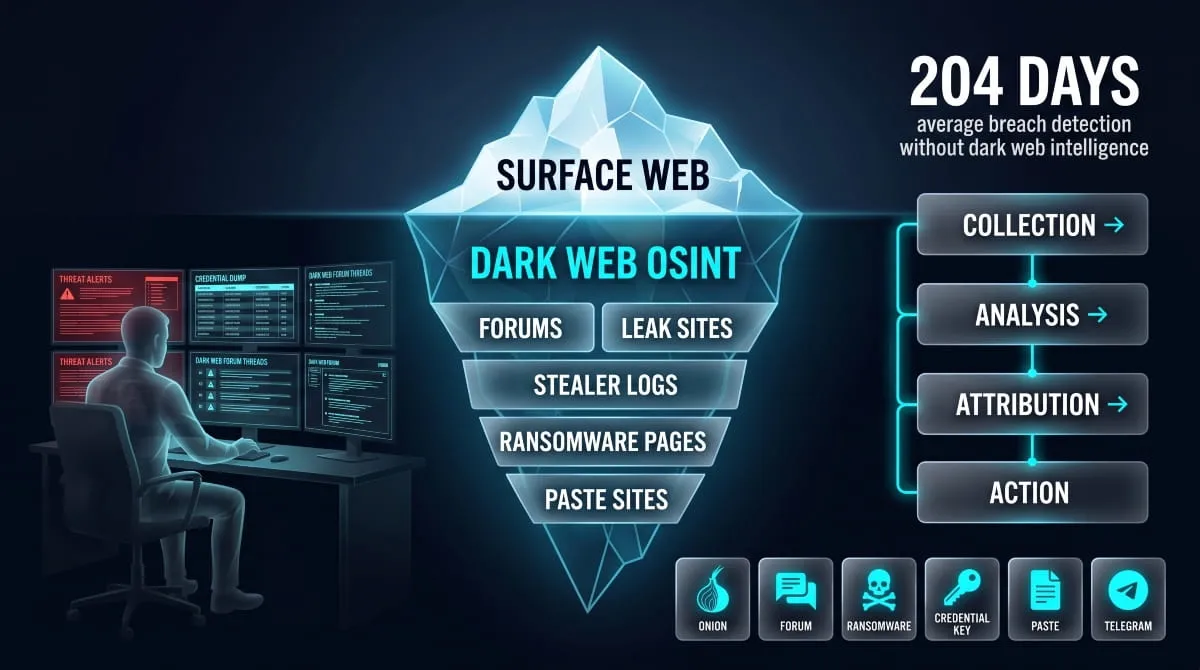
Dark web OSINT is the practice of collecting, analyzing, and acting on open-source intelligence gathered from hidden networks, primarily Tor-based sites, dark web forums, ransomware leak pages, and encrypted marketplaces, to support cybersecurity investigations, threat detection, and risk mitigation. Unlike surface web OSINT, it operates in an environment deliberately engineered to resist observation, which makes the discipline both more demanding and more valuable.
What Is Dark Web OSINT?
OSINT, Open Source Intelligence, refers to intelligence derived from publicly or semi-publicly accessible sources without covert access or legal interception. When applied to the dark web, it means extracting actionable intelligence from sources that, while technically accessible, require specialized tools, tradecraft, and legal awareness to navigate responsibly.
Dark web OSINT encompasses monitoring ransomware group leak sites, tracking threat actor personas across forums like BreachForums or Exploit.]in identifying stolen credential dumps, analyzing malware distribution channels, and mapping the digital infrastructure threat actors use to operate. The intelligence produced is raw, perishable, and often immediately actionable, which is precisely why organizations that do it well have a meaningful security advantage over those that don’t.
How Dark Web Intelligence Differs from Surface Web OSINT
Surface web OSINT draws on indexed content, news articles, social media, company registries, and academic publications. The sources are stable, searchable, and relatively easy to archive. Dark web OSINT operates under fundamentally different conditions. Sites appear and disappear within days. Threat actors rotate identities. Forums go invite-only or shut down after law enforcement action. Content is posted in multiple languages, often in slang or coded terminology specific to criminal communities.
This volatility means that dark web OSINT is not a one-time collection exercise; it requires continuous monitoring, persistent source relationships, and infrastructure that can survive the rapid churn of the underground ecosystem.
The Role of Dark Web Data in Modern OSINT Investigations
Dark web data fills a critical intelligence gap that surface web sources cannot cover. A corporate breach may be announced publicly weeks after stolen data first appears on a dark web marketplace. A phishing kit targeting a brand may be sold on a forum before a single victim reports it. Ransomware groups post proof-of-compromise, naming the victim, exfiltrating samples, before any extortion demand is formally delivered.
According to IBM’s Cost of a Data Breach Report, the average breach goes undetected for 204 days. Dark web OSINT exists, in part, to close that gap, catching signals in the underground economy before damage compounds on the surface.
Who Uses Dark Web OSINT?
The discipline spans several professional communities. Corporate threat intelligence teams use it to monitor for credential exposure and early breach indicators. Managed security service providers (MSSPs) build dark web monitoring into their client delivery stack. Law enforcement agencies, from local cybercrime units to INTERPOL and FBI task forces, use dark web OSINT to track trafficking networks, fraudsters, and ransomware operators. Red teams and penetration testers use it to assess what an adversary could learn about a target organization before launching an attack. And increasingly, brand protection specialists use it to track counterfeit goods, executive impersonation campaigns, and fraudulent domain registrations.
Why the Dark Web Matters for Intelligence Gathering
The dark web is not a fringe environment populated by occasional criminals. It is an active, structured underground economy with its own markets, reputation systems, service providers, and communication norms. Understanding that the economy is not optional for serious threat intelligence work is foundational.
What Kind of Data Lives on the Dark Web
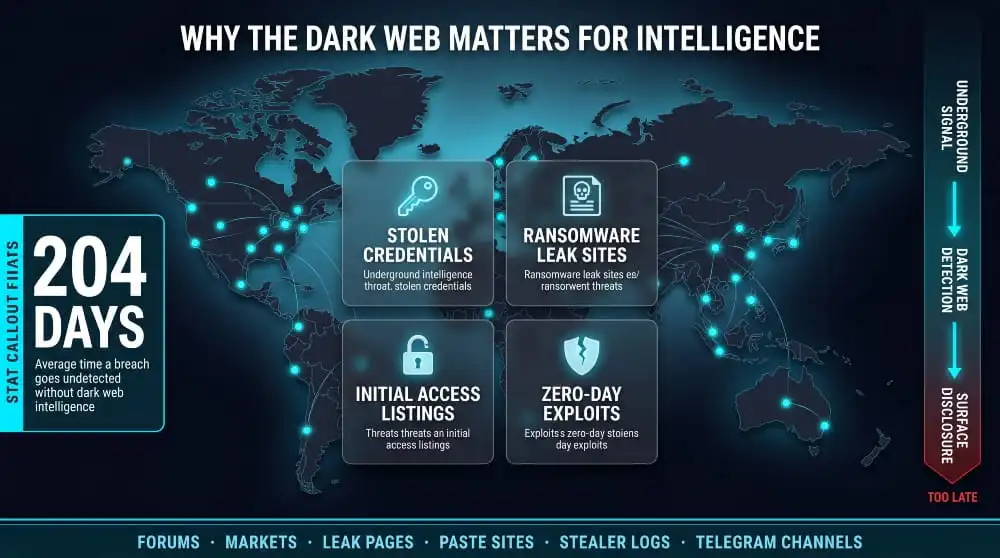
The categories of intelligence available on dark web sources are wide-ranging. Stolen credentials, usernames, passwords, and session tokens are traded in bulk on markets and shared freely in credential dumps. Personal identifiable information (PII), including names, Social Security numbers, dates of birth, and financial account data, frequently surfaces after large breaches. Source code from compromised organizations is leaked or sold. Zero-day vulnerabilities and exploit kits are advertised. Ransomware-as-a-service affiliates recruit openly. Initial Access Brokers post network access for sale, often including the specific organization name, industry, and revenue details to attract buyers.
For intelligence analysts, this is a target-rich environment, but only if you have the infrastructure to collect it systematically and the analytical framework to make it meaningful.
Threat Actor Activity, Leaked Credentials, and Ransomware Postings
Modern ransomware groups operate with a level of structure that resembles a legitimate business. They maintain leak sites and dedicated .onion domains where they post victim names, countdown timers, and samples of stolen files as leverage. Groups like LockBit, ALPHV/BlackCat, and Cl0p maintained active leak infrastructure at various points, posting dozens of victims per month. Monitoring these sites in real time allows organizations and their security partners to identify compromise before public disclosure, assess the severity of exfiltrated data, and respond with appropriate urgency.
Beyond ransomware, dark web forums host active marketplaces for initial access. Threat actors who specialize in obtaining network access, Initial Access Brokers, post detailed listings including access type (VPN, RDP, web shell), industry, country, and revenue of the target. This intelligence, when acted on quickly, can allow defenders to identify and remediate compromised access before it is weaponized.
Dark Web as an Early Warning System for Breaches
One of the highest-value applications of dark web OSINT is as an early warning system. When employee credentials appear in a stealer log dump, it is often a signal, days or weeks before a full breach materializes, that an attacker may have a foothold. When a company’s internal documents surface on a pastebin site, that is an indicator of either an insider threat or a breach in progress. When a threat actor begins asking questions about a specific organization on a forum, that is pre-attack reconnaissance that can be detected and acted on.
This early warning function distinguishes passive dark web awareness from active dark web intelligence. The goal is not to discover breaches after the fact; it is to detect attack precursors before damage occurs.
Dark Web OSINT Investigation Methodology
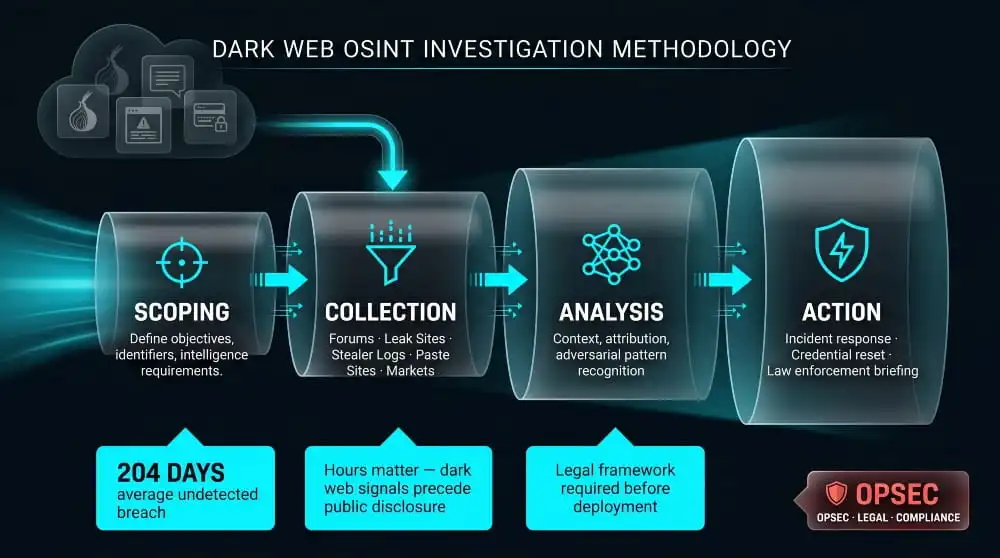
Effective dark web OSINT is not about accessing hidden sites and hoping for useful data. It follows a structured intelligence lifecycle that ensures collection is purposeful, analysis is rigorous, and output is actionable.
The OSINT Investigation Lifecycle
A well-run dark web OSINT investigation moves through four phases. The first is scoping, defining what you are looking for, who or what the target entity is, and what intelligence requirements the investigation needs to satisfy. Without a clear scope, dark web investigations produce noise rather than signal.
The second phase is collection, systematically gathering data from relevant sources. This includes automated monitoring of known forums, markets, and leak sites, as well as targeted searches for specific identifiers (email domains, IP ranges, corporate names, executive names, brand assets). Collection should be continuous rather than episodic; the underground ecosystem moves too quickly for periodic snapshots to capture the full picture.
The third phase is analysis, applying context to raw data to produce intelligence. A credential dump is a raw data point. Understanding that it contains credentials for a specific organization’s VPN, that a known Initial Access Broker posted the dump with a history of selling to ransomware affiliates, and that the organization had no prior breach disclosure, that is intelligence. Analysis requires both technical depth and an awareness of adversarial threats.
The fourth phase is action, translating intelligence into decisions. This may mean triggering an incident response process, issuing a threat advisory, forcing a credential reset, or briefing law enforcement. Intelligence that does not drive action has no operational value.
How to Structure a Dark Web Investigation
Structured investigations begin with clearly defined intelligence requirements. What is the priority intelligence question? Is the investigation focused on a specific organization, threat actor, industry sector, or campaign? From that question, the analyst derives a collection plan, the specific sources, keywords, identifiers, and monitoring rules that will produce relevant data.
Source selection is critical. Not all dark web sources carry an equal signal. High-value sources for most corporate intelligence investigations include ransomware leak sites, established cybercrime forums (particularly those with reputation systems that filter out noise), stealer log markets, and paste sites where credential dumps and code fragments surface. Lower-value sources include newer forums without established reputation, markets with high scam rates, and sites that have gone dormant.
Documentation discipline throughout an investigation is non-negotiable. Screenshots, URLs, timestamps, and hash values of collected files must be maintained in a way that supports both internal reporting and, where relevant, legal proceedings.
Handling Dark Web Data: Legal and Ethical Considerations
Dark web OSINT operates in a legally complex environment that varies significantly by jurisdiction. In most Western jurisdictions, passively observing and collecting publicly accessible information, even on dark web forums, is legally permissible for intelligence and research purposes. However, downloading malware samples, purchasing stolen data (even to verify its authenticity), or actively participating in criminal transactions crosses clear legal lines.
Organizations conducting dark web OSINT should establish a legal framework before any investigation begins. This means defining what data can be collected, what tools can be used, how long data can be retained, and when intelligence must be shared with law enforcement. Engaging legal counsel familiar with computer fraud and intelligence law is strongly recommended before deploying dark web OSINT at scale.
Ethical considerations sit alongside legal ones. Analysts have access to data about private individuals, often stolen data, and have a responsibility not to further victimize those individuals by mishandling or retaining it for too long.
Counterterrorism and National Security Applications of Dark Web OSINT
Dark web OSINT has played a material role in counterterrorism and national security investigations. Extremist networks use dark web forums and encrypted channels to recruit, radicalize, plan attacks, and fundraise. Monitoring these spaces, identifying key nodes, tracking communication patterns, and mapping network structures are legitimate and operationally significant intelligence functions.
Law enforcement and intelligence agencies have used dark web OSINT to identify and dismantle major criminal infrastructure. Operation Cronos, the 2024 international action against LockBit ransomware infrastructure, involved extensive dark web intelligence work. Operation Bayonet, which took down AlphaBay and Hansa, similarly depended on sustained undercover and OSINT presence across dark web markets. These examples illustrate both the scale of what is possible and the operational complexity required to do it well.
Dark Web OSINT Tools: What Investigators Actually Use
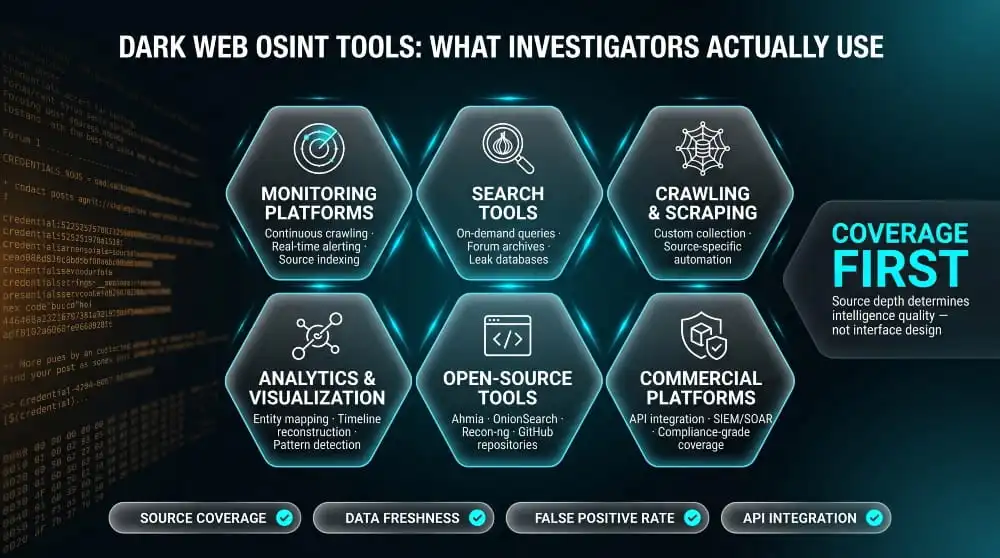
No dark web OSINT investigation operates without tools. The right tool stack depends on the use case, corporate threat intelligence, law enforcement investigation, and academic research, each of which has different requirements, but the underlying categories are consistent.
Categories of Dark Web OSINT Tools
Monitoring platforms continuously crawl and index dark web sources, alerting users when specified keywords, domains, emails, or other identifiers appear. These platforms handle the infrastructure burden of maintaining access to dark web sources and deliver processed intelligence rather than raw data.
Search tools allow targeted, on-demand queries against indexed dark web content. They function similarly to surface web search engines but target dark web sources such as forums, markets, paste sites, and leak databases.
Crawling and scraping tools allow technical analysts to build custom collection infrastructure for specific sources or investigation needs. Security researchers and intelligence professionals with engineering capability typically deploy these.
Analytics and visualization tools help analysts make sense of collected data, perform link analysis, reconstruct timelines, map entity relationships, and identify patterns across large datasets.
Open-Source Tools and GitHub Resources for Dark Web OSINT
The OSINT community has produced a substantial ecosystem of open-source tools for dark web investigation. OnionSearch aggregates results across multiple dark web search engines. Ahmia is an open-source dark web search engine that indexes .onion sites and is accessible via the surface web. Tor2Web proxies provide limited access to .onion content on the surface web without requiring a Tor client. Recon-ng and Maltego, while primarily surface web tools, have extensions and community modules that support integration with dark web sources.
GitHub hosts dozens of repositories covering dark web OSINT automation scripts, stealer log parsers, forum scrapers, and breach data analysis utilities. The quality and maintenance status of these tools vary widely, and any open-source tool used in a professional or legal context should be vetted carefully before deployment.
Commercial Dark Web OSINT Investigation Platforms
Commercial platforms offer a different value proposition from open-source tools: they handle source coverage, infrastructure maintenance, legal compliance frameworks, and data freshness at scale, freeing analysts to focus on analysis rather than collection mechanics.
The leading commercial platforms index millions of dark web records continuously across forums, markets, leak sites, paste sites, Telegram channels, and stealer log repositories. They provide APIs for integration with existing SIEM, SOAR, and threat intelligence platforms, as well as structured alerting, export functionality, and collaborative investigation features. For organizations that cannot maintain a dedicated dark web crawling infrastructure internally, commercial platforms represent the only operationally viable path to comprehensive dark web intelligence coverage.
How to Evaluate a Dark Web OSINT Tool
Source coverage is the most important evaluation criterion. A tool that monitors only the most visible dark web forums misses the majority of where meaningful intelligence actually lives. Ask vendors specifically which ransomware leak sites, forums, markets, and stealer log sources they index, and how recently each source was last updated.
Data freshness matters enormously. A credential exposure flagged 24 hours after it appears gives defenders time to act. The same exposure flagged three weeks later is largely historical documentation. Query any vendor about their average indexing latency from source publication to platform availability.
Accuracy and false positive rate determine analyst efficiency. A platform that generates dozens of irrelevant alerts per day trains analysts to ignore alerts, the worst possible outcome for a monitoring system. Look for platforms that offer context-rich alerts with entity disambiguation rather than raw keyword matches.
Dark Web OSINT Platforms vs. Manual Investigation
The question of whether to build a manual investigation capability, deploy a commercial platform, or combine both is a genuine strategic decision, and the right answer depends on organizational context.
Automated Monitoring vs. Active Dark Web OSINT Search
Automated monitoring addresses the continuous collection problem: keeping a persistent eye on thousands of dark web sources 24/7 and alerting when specified identifiers appear. This is operationally necessary for any organization with a non-trivial attack surface. No human team can manually check hundreds of forums, markets, and leak sites daily at the pace at which the dark web generates new content.
An active OSINT search, targeted, human-driven investigation into a specific threat actor, campaign, or incident, requires a different posture. It involves navigating live dark web environments, engaging with source material in context, and applying adversarial reasoning that automated systems cannot replicate. The best dark web intelligence programs combine both: automated monitoring for continuous coverage and early warning, active investigation for deeper intelligence when alerts warrant escalation.
What a Dark Web OSINT Investigation Platform Should Include
A purpose-built dark web OSINT platform should provide comprehensive source coverage across ransomware leak sites, criminal forums, dark web markets, paste sites, and stealer log repositories. It should deliver structured alerting with sufficient context, source, timestamp, content summary, and entity match, so an analyst can immediately assess severity without manual verification. It should support historical search so investigators can reconstruct timelines and identify when specific data first appeared. It should offer API access for integration with existing security workflows. And it should maintain compliance and data-handling standards appropriate to regulated industries.
Reporting and export functionality are frequently undervalued in evaluations but are critical in practice. Intelligence that cannot be efficiently documented, shared, and escalated creates operational friction that erodes the value of the entire program.
Platform Use Cases: Enterprise, Brand Protection, Law Enforcement
Enterprise security teams use dark web OSINT platforms primarily for credential exposure monitoring, early breach detection, and third-party/supply chain risk intelligence. The use case is defensive and continuous: catch exposure signals early, force credential resets, notify affected parties, and feed findings into broader vulnerability management processes.
Brand protection teams use dark web intelligence to identify phishing kits targeting their brand, fraudulent domains, counterfeit product channels, and materials impersonating executives being sold or distributed on dark web markets and forums.
Law enforcement agencies use specialized variants of dark web OSINT platforms to support criminal investigations, subject monitoring, and network disruption operations. Their requirements for evidence handling, chain of custody, and source confidentiality are more stringent than those for commercial use cases and typically require purpose-built or highly customized tooling.
DeXpose: Dark Web OSINT for Real-World Investigations
DeXpose is a dark web monitoring and threat intelligence platform built for organizations that need comprehensive, continuous visibility into their dark web exposure. It provides the source coverage, data freshness, and analytical structure that dark web OSINT at scale requires.
What DeXpose Monitors Across Dark Web Sources
DeXpose monitors dark web markets, ransomware leak sites, cybercrime forums, stealer log repositories, paste sites, and Telegram threat channels, continuously indexing new data to ensure exposure signals surface in real time rather than after the fact. When an organization’s credentials appear in a stealer log, when their brand appears on a ransomware leak page, or when threat actors discuss them on a forum, DeXpose flags it.
The platform covers both the immediate exposure event, a credential appearing in a dump, a domain appearing in a phishing kit, and the broader threat context: who posted the data, what source it came from, and what patterns of activity surround it.
How DeXpose Integrates Dark Web Data into OSINT Workflows
DeXpose is designed to fit into existing security workflows rather than replace them. Its API allows intelligence feeds to flow directly into SIEM and SOAR platforms. Alerts are structured to give analysts the context they need to triage and escalate without manual verification. Historical search capability supports active investigations, allowing analysts to reconstruct the timeline of a breach or track a threat actor’s activity across sources over time.
For MSSPs and security teams managing exposure across multiple client organizations, DeXpose provides the scalable infrastructure to deliver dark web intelligence as a service without building and maintaining independent crawling infrastructure.
Run a Free Dark Web Report on Your Organization
Understanding your organization’s current dark web exposure is the necessary starting point for any dark web intelligence program. DeXpose offers a free dark web report that surfaces existing exposure across dark web markets, stealer log databases, and public breach sources, giving security teams an immediate baseline.
→ Run your free dark web report
For organizations ready to implement continuous dark web monitoring, DeXpose’s full platform provides the source coverage and operational tooling that enterprise-grade dark web OSINT demands.
→ Explore DeXpose Dark Web Monitoring
Dark Web OSINT in Counterterrorism and High-Stakes Investigations
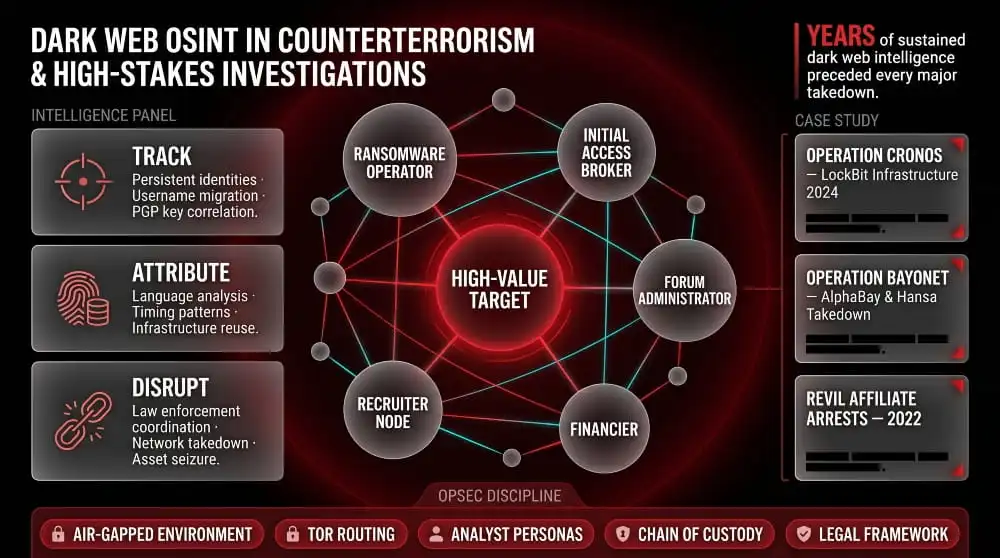
The application of dark web OSINT to counterterrorism, organized crime, and national security investigations represents the discipline at its most operationally demanding. The stakes are higher, the tradecraft requirements are more stringent, and the consequences of errors, both analytical and operational security errors, are more severe.
Tracking Threat Actors Across Dark Web Forums and Markets
Threat actor tracking is a core dark web OSINT function. Actors maintain persistent identities, usernames, writing styles, PGP keys, and reputation scores across dark web forums and markets, often for years. Mapping those identities, linking them across sources, and building a picture of an actor’s capabilities, affiliations, and operations is painstaking analytical work that combines technical collection with adversarial behavioral analysis.
Key tradecraft elements include handling actor identity transitions (actors rebrand after law enforcement attention or forum shutdowns), recognizing sockpuppet accounts, and distinguishing between a threat actor’s public-facing persona and their operational behavior. Language analysis, timing patterns, and infrastructure reuse are all analytical vectors that experienced dark web OSINT analysts employ.
Operational Security for Investigators Working in Dark Web Environments
Investigators working in dark web environments face their own operational security requirements. Accessing dark web sources without adequate OPSEC can expose an investigation and, in law enforcement contexts, compromise ongoing operations or place investigators at personal risk. Standard practices include using dedicated, air-gapped, or isolated investigation environments, routing traffic through Tor with no identifying information in any browsing session, using purpose-built analyst personas with no connection to real identities, and following strict data-handling procedures for collected material.
Commercial dark web OSINT platforms largely abstract these requirements for monitoring use cases; the platform handles access, and the analyst works with structured data output. For active investigation in live dark web environments, however, dedicated OPSEC discipline remains non-negotiable.
Case Examples: How Dark Web OSINT Has Supported Real Investigations
The 2022 takedown of Hydra Market, then the world’s largest dark web marketplace, involved years of intelligence work by German and American law enforcement, combining dark web OSINT with traditional investigative techniques. Analysis of on-chain cryptocurrency transactions, forum activity, and shipping records built the evidentiary picture that supported the operation.
The identification and arrest of REvil ransomware affiliates in 2022 similarly involved sustained dark web intelligence work, tracking actor identities across forums and correlating them with financial infrastructure and operational mistakes that allowed attribution. These operations illustrate a consistent pattern: successful major dark web investigations combine automated monitoring at scale with skilled human analysis and sustained collection discipline over time.
Frequently Asked Questions (FAQ’s)
What is the difference between dark web monitoring and dark web OSINT?
Dark web monitoring is typically a continuous, automated function, a platform or service that watches specified sources for specified identifiers and alerts when matches are found. Dark web OSINT is a broader discipline that includes monitoring but also encompasses active investigation, manual source engagement, analytical tradecraft, and the full intelligence production cycle. Monitoring is a component of dark web OSINT; OSINT is not reducible to monitoring alone.
Can I conduct dark web OSINT investigations without technical skills?
Commercial dark web OSINT platforms have significantly lowered the technical barrier to entry for monitoring use cases. Running a structured monitoring program, defining identifiers, configuring alerts, and triaging results requires analytical capability but not great technical skills. Active investigation in live dark web environments, building custom collection infrastructure, or conducting adversarial actor tracking are more technically demanding and typically require dedicated expertise.
What are the best free dark web OSINT tools?
Useful free and open-source resources include Ahmia (dark web search engine), OnionSearch (multi-engine aggregator), Have I Been Pwned (breach credential lookup), and IntelX (surface and dark web intelligence archive with a free tier). These tools are valuable for targeted queries and research, but do not provide the continuous monitoring coverage that organizational security programs require.
How do organizations use dark web data in OSINT investigations?
Organizations integrate dark web data into several core security workflows: vulnerability management (identifying exposed credentials before they are exploited), incident response (determining scope and data involved in a breach), threat intelligence (understanding adversary TTPs, tooling, and targeting), and brand protection (detecting phishing infrastructure, impersonation, and counterfeit channels). The common thread is using dark web intelligence to reduce the time between an event in the underground and a defender’s ability to act on it.
Is dark web OSINT legal?
In most jurisdictions, passively collecting and analyzing publicly accessible dark web content for security and intelligence purposes is legal. The legal boundaries include active participation in criminal activity, purchasing stolen data, downloading malware with the intent to deploy it, and accessing systems without authorization. Legal frameworks vary by country, and organizations conducting dark web OSINT at scale should establish a clear legal framework, preferably with legal counsel experienced in cybercrime and intelligence law, before deploying investigative programs.
What should a dark web OSINT investigation platform include?
A capable dark web OSINT platform should provide broad source coverage (ransomware sites, forums, markets, paste sites, stealer logs), real-time or near-real-time alerting, historical search, API integration with security workflows, structured context for alerts rather than raw keyword matches, and data-handling practices appropriate for regulated environments. Analyst usability, how quickly a practitioner can triage an alert, investigate context, and document findings, is a practical differentiator that is often underweighted in vendor evaluations.
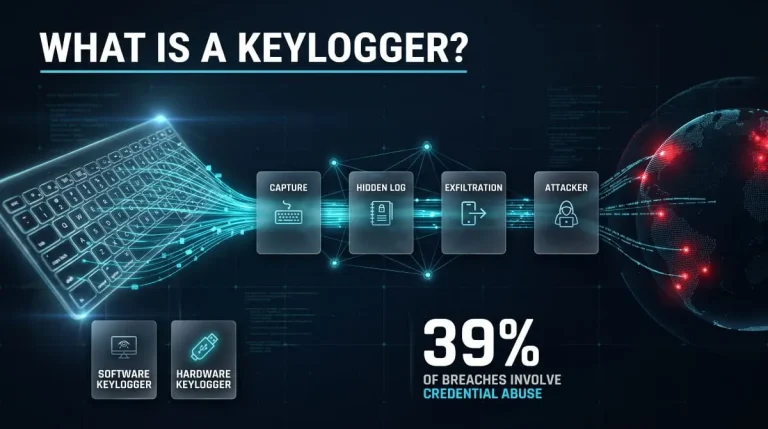
What Is a Keylogger? Definition, Types, Detection and Removal (Complete 2026 Guide)
A keylogger is software or hardware that records every keystroke typed on a device, usually without the user knowing. Attackers use keyloggers to steal passwords, card…
Read more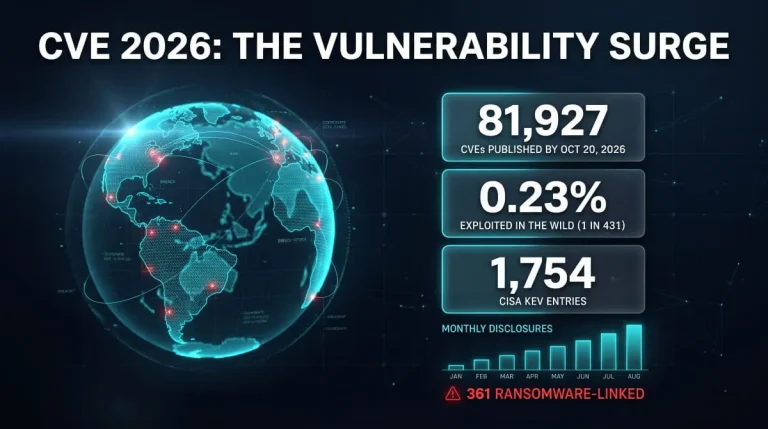
CVE 2026 | The Complete Guide to New, Critical & Actively Exploited Vulnerabilities (Updated Weekly)
CVE 2026 covers every publicly disclosed software flaw assigned a CVE-2026-NNNNN identifier this year, and it is already the largest annual list on record. This guide…
Read more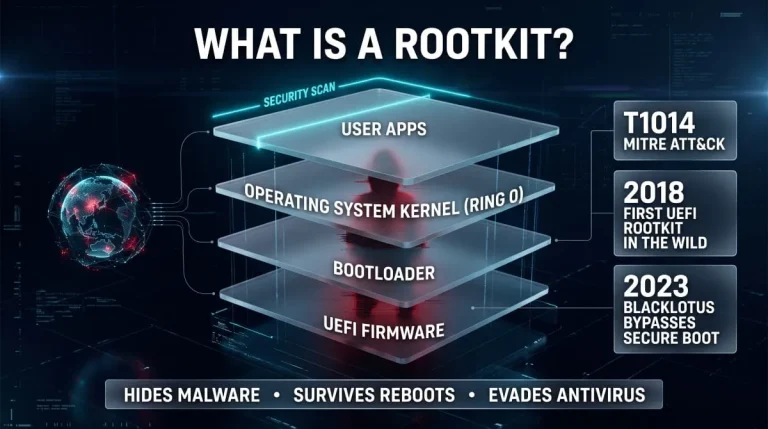
What Is a Rootkit? Definition, Types, Examples, Detection and Removal (Complete Guide)
A rootkit is malicious software that hides itself and the malware it protects by running with the highest privileges and tampering with what the operating system…
Read more