Ransomware is malware, but not all malware is ransomware. That distinction sounds simple, yet it’s the source of most of the confusion around these two terms. Malware is the umbrella category for any software designed to damage, disrupt, or gain unauthorized access to a system; ransomware is one specific, highly aggressive branch of that family, built to lock up data and extort a payment for its release.
The confusion is understandable. Security vendors, news headlines, and breach reports often use “malware” and “ransomware” almost interchangeably, which makes it hard to tell where one ends and the other begins. In practice, the difference comes down to intent and behavior: most malware quietly steals, spies, or spreads, while ransomware announces itself the moment it strikes, encrypting files and demanding payment before the victim can do anything else.
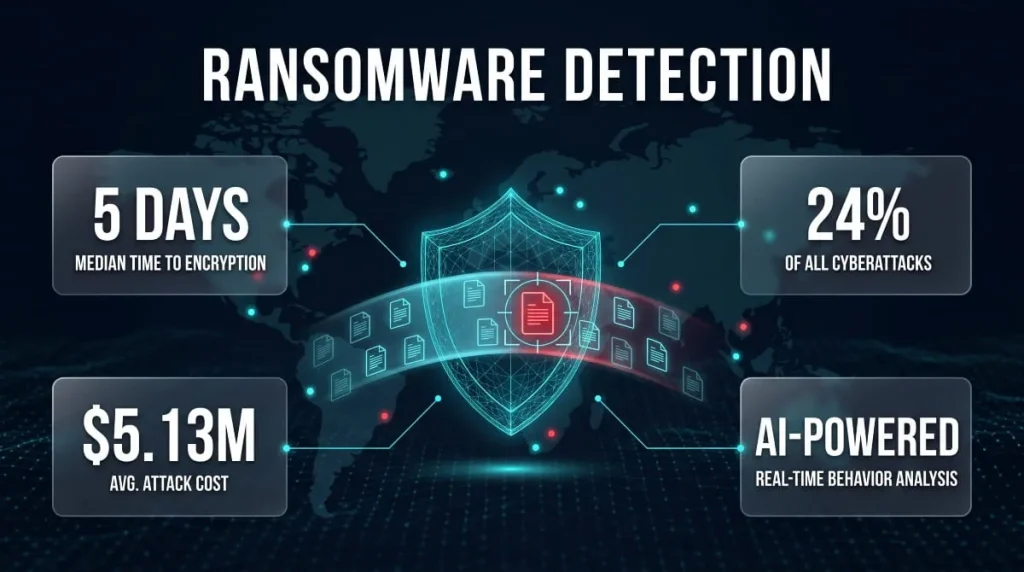
The stakes for getting this distinction right are real. Ransomware attacks accounted for roughly a quarter of all malware-related breaches in recent industry analyses, and the average ransom payment has climbed well into six figures, making it one of the costliest categories of malware an organization can face. Understanding exactly how ransomware fits into (and stands apart from) the broader malware landscape is the first step toward defending against it.
What Is Malware? (The Umbrella Term)
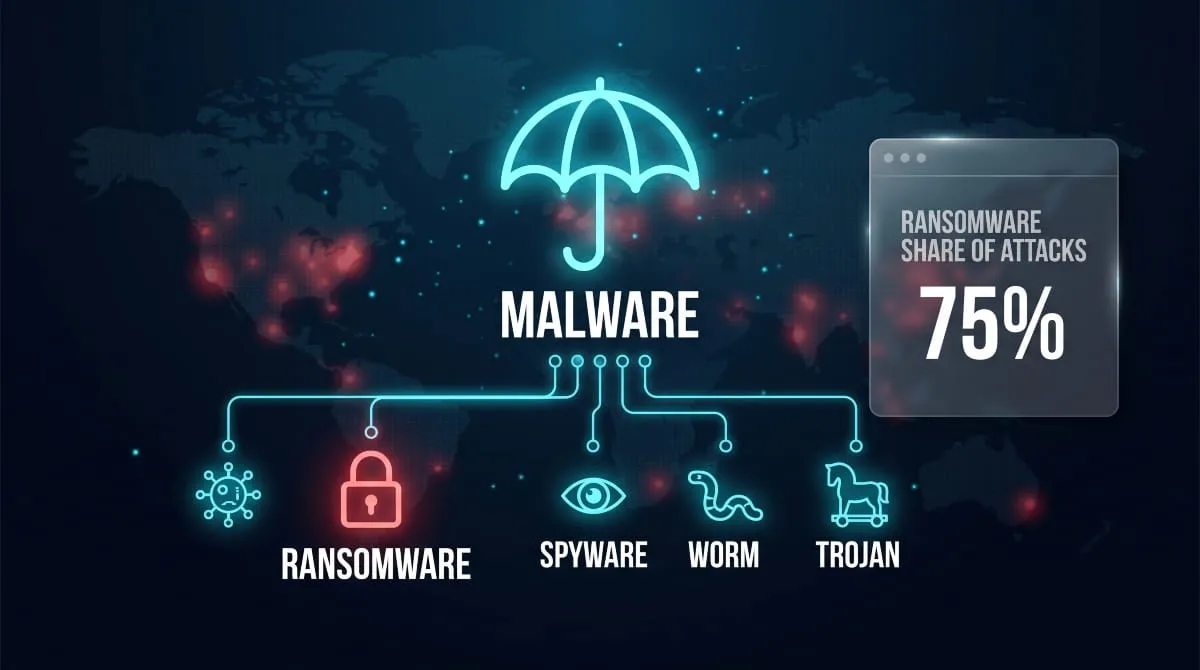
Malware is any software intentionally designed to damage, disrupt, or gain unauthorized access to a computer system, network, or device. The word itself is a blend of “malicious” and “software,” and it functions as an umbrella term, every virus, worm, spyware program, trojan, and yes, every piece of ransomware, falls under this single category. When people ask whether something “is malware,” the answer is almost always yes, because malware describes the entire class of harmful code rather than one specific behavior.
Definition of Malware
At its core, malware is defined by intent rather than method. Legitimate software can have bugs or unintended side effects, but malware is built from the ground up to cause harm, whether that’s stealing data, corrupting files, spying on activity, or holding a system hostage. It can enter a device through infected email attachments, compromised websites, malicious downloads, USB drives, or exploited software vulnerabilities. Once inside, its specific goal determines which “type” of malware it becomes, but the unauthorized, harmful intent is the constant thread connecting all of them.
Common Malware Categories
Malware isn’t a single tool, it’s a family of distinct attack types, each with its own method of causing damage. A virus attaches itself to legitimate files and spreads when those files are shared or executed. A worm spreads on its own across networks without needing a host file or user action, often causing damage simply through the speed of its replication. Spyware operates quietly in the background, harvesting credentials, keystrokes, or browsing activity without the victim’s knowledge. A trojan disguises itself as legitimate software to trick users into installing it, then opens a backdoor for further attacks. And ransomware, the focus of this guide, encrypts a victim’s files and demands payment for their release, making it one of the most disruptive and financially damaging categories in the entire malware family.
One industry analysis found that ransomware alone was responsible for a significant share of all reported malware incidents in the past year, underscoring just how dominant this one category has become within the broader malware landscape.
Is Ransomware a Type of Malware?
Yes, ransomware is a type of malware. It meets every criterion that defines malicious software: it’s installed without consent, it’s designed to cause harm, and it operates against the interests of the system’s legitimate owner. What sets it apart from the rest of the malware family isn’t its classification, but its method and its motive.

Why Ransomware Is Classified as Malware
Malware is defined by intent, not by any single technique, and ransomware satisfies that definition on every count. It infiltrates a system without authorization, executes code the user never approved, and causes direct harm by denying access to data the victim owns. Security researchers, antivirus vendors, and threat intelligence platforms all categorize ransomware under the malware umbrella for exactly this reason, the same way a virus or a trojan is classified, ransomware is simply malicious code with a specific payload and a specific goal.
What Makes Ransomware Distinct from Other Malware
While ransomware shares its core classification with viruses, worms, spyware, and trojans, its behavior sets it apart in one key way: most malware is built to stay hidden, while ransomware is built to be impossible to ignore. Spyware wants to remain undetected for as long as possible to keep collecting data; a worm’s damage often comes from stealth and speed of spread. Ransomware inverts that logic entirely, it announces itself the moment it strikes, because its entire business model depends on the victim knowing exactly what’s been taken and exactly what it will cost to get it back. That direct, transactional demand for payment is unique to ransomware among malware types, and it’s a major reason ransomware has become one of the most financially damaging categories in the malware family, with global ransomware damage costs projected to reach $265 billion annually by 2031, according to industry forecasts.
Ransomware vs Malware: Key Differences at a Glance
The core difference between ransomware and malware is scope: malware is the broad category of all malicious software, while ransomware is one specific type within it defined by encryption and extortion. Comparing the two side by side makes the relationship, and the distinction, much easier to see.
Comparison Table (Goal, Behavior, Detection, Impact)
This comparison highlights why ransomware is often treated as its own conversation topic even though it technically belongs to the malware family: its visible, time-pressured impact makes it operationally different from quieter malware types like spyware or trojans, even though all of them share the same underlying classification.
| Feature / Dimension | Malware (General) | Ransomware (Specific) |
|---|---|---|
| Goal | Varies broadly depending on payload: exfiltrating credentials, covert espionage, resource hijacking (cryptomining), or long-term system access. | Direct financial extortion by encrypting critical data and demanding payment in exchange for decryption keys. |
| Behavior | Typically operates covertly to maintain persistence, evade detection mechanisms, and maximize operational impact over extended periods. | Announces its presence immediately upon completing file encryption by displaying explicit ransom notes and changing file extensions. |
| Detection Timeframe | Can remain undetected for weeks, months, or years (high dwell time) while quietly monitoring or gathering intelligence. | Detected almost instantaneously once bulk encryption begins or user access to essential files is blocked. |
| System Impact | Ranges from subtle performance degradation and baseline background activity to mass credential harvesting and silent data exfiltration. | Immediate operational halt, complete data unavailability, severe business disruption, and high financial/regulatory damage. |
Real-World Examples of Each
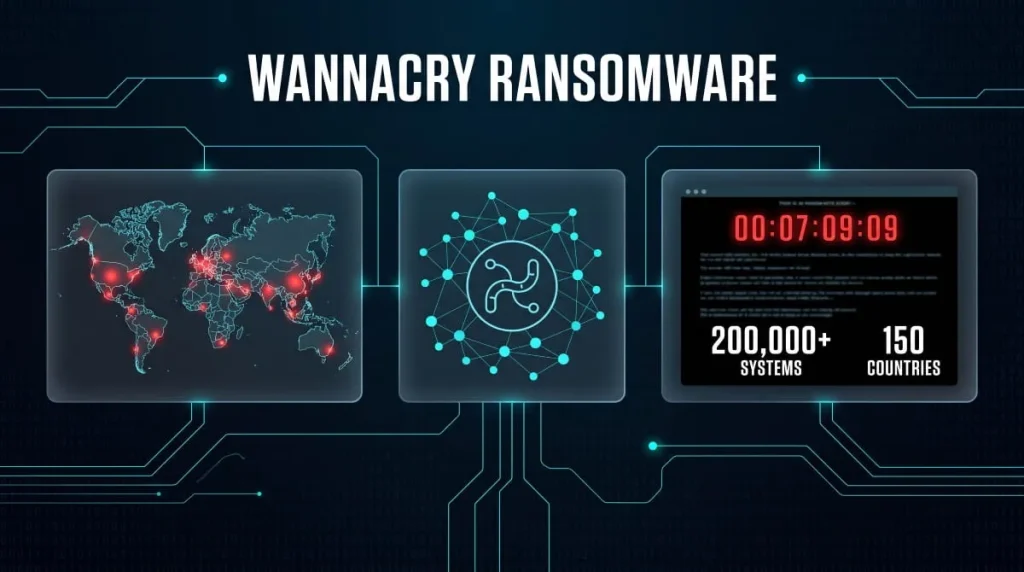
Real-world incidents make the distinction concrete. WannaCry and Ryuk are well-known ransomware strains that encrypted systems across hospitals, businesses, and government agencies, each demanding cryptocurrency payment for decryption. On the broader malware side, worms like Conficker spread rapidly across networks without any extortion component at all, while spyware families like Pegasus were built purely for covert surveillance rather than any financial demand. Trojans such as Emotet started as banking credential thieves before evolving into delivery mechanisms, often used to install ransomware as a second-stage payload, illustrating how these categories frequently overlap in real attacks. One notable case, NotPetya, is often cited by researchers as ransomware-like malware that behaved more like a destructive wiper, since paying its ransom never actually restored access, a reminder that not every attack demanding payment behaves like true ransomware underneath.
Ransomware vs Other Malware Types
Ransomware differs from other malware types primarily in its goal: while most malware aims to spy, spread, or steal quietly, ransomware exists specifically to extort payment by denying access to data. Placing ransomware next to its closest relatives, viruses, spyware, crypto malware, and phishing, makes that distinction easier to pin down.

Ransomware vs Virus
A virus and ransomware are both malware, but they differ in mechanism and intent. A virus is defined by how it spreads, it attaches itself to a legitimate file or program and activates when that file is opened or executed, often replicating further as the infected file is shared. Its damage can range from corrupting data to slowing down a system, but a virus doesn’t inherently demand anything from its victim. Ransomware, by contrast, is defined by its outcome, not its spread mechanism, it can arrive via a virus, a trojan, or a direct exploit, but its defining feature is the encryption-and-ransom-demand sequence that follows once it activates.
Ransomware vs Spyware
Ransomware and spyware sit at opposite ends of the malware spectrum in terms of visibility. Spyware is built to remain undetected for as long as possible, quietly logging keystrokes, harvesting credentials, or tracking browsing activity to feed information back to an attacker over time. Ransomware does the reverse: it wants to be found immediately, because its entire model depends on the victim seeing the ransom note and reacting to it. Where spyware’s value comes from staying hidden, ransomware’s value comes from being loud and undeniable the moment it strikes.
Ransomware vs Crypto Malware
“Crypto malware” is a broader term than many people realize, and it’s often confused with ransomware because both involve cryptography or cryptocurrency. Crypto malware most commonly refers to cryptojacking, malware that secretly uses a victim’s computing power to mine cryptocurrency without their knowledge or consent, generating ongoing profit for the attacker without ever alerting the victim. Ransomware also uses cryptography, but for encryption rather than mining, and its cryptocurrency connection is limited to how the ransom payment is collected. In short: crypto malware steals computing resources quietly, while ransomware locks data and demands payment openly.
Ransomware vs Phishing (Delivery vs Payload)
Ransomware and phishing aren’t really comparable on the same axis, because one is a delivery method and the other is a payload. Phishing is a social engineering technique, a deceptive email, message, or website designed to trick a user into clicking a link, opening an attachment, or handing over credentials. Ransomware is the malicious software that phishing often delivers once that click happens. Confusing the two is common because they’re so frequently paired together in real attacks: industry data consistently shows phishing as the leading initial access vector for ransomware campaigns, which is why email security and user awareness training remain two of the highest-impact defenses against ransomware specifically.
How Networks Get Infected with Malware and Ransomware
Networks get infected with malware and ransomware through a small set of well-established entry points, phishing, unpatched vulnerabilities, and drive-by downloads, that attackers then use as a launchpad to spread further inside the environment. Understanding these paths matters more than memorizing malware types, since the same handful of entry methods deliver nearly every major threat, ransomware included.

Phishing and Social Engineering
Phishing remains the single most common way malware and ransomware enter a network. An attacker crafts an email, message, or fake login page designed to look legitimate, then relies on a user clicking a link, opening an attachment, or entering credentials to trigger the infection. Because this method targets human trust rather than technical weaknesses, it bypasses many traditional security controls entirely, a well-crafted phishing email can succeed even on a fully patched, well-defended network simply because one person clicked before verifying. This is precisely why phishing is consistently cited as the leading initial access vector in ransomware incident reports.
Exploited Vulnerabilities and Drive-By Downloads
Not every infection requires a user to take action. Attackers routinely scan the internet for systems running outdated or unpatched software, then exploit known vulnerabilities to gain access directly, no click required. Drive-by downloads work similarly: simply visiting a compromised or malicious website can silently install malware in the background if the browser or a plugin has an exploitable flaw. Exposed remote access services, like unsecured RDP ports, are a particularly common target for ransomware operators specifically, since they offer a direct path into a network without needing to trick anyone at all.
Lateral Movement After Initial Compromise
Getting into a network is rarely the attacker’s end goal, it’s the starting point. Once malware establishes an initial foothold, attackers often spend days or even weeks moving laterally: harvesting additional credentials, mapping the network, and identifying high-value systems like domain controllers and backup servers before deploying the final payload. This is especially true in ransomware attacks, where operators frequently disable or encrypt backups first, specifically to remove the victim’s ability to recover without paying. Limiting this lateral movement, through network segmentation, least-privilege access, and continuous monitoring, is one of the most effective ways to stop an initial infection from escalating into a full-blown ransomware event.
Risks and Mitigation: Protecting Against Both
Protecting against malware and ransomware requires the same foundational strategy: early detection, contained blast radius, and visibility into threats before they reach the network. The specific risks differ slightly, malware can quietly exfiltrate data for months, while ransomware can bring operations to a complete halt within hours, but the mitigation approach for both rests on the same three pillars.
Detection and Monitoring Best Practices
The earlier a threat is detected, the smaller the damage tends to be. Endpoint detection and response (EDR) tools, combined with continuous network monitoring, allow security teams to spot unusual behavior, like unexpected encryption activity or abnormal data transfers, before it escalates into a full incident. Regular vulnerability scanning and patch management close off the exploited-vulnerability entry point discussed earlier, while email filtering and phishing simulation training address the human-targeted entry point. Organizations that combine these layers consistently detect incidents faster than those relying on a single control, and speed of detection remains one of the strongest predictors of how costly a ransomware incident ultimately becomes.
Blocking Lateral Movement and Containment
Since most ransomware attacks depend on lateral movement to reach high-value targets before deploying their payload, containment strategy matters as much as prevention. Network segmentation limits how far an attacker can move even after an initial compromise, while least-privilege access policies ensure that a single compromised account can’t reach critical systems like backup servers or domain controllers. Isolating backups from the primary network, keeping at least one copy offline or immutable, directly counters the tactic of encrypting or deleting backups before the ransom demand appears, removing one of ransomware’s most effective pressure points.
How Dark Web Monitoring Fits into Early Ransomware Warning
One layer that’s often overlooked in traditional security stacks is visibility into what happens after initial access, specifically, whether stolen credentials, leaked data, or early signs of a targeted attack are already circulating on the dark web. Ransomware groups frequently list victims on leak sites or sell initial access to a network before deploying the actual encryption payload, which means dark web monitoring can sometimes surface a warning before the ransomware event itself occurs. Platforms like DeXpose track these exposure signals, compromised credentials, mentions in threat actor forums, and data appearing on ransomware leak sites, giving security teams a chance to respond during the window between initial compromise and full-scale attack, rather than finding out only after files are already encrypted.
Frequently Asked Questions (FAQ’s)
Is Ransomware a Virus?
Not exactly, ransomware and a virus are both malware, but they’re different types. A virus is defined by how it spreads (attaching to files and replicating), while ransomware is defined by what it does (encrypting data and demanding payment). Ransomware can arrive via a virus, but it isn’t one by definition.
Is Phishing Malware or Ransomware?
Phishing is neither, it’s a delivery method, not malicious software itself. It’s the deceptive email or message used to trick someone into installing malware or ransomware. In fact, phishing is the leading initial access vector in most ransomware attacks.
What Are Examples of Ransomware Malware Families?
Well-known ransomware families include WannaCry, Ryuk, LockBit, and Conti, each known for large-scale attacks on hospitals, businesses, and government systems. These strains differ in tactics but share the same core behavior: encrypt data, then demand payment for its return.