Social engineering is the practice of manipulating people, rather than hacking systems, into giving up confidential information, access, or money. Instead of breaking through a firewall, an attacker convinces an employee to hand over a password, click a malicious link, or approve a fraudulent wire transfer, often by impersonating someone the victim already trusts.
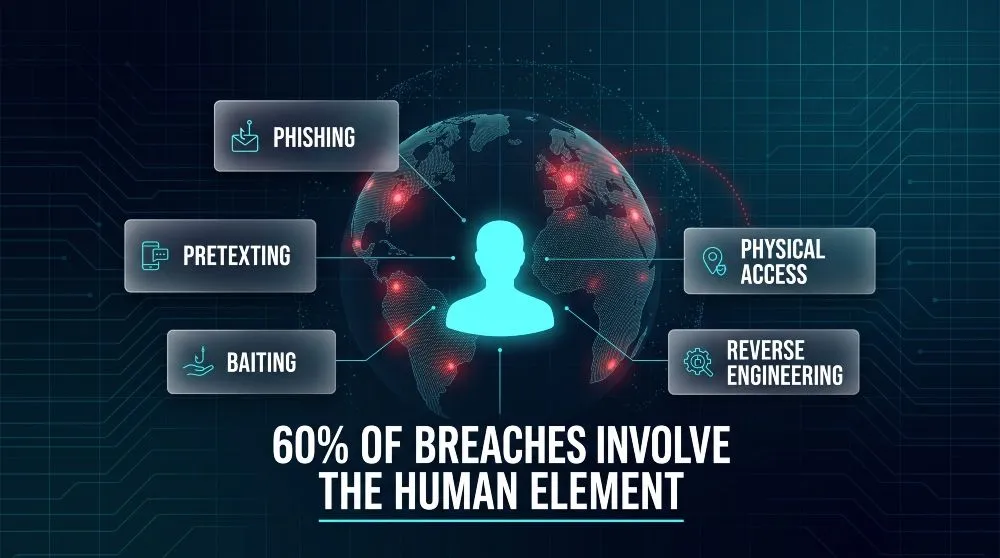
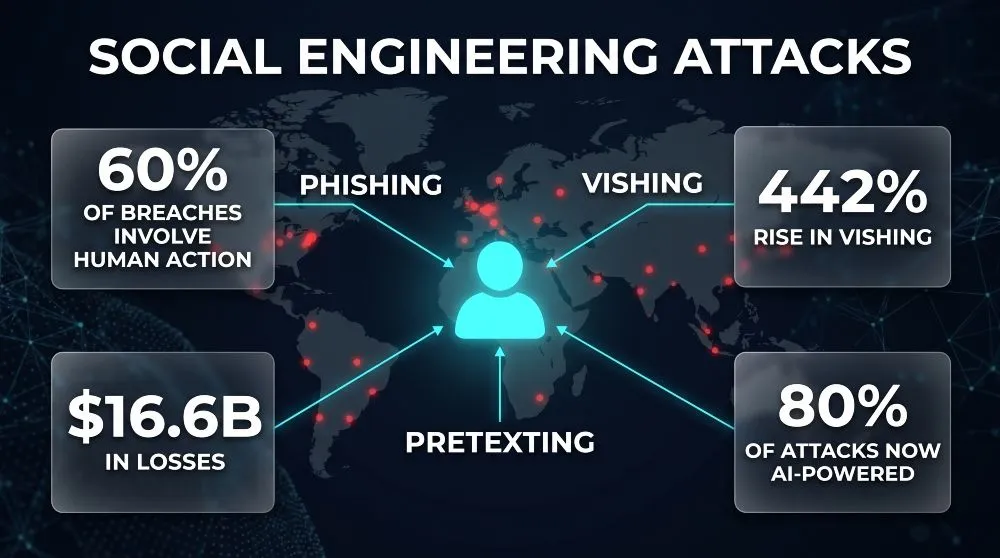
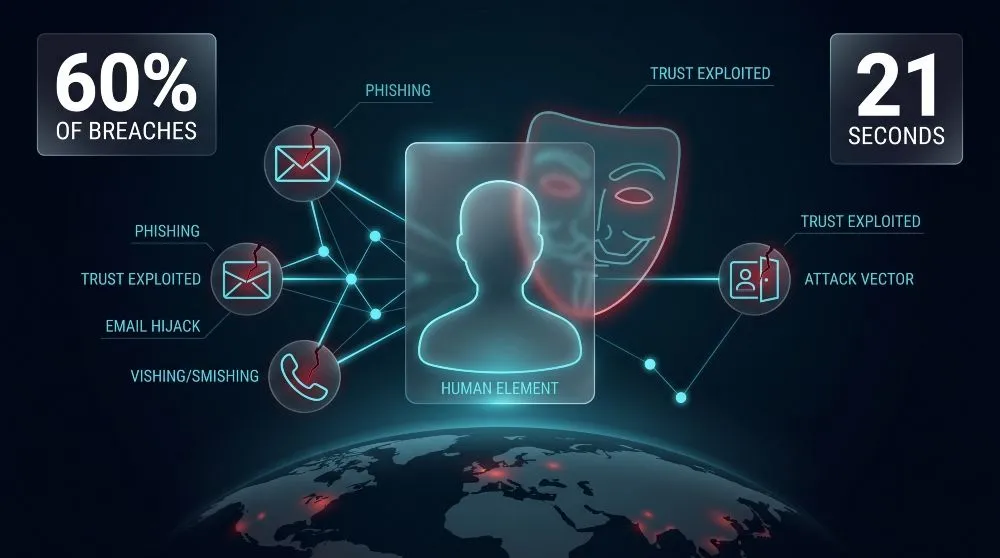
It works because it targets a weakness no software patch can fix: human judgment under pressure. According to Verizon’s 2025 Data Breach Investigations Report, the human element, including social engineering, user error, and misused credentials, is a factor in roughly 60% of all data breaches, making it one of the most consistently exploited entry points in cybersecurity, year after year.
A social engineer doesn’t need advanced technical skills to succeed. They need a believable story, a sense of urgency, and one person willing to trust it.
What Is Social Engineering?
Social engineering is a method of attack that manipulates human psychology rather than technical systems, tricking people into handing over information, access, or money they’d normally protect. It’s the reason a company can spend millions on firewalls and still get breached through a single convincing phone call or email.
In plain terms, social engineering is deception used as a hacking tool. Instead of exploiting a flaw in software, an attacker exploits a flaw in judgment , impersonating a coworker, a vendor, or an IT technician to get someone to do something they otherwise wouldn’t, like sharing a password, opening an attachment, or approving a payment. No malware or code is required for the attack to work; the “vulnerability” being exploited is trust itself.
What Is a Social Engineer?
A social engineer is anyone who uses manipulation, impersonation, or deception to gain unauthorized access to systems, data, or funds. Malicious social engineers pose as scammers, fraudsters, or cybercriminals; the same skill set is also used legitimately by penetration testers, who simulate these attacks under contract to expose an organization’s human security gaps before a real attacker does. The distinction isn’t the technique, it’s the authorization behind it.
Why Is Social Engineering Effective?
Social engineering works because it’s built around how people naturally respond to authority, urgency, and trust, not around any flaw a patch can fix. A message that appears to come from a boss, a bank, or a help desk short-circuits the instinct to double-check, especially when it’s paired with time pressure. That speed is exactly what the data shows: according to Verizon’s 2025 Data Breach Investigations Report, the median time between someone opening a phishing email and clicking the malicious link is just 21 seconds , barely enough time to read it, let alone verify it. Attackers don’t need a sophisticated exploit when they can count on a fast, emotional reaction instead.
Types of Social Engineering Attacks
Social engineering isn’t a single technique; it’s a family of tactics that all exploit trust, but through different channels and triggers. Understanding the main types makes it far easier to recognize an attack in progress, whether it arrives by email, phone, text, or in person.

Phishing & Spear Phishing
Phishing is the most common form of social engineering: a fraudulent email, text, or message designed to appear to be from a trusted source to steal credentials or install malware. Spear phishing is the targeted version of the same attack, personalized with real details about the victim , their name, employer, or role , to make the deception far more convincing. Social engineering accounts for roughly 22% of breaches involving external attackers, and phishing alone accounts for 57% of those breaches, according to Verizon’s 2025 Data Breach Investigations Report.
Pretexting
Pretexting is a social engineering attack built entirely around a fabricated scenario, or “pretext,” that gives the attacker a believable reason to ask for sensitive information. A common example is someone posing as an IT technician who needs a password to “fix an urgent issue,” or a fake vendor calling to “verify” account details before processing a payment. Unlike phishing, pretexting often unfolds over multiple interactions, giving the attacker time to build credibility before making the real request.
Baiting
Baiting lures a victim with the promise of something desirable , a free download, a gift card, or a USB drive left in a parking lot labeled “Confidential” , in exchange for triggering a malicious action. The bait doesn’t need to be sophisticated; it only needs to be tempting enough to override caution for a moment. Once clicked, downloaded, or plugged in, it delivers malware or harvests credentials just like any other social engineering payload.
Vishing (Voice Phishing)
Vishing is phishing carried out by phone or voicemail instead of email, typically impersonating a bank, government agency, or internal help desk to extract information or push a victim toward an urgent action. It has become one of the fastest-growing attack methods: CrowdStrike recorded a 442% increase in vishing activity between the first and second half of 2024 alone, driven largely by attackers using AI-generated voices to impersonate real employees or executives.
Tailgating & Piggybacking
Tailgating is a physical form of social engineering, where an attacker follows an authorized person into a restricted building or area without using their own credentials , often simply by carrying boxes and asking someone to “hold the door.” Piggybacking is closely related but implies at least tacit permission, such as an employee knowingly letting someone in as a courtesy. Both bypass badge readers and access control systems entirely by exploiting basic politeness.
Quid Pro Quo Attacks
A quid pro quo attack offers something in return for information or access, framing the exchange as a fair trade rather than a request. A classic version involves an attacker posing as tech support who offers to “fix” a problem the employee didn’t even report, in exchange for login credentials or remote access to their machine. The perceived reciprocity is what makes it effective , the victim feels they’re getting help, not being exploited.
Reverse Social Engineering
Reverse social engineering flips the usual script: instead of the attacker reaching out to the victim, the attacker sets up a scenario that causes the victim to reach out to them for help. This might involve sabotaging a system and then posing as the only available “support contact,” so the target initiates contact and hands over access willingly. Because the victim believes they sought out the help themselves, reverse social engineering tends to bypass the skepticism that a cold approach would normally trigger.
Common Social Engineering Tactics & Techniques
Beneath every social engineering attack, regardless of which channel it uses, lies one of a handful of psychological levers. Attackers don’t need new technology to be effective; they need to trigger a predictable human response, and three tactics do most of the work.

Authority & Urgency
Authority-based social engineering works by impersonating someone the target is conditioned not to question , a CEO, a manager, a government agency, or a bank , and pairing that impersonation with time pressure that discourages verification. A message that says “approve this wire transfer before the deadline in 10 minutes” is designed to make hesitation feel riskier than compliance. This combination is central to Business Email Compromise (BEC) scams, where an attacker impersonates a company executive to authorize a fraudulent payment; the average BEC attack costs organizations $4.89 million, making it one of the most financially damaging social engineering techniques in use today.
Trust & Familiarity Exploitation
This tactic relies on impersonating , or actually compromising , someone the victim already knows and trusts, such as a colleague, a vendor, or a friend, rather than a random stranger. Because the request appears to come from within an established relationship, it bypasses the natural skepticism people reserve for unfamiliar senders. Attackers often achieve this by hijacking a real email account or spoofing a familiar name and email signature, making the message nearly indistinguishable from a genuine one at a glance.
Fear-Based Manipulation
Fear-based social engineering threatens a negative consequence , a suspended account, a legal action, a security breach , to push the victim into acting before they think it through. The tactic works precisely because fear narrows attention onto the threat itself and away from the details that would normally expose the scam, like a mismatched sender address or an unusual request. Unlike authority-based attacks, which borrow legitimacy, fear-based attacks manufacture a crisis, giving the victim a reason to believe they have no time to verify.
Social Engineering vs. Phishing: What’s the Difference?
Social engineering is the broader category , any manipulation tactic used to deceive someone into giving up information or access , while phishing is one specific method of delivering that manipulation, typically through email or messaging. Every phishing attack is social engineering, but not every social engineering attack is phishing.

Is Phishing a Form of Social Engineering?
Yes, phishing is a digital, message-based form of social engineering, not a separate category of attack. It applies the same psychological triggers as any other social engineering tactic , urgency, authority, familiarity , but delivers them through a fraudulent email, text, or link rather than a phone call or in-person interaction. Phishing is simply the most scaled, automatable version of social engineering, which is why it remains the most common entry point into a breach: Verizon’s 2025 DBIR found it accounts for 57% of social engineering-related breaches involving external attackers.
Where the Two Overlap
The two overlap most clearly in attacks that combine channels, a phishing email that sets up a follow-up vishing call, or a pretexting scenario that concludes with a malicious link sent by text. In practice, security teams treat phishing as a subset of social engineering because defending against one requires the same core skill: teaching people to recognize manipulation regardless of what channel it arrives through, rather than training them to spot email red flags alone.
Real-World Social Engineering Examples
Social engineering isn’t a theoretical risk , it’s behind some of the most damaging breaches in recent corporate history, precisely because it bypasses the technical defenses companies invest in most heavily. Two 2023 casino breaches show how differently the same attack can play out depending on how a company responds.
The Caesars Entertainment 2023 Help Desk Attack
In August 2023, the hacking group Scattered Spider social-engineered a Caesars Entertainment IT support vendor, convincing a help desk employee to reset credentials and hand over access to internal systems. From there, attackers downloaded Caesars’ loyalty program database, exposing names, driver’s license numbers, and Social Security numbers for a significant portion of its 65 million rewards members. Rather than risk the data being leaked, Caesars paid a $15 million ransom , half of the attackers’ original $30 million demand , making it one of the clearest examples of how a single social engineering call can outmaneuver an entire security stack.
Other Notable Incidents
Days after the Caesars breach, the same Scattered Spider group used nearly identical tactics against MGM Resorts, calling the company’s help desk and using an employee’s publicly available LinkedIn details to impersonate them and gain network access in roughly ten minutes. Unlike Caesars, MGM refused to pay the ransom and instead shut down systems across its properties to contain the damage , a decision that disrupted hotel bookings, slot machines, and payment systems for over a week and cost the company an estimated $100 million in lost operations. Together, the two incidents illustrate the same lesson from opposite outcomes: the vulnerability wasn’t in either company’s technology, it was in a help desk process that trusted a caller’s word over verification.
Signs & Red Flags of a Social Engineering Attempt
Most social engineering attacks share a handful of warning signs, whether they arrive through email, text, or a phone call , the details differ, but the underlying pressure tactics don’t. Learning to spot these patterns is one of the most effective defenses available, since it works regardless of how sophisticated the attacker’s technology is.
Email & Message Red Flags
A social engineering email typically pushes urgency (“your account will be locked in 24 hours”), requests something unusual for the sender’s role, or asks the recipient to bypass normal verification steps. Mismatched sender addresses, generic greetings on a message that claims to be personal, and links that don’t match their displayed text are all common tells, along with unexpected attachments from senders the recipient wasn’t expecting to hear from. Despite growing awareness, KnowBe4’s 2025 Phishing by Industry Benchmarking Report found that roughly one in three untrained employees will still interact with a simulated phishing message , a reminder that these red flags are easy to describe but harder to catch at the moment.
Phone & In-Person Red Flags
Vishing and in-person social engineering attempts rely on the same urgency and authority cues as email, but add the pressure of a live, real-time interaction that makes it harder to pause and verify. Warning signs include a caller who already knows partial account or employee details (often gathered from social media) and uses them to seem legitimate, a refusal to be called back through an official number, or a request to skip standard identity verification “just this once” because of an emergency. In person, the same pattern shows up as someone requesting building access without their own badge, or a “vendor” who wasn’t scheduled but claims to be there for an urgent fix.
How to Prevent Social Engineering Attacks
Preventing social engineering isn’t about eliminating trust , it’s about building verification into the moments where trust is most likely to be exploited. The strongest defenses combine individual awareness with organizational processes that don’t rely on any one person catching every attempt.

For Individuals
The single most effective habit against social engineering is verifying unexpected requests through a separate, known channel , calling a colleague back on their known number rather than replying to the message that raised suspicion in the first place. It’s also worth treating urgency itself as a red flag: legitimate requests from banks, employers, or IT departments rarely require an irreversible action within minutes. Being cautious about what’s shared publicly on LinkedIn or social media matters too, since attackers routinely use those details , job titles, coworker names, even out-of-office dates , to make a pretexting or vishing attempt sound credible.
For Organizations & the Workplace
Organizations reduce social engineering risk most effectively by removing the decision from any single employee’s judgment , requiring callback verification before a help desk resets credentials, enforcing multi-factor authentication that can’t be bypassed with a password alone, and setting clear approval chains for wire transfers or sensitive data requests. Phishing-resistant MFA, such as hardware keys or passkeys, closes the gap that traditional MFA leaves open when an attacker socially engineers a one-time code directly from the victim. These controls matter because they assume, correctly, that someone in the organization will eventually be targeted successfully , the goal is limiting what one compromised interaction can do.
Building a Social Engineering Awareness Culture
Ongoing awareness training works because it changes behavior, not just knowledge , KnowBe4’s 2025 benchmarking data shows that consistent phishing simulation and training can cut an organization’s susceptibility rate from an industry baseline of roughly 33% down to under 5%. The most resilient organizations treat reporting a suspicious message as a rewarded action, not an inconvenience, so employees flag attempts early rather than staying quiet out of embarrassment or uncertainty. A culture that normalizes questioning unusual requests , even from someone senior , closes the exact gap that authority-based social engineering is designed to exploit.
Social Engineering in Cybersecurity & Ethical Hacking
Social engineering isn’t only a criminal tactic , it’s also a recognized discipline within ethical hacking, used legally to test whether an organization’s people, not just its systems, can withstand a real attack. Security teams treat it as a required part of a mature security program, not an afterthought to technical testing.
How Pentesters Use Social Engineering (Briefly)
Penetration testers run authorized social engineering exercises , simulated phishing emails, pretext phone calls, or even physical tailgating attempts , to find the human vulnerabilities that firewalls and endpoint tools can’t detect. The goal isn’t to catch individual employees making mistakes; it’s to surface gaps in process, like a help desk that resets passwords without verifying identity, so they can be fixed before a real attacker finds them. Because the methods are identical to malicious social engineering, the only real difference is authorization, scope, and a contract that defines exactly what’s being tested.
AI & the Future of Social Engineering
Artificial intelligence hasn’t introduced new social engineering tactics so much as it’s made the existing ones faster, cheaper, and far more convincing to produce at scale. The same authority, urgency, and trust exploits described earlier now arrive with a cloned voice or a flawlessly written email behind them.
Deepfake Voice & Video Scams
Deepfake social engineering uses AI-generated audio or video to impersonate a real person , often a company executive , convincingly enough to authorize actions the impersonated person never approved. In one of the most widely documented cases, a finance employee at engineering firm Arup joined a video call in Hong Kong featuring deepfaked versions of the company’s CFO and several colleagues, and authorized transfers totaling roughly $25 million before the fraud was discovered. What makes these attacks especially effective is that they defeat the exact verification habit security teams usually recommend , seeing or hearing the person you’re talking to , because that signal itself can now be faked.
AI-Generated Phishing at Scale
Generative AI has removed the two biggest limitations on traditional phishing: poor writing and limited volume. An attacker no longer needs fluent English or manual effort to produce a convincing, personalized message , they can generate thousands of variations instantly, each one grammatically clean and tailored with details scraped from public profiles. According to a KnowBe4 analysis of phishing emails collected between September 2024 and February 2025, 82.6% showed evidence of AI involvement, up sharply from the year before, signaling that AI-assisted social engineering is now the norm rather than the exception.
Social Engineering Statistics (2025)
The numbers behind social engineering make its scale hard to overstate: it’s not a niche threat, it’s the dominant way modern breaches begin.
- The human element , including social engineering, error, and misused credentials , is a factor in roughly 60% of all data breaches (Verizon 2025 DBIR).
- Social engineering accounts for about 22% of breaches involving external attackers, and phishing makes up 57% of those (Verizon 2025 DBIR).
- The median time between a phishing email being opened and clicked is just 21 seconds (Verizon 2025 DBIR).
- Vishing (voice phishing) attacks surged 442% between the first and second half of 2024 (CrowdStrike 2025).
- The average Business Email Compromise (BEC) attack costs organizations $4.89 million.
- Untrained employees have a baseline phishing susceptibility of 33.1%, which drops to under 5% after consistent security awareness training (KnowBe4 2025).
- 82.6% of phishing emails analyzed in late 2024–early 2025 showed signs of AI involvement (KnowBe4).
- Caesars Entertainment paid a $15 million ransom after a single help-desk social engineering call led to a full customer database breach (2023).
Frequently Asked Questions (FAQ’s)
Which of the Following Best Describes Social Engineering?
It’s best described as the use of psychological manipulation , not technical exploits , to trick someone into revealing sensitive information or granting unauthorized access. The “hack” targets human judgment, not a system vulnerability.
What’s an Example of Reverse Social Engineering?
An attacker sabotages a system, then poses as the only available support contact so the victim reaches out to them for help. Because the victim initiates contact, they let their guard down and hand over access willingly.
Is Social Engineering the Same as Hacking?
Not quite , traditional hacking exploits flaws in software or networks, while this approach exploits trust and human behavior instead. The two are often combined, with a convincing pretext used to gain the access a technical exploit alone couldn’t.
What Are the Goals Behind These Attacks?
Beyond stealing credentials, common goals include financial fraud, installing malware, gaining physical building access, or extracting confidential business information. The specific goal usually shapes which tactic , a phone call, an email, or an in-person approach , gets used.
Which Behaviors Are Not Considered Part of This Threat?
Randomly guessing a password or exploiting an unpatched software bug isn’t part of this category, since no manipulation of a person is involved. The defining trait is always a human being deceived into taking an action, not a system being broken into directly.
Is This Threat Always Delivered Through a Screen?
No , while email and text are the most common channels, plenty of attempts happen entirely by phone or face-to-face, like a caller impersonating IT support or someone tailgating into a secured building. The channel changes; the manipulation tactic underneath stays the same.