
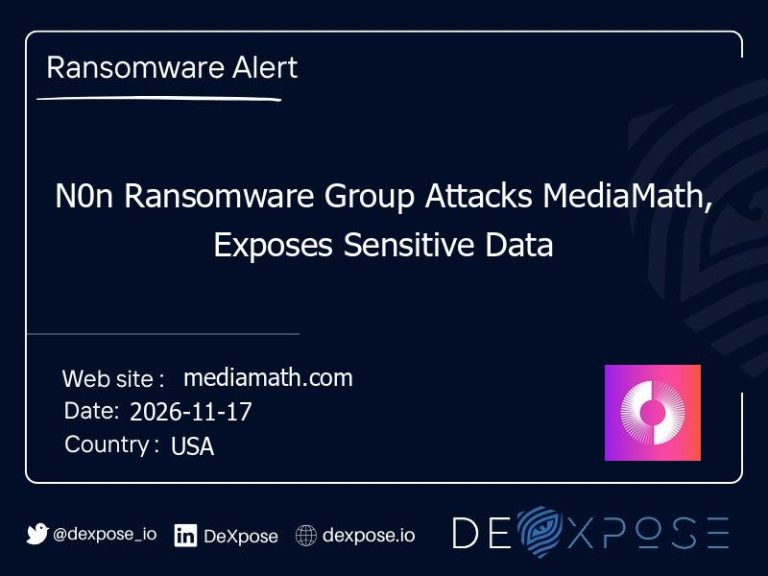
N0n Ransomware Group Attacks MediaMath, Exposes Sensitive Data
- Target
- MediaMath
- Domain
- mediamath.com
- Country
- USA
- Attacking Group
- N0n
- Date Reported
- November 16, 2026
Summary
On November 16, 2026, the notorious ransomware group N0n declared a successful cyberattack on MediaMath (mediamath.com), a leading programmatic advertising firm based in the USA. The group has exposed sensitive data, including consumer identity graphs and advertising analytics, after failed negotiations.
Incident Report
| Field | Details |
|---|---|
| Target | MediaMath |
| Domain | mediamath.com |
| Country | USA |
| Attacking Group | N0n |
| Date Reported | November 16, 2026 |
| Threat Actor Statement | “A consumer identity graph export of 143,186,369 rows linking consumer cookie identifiers to device identifiers; Campaign analytics exports with agency and advertiser names, budgets and performance for well known consumer brands; Curated marketplace consumer segment memberships; Brand safety and fraud verification data; A named client’s site whitelist; Monthly campaign performance and verification reports for well known consumer brands | [NOT PAID — EXPOSED]” |
Recommended Security Actions
Ransomware attacks are increasingly targeting both enterprise and mid-sized organizations across all sectors. The following steps are critical to reduce impact and prevent future incidents:
- Monitor continuously: Use DeXpose’s dark web and infostealer monitoring platform to detect breached credentials, leaked databases, and threat actor chatter in near real-time—before damage spreads internally.
- Conduct a compromise assessment: Immediately initiate a full incident review to determine how attackers infiltrated your network, what data may have been exfiltrated, and whether any persistence mechanisms remain active.
- Validate your backups: Ensure that your backups are current, encrypted, and stored offline. Utilize immutable backup solutions to defend against ransomware encryption and deletion attempts.
- Apply threat intelligence: Integrate external threat feeds, including DeXpose-provided indicators of compromise (IOCs), into your SIEM or XDR platforms for real-time alerting and correlation.
- Harden employee defenses: Run phishing simulations and enforce multi-factor authentication (MFA) across all access points. Attackers often exploit weak or reused credentials sourced from the dark web.
- Engage professional response teams: Involve cybersecurity incident response experts, threat analysts, and legal counsel before initiating any dialogue with ransomware groups or ransom brokers.
How DeXpose Helps You Stay Ahead
At DeXpose, we specialize in early detection and proactive defense. Our hybrid threat intelligence solution combines automated deep/dark web crawling, Telegram and forum monitoring, and real analyst verification to deliver:
- Continuous scanning of ransomware group leak sites, stolen credential markets, and malware log dumps
- Timely alerts for breaches linked to your domains, email addresses, and key personnel
- Intelligence correlation that connects leaked credentials to infostealer malware infections, often weeks before a public ransom demand
- Real-time visibility into supply chain and third-party exposures through passive surveillance of dark web channels
Don’t wait for public disclosure or ransom notices—gain visibility into your cyber exposure now.
-
Scan your domain for data breaches:
Free Dark Web Report -
Check employee or partner email exposure:
Email Data Breach Scan
Disclaimer
DeXpose does not engage in the exfiltration, hosting, redistribution, or purchase of stolen data. All breach information reported here is collected from publicly accessible dark web sources and threat intelligence platforms.
Our mission is to equip organizations with early-warning indicators, contextual threat insights, and actionable intelligence that help them secure their digital assets against evolving cyber threats.
Blackout Strikes Wakao Stage Crafts Co., Ltd.
The ransomware group Blackout targeted Wakao Stage Crafts Co., Ltd., a prominent Japanese theater company. The attackers have threatened to leak sensitive data unless negotiation terms…
Read more
SpaceBears Strikes Epoch Residential
Epoch Residential, a US-based real estate developer, has fallen victim to a ransomware attack by the SpaceBears group. Sensitive data is at risk of being leaked…
Read more
Akira Ransomware Targets Spanish Engineering Firm Audiotec
The Akira ransomware group has targeted Audiotec, a Spanish acoustic engineering firm. Sensitive corporate data, including personal employee information and financial records, is at risk as…
Read more