
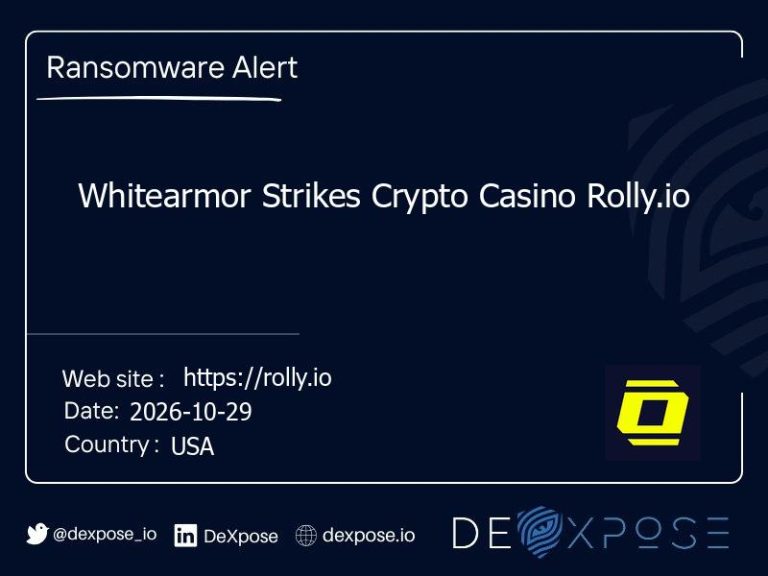
Whitearmor Strikes Crypto Casino Rolly.io
- Target
- Rolly.io
- Domain
- rolly.io
- Country
- USA
- Attacking Group
- Whitearmor
- Date Reported
- October 29, 2026
Summary
On October 29, 2026, the ransomware group Whitearmor publicly claimed responsibility for a cyberattack against
Rolly.io (rolly.io), a crypto casino operating on the Arbitrum network.
The group disclosed a breach involving sensitive data of players and internal communications without demanding ransom.
Incident Report
| Field | Details |
|---|---|
| Target | Rolly.io |
| Domain | rolly.io |
| Country | USA |
| Attacking Group | Whitearmor |
| Date Reported | October 29, 2026 |
| Threat Actor Statement | “Rolly.io is an on-chain crypto casino on Arbitrum featuring a public bankroll, transparent bonus formulas (rakeback, weekly bonuses), and active player reward systems. We hold 1,364 rolly.gg player PII records with linked on-chain wallets, 430K+ ledger transactions, 11,442 wallet addresses, 155 whale payout maps, 299 deanonymized staff/CTO emails, and 313 internal chat messages. We aren’t asking for any ransom, we just thought it was funny to hack a casino that made a joke about Gamdom.” |
Recommended Security Actions
Ransomware attacks are increasingly targeting both enterprise and mid-sized organizations across all sectors. The following steps are critical to reduce impact and prevent future incidents:
- Monitor continuously: Use DeXpose’s dark web and infostealer monitoring platform to detect breached credentials, leaked databases, and threat actor chatter in near real-time—before damage spreads internally.
- Conduct a compromise assessment: Immediately initiate a full incident review to determine how attackers infiltrated your network, what data may have been exfiltrated, and whether any persistence mechanisms remain active.
- Validate your backups: Ensure that your backups are current, encrypted, and stored offline. Utilize immutable backup solutions to defend against ransomware encryption and deletion attempts.
- Apply threat intelligence: Integrate external threat feeds, including DeXpose-provided indicators of compromise (IOCs), into your SIEM or XDR platforms for real-time alerting and correlation.
- Harden employee defenses: Run phishing simulations and enforce multi-factor authentication (MFA) across all access points. Attackers often exploit weak or reused credentials sourced from the dark web.
- Engage professional response teams: Involve cybersecurity incident response experts, threat analysts, and legal counsel before initiating any dialogue with ransomware groups or ransom brokers.
How DeXpose Helps You Stay Ahead
At DeXpose, we specialize in early detection and proactive defense. Our hybrid threat intelligence solution combines automated deep/dark web crawling, Telegram and forum monitoring, and real analyst verification to deliver:
- Continuous scanning of ransomware group leak sites, stolen credential markets, and malware log dumps
- Timely alerts for breaches linked to your domains, email addresses, and key personnel
- Intelligence correlation that connects leaked credentials to infostealer malware infections, often weeks before a public ransom demand
- Real-time visibility into supply chain and third-party exposures through passive surveillance of dark web channels
Don’t wait for public disclosure or ransom notices—gain visibility into your cyber exposure now.
-
Scan your domain for data breaches:
Free Dark Web Report -
Check employee or partner email exposure:
Email Data Breach Scan
Disclaimer
DeXpose does not engage in the exfiltration, hosting, redistribution, or purchase of stolen data. All breach information reported here is collected from publicly accessible dark web sources and threat intelligence platforms.
Our mission is to equip organizations with early-warning indicators, contextual threat insights, and actionable intelligence that help them secure their digital assets against evolving cyber threats.
N0n Targets Biopharmaceutical Leader Company #252
Ransomware group N0n has targeted Company #252, a leading biopharmaceutical organization in the USA. The attack threatens exposure of sensitive data pending negotiations.
Read more
Qilin Ransomware Strikes Mayerhofer Hoch-, Tief- und Ingenieurbau GmbH
The ransomware group Qilin has targeted Mayerhofer Hoch-, Tief- und Ingenieurbau GmbH in Germany, threatening to expose sensitive data unless negotiations are initiated.
Read more
Black X Ransomware Attack on Vincci Hotels
Vincci Hotels in Spain has fallen victim to a ransomware attack by Black X. The cybercriminal group claims to have obtained complete personal data, including card…
Read more