Data breaches no longer begin with a headline; they begin quietly, in hidden forums and encrypted marketplaces where stolen credentials, corporate records, and customer information are bought and sold. Dark web monitoring exists to detect those risks early, before they escalate into financial loss, regulatory penalties, or reputational damage.
At its core, dark web monitoring is a cybersecurity process that continuously scans deep- and dark-web environments for exposed data linked to an individual, organization, or brand. This includes compromised email addresses, leaked passwords, customer databases, financial information, intellectual property, and even attempts at brand impersonation. Instead of waiting for fraud or a breach notification, monitoring provides proactive visibility into emerging threats.
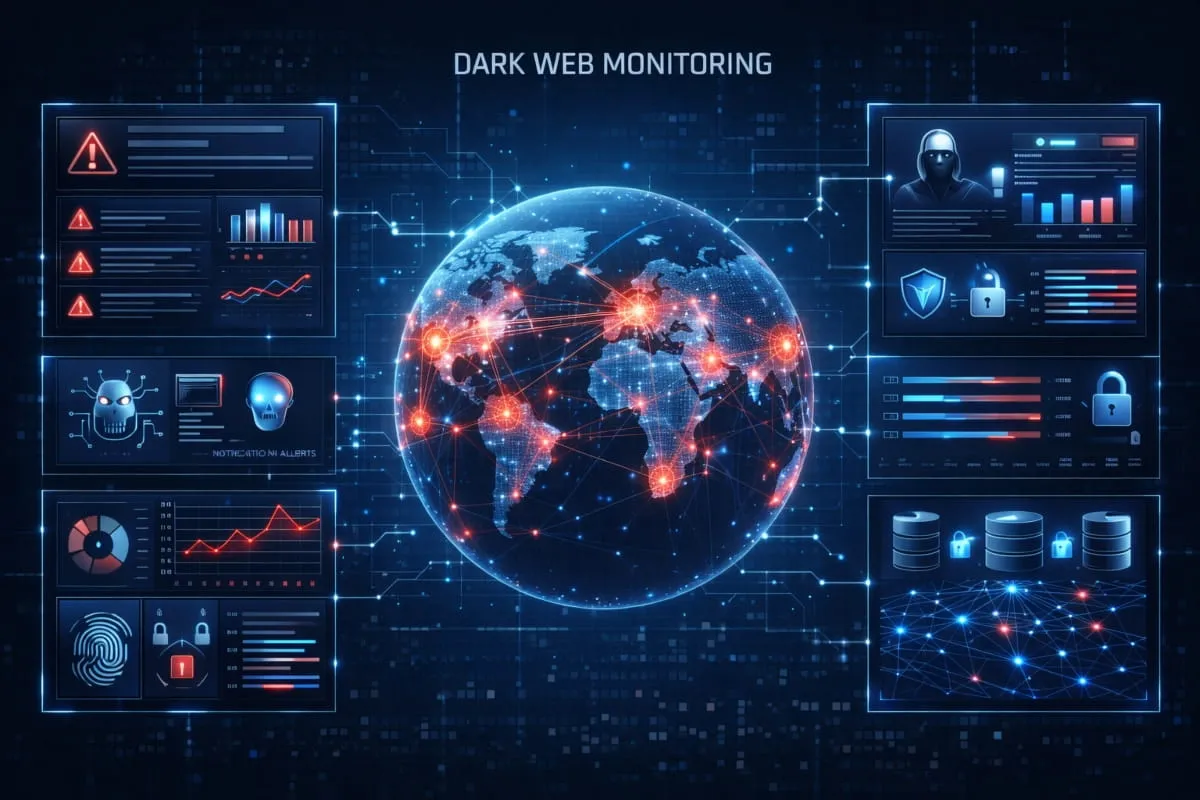
But dark web monitoring is not about browsing the dark web. It is a structured, intelligence-driven system powered by automated crawlers, threat intelligence feeds, and alert mechanisms designed to identify stolen or leaked data in real time. When relevant information is discovered, alerts allow businesses and individuals to respond quickly by resetting credentials, securing accounts, notifying stakeholders, or launching incident response protocols.
For businesses, the value goes far beyond password exposure. Enterprise dark web monitoring supports broader business security objectives such as breach detection, brand protection, regulatory compliance, and third-party risk management. It enables organizations to monitor for:
- Stolen employee credentials
- Leaked customer data
- Mentions of company assets in underground forums
- Counterfeit or impersonation activity
- Discussions indicating planned cyberattacks
In today’s threat landscape, the question is no longer whether sensitive information will surface online; it is how quickly you can detect and contain the exposure. Dark web monitoring bridges that gap by turning hidden risks into actionable intelligence.
This guide explores how dark web monitoring works, who needs it, what types of tools and platforms exist, and whether it is truly worth implementing as part of a modern protection and business security strategy.
What Is Dark Web Monitoring?
Dark web monitoring is a cybersecurity practice focused on identifying and tracking exposed information within hidden areas of the internet where stolen data is frequently traded or shared. When people ask what dark web monitoring is or what it means, they are typically trying to understand how organizations detect leaked credentials, compromised customer records, or sensitive company data before it leads to fraud or a full-scale breach.
In practical terms, dark web monitoring involves continuously scanning underground marketplaces, forums, encrypted communities, and breach repositories for specific data points linked to an individual or business. This may include email addresses, passwords, phone numbers, corporate domains, financial details, or proprietary information. When relevant data is discovered, alerts are generated to enable immediate action.
The dark web monitoring meaning goes beyond simply searching the internet. It refers to a structured, intelligence-driven process that combines automation, threat analysis, and real-time alerting to reduce exposure risk. Whether described as a dark web monitor, dark web activity monitoring, or dark web security monitoring, the goal remains the same: early detection of hidden threats before they escalate into measurable damage.
Modern deep- and dark-web monitoring solutions are designed to support both individuals and organizations. For businesses, it becomes a critical component of business security, incident response readiness, and data protection strategy.

Dark Web vs Deep Web Explained
To fully understand dark web monitoring, it’s important to clarify the difference between the deep web and the dark web, terms that are often confused.
The deep web refers to any part of the internet not indexed by traditional search engines. This includes password-protected portals, internal databases, private cloud storage, subscription-based platforms, and corporate systems. Most of the deep web is legitimate and secure.
The dark web, on the other hand, is a small segment of the deep web that requires specialized software to access. It is intentionally anonymized and often used for both privacy-focused communication and illicit activities. Cybercriminals commonly use dark web forums and marketplaces to trade stolen credentials, financial data, malware, and access to compromised systems.
When organizations talk about deep and dark web monitoring, they refer to scanning both hidden but legitimate sources (such as breach dumps) and anonymized underground environments where stolen data circulates. Understanding this distinction helps clarify why monitoring these areas is a proactive security measure rather than surveillance of everyday internet activity.
What Does Monitoring Actually Mean?
The word monitoring can sound vague, but in cybersecurity it has a precise meaning.
Monitoring the dark web involves continuously scanning and analyzing hidden online environments for predefined indicators of exposure. These indicators may include company domains, executive email addresses, customer databases, or sensitive keywords tied to an organization’s digital footprint.
Monitoring is not a one-time search. It is an ongoing process that involves:
- Automated data collection from underground sources
- Pattern matching against known assets
- Threat intelligence analysis
- Alert generation when exposure is detected
In other words, a dark web monitor does not prevent data theft. Instead, it reduces the time between exposure and response. The shorter the window, the lower the potential financial and reputational impact.
This is why dark web security monitoring is often integrated into broader cybersecurity strategies, alongside endpoint protection, identity monitoring, and incident response frameworks.
Can the Dark Web Really Be Monitored?
A common question is whether it is even possible to monitor something designed for anonymity. The answer is nuanced.
While no solution can see every corner of the dark web in real time, large portions of underground forums, breach repositories, and marketplaces can be observed through intelligence networks, automated crawlers, and human analysts. Over time, patterns emerge, repeat offenders are tracked, and leaked data sets are cataloged.
Effective dark web monitoring focuses on high-risk, high-relevance sources rather than attempting to index the entire hidden internet. The objective is not total visibility, but actionable visibility.
So when someone asks, ” Can the dark web really be monitored?, the more accurate answer is this: it cannot be fully controlled, but it can be systematically observed to detect exposure early.
For businesses and individuals alike, early detection can mean the difference between a contained incident and a public crisis.
Dark Web Monitoring vs Data Breach Monitoring
Many organizations use the terms dark web monitoring and data breach monitoring interchangeably. In reality, they serve related but distinct purposes. Understanding the difference is essential for choosing the right level of protection and setting realistic expectations.
When buyers compare these two approaches, they are often asking:
- Is breach monitoring the same thing as dark web monitoring?
- Is it just a database check like public breach lookup tools?
- Does dark web monitoring go deeper?
The answer lies in scope, timing, and depth of intelligence.

Scope Difference
Data breach monitoring focuses primarily on identifying whether your email address, domain, or credentials appear in known breach databases. These databases usually contain previously exposed information from confirmed incidents.
In contrast, dark web monitoring scans a broader range of underground environments. This includes illicit marketplaces, encrypted forums, leak sites, and criminal communities where stolen data is traded before, or sometimes without, formal public disclosure.
While breach monitoring is often limited to confirmed datasets, dark web monitoring extends into hidden spaces where early signals of compromise may surface.
In simple terms:
- Breach monitoring checks known exposures.
- Dark web monitoring searches for emerging and circulating threats.
Timing Difference
Timing is one of the most important distinctions.
Data breach monitoring is typically reactive. It alerts you after a breach has already occurred and been documented. By the time the dataset is publicly indexed, attackers may already have begun exploiting it.
Dark web monitoring can provide earlier detection. Stolen credentials and sensitive data are often for sale or discussed on underground forums before official breach announcements. Monitoring these environments can shorten the time between compromise and awareness.
Reducing that detection window directly impacts business security. The earlier exposure is identified, the faster organizations can reset credentials, enforce authentication updates, and prevent escalation.
Proactive vs Reactive Protection
Data breach monitoring functions primarily as a notification service. It tells you that exposure has happened.
Dark web monitoring supports a more proactive security posture. By continuously scanning hidden marketplaces and tracking risk indicators, it provides early-warning signals that may not yet be widely reported.
This proactive visibility is especially important for businesses managing large employee ecosystems or sensitive customer data. Rather than waiting for public confirmation, organizations gain independent insight into potential compromise.
The difference is subtle but critical: breach monitoring confirms exposure; dark web monitoring helps anticipate and contain it.
Intelligence Depth
Another key distinction lies in the level of intelligence provided.
Basic breach monitoring tools often deliver simple notifications, for example, that an email address was found in a particular breach. Context may be limited to the breach name and date.
Advanced dark web monitoring platforms add depth to intelligence. They analyze where the data was discovered, whether it is part of an active criminal marketplace, whether threat actors are discussing it, and how the exposure may impact your organization.
This deeper analysis enables more strategic decision-making. Security teams can prioritize high-risk findings and allocate resources effectively, rather than treating every alert equally.
Which One Do You Need?
For individuals seeking basic awareness of exposed credentials, breach monitoring may provide sufficient visibility. For businesses, especially those handling sensitive information or operating at scale, dark web monitoring offers broader coverage and earlier detection.
The two approaches are not mutually exclusive. In many security frameworks, breach monitoring acts as a baseline layer, while dark web monitoring provides expanded threat intelligence and proactive exposure detection.
Understanding this distinction helps eliminate confusion. Data breach monitoring looks backward at confirmed incidents. Dark web monitoring looks outward, and often forward, into hidden environments where emerging threats take shape.
| Feature | Dark Web Monitoring | Data Breach Monitoring |
|---|---|---|
| Primary Purpose | Detects exposed data circulating in underground forums, marketplaces, and leak sites | Alerts users when their data appears in confirmed breach databases |
| Scope of Coverage | Deep and dark web sources, criminal forums, threat actor marketplaces, breach dumps | Publicly disclosed or indexed breach datasets |
| Detection Timing | Often detects exposure before or without official breach announcements | Usually alerts after a breach has been confirmed and published |
| Proactive vs Reactive | More proactive — scans hidden environments for emerging threats | Primarily reactive — notifies after exposure is documented |
| Intelligence Depth | Provides contextual threat intelligence, risk scoring, and exposure analysis | Typically limited to breach name, date, and compromised data type |
| Credential Monitoring | Continuous monitoring for stolen credentials across underground sources | Checks credentials against known breach lists |
| Brand & Corporate Risk Visibility | Can detect brand mentions, impersonation attempts, and corporate data leaks | Does not monitor brand abuse or underground discussions |
| Use Case for Businesses | Supports enterprise security, brand protection, and early breach detection | Basic exposure awareness for employees or domains |
| Best For | Organizations needing ongoing threat visibility and risk intelligence | Individuals or small entities wanting breach notifications |
| Prevents Breaches? | No — detects exposure early to reduce escalation risk | No — informs after exposure has already occurred |
How Dark Web Monitoring Works
Understanding how dark web monitoring works is key to evaluating its effectiveness. Modern solutions combine automation, data analytics, and human intelligence to create continuous surveillance of high-risk online environments.
Rather than manually searching hidden forums, advanced monitoring platforms use structured processes that operate at scale and in real time.

Crawling Hidden Forums & Marketplaces
The first layer involves automated crawlers and collection systems that access hidden forums, marketplaces, and encrypted communities. These systems gather publicly accessible data from underground sources where stolen credentials, corporate data, and financial records are commonly traded.
Unlike traditional search engines, these crawlers are built to navigate anonymized networks and restricted environments. The collected information is then indexed and analyzed to determine whether it contains relevant indicators tied to a monitored organization.
Credential & Data Leak Detection
Once data is collected, the system performs credential and data leak detection. This process compares gathered information against known assets such as company domains, employee email addresses, phone numbers, or internal identifiers.
For example, if a database containing corporate login credentials appears in a breach dump, the monitoring system identifies matching records and flags them. This form of dark web credential monitoring is one of the most valuable use cases for businesses because stolen login credentials are often the entry point for larger attacks.
Detection is not limited to passwords. It can also include customer records, internal documents, payment information, and exposure to intellectual property.
AI & Threat Intelligence Integration
Modern dark web security monitoring platforms integrate artificial intelligence and threat intelligence feeds to improve accuracy. AI helps filter noise, reduce false positives, and prioritize high-risk findings based on context.
Threat intelligence adds another layer of analysis by tracking known threat actors, commonly targeted industries, and emerging tactics. By combining automated scanning with contextual intelligence, monitoring becomes more strategic rather than reactive.
This integration ensures that alerts are meaningful and actionable, rather than overwhelming security teams with irrelevant data.
Real-Time Alerts & Incident Response
Detection alone is not enough. Real-time alerts transform raw findings into actionable security workflows.
When compromised data is discovered, alerts are generated and delivered to designated stakeholders. These alerts often include contextual information such as where the data was found, what type of information is exposed, and the potential risk level.
From there, organizations can initiate incident response steps, resetting passwords, enforcing multi-factor authentication, notifying affected users, or investigating deeper network vulnerabilities. The speed of this response can significantly reduce the impact of an attack.
Monitoring for Stolen Emails, Passwords & Phone Numbers
One of the most common applications of dark web monitoring is tracking the use of compromised personal identifiers. Monitoring for stolen emails, passwords, and phone numbers helps prevent account takeovers and identity-related fraud.
For businesses, exposed employee credentials online can give attackers direct access to internal systems. For individuals, leaked email-password combinations can lead to financial theft, social engineering attacks, or broader identity compromise.
By continuously scanning for these identifiers, dark web monitoring creates an early warning system. It shifts organizations from reactive crisis management to proactive risk reduction, strengthening overall protection and business security in an increasingly complex threat landscape.
What Types of Data Are Found on the Dark Web?
To understand the true value of dark web monitoring, it’s important to recognize what actually circulates in hidden online marketplaces and forums. The dark web is not a single database, but a constantly evolving network of communities where stolen, leaked, or illegally obtained data is exchanged.
When businesses invest in dark web security monitoring, they primarily aim to detect exposure across four major categories of risk: compromised credentials, financial data, corporate breach materials, and brand-related abuse. Each category carries different implications for protection and business security.

Compromised Credentials
Compromised credentials are among the most common types of data found on the dark web. These typically include email addresses, usernames, and passwords exposed through data breaches, phishing campaigns, malware infections, or credential-stuffing attacks.
Once leaked, these credentials are often packaged and sold in bulk. In many cases, attackers use automated tools to test stolen email and password combinations across multiple platforms. If password reuse is involved, a single exposed credential can lead to unauthorized access to corporate systems, financial accounts, or cloud services.
This is why dark web credential monitoring is a core component of modern cybersecurity strategies. By detecting when employee or customer login data appears in underground forums, organizations can reset passwords, enforce multi-factor authentication, and reduce the likelihood of account takeover.
For individuals, monitoring compromised credentials can prevent identity fraud and protect digital accounts before attackers exploit them further.
Financial Data & Credit Information
Financial data is another high-value asset commonly traded on the dark web. This can include credit card numbers, bank account details, transaction histories, tax records, and other sensitive financial identifiers.
Unlike compromised credentials, which may be used to gain access to accounts, financial information is often directly monetized. Fraudsters purchase stolen card data for unauthorized transactions, while larger financial datasets may be sold to organized cybercrime groups.
Dark web monitoring plays a critical role by identifying when financial data linked to a business or individual surfaces. Early detection allows financial institutions and companies to freeze accounts, reissue cards, investigate fraudulent activity, and limit financial loss.
Understanding the difference between credit monitoring and dark web monitoring is also important. Credit monitoring typically tracks changes in credit reports, while dark web monitoring focuses on detecting stolen financial data before it impacts credit systems.
Corporate Data & Breach Dumps
Corporate data exposure is one of the most damaging forms of dark web risk. After a cyberattack, threat actors frequently publish or sell breach dumps that contain internal databases, employee records, customer information, intellectual property, or confidential communications.
These breach dumps may appear in underground marketplaces, private forums, or data-leak sites associated with ransomware groups. In some cases, attackers release small samples of stolen data publicly to pressure organizations into paying ransom demands.
Deep and dark web monitoring helps identify when corporate domains, internal file references, or sensitive datasets are circulating in these environments. Early discovery can provide critical response time, enabling organizations to:
- Investigate the source of the breach
- Notify affected stakeholders
- Strengthen internal controls
- Prepare regulatory disclosures
For enterprises, continuous monitoring of potential breach exposure is essential for risk management, compliance, and long-term business security.
Brand Impersonation & Counterfeits
Beyond data theft, the dark web is also used to facilitate brand abuse. This includes impersonation schemes, counterfeit product listings, phishing kits designed to mimic legitimate companies, and the sale of stolen branded assets.
Brand impersonation can damage customer trust and lead to financial fraud. Counterfeit goods distributed through hidden networks can undermine intellectual property and create legal complications. In some cases, attackers even sell access to compromised corporate systems under a company’s name.
Dark web monitoring for brand protection focuses on identifying unauthorized mentions, fake listings, impersonation attempts, and trademark misuse in underground communities. By detecting these threats early, organizations can take legal action, shut down malicious campaigns, and protect their reputation.
For brand managers and security teams alike, monitoring these hidden environments becomes a proactive defense strategy rather than a reactive cleanup effort.
The dark web contains far more than isolated pieces of stolen information. It functions as an ecosystem where credentials, financial records, corporate data, and brand assets are exchanged at scale. Effective dark web monitoring transforms that hidden activity into actionable intelligence, giving businesses and individuals the visibility they need to protect what matters most.
Dark Web Monitoring for Businesses
Cyber threats no longer target only large corporations. Today, organizations of every size face exposure risks ranging from stolen employee credentials to leaked customer databases and brand impersonation schemes. That is why dark web monitoring for business has become a strategic security layer rather than a niche cybersecurity feature.
Business dark web monitoring focuses on detecting compromised data linked to company domains, internal systems, employees, customers, and brand assets. Instead of waiting for attackers to exploit stolen information, organizations gain early visibility into exposure events. This proactive approach strengthens incident response, reduces financial risk, and supports long-term business security planning.
From startups to multinational enterprises, dark web monitoring for businesses must be aligned with scale, complexity, and regulatory requirements.

Small Business Risk Exposure
Small businesses are frequently targeted because attackers assume defenses are weaker and response capabilities are limited. A single exposed email-password combination can grant access to accounting systems, CRM platforms, or cloud infrastructure.
Dark web monitoring for small businesses helps identify:
- Compromised employee credentials
- Customer data appearing in breach dumps
- Phishing kits impersonating the brand
- Early signs of targeted attacks
For small and mid-sized companies, even minor data leaks can result in significant financial disruption. Monitoring allows business owners to act quickly, resetting passwords, strengthening access controls, and investigating potential vulnerabilities before they escalate.
As cybersecurity becomes more accessible, the best dark web monitoring solutions for SMBs in 2025 are expected to emphasize affordability, automation, and simplified alert workflows, making proactive protection realistic even with limited IT resources.
Enterprise-Level Monitoring
Larger organizations operate in far more complex threat environments. Enterprise dark web monitoring expands beyond basic credential detection to include comprehensive risk intelligence.
Enterprise-level monitoring typically covers:
- Multiple corporate domains and subsidiaries
- Executive and high-profile employee exposure
- Intellectual property leaks
- Sensitive internal documentation
- Discussions indicating planned attacks
Enterprise dark web monitoring solutions often integrate with broader security operations frameworks, including SIEM systems, identity management platforms, and incident response workflows. The goal is not just detection, but coordinated action.
For corporations managing global operations, supply chains, and distributed workforces, leading dark web monitoring solutions provide scalable data collection, advanced analytics, and prioritized threat reporting. This level of monitoring supports both operational resilience and board-level risk governance.
MSP & B2B Security Models
Managed Service Providers (MSPs) and B2B security firms increasingly offer dark web monitoring for MSPs as part of broader cybersecurity service packages. In this model, monitoring becomes a value-added offering that protects multiple client environments simultaneously.
MSP dark web monitoring typically includes:
- Multi-tenant visibility across client domains
- Credential exposure tracking for customer organizations
- Automated alert distribution to relevant stakeholders
- Integration with remediation services
Dark web monitoring for business B2B environments strengthens partnerships by demonstrating proactive risk management. Instead of responding only after a breach occurs, MSPs can notify clients when exposure is detected and guide them through mitigation steps.
This service-based approach transforms monitoring into an ongoing security relationship rather than a standalone tool.
Compliance-Heavy Industries
Industries governed by strict regulatory frameworks, such as finance, healthcare, legal services, and education, face heightened consequences when sensitive data is exposed. In these environments, dark web monitoring for enterprise use becomes closely tied to compliance obligations.
Organizations subject to data protection regulations must demonstrate reasonable security controls and rapid breach response procedures. Dark web monitoring solutions for company data breaches support this requirement by identifying exposure early and documenting detection timelines.
For compliance-heavy sectors, monitoring can help:
- Detect leaked personally identifiable information (PII)
- Identify unauthorized sharing of protected health information (PHI)
- Monitor for intellectual property theft
- Support audit readiness and risk reporting
As regulatory pressure increases globally, enterprise dark web monitoring is becoming a foundational component of corporate governance and cybersecurity strategy.
Across all business sizes and models, the core value remains consistent: visibility. Whether protecting a small team or a multinational corporation, dark web monitoring for businesses provides early detection of hidden risks, and early awareness can be the difference between contained mitigation and a public crisis, making monitoring an essential pillar of modern business security.
Dark Web Monitoring for Brand Protection
Brand reputation is no longer shaped only by marketing campaigns and customer experience. It is increasingly influenced by how well an organization can detect and respond to hidden digital threats. Dark web monitoring for brand protection has become a critical strategy for companies seeking to safeguard their names, assets, and customer trust in an environment where impersonation and counterfeit activity can spread quickly.
Unlike traditional reputation management, dark web monitoring focuses on identifying unauthorized brand activity in underground forums, illicit marketplaces, and encrypted communities. These environments are often used to distribute fake products, sell stolen customer data, or coordinate phishing campaigns that misuse legitimate brand identities.
For brand managers, the importance of dark web monitoring lies in its ability to enable early detection. The faster a threat is identified, the faster legal, security, and communications teams can respond before reputational damage escalates.

Detecting Brand Mentions
One of the primary ways dark web monitoring helps protect brands is through tracking unauthorized mentions across hidden forums and marketplaces. Cybercriminal discussions often reference company names when selling access to compromised systems, advertising stolen databases, or offering phishing kits designed to mimic a legitimate brand.
Dark web investigations and monitoring tools scan these environments for brand-related keywords, domains, and product names. When suspicious activity is detected, alerts allow organizations to assess the context and potential risk.
For example, a post offering admin access to a company’s internal system can signal a breach that has not yet been publicly disclosed. Early awareness provides an opportunity to investigate internally and contain the issue before customers or regulators are affected.
Detecting brand mentions in these spaces transforms hidden threats into actionable intelligence rather than unexpected crises.
Monitoring Counterfeit Products
Counterfeit goods are frequently distributed through hidden marketplaces and closed communities. These products not only impact revenue but can also damage brand credibility, especially if quality or safety standards are compromised.
Dark web monitoring for counterfeits focuses on identifying unauthorized product listings, trademark misuse, and distribution networks operating outside approved channels. By scanning underground sales platforms and encrypted forums, organizations gain visibility into how their intellectual property is being exploited.
This information supports legal enforcement efforts and helps companies shut down illicit supply chains. It also strengthens internal risk management by revealing vulnerabilities in distribution networks or supply chains that may have been compromised.
For global brands, proactive monitoring of counterfeit activity is essential to maintaining trust and long-term market integrity.
Preventing Brand Impersonation
Brand impersonation is one of the most common forms of digital abuse. Cybercriminals create fake domains, social engineering campaigns, or phishing kits designed to appear identical to legitimate company platforms. These schemes often originate or are coordinated through dark web communities.
Automated tools for monitoring dark web brand impersonation scan for cloned websites, fraudulent login portals, and discussions about launching impersonation campaigns. When detected early, organizations can issue takedown requests, alert customers, and strengthen authentication measures.
Dark web risk monitoring vendors typically integrate impersonation detection with broader threat intelligence, enabling companies to see patterns across multiple sources rather than isolated incidents. This holistic visibility reduces the window attackers have to exploit customer trust.
Preventing impersonation is not only about protecting brand equity but also about safeguarding customers from fraud.
Executive & VIP Exposure Monitoring
Executives and high-profile employees are often targeted in credential theft and social engineering attacks. Stolen corporate email accounts or leaked personal information can be used for business email compromise (BEC), insider threats, or reputational harm.
Dark web monitoring for brand protection often includes tracking executive and VIP exposure. This involves scanning for compromised credentials, leaked personal identifiers, or discussions referencing key personnel.
By identifying exposure tied to leadership or sensitive roles, organizations can act quickly to secure accounts, implement stronger access controls, and prevent targeted attacks. This level of monitoring strengthens both corporate governance and operational resilience.
Dark web monitoring for brand protection is no longer optional in highly competitive and digitally connected markets. It provides visibility into hidden risks that traditional monitoring tools cannot see. By detecting brand mentions, counterfeit activity, impersonation schemes, and executive exposure early, organizations move from reactive damage control to proactive brand defense.
For brand managers and security leaders alike, the value lies in foresight, knowing what is happening in hidden online spaces before it affects public perception and customer trust.
Dark Web Credential & Identity Monitoring
Stolen credentials are one of the most common entry points for cyberattacks. Whether targeting individuals or organizations, attackers rely heavily on exposed email addresses, passwords, and personal identifiers to gain unauthorized access. Dark web identity monitoring focuses specifically on detecting when this sensitive information appears in hidden online marketplaces, breach dumps, or underground forums.
Unlike general security monitoring, dark web credential monitoring tools are built to scan high-risk environments for specific identifiers tied to individuals or companies. The goal is early exposure detection. The faster compromised data is discovered, the faster it can be contained, reducing the likelihood of account takeover, financial fraud, or larger system breaches.

Credential and identity monitoring play a central role in strengthening overall protection and business security because compromised login data often serves as the gateway to deeper intrusion.
Email Compromise Detection
Email addresses are frequently found in breach databases and credential dumps. When attackers obtain email-password combinations, they can attempt unauthorized logins across multiple platforms through credential-stuffing attacks.
Dark web monitoring email-compromise alerts are triggered when an email address associated with an individual or organization appears in a breach dataset or an underground listing. These alerts typically include contextual details such as the source of the exposure and the type of associated data.
For businesses, detecting compromised employee email credentials is critical. A single exposed corporate email account can lead to unauthorized access to internal systems, cloud applications, or financial platforms. Early detection allows security teams to enforce password resets, implement multi-factor authentication, and investigate whether additional access was gained.
For individuals, timely alerts reduce the risk of identity theft and phishing campaigns that exploit leaked email accounts.
Phone Number & Identity Monitoring
Phone numbers are increasingly used as authentication factors for financial services, messaging platforms, and business applications. When a phone number is exposed in breach data, it can be used for SIM-swapping attacks, social engineering, or account recovery manipulation.
Dark web monitoring phone number compromised alerts help identify when personal identifiers, such as phone numbers, addresses, or identification numbers, are circulating in hidden environments. This form of identity monitoring strengthens fraud prevention efforts and reduces the likelihood of targeted scams.
Identity protection platforms often integrate dark web identity monitoring into broader identity defense frameworks. These systems combine breach detection with account recovery guidance, credit alerts, and fraud response support to provide layered security for both individuals and executives.
Password Monitoring & Integrations
Password reuse remains one of the most significant cybersecurity vulnerabilities. When one set of credentials is exposed, attackers test it across multiple services in search of accessible accounts.
Dark web credential monitoring tools continuously scan for leaked passwords associated with monitored email addresses or domains. Once detected, organizations can immediately reset affected accounts and enforce stronger authentication policies.
Many security environments now support dark web monitoring integration with password managers. This allows password management platforms to automatically check stored credentials against known breach datasets and alert users if a saved password has been compromised. Integration between credential monitoring and identity tools enhances overall security posture by connecting detection directly with remediation.
This interconnected approach reduces the time between exposure and corrective action, limiting the window attackers have to exploit stolen credentials.
Credit Monitoring vs Dark Web Monitoring
While often mentioned together, dark web credit monitoring and traditional credit monitoring serve different purposes.
Credit monitoring tracks changes to a person’s credit report, such as new accounts, loan applications, or significant financial activity. It typically alerts users after suspicious financial behavior has occurred.
Dark web monitoring, by contrast, focuses on detecting stolen financial data or identity information before it is used. For example, if credit card details or personal identifiers appear in a breach dataset on the dark web, monitoring systems can generate alerts before fraudulent transactions appear on a credit report.
Both approaches contribute to identity protection, but dark web monitoring provides earlier visibility into potential misuse. By identifying exposure at the source, individuals and organizations gain valuable time to freeze accounts, notify financial institutions, and prevent larger financial damage.
Dark web credential and identity monitoring is fundamentally about proactive defense. By continuously scanning hidden environments for compromised email addresses, passwords, phone numbers, and financial identifiers, organizations and individuals reduce the likelihood of silent intrusions. In a threat landscape where stolen credentials fuel many attacks, early detection is not just helpful; it is essential.
Types of Dark Web Monitoring Tools
Not all dark web monitoring tools are built for the same purpose. Some focus on high-level threat intelligence, while others are designed for credential detection, enterprise security operations, or brand protection. Understanding the different categories of dark web monitoring software helps organizations choose the right solution based on risk exposure, internal resources, and security maturity.
A modern dark web monitoring platform typically combines automation, data aggregation, analytics, and alerting capabilities. However, the depth, scalability, and integration options vary significantly across dark web monitoring tools.

Threat Intelligence Platforms
Dark web threat intelligence monitoring platforms are designed for advanced security teams that require contextual analysis, not just exposure alerts. These platforms collect data from underground forums, marketplaces, leak sites, and encrypted communities, then correlate that information with known threat actors and attack patterns.
Real-time threat intelligence dark web monitoring solutions provide insights such as:
- Discussions referencing targeted industries
- Emerging ransomware campaigns
- Stolen data linked to specific sectors
- Indicators of planned attacks
Rather than simply identifying leaked credentials, these platforms deliver strategic intelligence that supports proactive defense planning. They are commonly used by enterprises with dedicated security operations centers (SOCs) that need ongoing situational awareness.
Enterprise Monitoring Software
Enterprise dark web monitoring software focuses on large-scale visibility across multiple domains, subsidiaries, and user accounts. These platforms prioritize automation, scalability, and integration with broader security systems.
Enterprise monitoring tools typically support:
- Domain-wide credential scanning
- Executive exposure tracking
- Breach dataset analysis
- Integration with SIEM and identity management systems
- Customizable alert workflows
A comprehensive dark web monitoring platform at the enterprise level becomes part of a larger cybersecurity framework. It connects exposure detection directly to incident response processes, enabling organizations to move from alert to remediation efficiently.
For corporations managing complex digital ecosystems, this type of monitoring software is often essential for risk management and compliance oversight.
Open Source Monitoring Tools
Open source dark web monitoring tools are typically used by security researchers, independent analysts, or technically advanced teams. These tools provide partial access to underground data sources or allow organizations to build customized monitoring environments.
While open source dark web monitoring can offer flexibility and cost advantages, it often requires manual configuration, technical expertise, and ongoing maintenance. Data coverage may be limited compared to commercial platforms, and automated alerting features can be minimal.
For smaller teams with strong technical capabilities, open source tools may serve as a supplementary solution. However, they are rarely sufficient as a standalone security strategy for larger organizations.
Free vs Premium Monitoring Solutions
Free dark web monitoring solutions usually focus on limited use cases, such as checking whether an email address has appeared in a known breach database. These tools can provide basic visibility but often lack continuous scanning, advanced threat intelligence, and contextual analysis.
Premium monitoring solutions, by contrast, offer ongoing surveillance of underground forums and marketplaces, prioritized alerts, risk scoring, and integration with broader identity protection platforms.
The difference between free and premium options often comes down to:
- Depth of data coverage
- Frequency of scanning
- Real-time alert capabilities
- Contextual threat analysis
- Integration with enterprise security systems
For individuals, a basic solution may provide useful alerts. For businesses, especially those handling sensitive customer or financial data, premium monitoring software is typically necessary to support comprehensive protection.
API-Based Monitoring Solutions
Many modern dark web monitoring platforms offer APIs to support system integration. API-based solutions allow organizations to embed monitoring capabilities directly into existing applications, identity protection systems, or managed service environments.
Through an API, businesses can:
- Automate credential checks within internal systems
- Integrate alerts into dashboards or ticketing platforms
- Provide monitoring services to clients in MSP environments
- Combine dark web threat monitoring with other risk analytics
API-based monitoring increases flexibility and scalability, especially for B2B security providers and enterprise environments that require seamless workflow integration.
Selecting the right dark web monitoring tool depends on organizational size, risk exposure, and technical maturity. Whether leveraging threat intelligence platforms, enterprise monitoring software, open-source tools, or API-based solutions, the goal remains the same: transform hidden online risks into actionable intelligence.
In a threat landscape where compromised data circulates rapidly, the effectiveness of a monitoring solution often determines how quickly an organization can detect, respond, and contain potential damage.
Evaluating Dark Web Monitoring: What to Look For Before Choosing a Solution
Once organizations understand how dark web monitoring works, the next logical step is to evaluate it. Top dark web monitoring tools reflect a deeper intent: decision-making. Buyers are no longer asking what it is; they are asking whether it works, whether it is necessary, and how to choose the right solution.
Selecting the best dark web monitoring solutions requires more than comparing feature lists. It involves understanding coverage depth, detection speed, alert accuracy, scalability, and integration capabilities. The right platform should align with your business size, risk profile, and internal security maturity.

Do Dark Web Monitoring Tools Work?
A common question during evaluation is: Do dark web monitoring tools work? The short answer is yes, when implemented correctly and used as part of a broader security strategy.
Effective dark web monitoring platforms for breach detection provide early visibility into compromised credentials, leaked corporate data, and brand-related threats. They reduce the time between exposure and response, which directly impacts financial and reputational outcomes.
However, it’s important to understand limitations. Monitoring does not prevent data theft. Instead, it detects exposure after it has surfaced in underground environments. The effectiveness of a solution depends on:
- Breadth of source coverage
- Frequency of scanning
- Quality of threat intelligence
- Alert accuracy and context
Organizations that integrate monitoring with incident response and identity security measures typically see the strongest results.
Is Dark Web Monitoring Worth It?
When evaluating whether dark web monitoring is worth it, businesses must compare potential breach costs with the cost of monitoring.
A single compromised credential can lead to ransomware, regulatory fines, customer churn, and operational disruption. In that context, the value of early detection becomes clear. For organizations handling customer data, financial information, or intellectual property, monitoring often shifts from optional to essential.
The question is less about whether monitoring is necessary in general, and more about whether your organization’s risk exposure justifies proactive detection. For many companies, especially those operating digitally or storing sensitive information, dark web monitoring is increasingly viewed as a foundational security layer.
Is Dark Web Monitoring Necessary for Businesses?
The need for monitoring depends on the industry, regulatory requirements, and the size of the digital footprint. Small businesses may face targeted credential theft, while enterprises manage complex attack surfaces involving employees, vendors, and customers.
In regulated industries, monitoring can support compliance obligations by demonstrating the effectiveness of reasonable detection controls. In highly competitive markets, it strengthens brand protection and reduces reputational risk.
For businesses with remote workforces, cloud-based infrastructure, or large customer databases, dark web monitoring is often no longer a luxury; it is a risk management strategy.
What Defines the Best Solution?
When searching for the best dark web monitoring tools for companies or the best platforms for monitoring brand mentions on the dark web, buyers should focus on capability rather than popularity.
Key evaluation criteria include:
- Real-time or near real-time detection
- Coverage of underground forums and leak sites
- Credential and brand exposure tracking
- Risk prioritization and contextual intelligence
- Integration with security systems
- Scalable alert workflows
The best dark web monitoring solutions combine automated scanning with threat intelligence analysis. They provide actionable alerts rather than raw data dumps.
For organizations focused on breach detection, the best dark web monitoring platforms prioritize credential exposure and corporate data leaks. For brand-driven companies, monitoring solutions must also track impersonation, counterfeit activity, and brand mentions in hidden environments.
Pricing: Cost vs Risk
Dark web monitoring pricing varies widely depending on scope, number of monitored assets, integration complexity, and service level. Premium dark web monitoring costs typically reflect expanded data coverage, real-time threat intelligence, and enterprise integration capabilities.
When evaluating price vs cost in dark web monitoring, consider the broader financial implications of a breach:
- Incident response expenses
- Legal and regulatory penalties
- Customer notification and remediation costs
- Reputation damage and lost revenue
Monitoring is often modest compared to the financial and operational impact of a major security incident. Organizations should assess not only subscription pricing but also the potential value in reducing risk.
Moving Beyond Top 10 Lists
Searches for the top 10 dark web monitoring tools often lead to comparison articles. While rankings can provide a starting point, strategic evaluation should focus on business needs rather than generic lists.
Instead of asking which tool is most popular, ask:
- Does this platform align with our risk profile?
- Can it scale as we grow?
- Does it integrate with our existing security stack?
- Will it support our compliance and governance objectives?
The best dark web monitoring solution is not universally defined; it is defined by fit, effectiveness, and strategic alignment.
Ultimately, evaluating dark web monitoring is about risk management, not trend adoption. Organizations that approach decision-making strategically, weighing effectiveness, necessity, and cost, position themselves to make informed investments that strengthen long-term business security.
Benefits of Dark Web Monitoring
When organizations ask, what are the benefits of dark web monitoring? They are really asking whether visibility into hidden online threats translates into measurable security value. The answer lies in risk reduction, faster response, and stronger operational resilience.
While no security solution eliminates cybercrime, dark web monitoring can have a significant impact on business security. It shifts companies from reactive breach management to proactive exposure detection. Instead of discovering incidents through customer complaints or financial discrepancies, businesses gain early awareness of compromised data and emerging threats.

For brand managers, security teams, and executives alike, understanding the top benefits of dark web monitoring clarifies why it has become a core component of modern cybersecurity strategies.
Early Breach Detection
One of the most critical advantages of dark web monitoring is early breach detection. Stolen credentials, internal documents, and customer databases often appear in underground forums before a breach becomes publicly known.
Monitoring hidden marketplaces and leak sites enables organizations to identify exposure earlier. This reduces the gap between compromise and response, limiting the damage attackers can cause.
Many decision-makers wonder, can the dark web be monitored? Or is it possible to monitor the dark web? While complete visibility is impossible due to anonymity and encryption, large portions of underground activity can be observed. Effective monitoring systems focus on high-risk environments where stolen data is most frequently shared.
By detecting leaked credentials or corporate data early, organizations can secure accounts, investigate vulnerabilities, and prevent escalation.
Reduced Financial Loss
Cyber incidents are expensive. Costs often include incident response, legal fees, regulatory penalties, operational downtime, customer remediation, and reputational damage.
Dark web monitoring reduces financial loss by identifying exposure before attackers fully exploit stolen data. For example, discovering compromised login credentials early can prevent ransomware deployment or large-scale data exfiltration. Detecting stolen financial information quickly allows organizations to freeze accounts and limit fraudulent transactions.
When comparing monitoring costs against potential breach expenses, the financial argument becomes clear. Proactive detection is typically far less expensive than reactive crisis management.
Improved Incident Response Time
Speed is one of the most valuable assets in cybersecurity. The longer a threat goes undetected, the greater the damage.
Dark web monitoring improves incident response time by generating alerts when relevant data appears in hidden environments. Instead of waiting for suspicious activity within internal systems, security teams receive early warnings tied to external exposure.
This faster awareness supports:
- Immediate password resets
- Multi-factor authentication enforcement
- Internal investigations
- Customer notification procedures
Reducing response time limits the window attackers have to exploit compromised assets. In many cases, early detection prevents secondary attacks that would otherwise expand the scope of damage.
Brand Reputation Protection
Beyond financial impact, reputational harm can be long-lasting. Customers expect organizations to safeguard their data and protect their brand integrity.
Dark web monitoring strengthens brand reputation protection by detecting unauthorized brand mentions, impersonation schemes, and counterfeit activity in underground markets. For brand managers, understanding why they need dark web monitoring comes down to preserving trust.
If stolen customer data is circulating or fake products are being sold under a company’s name, early awareness enables swift corrective action. Proactive communication and rapid response demonstrate accountability and responsibility, key elements in maintaining public confidence.
In competitive industries, protecting brand credibility can be just as important as preventing direct financial loss.
Regulatory & Compliance Advantages
In regulated industries, security obligations extend beyond technical protection to documented detection and response capabilities. Many frameworks require organizations to demonstrate reasonable safeguards for sensitive data.
Dark web monitoring supports regulatory and compliance advantages by providing evidence of proactive risk management. Early detection of exposed personally identifiable information (PII) or protected data helps organizations meet notification timelines and mitigate penalties.
The question is whether the dark web is monitored. Often reflecting curiosity about law enforcement activity, businesses should focus on their own monitoring capabilities. Relying solely on external enforcement is insufficient. Internal monitoring ensures that exposure linked to your organization does not go unnoticed.
Dark web monitoring delivers value by increasing visibility into hidden threats, accelerating response times, reducing financial impact, and strengthening the brand and compliance posture. Its greatest benefit is not prevention alone; it is awareness.
In an environment where stolen data can circulate globally within minutes, awareness is power. And for modern organizations, that visibility can make the difference between contained risk and widespread crisis.
Is Dark Web Monitoring Worth It?
As organizations evaluate cybersecurity investments, one question consistently surfaces: Is dark web monitoring worth it? The answer depends on risk exposure, data sensitivity, and how quickly a business needs to detect potential compromise.
Dark web monitoring does not prevent data theft. It does not replace endpoint protection, firewalls, or identity controls. What it does provide is visibility, specifically, early awareness when compromised credentials, financial data, or corporate information appear in underground environments.
For many businesses, that early detection window can significantly reduce operational disruption, financial damage, and reputational harm. The real value lies not in eliminating risk, but in reducing the time attackers have to exploit it.

Effectiveness of Monitoring Tools
A common follow-up question is whether monitoring tools are truly effective. The effectiveness of dark web monitoring depends largely on three factors: coverage depth, detection speed, and alert accuracy.
Well-designed monitoring tools continuously scan known underground forums, breach repositories, and illicit marketplaces for relevant identifiers, such as company domains, employee email addresses, and brand-related keywords. When exposure is identified, alerts allow security teams to act before attackers escalate their activity.
Monitoring is most effective when integrated into a broader security strategy. Organizations that connect dark web alerts to incident response workflows, password reset protocols, and identity management systems see the strongest results. Used in isolation, monitoring provides awareness. Used strategically, it becomes a risk-reduction mechanism.
When Businesses Actually Need It
Not every organization has the same level of exposure. However, businesses that handle customer data, financial information, intellectual property, or regulated records face increased risk if that data is shared through underground channels.
Dark web monitoring becomes particularly valuable for:
- Companies with remote or hybrid workforces
- Organizations operating in regulated industries
- Brands with significant online customer interaction
- Enterprises managing large employee credential ecosystems
- Businesses are frequently targeted by phishing or ransomware
If compromised credentials or leaked data could materially impact operations, customer trust, or compliance standing, monitoring is no longer optional; it becomes a strategic safeguard.
Smaller businesses are not exempt. In many cases, attackers view smaller organizations as easier targets because of their limited security infrastructure. Early detection of credential exposure can prevent larger downstream consequences.
Cost vs Risk Comparison
Evaluating whether dark web monitoring is worth it often comes down to cost versus potential loss. Monitoring pricing varies depending on scope and scale, but the financial consequences of a data breach can be substantial.
Consider the broader cost of a serious security incident:
- Operational downtime
- Legal and regulatory penalties
- Customer notification expenses
- Reputation damage
- Lost revenue and churn
Compared to these risks, monitoring is typically a modest investment. Its value increases when detection enables organizations to contain threats before they become full-scale breaches.
When assessing costs, businesses should measure not just subscription fees but also the potential reduction in exposure time and incident severity. Shortening the detection window often has a measurable financial impact.
Limitations & Misconceptions
Despite its advantages, dark web monitoring is sometimes misunderstood. One misconception is that it provides total visibility across the entire dark web. In reality, no solution can see every hidden or encrypted conversation in real time.
Effective monitoring focuses on high-risk sources where stolen data is most likely to surface. It prioritizes actionable intelligence rather than attempting universal surveillance.
Another misconception is that monitoring prevents breaches entirely. It does not. Instead, it detects exposure after it occurs, allowing for faster remediation. Prevention still requires strong internal security controls, employee awareness, and layered defenses.
Finally, some assume that only large enterprises benefit from monitoring. In practice, organizations of all sizes can gain value from early credential and data exposure alerts.
So, is dark web monitoring worth it? For businesses with meaningful digital exposure, the answer often comes down to preparedness. Monitoring transforms hidden threats into visible risks. And in cybersecurity, visibility is the foundation of effective defense.
How to Choose the Best Dark Web Monitoring Solution
Choosing the best dark web monitoring solution is not about finding the most popular platform; it’s about selecting the right fit for your organization’s risk profile, operational structure, and security maturity. As demand for dark web monitoring tools continues to grow, businesses face a wide range of platforms offering varying levels of coverage, automation, and intelligence.
To make a strategic decision, organizations must look beyond surface-level claims and evaluate how a solution supports long-term protection and business security objectives.

Key Features to Look For
The foundation of any effective dark web monitoring platform is visibility. A strong solution should continuously scan high-risk underground sources, including breach repositories, forums, and illicit marketplaces, for relevant indicators tied to your organization.
Key capabilities to prioritize include:
- Continuous monitoring rather than one-time scans
- Credential exposure detection for company domains
- Brand and executive monitoring options
- Contextual threat intelligence reporting
- Risk prioritization and severity scoring
The best dark web monitoring tools provide actionable alerts rather than raw data. Alerts should clearly explain what was found, where it appeared, and why it matters, enabling teams to move directly into response workflows.
A platform that simply lists exposed data without context adds operational noise rather than security value.
Scalability & Enterprise Support
As organizations grow, their attack surface expands. A solution that works for a small business may not meet the needs of a multinational enterprise. Scalability is therefore a critical consideration when selecting dark web monitoring software.
Enterprise-ready platforms should support:
- Monitoring across multiple domains and subsidiaries
- High-volume credential tracking
- Executive and VIP exposure protection
- Multi-user administrative controls
- Dedicated support or managed services
Scalable enterprise dark web monitoring solutions often include advanced reporting features that help security leaders communicate risk insights to executives and compliance teams. For larger organizations, vendor reliability and long-term support infrastructure are just as important as core detection capabilities.
Alert Accuracy & False Positives
One of the biggest challenges in cybersecurity is alert fatigue. If a monitoring solution generates excessive false positives or vague notifications, security teams may begin to ignore alerts, undermining the entire purpose of monitoring.
The best dark web monitoring solutions balance broad data collection with intelligent filtering. This means correlating findings with verified breach datasets, eliminating duplicate records, and prioritizing high-risk exposures.
When evaluating a platform, organizations should assess:
- How alerts are validated
- Whether contextual threat analysis is included
- How risk levels are assigned
- The historical accuracy rate of reported findings
Precision matters. Effective monitoring should improve operational clarity, not overwhelm internal teams.
Integration with Existing Security Stack
Dark web monitoring is most powerful when integrated into an organization’s broader security ecosystem. Standalone tools provide visibility, but integrated systems enable coordinated response.
Look for platforms that support integration with:
- SIEM systems
- Identity and access management solutions
- Incident response workflows
- Ticketing and case management systems
- Managed security service provider environments
Seamless integration ensures that exposure alerts automatically trigger remediation processes, such as forced password resets or access audits. For enterprises, API access can further enhance automation and cross-platform intelligence sharing.
The best solution should fit naturally into your existing infrastructure rather than requiring manual processes to bridge security gaps.
Pricing Models Explained
Dark web monitoring pricing varies depending on coverage scope, number of monitored assets, and enterprise features. Some vendors charge per domain, per user, or per monitored identifier, while others offer tiered subscription models based on functionality.
When evaluating pricing, organizations should consider:
- The number of domains or email addresses requiring monitoring
- The depth of underground source coverage
- Whether brand and executive monitoring are included
- Integration capabilities
- Support level and service agreements
Premium dark web monitoring solutions often include expanded threat intelligence, real-time alerting, and enterprise support. While cost is an important factor, it should be weighed against potential breach impact and operational risk.
Ultimately, choosing the best dark web monitoring solution requires balancing capability, scalability, integration, and cost. The right platform should not only detect exposure but also strengthen your overall security posture, improve response speed, and align with your long-term risk management strategy.
What Dark Web Monitoring Cannot Do?
Dark web monitoring is a powerful detection tool, but it is not magic or omniscient. Many competitors overstate their capabilities, implying total visibility or complete prevention. A realistic understanding of its limitations is essential for setting expectations and building a balanced cybersecurity strategy.
Transparency builds trust. And in security, clarity matters more than hype.

It cannot See Private Encrypted Chats
While dark web monitoring tools scan known forums, marketplaces, and leak sites, they cannot access every private conversation. Encrypted messaging platforms, closed peer-to-peer exchanges, and direct communications between threat actors are often beyond the reach of monitoring systems.
If stolen data is shared exclusively in private encrypted channels, it may not immediately surface in observable environments. Monitoring focuses on sources where data is publicly posted, traded, or advertised, not every hidden interaction that occurs online.
This is why dark web monitoring should be viewed as broad visibility, not universal surveillance.
It cannot prevent the Initial Breach
Dark web monitoring is a detection mechanism, not a prevention system. It does not stop phishing attacks, block malware, or prevent unauthorized system access.
If credentials are stolen through a phishing email or a vulnerability is exploited within your infrastructure, monitoring will not stop that event from occurring. Instead, it helps identify when stolen data appears on underground markets or in breach dumps.
Prevention requires layered security controls such as:
- Endpoint protection
- Strong authentication policies
- Employee awareness training
- Network security monitoring
Dark web monitoring complements these defenses by shortening detection time after exposure, but it cannot replace preventative security measures.
It cannot Access Closed Invite-Only Groups.
Some underground communities operate on invitation-only access models. These closed groups may require vetting, reputation history, or criminal sponsorship to join. Monitoring platforms may not have visibility into every restricted network.
Although many stolen datasets eventually circulate more broadly, there can be a delay before exposure becomes detectable in accessible environments. That delay varies depending on how and where data is traded.
Organizations should understand that while monitoring covers significant portions of the dark web ecosystem, it does not guarantee access to every closed channel.
It cannot Guarantee Total Visibility
The dark web is dynamic and constantly evolving. New forums emerge, marketplaces shut down, and threat actors frequently shift platforms. No monitoring solution can claim 100% coverage of every hidden source.
Effective dark web monitoring prioritizes high-risk environments where stolen data most commonly appears. It provides strong, actionable visibility, but not total omniscience.
Security leaders should view monitoring as a probability advantage. It dramatically increases the likelihood of detecting exposure early, but it cannot guarantee that every compromised dataset will be identified instantly.
Why Understanding Limitations Matters
Recognizing what dark web monitoring cannot do strengthens, rather than weakens, its value. It positions monitoring correctly within a layered cybersecurity framework.
Dark web monitoring:
- Detects exposure
- Reduces time to respond
- Enhances threat visibility
- Supports risk management
But it does not eliminate risk.
Organizations that combine realistic expectations with continuous monitoring, strong prevention controls, and structured incident response processes gain the greatest benefit. In cybersecurity, a balanced strategy, not exaggerated claims, creates lasting resilience.
Best Practices in Dark Web Monitoring
Implementing dark web monitoring is only the first step. To generate real security value, organizations must apply it strategically. Monitoring should not serve as a passive alert system; it should be an integrated component of a broader cybersecurity framework.
The effectiveness of dark web monitoring depends on how consistently it is used, how quickly alerts are acted upon, and how well it aligns with existing threat intelligence and incident response processes. The following best practices help transform monitoring from a detection tool into a proactive risk management strategy.

Continuous Monitoring Strategy
Dark web risks evolve constantly. Stolen credentials, leaked databases, and brand impersonation campaigns can appear at any time. For that reason, monitoring should be continuous rather than periodic.
A strong continuous monitoring strategy ensures that:
- Company domains and executive accounts are consistently tracked
- New breach datasets are scanned as they surface
- Brand mentions are reviewed across underground communities
- Alerts are delivered in near real time
One-time scans may identify past exposures, but ongoing surveillance reduces the window between data leakage and detection. Organizations that treat dark web monitoring as a live intelligence feed, rather than a quarterly audit, gain stronger early-warning capabilities.
Consistency is critical. Threat actors do not operate on business schedules, and monitoring systems should reflect that reality.
Internal Security Workflow Integration
Monitoring is most effective when integrated directly into internal security workflows. Alerts should not remain isolated within a dashboard. Instead, they should trigger predefined actions across identity management, IT operations, and security teams.
For example, when compromised employee credentials are detected, automated processes can:
- Force password resets
- Require multi-factor authentication updates
- Flag accounts for access review
- Generate incident tickets for investigation
Integration with SIEM platforms, case management systems, and identity protection tools strengthens response efficiency. When monitoring becomes part of the organization’s operational rhythm, response times improve, and oversight becomes measurable.
Without workflow integration, alerts risk becoming informational rather than actionable.
Incident Escalation Protocols
Not every alert requires the same level of urgency. Establishing clear incident escalation protocols ensures that high-risk exposures receive immediate attention while lower-risk findings are assessed appropriately.
Organizations should define:
- Risk severity categories
- Escalation timelines
- Responsible stakeholders
- Communication procedures
- Documentation requirements
For example, leaked administrative credentials should trigger immediate investigation and containment, while minor exposure of outdated data may require review but not emergency response.
Formal escalation protocols reduce confusion during high-pressure situations and ensure that monitoring results are translated into structured action.
Combining Monitoring with Threat Intelligence
Dark web monitoring provides detection. Threat intelligence provides context. Combining the two significantly enhances strategic security planning.
Threat intelligence adds insight into:
- Known threat actors targeting your industry
- Emerging ransomware campaigns
- Tactics used in recent credential-based attacks
- Patterns in data leak publications
When monitoring findings are enriched with contextual intelligence, organizations can better assess risk impact and anticipate future threats. This combination strengthens both reactive and proactive defense strategies.
Rather than simply responding to individual alerts, businesses gain a broader understanding of evolving risk trends and attack behaviors.
Adopting best practices in dark web monitoring ensures that the technology delivers measurable value. Continuous visibility, workflow integration, structured escalation, and threat intelligence alignment together create a mature monitoring framework.
In today’s threat landscape, awareness alone is not enough. What defines effective security is the ability to translate awareness into timely, coordinated action, and that is where disciplined monitoring practices make the difference.
How to Measure the Effectiveness of Dark Web Monitoring
Implementing dark web monitoring is only the beginning. For enterprise security leaders and risk managers, the real question is performance: Is the monitoring program actually reducing risk?
Advanced organizations do not evaluate monitoring tools solely on features. They measure operational impact. By tracking defined KPIs, businesses can determine whether their dark web monitoring strategy is delivering meaningful security outcomes or simply generating alerts.
Below are the most important metrics enterprise buyers should monitor.

Mean Time to Detect (MTTD)
Mean Time to Detect measures how quickly exposed data is identified after it appears in underground environments.
In the context of dark web monitoring, this KPI evaluates:
- The speed between data exposure and alert generation
- How quickly threat intelligence sources are updated
- The responsiveness of monitoring systems
A shorter MTTD reduces the window attackers have to exploit stolen credentials or leaked data. For example, detecting exposed login credentials within hours rather than weeks can significantly reduce the risk of account takeover.
For enterprise security teams, improving detection speed directly impacts overall incident containment and breach mitigation performance.
Alert Validation Rate
Not all alerts carry equal weight. The alert validation rate measures the percentage of monitoring alerts that are confirmed as legitimate exposures rather than false or irrelevant findings.
A strong dark web monitoring platform should deliver high-confidence alerts that require minimal manual verification. If security teams spend excessive time reviewing inaccurate or low-context notifications, operational efficiency suffers.
Tracking validation rate helps organizations assess:
- Data source reliability
- Quality of contextual threat analysis
- Effectiveness of filtering and risk prioritization
Enterprise buyers should favor solutions that prioritize actionable intelligence over volume-based alerting.
Credential Reset Time
When compromised credentials are detected, response speed matters. Credential reset time measures the time from receiving an alert to securing affected accounts.
This KPI evaluates internal workflow efficiency, not just tool performance. It reflects how well dark web monitoring integrates with identity management systems and incident response processes.
Reducing credential reset time can:
- Prevent unauthorized system access
- Limit lateral movement within networks
- Decrease the likelihood of ransomware escalation
For enterprises, tight coordination between monitoring alerts and identity controls significantly enhances overall protection.
False Positive Ratio
The false-positive rate measures the proportion of alerts that do not represent actual risk.
Excessive false positives create alert fatigue, reduce trust in monitoring systems, and slow down response workflows. A lower false positive ratio indicates better signal accuracy and stronger threat intelligence correlation.
Enterprise dark web monitoring solutions should use contextual analysis, cross-referenced datasets, and risk scoring to minimize noise.
Monitoring this KPI ensures that security teams focus on genuine threats rather than wasting time investigating low-impact alerts.
Turning Metrics Into Strategy
KPIs are not just reporting tools; they are strategic indicators. By tracking mean time to detect, alert validation rate, credential reset time, and false-positive ratio, organizations can evaluate whether their monitoring investment is improving their risk posture.
Effective dark web monitoring should demonstrate measurable impact across:
- Faster detection
- Faster response
- Reduced operational friction
- Improved incident containment
For enterprise buyers, these metrics provide clarity. They transform dark web monitoring from a theoretical security layer into a performance-driven component of business risk management.
Conclusion
The dark web is not a distant, abstract threat. It is an active marketplace where stolen credentials, financial data, corporate records, and brand assets are traded every day. The real risk is not just that data can appear there, but also how long it remains undetected.
Dark web monitoring changes that equation.
By continuously scanning hidden forums, breach dumps, and underground marketplaces, organizations gain early visibility into compromised credentials, leaked information, and brand misuse. That visibility shortens response time, reduces financial exposure, strengthens compliance posture, and protects long-term reputation.
For individuals, it means faster detection of stolen emails, passwords, and identity data.
For small businesses, it means reducing the risk that a single credential leak leads to operational disruption.
For enterprises, it means scalable intelligence that supports governance, risk management, and incident response.
For brand leaders, it means proactive defense against impersonation and counterfeit activity.
Is dark web monitoring a standalone solution? No.
Is it a critical layer in modern cybersecurity strategy? Increasingly, yes.
It does not eliminate threats. It illuminates them. And in cybersecurity, visibility is power.
Organizations that invest in structured, continuous dark web monitoring move from reactive damage control to proactive risk management. Instead of discovering breaches through headlines or customer complaints, they gain actionable intelligence when exposure first surfaces.
In a digital landscape where data moves quickly and attackers operate quietly, early awareness is often the difference between contained risk and public crisis.
Dark web monitoring provides that awareness, transforming hidden threats into manageable action.
Frequently Asked Questions
Can the Dark Web Be Monitored Legally?
Yes, dark web monitoring can be conducted legally when it focuses on collecting publicly accessible data from underground forums, marketplaces, and breach repositories. Reputable monitoring providers operate within legal and ethical boundaries, using intelligence-gathering techniques rather than hacking or unauthorized access.
Organizations are not invading private systems when they use dark web monitoring tools. Instead, they are observing data that has already been exposed or published in hidden environments. The purpose is defensive, detecting compromised credentials, leaked information, or brand misuse to reduce harm.
However, companies should ensure that any monitoring platform they use complies with data protection laws and industry regulations relevant to their jurisdiction.
Is Dark Web Monitoring Safe?
Dark web monitoring is safe when implemented through trusted security platforms that follow strict compliance and privacy standards. These solutions do not expose your data to additional risk. Instead, they compare monitored identifiers, such as email addresses or domains, against datasets discovered in underground sources.
The monitoring process itself does not require publishing sensitive information. It functions as a detection layer, scanning external environments for matches tied to predefined assets.
For businesses and individuals concerned about privacy, it is important to choose solutions that prioritize encrypted data handling, secure alert delivery, and transparent data usage policies.
How Accurate Are Alerts?
The accuracy of alerts depends largely on the quality of the monitoring platform. Advanced dark web monitoring solutions leverage filtering mechanisms, contextual threat intelligence, and risk-scoring systems to reduce false positives.
High-quality alerts typically include:
- The source of the exposure
- The type of compromised data
- The associated risk level
- Recommended response steps
No system is perfect, and occasional false positives can occur. However, mature platforms prioritize verification processes to ensure that alerts are actionable rather than speculative.
Accuracy improves significantly when monitoring is integrated with identity management and internal security workflows, enabling organizations to validate exposures quickly.
What Should I Do After Receiving an Alert?
The appropriate response depends on the nature of the alert. In general, organizations should follow a structured response plan.
For compromised credentials, immediate actions may include password resets, enforcing multi-factor authentication, and reviewing recent login activity. If customer data is involved, internal investigations and compliance notifications may be necessary.
For brand impersonation or counterfeit findings, legal teams may initiate takedown procedures while communications teams prepare messaging strategies.
The key is speed and coordination. Having predefined incident response protocols ensures that alerts translate into timely action rather than uncertainty.
How Often Should Monitoring Run?
Effective dark web monitoring should operate continuously. The threat landscape changes daily, and new breach datasets or underground postings can surface at any time.
Periodic scans may identify historical exposure, but continuous monitoring reduces the detection window. Near real-time alerts provide earlier awareness, which can significantly limit financial and reputational impact.
Organizations that rely on ongoing monitoring rather than one-time checks maintain a stronger security posture and preparedness.
Does It Prevent Breaches or Only Detect Them?
Dark web monitoring does not prevent breaches. Its primary function is detection, identifying when stolen data or compromised credentials appear in hidden environments.
Prevention requires layered security controls, including endpoint protection, network monitoring, employee training, and strong authentication policies. Monitoring complements these defenses by acting as an external early-warning system.
While it does not stop an attack before it happens, early detection can prevent escalation. By identifying exposure quickly, organizations reduce the likelihood that attackers will successfully exploit stolen information.
In modern cybersecurity strategy, detection speed is often just as critical as prevention, and that is where dark web monitoring delivers its greatest value.