The darknet. You have probably seen the Word in news headlines, crime documentaries, or cybersecurity briefings. Some people picture it as a shadowy digital underworld run by hackers and criminals. Others assume it is simply another name for the dark web. Neither image is quite right.
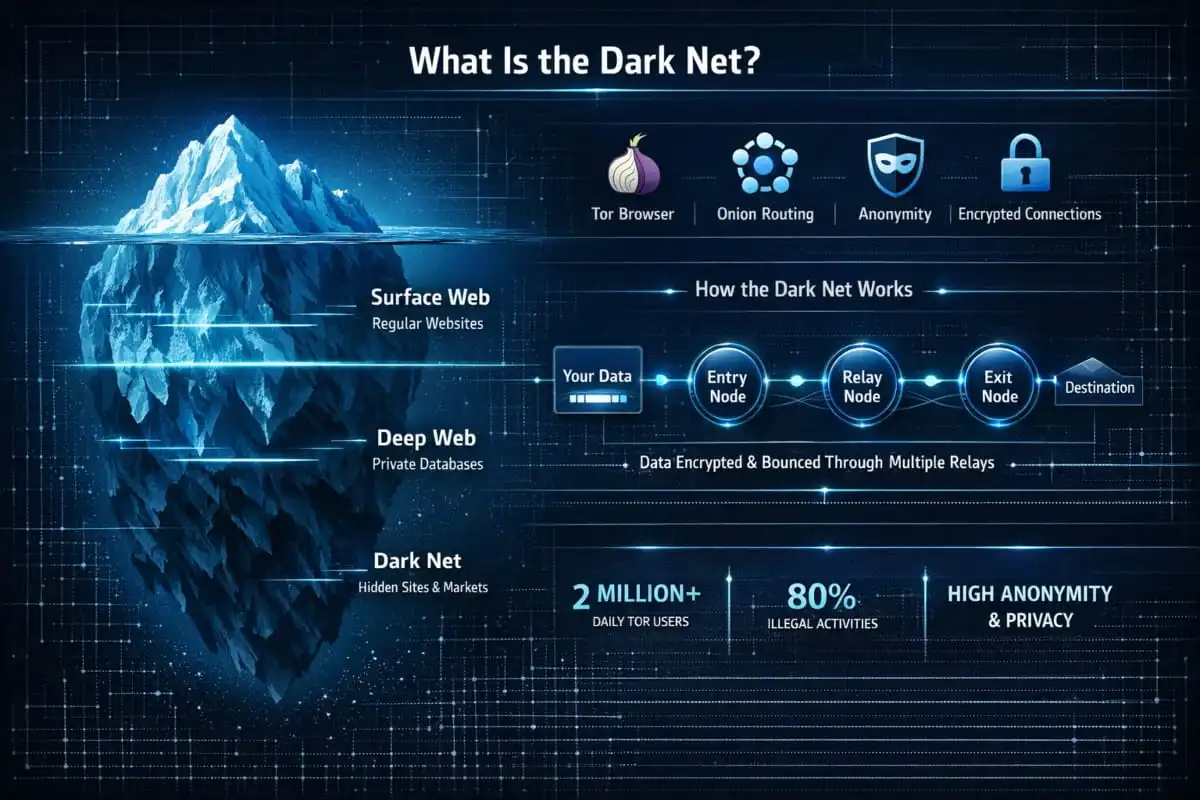
So what is the darknet, exactly? The darknet definition is straightforward: it is an encrypted, overlay network built on top of the standard internet, intentionally hidden from public access. Unlike the websites you find through Google or Bing, darknet sites are not indexed by search engines, cannot be reached through a regular browser, and require special software, most commonly the Tor browser, to access. The darknet’s meaning goes beyond just “hidden websites,” though. It refers specifically to the underlying anonymous network infrastructure itself, not just the content hosted on it.
The darknet explained simply: it runs on the same physical cables and servers as the regular internet, but with a sophisticated layer of encryption and anonymous routing sitting on top. That layer is what makes it fundamentally different from the internet you use every day, one that exists in parallel to it but operates on an entirely separate layer.
It was not built for crime. Darknet origins date back to the mid-1990s, when researchers at the United States Naval Research Laboratory developed technology enabling private, anonymous communication for military and intelligence purposes. Over time, it was adopted by journalists, whistleblowers, privacy advocates, and eventually a much wider range of users, both legitimate and otherwise.
In this darknet guide, you will learn exactly what the darknet is, how it differs from the deep web and the dark web, how it works technically, what you will actually find on it, and whether accessing it is legal in 2026. Whether you are simply curious or work in cybersecurity, this is the complete resource, written clearly, without sensationalism, and updated to reflect how the darknet actually operates today.
What Is the Darknet?
Darknet Definition, Meaning, and Etymology
The Word ” darknet is a compound of two straightforward English words, but its meaning is more precise than casual usage suggests. Understanding the darknet definition and its origins clears up most of the confusion surrounding it.
Darknet meaning: a network overlay built on top of existing internet infrastructure that requires specific software, configurations, or authorisation to access, and within which both users and servers remain intentionally anonymous. The “dark” in darknet does not refer to criminal content. It refers to the network being dark to standard observation, invisible to search engines, inaccessible via regular browsers, and hidden from standard network-scanning tools.
The term itself predates the popular internet. In its earliest technical usage, “darknet” referred simply to portions of a network that did not respond to probes, IP address ranges that were allocated but not in active use, used by researchers to detect anomalous traffic patterns. Microsoft researchers Stuart Feldman, David Lorber, Peter Biddle, and Paul England are widely credited with popularising the term in their 2002 paper “The Darknet and the Future of Content Distribution”, in which they described the darknet as any system enabling peer-to-peer file sharing outside observable, controlled networks.
The contemporary definition of the darknet evolved from that foundation. Today, the term most commonly refers to encrypted overlay networks, primarily the Tor network, in which users and servers operate anonymously and communication is deliberately hidden from external observers.
Darknet vs dark web, etymology note: the distinction between these two terms reflects a layer difference, not a content difference. Darknet refers to the network. The dark web refers to the websites and content accessible on it. Both terms entered mainstream usage around 2013, following the FBI’s shutdown of Silk Road and the subsequent wave of global media coverage. Before that, both were primarily technical terms used within cybersecurity and academic research communities.
In short, the darknet is defined by its architecture, anonymous, encrypted, and deliberately hidden. What happens on it is a separate question entirely.
Who Created the Darknet?
Criminals did not invent the darknet. Its origins date back to the mid-1990s, when researchers at the United States Naval Research Laboratory set out to build a system that would allow intelligence agents and military personnel to communicate online without revealing their identities or locations. The darknet was a government project before it was anything else.
The core technology behind it, called onion routing, was invented by mathematicians Paul Syverson, Michael Reed, and David Goldschlag. Their approach was to wrap internet traffic in multiple layers of encryption, like the layers of an onion, so that no single point in the network could ever identify both who was sending a message and where it was going.
In 2002, this technology was released to the public as the Tor Project, a non-profit organisation that maintains it to this day. Making it open-source was a deliberate strategic choice: a private anonymity network used only by the US government would actually be less secure. The more people using it, the harder it becomes to identify any individual user inside the crowd.

Darknet History Timeline
The darknet has evolved significantly since its origins in classified government research.
| Year | Event |
|---|---|
| 1990s | Onion routing was developed by the US Naval Research Laboratory for secure government communications. |
| 2002 | The Tor Project was publicly released, making anonymous browsing available to anyone worldwide. |
| 2004–2010 | Journalists, activists, and privacy advocates adopted Tor extensively, particularly in countries with strict internet censorship. |
| 2011 | Silk Road launched as the first major darknet marketplace, introducing anonymous online commerce using Bitcoin. |
| 2013 | The FBI shut down Silk Road and arrested founder Ross Ulbricht, bringing worldwide media attention to the darknet for the first time. |
| 2013 onwards | Snowden’s revelations about mass surveillance drove a surge in mainstream interest in online privacy and Tor usage. |
| 2020s | Law enforcement continues running increasingly sophisticated operations against illegal darknet markets while legitimate privacy use continues to grow. |
Is the Darknet Real?
Yes, completely. The darknet is not a myth, an urban legend, or a Hollywood invention. It is a real, functioning network accessed by millions of people worldwide every single day.
What tends to be exaggerated is its scale and content. Popular culture has painted it as an endless abyss of extreme illegal activity. The reality is more measured: the majority of darknet traffic is driven by privacy-conscious individuals, people living under authoritarian governments, journalists protecting sources, and cybersecurity researchers, not the extreme criminal content that headlines fixate on.
Is the darknet real? Absolutely. Understanding what it actually is, rather than what films and news reports make it out to be, is the first step toward forming an accurate picture of how this network works and who uses it.
Darknet vs Dark Web vs Deep Web: The Differences Explained
These three terms get used interchangeably in casual conversation, but they are not the same thing. Confusing them is one of the most common mistakes people make when trying to understand how the hidden internet works. Getting the distinction right matters, particularly if you are approaching this topic from a cybersecurity, journalism, or research angle.

Darknet vs Dark Web: What Is the Difference?
This is where the majority of the confusion lives, and it is worth resolving precisely.
The darknet refers to the network itself, the underlying infrastructure of encrypted, anonymous connections. Think of it as the road system.
The dark web refers to the websites and content that exist on top of that network. Think of it as the buildings built along those roads.
So technically, the dark web is a subset of the darknet. You access dark websites by first connecting through the darknet. When someone says they “visited the dark web,” what they actually did was connect to the darknet using software like Tor and then navigate to websites hosted on it.
In everyday usage, most people use both terms interchangeably, and that is fine for casual conversation. But in cybersecurity, digital forensics, or threat intelligence work, the distinction between the darknet and the dark web is worth keeping precise. The network and the content it carries are two different things.
Darknet vs Deep Web: Not the Same Thing
The deep web is far larger than most people realise, and far less dramatic than the darknet.
The deep web is any part of the internet that is not indexed by search engines. That includes your email inbox, online banking portal, company intranets, academic databases, private cloud storage, and subscription-based content. None of those pages appear in Google results, which technically makes all of them part of the deep web.
By that definition, the deep web accounts for an estimated 90-95% of the entire internet. Most of it is completely ordinary, entirely legal, and accessed by billions of people every day without a second thought.
The darknet is a small, specific subset of the deep web, but what sets it apart is its intent. Deep web content is simply unindexed. Darknet content is deliberately hidden, requires specialized software to access, and is built from the ground up around the principle of anonymization.
The darknet vs deep web distinction in one sentence: all darknet content is technically deep web content, but the vast majority of the deep web has nothing to do with the darknet.
Clearnet vs Darknet: Opposite Ends of the Spectrum
The clearnet, sometimes called the surface web, is the internet most people use every day. Every website reachable through Chrome, Safari, or Firefox without any special configuration is part of the clearnet. It is indexed by search engines, publicly accessible, and your internet service provider can track your activity on it, the sites you visit, and numerous third parties operating in the background.
The darknet sits at the opposite end of almost every one of those dimensions. It is not indexed. It is not accessible through standard browsers. It is built around anonymity as a structural principle rather than an optional feature. Your traffic is encrypted and routed through multiple independent servers before it reaches its destination, making it extremely difficult to trace back to you.
The clearnet vs darknet difference ultimately comes down to visibility and privacy. On the clearnet, you are largely visible by default. On the darknet, you are largely anonymous by design, though not completely untraceable, as years of successful law enforcement operations have made clear.
The Three Layers of the Internet
A useful way to picture the full structure of the internet is to think of it as three distinct layers stacked on top of each other.
The surface web (clearnet) sits at the top. This is everything publicly accessible and searchable: news sites, social media platforms, online shops, and YouTube. Despite its enormous size for everyday users, it represents only a small fraction of total internet content.
The deep web occupies the vast middle layer and accounts for the overwhelming majority of all internet content. Emails, private databases, banking portals, internal corporate systems, medical records, academic archives, anything not indexed by a search engine lives here. It is enormous, mostly legal, and mostly mundane.
The darknet sits at the bottom as a deliberately hidden layer accessible only through tools like Tor or I2P. It is the smallest of the three layers by volume. Still, it contains the widest range of content, from legitimate privacy-focused communities, whistleblowing platforms, and censorship-resistant journalism, to, in certain corners, illegal activity.
Understanding where the darknet sits within this three-layer structure makes every subsequent question about it, how it works, who uses it, and why it exists significantly easier to answer.
The table below presents a side-by-side comparison of the darknet, dark web, and deep web across every dimension that matters, from how each layer is accessed to who can see your activity and what risks each carries.
| Feature | Surface Web (Clearnet) | Deep Web | Darknet / Dark Web |
|---|---|---|---|
| Indexed by Google? | Yes (Publicly crawlable and searchable) | No (Hidden behind paywalls, forms, or authentication layers) | No (Requires specialized darknet crawlers or direct links) |
| Access Method | Standard web browser (Chrome, Safari, Firefox, Edge). | Standard web browser combined with specialized user logins, credentials, or direct unindexed URLs. | Specialized peer-to-peer routing software required (Tor Browser, I2P, Freenet). |
| Anonymous by Design? | No — User activity, IP addresses, and cookies are tracked by default. | No — Heavily tied to verified user sessions, accounts, and financial signatures. | Yes — Layered cryptographic encryption masks physical client identity and routing nodes. |
| Estimated Size | Small (Comprises roughly 4% to 10% of total web traffic). | Vast (The massive bulk of the internet, estimated at ~90%+ of total data volume). | Tiny (A miniscule subset, making up less than 0.01% of the accessible web). |
| Common Examples | YouTube, Wikipedia, public news networks, and open e-commerce platforms. | Online banking applications, private email systems, corporate intranets, and premium academic research databases. | Cryptographic .onion marketplaces, secure whistleblowing networks (SecureDrop), and unindexed privacy forums. |
| ISP Visibility | Full — Your Internet Service Provider logs all visited hostnames, destination domains, and plain-text metadata. | Full — Your ISP monitors the network connection to the domain gateway, though payload content is usually encrypted via HTTPS. | Hidden — Your ISP only logs an active connection to an entry guard node or bridge. They cannot read your target destination or traffic. |
| Primary Risk Profile | Phishing campaigns, persistent ad tracking, script profiling, and corporate data harvesting. | Massive corporate data breaches, server-side database injections, credential stuffing, and identity fraud. | Drive-by zero-day malware, financial exit scams, phishing clones, and sophisticated law enforcement stings. |
| Legality | Completely legal and highly standardized. | Completely legal and mandatory for modern corporate, academic, and personal data management. | Generally legal to access and browse in democratic states; liability shifts based strictly on illicit procurement or transactions. |
What the table makes clear: the deep web is not dangerous; it is your inbox and your bank account. The darknet is a small, deliberately hidden layer where anonymity is structural, not optional. Accessing it is legal in most countries; what you do once inside determines your legal exposure.
Darknet Statistics 2026: The Numbers Behind the Hidden Network
Understanding the darknet in numbers puts its scale, use, and risk in accurate perspective. The following darknet statistics are drawn from the most recent publicly available data from Tor Project metrics, Chainalysis annual reports, and cybersecurity research published through 2025 and 2026.
Tor Network Usage Statistics
- The Tor network currently serves an estimated 2 to 3 million daily users worldwide, according to Tor Project metrics.
- Tor relay infrastructure consists of approximately 7,000 to 8,000 volunteer-operated relays distributed across more than 90 countries.
- The countries with the highest direct Tor usage include the United States, Germany, Russia, France, and the Netherlands.
- Tor usage spikes significantly in countries experiencing political instability or internet censorship events. Documented spikes have been recorded in Iran, Russia, and Belarus following government crackdowns.
- The Tor Browser has been downloaded more than 700 million times since its public release, across all versions.
Darknet Market Statistics
- Darknet markets generated an estimated $1.7 billion in cryptocurrency revenue in 2023, according to Chainalysis, down from the peak years when Hydra Market alone processed over $1 billion annually before its 2022 takedown.
- Following Hydra’s dismantlement, darknet market revenue dropped sharply before recovering, demonstrating the ecosystem’s consistent pattern of disruption and renewal
- Drug sales account for the overwhelming majority of darknet market revenue, estimated at over 90% of total transaction volume across tracked markets.
- The average lifespan of a darknet market before a shutdown or exit scam is approximately 8 to 18 months, though some platforms have operated for several years.
- Exit scams account for a significant proportion of darknet market closures, in some years exceeding the number of law enforcement takedowns.
Darknet and Data Breach Statistics
- Billions of stolen credentials are currently available across darknet forums and markets, with new breach data appearing for sale within hours to days of a corporate breach occurring.
- The average cost of a data breach reached $4.88 million in 2024, according to IBM’s Cost of a Data Breach Report, a figure directly linked to how quickly stolen data is monetised on darknet markets.
- Credential-based attacks, enabled by darknet credential markets, account for a significant share of initial access vectors in enterprise breaches.
- Ransomware groups operate dedicated darknet leak sites where victim data is published as leverage. Over 60 active ransomware leak sites have been tracked by security researchers at various points in 2024 and 2025
- Initial access brokers (IABs), threat actors who sell access to compromised corporate networks on darknet forums, have become one of the fastest-growing segments of the darknet criminal economy.
Law Enforcement Darknet Statistics
- Operation Onymous (2014): 414 darknet services taken down across 16 countries
- Operation Bayonet (2017): simultaneous takedowns of AlphaBay and Hansa Market, affecting hundreds of thousands of users
- Operation DisrupTor (2020): 179 arrests across 6 countries, $6.5 million in cash and cryptocurrency seized
- Hydra Market takedown (2022): largest darknet market seizure in history, $25 million in Bitcoin seized, server infrastructure dismantled by German authorities
- Darknet-related prosecutions have been successfully brought in the US, UK, Germany, Netherlands, Australia, Canada, and dozens of other jurisdictions, demonstrating that darknet anonymity, while powerful, is not absolute.
How Does the Darknet Work? Technology, Infrastructure, and Networks
Understanding how the darknet works is the foundation for understanding everything else about it, who uses it, why it exists, and what makes it genuinely different from simply using a VPN or a private browser tab.

The darknet does not run on a separate physical internet. It runs on the same infrastructure as the regular web. What makes it different is a sophisticated layer of encryption and anonymous routing sitting on top of that shared infrastructure. Before exploring how to access the darknet, it helps to understand the technology that enables it.
Tor Network Explained: How the Onion Router Works
Tor, short for The Onion Router, is the most widely used network for accessing the darknet. It is free, open-source, and maintained by a non-profit organisation. When you connect to Tor, your internet traffic does not travel directly from your device to the website you are visiting. Instead, it is bounced through a series of volunteer-operated servers called nodes or relays, distributed across the world.
Each relay knows only the address of the relay immediately before it and the one immediately after it. No single server in the chain ever knows both who you are and where you are going at the same time. By the time your request reaches its destination, it has passed through at least three different relays in different countries.
This is what makes the Tor network so effective for anonymous browsing. It does not just hide your activity; it structurally prevents any single point in the network from holding enough information to identify you.
Websites on the Tor network use .onion addresses instead of standard domain extensions like .com or .org. These addresses are only resolvable inside the Tor network, which is why they cannot be visited through a regular browser.
Darknet vs VPN: Key Differences
A VPN (Virtual Private Network) and the darknet are both used for privacy, but they work in fundamentally different ways and offer different levels of protection. Confusing the two is one of the most common misunderstandings among users exploring their privacy options for the first time.
| Feature | Virtual Private Network (VPN) | Darknet (Tor Network) |
|---|---|---|
| How it works | Encapsulates and routes all system network traffic through a single encrypted tunnel to a centralized proxy server controlled by the VPN vendor. | Encrypted data packets are wrapped in multiple operational layers and bounced through a decentralized network of 3 distinct, independent relays (Entry, Middle, Exit). |
| Who knows your IP? | The specific VPN provider maintains full visibility over your true residential IP address and public source location. | No single point in the path holds the full map. The entry guard sees your real IP but not the target site; the exit node sees the target site but not your real IP. |
| Who do you trust? | Centralized Trust Model: You place absolute trust in a single commercial entity to manage your metadata, keys, and connection logs securely. | Distributed Trust Model: Security is structurally divided across distinct, volunteer-run cryptographic nodes around the globe. No single party can compromise the chain. |
| Speed & Latency | High / Near-Normal: Direct single-hop routing layout allows for high-bandwidth activities, full HD media streaming, and low-latency gaming. | Noticeably Slower: High latency overhead caused by structural multi-hop bouncing, asymmetric paths, and continuous onion layer processing. |
| Access to .onion sites? | No (Cannot natively resolve cryptographic darknet hidden service domains). | Yes (Natively handles top-level .onion routing tables directly inside the network layer). |
| ISP Visibility | Your Internet Service Provider detects an encrypted tunnel stream targeting a specific VPN data-center IP address. Your final web destinations remain hidden. | Your ISP detects a specialized network signature establishing an connection with a public Tor directory or entry node. Final payloads remain hidden. |
| Anonymity Level | Moderate: Protects your tracking footprint from edge websites, but remains vulnerable if the provider is compelled to log or becomes legally compromised. | High: Built explicitly to withstand mass targeted traffic analysis, metadata collation, and localized surveillance infrastructure. |
| Primary Use Case | Sustaining general clear-web privacy, bypassing regional geographic content walls, securing open public Wi-Fi networks, and streaming media assets. | High-security journalistic source protection, political whistleblowing, bypassing nation-state deep packet inspection (DPI) blocks, and darknet threat intelligence research. |
| Legal Status | Completely legal across the vast majority of international jurisdictions; actively restricted or blocked inside highly authoritarian regimes. | Completely legal to install and browse in standard democratic states; specific underlying transactions or data extractions remain criminal. |
| Provider Accountability | Directly dependent on the commercial vendor’s corporate jurisdiction, business model, and structural audit assertions regarding their “No-Logs” policy. | Decentralized by Design: There is no corporate registry, central point of data storage, or single system administrator to compromise or subpoena. |
The critical distinction is where trust is concentrated. A VPN moves your trust from your internet service provider to your VPN provider, but that provider still knows exactly who you are and what you are connecting to. If their servers are compromised, subpoenaed, or if their no-logs policy is not honoured, your activity can be exposed.
The darknet, through Tor, distributes that trust across multiple independent nodes so that no single party ever holds the complete picture. The entry node knows your IP but not your destination. The exit node knows the destination but not your IP. The middle relay knows neither.
Can you use both together? Yes, and for users in countries where Tor usage itself is monitored, doing so is advisable. Connecting to a VPN before launching Tor (Tor-over-VPN) means your ISP sees only a VPN connection, not that you are using Tor. The VPN provider sees a Tor connection but not your .onion destinations. Neither party holds the full picture.
For everyday privacy needs, streaming, bypassing regional restrictions, and protecting activity on public Wi-Fi, a reputable VPN is sufficient. For genuine anonymity, protecting a source, conducting darknet research, or operating in a high-risk environment, the Tor network provides a structurally stronger foundation than any VPN can.
I2P and Freenet: Alternative Darknet Networks
Tor is not the only darknet network, though it is the most widely known. Two significant alternatives are I2P and Freenet, each built on slightly different principles and serving different use cases within the broader darknet infrastructure.
I2P (Invisible Internet Project) is designed primarily for communication within its own self-contained network rather than anonymous access to the regular web. It uses a system called garlic routing, which bundles multiple encrypted messages together to make traffic analysis even harder than Tor’s approach. I2P is favoured by users who want a highly private, self-enclosed ecosystem for messaging, file sharing, and hosting services entirely within its own network.
Freenet takes a different approach entirely. It is a decentralised, censorship-resistant platform where users contribute a portion of their hard drive storage to host content collectively. Files are broken into encrypted fragments and distributed across thousands of nodes. No single person hosts the entire file, making it extremely difficult for anyone, including law enforcement, to locate or remove content once it has been published.
Both I2P and Freenet are smaller and more technically demanding than Tor, but they serve important and distinct roles within the darknet ecosystem.
Onion Routing Explained: The Technology Behind Darknet Anonymity
Onion routing is the foundational technology behind Tor and the core concept that enables anonymous internet communication. The name comes directly from how it works.
When you send a request through Tor, your data is wrapped in multiple layers of encryption, one for each relay node it will pass through. As the data travels through the network, each relay decrypts one layer at a time, like peeling back the skin of an onion, revealing only the address of the next relay in the chain. The innermost layer is decrypted only by the final destination.
The result is a strict separation of knowledge across the network:
- The entry node knows your IP address but not your destination
- The middle relay knows neither your IP nor your destination
- The exit node knows the destination but not your original IP address
No single point in the chain holds the full picture. This architecture was specifically designed so that even if one or two nodes are compromised or monitored, the anonymity of the overall communication remains intact. It is an elegant engineering solution to a genuinely difficult problem.
Darknet Architecture: How It Differs from a VPN
The darknet’s architecture is what sets it fundamentally apart from tools like a VPN or a private browser.
A VPN hides your traffic from your internet service provider and routes it through a single server, but that server knows exactly who you are and where you are going. Using a VPN means shifting your trust from your ISP to your VPN provider. The trust is still concentrated in one place.
The darknet, particularly through Tor, distributes that trust across multiple independent nodes so that no single party ever holds complete information. Combined with end-to-end encryption, .onion hidden services, and the fact that darknet servers can also hide their own physical location, the architecture creates a genuinely two-way anonymity system, one that protects both the user and the server from identification simultaneously.
This is why the darknet is used not just for browsing but for hosting. Journalists configure secure drop platforms on .onion addresses. Organisations publish censorship-resistant content. The architecture ensures that both sides of the connection remain private by design, not by policy.
P2P Darknets: Friend-to-Friend Networks
Beyond Tor, I2P, and Freenet, there is a broader category of darknet infrastructure known as peer-to-peer darknets. These are decentralised networks where users connect directly to each other, often by invitation only, rather than through any centralised relay infrastructure.
Friend-to-friend networks are the clearest example. In these systems, each user connects only to people they personally trust, creating a web of private, encrypted connections that is nearly impossible to map from the outside. Retroshare is one of the more established platforms built on this model.
P2P darknets tend to be smaller and slower than Tor, but they offer a fundamentally different kind of security, one based on social trust rather than technical anonymity alone. They are particularly valuable in high-risk environments where even connecting to a publicly known network like Tor could itself attract unwanted attention.
How to Access the Darknet Safely in 2026
Accessing the darknet is not as technically complex as most people assume. The barrier is not skill; it is knowledge. The bigger challenge is doing it safely, because careless mistakes can expose your identity even on a network built for anonymity.

One important note before starting: accessing the darknet is legal in most countries. What you do once inside determines the legal boundary. Browsing privacy forums, reading uncensored news, or researching cybersecurity is entirely lawful. Engaging in illegal transactions is not.
How to Access the Darknet on Desktop (Tor Browser)
The Tor Browser is the standard method for accessing the darknet on desktop and laptop computers. It is a modified version of Firefox, preconfigured to automatically route all traffic through the Tor network. Download it only from the official Tor Project website at torproject.org; third-party downloads carry a real risk of containing malware.
Once installed, click Connect. Tor establishes a circuit through three relay nodes in 5 to 30 seconds. You can then navigate directly to .onion addresses in the address bar. Never resize the browser window, install additional extensions, or log in to personal accounts while connected; each action creates a fingerprint that undermines your anonymity.
How to Access the Darknet on Android
Download the official Tor Browser for Android from the Google Play Store or directly from torproject.org. It functions identically to the desktop version. For system-wide Tor routing, not just browser traffic, use Orbot, the Tor Project’s proxy app, which tunnels your entire device’s connection through the Tor network. Avoid any unofficial Tor apps on third-party stores; several are designed to harvest data rather than protect it.
How to Access the Darknet on iPhone
The recommended option for iOS is Onion Browser, an open-source app endorsed by the Tor Project and available on the App Store. It supports .onion addresses and routes browsing through the Tor network. Unlike Android with Orbot, there is currently no reliable way to route all iOS device traffic through Tor; Onion Browser only covers in-browser activity.
Darknet OPSEC Guide: Protecting Your Identity in 2026
Technical tools only go so far. Human behaviour is consistently the weakest point in any anonymity setup; it is the reason the majority of identified darknet users were caught, not a flaw in Tor itself.
The core darknet OPSEC principles every user should follow:
- Never use your real identity. No real name, personal email, or any account linked to your normal online presence. Create entirely separate identities for darknet activity.
- Stay silent on clearnet platforms. A significant number of arrests have resulted from users discussing darknet activity on Reddit, Twitter, or Discord servers that were later monitored.
- Handle downloaded files carefully. PDFs, images, and documents can contain tracking beacons that phone home to a server with your real IP the moment you open them outside of Tor. Open downloads only in an isolated, offline environment.
- Disable JavaScript in the Tor Browser when visiting unknown .onion sites. JavaScript has been exploited historically to de-anonymise Tor users through browser vulnerabilities.
- Use Tails OS for high-security access. Tails is a privacy-focused operating system that runs entirely from a USB drive, loads into RAM only, and wipes every trace of your session on shutdown. It is the setup of choice for journalists, activists, and security researchers working in sensitive environments, and it comes with the Tor Browser pre-installed.
For a complete step-by-step walkthrough, including VPN configuration, Tails OS setup, and device-specific guides for Mac, Windows, Chromebook, and mobile, see the full How to Access the Dark Web Safely guide →
Darknet OPSEC Guide 2026: Protecting Your Identity Beyond Tor
OPSEC (operational security) refers to the practices and disciplines that protect your identity beyond simply using Tor. Technical anonymity tools are the foundation, but they are not sufficient on their own. Human behaviour is consistently the weakest point in any anonymity setup, and it is the primary reason the majority of identified darknet users have been caught, not through Tor vulnerabilities, but through their own mistakes.
The following darknet OPSEC principles apply in 2026, regardless of what you are using the darknet for:
Compartmentalise your identity completely. Never use your real name, personal email address, or any account linked to your actual identity on the darknet. Create entirely separate identities for darknet activity, separate usernames, separate email addresses created through the Tor network, separate personas, and never allow them to cross-reference your normal online presence in any way. A single slip, or a reused username across both environments, is enough to link an anonymous darknet identity to a real person.
Never discuss darknet activity on clearnet platforms. A disproportionate number of darknet arrests have resulted not from sophisticated surveillance but from users discussing their activity on Reddit, Twitter, Telegram, or Discord servers that were later monitored or seized. What you do on the darknet should not be discussed anywhere on the regular internet.
Handle all downloaded files in isolation. PDFs, images, Word documents, and executable files downloaded from the darknet can contain tracking beacons or embedded malware designed to contact an external server with your real IP address the moment you open them outside of Tor. Always open downloaded files in an isolated, air-gapped environment, ideally while completely offline and running a privacy-focused OS like Tails.
Disable JavaScript on unknown .onion sites. JavaScript has been exploited in documented cases to de-anonymise Tor Browser users by exploiting browser-level vulnerabilities. In the Tor Browser security settings, set the security level to Safest when visiting unfamiliar .onion addresses.
Use Tails OS for anything sensitive. Tails is a live operating system that runs entirely from a USB drive, loads into RAM only, and automatically wipes every trace of your session on shutdown. Nothing is written to your hard drive. For journalists, activists, security researchers, or anyone accessing sensitive darknet content professionally, Tails is not a luxury; it is the minimum responsible standard. Download it only from the official source at tails.boum.org and verify the cryptographic signature before use.
Treat cryptocurrency as pseudonymous, not anonymous. Bitcoin transactions are permanently recorded on a public blockchain. If you transact on the darknet using Bitcoin without additional privacy measures, those transactions can be traced. Use Monero for any privacy-sensitive transactions, and avoid converting darknet cryptocurrency back to fiat through exchanges that require identity verification.
Assume every market could be law enforcement. In several documented operations, agencies have quietly assumed control of darknet markets and continued running them for weeks or months before making arrests. The users transacting on those platforms had no way of knowing. Never assume that operating on a functioning market means the market is legitimate.
OPSEC is not paranoia. It is the recognition that anonymity is a system of layered practices, not a single tool. Tor protects your network traffic. Everything else is up to you.
What Is on the Darknet? A Realistic Overview of Content and Services
The darknet has a reputation problem. Years of sensationalised news coverage and Hollywood dramatisation have created an image of an endless digital hellscape where every click leads to something horrifying or criminal. The reality is considerably more layered than that.

Yes, illegal content and services exist on the darknet. But they represent one corner of a much broader ecosystem. Understanding the full picture, what is actually on the darknet, who puts it there, and why, is essential for anyone trying to form an accurate view of how this network operates.
Legitimate Darknet Uses
The single most important thing to understand about darknet content is that a substantial portion of it serves entirely legitimate purposes. The same anonymity that makes the darknet attractive to bad actors makes it equally valuable to people with genuinely good reasons to stay private.
People living under authoritarian governments use the darknet to access news, social media, and communication tools that are blocked or censored in their countries. Citizens of nations with heavy internet surveillance use it simply to speak freely without fear of government monitoring. Privacy advocates and technologists use it to research and develop tools that protect civil liberties online.
Security teams and corporations use it for darknet threat intelligence, monitoring forums and marketplaces for leaked credentials, stolen data, or early chatter about planned attacks against their organisations. Law enforcement agencies worldwide maintain an active presence on the darknet for investigative purposes.
The darknet also hosts mirrors of mainstream websites specifically for users in censored regions. Facebook operates an official .onion address. The BBC and other major news organisations publish darknet versions of their sites to reach audiences in countries where their content is blocked.
Whistleblowing and Journalism on the Darknet
One of the most important and well-documented legitimate uses of the darknet is secure communication between journalists and their sources. SecureDrop, an open-source whistleblowing platform developed with support from the Freedom of the Press Foundation, runs exclusively as a .onion service and is used by major news organisations including The New York Times, The Washington Post, and The Guardian.
The reason is structural, not preferential. A whistleblower contacting a journalist via email, phone, or even an encrypted messaging app leaves metadata that can eventually be traced. A SecureDrop submission through Tor leaves none. The source’s identity is protected by the network’s architecture, not by a promise.
This use case alone illustrates why the darknet matters beyond its criminal associations. Without it, many of the most significant investigative journalism stories of the past decade, stories that exposed genuine wrongdoing at the highest levels of government and industry, would never have reached a reporter’s desk.
Darknet Forums and Communities
A significant share of darknet traffic is simply people talking. The darknet hosts a wide range of forums and communities covering cybersecurity research, privacy technology, politics, philosophy, and harm reduction, many of which exist specifically because their participants feel monitored, marginalised, or censored on the clearnet.
Dread is the most prominent darknet forum, consistently described as the Reddit of the darknet. It hosts discussions on security, privacy, darknet market reviews, and general topics, functioning as a community hub where users share information and debate ideas in an environment free from surveillance.
Beyond Dread, forums exist for specific technical disciplines, political movements, and communities engaging in legal but sensitive activities, political dissent, drug harm reduction discussions, and conversations on topics that are taboo in certain countries but entirely lawful in others.
Not all of it is content worth defending. But the existence of these communities reflects a genuine human need for spaces where speech is not monitored or filtered by default.
Darknet Markets Overview
Darknet markets are online marketplaces operating within the Tor network that typically facilitate the sale of goods, most commonly controlled substances, using cryptocurrency as payment. They function similarly to mainstream e-commerce platforms, complete with product listings, seller ratings, buyer reviews, and escrow systems to manage transactions.
The concept was introduced in 2011 with Silk Road, the first major darknet marketplace, founded by Ross Ulbricht. Silk Road operated for two years and processed hundreds of millions of dollars in transactions before the FBI shut it down in 2013. Ulbricht’s subsequent life sentence sent a clear message, but it did not end darknet markets. It multiplied them.
AlphaBay emerged as the largest darknet market of its era before a coordinated international law enforcement operation took it down in 2017. It was later relaunched by one of its original administrators. The cycle of markets rising, being dismantled, and being replaced by new platforms has continued ever since.
According to Chainalysis darknet market reports, these markets collectively process hundreds of millions of dollars in cryptocurrency transactions annually, even as individual platforms are regularly taken down. The 2025 and 2026 reports show that while major operations temporarily reduce activity, the overall darknet market ecosystem has proven consistently resilient.
Are darknet markets still active in 2026? Yes. The landscape shifts constantly, and specific platforms come and go, but the ecosystem itself shows no signs of disappearing. Demand drives supply, and supply continues to find a way to operate.
One risk worth understanding clearly: exit scams. An exit scam occurs when the administrators of a market that holds cryptocurrency in escrow for buyers and sellers abruptly disappear, taking all funds with them. Several of the largest darknet markets have ended this way rather than through law enforcement action, leaving users with no recourse and no recovery mechanism.
Darknet Myths and Horror Stories: What Is Not Real
No honest overview of darknet content is complete without addressing the myths, because they are persistent, widely believed, and almost entirely false.
The most enduring darknet myth is the red room: a live-streamed torture or murder broadcast that viewers pay to watch in cryptocurrency. Despite decades of claims, no verified evidence of a functioning red room has ever been produced. The concept is almost certainly an internet urban legend that has been recycled and embellished across forums and documentaries for years.
Darknet hitman services are another common myth. Numerous sites claiming to offer contract killing are straightforward scams; they accept Bitcoin and deliver nothing because the service does not exist. Several documented cases show that individuals who attempted to use these services were either defrauded or, in some cases, identified and arrested for attempted murder.
The broader idea that the darknet contains an infinite catalogue of extreme illegal content in every imaginable category is significantly overstated. Illegal content exists, which is not in dispute. But the darknet is not the bottomless pit of horror that popular media portrays. Much of what circulates as darknet “screenshots” or first-hand accounts is fabricated, exaggerated, or taken wildly out of context.
Understanding the darknet accurately means resisting two equal and opposite distortions: dismissing it as entirely harmless, or mythologising it as uniquely monstrous. It is a technology, one that reflects the full range of human behaviour, constructive and destructive alike.
Is the Darknet Illegal? Laws, Risks, and What Can Get You Arrested
This is one of the most searched questions about the darknet, and the answer is not as simple as yes or no. The legality of the darknet depends entirely on where you are in the world and, more importantly, what you are doing on it. Conflating the network itself with the illegal activity that sometimes occurs on it is a mistake that leads to unnecessary fear and genuine misunderstanding.

Is Accessing the Darknet Illegal?
In most countries, accessing the darknet is completely legal. Downloading the Tor Browser, connecting to the Tor network, and browsing .onion websites do not, in themselves, carry criminal liability. They are no different, legally, from using a VPN or opening a private browser window.
The United States, the United Kingdom, most of Europe, Canada, and Australia all permit access to the darknet without restriction. Journalists, security researchers, academics, and privacy advocates use it openly and professionally every day.
There are exceptions. In countries like China, Russia, Iran, and North Korea, Tor usage is either heavily restricted or outright banned as part of broader internet censorship regimes. In those jurisdictions, simply connecting to the Tor network can attract government attention, regardless of what you do once connected.
For the vast majority of users in democratic countries, the answer is clear: accessing the darknet is not illegal. What you do there is what determines your legal exposure.
Is the Darknet Safe to Access?
Accessing the darknet is not inherently dangerous, but it is not without risk, and conflating legal safety with physical or technical safety is a mistake worth avoiding.
From a legal standpoint, accessing the darknet is safe in most democratic countries. Downloading the Tor Browser, connecting to the Tor network, and browsing .onion sites do not, in and of themselves, carry criminal liability in the United States, United Kingdom, European Union, Canada, or Australia. The legal risk comes from what you do once connected, not from the act of connection itself.
From a technical standpoint, the risks are more nuanced. Tor provides strong but not absolute anonymity. The most common technical risks on the darknet include:
- Malicious .onion sites that attempt to install malware or exploit browser vulnerabilities the moment you visit
- Phishing sites impersonating legitimate darknet markets or services are designed to steal login credentials or cryptocurrency.
- JavaScript exploits that have historically been used to de-anonymise Tor users by making the browser contact an external server with your real IP address.
- Malware-laced downloads, files that appear legitimate but contain tracking beacons or remote access tools
From a personal safety standpoint, the darknet itself poses no direct physical threat to someone browsing it. The risks are digital: malware, scams, and the potential legal exposure that comes from accessing illegal content, even accidentally in some jurisdictions.
The honest answer to “Is the darknet safe?” is: safe enough to access responsibly, with the right tools and reasonable caution. Using the Tor Browser with JavaScript disabled, avoiding unverified downloads, and staying away from illegal content removes the vast majority of practical risk for the ordinary user. For anyone accessing it in a professional capacity, security research, journalism, threat intelligence, Tails OS, and strict OPSEC practices raise that safety floor considerably.
What Activities Are Illegal on the Darknet?
The darknet does not create a legal exception for criminal behaviour. Every law that applies in the physical world and on the regular internet applies equally to activity conducted on the darknet. Anonymity is a technical feature of the network; it is not a legal shield.
The activities that carry serious criminal liability on the darknet fall into well-defined categories:
- Purchasing or selling controlled substances through darknet markets is a criminal offence in virtually every jurisdiction, regardless of whether the transaction is conducted anonymously.
- Buying, selling, or possessing child sexual abuse material carries severe criminal penalties and is subject to active international law enforcement cooperation.
- Commissioning or facilitating violence, even through services that turn out to be scams, can constitute attempted murder or conspiracy charges.
- Trafficking in stolen financial data, hacked credentials, counterfeit documents, or illegally obtained personal information constitutes fraud and identity theft.
- Conducting or facilitating cyberattacks, deploying ransomware, or selling hacking tools and exploit kits carries significant criminal exposure under computer fraud laws in most countries.
The common thread is straightforward: the crime is the activity, not the network. Using Tor does not make illegal things legal. It makes them harder to trace, but as years of successful prosecutions have demonstrated, not impossible.
Darknet Arrests and Major Law Enforcement Busts
The history of law enforcement on the darknet is a consistent reminder that anonymity there is powerful but not absolute. Some of the most significant criminal prosecutions of the past decade have centred on darknet activity, and in almost every case, the technical anonymity of Tor remained intact. What failed was human behaviour.
Ross Ulbricht, founder of Silk Road, was arrested in 2013 in a San Francisco public library. Despite operating one of the most sophisticated anonymous marketplaces ever built, he was identified through a combination of early OPSEC mistakes, including using his real email address in early forum posts, and traditional investigative work. He was sentenced to life in prison without the possibility of parole.
Alexandre Cazes, administrator of AlphaBay, was arrested in Thailand in 2017 following a joint FBI, DEA, and Europol operation. The vulnerability was not Tor. A server configuration error caused AlphaBay’s welcome email to be sent from his personal ProtonMail address, which was registered under his real name.
Welcome to Video, a darknet platform distributing child sexual abuse material, which was dismantled in 2018 through blockchain analysis. Investigators traced Bitcoin transactions to real-world identities, resulting in arrests across 38 countries. The case established clearly that cryptocurrency is far less anonymous than many darknet users assume.
The pattern across all major darknet arrests is the same: poor operational security, careless mistakes, and the false assumption that anonymous online activity can never be linked back to a physical identity.
FBI and Law Enforcement Darknet Operations
Law enforcement engagement with the darknet has grown substantially more sophisticated over the past decade. Early operations relied on informants and traditional investigative methods. Modern darknet operations combine those approaches with advanced blockchain analytics, undercover infiltration, international cooperation, and legal processes to compel information from infrastructure providers.
The FBI, Europol, the DEA, and equivalent agencies across dozens of countries now maintain dedicated units focused exclusively on darknet investigations.
- Operation Onymous (2014) took down over 400 darknet services simultaneously in a coordinated international operation.
- Operation DisrupTor (2020) resulted in 179 arrests across six countries targeting darknet drug vendors.
- In several documented cases, agencies have quietly assumed control of darknet markets and continued operating them for weeks or months, harvesting user data and mapping vendor networks before making arrests.
That last point is worth emphasising. Users who believed they were transacting on a legitimate darknet market were, in some instances, transacting directly with federal agents. The takeaway is not that the darknet is a trap; it is that law enforcement has developed genuinely effective methods for darknet investigation, and the assumption that anonymity guarantees safety has cost many people their freedom.
Legal Darknet Uses: Who Should Not Worry
The darknet has substantial, well-documented, legitimate uses, and using it for those purposes carries no legal risk whatsoever in most countries.
Journalists and sources use it to communicate securely through platforms like SecureDrop, protecting identities that email and messaging apps cannot fully shield. Activists and political dissidents in authoritarian countries use it to organise, communicate, and access uncensored information that their governments have blocked. Cybersecurity professionals use it to conduct threat research, monitor for leaked organisational data, and study attack methodologies in a controlled environment. Privacy-conscious individuals use it because they prefer not to be tracked, profiled, or monetised by corporations or governments.
Academic researchers study darknet ecosystems to understand cybercrime, drug markets, and underground economies, research that directly informs policy, law enforcement strategy, and public health initiatives worldwide.
The darknet is a tool. Like any tool, its legal and ethical character is determined entirely by how it is used. That distinction is the foundation of any honest conversation about it, and it separates the overwhelming majority of darknet users from the minority that law enforcement is actually focused on.
Darknet Monitoring and Cybersecurity: Protecting Your Organization
For most individuals, the darknet is something to understand and navigate carefully. For cybersecurity professionals, it is something to watch closely and continuously. The darknet is where stolen data gets sold, where cyberattack infrastructure gets built, and where the earliest warning signs of threats against organisations first appear. Knowing how to monitor it effectively has become a core competency for modern security teams.

What Is Darknet Monitoring?
Darknet monitoring is the practice of systematically scanning darknet forums, marketplaces, paste sites, and hidden services to identify information or activity that poses a risk to an organisation or individual. It is a form of proactive cybersecurity, finding threats before they materialise rather than responding after damage has already been done.
At its most fundamental level, darknet monitoring means checking whether your organisation’s data has appeared where it should not. Leaked employee credentials, stolen customer records, exposed internal documents, and compromised payment card data all routinely surface on darknet marketplaces and forums shortly after a breach, often before the affected organisation even knows the breach occurred.
At a more advanced level, darknet monitoring extends to tracking threat actor behaviour, identifying new malware or exploit kits being sold or distributed, monitoring chatter about planned attacks, and mapping the infrastructure of cybercriminal networks targeting specific industries.
The value of darknet monitoring is fundamentally about timing. A breach detected through darknet exposure monitoring within hours of data appearing for sale allows an organisation to reset credentials, notify affected parties, and close vulnerabilities before the leaked data is widely exploited. A breach discovered weeks or months later, after credentials have been sold and used repeatedly, is dramatically more damaging and dramatically more expensive to contain.
Internal Darknet Scan: What It Reveals About Your Exposure
An internal darknet scan checks whether your organisation’s specific assets, employee credentials, corporate email domains, internal IP ranges, proprietary documents, or executive identities have appeared across darknet markets, forums, malware logs, or breach databases.
The results of a darknet scan typically reveal one of three situations: no exposure (clean), passive exposure (data present but not yet actively exploited), or active exposure (credentials or data currently being traded or used in attacks). Each scenario requires a different response, and knowing which one you are in is the starting point for any meaningful darknet risk programme.
Run a free darknet exposure report for your domain →
Best Darknet Monitoring Tools in 2026
The darknet monitoring tool market has grown significantly as enterprise demand for threat intelligence has increased. Tools range from fully automated platforms that continuously scan and alert to research-oriented services that deliver curated intelligence reports. Here is how the leading platforms compare.
DeXpose is a unified digital risk protection platform built by a team averaging 10 years of hands-on offensive security experience, practitioners who understand how cybercriminals actually operate, not just how to observe them from a distance. DeXpose gives enterprises and government organisations real-time visibility into their exposure across dark web markets, malware logs, data breaches, and deep web sources, all from a single dashboard.
What distinguishes DeXpose in practical terms is its starting point: a free darknet exposure report that any organisation can run immediately, covering dark web market mentions, compromised credentials from malware logs, and known breach appearances, before committing to a paid service. For organisations that need enterprise-grade darknet intelligence without the complexity and cost of the largest market players, DeXpose offers the right combination of technical depth and operational accessibility. Start with a free report at dexpose.io →
Darknet Threat Intelligence: Beyond Basic Monitoring
Darknet threat intelligence goes beyond checking whether your data has leaked. It involves understanding the threat landscape your organisation operates in, who is targeting your industry, what tools and techniques are being actively traded, and where the next wave of attacks is likely to originate.
Threat intelligence analysts working the darknet monitor a specific set of environments. Criminal forums like Exploit and XSS, Russian-language platforms where sophisticated threat actors trade tools, services, and stolen data, provide early visibility into emerging attack techniques before they are deployed in the wild. Darknet marketplaces reveal what types of access and data are being actively commoditised. Telegram channels, sitting at the intersection of the clearnet and darknet ecosystems, have become increasingly important as coordination hubs for cybercriminal groups.
The output of this intelligence work feeds directly into defensive operations. When an analyst identifies that initial access brokers are selling VPN credentials for companies in a specific sector, that intelligence can trigger immediate credential audits and the enforcement of multi-factor authentication across affected organisations, before a single attack has been launched.
Darknet threat intelligence is also essential for ransomware visibility. Most major ransomware operators maintain dedicated darknet leak sites where they publish victim names, post stolen data as leverage, and negotiate ransoms publicly. Monitoring these sites gives security teams and incident responders real-time visibility into active campaigns targeting their industry.
Darknet Brand Protection
Brand protection on the darknet is a specific, increasingly urgent discipline for organisations whose reputations, intellectual property, or customer trust can be damaged by darknet activity.
The most common brand-related darknet threats include the sale of counterfeit products using a brand’s identity, phishing kits designed to impersonate a brand’s login pages, the sale of compromised customer accounts, and the leaking or auctioning of proprietary documents, source code, or trade secrets.
Darknet brand protection monitoring involves continuously scanning for mentions of an organisation’s name, domain, product names, and executive identities across forums and markets. When a threat is identified, a phishing kit is being sold, counterfeit goods are being advertised, or customer data is being auctioned, the organisation can act to mitigate damage, notify affected customers, and in some cases work with law enforcement to pursue responsible parties.
For financial institutions, healthcare organisations, and large consumer brands, darknet brand protection is no longer optional. The volume and speed at which brand-related threats emerge and circulate make manual monitoring impractical. Automated darknet scanning with human analyst oversight is the operational standard for organisations taking this seriously.
Darknet OSINT and Investigation
Darknet OSINT and darknet investigation are closely related disciplines that overlap significantly in professional practice. OSINT, open-source intelligence, refers to the collection and analysis of information from publicly available sources. Darknet investigation extends that practice into hidden corners of the internet that require specialised access and tools.
For cybersecurity investigators, journalists, and law enforcement analysts, combining OSINT techniques with darknet research yields a more complete picture of threat actors, criminal networks, and illicit operations than either approach alone.
A typical darknet investigation begins with a leaked credential surfacing on a paste site, a clearnet OSINT source. Tracing that credential leads to a darknet forum where it was first sold. Analysing the seller’s posting history reveals patterns, communication styles, and operational details that can be cross-referenced with clearnet sources to build a profile of the actor behind the account.
Tools commonly used in darknet OSINT investigations include Maltego for relationship mapping, Chainalysis and TRM Labs for tracing cryptocurrency flows across blockchain records, and specialised darknet indexing services that enable investigators to query archived darknet content without manually visiting every relevant site.
The discipline requires patience, technical knowledge, and a clear understanding of legal boundaries, particularly around evidence handling when an investigation is intended to support legal proceedings.
Darknet Data Feeds
For organisations that want to integrate darknet intelligence directly into their security operations infrastructure, darknet data feeds provide a structured, continuous stream of threat data that SIEM platforms, threat intelligence tools, and automated alerting systems can ingest directly.
Darknet data feeds typically deliver information in standardised formats, JSON, STIX/TAXII, or CSV, covering newly discovered leaked credentials, fresh paste site content, newly listed stolen data on darknet markets, newly registered .onion domains, and indicators of compromise associated with known threat actors.
The key advantage of data feeds over platform-based monitoring tools is automation and integration. Rather than logging into a separate portal to check alerts, security teams receive darknet intelligence directly inside the tools they already use, correlating darknet signals with internal telemetry to surface threats specific to their environment.
Providers, including DarkOwl, Flashpoint, and Recorded Future, offer API-based darknet data feeds for enterprises. For organisations with mature security operations centres, integrating darknet data feeds into the broader threat intelligence pipeline turns the darknet from an unmonitored blind spot into a managed and visible part of the threat landscape.
Darknet, Cryptocurrency, and Financial Crime
The relationship between the darknet and cryptocurrency is not accidental; it is structural. The anonymity that makes the darknet attractive as a network is only useful for commerce if the payment system matches it. Traditional financial systems, bank transfers, credit cards, and PayPal leave clear identity trails that completely undermine any anonymity the Tor network provides. Cryptocurrency filled that gap, and the two technologies have been deeply intertwined ever since.

Understanding how darknet financial flows work matters well beyond the darknet itself. It sits at the centre of modern financial crime, regulatory policy, and the ongoing debate about how much privacy cryptocurrency users should have, and how much law enforcement can see through.
Why the Darknet Uses Cryptocurrency
The core requirement for darknet commerce is a payment method that does not require either party to reveal their real identity and cannot be reversed or frozen by a third party. No traditional financial instrument meets both criteria simultaneously.
Credit cards require identity verification and can be charged back or traced through the issuing bank. Wire transfers are logged by financial institutions and subject to anti-money laundering reporting requirements. Even cash, the most anonymous traditional payment method, becomes impractical for online transactions and international commerce.
Cryptocurrency solves both problems at once. A wallet can be created without identity verification. Transactions are processed by a decentralised network rather than a bank or payment processor, meaning no single institution can freeze funds or reverse a transaction. And while the transaction history is recorded on a public blockchain, wallet addresses are strings of characters rather than names, providing a layer of pseudonymity that, combined with the Tor network, creates a reasonably effective system for financial privacy.
Bitcoin was the natural first choice when Silk Road launched in 2011, simply because it was the only viable cryptocurrency at the time. Its widespread adoption on darknet markets drove significant early public awareness of Bitcoin, one of the more ironic footnotes in the history of both technologies.
Bitcoin Mixers and Tumblers: How Darknet Users Hide Transactions
Bitcoin’s pseudonymity has a fundamental limitation that darknet users discovered quickly: the blockchain is entirely public. Every transaction ever made in Bitcoin is permanently recorded and publicly visible. While wallet addresses are not inherently linked to real identities, the transparent transaction graph means that with sufficient analysis, Bitcoin flows can be traced, and real identities can sometimes be inferred at the points where cryptocurrency intersects with the real world, such as exchange deposits and withdrawals.
Bitcoin mixers, also called tumblers, were developed specifically to address this problem. A mixer pools Bitcoin from multiple users, breaks the transaction chain, and returns equivalent amounts from a different set of inputs. The goal is to sever the traceable link between the source of funds and their destination.
The process works as follows: a user sends Bitcoin to the mixer along with a destination address. The mixer combines those funds with Bitcoin from other users in the pool, applies randomised delay times and variable transaction amounts to obscure patterns, then sends back equivalent funds from a different wallet, ensuring the output cannot be directly linked to the input on the blockchain.
Mixing services have faced sharply increasing legal scrutiny. In 2022, the US Treasury Department sanctioned Tornado Cash, a cryptocurrency mixer operating on the Ethereum network, marking the first time a piece of open-source software was formally sanctioned. Several Bitcoin mixer operators have since faced criminal prosecution for facilitating money laundering. The legal environment around mixing services has become significantly more hostile, as regulators and law enforcement have developed clearer frameworks that treat mixing as an enabler of financial crime rather than a neutral privacy tool.
Darknet Money Laundering: How Criminally Obtained Crypto Gets Cleaned
Money laundering, the process of making criminally obtained funds appear to have a legitimate origin, is a central operational challenge for anyone profiting from darknet criminal activity. Cryptocurrency earned through darknet drug sales, fraud, or cybercrime is recorded on a blockchain where its criminal origin can potentially be traced. Converting it into spendable real-world currency without triggering financial crime detection is the problem darknet money laundering attempts to solve.
The darknet money laundering process typically follows a layering structure:
- Breaking the trail, funds earned on darknet markets are first moved through mixing services or exchanged for privacy coins like Monero to sever the transaction chain.
- Layering, funds are moved through a series of intermediate wallets, sometimes dozens, to obscure the origin further and complicate blockchain tracing.
- Conversion, funds eventually reach a cryptocurrency exchange where they are converted into fiat currency, ideally through exchanges in jurisdictions with less rigorous know-your-customer requirements or through peer-to-peer trading platforms.
The scale of darknet money laundering is substantial. Chainalysis data consistently shows that a significant portion of cryptocurrency flowing out of darknet markets moves through exchanges, including, in documented cases, major regulated exchanges where automated compliance systems failed to flag the funds as high risk.
Beyond direct drug sales, darknet markets facilitate the sale of stolen financial credentials, compromised bank account access, and money mule recruitment, creating interconnected financial crime networks in which the darknet serves as both a marketplace and a coordination infrastructure for laundering operations that extend deep into the legitimate financial system.
Blockchain Analytics: How Chainalysis and TRM Labs Trace Darknet Funds
The development of blockchain analytics as a professional discipline has fundamentally changed the risk calculation for darknet financial activity. What was once assumed to be essentially untraceable has proven, case after case, to be significantly more transparent than its users believed.
Blockchain analytics firms work by mapping the flow of cryptocurrency transactions across public blockchains. These clustering wallet addresses appear to be controlled by the same entity, and identify points where anonymous cryptocurrency intersects with known exchanges, services, and previously identified criminal wallets. Over time, these firms have built extraordinarily detailed maps of how cryptocurrency moves through the global financial system, including directly through darknet markets.
Chainalysis is the dominant player in the space, working extensively with the FBI, DEA, IRS Criminal Investigation, and Europol. Its tools have been used as evidence in major darknet prosecutions, and its annual crypto crime reports set the standard for public data on illicit cryptocurrency flows. The Chainalysis Reactor tool allows investigators to trace cryptocurrency transactions across complex multi-hop laundering chains visually.
TRM Labs operates in the same space with a strong focus on financial institution compliance and law enforcement support. Its blockchain intelligence platform covers a broader range of blockchains than most competitors, reflecting the diversification of cryptocurrency use across the darknet ecosystem well beyond Bitcoin.
Elliptic provides similar capabilities with particular strength in exchange compliance, helping regulated cryptocurrency businesses identify and reject deposits originating from darknet markets or other high-risk sources.
The real-world impact of these tools has been significant and well-documented. The Welcome to Video case, in which a darknet platform distributing child sexual abuse material was dismantled through Bitcoin transaction tracing, resulted in arrests across 38 countries. The Colonial Pipeline ransomware recovery saw the FBI recover the majority of a Bitcoin ransom payment through blockchain analysis. Both cases demonstrated that cryptocurrency’s apparent anonymity is far more conditional than the darknet community once assumed.
The Arms Race: Privacy Technology vs Blockchain Forensics
The adoption of Monero, zero-knowledge proofs, and cross-chain bridges reflects the darknet community’s ongoing efforts to stay ahead of forensic capabilities in blockchain analysis. Each privacy-enhancing technology introduces new analytical challenges for investigators. Each analytical advance from firms like Chainalysis or TRM Labs narrows the gap again.
Whether current privacy techniques remain effective against the next generation of blockchain analytics tools is an open question, and the answer will significantly shape the Future of darknet financial crime, the regulatory frameworks designed to contain it, and the broader debate about how much genuine financial privacy cryptocurrency can or should provide.
Final Thoughts
The darknet is one of the most misunderstood corners of the internet. It is not the endless criminal underworld that headlines suggest, nor is it an innocent privacy tool free from serious risks. The truth sits firmly in between.
It was built for anonymity, adopted for both noble and destructive purposes, and it continues to evolve in response to technology, law enforcement, and human behaviour. Journalists rely on it to protect sources. Activists use it to speak freely. Criminals exploit it for profit. Security professionals monitor it to defend organisations.
What matters most is understanding it accurately, because accurate understanding leads to informed decisions, whether you are a curious individual, a cybersecurity professional, or a policymaker shaping the rules around digital privacy.
The darknet exists. It is real, complex, and here to stay. Now you know what it actually is.
Frequently Asked Questions (FAQ’s)
Can you access the darknet on a phone?
Yes. On Android, the official Tor Browser and the Orbot app both provide reliable access to the darknet. On iPhone, Onion Browser, endorsed by the Tor Project, is the recommended option.
Is Tor the same as the darknet?
Not exactly. Tor is the software and network used to access the darknet. Think of Tor as the road and the darknet as the destination; one enables access to the other, but they are not the same thing.
Is the darknet the same as the dark web?
They are closely related but technically different. The darknet is the underlying anonymous network infrastructure. The dark web refers to websites and content hosted on it. In everyday conversation, the terms are used interchangeably, but the distinction matters in technical and security contexts.
Who created the darknet?
The core technology behind the darknet, onion routing, was developed in the mid-1990s by researchers at the United States Naval Research Laboratory. It was released to the public as the Tor Project in 2002 and has been maintained as an open-source non-profit ever since.
What is Dread on the darknet?
Dread is the darknet’s most prominent discussion forum, often described as the Reddit of the darknet. It hosts communities focused on darknet market reviews, cybersecurity, privacy, and general discussion in an environment designed for anonymous, uncensored conversation.
Are darknet markets still active in 2026?
Yes. Darknet markets remain active in 2026, though the landscape is more fragmented than in previous years. No single platform dominates the way Silk Road or AlphaBay once did, but multiple markets continue to operate, and the overall ecosystem shows no signs of disappearing.
What is PGP, and why does the darknet use it?
PGP (Pretty Good Privacy) is an encryption standard that scrambles messages so only the intended recipient can read them. The darknet uses it to secure communications between buyers and vendors, ensuring that sensitive information like shipping addresses cannot be read even if a market’s servers are seized.
What is escrow on the darknet?
Escrow is a system where a buyer’s payment is held by the market rather than sent directly to the vendor until the order is confirmed as received. It protects buyers from vendors who take payment without delivering, and it is the primary trust mechanism that enables darknet commerce to function at scale.