Data breach protection is the combination of tools, practices, and monitoring strategies that prevent unauthorized access to sensitive data and limit the damage when a breach occurs. Whether you’re an individual worried about your email and Social Security number or a business securing customer records, the threat is the same: someone is trying to steal data that isn’t theirs, and the consequences of failing to stop them are severe.
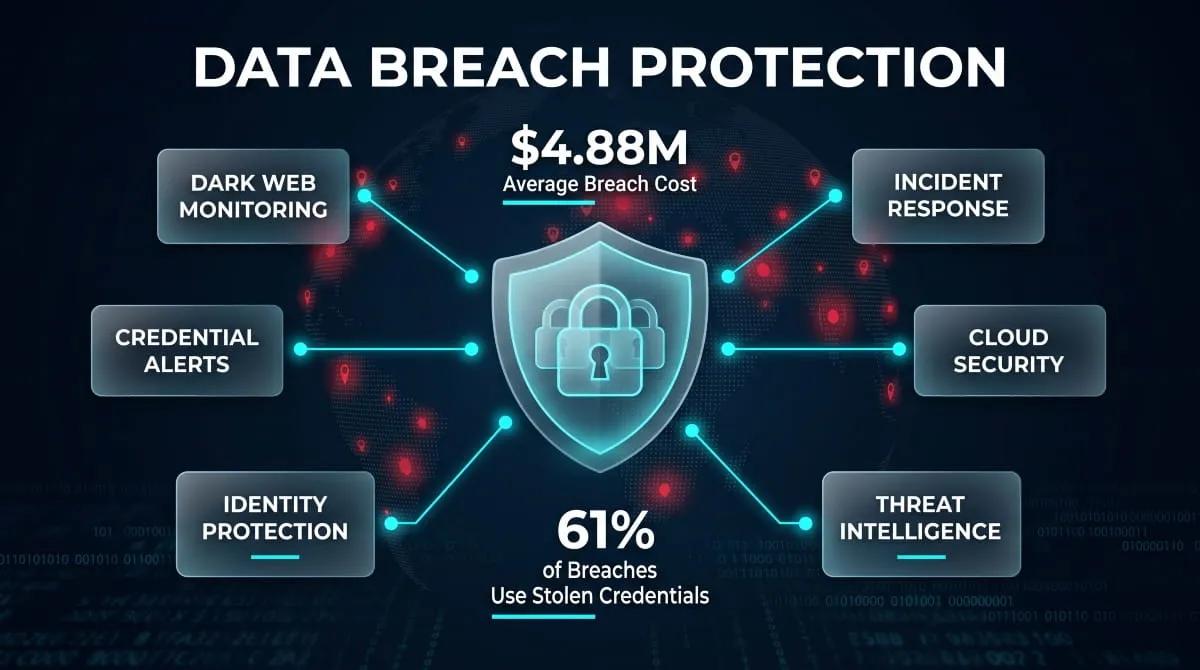
The scale of the problem is no longer abstract. IBM’s 2024 Cost of a Data Breach Report put the global average cost of a single breach at $4.88 million, a record high. That number doesn’t account for the reputational damage, customer churn, or regulatory penalties that follow. For individuals, the fallout is equally personal: drained accounts, stolen identities, and years spent proving who you are.
Most people assume a breach won’t happen to them until it already has. That assumption is exactly what attackers count on. Data breach protection isn’t a reactive measure you activate after receiving a fraud alert; it’s an ongoing posture that starts well before any attacker gets close. This guide covers exactly how to build that posture: what breaches look like, why they happen, how to detect them early, and what to do when prevention isn’t enough.
What Is Data Breach Protection?
Data breach protection refers to the layered set of security measures, monitoring systems, and response protocols designed to prevent sensitive information from being accessed, stolen, or exposed by unauthorized parties, and to minimize harm when that access occurs despite defenses. It operates on two fronts simultaneously: stopping breaches before they happen and containing the damage when they do.
Definition: What Constitutes a Data Protection Breach
A data protection breach occurs any time personal, financial, or confidential information is accessed, disclosed, altered, or destroyed without authorization. That definition is intentionally broad because the breach itself doesn’t have to be malicious to qualify. A misconfigured database left publicly accessible, an employee emailing a spreadsheet to the wrong recipient, or a laptop stolen from a parked car, all of these constitute a breach under most data protection frameworks, including GDPR and HIPAA.
The common thread is loss of control. The moment data leaves its authorized environment, or someone unauthorized gains access to it, a breach has occurred, regardless of whether the data was actually viewed or used. This distinction matters because organizations often assume “no harm done” if stolen data doesn’t appear on the dark web immediately. In reality, the breach clock starts at the point of unauthorized access, not the point of discovery.
The Difference Between a Data Breach and a Data Leak
These two terms are frequently used interchangeably, but they describe fundamentally different failure modes. A data breach results from an external attack or a deliberate intrusion by a threat actor actively exploiting a vulnerability to gain unauthorized access. A data leak, by contrast, is an unintentional exposure of data caused by internal misconfiguration, human error, or inadequate security controls, with no attacker required.
The practical distinction matters for response and liability. A breach implies a perpetrator; a leak implies a process failure. Both result in exposed data, both carry regulatory consequences, and both require remediation, but the investigation path, notification obligations, and root-cause fix differ significantly. A company that suffers a leak through a misconfigured cloud storage bucket needs to fix its access controls. A company that suffers a breach due to stolen credentials needs to determine how those credentials were obtained and who else may have been compromised.
What Is a Breach of Protected Health Information (PHI)?
A breach of protected health information (PHI) occurs when individually identifiable health data, anything that connects a person to their medical history, diagnoses, treatment, or payment records, is accessed, used, or disclosed in a way that isn’t permitted under HIPAA. This applies to healthcare providers, insurers, hospitals, and any third-party vendor that handles patient data on their behalf.
PHI breaches are treated with particular severity because health data is among the most sensitive categories of personal information. Unlike a compromised password, which can be reset, a person’s medical history is permanent. Attackers who obtain PHI can use it to commit insurance fraud, access prescription drug systems, or build highly targeted social engineering profiles. Under HIPAA’s Breach Notification Rule, covered entities must notify affected individuals within 60 days of discovering a breach. If more than 500 individuals in a single state are affected, the relevant state media must also be notified.
How Data Breaches Happen: The Attack Chain Explained
Most breaches don’t begin with a dramatic zero-day exploit. They begin with something far more mundane: a stolen password, a phishing email that gets clicked, or a vendor with weak security controls and access to your network. Understanding the attack chain, the sequence of steps an attacker follows from initial access to data exfiltration, is essential to building protection that actually intercepts threats rather than just documenting them after the fact.
The chain typically starts with reconnaissance, where attackers identify targets and surface vulnerabilities through public records, dark web credential markets, or open-source intelligence. Initial access is then gained through one of a handful of reliable methods: phishing, credential stuffing using previously breached passwords, exploiting unpatched software, or compromising a third-party supplier. Once inside, attackers move laterally through the network, escalating privileges, disabling logging, and mapping where valuable data resides. The final stage is exfiltration: quietly copying data out of the environment, often in small batches over days or weeks to avoid triggering volume-based alerts.
The average dwell time, the period between initial intrusion and detection, was 194 days in a recent analysis by IBM. That gap is why reactive security alone fails. By the time most organizations realize a breach has occurred, the attacker has already finished the job.
Why Data Breach Protection Matters in 2026
Data breach protection has never been more urgent than it is right now. The volume of breaches is rising, the methods attackers use are becoming harder to detect, and the consequences for individuals and organizations alike are compounding in ways that weren’t true even five years ago. In 2025, a breach isn’t a possibility to plan for someday. It’s a near-statistical certainty to defend against today.

The Real Consequences of a Data Protection Breach
The consequences of a data protection breach stretch across four distinct dimensions: financial, legal, reputational, and operational. Most organizations focus on the first and underestimate the rest.
Financially, the direct costs include forensic investigation, breach notification, credit monitoring for affected individuals, regulatory fines, and legal fees. These costs are immediate and largely non-negotiable. Indirect costs, lost business, customer churn, increased insurance premiums, and the expense of rebuilding security infrastructure often arrive more slowly but often exceed the direct costs by a significant margin. Verizon’s 2024 Data Breach Investigations Report found that the median financial impact of a breach on small businesses was enough to threaten operational continuity for a meaningful percentage of affected companies.
The reputational damage is harder to quantify but often more lasting. Customers who lose trust after a breach rarely announce their departure; they simply stop engaging. Partners and vendors quietly reassess the risk of working with a compromised organization. For consumer-facing brands, a single breach headline can undo years of trust-building investment.
What Happens If Data Protection Is Breached (For Individuals)
When a data protection breach exposes personal information, the affected individual rarely learns of it immediately. The data, an email address, a password, a Social Security number, a credit card number, moves quietly through underground markets before being deployed in fraud, account takeover, or identity theft, sometimes months after the original breach.
The practical fallout for individuals varies by the type of data exposed. Compromised email credentials lead to account takeovers across any service that reuses the same password. Exposed financial data gets sold to carding networks and used for unauthorized purchases. Social Security numbers are the most dangerous category: once in the wrong hands, they can be used to open new lines of credit, file fraudulent tax returns, claim government benefits, or create synthetic identities, all in the victim’s name, all without their knowledge.
Recovery is neither fast nor simple. The FTC estimates that resolving identity theft takes an average of 200 hours over 6 months. That figure doesn’t capture the psychological burden of disputing fraudulent accounts, freezing credit, and monitoring for new misuse while still managing a normal life.
What Happens If Data Protection Is Breached (For Businesses)
For businesses, a breach triggers a cascade of obligations and consequences that begin the moment the incident is confirmed, and in some jurisdictions, the moment it should have been detected. The notification clock starts immediately. Under GDPR, affected supervisory authorities must be notified within 72 hours of becoming aware of a breach. Under HIPAA, the window is 60 days. State-level laws in the US vary, with some requiring notification within 30 days of discovery.
Beyond regulatory timelines, businesses face the operational reality of containing the breach, identifying its scope, and communicating transparently with affected customers, all while under public scrutiny. Organizations that handle this poorly face compounding damage: regulators penalize inadequate response as harshly as they penalize the breach itself. The UK’s ICO, for example, has levied significant fines not just for allowing breaches to occur but for failing to notify affected parties within the required window.
Stock price impact is measurable and consistent. Research published in the Harvard Business Review found that breached companies underperformed the market by an average of 8.6% over the year following a disclosed breach, with recovery taking an average of 46 days just to return to pre-breach price levels, and that’s for publicly traded companies with the resources to respond professionally.
Data Breach Liability: Who Is Responsible?
Liability for a data protection breach depends on who controlled the data, who was responsible for securing it, and whether the breach resulted from negligence, a third-party failure, or an unforeseeable attack. In most regulatory frameworks, the organization that collected the data, the data controller, bears primary responsibility, even when the breach occurred in a vendor’s system.
This has significant implications for businesses that rely on third-party processors, cloud providers, or SaaS platforms. If a vendor suffers a breach that exposes your customer data, your organization still owns the notification obligation and faces the regulatory exposure. The vendor contract may provide indemnification, but that doesn’t protect you from regulators or your customers. Supply chain breaches have made this dynamic increasingly common and increasingly costly.
For individuals, liability questions arise differently: when can a person sue the organization that failed to protect their data? In the US, class action lawsuits following major breaches have resulted in settlements ranging from modest credit monitoring offers to nine-figure payouts, depending on the severity of harm and the plaintiff’s ability to demonstrate that the organization’s negligence was the proximate cause of that harm.
The Hidden Cost of Breach Dwell Time
Dwell time, the gap between when an attacker first gains access to a network and when that access is detected, is one of the most underappreciated factors in breach severity. The longer an attacker remains undetected, the more data they can access, the deeper they can embed themselves in the infrastructure, and the harder remediation becomes.
IBM’s research consistently shows that breaches with longer dwell times cost significantly more than those detected quickly. Organizations that contain a breach within 200 days save an average of $1.12 million compared to those that take longer, a figure that reflects both the reduced scope of data exfiltration and the lower cost of a contained incident versus a fully realized one.
The problem is that most traditional security tools are designed to block attacks at the perimeter, not to detect adversaries already inside the network moving quietly. This is precisely why dark web monitoring has become a critical early-warning layer in breach protection strategies: compromised credentials and stolen data often surface on dark web markets before the victim organization has any indication an intrusion occurred. Catching that signal early collapses dwell time, and with it, the full downstream cost of the breach.
Types of Data Breaches You Need to Know
Not all data breaches are the same; they differ in the data targeted, the methods attackers use to gain access, and the consequences for those affected. Understanding the major breach categories is the first step toward building protection that addresses the specific risks most relevant to your situation, rather than applying generic security measures that leave real gaps exposed.

Personal Data Breaches (PII, SSN, Email, Passwords)
Personal data breaches involve the unauthorized exposure of personally identifiable information, the category of data that directly identifies or can be used to locate a specific individual. This includes names, addresses, dates of birth, Social Security numbers, email addresses, phone numbers, and login credentials. It is the most common breach category by volume, and the one most likely to affect ordinary people who have never given cybersecurity a second thought.
What makes PII breaches particularly damaging is the compounding effect of aggregation. A single exposed email address carries limited risk. That same email address, combined with a password, a date of birth, and a home address, creates a profile that can be used to compromise financial accounts, pass identity verification checks, and impersonate the victim across multiple services. Attackers who purchase PII packages from dark web markets aren’t buying isolated data points; they’re buying assembled profiles ready for immediate exploitation.
The scale is difficult to overstate. The Identity Theft Resource Center tracked over 3,200 publicly reported data compromises in the US in 2023 alone, affecting hundreds of millions of individual records. Most victims had no idea their information was exposed until they were contacted, noticed fraudulent activity, or ran a breach check themselves.
Medical and Healthcare Breaches (PHI)
Healthcare breaches involve protected health information, the category of data that links an individual to their medical history, diagnoses, prescriptions, treatment records, or health insurance details. PHI breaches are among the most consequential breach types because health data is permanent, deeply personal, and extraordinarily valuable on criminal markets, where a complete medical record can sell for many times the price of a stolen credit card number.
The healthcare sector is disproportionately targeted for several reasons. Hospitals and clinics operate legacy systems that are difficult to patch without disrupting critical care. Staff turnover is high, creating persistent challenges with credential management. And the urgency of patient care creates pressure to prioritize access over security, an environment that attackers exploit deliberately. Ransomware groups have made healthcare one of their primary targets precisely because the combination of sensitive data and operational pressure makes organizations more likely to pay.
The HHS Office for Civil Rights breach portal, often called the “Wall of Shame” in healthcare circles, reported that breaches affecting 500 or more individuals totaled over 133 million records exposed in 2023, the highest annual figure on record at the time.
Employee and HR Data Breaches
Employee data breaches expose the internal records organizations hold on their own workforce: payroll information, tax documents, performance reviews, disciplinary records, benefit enrollments, background check results, and, in many cases, Social Security numbers and bank account details used for direct deposit. This category of breach is frequently underreported because it doesn’t involve customer data, and organizations are often reluctant to disclose internal exposures that reflect poorly on HR or IT governance.
The risk to affected employees mirrors the risk of any PII breach, with one additional dimension: employment records often contain information that employees never consented to share publicly, including medical accommodations, disciplinary history, and compensation data. When this information falls into the wrong hands, whether from an external attacker or a malicious insider, the damage extends beyond financial fraud to professional and personal reputations.
Insider threats are a significant driver of HR data breaches. A disgruntled employee with legitimate access to HR systems, or a contractor with broader permissions than their role requires, can exfiltrate sensitive workforce data without triggering the perimeter-level alerts designed to catch external attackers.
Business and Enterprise Breaches
Enterprise breaches target the confidential data organizations generate and hold in the course of doing business: intellectual property, financial records, strategic plans, merger and acquisition documentation, client contracts, and proprietary source code. These breaches are often more targeted and more sophisticated than consumer-facing attacks, because the attacker has done enough reconnaissance to know what’s valuable and where it lives.
The consequences of an enterprise breach frequently extend beyond the organization itself. A law firm whose client files are stolen exposes its clients’ confidential matters. A financial institution whose trading data is compromised potentially affects market integrity. A technology company whose source code is stolen loses the competitive advantage that may have taken years and hundreds of millions of dollars to build. This is why enterprise breaches are increasingly treated not just as security incidents but as material business events requiring board-level response and, in many cases, SEC disclosure.
Advanced persistent threat (APT) groups, typically state-sponsored actors targeting specific industries or organizations for strategic intelligence, are the primary driver of high-value enterprise breaches. Their distinguishing characteristic is patience: they establish access and maintain it quietly for months, extracting data methodically rather than triggering alarms with aggressive activity.
Cloud Infrastructure Breaches
Cloud infrastructure breaches occur when attackers gain unauthorized access to data stored in cloud environments, typically through misconfiguration, stolen cloud access credentials, or exploitation of vulnerabilities in cloud-hosted applications. As organizations have migrated data and workloads to cloud platforms at scale, the cloud has become one of the most targeted environments in modern cybersecurity.
Misconfiguration is the leading cause of cloud breaches, and it’s a more mundane problem than most security narratives suggest. An S3 bucket left publicly readable, an administrative console exposed to the internet without multi-factor authentication, or an overly permissive IAM role; these are the gaps attackers systematically scan for, often using automated tools that probe millions of cloud assets daily. The 2019 Capital One breach, which exposed over 100 million customer records, originated from a misconfigured web application firewall in a cloud environment, a technical error, not a sophisticated zero-day exploit.
The shared responsibility model that governs most cloud platforms creates an additional layer of risk: the cloud provider secures the infrastructure, but the customer is responsible for securing what runs on top of it. Organizations that misunderstand where that boundary falls consistently leave data exposed in entirely preventable ways.
Supply Chain and Third-Party Breaches
Supply chain breaches occur when an attacker compromises a vendor, supplier, or technology partner to gain access to the networks and data of the organizations that vendor serves. Rather than attacking a well-defended primary target directly, the attacker finds a weaker entry point in the supply chain, a managed service provider, a software vendor with privileged system access, or a contractor with network credentials, and uses that foothold to reach the real target.
The 2020 SolarWinds attack remains the defining example: attackers compromised a software update mechanism used by thousands of organizations, including US federal agencies. They used that access to conduct espionage across multiple targets simultaneously. A single point of supply chain compromise became a master key to hundreds of environments. The scale and sophistication of that attack changed how security professionals think about third-party risk, but the underlying vector remains prevalent and widely exploited.
Verizon’s DBIR consistently identifies third-party involvement as a factor in a significant and growing percentage of breaches year over year. Organizations that have invested heavily in their own security perimeter while neglecting vendor risk assessments are particularly exposed to this category.
API and Credential-Based Breaches
API breaches and credential-based attacks have become two of the fastest-growing breach categories as organizations have expanded their digital surface area through connected applications, partner integrations, and cloud-native architectures. APIs, the interfaces that allow different systems to communicate and share data, are now a primary attack target because they often expose sensitive data directly and are frequently less rigorously secured than user-facing applications.
Credential-based breaches don’t require any technical exploitation. When an attacker obtains a valid username and password, purchased from a dark web credential market, extracted from a previous breach, or harvested through phishing, they simply log in. No vulnerability required. This is the mechanism behind credential stuffing attacks, where automated tools test billions of stolen credential combinations against popular services, exploiting the widespread human habit of password reuse across multiple accounts.
The SpyCloud 2024 Identity Exposure Report found that 61% of data breaches involved stolen credentials, making compromised login information the single most common attack vector across all breach categories. It is also the most preventable, through a combination of multi-factor authentication, dark web credential monitoring, and password hygiene, none of which require sophisticated security tooling to implement.
How to Protect Yourself from Data Breaches (Personal)
Protecting yourself from data breaches means combining proactive habits that reduce your exposure before a breach occurs with a clear response plan for when one does. No single measure eliminates the risk, but the right combination of steps makes you a significantly harder target and limits the damage when your data is caught up in someone else’s security failure.

How to Protect Your Identity After a Data Breach
Identity protection after a data breach starts with accepting that the compromised data is already out there, you cannot retrieve it, and shifting focus entirely to limiting what an attacker can do with it. The goal is to close the doors that stolen information can open, before someone walks through them.
The most effective single action is placing a credit freeze with all three major bureaus: Equifax, Experian, and TransUnion. A credit freeze prevents new lines of credit from being opened in your name, even by someone who has your Social Security number, date of birth, and address. It costs nothing, can be lifted temporarily when you need to apply for credit, and blocks the most common form of identity fraud that follows a breach. An extended fraud alert, which requires lenders to take additional verification steps before approving credit, is a lighter alternative, but a full freeze provides stronger protection.
Beyond credit, identity protection means auditing every account connected to the exposed data. If the breach involved your email address, assume that email is now the starting point for targeted phishing attempts. If it involved your date of birth and address, assume those details will be used to pass security questions on other accounts. Work through your accounts systematically, financial, government, healthcare, utilities, and update credentials, enable multi-factor authentication, and review recent activity for anything you don’t recognize.
How to Protect Your Social Security Number After a Breach
Your Social Security number is the most dangerous piece of personal information that can be exposed in a data breach, because it is permanent, government-issued, and accepted as a primary identity verification credential across financial, medical, and government systems. Once it’s in circulation on dark web markets, it doesn’t expire or reset.
If your SSN has been exposed or if you suspect it may have been, the first action is to place a credit freeze immediately across all three bureaus, as described above. The second is to create an account with the IRS Identity Protection PIN program, which generates an annual six-digit PIN required to file your federal tax return. This single step prevents tax identity fraud, one of the most common and disruptive ways stolen SSNs are monetized. The IRS reported issuing over 10 million IP PINs to taxpayers in 2023, reflecting how widespread the problem has become.
You should also monitor your Social Security Administration account at ssa.gov for any unauthorized changes to your earnings record or benefit information. If someone is using your SSN for employment, a common scenario known as employment identity theft, it will appear as unfamiliar income on your Social Security earnings statement before it shows up anywhere else.
How to Protect Your Email and Passwords
Email is the skeleton key of your digital identity. Whoever controls your primary email address can reset passwords, intercept two-factor authentication codes, and gain access to virtually every other account you own. Protecting it is therefore not just one item on a security checklist; it is the foundation on which everything else rests.
Start by enabling multi-factor authentication on your email account using an authenticator app rather than SMS. SMS-based two-factor authentication is better than nothing, but it is vulnerable to SIM-swapping attacks where an attacker convinces your carrier to transfer your number to a device they control. An authenticator app generates codes locally on your device and cannot be intercepted through your phone carrier.
For passwords, the non-negotiable rule is uniqueness. Every account should have a password that exists nowhere else. The mechanism that makes credential stuffing attacks so effective is password reuse. Attackers steal credentials from one breach and systematically test them against hundreds of other services, knowing that a large percentage of people use the same password across multiple services. A password manager eliminates this risk by generating and storing unique, complex passwords for every account, so you don’t have to remember them. This is one of the highest-leverage security changes any individual can make, and it costs almost nothing.
How to Protect Your Payment Data
Payment data protection operates on two levels: reducing the surface area of exposure before a breach and limiting fraud capability after one. On the prevention side, the most effective habit is minimizing where your primary card number is stored. Every merchant, app, or subscription service that holds your card on file is a potential breach point. Using virtual card numbers, disposable or single-merchant card numbers generated through your bank or a service like Privacy.com, means that even if a merchant is breached, the compromised card number is useless outside that specific context.
For physical card security, chip-and-PIN transactions are significantly more secure than swipe transactions, and contactless payments through Apple Pay or Google Pay are even more secure, as they transmit a one-time token rather than your actual card number, making the data worthless if intercepted. Avoid entering card details on any site that doesn’t use HTTPS, and be especially cautious on mobile checkout flows where the security indicators are less visible.
After a breach that may have included your payment data, request new card numbers immediately rather than waiting for fraudulent activity to appear. Banks and card issuers will replace cards without question when you inform them that your number may have been compromised. Proactive replacement is faster and less disruptive than disputing fraudulent charges after the fact.
What to Do Immediately After a Data Breach (Step-by-Step)
The first 48 hours after discovering your data has been breached are the highest-leverage window you have. Acting quickly doesn’t undo the exposure, but it dramatically narrows the window attackers have to use your information before you’ve closed the most vulnerable doors.
The sequence that matters most follows a clear priority order. First, identify exactly what was exposed. The breach notification you receive, or the breach check you run, should tell you which data categories were involved. The specific data types determine which steps are most urgent. A breach involving only your email address requires a different response than one involving your SSN and financial account numbers.
Second, immediately change the password on the breached account and on every other account that used the same password. Do this before anything else, because credential-stuffing attacks begin almost immediately after stolen credentials hit dark web markets.
Third, enable multi-factor authentication on the breached account and on your primary email account if it isn’t already active. This closes the most common follow-on attack vector.
Fourth, if financial data or your SSN was involved, place a credit freeze with all three bureaus and set up fraud alerts with your bank and card issuers. Most banks allow you to do this through their mobile app in under two minutes.
Fifth, monitor your accounts actively for the next 90 days. The majority of breach-related fraud occurs within the first three months of a compromise, and early detection minimizes both the financial impact and the recovery effort. Running a dark web scan through a service like DeXpose’s free dark web report gives you visibility into whether your data is actively circulating in criminal markets, and flags additional exposure you may not have known about.
How to Protect Your Business from Data Breaches
Protecting a business from data breaches requires a different mindset than personal protection; the attack surface is larger, the data is more varied, the regulatory obligations are more demanding, and the consequences of failure extend beyond the organization to every customer, employee, and partner whose information was entrusted to you. The foundation is the same: reduce exposure, detect early, respond fast, but the implementation requires deliberate architecture, not just good habits.

Data Breach Protection Measures Every Business Needs
Effective data breach protection for businesses isn’t built on any single tool or policy. It’s built on a stack of controls that reinforce each other, so that the failure of any one layer doesn’t result in a catastrophic breach.
The non-negotiables start with access control. The principle of least privilege, giving employees access only to the data and systems their role requires, is one of the most effective breach-prevention measures available and one of the most consistently ignored in practice. When every employee has broad access to everything, a single compromised account becomes a master key to the entire organization. Tight access controls mean a breach of one account exposes only what that account could reach.
Multi-factor authentication must be enforced across all systems, not just email. VPNs, cloud consoles, HR platforms, financial systems, and any third-party SaaS tool that stores sensitive data should all require two-factor authentication. Verizon’s DBIR has consistently found that MFA would have prevented the majority of credential-based breaches it analyzed, a finding that has held across multiple years of reporting.
Endpoint detection and response (EDR) tools provide visibility into what’s happening on devices across the organization. Patch management ensures that known vulnerabilities aren’t left open longer than necessary. Employee security awareness training, not a once-a-year checkbox exercise but regular, realistic phishing simulations and clear reporting procedures, addresses the human layer that technical controls alone cannot fully cover.
Dark web monitoring rounds out the foundational stack by providing early warning when employee credentials, customer data, or proprietary information surfaces in criminal markets. This is the signal that tells you a breach may have occurred before your internal systems detect it, often weeks or months earlier.
How to Protect Small Businesses from Data Breaches
Small businesses are disproportionately targeted by cybercriminals precisely because they are assumed to have weaker defenses than enterprise organizations, even though they still hold valuable customer data, financial records, and payment information. The Verizon DBIR consistently finds that small businesses account for a significant share of total breach victims, not because attackers single them out strategically, but because automated scanning tools don’t discriminate by company size.
The practical challenge for small businesses is resource constraints. A 20-person company doesn’t have a dedicated security team, a CISO, or an enterprise security budget. What it does have is the ability to implement high-leverage controls that provide outsized protection relative to their cost.
Password managers and MFA are free or near-free, and they eliminate the credential vulnerabilities that drive most small-business breaches. Cloud-based security tools have democratized capabilities that previously required expensive on-premise infrastructure. Cyber insurance has become more accessible and necessary. It doesn’t prevent breaches, but it limits the financial catastrophe when one occurs. And a written incident response plan, even a simple one-page document that tells staff what to do, who to call, and how to notify customers, dramatically improves the speed and quality of response when something goes wrong.
The single most important investment a small business can make is knowing what data it holds and where it lives. Organizations that have never conducted a basic data inventory routinely discover, during breach response, that they were storing sensitive customer information in places they’d forgotten about, old email threads, unsecured spreadsheets, and legacy systems that were never properly decommissioned.
How to Protect Data in the Cloud from Breaches
Protecting data in the cloud from breaches begins with understanding that moving to the cloud doesn’t transfer security responsibility to the cloud provider; it divides it. Under the shared responsibility model, the provider is responsible for the underlying infrastructure. Everything built on top of that infrastructure, configurations, access controls, data handling, and application security, remains the customer’s responsibility.
Encryption is the foundational layer. Data should be encrypted at rest and in transit, using keys the organization controls rather than those managed by the cloud provider. If an attacker gains access to a storage environment where data is encrypted with properly managed keys, the data itself remains unreadable. Encryption doesn’t prevent unauthorized access, but it makes that access worthless.
Identity and access management in cloud environments deserves particular attention. Cloud IAM configurations are notoriously easy to over-provision and difficult to audit retrospectively. Roles and permissions should be reviewed regularly; service accounts should have only the minimum access necessary to function; and administrative access should require MFA without exception. A cloud environment where administrative credentials are stolen, and MFA isn’t enforced, is fully compromised the moment those credentials are used.
Logging and monitoring should be enabled across all cloud services, with alerts configured for unusual activity, large data downloads, access from unexpected geographic locations, changes to security configurations, or the creation of new administrative accounts. These signals are frequently the earliest detectable indicator of a breach in progress.
Ways to Protect Cloud Environments from Breaches
Beyond the foundational controls, cloud environment protection requires a posture of continuous verification rather than periodic review. The cloud is not a static environment; configurations change, new services get provisioned, permissions drift over time, and security controls that were correct six months ago may no longer reflect the current architecture.
Cloud Security Posture Management (CSPM) tools automate the continuous monitoring of cloud configurations against security best practices and compliance frameworks, flagging misconfigurations before attackers find them. Given that misconfiguration remains the leading cause of cloud breaches, automated posture management provides a level of coverage that manual audits cannot match.
Network segmentation in cloud environments, isolating workloads, databases, and services so that a compromise in one area cannot propagate freely across the environment, reduces the blast radius of any successful intrusion. Zero-trust architecture takes this further by eliminating the assumption that anything within the network perimeter is trustworthy, requiring continuous verification of every access request, regardless of its origin.
Regular penetration testing of cloud environments, conducted by external security professionals with fresh eyes and no assumptions about what’s already been secured, routinely surfaces vulnerabilities that internal teams have overlooked, not because of incompetence, but because familiarity breeds blind spots.
How to Protect Against Supply Chain Breaches
Supply chain breaches are among the hardest to prevent because the vulnerability doesn’t lie within your own organization; it lies in the security posture of every vendor, supplier, and technology partner that has access to your systems or data. You cannot directly control their security practices. You can only control how much trust and access you extend to them, and how closely you monitor that relationship.
Vendor risk assessments should be a prerequisite for any third-party relationship that involves access to sensitive data or critical systems. This means requesting evidence of security certifications, reviewing incident response procedures, and asking specific questions about how the vendor would notify you in the event of a breach affecting your data. A vendor that cannot answer these questions clearly should have its access limited accordingly.
The principle of least privilege applies to third-party access just as it does to internal employees. Vendors should have access to exactly what they need to perform their function, scoped as narrowly as possible, and that access should be revoked immediately upon the engagement’s end. Persistent, broad third-party access that accumulates over time without review is one of the most common patterns found in post-breach investigations.
Monitoring third-party access in real time, flagging unusual activity, large data transfers, or access outside of normal working patterns, provides detection capability for supply chain compromises that might otherwise go unnoticed for months. The SolarWinds breach persisted for an estimated nine months before discovery, largely because the access pattern was designed to blend in with legitimate activity.
Best API Protection Practices to Prevent Data Breaches
APIs represent one of the fastest-growing and most underprotected attack surfaces in modern business environments. Every API endpoint that exposes data is a potential breach vector, and many organizations have far more API endpoints than they can monitor, particularly in large enterprises where development teams build and deploy integrations independently.
API security starts with a complete inventory. You cannot protect what you don’t know exists. Shadow APIs, endpoints built for internal use, legacy integrations, or development testing that were never formally documented or secured, are a persistent problem that attackers actively scan for because they tend to have weaker authentication and less monitoring than production APIs.
Authentication and authorization must be enforced rigorously at every API endpoint. OAuth 2.0 and API keys with appropriate scoping ensure that even authenticated callers can access only the data permitted by their role. Rate limiting prevents automated credential-stuffing and enumeration attacks that attempt to extract data by sending high volumes of requests. Input validation prevents injection attacks that exploit APIs to reach underlying databases.
API traffic should be continuously monitored for anomalous patterns: unusual request volumes, access at unexpected times, and calls that traverse data relationships in ways that don’t match normal application behavior. These patterns are often the earliest signal of an API-based data exfiltration attempt, one that will look like normal application traffic unless someone is specifically looking for the anomaly.
How to Protect Payment and Customer Data
Payment and customer data carry both the highest fraud value for attackers and the most significant regulatory obligations for businesses. Protecting them requires both technical controls and organizational discipline about how that data is collected, stored, and retained.
For payment data, the primary standard is PCI DSS (Payment Card Industry Data Security Standard), which mandates specific controls for any organization that stores, processes, or transmits cardholder data. Compliance with PCI DSS is not optional for businesses that accept card payments, and non-compliance at the time of a breach significantly increases liability exposure. But PCI compliance should be treated as a floor, not a ceiling: the standard defines the minimum acceptable posture, not a comprehensive security program.
Tokenization is the most effective technical control for reducing exposure of payment data. Rather than storing actual card numbers, tokenization replaces them with non-sensitive placeholders that have no value outside the specific transaction context. A breach of a tokenized payment environment yields data that is cryptographically useless to the attacker. End-to-end encryption of payment data from the point of capture to the point of processing ensures that the card number is never transmitted or stored in a form that can be stolen in transit.
For broader customer data, data minimization, collecting only what you genuinely need and retaining it only as long as necessary, is both a privacy principle and a security strategy. Data you don’t hold cannot be breached. Regular data audits that identify and purge obsolete customer records reduce the breach impact surface without requiring any security investment. The customer data that matters most to your business operations should be the only customer data your systems hold.
Data Breach Protection Tools and Services
The market for data breach protection tools has matured significantly over the past five years, moving from reactive notification services to proactive, intelligence-driven platforms that detect threats before they materialize into confirmed breaches. Choosing the right combination of tools depends on your threat profile and your data environment. Whether you’re protecting an individual, a small business, or an enterprise, the underlying capabilities that matter most are consistent across all three.

What Is a Breach Protection Platform?
A breach protection platform is an integrated security solution that combines threat detection, real-time monitoring, incident response support, and visibility into data exposure into a single operational layer. Unlike point solutions that address one specific risk, a password manager, a credit monitoring service, a firewall, and a breach protection platform are designed to provide continuous, comprehensive coverage across the full breach lifecycle: before, during, and after an intrusion attempt.
At the enterprise level, breach protection platforms typically integrate with existing security infrastructure, SIEM systems, endpoint detection tools, and identity providers to correlate signals across the environment and surface threats that would be invisible to any individual tool operating in isolation. At the consumer and SMB level, platforms have evolved toward consolidated dashboards that combine dark web monitoring, credential exposure alerts, identity protection, and guided response workflows in a format that doesn’t require a security team to operate.
The defining characteristic of a modern breach protection platform, regardless of market segment, is continuous operation. Threats don’t follow business hours. A platform that checks for exposure once a day and reports findings in a weekly digest is not providing breach protection; it’s providing a historical record. Real protection requires continuous monitoring that alerts the moment a meaningful signal appears.
Real-Time Breach Alerts and Monitoring Services
Real-time breach alerts are notifications triggered the moment a monitoring service detects that your data, email addresses, credentials, financial account information, or other tracked identifiers have appeared in a newly identified breach dataset, a dark web market listing, or a criminal forum post. The speed of that alert is not incidental to the value of the service; it is the value of the service.
The window between when stolen data first appears in criminal markets and when it is actively exploited is often measured in hours to days, not weeks. Attackers who purchase fresh credential dumps move quickly, running automated stuffing attacks against high-value targets while the credentials are still valid and before victims have had the opportunity to change their passwords. A monitoring service that delivers a real-time alert the moment your credentials surface gives you a realistic chance to change them before they’re used. A service that delivers a weekly digest does not.
Effective real-time monitoring covers multiple data sources simultaneously: known breach databases, dark web forums and marketplaces, paste sites where stolen data is frequently published, and threat intelligence feeds that track criminal activity across underground networks. The breadth of source coverage determines the completeness of the protection; a service that monitors only one or two sources will miss exposure events that surface elsewhere.
Personal Data Protection Tools with Breach Alerts
Personal data protection tools have expanded considerably beyond the basic “have I been pwned” check that defined early breach awareness. Modern consumer-grade tools combine ongoing monitoring across multiple data categories with actionable guidance that tells users not just that their data was exposed but specifically what to do about it.
The most useful personal tools monitor a range of identifiers simultaneously: email addresses, phone numbers, Social Security numbers, passport numbers, driver’s license numbers, credit card numbers, and bank account details. Each category has a different risk profile and requires different response actions, and a tool that monitors only email addresses provides an incomplete picture of a person’s actual exposure.
Breach alert quality matters as much as coverage. An alert that says “your email was found in a breach” with no additional context, which breach, what data was included, when it occurred, and what the specific risk is, provides minimal actionable value. The best personal protection tools deliver alerts that include the breach source, the data categories exposed, a risk-severity assessment, and a prioritized list of recommended actions. That specificity is what separates a protection tool from a notification service.
DeXpose’s free dark web report provides exactly this kind of contextual visibility, scanning dark web markets, malware logs, and public breach databases to show not just whether your data is exposed but where it was found and what it means for your specific risk profile.
Managed Breach Protection Services: What to Look For
Managed breach protection services, in which a third-party provider assumes operational responsibility for monitoring, detection, and response rather than simply providing tools for your team to use, have become increasingly relevant for organizations that lack the internal security capacity to run a protection program effectively. The managed model removes the staffing burden but introduces its own evaluation challenges: not all managed services deliver equivalent value, and the differences aren’t always visible until an incident occurs.
The first evaluation criterion is source coverage. A managed service is only as good as the intelligence it monitors. Ask specifically which dark web sources, threat intelligence feeds, criminal forums, and breach databases the service covers, and how frequently that coverage is updated. A provider that cannot answer this question with specificity is likely reselling a narrow data feed rather than operating genuine broad-spectrum monitoring.
Response capability is the second criterion. Monitoring without response is an alert service, not a protection service. When an exposure is detected, what happens next? Does the provider offer guided remediation? Do they have a dedicated response team? Is there a defined SLA for alert delivery and response initiation? The value of a managed service is largely determined by what it does in the critical window between detection and confirmation. That window is where the damage is either contained or compounded.
Integration with your existing security stack, clear escalation procedures, transparent reporting, and contractual accountability for detection performance round out the evaluation framework. A managed breach protection provider that cannot demonstrate historical detection metrics, mean time to detect, alert accuracy rates, or false positive rates is one whose performance claims cannot be independently verified.
AI and Automation in Modern Breach Protection
Artificial intelligence and automation have fundamentally changed what breach protection can detect and how quickly it can respond. The volume of threat data generated across dark web markets, breach databases, criminal forums, and network telemetry has long exceeded the capacity of human analysts to process manually. AI enables monitoring at a scale and speed no human team can match. At the same time, automation ensures that a response to a detected threat begins immediately rather than waiting for an analyst to review an alert queue.
Machine learning models trained on historical breach data can identify patterns that precede confirmed breaches, anomalous credential access patterns, data staging behavior, unusual network communication with known malicious infrastructure, and flag them as high-priority signals before exfiltration occurs. This shifts breach protection from a reactive posture to a genuinely predictive one, where threats are surfaced based on behavioral indicators rather than confirmed incidents.
On the automation side, playbook-driven response ensures that the first actions following a detection event, isolating a compromised endpoint, forcing a password reset on a flagged account, and blocking a suspicious IP range, happen in seconds rather than minutes. IBM’s research found that organizations using security AI and automation extensively contained breaches 108 days faster than those that didn’t, and saved an average of $2.22 million in breach costs. That gap will only widen as AI capabilities continue to advance.
How Deception Technology Strengthens Breach Protection
Deception technology is a breach protection approach built on a counterintuitive premise: instead of trying to make every asset in your environment impenetrable, you deliberately place convincing fake assets, decoy credentials, honeypot systems, and synthetic data caches throughout the network, then watch who interacts with them. Any access to a deception asset is, by definition, unauthorized, which means every interaction is a high-confidence alert with virtually no false positives.
The power of deception technology lies in what it detects: lateral movement. Once an attacker has established initial access, they move through the network looking for valuable data and higher-privilege accounts. This movement is difficult to distinguish from legitimate user behavior using conventional monitoring tools. Deception assets are specifically designed to be attractive to an attacker conducting reconnaissance while remaining invisible to legitimate users who have no reason to access them. When an attacker touches a honeypot credential or attempts to connect to a decoy server, the alert fires with a level of confidence that other detection methods cannot match.
Deception technology is particularly effective against the slow, methodical intrusions conducted by sophisticated threat actors who specifically avoid triggering volume-based or signature-based detection. By creating a minefield of invisible tripwires throughout the network, it catches attackers who have specifically engineered their behavior to evade every other detection layer.
Can Breach Protection Platforms Reduce Dwell Time in Ransomware Attacks?
Breach protection platforms can meaningfully reduce dwell time in ransomware attacks, and dwell time reduction is one of the most consequential outcomes a security investment can deliver. In ransomware attacks, dwell time is the period between initial compromise and the deployment of the ransomware payload. During that window, attackers are conducting reconnaissance, escalating privileges, exfiltrating data for double-extortion leverage, and turning off backup systems. The longer that window, the more devastating the eventual attack.
Platforms that combine dark web monitoring, credential exposure detection, behavioral analytics, and deception technology create multiple overlapping detection opportunities during the pre-encryption phase, when dwell-time reduction is still possible. A compromised credential appearing on a dark web market triggers an alert before that credential is used for lateral movement. A behavioral anomaly in an endpoint agent flags suspicious activity before data staging completes. A honeypot interaction fires an alert the moment an attacker begins internal reconnaissance.
The practical evidence supports the impact. IBM’s Cost of a Data Breach Report found that ransomware attacks where the victim had deployed security AI and automation, a core component of modern breach protection platforms, had significantly lower costs and faster containment times than attacks against organizations relying on manual detection. The mechanism is straightforward: every detection layer that fires during dwell time creates an opportunity to interrupt the attack before the payload deploys. More detection layers, operating continuously and at machine speed, mean more opportunities to catch the attacker before the damage becomes irreversible.
Dark Web Monitoring as a Core Breach Protection Strategy
Dark web monitoring belongs at the center of any serious breach protection strategy because it closes the most dangerous gap in conventional security: the period between when your data is stolen and when you find out. Most breach victims don’t discover their exposure through their own security tools; they learn about it through a fraud alert, a notification letter, or a journalist. Dark web monitoring changes that equation by watching the markets where stolen data is bought and sold, and alerting you the moment your information appears.

How Stolen Data Ends Up on the Dark Web
The journey from a breach to a dark web listing typically follows a predictable path, even if the timeline varies. When an attacker successfully exfiltrates data, credentials, financial records, PII, or health information, that data doesn’t immediately become actionable for every criminal who wants it. The attacker has to monetize it, and the dark web is the primary marketplace for that monetization.
Initial access brokers and data thieves typically sort and package stolen data before listing it. Large credential dumps get cleaned, deduplicated, and segmented by data type or geographic origin to increase their market value. High-value targets, executives, financial account holders, and healthcare patients may be separated into premium listings sold individually. Bulk datasets get listed on dark web marketplaces or posted to paste sites and criminal forums where buyers can preview sample records before purchasing.
The speed of this process has accelerated considerably. Analysis of breach timelines shows that stolen credentials can appear on dark web markets within hours of a successful phishing attack or credential theft event, well before the victim organization has detected the intrusion, let alone notified affected individuals. By the time a formal breach notification letter arrives in the mail, the data it describes has often been circulating in criminal networks for weeks or months.
What a Dark Web Breach Alert Actually Means
A dark web breach alert means that a monitoring service has detected your data, or data specifically associated with your identifiers, in a source it surveils across the dark web ecosystem. That detection could originate from a known breach database, a dark web marketplace listing, a criminal forum post, a paste site dump, or a malware log containing credentials harvested from an infected device.
What the alert means in practice depends heavily on what was found and where it was found. A credential appearing in an old, well-documented breach database that has been circulating for years carries a different urgency than a fresh credential dump posted to an active dark web market within the past 24 hours. A monitoring service that provides this context, breach source, date of first detection, data categories exposed, and the assessed freshness of the listing gives you the information needed to prioritize your response. One that delivers only a generic “your data was found” notification without context is providing awareness without actionable intelligence.
Critically, a dark web alert is not confirmation that your account has already been compromised. It is an early warning that your data is in circulation and that compromise is now a realistic near-term risk. That distinction matters because it means the alert arrives during a window when you can still act, changing passwords, enabling MFA, freezing credit, contacting your bank, before an attacker has used the exposed data to cause tangible harm.
How to Check If Your Data Is on the Dark Web
Checking whether your data is on the dark web requires a monitoring service with genuine access to dark web sources, not a surface web search engine, which cannot index dark web content, and not a simple breach database lookup, which covers only publicly known historical breaches rather than the full spectrum of active criminal markets.
The most straightforward starting point for individuals is a free dark web scan from a service that monitors multiple sources simultaneously. You typically provide one or more identifiers, your email address, phone number, or other personal details, and the service checks those identifiers against its database of known exposures. The quality of the result depends entirely on the breadth of sources the service monitors: a scan that checks only a handful of breach databases will miss exposure events that occurred on dark web forums, paste sites, or markets that weren’t indexed by those databases.
For a more complete picture, particularly if you have reason to believe your information may have been exposed in a recent breach, a service that monitors in real time rather than checking against a static snapshot provides significantly more current intelligence. Historical breach databases are valuable context, but they document what has already been discovered and catalogued; they don’t surface new exposures as they occur. Real-time dark web monitoring does.
DeXpose Free Dark Web Report: Instant Exposure Check
DeXpose’s free dark web report gives individuals and businesses an immediate, no-cost view of their current dark web exposure, covering dark web markets, malware logs, and public breach databases in a single scan. Unlike tools that check only historical breach records, DeXpose monitors live dark web sources, so the report reflects current exposure rather than a catalogue of incidents already publicly known.
The report identifies not just whether your data was found, but where it was found and what categories of information are involved, a level of specificity that makes the output immediately actionable rather than simply alarming. If your credentials appear in a malware log, that tells you something different from if they appear in a marketplace listing, and the response priorities are different accordingly. DeXpose surfaces that context so you can move directly to the right remediation steps without having to interpret a generic alert on your own.
Running the free dark web report at dexpose.io/free-darkweb-report takes under a minute and requires no account creation. For organizations that need continuous monitoring rather than a point-in-time check, with ongoing alerts as new exposure events are detected, DeXpose’s full dark web monitoring service extends that visibility into a persistent protection layer that runs without requiring manual intervention.
Continuous Dark Web Monitoring vs. One-Time Scans
A one-time dark web scan tells you what your exposure looked like at a single point in time. Continuous dark web monitoring shows you what your exposure looks like right now, and the gap between those two grows larger every day after the scan.
The dark web is not a static archive. New breach data is posted continuously. Criminal forums publish fresh credential dumps daily. Malware logs containing harvested credentials from recently infected devices are uploaded and sold in near real time. A scan conducted today captures the exposure picture as of today. It says nothing about what will be posted tomorrow, next week, or in three months when the next major breach dataset hits the market. If your monitoring strategy consists of running a scan once and assuming you’re covered, you have a snapshot, not protection.
Continuous monitoring solves this by maintaining a persistent watch over dark web sources and delivering alerts when new exposures are detected, rather than requiring you to remember to run a scan periodically. For individuals, this means an alert the moment a newly posted breach dataset contains your email address or credentials, giving you response time measured in hours rather than the weeks or months that typically elapse between a breach and a formal notification. For businesses, continuous monitoring serves as an early warning system for the entire organization, flagging employee credential exposures, customer data listings, and brand-related threat intelligence as they surface.
The practical argument for continuous over one-time monitoring comes down to timing. The value of breach intelligence is almost entirely a function of how quickly you receive it. Data that reaches you within hours of appearing on a dark web market gives you a genuine window to act before it’s exploited. Data that reaches you three months later, through a notification letter, a fraud alert, or the next time you remember to run a scan, arrives after the window has already closed.
Data Breach Protection for Specific Industries
Data breach protection looks different depending on the industry you operate in, the data types you handle, the regulatory frameworks you follow, and the motivations of attackers. The consequences of a breach vary. A healthcare organization faces fundamentally different breach risks than a government agency or an HR department, and the protection strategies that matter most reflect those differences. What stays constant across all of them is the underlying principle: know what data you hold, limit who can access it, monitor for exposure, and have a response plan ready before you need it.

Healthcare Data Breach Protection (HIPAA & PHI)
Healthcare data breach protection operates under one of the most demanding regulatory frameworks of any industry. HIPAA, the Health Insurance Portability and Accountability Act, establishes specific, enforceable requirements for how covered entities and their business associates must protect protected health information, respond to breaches, and notify affected individuals and regulators when a breach occurs. Non-compliance doesn’t require a breach to carry penalties; inadequate safeguards alone can result in significant fines.
The HIPAA Security Rule mandates administrative, physical, and technical safeguards for electronic PHI. In practice, this means access controls that ensure only authorized personnel can view patient records, audit controls that log every access event, transmission security that encrypts PHI in transit, and integrity controls that detect unauthorized alteration of health data. These requirements are not optional guidance; they are the minimum standard against which a covered entity will be measured during a breach investigation.
The financial exposure is substantial. The HHS Office for Civil Rights has levied fines ranging from tens of thousands to multiple millions of dollars for HIPAA violations, with the penalty tier determined by the level of culpability, from unknowing violations at the low end to willful neglect with no corrective action at the high end. Beyond regulatory penalties, healthcare breaches generate significant civil litigation exposure, particularly when patient harm can be demonstrated as a direct consequence of the exposure.
Medical Breach Protection: Patient Data Risks
Patient data carries a unique combination of characteristics that make it exceptionally valuable to attackers and exceptionally damaging to breach victims. It is permanent, unlike a credit card number; a person’s medical history cannot be changed or reissued. It is comprehensive; medical records connect a person’s identity to their physical condition, medications, insurance details, and financial information in a single document. And it is deeply personal in ways that create harm well beyond financial fraud, including discrimination, stigma, and the exploitation of vulnerable health conditions.
The specific risks patients face when their medical data is breached span several distinct fraud categories. Medical identity theft, in which an attacker uses stolen patient information to obtain medical care, obtain prescription drugs, or file fraudulent insurance claims under the victim’s identity, is one of the most difficult forms of identity fraud to detect and resolve. The fraudulent records created in the victim’s name can persist in the healthcare system indefinitely, creating dangerous inaccuracies that affect future care. Resolving medical identity theft takes an average of 200 hours and a significant out-of-pocket expense, according to the Medical Identity Fraud Alliance.
For healthcare organizations, patient data protection requires controls that go beyond perimeter security. Role-based access controls that limit which staff members can view which patient records, audit logging that creates a complete record of every access event, and dark web monitoring that surfaces stolen patient data before it is actively exploited are all components of a protection posture adequate to the specific risk profile of medical data.
Social Security and Government Data Breach Protection
Government data breaches are uniquely consequential because the data governments hold is both extraordinarily comprehensive and nearly impossible to replace. Social Security numbers, tax records, benefit enrollment data, security clearance information, immigration records, and law enforcement databases all represent categories of information that, once exposed, create lasting vulnerability for the individuals affected, and in some cases, national security implications that extend far beyond individual harm.
The 2015 Office of Personnel Management breach remains the defining example of government data breach consequences at scale. Attackers, later attributed to Chinese state-sponsored actors, exfiltrated personnel records for approximately 21.5 million current and former federal employees, including highly sensitive background investigation files containing financial history, foreign contacts, psychological evaluations, and fingerprint records. The data was not just personal; it was a comprehensive profile of the federal workforce, with intelligence value that persisted for years after the breach was discovered.
Social Security number protection at the government level requires a combination of technical controls, encryption, access segmentation, MFA for system access, and policy controls that govern how SSNs are collected, stored, and used across agency systems. The broader trend in government data protection has moved toward minimizing SSN use as a primary identifier in favor of agency-specific identifiers that carry less systemic risk when compromised. For individuals concerned about government data exposure, the IRS Identity Protection PIN program and regular monitoring of Social Security Administration account activity represent the most direct personal protections available.
Employee Data Breach Protection for HR Teams
HR departments hold a concentration of sensitive data that rivals that of almost any other business function: Social Security numbers, payroll bank account details, salary and compensation records, performance reviews, disciplinary history, medical accommodation requests, background check results, and benefits enrollment information. That concentration makes HR systems a high-value target, and the consequences of an HR data breach extend to every employee in the organization, not just the customers or clients the business serves.
The internal threat is particularly relevant in HR contexts. Disgruntled employees, departing staff who retain system access beyond their last day, and contractors with permissions beyond their role requirements are all potential sources of unauthorized data access. HR teams should enforce strict access controls that limit visibility into employee records on a need-to-know basis; payroll staff doesn’t need access to performance reviews; hiring managers don’t need access to payroll records, and those access rights should be reviewed and revoked promptly when roles change or employment ends.
Data retention discipline is a specific area where HR teams frequently create unnecessary exposure. Many organizations retain employee records indefinitely, including records for employees who left years or decades ago. Former employee data that has no current operational purpose but remains in accessible systems represents pure breach liability. A structured retention and deletion policy, aligned with applicable employment law requirements, reduces the volume of sensitive data at risk without sacrificing any data the organization legitimately needs.
Verizon’s DBIR has consistently found that insider privilege misuse is a significant driver of HR data breaches, second only to external attacks in this sector. Combining access controls, audit logging, and anomaly detection for HR system activity provides the visibility needed to detect both external attackers who have gained access and internal actors who misuse legitimate credentials.
Data Breach Insurance and Liability Coverage
Data breach insurance, commonly referred to as cyber liability insurance, has evolved from a niche product into an increasingly essential component of business risk management, as the financial consequences of breaches have grown too large for most organizations to absorb without coverage. A policy that covers breach response costs, regulatory fines, legal defense, business interruption losses, and third-party liability claims provides a financial backstop that makes the difference between a survivable incident and an existential one for many businesses.
Coverage terms vary significantly between policies, and the differences matter enormously in practice. First-party coverage addresses costs the insured organization incurs directly: forensic investigation, breach notification, credit monitoring for affected individuals, public relations management, and ransom payments if ransomware is involved. Third-party coverage covers claims brought by customers, partners, or regulators whose data was compromised. Many organizations assume their general liability policy covers cyber incidents and discover during a breach response that it doesn’t; cyber liability is almost universally excluded from standard commercial general liability policies.
The underwriting process for cyber insurance has become considerably more rigorous as insurers have accumulated claims data and refined their risk models. Insurers now routinely require evidence of specific security controls, MFA, endpoint detection, employee security training, backup procedures, and incident response plans as conditions of coverage or factors in premium calculation. Organizations with demonstrably stronger security postures pay lower premiums and face fewer coverage exclusions. This creates a practical incentive alignment between good security hygiene and manageable insurance costs, making investing in breach protection a financially rational business decision, regardless of whether a breach ever occurs.
Identity Theft Protection and Breach Recovery
Identity theft protection after a data breach is not a single action; it is an ongoing posture that combines immediate damage control with long-term monitoring to detect delayed exploitation that often follows initial exposure. Breaches and identity theft are not always simultaneous events; stolen data is often held, traded, and used months or years after the original incident, which means recovery is less a finish line than a sustained practice.

Best Identity Theft Protection Services After a Data Breach
The best identity theft protection services do more than monitor; they provide the infrastructure for recovery when theft has already occurred, including dedicated restoration specialists, insurance coverage for out-of-pocket losses, and step-by-step guidance through the process of disputing fraudulent accounts, correcting credit records, and reclaiming compromised identities. Monitoring without recovery support is half a service.
When evaluating identity theft protection after a breach, the critical criteria are coverage breadth, alert speed, and restoration quality. Coverage breadth determines how many of your identifiers, email addresses, SSN, phone numbers, financial account numbers, passport and driver’s license numbers the service actively monitors across how many source types. Alert speed determines how quickly you’re notified when a new exposure is detected. Restoration quality, the hardest to evaluate before you need it, determines whether the service assigns you a dedicated specialist who handles the recovery work on your behalf or simply points you toward a checklist of steps to take yourself.
For individuals whose data has been exposed in a breach, services like Aura, IdentityForce, and LifeLock offer comprehensive monitoring and restoration packages at the consumer level. DeXpose’s dark web monitoring provides particularly strong coverage at the intelligence layer, continuously scanning dark web markets, malware logs, and breach databases for exposed credentials and personal data with source-level specificity that consumer services rarely match. The most effective post-breach protection strategy typically combines a consumer identity protection service for restoration support with a dedicated dark web monitoring tool for intelligence coverage, since the two capabilities address different parts of the same problem.
How to Protect Your Identity Long-Term After a Breach
Long-term identity protection after a breach requires accepting that the stolen data doesn’t expire, and that the risk it creates doesn’t either. A Social Security number exposed in a breach five years ago can be used to open a fraudulent account today. An email address and password combination harvested years ago may surface in a credential-stuffing attack the first time an attacker runs it against a service you use. The exposure is permanent; the monitoring has to match.
The foundation of long-term protection is a permanent credit freeze maintained with all three major bureaus. Unlike a fraud alert, which expires and must be renewed, a credit freeze has no expiration date and remains in place until you explicitly lift it. It is free, it does not affect your credit score, and it prevents new credit accounts from being opened in your name, regardless of what information an attacker has about you. For most breach victims, a permanent credit freeze is the single most effective long-term protection available.
Beyond the credit freeze, long-term identity protection means building a monitoring routine into normal life rather than treating it as a post-breach temporary measure. Annual free credit reports from all three bureaus, now available weekly through AnnualCreditReport.com, should be reviewed systematically for accounts you don’t recognize. Social Security Administration account statements should be checked periodically for unfamiliar earnings records that could indicate employment identity theft. Dark web monitoring should run continuously, not as a one-time check, because new breach datasets surface constantly, and your data may appear in a breach that occurred years after the one that originally compromised it.
The FTC’s IdentityTheft.gov provides a personalized recovery plan based on the specific type of identity theft experienced. This resource is particularly valuable for breach victims navigating the complexity of disputing fraudulent accounts across multiple institutions simultaneously.
Government Identity Protection Programs (OPM and Beyond)
The US government operates several identity protection programs specifically designed for individuals whose data was exposed through government-related breaches or whose sensitive information is held in federal systems. These programs exist because government breaches tend to involve data categories, security clearance information, tax records, and benefit enrollment data that consumer identity protection services are not equipped to address comprehensively.
The OPM breach of 2015 prompted the federal government to establish one of the largest identity protection programs in history, providing affected federal employees and contractors with credit monitoring, identity restoration services, and identity theft insurance through a government-contracted provider. The scale of that program, covering more than 21 million individuals, illustrated both the severity of the consequences of government data breaches and the government’s recognition that affected individuals require sustained support beyond a notification letter.
The IRS Identity Protection PIN program is the most widely available government identity protection tool for any US taxpayer, not just breach victims. An IP PIN is a six-digit code that must be included with your federal tax return each year, preventing anyone without the current year’s PIN from filing a return in your name. Given that tax identity fraud, filing a fraudulent return to claim a victim’s refund, is one of the most common ways stolen SSNs are monetized, the IP PIN provides direct protection against one of the highest-frequency post-breach fraud types. The IRS issued over 10 million IP PINs in 2023, and enrollment is available to any taxpayer who can verify their identity through the IRS online portal.
Social Security Administration mySSA accounts provide another layer of government-level protection. Creating and securing your mySSA account prevents an attacker from creating one in your name to redirect benefits, change direct deposit information, or access earnings records. Enabling two-factor authentication on the mySSA account ensures that even a fraudster with your SSN cannot access or modify your Social Security records without also controlling your authenticated device.
Credit Monitoring vs. Dark Web Monitoring: What’s the Difference?
Credit monitoring and dark web monitoring are frequently conflated because both are offered as identity protection services and both deliver breach-related alerts. Still, they monitor fundamentally different environments, detect different types of events, and provide protection at different stages of the breach-to-fraud timeline. Understanding the distinction is essential to building protection that covers the full exposure lifecycle rather than just a single part.
Credit monitoring watches for changes to your credit file at one or more of the three major bureaus: new account openings, hard inquiries, changes to existing account information, derogatory marks, or significant changes to your credit score. It is inherently a lagging indicator. By the time a new fraudulent account appears on your credit report, the identity theft has already occurred, and the fraudster has already successfully used your information to open the account. Credit monitoring catches fraud after the fact and enables you to dispute it quickly. It does not detect the data exposure that enabled the fraud.
Dark web monitoring operates upstream of the fraud event. It watches the criminal markets, forums, and databases where stolen data is bought and sold before it is deployed in fraud. When your credentials or personal information appear on the dark web, dark web monitoring alerts you during the window between exposure and exploitation, the period when you can still change your password, freeze your credit, or take other protective action before an attacker uses the data. It is a leading indicator rather than a lagging one.
The practical implication is that the two services are complementary rather than interchangeable. Credit monitoring alerts you when fraud occurs so you can dispute it. Dark web monitoring lets you know when your data is in circulation, so you can prevent fraud from succeeding in the first place. A protection strategy that relies exclusively on credit monitoring is reactive by design; it will always be one step behind the attacker. Adding dark web monitoring shifts the detection point earlier in the timeline, so the alert can still prevent harm rather than simply document it.
Check Your Breach Exposure Now
Reading about data breach protection is only useful if it leads to action, and the most important action you can take right now is finding out whether your data is already exposed. Most people discover their breach exposure too late, after fraud has occurred or after a notification letter arrives. The tools to check your exposure exist, are accessible, and, in many cases, are free. There is no good reason to wait.
Run a Free Dark Web Report
DeXpose’s free dark web report gives you an immediate picture of your current exposure across dark web markets, malware logs, and public breach databases, in a single scan that runs in under a minute. Unlike basic breach lookup tools that check only historical records, the DeXpose report monitors live dark web sources, which means the results reflect what is actively circulating in criminal markets right now, not just what was publicly catalogued months ago.
The report tells you not only whether your data was found, but also where it was found and which categories of information are involved. That specificity matters because the right response to a credential appearing in a fresh malware log is different from the response to an email address appearing in a three-year-old breach database, and a report that doesn’t make that distinction leaves you without the context needed to prioritize correctly. DeXpose surfaces that context as part of the standard output, so the path from alert to action is direct rather than ambiguous.
Running the report requires no account creation and no commitment. Go to dexpose.io/free-darkweb-report, enter your details, and get an honest assessment of your current dark web exposure. If the report surfaces active exposure, the remediation steps are clear. If it comes back clean, you have a verified baseline and the knowledge that your next step is to set up continuous monitoring to keep it that way.
Check If Your Email Appeared in a Data Breach
Your email address is the most commonly exposed identifier in data breaches; it appears in nearly every breach dataset because it serves as the universal login credential across most online services. Checking whether your email has appeared in a known breach is the fastest way to assess your baseline exposure and identify which accounts and passwords need immediate attention.
DeXpose’s email data breach scan at dexpose.io/email-data-breach-scan checks your email address against breach databases and dark web sources to identify known exposure events, the specific breaches your email address appeared in, and the additional data included alongside it. This last point is critical: an email address alone carries limited risk, but an email address packaged with a password, a date of birth, and a phone number is a fully assembled attack profile. Knowing what was bundled with your email in each breach tells you exactly how much of your identity is already in circulation.
If your email appears in a breach that included passwords, treat every account where you used that password, or any variation of it, as compromised until you’ve changed it. If the breach included financial information, contact the relevant institutions immediately. The scan result is not an alarm to dismiss; it is a precise intelligence report that tells you exactly where to focus your response effort. According to SpyCloud’s research, the average breached user has credentials exposed across multiple breach events, meaning a single email scan often surfaces more exposure than most people expect.
Set Up Continuous Breach Monitoring for Your Organization
A one-time breach check establishes your current exposure baseline; it doesn’t protect you from what gets posted tomorrow. For organizations that hold customer data, employee records, or any category of sensitive business information, continuous breach monitoring is not an optional enhancement to a security program. It is a foundational layer that provides the early warning capability no other security tool reliably delivers.
DeXpose’s dark web monitoring service at dexpose.io/darkweb-breaches-monitoring runs continuously across dark web markets, criminal forums, paste sites, and breach databases, alerting your team the moment employee credentials, customer data, or organizational information surfaces in criminal networks. That real-time detection window, between when stolen data appears on the dark web and when it is actively exploited, is where continuous monitoring delivers its core value. Organizations that detect a compromised employee credential within hours of its appearance on a dark web market can force a password reset and close the attack vector before an intruder uses it for lateral movement. Organizations that find out three months later are responding to a breach rather than preventing one.
For businesses evaluating their monitoring posture, the starting point is the free dark web report, which provides an immediate snapshot of organizational exposure, followed by a conversation with the DeXpose team about continuous monitoring coverage calibrated to your specific data environment, employee footprint, and industry risk profile. The shift from periodic scanning to continuous monitoring is the single highest-leverage upgrade most organizations can make to their breach detection capability, and it is the difference between knowing about your exposure in time to act and learning about it after the damage is done.
Frequently Asked Questions (FAQ’s)
What constitutes a data protection breach?
A data protection breach occurs any time personal or sensitive information is accessed, disclosed, altered, or destroyed without authorization, whether through an external attack, human error, or system misconfiguration. The breach is defined by the loss of control over data, not by whether that data was actually viewed or misused. Even an accidentally exposed database that was quickly secured qualifies as a breach under most regulatory frameworks.
What is a breach of protected health information?
A breach of protected health information (PHI) occurs when individually identifiable health data, medical records, diagnoses, insurance details, or treatment history is accessed or disclosed in a way that violates HIPAA’s Privacy or Security Rules. PHI breaches trigger mandatory notification obligations to affected patients, the HHS Office for Civil Rights, and, in large-scale incidents, state media. Health data is treated with heightened regulatory severity because it is permanent, deeply personal, and carries fraud risk that extends well beyond financial accounts.
How do I protect myself after a data breach?
Start by identifying exactly which data was exposed, then immediately change the compromised credentials on every account where that password was reused. Place a credit freeze with all three major bureaus if financial data or your SSN was involved, enable multi-factor authentication on your primary accounts, and run a dark web scan to check whether your data is actively circulating in criminal markets.
Can I sue for a data protection breach?
Yes, individuals affected by a data protection breach can pursue legal action against the responsible organization, particularly when negligence can be demonstrated, and tangible harm has resulted. In the US, class action lawsuits following major breaches have produced settlements ranging from modest credit monitoring offers to nine-figure payouts depending on the scale of harm. In the UK, individuals can claim compensation under UK GDPR for both material damage and distress caused by a breach of data protection law.
How much compensation can I claim for a data breach?
Compensation amounts vary significantly depending on the type of data exposed, the harm suffered, the jurisdiction, and whether the claim is pursued individually or through a class action. UK courts have awarded individual claimants anywhere from a few hundred to several thousand pounds for data protection breaches involving distress and reputational damage. In the US, individual payouts from class action settlements are often modest. Still, cases involving significant demonstrable harm, fraudulent accounts, identity theft losses, and employment consequences can support substantially higher individual claims.
What should I do if my SSN is exposed in a breach?
Place a credit freeze with Equifax, Experian, and TransUnion immediately, then enroll in the IRS Identity Protection PIN program to prevent fraudulent tax returns from being filed in your name. Check your Social Security Administration account at ssa.gov for any unfamiliar earnings records that could indicate employment identity theft. From that point forward, treat your SSN as permanently compromised and maintain continuous monitoring rather than assuming the risk diminishes over time.
How do breach protection platforms reduce ransomware dwell time?
Breach protection platforms reduce ransomware dwell time by creating multiple detection layers during the pre-encryption phase, when attackers are still conducting reconnaissance and moving laterally before deploying the ransomware payload. Dark web monitoring flags compromised credentials before they’re used for initial access; behavioral analytics detect anomalous network activity; deception technology triggers high-confidence alerts the moment an attacker touches a honeypot asset. IBM research found that organizations using security AI and automation contained breaches 108 days faster than those relying on manual detection.
What are the best free tools to check for data breaches?
DeXpose’s free dark web report at dexpose.io/free-darkweb-report and email data breach scan at dexpose.io/email-data-breach-scan provide immediate, source-specific exposure visibility across dark web markets, malware logs, and breach databases at no cost. Have I Been Pwned remains a reliable reference for historical breach lookups by email address. For the most current and actionable intelligence, particularly exposure in live criminal markets rather than catalogued historical breaches, DeXpose provides significantly broader source coverage than free lookup tools built solely on static databases.
How does AI improve proactive breach protection?
AI improves proactive breach protection by processing threat data at a scale and speed that no human analyst team can match, identifying behavioral patterns that precede confirmed breaches, correlating signals across disparate data sources, and triggering automated responses before an attacker completes their objective. Machine learning models trained on historical breach data can detect credential anomalies, data staging behavior, and lateral movement patterns that appear normal to signature-based tools. The practical result is a detection posture that catches threats earlier in the attack chain, when intervention is still possible.
Is dark web monitoring the same as breach protection?
Dark web monitoring is a critical component of breach protection, but the two are not the same thing. Breach protection is a full-layered strategy that includes access controls, endpoint security, encryption, incident response, employee training, and monitoring, addressing the entire breach lifecycle from prevention through recovery. Dark web monitoring specifically covers the intelligence layer: watching criminal markets and forums for stolen data that signals a breach has occurred or is imminent. Think of dark web monitoring as the early warning system within a broader breach protection architecture, essential, but most effective when it operates alongside the other layers rather than as a standalone substitute for them.