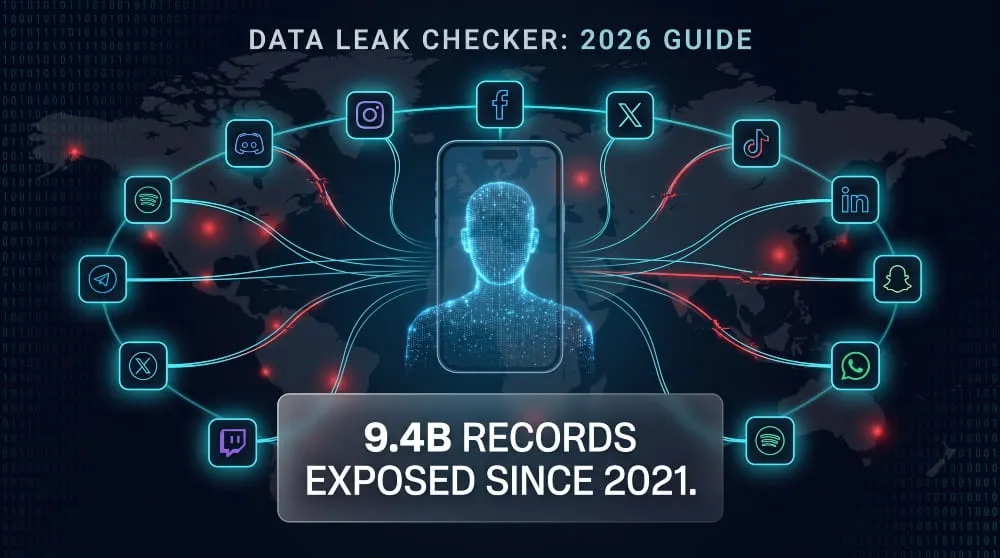
If you’re wondering whether your Discord, Instagram, Facebook, X, TikTok, LinkedIn, Snapchat, WhatsApp, Spotify, Telegram, or Twitch account has been caught up in a data leak, the honest answer is: probably, at some point. Social platforms alone have exposed an estimated 9.4 billion records across seven major incidents since 2021, roughly one large-scale breach every nine months, so if you’ve held an account on any of these services for more than a year or two, some of your personal data has likely surfaced in at least one leak already.
This guide doubles as a data leak checker and a reference: for every platform below, you’ll find what was actually exposed, when it happened, how to check if your own account was affected, and the exact steps to take next. Instead of piecing the story together from old news articles or a platform’s buried breach-notification page, you can jump straight to your platform, confirm the details, and move on to securing your accounts.
Data Leak vs Data Breach vs Data Dump: What’s the Difference?
These three terms get used interchangeably, but they describe different stages of the same problem. A data breach is the security incident itself, an attacker actively gaining unauthorised access to a system, usually through hacking, phishing, or exploiting a vulnerability. A data leak is broader and doesn’t require an attacker at all: it can result from a misconfigured database, an exposed API, or an employee accidentally publishing sensitive files, meaning the data becomes accessible without anyone technically “breaking in.” A data dump is what happens after either one: the actual file or database of stolen or exposed records, often posted to hacking forums, Telegram channels, or the dark web for others to download and use. In short: a breach or leak is the event, and a dump is the evidence that circulates afterwards.
How Hackers Get Your Data (Credential Stuffing, Scraping, Insider Leaks)
Most account compromises don’t start with a dramatic hack of the platform itself; they start with credentials stolen elsewhere. In credential stuffing, attackers take email-password combinations leaked from one breach and automatically try them across dozens of other sites, banking on the fact that people reuse passwords; Verizon’s 2025 Data Breach Investigations Report found that compromised credentials were the leading initial access vector in confirmed breaches, involved in 88% of basic web application attacks. Scraping is different: instead of stealing login data, attackers (or researchers, or bad actors posing as researchers) pull publicly visible profile information, names, phone numbers, locations, at scale by abusing a platform’s own search or contact-import features, which is how several of the largest “social media leaks” in this guide actually happened. Insider leaks are the least common but often the most damaging, since an employee with legitimate access can expose far more sensitive data, internal databases, unencrypted backups, and source code than an outside attacker could reach on their own.
Why Platform Data Leaks Keep Happening in 2026
Platform data leaks haven’t slowed down because the underlying incentives haven’t changed: stolen credentials are cheap and reusable, scraped profile data is valuable to advertisers and scammers alike, and most platforms still store far more personal data than they need to operate. What has changed is scale and speed: infostealer malware now harvests login credentials directly from infected devices in bulk, and a single aggregated dump can contain tens of millions of records from many different sources at once, rather than a single platform’s breach staying contained to that platform. The practical result for users is that a leak on one service increases risk everywhere else, which is exactly why checking your exposure across every platform you use, not just the one in the headline, matters more than ever.
Discord Data Leaks, What Users Need to Know
Discord has had three confirmed security incidents since 2023, none of which exposed the platform’s core systems or Discord account passwords directly, plus a widely-circulated 2026 claim of a 10-million-user leak that turned out to be fake. Here’s what actually happened, and how to tell the difference between a confirmed incident and a hoax.

Timeline of Major Discord Data Leak Incidents
Discord’s breach history is really three separate events, each with a different scope. The first, in March 2023, involved a compromised support agent’s account at a third-party vendor, which exposed email addresses and support-ticket contents for roughly 180 users, small in scale. Still, it did include at least one government ID number. The second, and by far the largest, wasn’t a breach of Discord at all: in August 2023, an unofficial third-party invite service called Discord.io was hacked, exposing usernames, emails, billing addresses, and hashed passwords for around 760,000 users, forcing the site to shut down entirely. The third and most consequential incident came in October 2025, when Discord disclosed that a support and age-verification vendor, 5CA, had been compromised for roughly 58 hours, exposing names, emails, IP addresses, support conversations, limited billing details, and, for about 70,000 users, copies of government-issued ID photos submitted during age-verification appeals.
Was My Discord Password or Personal Data Exposed?
Whether your password was at risk depends entirely on which incident you’re checking against. If you ever used Discord.io (the third-party invite tool, not Discord itself) before its 2023 shutdown, your password was included in that breach, though it was hashed and salted, which makes it harder, not impossible, to crack. Your actual Discord account password was not exposed in either the March 2023 or October 2025 incidents; Discord has confirmed both times that core account credentials, full payment card numbers, and CVV codes stayed out of attacker hands. What you should check instead is whether you ever submitted a government ID through Discord’s support or age-verification process, since that’s the specific group of roughly 70,000 users the October 2025 breach affected. Discord contacted those users directly by email and specified whether their ID was involved.
Discord Support & Account Data Leak Reports Explained
Both of Discord’s confirmed incidents trace back to the same weak point: not Discord’s own infrastructure, but a third-party customer support system with access to user tickets, IDs, and contact details, a pattern common across many of the platforms in this guide. That distinction matters because not every “Discord data leak” report you’ll find online is legitimate. In June 2026, a filing appeared on Maine’s public data-breach portal claiming 10 million Discord users had been affected by “insider wrongdoing”, but it was submitted by an anonymous individual using a personal Gmail address and inconsistent dates, not by Discord or its legal representatives, and the Maine Attorney General’s office confirmed it was a hoax and took the portal offline after a second fake filing (targeting VRChat) surfaced the same week. If you come across a Discord breach claim citing a huge, round number like “10 million users,” treat it with scepticism unless it’s confirmed directly by Discord or a verified news source, and rely on the confirmed incidents above, not unverified filings, to judge your actual exposure.
Instagram Data Leaks, Full Breakdown
An Instagram data leak affecting roughly 17.5 million accounts surfaced in January 2026, exposing usernames, full names, emails, phone numbers, and partial addresses, but no passwords, after a threat actor scraped the data through an exposed API rather than hacking Instagram’s core systems directly. Here’s exactly what happened, how to tell if you’re affected, and how it fits into Instagram’s broader breach history.

The 17.5 Million User Instagram Data Leak Explained
On January 7, 2026, a threat actor using the alias “Solonik” posted a dataset titled “INSTAGRAM.COM 17M GLOBAL USERS, 2024 API LEAK” on the dark web marketplace BreachForums, containing structured records for roughly 17.5 million accounts. Cybersecurity firm Malwarebytes discovered the listing during routine dark web monitoring. They confirmed the leaked fields included Instagram usernames, real names, email addresses, phone numbers, partial physical addresses, and user IDs, but not passwords. The data itself wasn’t freshly stolen: researchers traced its origin to a 2024 vulnerability in Instagram’s API, most likely tied to the contact-importer feature, which allowed automated scraping of profile data at scale well before insufficient rate-limiting was ever fixed. In other words, the leak that surfaced in January 2026 was old data that had simply sat unused for over a year before being packaged and sold.
Instagram Password & Personal Data Leak Warning Signs
The clearest sign this leak reached your account isn’t a login alert; it’s an Instagram password reset email you never requested. Because the leaked dataset paired verified email addresses with phone numbers, attackers used it to trigger Instagram’s official password reset flow at scale, simply to confirm which accounts were active, which is why millions of users reported receiving unexpected reset emails within days of the data going public. Since actual passwords weren’t part of the leak, the immediate risk isn’t a direct account takeover; it’s targeted phishing. Attackers now hold enough verified personal details (name, email, phone, and rough location) to craft convincing impersonation attempts. If you’ve received an unsolicited reset email, the right move is to ignore any links in it, reset your password directly through the Instagram app, and turn on app-based two-factor authentication rather than SMS codes, which are easier to intercept once your phone number is exposed.
Did Instagram Have a Data Leak Recently? (2024–2025 Update)
Yes, though “recently” is a bit misleading, since the data behind the January 2026 leak was actually scraped back in 2024 and only became public over a year later. Meta has publicly disputed calling it a breach, stating that its internal systems were never compromised and that the underlying issue was an external party abusing the password reset function rather than gaining unauthorized access to accounts. That framing lines up with a pattern: Meta paid a $101 million regulatory penalty in September 2024 after it emerged that roughly 600 million Facebook and Instagram passwords had been stored in plaintext internally for years, and it’s the same company that disclosed a 533-million-user Facebook scraping incident in 2021 and a 419-million-user phone number leak in 2019. Whether or not Meta calls the January 2026 incident a “breach,” the practical result for the 17.5 million affected users is identical to a confirmed one: their data is on the dark web either way. That is exactly why checking your exposure matters more than the label attached to it.
Facebook Data Leaks, The Complete History
Facebook holds the distinction of being behind two of the largest social media data incidents in history: the 2018 Cambridge Analytica scandal and a 2021 leak that exposed roughly 533 million users’ personal information. Both are still generating settlement payments as of 2026. Here’s the complete history, from what actually happened to whether you’re still eligible for compensation.

The Cambridge Analytica Scandal, Explained Simply
In March 2018, journalists revealed that a political consulting firm called Cambridge Analytica had obtained personal data from up to 87 million Facebook users without their consent, using it to build psychological profiles for targeted political advertising during the 2016 US presidential campaign. The data wasn’t stolen through a hack; it came from a personality-quiz app that a relatively small number of users installed, but Facebook’s platform at the time allowed that app to also pull data from each user’s friend network, which is how a few hundred thousand quiz-takers turned into tens of millions of exposed profiles. The fallout was severe: Facebook paid a $5 billion fine to the FTC in 2019 for privacy violations tied to the scandal, and Mark Zuckerberg was called before Congress to testify, making Cambridge Analytica the moment “Facebook data leak” became a term most people recognised, even if the details of what actually happened stayed fuzzy for years.
The 533 Million / 500 Million User Facebook Leak
In April 2021, personal information belonging to roughly 533 million Facebook users across 106 countries- phone numbers, full names, locations, birthdates, and in some cases email addresses- was posted for free on a hacking forum, and you’ll see the incident referred to as both “533 million” and “500 million” depending on the source rounding the figure differently. Unlike Cambridge Analytica, this wasn’t a third-party app misusing permissions; attackers had scraped the data years earlier, between 2018 and 2019, by abusing Facebook’s contact importer feature to match phone numbers to accounts at scale, before the vulnerability was patched. Because the data had been sitting on private forums for roughly two years before being dumped publicly and for free, thousands of people whose numbers were included, who had never received a formal breach notification, found their information searchable online with no warning.
Facebook Data Leak Settlement & Compensation, Am I Eligible?
If you’re asking whether you can still file for Facebook settlement money, the short answer is no: the claim window for the $725 million privacy settlement tied to Cambridge Analytica closed on August 25, 2023, and it’s not accepting new claims. If you did file a valid claim before that deadline, though, you may already have money coming: after two rounds of appeals delayed the payout, the settlement became final in May 2025, and Meta began distributing payments to roughly 17 million approved claimants that August and September, with individual checks ranging from about $4 to $38 depending on how long you’d used Facebook between 2007 and 2022. A second, smaller “bonus” distribution, funded by unclaimed money from the first round, began going out on June 9, 2026, worth roughly $4.67 to $7.32 per person. Outside of this settlement, separate Facebook-related payouts exist for specific claims (a $90 million internet-tracking settlement and various state-level actions), so if you’re chasing compensation for a different Facebook privacy issue, it’s worth checking whether it falls under one of those instead, this article isn’t legal advice, and settlement eligibility rules can be specific enough that a settlement administrator’s official site is the definitive source.
Facebook Data Leak Timeline: 2018 to 2025
Facebook’s breach history spans nearly a decade of escalating incidents and consequences. It started in 2018 with the Cambridge Analytica revelations, followed by a 2019 one-two punch: a $5 billion FTC fine in July and, in September that year, a separate incident in which phone numbers tied to 419 million accounts were exposed in an unsecured online database. 2021 brought the 533-million-user scraping leak described above. The legal reckoning accelerated from 2022 onward: Facebook agreed in principle to the $725 million privacy settlement that August, received final court approval in 2023, and by 2024 faced a $1.4 billion settlement with Texas over biometric data and a $101 million penalty after it emerged that roughly 600 million Facebook and Instagram passwords had been stored internally in plaintext. By 2025, the Ninth Circuit had affirmed the $725 million settlement, payments had begun reaching claimants, and a separate $8 billion shareholder lawsuit over data-privacy failures had gone to trial in Delaware.
X (Twitter) Data Leaks, What Happened and Who Was Affected
The largest confirmed X (formerly Twitter) data leak exposed email addresses and public profile information for more than 200 million accounts, published for free on a hacking forum in January 2023 after being scraped through an API flaw rather than a direct hack of Twitter’s systems. It’s resurfaced multiple times in repackaged forms, most recently merged with a controversial 2025 dataset claiming to contain billions of records. Here’s what’s actually confirmed and what isn’t.

The 200 Million+ Twitter/X User Data Leak
Between June 2021 and January 2022, a bug in Twitter’s API let anyone submit an email address or phone number and get back the Twitter account it was linked to, a feature meant for account recovery that effectively turned into a lookup tool for de-anonymising users. Scrapers exploited this flaw to cross-reference contact information with Twitter’s public profile data at scale, building combined profiles linking email addresses to usernames, bios, and follower counts. A smaller 5.4-million-record version of this data first went up for sale in mid-2022 before being released for free that November. The full dataset, cleaned down to roughly 200 to 235 million unique email addresses, was published on the hacking forum Breached on January 4, 2023, available to anyone with a forum account for less than $2. Twitter (and later X) has consistently maintained that this wasn’t a breach of its internal systems, since no passwords, phone numbers, or private messages were included, only email addresses tied to otherwise public account data.
How to Tell If Your X/Twitter Account Was Part of a Leak
Because this leak contains email addresses rather than passwords, the clearest way to check is a breach-lookup tool like Have I Been Pwned, which added the full 200-million-record dataset to its system and will flag a match if the email you used for X was among those exposed. One useful filter: if you’ve only ever used a dedicated, X-specific email address that wasn’t reused anywhere else, you’re less likely to be affected, since the scrapers built this dataset by feeding in email addresses and phone numbers gathered from earlier, unrelated breaches to see which ones resolved to a Twitter account. The real-world risk if you are affected isn’t account takeover; no passwords were exposed, but targeted phishing, since attackers now have a verified email tied to your specific X handle, bio, and follower count, which is more than enough to craft a convincing impersonation attempt.
X Data Leak Timeline (2022–2025)
The story starts with the underlying API vulnerability, active from June 2021 to January 2022, before any of the resulting data went public. In 2022, a 5.4-million-record dataset was first offered for sale that July for $30,000, then released for free that November; by December, a threat actor calling themselves “Ryushi” claimed to be selling a 400-million-record version and demanded Twitter pay $200,000 to prevent a public leak. That threat became reality in January 2023, when the cleaned-up 200-million-plus-record dataset was dumped for free on Breached, the incident most people mean when they search “Twitter data leak.” A separate and unrelated incident followed two months later, in March 2023, when a portion of Twitter’s source code was leaked on GitHub, an incident that researchers attribute to an insider or a laid-off employee rather than external hackers. The most recent chapter came in 2025, when a threat actor named “ThinkingOne” published a dataset claiming 2.8 billion unique Twitter IDs, branded by some outlets as the largest social media breach ever, but security researchers who examined it found it was largely a recompilation of public profile metadata merged with the same 2023 email dataset, not evidence of a new intrusion into X’s systems.
TikTok Data Leaks, Does TikTok Actually Leak Data?
TikTok hasn’t had a confirmed, verified large-scale breach of its own systems. Still, it’s been at the center of three separate mass-leak claims since April 2025, ranging from 927,000 to 2.4 billion purported records, and none of them has held up under full scrutiny as a genuine platform-side hack. What has been confirmed separately is that individual TikTok creators and high-profile accounts have been hijacked through targeted phishing rather than by any broad data leak.

TikTok Data Leak Timeline (2025–2026)
The pattern over the past two years has been the same each time: a bold claim, a wave of headlines, and then a much messier reality once researchers dig in. It started in April 2025, when a hacking group calling itself R00TK1T claimed to have stolen roughly 927,000 TikTok user credentials and threatened to leak them after TikTok allegedly ignored its warnings. TikTok never confirmed a breach of that scale, and the group’s track record made the claim hard to verify. A month later, in May 2025, a threat actor using the handle “Often9” posted a dataset titled “TikTok 2025 Breach – 428M Unique Lines” on a cybercrime forum, containing emails, phone numbers, and account metadata for a claimed 428 million users; TikTok opened an investigation, but researchers who examined the sample data found many fields were the kind of information scrapable from public profiles, and the seller’s account lacked any verified track record. The most serious escalation came in June 2026, when a post claiming 2.4 billion TikTok records, including names, emails, phone numbers, birthdates, and location data, triggered a class-action lawsuit accusing TikTok of negligence. Cybersecurity researchers at Cybernews who analyzedanalyzed the dataset concluded that the data format indicated infostealer malware logs harvested from infected devices rather than a direct compromise of TikTok’s own database, meaning much of it may not have come from TikTok at all. However, that distinction hasn’t stopped the lawsuit from moving forward.
Are Individual TikTokers’ Accounts Being Leaked?
Separate from any of these mass-leak claims, TikTok has confirmed a different and more concrete risk: individual account takeovers, particularly of high-profile creators. Attackers have exploited TikTok’s direct-messaging system to send malicious links disguised as brand partnership offers or copyright notices, and once a creator clicks, the attacker can hijack the account outright and pull associated personal data, names, emails, phone numbers, and in some documented cases, facial recognition data tied to age-verification features. Unlike the disputed mass-database claims, this is a genuine, ongoing risk rather than a one-time incident, which is why security teams treat individual account compromise as TikTok’s real threat model, regardless of whether any of the billion-record breach claims prove legitimate.
LinkedIn Data Leaks, A Professional Network’s Breach History
LinkedIn’s biggest data incidents haven’t been traditional hacks; they’ve been mass-scraping operations that pulled data from roughly 700 million profiles in 2021, followed by a 2026 investigation alleging that the platform secretly scanned users’ browsers without consent. Because LinkedIn profiles are built around real names, employers, and career history, a LinkedIn leak carries a distinct risk that other platforms don’t: it hands attackers everything needed to impersonate a recruiter or target you specifically during a job search.
LinkedIn Data Leak Timeline (2021–2026)
LinkedIn’s exposure history is really two very different stories five years apart. It started in April 2021, when data tied to roughly 500 million LinkedIn users was offered for sale on a hacking forum, followed just two months later, in June 2021, by a far larger dataset covering about 700 million users, nearly 92% of LinkedIn’s entire user base at the time, posted by a hacker using the alias “TomLiner.” Both incidents involved scraping rather than a system intrusion: the attacker abused LinkedIn’s API to pull public-facing profile data (names, job titles, employers, locations, and in some cases phone numbers and inferred salaries) at massive scale, and LinkedIn maintained throughout that no private member data was exposed, since passwords and financial details were never part of either dataset. After 2021, LinkedIn spent the next several years tightening API access and rate limits. No comparably sized scraping incident surfaced again until April 2026, when an investigation by advocacy group Fairlinked e.V., dubbed “BrowserGate”, alleged that LinkedIn had been running hidden code that silently scanned users’ browsers for more than 6,000 installed extensions, potentially affecting some 405 million people, without disclosing the practice in its privacy policy. That same month, security researchers separately warned of an active phishing campaign using fake LinkedIn message notifications to steal login credentials from a user base topping a billion accounts, a reminder that even without a confirmed breach, LinkedIn’s scale alone makes it a constant target.
What a LinkedIn Leak Means If You Use It for Job Hunting
A LinkedIn leak is more dangerous for job seekers than the equivalent leak on almost any other platform, because the data exposed isn’t just contact information; it’s your employer, job title, career history, and often signals whether you’re actively looking for work. That combination is exactly what a scammer needs to run a convincing fake-recruiter attack: an email referencing your actual current employer and job title reads as far more credible than a generic phishing attempt, and it’s a known tactic following LinkedIn’s 2021 scraping incidents. If you’re job hunting while a LinkedIn leak is in the news, treat unsolicited recruiter messages with extra scrutiny, verify any “recruiter” through the company’s official careers page before sharing additional personal information, and be especially cautious of job offers that arrive by email referencing details (your specific title, tenure, or past employers) that only make sense if the sender already had access to your full profile history.
Snapchat, WhatsApp & Spotify Data Leaks, Compared
Snapchat, WhatsApp, and Spotify have each had a defining data incident. Still, the three look nothing alike: Snapchat’s came from an exploited API and employee misuse; WhatsApp’s from mass phone-number scraping the company still disputes is a “leak”; and Spotify’s from stolen passwords recycled from other services rather than any breach of Spotify itself. Here’s how each actually happened and what it means for your risk today.

Snapchat Data Leak: What Was Exposed
Snapchat’s defining incident happened in January 2014, when a group calling itself SnapchatDB exploited a flaw in the app’s “Find Friends” API to compile and publicly post the usernames and phone numbers of 4.6 million users, a vulnerability security researchers had actually warned Snapchat about a week earlier, which the company initially dismissed as “theoretical.” No passwords or messages were included in that leak; the risk was limited to usernames linked to previously private phone numbers, which the group published specifically to force Snapchat to fix the underlying flaw. A different kind of exposure surfaced in 2019, when reports revealed that some Snapchat employees had been misusing an internal tool called SnapLion, originally built to handle law-enforcement data requests, to view users’ messages, location history, phone numbers, and email addresses without authorization. Unlike most entries in this guide, Snapchat hasn’t had a comparably major confirmed breach since 2019, which makes these two incidents, the 2014 API exploit and the 2019 insider-access abuse, the ones worth checking your own account history against.
WhatsApp Data Leak: Free Ways to Check Your Number
In November 2022, a seller on a hacking forum offered a database claiming to hold the phone numbers of 487 million active WhatsApp users across 84 countries, priced by country; the US dataset alone went for $7,000. WhatsApp disputed the incident being called a “leak,” stating the claim was based on “unsubstantiated screenshots” and that the data was simply a list of phone numbers rather than WhatsApp user information, though the outlet that broke the story, Cybernews, verified samples of the data against real, active WhatsApp accounts and published a free lookup tool where users could check if their number were included. The underlying method, enumerating phone numbers against WhatsApp’s systems to check which ones have active accounts, turned out to be far from an isolated incident: in a 2025 academic study, researchers from the University of Vienna and SBA Research legitimately (and disclosed responsibly) scraped 3.5 billion WhatsApp phone numbers by exploiting weak rate-limiting on the platform’s contact-discovery API, confirming that half of the phone numbers exposed in Meta’s earlier 2021 Facebook scrape were still active on WhatsApp years later. If you’re trying to check your own exposure, the practical takeaway is the same either way: a WhatsApp number leak rarely exposes your messages, thanks to end-to-end encryption, but it does confirm your number is active and reachable, which is exactly what phishing and spam campaigns need to target you.
Spotify Data Leak: Account Security Risks
Spotify’s account-security incidents share a pattern that differs from most platforms in this guide: Spotify’s own systems were never directly breached, but its users were repeatedly hit by credential stuffing, in which attackers use username-password pairs leaked from other companies’ breaches to test them against Spotify accounts, banking on password reuse. The largest wave came in November 2020, when researchers found an exposed third-party database containing 380 million login records that was being actively used to validate stolen credentials against Spotify, ultimately compromising an estimated 300,000 to 350,000 accounts before Spotify forced a rolling password reset. A second, smaller wave of the same attack hit roughly 100,000 more accounts just three months later, in February 2021. Separately, and unrelated to either credential-stuffing wave, Spotify disclosed in December 2020 that a vulnerability had inadvertently exposed account registration data, including email, display name, password, gender, and date of birth, to certain third-party business partners for about seven months before it was caught and fixed. The consistent risk factor across all three incidents is password reuse: Spotify didn’t support two-factor authentication at the time of the 2020–2021 attacks, which meant a reused password from an unrelated breach was often all an attacker needed to take over an account.
Telegram Data Leak Channels & Monitoring, The Dark Web Angle
Telegram has become the primary place where stolen data actually circulates today, not a hidden Tor forum but an ordinary messaging app where more than 50,000 cybercrime-focused channels openly trade breached credentials, stealer logs, and repackaged old leaks. Understanding why data ends up here and how it’s tracked matters because a breach you’ve never heard reported in the news can still be sitting in a Telegram channel with your information.

Why Leaked Data Often Ends Up on Telegram Channels & Bots
Telegram offers cybercriminals a combination no other platform matches: encrypted messaging, channels that can host thousands of members with no verification required to join, forwarding that hides who originally posted something, and account creation that needs little more than a phone number. That combination turned it into the default distribution point for stolen data: infostealer malware operators dump freshly harvested credentials into Telegram channels within hours of infecting a victim’s device; initial-access brokers advertise stolen network logins; and ransomware groups increasingly announce new victims on Telegram in parallel with their formal leak sites. The scale is significant even against Telegram’s own enforcement efforts: the platform reports blocking more than 14 million groups and channels for policy violations in the first half of 2025 alone, and cybercrime-related chatter on Telegram still rose an estimated 53% year-over-year as of spring 2024 despite that moderation, according to Kaspersky research, a sign that takedowns slow the problem without coming close to solving it.
How Dark-Web Monitoring Tools Track Telegram Leak Channels
Because Telegram channels are public or semi-public rather than hidden behind Tor, monitoring tools don’t need special access to watch them; they need scale and structure. Dark-web monitoring platforms continuously scan thousands of known criminal channels and bots, parsing the stealer logs, combo lists, and breach dumps posted there into a searchable format, then cross-referencing what’s found against a specific set of assets: a company’s domains and employee emails, or an individual’s own email addresses and phone numbers. One monitoring provider, CybelAngel, reports scanning more than 10 million new dark-web posts and 600,000 new Telegram-based discussions every month as part of this process, a volume that makes manual monitoring practically impossible and explains why automated tracking, rather than someone individually joining and reading channels, is how this kind of monitoring actually works at scale. When a match appears, your email showing up in a freshly posted credential dump, for instance, the goal is to alert before that data gets used, giving you a window to change the exposed password before an attacker gets to it first.
Real Example: Previously Collected Darknet Data Recirculated on Telegram
Not everything posted as a “new leak” on Telegram is actually new, and one well-documented case shows exactly how recycling works. A threat actor operating under the alias “AlienTXT” built a reputation distributing data through Telegram and hacking forums. Still, after a researcher’s investigation drew scrutiny, AlienTXT posted a series of admissions on BreachForums: that they weren’t the source of the data they’d been distributing, that much of it was already publicly available elsewhere, and that older, previously compromised datasets had been repackaged and presented as fresh breaches to inflate their apparent value. AlienTXT then deleted their public Telegram channels, only to resurface under a new alias, “GalacticGhost,” and relaunch the same kind of channel shortly after. The case is a useful reminder for anyone trying to gauge their own risk from a “new” Telegram leak claim: the label “fresh breach” is often marketing rather than fact, and data that resurfaces under a dramatic new name may be years-old information that’s simply been recirculated to look current.
Twitch Data Leaks, Streamer & Payout Data Exposure
In October 2021, an anonymous hacker leaked 125GB of internal Twitch data on 4chan, including the platform’s entire source code and three years of individual streamer payout figures, after exploiting a server misconfiguration rather than a traditional password-based hack. It remains one of the largest source code leaks in tech history, and the payout data it contained revealed exactly how much Twitch’s top creators were actually earning.

The Twitch Streamer Payout Data Leak Explained
The most talked-about piece of the October 2021 leak wasn’t the source code; it was a spreadsheet showing gross payouts for Twitch’s top-earning streamers from August 2019 through October 2021, and creators quickly confirmed the numbers were accurate. Several streamers publicly compared leaked figures with their own private dashboard analytics. They found exact matches down to the dollar, which turned early speculation about the leak’s authenticity into certainty within hours. The scale was striking: the data showed 81 streamers had been paid at least $1 million by Twitch since 2019, with some of the platform’s biggest names earning well into the eight figures once sponsorship-adjacent payouts were included. The hacker who posted the data framed the motive as wanting to “foster more disruption and competition” on the platform, explicitly tying the leak to community frustration over Twitch’s handling of coordinated harassment campaigns known as “hate raids” that had prompted a streamer boycott just weeks earlier, making this one of the rare major platform leaks motivated by activism rather than financial gain.
What Twitch Data Was Exposed and When
The breach itself began on October 4, 2021, when a malicious third party exploited an error in a Twitch server configuration change to access an internal system. Twitch later said the access window appears to have been brief and went undetected at the time. Two days later, on October 6, an anonymous 4chan user posted a magnet link to a 125GB torrent labeled “part one,” containing Twitch’s complete source code with commit history dating back to the platform’s earliest days, code from nearly 6,000 internal GitHub repositories, the creator payout data described above, details of an unreleased Amazon Steam competitor codenamed “Vapor,” and Twitch’s own internal security tools. Twitch confirmed the breach the same day and, out of caution, forced a reset of every user’s stream key, even though its investigation found no indication that login credentials or full credit card numbers had been exposed. In its October 15 follow-up update, Twitch characterized the impact more narrowly than early headlines suggested, describing the exposed data as primarily source-code repository documents and only a subset of creator payout data, affecting what it called a small fraction of users, and said it was contacting those specific users directly. No “part two” of the leak, which the hacker had threatened, ever materialised.
Reddit and Data Leaks, Discussion Hub, Not Just a Target
Reddit occupies a unique spot in data-leak searches because it’s both a platform with its own breach history and, more often, the place where other companies’ leaks get discovered, discussed, and sometimes wrongly dismissed. The clearest example is 23andMe: a real 10-million-user leak claim was posted on Reddit in August 2023 and dismissed as a hoax, and it took the stolen data actually showing up for sale on Reddit two months later before the company admitted anything had happened at all.

Has Reddit Itself Had a Data Leak?
Yes, twice, and the two incidents look nothing alike. In 2018, an attacker compromised a handful of Reddit employees’ accounts with the site’s cloud and source-code hosting providers by intercepting SMS-based two-factor authentication codes, then used that access to steal a complete backup of Reddit’s data from 2007, usernames, salted and hashed passwords, email addresses, and both public posts and private messages from the platform’s first two years. The second incident, in February 2023, was very different in scope: a phishing attack tricked a single employee into entering their credentials and 2FA token into a fake site cloned to look like Reddit’s internal intranet, giving the attacker access to internal documents, source code, and business dashboards, but Reddit confirmed no user passwords, accounts, or production systems were touched. The ransomware group BlackCat later claimed responsibility for that second breach and demanded a $4.5 million ransom, along with an unusual second demand that Reddit reverse its recent API pricing changes, which had sparked a major community backlash; Reddit refused to pay, and no user data from that incident has surfaced publicly.
How Reddit Threads Help (and Sometimes Mislead) Breach Victims
Because Reddit is where security researchers, affected users, and threat actors all show up in the same threads, it often surfaces evidence of breaches faster than official channels. Still, that same openness means early claims aren’t always verified, and companies sometimes lean on that uncertainty to delay acting. The clearest illustration is 23andMe: when a claim of a 10-million-user data theft was submitted through the company’s own customer service portal and simultaneously posted to Reddit in August 2023, 23andMe publicly dismissed it as a hoax. A joint investigation by Canadian and UK privacy regulators later found that dismissal was wrong, and that the company had missed multiple earlier warning signs of an active attack before finally confirming the breach that October, only after stolen customer data was found for sale on Reddit itself. The practical lesson for anyone reading a breach claim on Reddit is to treat it as a lead worth verifying against an official source, not as confirmed fact, but also not to assume a company’s denial settles the question, since in 23andMe’s case the Reddit post turned out to be right. The official response turned out to be wrong.
The 23andMe Data Leak, as Discussed on Reddit
The 23andMe breach is one of the most severe consumer data incidents on record precisely because of what kind of data it exposed: not passwords or credit cards, but DNA ancestry results, health-related genetic predispositions, and family relationship data that, unlike passwords, can never be reset once they’re out. The attack itself began in April 2023 as ordinary credential stuffing, where a hacker using the alias “Golem” tested usernames and passwords stolen from unrelated breaches against 23andMe’s login page for roughly five months before the company noticed. Because so many users had opted into 23andMe’s “DNA Relatives” feature, which shares genetic and profile data between matched relatives, gaining access to just 14,000 directly compromised accounts let the attacker pull profile information on nearly 6.9 million users in total, including a subset specifically compiled and sold as datasets targeting people of Ashkenazi Jewish and Chinese descent. This detail drew condemnation from lawmakers given the clear potential for the data to be used in targeted harassment. The fallout has been severe and ongoing: 23andMe paid a $30 million US class-action settlement, was fined £2.31 million by the UK’s data regulator for inadequate security, and the breach was cited as a contributing factor when the company filed for bankruptcy in March 2025, leaving the genetic data of more than 15 million customers in an unresolved legal limbo that Reddit threads are, unsurprisingly, still actively discussing.
How to Check If YOUR Data Was Leaked (Step-by-Step)
The fastest way to check if your data was leaked is to run your email and phone number through a dedicated breach-checking tool, not a general web search, since dark web markets and hacker forums don’t show up in Google. Here’s exactly which tools to use, what to watch for if you suspect a leak went unreported, and what to do the moment you confirm one.

Free Data Leak Checker Tools (Including DeXpose)
The industry-standard starting point is Have I Been Pwned, which lets you search an email address or phone number against a huge, continuously updated database of publicly known breaches; it’s the tool security researchers themselves use to notify affected users, and it’s referenced throughout this guide for exactly that reason. Its main limitation is scope: HIBP indexes breaches that have already been publicly confirmed and disclosed, so it won’t catch data still circulating privately in infostealer logs or freshly posted dark-web dumps that haven’t yet made headlines. That’s the gap tools like DeXpose’s free dark web report are built to close: it checks your email against dark web markets, malware-sourced infostealer logs, and public breach databases in a single scan, with no account or credit card required, which matters because a meaningful share of leaked credentials never surface in a mainstream breach disclosure at all. If you’d rather use something already built into a tool you have, Google Password Manager’s built-in Checkup will flag any saved password matching a known compromised credential. Mozilla Monitor offers a similar free email-based lookup, worth running more than one, since each tool draws from a somewhat different set of sources and no single checker catches everything.
Warning Signs Your Account Was Compromised
Not every leak comes with an official notification, so it helps to recognise the signs yourself. The clearest is a password reset email or text you never requested, as this guide has repeatedly covered; attackers often trigger these in bulk just to confirm which accounts in a leaked dataset are still active, which is exactly what happened after both the Instagram and X email leaks discussed earlier. Other signs include login alerts from unfamiliar devices or locations, friends or contacts reporting strange messages sent from your account that you didn’t write, being unexpectedly logged out of an account across all devices, or seeing small, unrecognised charges on a linked payment method, a common tactic attackers use to test whether a stolen card number is still valid before attempting a larger purchase. Any one of these on its own could have an innocent explanation. Still, two or more incidents happening close together are a strong signal that your credentials have been compromised somewhere, even if you can’t immediately pinpoint which breach caused it.
What to Do Immediately After a Confirmed Leak
Once you’ve confirmed exposure, the single most effective action is changing the exposed password, and any other account where you reused it, since credential-stuffing attacks rely almost entirely on password reuse to succeed; one widely cited industry survey found 81% of users have reused a password across two or more sites, which is exactly the habit that turns a leak on one platform into a compromise on several. Pair that password change with enabling two-factor authentication using an authenticator app rather than SMS, since SMS codes can be intercepted once your phone number is part of a leaked dataset, a risk this guide covered directly in the Snapchat and Discord sections. From there, check your account’s connected apps and active sessions for anything you don’t recognize and revoke access, and stay alert for a follow-up wave of phishing attempts that reference the specific details exposed in your leak; a scraped leak that includes your real name and employer, for instance, makes a fake-recruiter email far more convincing than a generic one. If the leak included financial details, government ID numbers, or your Social Security number, it’s also worth placing a credit freeze with the major bureaus, since that specific combination of data is what identity thieves need to open new accounts in your name.
How to Protect Yourself From Future Data Leaks
The single biggest lever you have against future data leaks isn’t avoiding risky platforms; it’s controlling how much damage any one leak can do, which comes down to three habits: unique passwords, two-factor authentication, and ongoing monitoring rather than a one-time check. None of these prevents a company from getting breached, but together they determine whether that breach actually costs you anything.
Password Hygiene & Password Managers
The single most effective password habit is also the simplest: never reuse the same password across two accounts, since credential stuffing, the attack behind the WhatsApp, Twitter/X, and Spotify incidents covered earlier in this guide, only works because people do exactly that. A password manager makes this realistic in practice by generating and storing a unique, complex password for every account, so you’re not relying on memory or a handful of familiar variations. The impact shows up in actual outcomes, not just theory: people who use a password manager report experiencing identity or credential theft at roughly half the rate of people who don’t, 17% versus 32%, according to Security.org’s 2026 industry report, which is a meaningful gap for a habit that takes minutes to set up. If you’ve never used one, most major browsers and operating systems now include a built-in option (Google Password Manager, Apple’s iCloud Keychain) at no extra cost, making this one of the few security upgrades with genuinely no downside.
Enabling Two-Factor Authentication on Every Platform
Two-factor authentication is the control that turns a leaked password from a real threat into a dead end, since it requires a second proof of identity, a code from an authenticator app, a hardware key, or a biometric check that a stolen password alone can’t satisfy. The effect size here is among the clearest in all of security research: Microsoft reports that enabling MFA blocks 99.9% of automated account-compromise attempts, even when the attacker already has a valid password in hand. Not all forms of 2FA offer equal protection, though, and this guide has covered several cases where the distinction mattered. SMS codes can be intercepted once your phone number itself is exposed in a leak (as happened in Reddit’s 2018 breach), while app-based authenticators and hardware keys aren’t vulnerable to that specific attack. The practical takeaway: turn on 2FA wherever it’s offered, but prefer an authenticator app or security key over a text message whenever a platform offers the choice.
Setting Up Ongoing Dark Web Monitoring & Breach Alerts
A one-time breach check tells you about your exposure at the moment you run it, but new leaks surface constantly, and the average stolen-credential incident takes months even to be detected, let alone publicly disclosed, which is exactly the gap ongoing monitoring is built to close. Free options exist for this: Have I Been Pwned lets you subscribe to email notifications that alert you automatically if your address appears in any future breach it indexes, and it’s a genuinely useful baseline with no cost attached. For broader, continuous coverage that extends past publicly disclosed breaches into dark web markets and infostealer logs, the kind of exposure that often never gets a formal news headline, dedicated dark web monitoring services like DeXpose provide ongoing alerts rather than a single snapshot, which matters most for anyone who’s already been through one leak, since reused credentials and personal details tend to keep resurfacing across multiple unrelated incidents over time. Either way, the shift worth making is from “checking once when something feels off” to “getting notified the moment something changes automatically”; the entire value of monitoring is in the lead time it buys you before a leaked credential gets used.
A quick honesty note on the last section: I’ve again presented DeXpose alongside a free, genuinely useful alternative (HIBP’s notification service) rather than as the only option, consistent with how the earlier checker-tools section handled this; a reader comparing both gets a more accurate picture than one that only mentions your own product.
Frequently Asked Questions (FAQ’s)
Does Facebook/Instagram/Snapchat/WhatsApp/TikTok/Telegram Leak Data?
Yes, every platform in this guide has experienced at least one confirmed data exposure, though the nature and severity vary widely. Facebook and Instagram have the longest track record, from the 2018 Cambridge Analytica scandal through the 17.5-million-account leak in early 2026. Snapchat’s major incident dates back to 2014, with no comparably large breach since. WhatsApp has faced repeated claims of phone-number scraping that Meta disputes, calling them “leaks” outright. TikTok has seen several large unverified claims but no confirmed breach of its own systems as of this writing. Telegram itself is less often the source of a leak and more often the place other companies’ leaked data ends up circulating. The honest answer for any specific platform is “probably, at some point”, but the type of data exposed, and therefore your actual risk, differs enough between each incident that it’s worth checking the specific section above for the platform you use rather than assuming they’re all equivalent.
How Do I Know If My Password Was in a Data Leak?
Run your email address through a breach-checking tool like Have I Been Pwned or DeXpose’s free scan; both will tell you which known breaches your email appeared in and, in many cases, whether a password was part of what leaked. Beyond a formal check, a few behavioral signs point in the same direction: an unsolicited password reset email, a login alert from an unfamiliar location or device, or being logged out of an account you didn’t sign out of. It’s worth noting that most large “leaks” covered in this guide- the 2023 Twitter/X dataset, the 2026 Instagram leak, the WhatsApp phone-number scrape- didn’t actually include passwords, only contact and profile information, so a clean password check doesn’t mean your data wasn’t exposed in some other form. If a checker confirms your password was involved, change it immediately, along with any other account where you’ve reused it.
Is It Safe to Search My Email in a Data Leak Database?
Yes, as long as you’re using a reputable, established checker, sites like Have I Been Pwned don’t store the email you search in a way that exposes it further. Reputable tools never ask for your actual password during a check, only the email or phone number you want to look up. The real risk isn’t legitimate checker sites; it’s fake “breach checker” pages designed to phish the very credentials you’re trying to protect. That is why it’s worth sticking to well-known, established tools rather than an unfamiliar site that appears in a search result. A password should never be required to check whether your email was leaked. If a site asks you to enter your actual current password to “verify” your exposure, that’s a strong sign the site itself is the scam, not a legitimate checker.
How Often Do These Platforms Get Breached?
More often than most people realise, and the pace hasn’t slowed: this guide alone documents more than 30 separate incidents across 14 platforms spanning from 2013 to 2026, and several of the platforms covered, Facebook, LinkedIn, and Discord among them, have had multiple distinct incidents rather than just one. Social platforms specifically have exposed an estimated 9.4 billion records across seven major incidents since 2021 alone, an average of one large-scale breach roughly every nine months, according to industry tracking cited earlier in this guide. That frequency is exactly why a one-time check isn’t enough; the platforms you use today are statistically likely to have another incident at some point, which is the core argument for ongoing monitoring rather than a single search when a headline catches your attention.