
Cybercrime Laws Around the World | A Complete Investigator’s Reference Guide
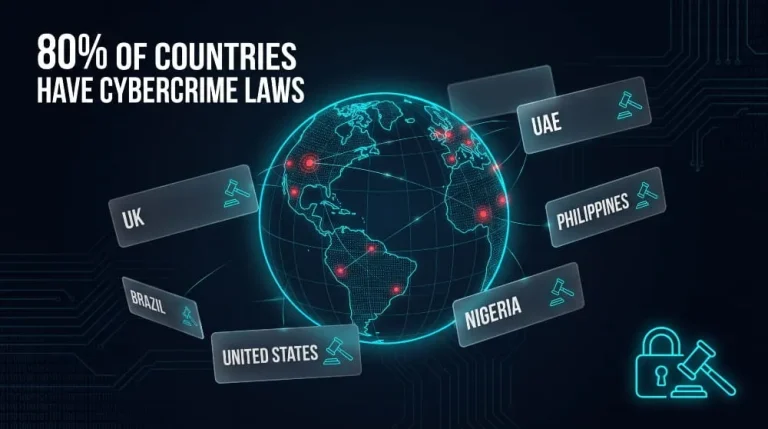
Cybercrime laws are the country-specific and international legal frameworks that define which online acts- unauthorized access, data theft, fraud, harassment- count as crimes and what penalties they carry. Because no single global cybercrime statute exists, the rules an investigator must follow change depending on which country’s law applies, what the act targeted, and whether more than one jurisdiction is involved.
That patchwork matters more than it used to. The FBI’s Internet Crime Complaint Center logged 859,532 complaints in a single year, with reported losses topping $16.6 billion, a 33% jump from the year before. Every one of those cases eventually runs into the same question: which law applies, and does it actually cover what happened? This guide breaks down what cybercrime law covers, how it differs by region, and where enforcement typically runs into trouble, serving as a working reference for investigators, legal researchers, and anyone who needs to know the law before applying it.
What Is Cybercrime Law?
Cybercrime law is the body of legislation that criminalizes offenses committed through or against computer systems, networks, and digital data, covering everything from hacking and ransomware deployment to online fraud, identity theft, and cyber harassment. Rather than a single unified code, it’s a collection of statutes that most countries have built or amended over the past two decades specifically to address conduct that didn’t exist, or wasn’t clearly illegal, before the internet made it possible.
Legal Definition and Scope
Legally, cybercrime law is defined by the medium and mechanism of the offense, not just its outcome. A statute typically covers unauthorized access to a computer system, interference with data or networks, using digital tools to commit fraud or theft, and distributing illegal content online. Most national laws, from the U.S. Computer Fraud and Abuse Act to the UAE’s Federal Decree-Law No. 34 of 2021, organize these offenses around a few recurring elements: whether access or use was authorized, whether intent to cause harm or gain existed, and whether the act crossed into protected categories like financial systems, critical infrastructure, or personal data. Scope varies significantly by jurisdiction; some laws stop at hacking and fraud, while others extend into online speech, defamation, and content deemed harmful to public morals or national security.
How Cybercrime Law Differs From Traditional Criminal Law
Cybercrime law diverges from traditional criminal law mainly in three areas: evidence, jurisdiction, and pace of change. A conventional theft case has a physical scene and a local suspect; a cybercrime case often has neither. The attacker, the server, and the victim can sit in three different countries, which is why the Council of Europe’s Budapest Convention exists specifically to standardize cross-border evidence-sharing and extradition for cyber offenses. Evidence itself is inherently different too: instead of physical exhibits, investigators work with logs, IP addresses, and digital forensics data that can be altered, encrypted, or wiped in seconds. And because attack methods evolve faster than legislative cycles, cybercrime statutes are amended far more frequently than most traditional criminal codes; the UAE alone has revised its core cybercrime law twice in under a decade to keep pace with new offense categories like cryptocurrency fraud and AI-generated deepfakes.
Core Categories of Cybercrime Under the Law
Most cybercrime statutes organize offenses into four broad categories: unauthorized access, financially motivated fraud, harassment-based offenses, and privacy or data protection violations. A single incident can trigger charges under more than one category; a phishing attack, for example, usually involves unauthorized access and fraud statutes, which is part of why cybercrime cases are often more legally complex than they first appear.
Unauthorized Access and Hacking
Unauthorized access laws criminalize entering a computer system, network, or account without permission, even if no data is stolen or damaged. Most statutes don’t require proof of financial harm to secure a conviction; bypassing security controls or exceeding authorized access is the offense itself. This is the core provision behind laws like the U.S. Computer Fraud and Abuse Act and similar hacking statutes across the UAE, EU, and Southeast Asia, and it typically carries the heaviest penalties when the accessed system involves critical infrastructure, financial institutions, or government networks.
Fraud, Phishing, and Identity Theft
Fraud and phishing offenses cover the use of deceptive digital communications, fake emails, spoofed websites, and impersonated identities to trick victims into handing over money, credentials, or personal data. Phishing remains the single most-reported cybercrime in the United States, with 193,407 complaints filed to the FBI’s Internet Crime Complaint Center in one year alone, ahead of every other category by a wide margin. Legally, these cases often layer cybercrime statutes on top of traditional fraud and identity-theft law, since the underlying deception mirrors offline fraud even though the delivery method is digital.
Cyberbullying, Harassment, and Online Defamation
Cyberbullying, harassment, and online defamation statutes address the use of digital platforms to threaten, intimidate, or damage someone’s reputation, and they’re among the most inconsistent laws worldwide. Some countries treat online harassment as an extension of existing harassment or stalking law. In contrast, others, particularly across the Gulf region and parts of Southeast Asia, have written standalone cybercrime provisions that criminalize defamation, insult, or reputational harm conducted online, sometimes with penalties well beyond what equivalent offline conduct would carry. This gap matters for investigators working cross-border cases, since conduct that’s a civil matter in one jurisdiction can be a criminal offense in another.
Data Protection and Privacy Violations
Data protection and privacy laws criminalize the unauthorized collection, use, or disclosure of personal data, and they increasingly function as a companion to core cybercrime statutes rather than a separate legal track. Frameworks like the EU’s GDPR and equivalent national data protection laws create liability for mishandling data even without a traditional “hacking” element. As a result, a breach investigation often has to weigh privacy obligations, such as mandatory disclosure timelines, alongside the criminal statute covering the underlying intrusion.
Cybercrime Laws by Country and Region
Cybercrime law isn’t standardized globally; each country defines offenses, sets penalties, and structures enforcement differently, which is exactly why a cross-border investigation often has to start with a jurisdictional question before it can start with an evidentiary one. The frameworks below represent the major approaches investigators are most likely to encounter.
United States, Federal and State-Level Cybercrime Statutes
U.S. cybercrime law operates on two tracks: the federal Computer Fraud and Abuse Act (CFAA), which criminalizes unauthorized access to protected computer systems nationwide, and state statutes that fill gaps around fraud, harassment, and identity theft. This dual structure means the same conduct can trigger federal charges, state charges, or both, depending on which systems were affected and whether the act crossed state lines. The scale of what these laws address is significant: the FBI’s Internet Crime Complaint Center recorded 859,532 complaints and $16.6 billion in reported losses in a single year, the highest figures on record.
United Arab Emirates, Federal Decree-Law No. 34 of 2021
The UAE’s core cybercrime statute, Federal Decree-Law No. 34 of 2021 on Combating Rumors and Cybercrimes, replaced the country’s earlier 2012 law and took effect in January 2022. It criminalizes unauthorized access and hacking, electronic fraud, and the dissemination of false information, with penalties for unauthorized network interception running from a prison term and a fine of AED 150,000 to AED 500,000, rising sharply if intercepted data is leaked. The law’s scope extends beyond typical hacking and fraud provisions into misinformation and reputational-harm offenses, giving it a notably broader reach than comparable Western statutes.
Philippines, Republic Act 10175 (Cybercrime Prevention Act)
The Philippines’ Cybercrime Prevention Act of 2012, or RA 10175, criminalizes illegal access, computer-related fraud, and online libel, and it does something unusual: it takes any existing crime under the Revised Penal Code. It imposes a penalty one degree higher if it’s committed through information technology. Illegal access alone carries six years and one day to twelve years’ imprisonment, or a fine of at least ₱200,000. The National Bureau of Investigation and the Philippine National Police enforce it, each with a dedicated cybercrime unit, and the law’s online libel provision has faced ongoing constitutional challenges since enactment.
Jordan, Cybercrime Law No. 17 of 2023
Jordan’s Cybercrime Law No. 17 of 2023 replaced the country’s 2015 statute, expanding it from 17 articles to 41 and taking effect in September 2023. Alongside standard unauthorized-access provisions, one week to three months’ imprisonment or a fine of 300 to 600 Jordanian dinars for gaining unauthorized access to a network, the law added broad offenses covering “spreading false news,” “provoking strife,” and online defamation. Human rights organizations have documented hundreds of prosecutions under these provisions in the law’s first year, mostly tied to social media posts criticizing government policy, making Jordan a frequently cited example of how cybercrime statutes can extend well past traditional hacking and fraud.
Saudi Arabia and Qatar, Gulf Region Cybercrime Statutes
Saudi Arabia’s Anti-Cyber Crime Law, in force since 2007, and Qatar’s Cybercrime Prevention Law (Law No. 14 of 2014) anchor cybercrime enforcement across the Gulf, both criminalizing unauthorized access, electronic fraud, and content offenses tied to public morals or national security. Of the two, Qatar’s statute is generally considered the more comprehensive, with more detailed provisions on procedural matters like evidence preservation and cross-border cooperation, areas where several neighboring GCC laws remain comparatively thin.
Kuwait, Egypt, and Nigeria: Emerging Enforcement Frameworks
Kuwait’s Law No. 63 of 2015, Egypt’s Anti-Cyber and Information Technology Crimes Law No. 175 of 2018, and Nigeria’s Cybercrimes Act, enacted in 2015 and substantially amended in 2024, represent a wave of frameworks built to catch up with cybercrime’s growth outside the traditional Western and Gulf centers of legislation. Egypt’s law requires service providers to retain system data for 180 days and grants authorities website-blocking powers tied to national security. Nigeria’s 2024 amendment increased penalties for identity theft and cyberstalking, extended data retention obligations, and repealed a controversial provision that had allowed passport cancellation for convicted offenders, changes driven partly by a 2020 ECOWAS Court ruling against the law’s earlier language.
China, Russia, and Southeast Asia
China addresses cybercrime primarily through Articles 285 and 286 of its Criminal Law, which cover illegal access and interference with computer systems, under the broader Cybersecurity Law of 2017, which imposes strict data localization and cross-border transfer rules on network operators. Russia relies on Articles 272 through 274 of its Criminal Code for unauthorized access and malware-related offenses. However, it has pushed, alongside China, for a more state-centric international cybercrime framework at the UN level, distinct from the Council of Europe’s Budapest Convention. Across Southeast Asia, statutes like Singapore’s Computer Misuse Act, first introduced in 1993 and modeled on the UK’s own legislation, represent an older but still-active generation of cybercrime law that predates most current threats yet remains the operative statute in court.
Countries With Limited or No Cybercrime Legislation
Roughly 80% of countries worldwide had cybercrime laws in place as of mid-2024, according to UNCTAD’s Global Cyberlaw Tracker, leaving about 13% with no cybercrime legislation at all and the remainder working from draft laws or undocumented status. That gap is heavily regional; legislative coverage is highest across Europe and lowest across Africa and among least-developed countries generally, and it creates real operational problems for investigators, since a cross-border case can stall entirely when the jurisdiction hosting a server, a suspect, or evidence simply has no statute to charge under.
International and Cross-Border Cybercrime Law
Cybercrime rarely stays within one country’s borders, and international cybercrime law exists to close the gap it creates: shared legal standards and cooperation mechanisms that let one country’s investigators access evidence, suspects, or systems in another country’s jurisdiction. Without these frameworks, a case can legally exist on paper while remaining practically unenforceable.
Jurisdictional Challenges in Prosecuting Cross-Border Crime
The core jurisdictional problem in cybercrime is straightforward to state and hard to solve: an attacker, the server they used, and the victim can each sit in a different country, and each country’s courts may have a legitimate claim to prosecute. Most cybercrime statutes address this by asserting jurisdiction broadly; the Philippines’ RA 10175, for example, applies if any element of the offense occurred within the country or if the offense used a computer system based there, even partly, regardless of where the offender is physically located. But asserting jurisdiction on paper doesn’t solve the practical problem of getting evidence or a suspect out of a country that doesn’t cooperate, which is why cross-border cybercrime cases routinely stall not on the law itself but on the mechanics of getting another government to act.
Treaties and International Cooperation Frameworks
Two treaties currently anchor international cybercrime cooperation. The Council of Europe’s Budapest Convention, in force since 2004, was the first international treaty to standardize cybercrime offenses and cross-border evidence-sharing procedures, and it’s since been ratified by 81 states, including several outside Europe. More recently, the UN General Assembly adopted the UN Convention against Cybercrime in December 2024 and opened it for signature in Hanoi in October 2025, aiming to extend similar cooperation globally. Still, as of mid-2026, only three of the roughly 74 countries that signed it had ratified it, short of the 40 needed for the treaty to take legal effect. Outside these formal treaties, most cross-border cases still move through bilateral Mutual Legal Assistance Treaties (MLATs) and INTERPOL coordination, which remain slower but more immediately usable than a convention still waiting on ratification.
Cybercrime Law Enforcement and Investigation
Cybercrime law only works if an agency is positioned to enforce it, and most countries now run dedicated cybercrime units because general police forces weren’t built to handle digital evidence at scale. Where that enforcement machinery breaks down, and it often does, has less to do with the statute itself than with the practical reality of catching someone.
Agencies Responsible for Enforcement (NBI, CICC, National Cybercrime Units)
Enforcement structures vary, but most countries follow a similar pattern: a specialized investigative unit paired with a coordinating body that sets policy and manages inter-agency cooperation. In the Philippines, the National Bureau of Investigation and Philippine National Police both run dedicated cybercrime units. At the same time, the Cybercrime Investigation and Coordinating Center (CICC), an inter-agency body created under RA 10175, handles national cybersecurity planning, monitors cases across agencies, and serves as the country’s liaison for international cybercrime cooperation. Nigeria, Kuwait, and most Gulf states follow a comparable model, with a national police cybercrime division working alongside a coordinating authority responsible for policy and cross-border liaison. The specifics differ, but the underlying logic doesn’t: investigation and coordination remain separate functions because digital cases move across so many jurisdictions and agencies that someone has to manage the handoffs.
Why Cybercrimes Are Difficult to Investigate and Prosecute
Cybercrimes are difficult to prosecute because the entire evidentiary chain- the attacker’s identity, location, and intent- has to be reconstructed from digital traces that were often designed to disappear. Attackers routinely use VPNs, proxy chains, and encrypted communications specifically to break the link between an act and an identifiable person, and by the time an investigation identifies a suspect, they may be operating from a country with no extradition arrangement or no interest in cooperating. The World Economic Forum has estimated that as little as 0.05% of cybercrimes globally ever result in prosecution, a gap driven less by weak laws than by how hard it is to turn digital evidence into a case that will hold up in court.
Common Challenges Facing Law Enforcement
Beyond attribution, law enforcement agencies face recurring structural problems: case volume that outpaces investigative capacity, a persistent shortage of digital forensics expertise relative to demand, and jurisdictional friction whenever a case crosses a border. Underreporting compounds all of it: many victims never file a complaint at all, either from embarrassment, doubt that anything will come of it, or simple uncertainty about which agency to contact, which means official case numbers likely understate the true scale of the problem. Even when cases are reported and investigated, prosecutors often have to work with statutes that haven’t kept pace with the specific technique used, forcing them to stretch older provisions to cover conduct the legislature never explicitly anticipated.
Case Law and Real-World Enforcement Examples
Cybercrime statutes reveal their real scope only when courts and prosecutors apply them to real cases, and the gap between what a law says on paper and how it plays out in court is often where investigators find the most useful guidance. A handful of prosecutions and rulings have defined the practical boundaries of cybercrime law more than the original statutes themselves.
Notable Cybercrime Prosecutions
Some of the most instructive cybercrime cases are the ones where enforcement stalled rather than succeeded. U.S. authorities indicted Dmitry Khoroshev in May 2024 as the alleged administrator of LockBit, a ransomware operation believed to have extracted more than $500 million from over 2,500 victims worldwide. Yet, he remains at large in Russia, illustrating how an indictment and an actual prosecution are two very different things when extradition isn’t available. On the other end of the spectrum, the Philippines’ prosecution of journalist Maria Ressa and researcher Reynaldo Santos Jr. under RA 10175’s cyberlibel provision proceeded all the way to a final Supreme Court denial in 2023, confirming that a single online article can trigger liability years after publication under the law’s “republication” doctrine. Together, these cases show cybercrime law operating at both extremes: aggressive on paper, but only as effective as a jurisdiction’s actual reach.
How Courts Interpret Cybercrime Statutes
Courts have repeatedly narrowed cybercrime statutes that were written broadly enough to sweep in conduct lawmakers likely never intended to criminalize. In Van Buren v. United States (2021), the U.S. Supreme Court rejected a broad reading of the Computer Fraud and Abuse Act, ruling that misusing access someone was already entitled to, rather than breaking into restricted files, does not violate the statute, resolving a years-long split among federal courts. The Philippines’ Supreme Court took a similar narrowing approach in Disini v. Secretary of Justice (2014), striking down RA 10175’s automatic website take-down clause and limiting online libel liability to a post’s original author rather than anyone who merely shared or reacted to it, while also ruling the law’s one-degree-higher penalty for tech-facilitated crimes unconstitutional under equal protection principles. In both cases, the pattern is the same: legislatures wrote cybercrime law expansively to keep pace with new technology, and the courts have had to pull the boundaries back in line with due process.
Emerging Issues in Cybercrime Law
Cybercrime law is being tested right now by two forces moving faster than most legislatures can track: AI tools that make fraud and impersonation dramatically easier to commit, and attack types like ransomware that keep outrunning statutes written for an earlier era of hacking. Both are reshaping what “cybercrime” legally means in real time.
Artificial Intelligence and Criminal Liability
AI-generated fraud has moved from theoretical risk to a measurable legal problem: generative AI-enabled financial fraud is projected to exceed $40 billion by 2027, up from $12.3 billion in 2023, driven largely by deepfake audio and video convincing enough to defeat basic identity checks. Legislatures are responding unevenly but quickly; as of mid-2026, 47 U.S. states had enacted legislation directly targeting AI-generated media. Meanwhile, the EU’s AI Act classifies deepfakes as “high-risk” and imposes mandatory disclosure requirements rather than an outright criminal ban. Some cybercrime statutes have moved to close this gap directly, most notably the UAE’s Federal Decree-Law No. 34 of 2021, which explicitly criminalizes developing deepfake-based online identities alongside its more traditional hacking and fraud provisions, a model likely to see more adoption as AI-facilitated impersonation becomes a standard tool in cybercrime cases.
How Cybercrime Law Is Evolving to Keep Pace With New Threats
Beyond AI, cybercrime law is shifting toward mandatory reporting and transparency requirements rather than relying solely on after-the-fact prosecution. Australia became the first country to require mandatory ransomware payment reporting, mandating that businesses with turnover above AUD $3 million report any ransomware or cyber extortion payment to the Australian Signals Directorate within 72 hours, a response to ransomware attacks hitting 69% of Australian businesses in 2024, up from 56% the year before. This reporting-first approach reflects a broader legislative trend: rather than waiting for treaties like the UN Convention against Cybercrime to reach the ratifications needed for global effect, individual countries are building faster domestic tools, data retention mandates, payment disclosure rules, and AI-specific offenses, designed to generate the visibility and evidence that slower-moving international frameworks can’t yet deliver.
Frequently Asked Questions (FAQ)
When Was Cybercrime Law First Implemented?
The first cybercrime-specific legislation was Florida’s Computer Crimes Act, passed in 1978, which criminalized unauthorized modification of computer data and damage to computer hardware years before the internet existed in any recognizable form. Nine other U.S. states followed with similar statutes soon after, and the federal government caught up in 1984 with the first federal computer crime provisions, later expanded into the Computer Fraud and Abuse Act in 1986. Most other countries didn’t follow with dedicated statutes until the 2000s, once internet access became widespread enough to make computer-specific crime a mainstream legislative priority rather than a niche concern.
What Penalties Do Cybercrime Laws Typically Carry?
Penalties vary widely by country and offense severity, but most statutes scale punishment based on the harm caused and whether the target was critical infrastructure, financial systems, or government networks. Basic unauthorized access typically carries penalties ranging from a few months to several years’ imprisonment plus fines; for example, the Philippines’ RA 10175 sets six years and one day to twelve years for illegal access, while Jordan’s more limited unauthorized-access provision starts as low as one week. Penalties escalate sharply for aggravating factors: data leaked after interception, financial fraud, or offenses tied to national security routinely push sentences and fines to several times the base offense.
What New Laws Might Help Reduce Cybercrime?
The legislative approaches showing the most traction right now share a common thread: forcing visibility rather than relying purely on after-the-fact prosecution. Mandatory incident and ransomware-payment reporting requirements, like Australia’s 72-hour disclosure rule, give law enforcement usable intelligence on attack patterns instead of only hearing about incidents victims choose to report. AI-specific fraud and impersonation statutes are closing a gap that general fraud law wasn’t written to cover, and broader ratification of cross-border cooperation treaties would address the jurisdictional gaps that currently let a large share of cybercrime go unprosecuted simply because evidence or a suspect sits in a country unwilling or unable to cooperate.
Lesser-Known Ransomware Groups Still Targeting Businesses in 2026
Groups like Monti, Vice Society, Royal (now rebranded as BlackSuit), Cuba, Nokoyawa, Yanluowang, and Lorenz rarely make national headlines like LockBit or Qilin, but they’re still…
Read more
New & Emerging Ransomware Groups 2025-2026 | How to Respond
Newer/emerging ransomware groups are ransomware-as-a-service operations that surfaced in 2025 and 2026; among them are Interlock, BlackSuit, SafePay, Fog, Cactus, Lynx, 8Base, El Dorado, and Cicada3301,…
Read more
Top 10 Active Ransomware Groups to Watch in 2026
Cl0p, BlackCat/ALPHV, RansomHub, Play, Medusa, Hunters International, INC Ransom, BianLian, Rhysida, and REvil are the ten ransomware groups causing the most damage in 2026, operating leak…
Read more