No, the dark web itself is not illegal to access in the United States, the UK, Canada, Australia, or most other countries. It’s a network, not a crime; what happens on it can be legal or illegal depending on the activity, just as a public street isn’t illegal even though crimes sometimes happen on it.
What Is the Dark Web? (Quick Context)
The dark web is the portion of the internet that isn’t indexed by search engines and requires special software to access. It sits underneath the parts of the internet most people use every day, and understanding where it fits helps explain why legality depends on what you do there, not where you are.
Dark Web vs. Deep Web vs. Surface Web
The surface web is everything a normal search engine can find: news sites, social media, and online stores. The deep web is much larger and includes anything behind a login or paywall, like your email inbox or online banking portal; almost everyone uses the deep web daily without realizing it. The dark web is a small, deliberately hidden subset of the deep web that requires specific software to access and isn’t linked to from ordinary web pages. In practical terms, the dark web represents a tiny fraction of total internet content, even though it draws outsized attention.
How People Access It (Tor, I2P)
Most people reach the dark web through Tor (The Onion Router), free software that routes traffic through multiple encrypted relays so no single point can trace a user back to their real location. I2P (Invisible Internet Project) works similarly but is built more around hosting hidden services than general browsing. Both were originally developed, in part, with backing from privacy and research communities; Tor itself grew out of U.S. Naval Research Laboratory work, which is one reason the software itself carries no legal weight on its own.
Is It Illegal to Access or Visit the Dark Web?
Accessing or visiting the dark web is legal in nearly every country, including the U.S., UK, Canada, Australia, and India. Downloading Tor and browsing dark web sites is comparable to using a private browser window, legal by default, with legality shifting only once you engage in a specific illegal act, like buying stolen data or illicit goods.
Is Opening Tor Illegal?
No. Tor is free, open-source software, downloadable directly from its official website, and using it is not a criminal act anywhere it isn’t specifically banned (a short list of authoritarian states, not most Western countries). Millions of people use Tor for entirely legal reasons, journalists protecting sources, researchers, people in countries with heavy censorship, or simply anyone who values extra privacy.
Is Browsing or “Just Looking” Illegal?
Browsing dark web sites out of curiosity is not, by itself, a crime. Law enforcement generally focuses on what’s transacted, downloaded, or distributed, not on the act of loading a page. That said, merely viewing certain categories of content (most notably child exploitation material) is itself a separate, serious crime in nearly every jurisdiction, regardless of intent. This is the one major exception to “looking isn’t illegal.”
Is It Illegal to Enter, View, or Surf the Dark Web?
Entering, viewing, or surfing the dark web are all functionally the same act from a legal standpoint: none of them are criminal on their own. The verb doesn’t change the analysis; what matters is what you do once you’re there, not how you describe getting there.
Is the Dark Web Illegal to Serve or Host?
Hosting a website on the dark web is legal, provided the content and services offered are themselves legal. Plenty of legitimate organizations run hidden services on Tor, including news outlets and privacy-focused nonprofits, without any legal exposure.
Running a Tor Node vs. Running a Hidden Service
Running a Tor relay, which helps route other users’ encrypted traffic, is generally legal and something thousands of volunteers do worldwide to strengthen the network. Running a hidden service (a “.onion” site) is also legal in itself; it’s simply a website reachable only through Tor. Neither activity is illegal on its own, though relay operators occasionally face law enforcement inquiries if their node routes traffic connected to a crime, which is a risk of the infrastructure, not evidence of wrongdoing.
When Hosting Crosses Into Illegal Territory
Hosting becomes illegal the moment the content or service itself breaks the law, such as a marketplace selling stolen credit card data, a forum trading illegal drugs, or a site distributing prohibited material. At that point, the operator faces the same liability they would for running an equivalent illegal operation on the surface web; the dark web changes the plumbing, not the underlying law.
What Makes the Dark Web Illegal: The Activities, Not the Network
The dark web’s reputation comes almost entirely from what’s traded on it, not from the network technology itself. Three categories account for the bulk of illegal activity people associate with the term.
Illegal Marketplaces and Stolen Data
Dark web marketplaces are best known for selling drugs, weapons, and stolen personal data, everything from credit card numbers to full identity packages harvested from data breaches. These markets operate much like illicit versions of e-commerce sites, complete with vendor ratings and customer support, which is part of why they’re so persistent even after high-profile takedowns.
Illegal Content and Prohibited Material
Beyond marketplaces, the dark web hosts prohibited content that’s illegal to create, distribute, or, in some cases, even possess or view, most seriously, child exploitation material, which is aggressively targeted by international law enforcement task forces.
Fraud, Hacking Tools, and Combo Lists
A large share of dark web activity involves fraud-enabling tools: malware kits, phishing templates, and “combo lists” pairing leaked usernames with passwords for use in credential-stuffing attacks. These tools are marketed openly on forums and marketplaces, often bundled with tutorials, making cybercrime accessible to people with minimal technical skill.
Is the Dark Web Illegal by Country?
Dark web access is legal in the vast majority of countries; what differs by country is how aggressively its activity is policed and which specific offenses are prosecuted.
United States
Accessing the dark web is legal in the U.S., and no law prohibits downloading or using Tor. Federal agencies, including the FBI and DEA, actively investigate and prosecute illegal marketplaces and their users, but browsing activity itself doesn’t trigger charges; the underlying transactions do.
United Kingdom
The UK does not criminalize access to the dark web. Buying illegal goods, distributing prohibited material, or facilitating crime through dark web services can trigger prosecution under existing UK laws, including the Computer Misuse Act and Serious Crime Act.
Canada
Canada treats access to the dark web the same way as the U.S. and the UK: legal by default, with Canadian law targeting specific illegal transactions, such as drug trafficking or fraud conducted on dark web platforms.
Australia
Australia permits access to the dark web, and the use of Tor itself isn’t restricted. Australian Federal Police have run high-profile operations against dark web drug markets and exploitation content, focused on the underlying offenses rather than access.
India
Accessing the dark web is not explicitly illegal under Indian law. However, India’s IT Act and other statutes apply fully to illegal activity conducted there, such as fraud, drug sales, or hacking-related offenses. Indian authorities have increasingly pursued cybercrime cases originating from dark web transactions.
Germany
Germany permits access to the dark web but has taken an aggressive enforcement stance against illegal marketplaces; German authorities were behind some of the largest dark web marketplace takedowns in recent years, including major drug and cybercrime platforms.
Singapore
Singapore does not ban dark web access outright. Still, its laws around drugs, obscene material, and cybercrime are notably strict, and enforcement tends to be swift once illegal activity is identified.
UAE
The UAE has some of the tightest internet regulations in the world. While dark web access isn’t explicitly named in legislation, its broader cybercrime laws are broad enough that authorities can and do pursue individuals for activity connected to it.
How Much of the Dark Web Is Actually Illegal? (Statistics)
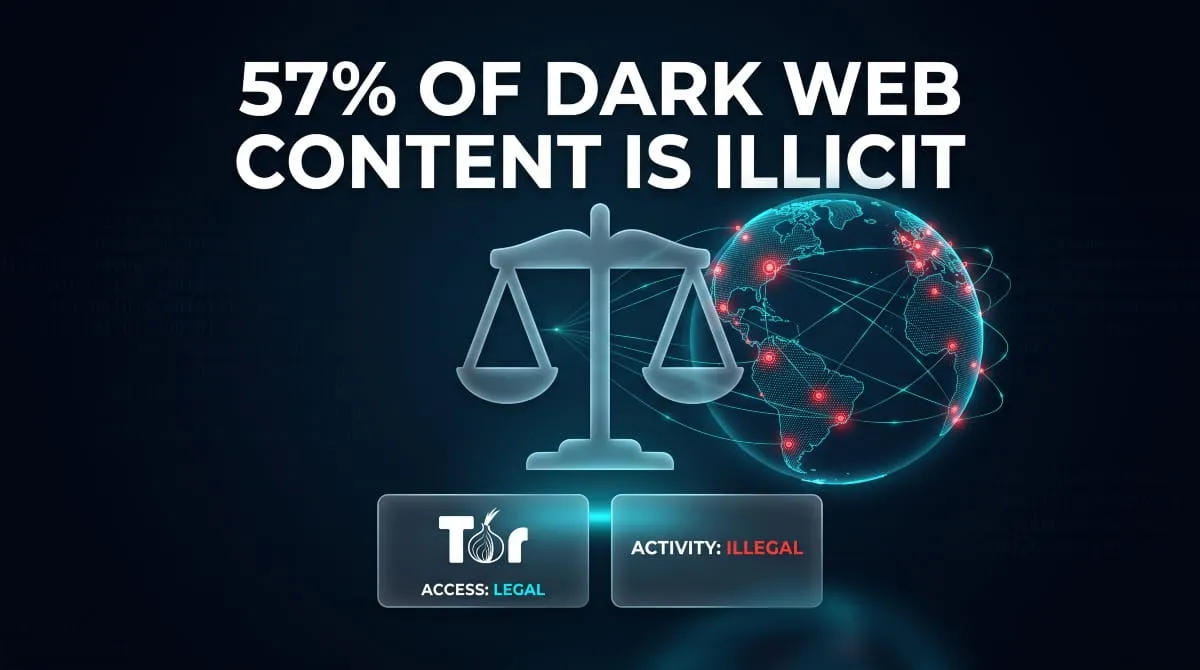
Independent research has repeatedly found that roughly 57% of dark web sites host illegal material, spanning drugs, stolen data, and hacking tools, meaning a meaningful minority of the dark web serves entirely legitimate purposes.
Legal Uses: Journalism, Privacy, Whistleblowing
Legitimate use cases include news organizations running secure tip lines for sources, privacy advocates operating uncensored forums, and people in restrictive regimes using Tor to access blocked information. Several major news outlets maintain official “.onion” mirrors specifically so that sources can reach them without the risk of surveillance.
2025 Data on Illegal vs. Legal Content Share
Even with illegal content making up a majority share by site count, the dark web’s overall footprint remains a sliver of the internet, commonly estimated at a small fraction of one percent of total web content. That means the “illegal majority” statistic describes what’s on the dark web itself, not the internet as a whole, which is an important distinction often lost in headlines.
Why Is the Dark Web Illegal (or Why It Isn’t)?
The dark web isn’t illegal because no law criminalizes anonymity software or hidden websites in most countries; instead, laws target the specific crimes that occur on it. This distinction, technology versus use, is the single most important concept for understanding dark web legality.
The Legal Technology vs. Illegal Use Distinction
Tor, encryption, and hidden services are neutral tools, comparable to a VPN, an email client, or a locked filing cabinet. None of these carry legal risk in themselves; risk arises entirely from what someone stores, sends, or transacts using them. Courts and regulators worldwide have consistently applied this logic rather than banning the underlying technology.
Common Misconceptions
A common misconception is that dark web presence alone signals criminal intent, or that law enforcement can automatically identify and track every visitor. In reality, millions of legitimate users access the dark web daily, and anonymity tools make blanket surveillance of “who visited” both legally and technically limited in most democratic countries.
How to Stay Safe and Legal If You Explore the Dark Web
Staying on the right side of the law while exploring the dark web mostly comes down to what you avoid doing, not the exploring itself.
Best Practices for Legal Access
Use official, verified software like the Tor Browser rather than unofficial builds, avoid downloading files from unknown sources, and never engage with marketplaces, forums, or listings that clearly involve stolen data, drugs, or illegal services. Keeping your operating system and browser updated also reduces exposure to malware commonly distributed through dark web links.
Red Flags That Signal Illegal Territory
Sites requesting payment in cryptocurrency for goods that would be illegal in the physical world, forums trading personal data dumps, and any page hosting exploitative imagery are unambiguous signs to leave immediately. If you’re monitoring the dark web for business or security reasons, checking whether your company’s credentials have leaked, for instance, using a dedicated monitoring service is safer and more effective than manually browsing these spaces yourself.
Frequently Asked Questions (FAQ’s)
Is it illegal to be on the dark web?
No. Being on the dark web is legal in nearly every country; only specific illegal activities conducted there, not the presence itself, carry legal risk.
Is it illegal to look at the dark web?
Looking at most dark web content isn’t illegal, but viewing certain categories, particularly child exploitation material, is a serious crime regardless of intent or how briefly it’s viewed.
What percentage of the dark web is illegal?
Studies commonly put the figure around 57% of dark web sites hosting illegal material, though legitimate uses like journalism and privacy tools make up a meaningful share of the rest.
Can I get in trouble just for visiting?
Simply visiting the dark web won’t get you in legal trouble in most countries. Trouble arises from specific actions, buying illegal goods, downloading prohibited content, or engaging with criminal services, not from the act of visiting itself.
This article is for general informational purposes and isn’t legal advice. Laws vary by jurisdiction and change over time, so consult a qualified legal professional for guidance on your specific situation.