A privacy breach happens when someone’s personal information is accessed, disclosed, collected, or used without their consent or in violation of a privacy law. It doesn’t always involve hacking; a misdirected email or an unlocked filing cabinet can count, as can an employee looking up a record they had no reason to view.
What Is a Privacy Breach?
A privacy breach is any incident in which personal information is handled outside the rules intended to protect it, whether those rules come from law, company policy, or a basic duty of confidentiality. The information involved can be as sensitive as a medical diagnosis or as ordinary as a home address, but what constitutes a breach is the loss of control: the person to whom the data belongs didn’t agree to how it was used, viewed, or shared.
Not every privacy breach is dramatic. It can be a single record sent to the wrong recipient, a database left publicly accessible, or a staff member browsing a colleague’s file out of curiosity. What separates a genuine breach from an everyday data-handling hiccup is whether personal information was actually exposed to someone who wasn’t authorized to see it.
Privacy Breach vs. Data Breach vs. Privacy Incident
These three terms get used interchangeably, but they aren’t quite the same thing. A privacy incident is the broadest category: any event that touches personal data, including ones that turn out to be harmless, like an email sent to the wrong internal team that never left the organization. A privacy breach is a narrower term: it’s an incident in which personal information is accessed, used, or disclosed without authorization. A data breach usually refers specifically to a security failure, a hack, a malware infection, or a stolen device that exposes data, and it’s often (though not always) the cause of a privacy breach.
In short: every data breach that exposes personal information is also a privacy breach, but not every privacy breach involves a security failure. A staff member emailing a client’s file to the wrong address is a privacy breach with no hacking involved at all.
When Does a Privacy Breach Legally Occur?
Under most privacy laws, a breach occurs the moment personal information is accessed, disclosed, or lost in a way that isn’t permitted by the applicable privacy rules, regardless of whether any harm has happened yet. Many statutes further narrow this to focus on breaches that pose a real risk of harm, meaning not every technical slip triggers legal reporting duties. This is why organizations typically conduct a risk assessment after any incident: to determine whether what happened crosses the legal threshold for a reportable breach or is a contained incident that doesn’t require notification.
Types & Causes of Privacy Breaches
Privacy breaches show up differently depending on the sector and the type of information involved, but most fall into a handful of recurring patterns.
Medical & Patient Privacy Breaches
Healthcare is one of the most breach-prone sectors because medical records combine identity and financial data with highly sensitive health information in a single file. Common causes include staff accessing a patient’s chart without a treatment-related reason, records faxed or emailed to the wrong provider, lost or stolen devices containing patient data, and third-party vendors mishandling outsourced billing or lab information. Because health records rarely change, a breached medical file tends to stay valuable to attackers for years.
Workplace & Employer Privacy Breaches
Employers hold a large amount of sensitive information about their staff, including Social Security numbers, salary details, performance reviews, and medical leave records. Breaches occur when that information is shared with anyone other than those who need it. Typical scenarios include HR discussing an employee’s confidential situation with unauthorized colleagues, payroll data sent to the wrong distribution list, or a manager accessing personnel files outside their role. Employee monitoring that goes further than what’s legally disclosed, tracking location or communications without proper notice, can also cross into a workplace privacy breach.
Social Media & Online Privacy Breaches
On social platforms, breaches often stem from misconfigured privacy settings, third-party apps harvesting more data than users realize they authorized, or platforms themselves experiencing a security failure that exposes user profiles. Because so much of this data is used for advertising and behavioral tracking, a single online privacy breach can quietly compound; exposed data gets scraped, resold, or combined with other leaked datasets long after the original incident.
Government & Institutional Privacy Breaches
Government agencies and public institutions hold some of the highest-stakes personal data: tax records, benefits applications, court filings, immigration and citizenship records. Breaches here typically stem from outdated legacy systems, insider misuse of access privileges, or third-party contractors mishandling data during transfers. Because reporting requirements and public accountability are usually higher for government bodies, these breaches tend to draw more regulatory scrutiny and media attention than similar private-sector incidents.
Emerging Causes: AI, Biometric & Location Data
Newer categories of privacy breach are emerging as fast as the technology that creates them. AI tools trained on datasets containing personal information can memorize and later expose that data in their outputs. Biometric systems- fingerprint, facial recognition, voice authentication- create a unique problem: unlike a password, a breached fingerprint or face scan can’t be reset. And continuous location tracking from phones, apps, and connected devices creates a detailed movement history that, if exposed, can reveal far more about a person’s life than the individual data points suggest.
Real-World Privacy Breach Examples
Common Categories: Healthcare, Education, Government
The most frequently cited real-world examples fall into a few recurring patterns: a healthcare provider whose database is left unsecured and indexed by search engines, a university whose student records system is breached by an external attacker, and a government department where an employee improperly accesses citizens’ records for personal reasons. What these have in common is scale: because institutions hold data on thousands or millions of people, the same single point of failure can expose an enormous number of individuals at once.
The Biggest Privacy Breaches on Record
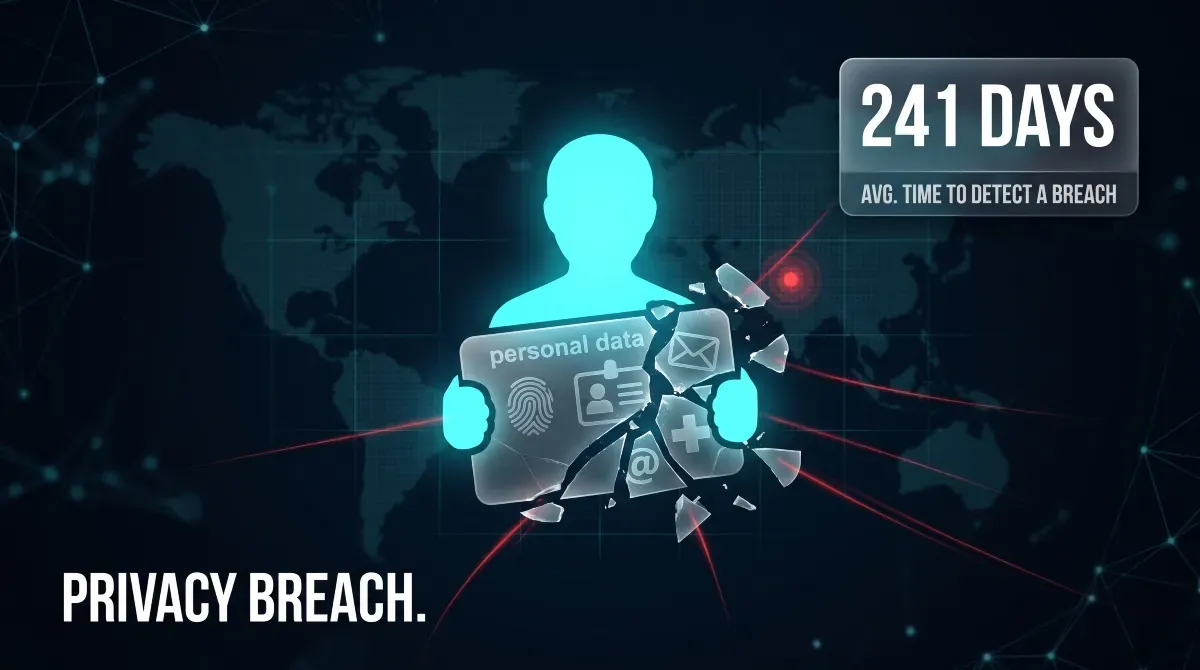
Large-scale breaches tend to share a pattern: a single vulnerability, once exploited, exposes personal data belonging to tens or hundreds of millions of people at a time. According to IBM’s 2025 Cost of a Data Breach Report, the global average cost of a breach was $4.44 million, down from the year before, largely because organizations are detecting and containing incidents faster. Even so, the same report found that it still takes companies an average of 241 days to identify and contain a breach, which means personal data is often exposed and circulating for months before the organization responsible even knows it happened.
Privacy Laws & Regulations Governing Breaches
Privacy Act Breaches & Penalties
Most countries have a central privacy statute, such as Australia’s Privacy Act, that sets out what constitutes a reportable breach and what organizations must do when one occurs. These laws generally define an “eligible” or notifiable breach as one likely to result in serious harm, and they require the responsible organization to notify both the regulator and the affected individuals within a set timeframe. Penalties for non-compliance can range from civil fines to court-ordered remediation, and repeated or serious violations can trigger investigations that extend well beyond the original incident.
HIPAA Privacy Rule Breaches
In U.S. healthcare, the HIPAA Privacy Rule governs how patient information can be used and disclosed, and a breach occurs when protected health information is accessed or shared outside those permitted uses. Covered entities are required to notify affected patients, and breaches affecting 500 or more individuals must also be reported to the Department of Health and Human Services and, in many cases, the media. HIPAA breach penalties are tiered based on the level of negligence involved, from unavoidable incidents to willful neglect.
GDPR & CCPA Breach Provisions
The EU’s GDPR takes one of the strictest approaches globally, requiring organizations to report a qualifying breach to their data protection authority within 72 hours of becoming aware of it, with fines that can reach into the tens of millions of euros for serious violations. California’s CCPA takes a different approach, focused less on mandatory breach notification timelines and more on giving consumers the right to sue directly when their unencrypted personal information is exposed due to a business’s failure to maintain reasonable security.
Is a Privacy Breach a Criminal Offense?
In most cases, a privacy breach is treated as a civil matter; it creates grounds for regulatory penalties or a lawsuit, not a criminal charge. That said, certain conduct can cross into criminal territory: unauthorized access to a computer system, identity theft, or the deliberate, malicious disclosure of someone’s private information can all be prosecuted as crimes in many jurisdictions, separate from any civil liability the organization involved might also face.
Consequences, Compensation & Legal Recourse
Can You Sue for a Privacy Breach?
In many jurisdictions, yes, individuals affected by a privacy breach can bring a civil claim, either individually or as part of a class action, particularly where the breach caused demonstrable harm such as financial loss, identity theft, or emotional distress. Whether a claim succeeds usually depends on whether the organization owed a duty of care, whether that duty was breached, and whether the breach caused real, provable harm, not just the fact that data was exposed.
Damages You May Be Entitled To
Compensation in privacy breach cases typically falls into a few categories: direct financial losses (such as fraudulent charges or identity theft recovery costs), damages for emotional distress or reputational harm, and, in some jurisdictions, statutory damages that don’t require proving a specific financial loss. Class action settlements involving large-scale breaches have, in some cases, resulted in payouts to hundreds of thousands of affected individuals. However, individual payments are often modest once divided across a large group of claimants.
How to Prevent a Privacy Breach
Best Practices for Individuals
The most effective everyday habits are also the simplest: use unique, strong passwords with a password manager, enable multi-factor authentication wherever it’s offered, review app and account permissions periodically, and be cautious about what personal information you share on public platforms. Monitoring where your information appears, including on the dark web, helps catch exposure early, before it’s used against you.
Best Practices for Organizations
Organizations reduce breach risk most effectively by limiting data access to what each employee’s role requires, encrypting sensitive data at rest and in transit, conducting regular security audits, and training staff to recognize phishing and social engineering attempts. A clear, tested incident response plan matters just as much as prevention; organizations that can detect and contain a breach quickly consistently see lower costs and less regulatory exposure than those that can’t.
Privacy Breach Response Plan
Detection & Immediate Actions
The priority after a suspected breach is containment: cutting off access at the point of entry, whether that means revoking credentials, isolating an affected system, or securing a physical location. At the same time, organizations should begin documenting what happened: what data was involved, how the exposure occurred, and how many individuals may be affected. This early record shapes every subsequent decision, including whether the incident meets the legal threshold for notification.
Notification Requirements
Once the scope of a breach is understood, organizations generally need to notify two groups: the relevant regulator (within a legally defined window, often ranging from 72 hours to 30 days depending on the jurisdiction) and the individuals whose data was affected, so they can take protective steps like changing passwords or monitoring for fraud. Delayed or incomplete notification is one of the most common sources of additional regulatory penalties, separate from the breach itself.
Recovery Steps After a Breach
Recovery involves closing the specific vulnerability that caused the breach, reviewing broader security practices for similar weaknesses, and often offering affected individuals support such as credit monitoring or identity theft protection. Many organizations also conduct a post-incident review to update their response plan, since how a breach is handled, not just the breach itself, often shapes the long-term reputational and legal fallout.
Frequently Asked Questions (FAQ’s)
What counts as a privacy breach?
Any unauthorized access, use, or disclosure of personal information, whether due to a hack, human error, or a policy violation, constitutes a privacy breach.
Is a privacy breach the same as a data breach?
Not exactly. A data breach usually refers to a security failure that exposes data. In contrast, a privacy breach is any unauthorized handling of personal information, whether or not a security failure is involved.
Do I have to be notified if my data was breached?
In most jurisdictions with a notifiable breach law, yes: if the breach is likely to cause serious harm, the responsible organization is legally required to notify you.
Can I take legal action after a privacy breach?
Depending on your jurisdiction and the harm involved, you may be able to bring a civil claim for compensation, either individually or as part of a class action.
How long does it typically take companies to detect a breach?
Industry data puts the average detection and containment time at around 241 days, meaning breaches are often live for months before they’re discovered.