
Abacus Dark Web Marketplace | Rise, Collapse & Exit Scam Explained
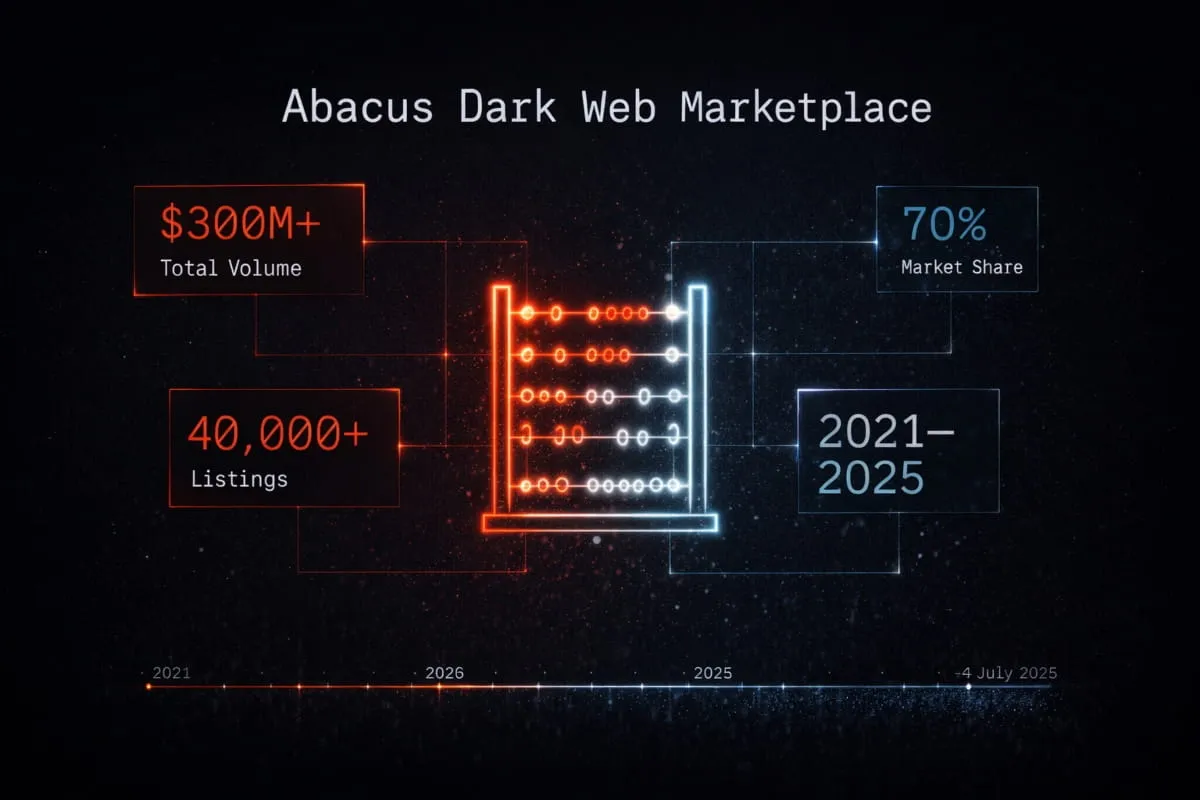
The Abacus Dark Web Marketplace was one of the most dominant platforms the darknet ecosystem has ever produced, and one of the most abrupt disappearances. Known interchangeably as Abacus Market, Abacus Marketplace, and the Abacus darknet market, the platform built a reputation over nearly four years that most of its competitors never approached: operational consistency, serious vendor accountability, and a user experience that felt deliberate rather than improvised. By late 2024, Abacus Market held more than 70% of all activity across Western darknet markets. In early July 2025, it vanished without announcement and has not returned.
For nearly four years, Abacus Market operated with a composure that few darknet marketplaces ever managed to sustain. It had what most of its competitors lacked: a recognisable structure, enforced security standards, and a growing reputation that compounded with every rival collapse. Then, in early July 2025, everything went dark. Every Abacus market onion link stopped resolving. Every mirror went silent. No seizure banner appeared. No administrator communication followed. The available evidence points to a deliberate exit scam, the platform’s operators leaving on their own terms at the peak of the market’s power, taking deposited funds with them.
This is not simply a story about another darknet market shutting down. It is a case study in how trust is manufactured in trustless environments, how consolidation creates fragility, and how the recurring cycle of darknet economics- rise, dominate, disappear- plays out with almost mechanical predictability when a platform reaches sufficient scale. What follows is the full account: what Abacus Market was, how it worked, what it sold, how the exit scam unfolded, and what the darknet landscape looks like in the aftermath.
Abacus Market Status (2026): Is It Still Active?
Abacus Market is not active. The platform has been completely offline since early July 2025, and as of mid-2026, no infrastructure, no .onion address, no clearnet mirror, and no backup access point have been returned or credibly re-established by its original operators. Every Abacus market onion link, URL, and Tor link in circulation before July 2025 resolves to nothing. The shutdown has the documented characteristics of a deliberate exit scam rather than a law enforcement seizure: no seizure banner appeared, no agency has publicly claimed a takedown, and blockchain analysis captured large fund transfers from known Abacus wallets in the days immediately before the infrastructure went dark.
The withdrawal freeze that signalled the end began in late June 2025, roughly two weeks after Archetyp Market was seized by law enforcement on June 16. Abacus’s administrator cited the resulting user influx and a simultaneous DDoS attack as the cause of the delays. The darknet community was unconvinced. Between June 1 and June 27, the platform processed an average of $230,000 in daily deposits. By early July, that figure had fallen 94% to approximately $13,000 per day as users pulled back in real time. Shortly after, everything went silent. No announcement followed. No administrator has resurfaced under any verified identity. Abacus Market is gone, and the evidence strongly indicates it left on its own terms.
What Is the Abacus Dark Web Marketplace?
Abacus Market was a large darknet market that operated on the Tor network from September 2021 until its disappearance in July 2025. Like other darknet markets, it functioned as an anonymous e-commerce platform, vendors listed products, buyers browsed and placed orders, and a feedback system allowed reputations to accumulate over time. Unlike most of its competitors, it sustained this model for nearly four years without a major operational failure, a law enforcement seizure, or a publicly confirmed security breach.
The platform launched in the immediate aftermath of several major darknet market closures, positioning itself as a destination for the displaced vendor and buyer communities those closures produced. It became particularly attractive to users who had operated on AlphaBay and other seized platforms and were looking for something with comparable structure and reliability. Abacus Market delivered that, and then, over the following years, surpassed the scale of nearly everything that had come before it in the Western darknet market space.
By the time the Abacus dark web marketplace reached its peak in mid-2025, it hosted over 37,000 active listings across drugs, stolen credentials, fraud services, and digital access tools. It processed an average of $230,000 in daily deposits across more than 1,400 transactions. Its revenue had grown 183% annually in 2024, according to Chainalysis, a growth rate driven not only by innovation but also by the vacuum left whenever a competing platform collapsed and sent its users searching for the next destination.
How Abacus Market Worked
Abacus Market operated as a Tor-hidden service, accessible exclusively through .onion addresses that changed periodically as a security measure. Users who searched for the Abacus Market onion link, Abacus Market URL, or Abacus Market Tor link were looking for these rotating hidden service addresses, the only entry points into the platform. The main .onion address, along with all clearnet mirrors and backup access points, has been unreachable since early July 2025. All known Abacus market links are permanently defunct.
Within the platform, the operational design was more deliberate than most darknet markets allowed themselves to be. Transactions were processed through a dual-cryptocurrency escrow system accepting Bitcoin and Monero, with funds held until buyers confirmed delivery. What set Abacus apart was not the escrow itself, which was standard, but how seriously the platform took the dispute-resolution process surrounding it. Dedicated moderators handled escalated cases. Vendor bond requirements created a financial barrier to entry, filtering out low-quality sellers. A tiered account system meant that vendors with established track records had verifiable reputations, which, in an environment with no legal recourse, was the only substitute for trust.
The Abacus market login process reflected the same security-forward thinking. Two-factor authentication via PGP was required rather than optional, a deliberate friction that reduced account takeovers and kept law enforcement from exploiting credential leaks to access active sessions. This level of operational hygiene, maintained consistently over nearly 4 years, is a significant factor in why Abacus commanded the market share it did.
Abacus Market Onion Link: Current Status and Why It No Longer Works
Every Abacus market onion link, Tor link, and URL that was in circulation before July 2025 is permanently offline. The .onion addresses no longer resolve. Clearnet mirrors that previously provided alternative access return nothing. If you are searching for a working Abacus market link in 2026, none exists; the platform is gone, and its infrastructure has not been re-established by anyone with a legitimate connection to the original operation.
During its active years, Abacus operated through a rotating set of .onion addresses on the Tor network, a standard security practice among darknet markets to complicate takedown attempts and avoid persistent link-based tracking. Users who searched for the Abacus market onion link, Abacus market URL, or Abacus dark web link were typically looking for the current active address, which changed periodically and was distributed through community forums and verified mirror lists. The platform also maintained clearnet-accessible mirrors, non-. onion addresses that allowed access without the Tor browser, though these were always secondary to the primary hidden service.
All of this infrastructure went silent in early July 2025. The sequence was not a gradual fadeout. The main .onion address, the clearnet mirrors, and the emergency backup access points that Abacus maintained specifically for DDoS scenarios stopped responding within the same short window. This simultaneous, across-the-board shutdown across independent infrastructure components is not consistent with a technical failure or DDoS attack; it is consistent with a coordinated, deliberate shutdown by the people who controlled the server infrastructure.
In 2026, searches for “abacus market onion link 2026,” “abacus market onion address,” and similar current-year variants are circulating because users assume the platform may have migrated or relaunched under a new address. It has not. Sites claiming to offer a current, working Abacus market link should be treated with significant caution; these are typically either outdated aggregator pages, phishing sites designed to steal cryptocurrency wallet credentials from users who believe they are logging into a darknet market, or scam pages created to exploit search traffic around the Abacus name. No verified successor to the original Abacus Market operation has launched under the same brand or with the same confirmed administrator team.
The Abacus market login page is similarly inaccessible. Account credentials, vendor profiles, order histories, and any balances held within the platform at the time of shutdown were effectively frozen and then lost when the infrastructure disappeared. There is no recovery mechanism, no administrator channel, and no official communication path. The platform closed without notice and has remained closed.
What the Abacus Dark Web Marketplace Actually Sold
To understand why the Abacus darknet market reached the scale it did, you have to understand the breadth of what it offered. This was not a niche marketplace serving a single category. It was a sprawling, category-organised bazaar covering nearly every corner of the illicit digital economy, maintained with an operational consistency that kept vendors invested in building their reputations there rather than migrating elsewhere.
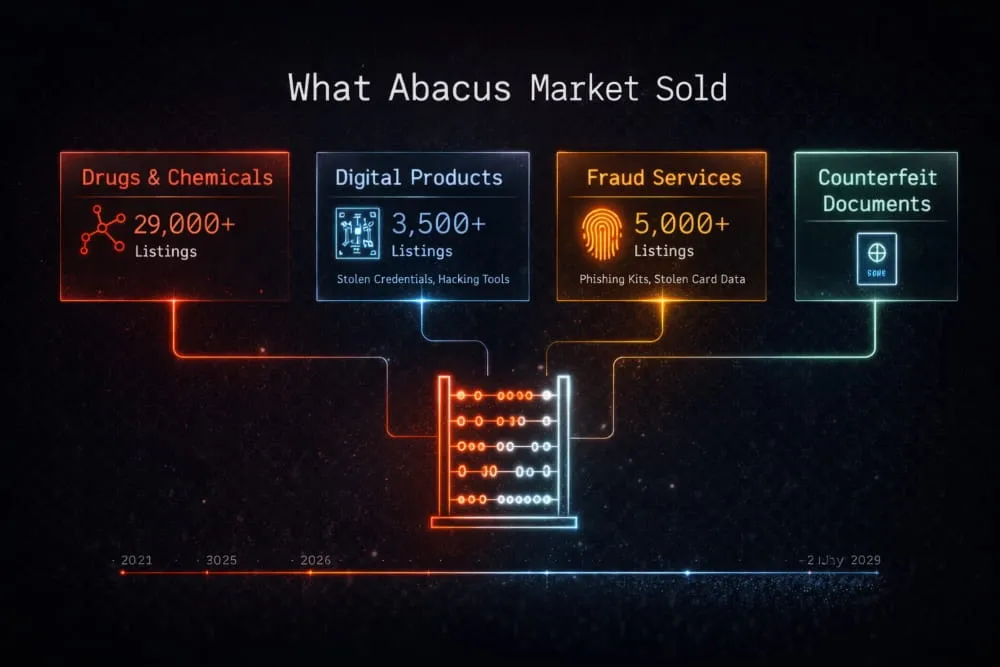
Drugs and controlled chemicals formed the commercial core, with over 29,000 listings at peak operation spanning stimulants, psychedelics, opioids, and pharmaceutical precursors. Beyond narcotics, the Abacus dark web market hosted nearly 3,500 listings for digital products, stolen credentials, network access brokers, hacking tools, and account takeover packages. A further 5,000-plus listings covered fraud services, including phishing kits, stolen card data, synthetic identity packages, and forged identity documents, including passports and government-issued IDs.
What distinguished Abacus from its peers was not just the volume but the operational architecture behind it. The platform ran a vendor verification system that created a layer of accountability unusual in a space built on anonymity. Vendors were required to post a bond before listing, a financial commitment that filtered low-effort operators and reduced the prevalence of vendor-side exit scams that degraded competing platforms. Dispute resolution was handled by dedicated moderators rather than left to automated systems or ignored entirely. Customer service was treated as a competitive differentiator, and for most of the platform’s life, the community recognised it as such.
Chainalysis reported 183% annual revenue growth for Abacus Market in 2024, a figure that reflects both the platform’s operational quality and the extent to which it benefited from competitors’ collapses that sent displaced users searching for a new home.
Bitcoin, Monero, and the Money Trail
The Abacus dark web marketplace accepted both Bitcoin and Monero, a deliberate dual-currency approach that served different segments of its user base. Bitcoin provided the accessible on-ramp, familiar, widely held, and easy to acquire through mainstream exchanges. Monero was where the serious transaction volume moved.
According to TRM Labs, Monero accounted for between two-thirds and three-quarters of all transactions processed on Abacus Market. The $100 million figure most commonly cited in reporting on the platform’s Bitcoin activity captures only a fraction of its actual financial footprint. When Monero volume is included in analyst estimates, total lifetime sales on Abacus are estimated at $300-$400 million, making it one of the highest-revenue darknet markets ever documented.
The preference for Monero over Bitcoin was not incidental. Monero’s architecture, ring signatures, stealth addresses, and confidential transactions built into the base protocol rather than added as optional layers, make blockchain surveillance substantially harder than Bitcoin analysis. Where Bitcoin transactions can be traced, clustered, and attributed through chain analysis tools, Monero forces investigators to rely on operational security failures, undercover operations, and physical evidence rather than on-chain forensics. Abacus’s operator and vendor community understood this, and the payment distribution reflected it.
The Abacus market’s Monero-heavy transaction profile also reflects a broader shift in the darknet economy. Nearly half of all newly launched darknet markets in 2024 accepted only Monero, up from roughly one-third in 2023. The direction of travel is toward privacy-native payment rails, and Abacus was both a product and an accelerant of that shift.
What Happened to Abacus Market?
Abacus Market conducted an exit scam in early July 2025, disappearing with funds held in active escrow and leaving vendors, buyers, and depositors with no recourse. The collapse followed a ten-day withdrawal freeze during which the platform’s administrators offered explanations that the darknet community found implausible. At the same time, blockchain analysts documented the simultaneous movement of large cryptocurrency balances out of known Abacus wallets.
The sequence of events leading to the disappearance was consistent with a premeditated exit rather than an emergency shutdown. In late June 2025, users on darknet discussion forums began flagging frozen withdrawal requests, a pattern that has preceded nearly every major darknet market exit scam on record. The platform’s administrator, operating under the pseudonym “Vito,” posted on Dread, attributing the delays to two converging pressures: a sudden surge of displaced users following the law enforcement seizure of Archetyp Market on June 16, and a sustained distributed denial-of-service attack. Both explanations were technically plausible. Neither was accepted at scale by the community.
What made the skepticism credible was the on-chain evidence. Blockchain analysts documented substantial fund transfers from wallets publicly associated with Abacus on June 28 and 29, indicating consolidation and an exit rather than operational maintenance. At the same time, platform communication became increasingly sparse. Support tickets went unanswered. The Dread presence, a consistent part of Abacus’s legitimacy-building strategy, went quiet.
By the first week of July, every layer of Abacus infrastructure had stopped responding. The primary .onion address returned nothing. Clearnet mirrors timed out. Emergency backup access points, which the platform had maintained specifically for DDoS scenarios, were equally unreachable. Dread administrator “Hugbunter,” who had maintained direct operational contact with the Abacus team and served as an informal public-facing guarantor of the platform’s intentions, stated publicly that the shutdown was not a law enforcement action. No seizure banner was confirmed, indicating that the government did not issue a takedown. No arrests connected to the Abacus administration have been publicly announced since then.
The most accurate description of what happened to Abacus Market is that its operators, having accumulated 4 years of revenue and reached the peak of the platform’s market dominance, chose the exit over the exposure. June 2025 was the platform’s single strongest month, $6.3 million in sales driven partly by the Archetyp user influx, and it appears that peak also served as the signal. The same pattern has defined the end of Silk Road, AlphaBay’s first iteration, Hansa, and a significant proportion of every major darknet market that has ever reached scale. Abacus followed it with fewer warning signs and less community anticipation than most.
The Collapse: Withdrawal Delays, Denial, Disappearance
The story of what happened to Abacus Market in the summer of 2025 is, in its broad structure, the same story that has ended nearly every large darknet market of the past decade. The specific details vary. The pattern does not.
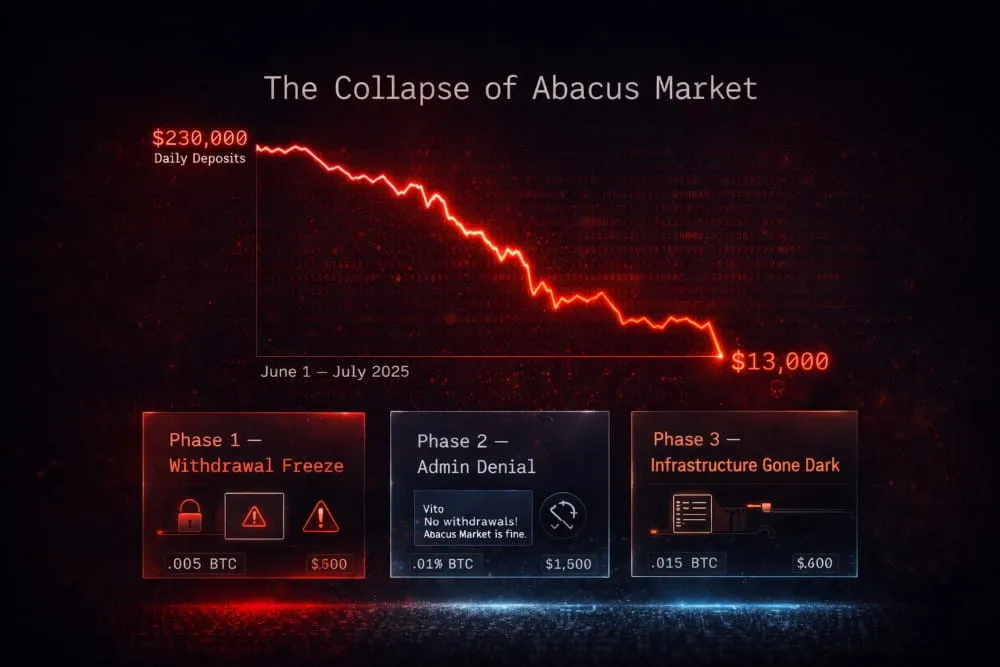
In late June 2025, users on darknet discussion forums began flagging frozen withdrawal requests. This is one of the most consistently documented early warning signs in the darknet market lifecycle: platforms that intend to exit typically begin by slowing and then blocking withdrawals in the days or weeks before the final disappearance, allowing escrow balances to accumulate and giving operators time to move funds before going dark. The community recognises the pattern immediately because they have seen it play out across platforms.
The Abacus market administrator, operating under the pseudonym “Vito,” responded publicly on Dread, the primary darknet discussion forum, attributing the delays to two converging pressures. The first was a sudden flood of new users migrating from Archetyp Market, which had been seized by law enforcement on June 16, just ten days earlier. The second was a sustained DDoS attack that the platform was working to counter. Both explanations were individually plausible. The darknet community had encountered both phenomena before, and both had caused genuine disruption to legitimate platforms. But the community had also seen this exact script used to buy time before an exit, and scepticism spread faster than any reassurance could contain it.
The transaction data told its own story. Between June 1 and June 27, Abacus Market processed an average of $230,000 in daily deposits across approximately 1,400 transactions, numbers consistent with its position as the dominant Western darknet market. By July, that daily deposit figure had collapsed to $13,000 across just 100 transactions: a 94% decline in user confidence, measured in real time as the community voted with its cryptocurrency.
At the same time, blockchain analysts began documenting unusual wallet activity. Large fund transfers out of wallets publicly associated with Abacus Market were recorded on June 28 and 29. The combination of withdrawal freeze, administrator explanations that didn’t fully hold, rapidly declining deposit volume, and documented outbound wallet movements produced a picture the community found impossible to explain innocently.
By early July 2025, every piece of Abacus infrastructure had stopped responding at the same time. The primary .onion address returned nothing. Clearnet mirrors timed out. The emergency backup access points the platform had maintained specifically for DDoS scenarios were equally dark. No seizure banner appeared on any of them. No law enforcement agency issued a public statement claiming a takedown. Dread administrator “Hugbunter,” who had maintained direct ties with the Abacus team throughout the platform’s life and served as an informal reputational anchor for it within the community, publicly stated that the shutdown was not a law enforcement action.
Based on the available evidence, what happened to Abacus Market was that its operators executed a deliberate exit at the moment of the platform’s greatest power, leaving without a Word.
Why Did Abacus Market Exit Scam at the Peak of Its Power?
Abacus Market disappeared in July 2025 at the single strongest moment in its operational history. June 2025 was its highest-revenue month on record, $6.3 million in sales across 30 days, driven substantially by the influx of displaced users following the law enforcement seizure of Archetyp Market on June 16. By every conventional measure of platform health, Abacus was not a market in decline. It was a market at the top. The exit scam, if that is what it was, was executed not from a position of desperation but from a position of maximum leverage.
This timing is counterintuitive only if you assume that platform operators share the same incentive structure as legitimate business owners. They do not. For a darknet market administrator, scale is not purely an asset. It is also a threat signal.
TRM Labs offered the most compelling analysis of why Abacus’s operators may have specifically chosen July 2025. Darknet markets that climb to the top of the ecosystem become, by definition, the highest-priority targets for law enforcement. Archetyp Market’s seizure on June 16 was not an isolated event; it was a demonstration of the trajectory of market dominance when it ends on law enforcement’s terms rather than the operator’s. Archetyp had been a major player. Its seizure had been preceded by years of investigative groundwork that the platform’s users and administrators had not seen coming until it was too late. The message to every other dominant market operator was unambiguous: you are next, and you will not know when.
In response to that demonstration, Abacus’s operators were running a specific calculation. On one side: continued operation, continued revenue, continued exposure. On the other: four years of accumulated gains, an uncompromised identity, and the ability to disappear on their own schedule rather than someone else’s. The Archetyp seizure did not create this calculus; it clarified it. It made the cost of staying visible and the value of an immediate exit concrete in a way that abstract risk assessments rarely do.
This is one of the defining structural dynamics of the darknet marketplace lifecycle, and it repeats with enough consistency to qualify as a pattern rather than a coincidence. The same network effects that drive volume also create forensic exposure. Every vendor relationship, every shipping address pattern, every cryptocurrency wallet cluster, every forum post made under a consistent pseudonym is a data point that accumulates over time in the datasets of blockchain analytics firms, law enforcement agencies, and rival threat actors. The longer a market operates at scale, the more of these data points exist, and the more pathways to attribution become available to investigators.
Abacus Market’s operators had watched this play out with Silk Road, AlphaBay, Hansa, Empire, Hydra, and now Archetyp. The rational response, if personal freedom is the priority rather than continued revenue, is to exit before the investigation reaches critical mass, not after. July 2025, immediately after the highest-revenue month in platform history and immediately following a high-profile seizure of a direct competitor, was a moment that satisfied both conditions simultaneously. The platform was at its most valuable, and the external environment had just made the cost of staying most legible.
Whether that is what actually happened, a deliberately timed strategic exit, or whether some combination of factors, including a genuine operational crisis or a covert law enforcement presence on the platform, contributed to the timing, remains unresolved. What the available evidence does not support is the interpretation that Abacus Market collapsed accidentally or under duress it could not have anticipated. The exit was clean, coordinated across all infrastructure simultaneously, and preceded by cryptocurrency movements consistent with planned consolidation. That is not what a panicked shutdown looks like. It is what a prepared one does.
Was the Abacus Market Collapse an Exit Scam or a Law Enforcement Action?
As of mid-2026, no official law enforcement agency has claimed responsibility for taking down Abacus Market. No seizure banner appeared on the .onion addresses when they went dark. No arrests connected to Abacus administration have been publicly announced. Dread administrator “Hugbunter,” who maintained direct communication with the platform’s team, stated publicly that the shutdown was not a law-enforcement action. The available evidence points to a deliberate exit scam executed by the platform’s own operators, not a takedown.
That said, the two possibilities are not mutually exclusive. Some darknet market collapses that initially appeared to be exit scams were later revealed to be covert law enforcement operations in which authorities chose not to publicize the seizure immediately, continuing to monitor traffic and communications before making arrests. The absence of a seizure banner and the absence of an arrest announcement are two different things. Abacus could represent a clean exit by its operators, a slow-burn law-enforcement investigation still unfolding, or something in between that the public record will eventually clarify.
What is clear is the pattern. Exit scams are not anomalies in the history of darknet markets; they are among the most common endpoints. Of the major platforms that have ceased operations over the past decade, a substantial proportion ended not with headlines and handcuffs but with silence and empty wallets. The same architecture that made Abacus a $300 million enterprise- anonymity, cryptocurrency, no legal accountability- made the exit as frictionless as the operation itself. The darknet does not forget. But it does move on, already building replacements under different names with the same underlying risks and the same eventual outcomes.
Abacus Market Alternatives and Successor Markets (2026)
When Abacus Market disappeared in July 2025, it did not take its user base with it. Tens of thousands of vendors and buyers found themselves without a primary platform overnight, and the displacement event that followed was immediate and visible in darknet market traffic data. Several platforms absorbed the majority of the migrating volume, though none has yet achieved the dominant market share Abacus held at its peak.
DrugHub was among the fastest beneficiaries. It had been growing steadily before Abacus’s collapse and was positioned to attract English-speaking Western users seeking a familiar marketplace structure. Its vendor base expanded significantly in the weeks following Abacus’s disappearance, and it has maintained a consistent presence on darknet monitoring forums through mid-2026.
TorZon Market attracted a portion of the displaced vendor community, particularly those with established reputations who wanted to rebuild their feedback profiles on a platform with strict vetting requirements. TorZon’s vendor bond structure and moderation practices were frequently cited in forum discussions as reasons to migrate there rather than to less-regulated alternatives.
MGM Grand emerged as a third destination, drawing users who prioritized platform stability and operational longevity over breadth of listings. Like its competitors, it now faces the structural challenge that defined Abacus’s final months: rapid growth in the aftermath of a high-profile collapse attracts law enforcement attention at exactly the moment a platform is least operationally mature enough to withstand it.
Beyond individual platforms, the more significant shift underway is structural. Both TRM Labs and Chainalysis have documented an accelerating trend away from centralized marketplace models toward decentralized alternatives. Vendor-operated storefronts, which eliminate the single point of failure risk of a central platform, are growing in number. Encrypted messaging channels, most notably Telegram, have become serious distribution infrastructure for communities that previously operated through marketplaces. This fragmentation makes the ecosystem harder to monitor and harder to disrupt through single-operation takedowns.
The lesson the Abacus collapse reinforces, as did Silk Road and AlphaBay before it, is that centralization in the darknet economy is ultimately a structural vulnerability rather than a competitive advantage. Platforms that become dominant become targets. Every successor market that absorbs Abacus’s user base inherits not just its customers but also its trajectory.
For organizations operating in sectors where employee credentials, payment data, or proprietary information are regularly targeted and traded through darknet channels, migrating an active community from one platform to several others does not reduce exposure; it distributes it across more surfaces simultaneously. As displaced vendors and buyers establish themselves on successor platforms, data that was previously circulating through Abacus listings resurfaces in new listings on new markets. DeXpose’s dark web monitoring tracks this movement continuously, flagging organizational exposure as it migrates across successor platforms rather than waiting for a breach to surface through conventional channels. Run an immediate check with the free dark web report.
Was Abacus Market Legit? Reviews, Reputation, and the Exit Scam Verdict
For most of its operational life, Abacus Market had a stronger reputation for reliability than the darknet marketplace category typically produces. Community reviews on Dread and darknet-adjacent forums consistently rated it above competitors for operational stability, dispute-resolution responsiveness, and vendor quality control. That reputation was not accidental; it was the product of deliberate design choices that distinguished Abacus from markets that treated user trust as an afterthought.
The vendor verification system was the most visible expression of this. Vendors were required to post a bond before listing, creating a financial commitment that filtered out casual scammers and fly-by-night operators who degraded the user experience on less-structured platforms. PGP-based two-factor authentication was mandatory for all accounts, not optional, a security requirement that reduced account takeovers and gave buyers additional confidence that the vendor profile they were interacting with was not compromised. Customer service infrastructure handled disputes with a consistency that darknet market users found notable enough to comment on. For a platform operating in a space defined by anonymity and no legal accountability, Abacus Market reviews from active users were, for the majority of its life, genuinely positive.
The red flags emerged in the final weeks. The withdrawal freeze that began in late June 2025 was the first public signal that something was wrong, and the community recognized it immediately as a pattern associated with pre-exit behavior. Abacus had built enough goodwill that some users initially accepted the administrator’s explanations- DDoS pressure, Archetyp user influx- as plausible. That goodwill eroded quickly once blockchain analysts began publishing evidence of large wallet movements out of known Abacus addresses. The gap between what the administrator said and what the on-chain data showed was too wide to be explained away, and forum sentiment shifted from concern to certainty within days.
The exit scam verdict, as of mid-2026, is supported by the preponderance of available evidence: the withdrawal freeze, the wallet movements, the simultaneous infrastructure shutdown across all access points, the absence of a seizure banner, and the complete silence from the administration team in the months since. Abacus Market was, for most of its existence, a functionally reliable marketplace within an inherently unreliable category. It ended the way many darknet markets do: by taking its users’ funds and disappearing. The final verdict on whether Abacus Market was “legit” depends on the timeframe: operationally, for nearly four years, yes; as a counterparty you could trust with deposited funds, ultimately, no.
What Happened to Users’ Funds in the Abacus Market Exit Scam?
When Abacus Market went dark in early July 2025, it did so without a clean shutdown. The withdrawal freeze that preceded the shutdown meant that a significant volume of cryptocurrency was held in platform escrow at the moment the infrastructure disappeared. Vendors waiting on pending order completions, buyers who had deposited funds for in-progress purchases, and users who had not yet moved balances to personal wallets all lost access simultaneously and permanently. No administrator communication followed. No refund mechanism existed. The funds simply ceased to be reachable.
The financial losses were compounded by a secondary risk that received less attention: data exposure. Every account that had ever interacted with Abacus Market, vendor profiles, transaction histories, communication logs, and any operational security failures over the platform’s four-year lifespan represent a potential intelligence asset. Whether that data ends up in law enforcement hands, in the possession of other threat actors, or in dark web data markets depends on how the shutdown actually concluded, a question that remains unresolved. What is not in question is that participation in Abacus created a documented trail.
For organizations whose credentials, payment data, or employee information appeared in Abacus Market listings, either as stolen goods or as breach data being traded, the shutdown does not reduce exposure. That data migrates with the community that held it. DeXpose’s dark web monitoring continuously tracks credential and breach data as it moves across successor platforms, ensuring that exposure originating from markets like Abacus doesn’t go undetected when it resurfaces elsewhere. You can run an immediate check with the free dark web report.
Double Extortion Ransomware | What It Is, How It Works, and How to Defend Against It (2026 Guide)
Double extortion ransomware is an attack in which criminals steal your data, encrypt your systems, and then demand payment twice: once for the decryption key and…
Read more
ShinyHunters | Who They Are, the Canvas Breach, and Every Company They’ve Hacked (Updated 2026)
ShinyHunters is a financially motivated hacking and extortion group that has spent the past several years breaching companies, universities, and cloud platforms, stealing data, and threatening…
Read more
Lapsus$ Explained | The Hacking Group Behind Okta, Uber, Nvidia and Its Return
Lapsus$ is a hacking and extortion group first known for breaching Okta, Microsoft, Nvidia, Samsung, and Uber in 2021 and 2022 using social engineering rather than…
Read more