
Cyber Threats Guide to Understanding, Detecting, and Defending Against Modern Attacks [2025–2026]
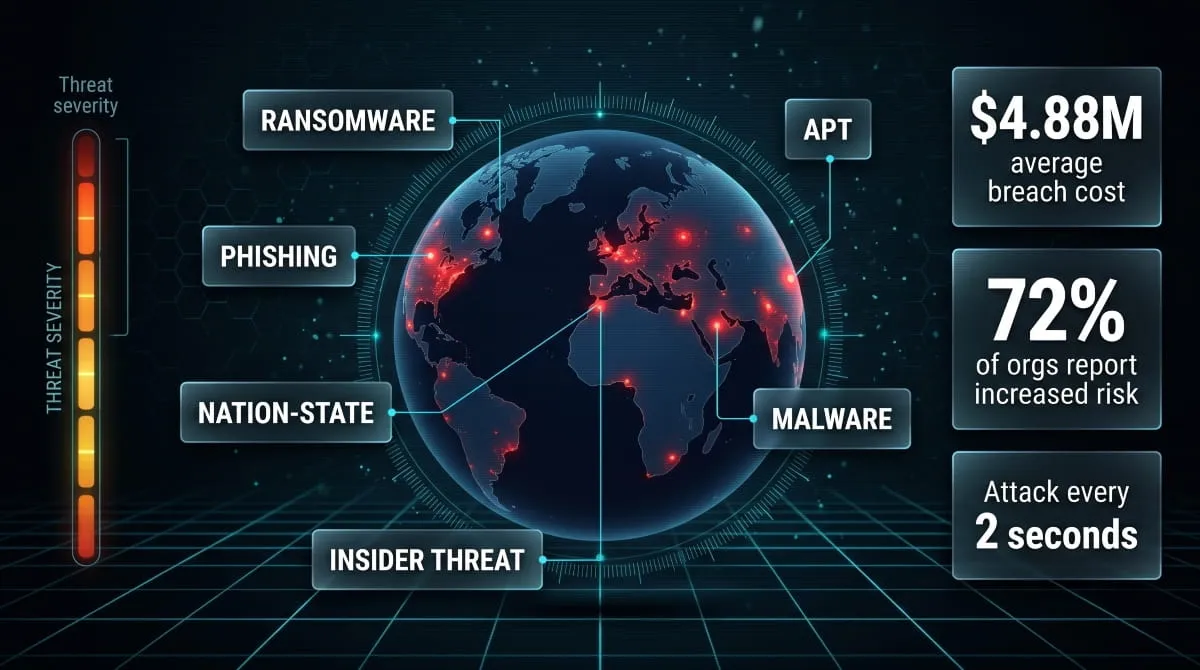
A cyber threat is any malicious act or condition that could compromise the confidentiality, integrity, or availability of a digital system, network, or the data it holds. Whether it originates from a criminal syndicate running ransomware-as-a-service, a nation-state conducting espionage, or an employee who clicks the wrong link, the defining characteristic is the same: potential to cause harm before a single defence has a chance to respond.
The scale of that potential has become impossible to ignore. The World Economic Forum’s 2025 Global Cybersecurity Outlook found that 72 percent of organizations reported an increase in cyber risk over the previous year, while the average CostCost of a single data breach climbed to $4.88 million, the highest figure ever recorded. Behind those numbers is a threat landscape that has grown not just in volume but in sophistication, driven by the rapid adoption of AI by adversaries, the expansion of remote and cloud infrastructure, and the deepening interconnection of supply chains across every industry.
This guide maps the entire terrain. From the foundational definitions that separate a threat from a vulnerability and a vulnerability from a risk, through the full taxonomy of attack types, the actors who launch them, the intelligence disciplines used to anticipate them, and the layered defences organizations deploy in response, everything you need to understand modern cyber threats is covered here, in one place, without the noise.
What Is a Cyber Threat? Definition and Core Concepts
A cyber threat is any circumstance or event with the potential to cause harm to an information system through unauthorized access, destruction, disclosure, modification of data, or denial-of-service. It is the precondition to an attack, the danger that exists before damage occurs.
The term is deliberately broad because the sources of harm are equally broad. A cyber threat can be a piece of code engineered to exfiltrate credentials, a disgruntled employee with privileged access and a grievance, a foreign intelligence service probing critical infrastructure, or a misconfigured cloud storage bucket sitting exposed on the open internet. What unites all of them is intent or potential, the capacity to cause harm, regardless of whether that harm has yet materialized.
Understanding what a cyber threat actually is, and how it differs from related terms, is the foundation on which every security decision rests. Organizations that conflate threats with vulnerabilities, or treat all threats as equally urgent, consistently misallocate resources and leave their most critical exposures unaddressed.
Cyber Threat vs. Vulnerability vs. Risk, What’s the Difference?
These three terms appear together so often they are frequently treated as interchangeable. They are not, and the distinction has real operational consequences.
A vulnerability is a weakness, a flaw in software, a gap in a process, or a misconfiguration in an environment that could be exploited. It is a condition that exists within your own systems, entirely independent of any external actor. A cyber threat is the external or internal actor, method, or event that could exploit that weakness. Risk is what emerges when the two meet: the probability that a given threat will successfully exploit a specific vulnerability, multiplied by the impact of that exploitation if it occurs.
The practical implication is straightforward. A vulnerability with no corresponding threat carries minimal risk. A severe threat targeting a system with no relevant vulnerability also carries minimal risk. Security teams that manage these concepts separately, maintaining vulnerability registers, tracking the threat landscape, and calculating risk as their intersection, make measurably better prioritization decisions than those who treat every CVE as equally dangerous regardless of whether an active threat actor is actually exploiting it.
Cyber Threat vs. Cyber Attack, How They Relate
A cyber threat is potential; a cyber attack is the actualization of that potential. The threat is the armed actor at the perimeter; the attack is the moment they breach it.
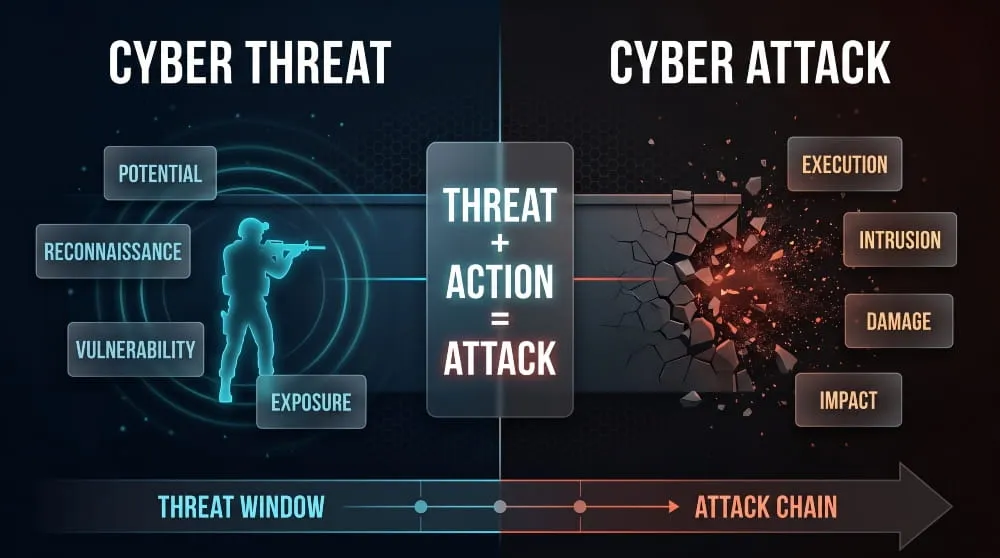
This distinction matters because the window between threat and attack is where defence lives. Threat intelligence, monitoring, and hunting disciplines all operate in that window, working to identify, assess, and neutralize threats before they convert into active attacks. Once an attack is underway, the discipline shifts entirely, from prevention to detection, containment, and recovery.
The relationship between the two is also non-linear. A single persistent threat actor may probe an organization’s environment for months, conducting reconnaissance and testing defences, before launching an attack that appears sudden and overwhelming to those without visibility into the preceding threat activity. This is precisely why organizations with mature cyber threat intelligence programs consistently detect and contain breaches faster than those relying solely on reactive security. IBM’s CostCost of a Data Breach report found that organizations using AI and automation in their security operations identified breaches 108 days faster than those that did not.
How Cyber Threats Have Evolved Over the Last Decade
A decade ago, the dominant cyber threat model was opportunistic and relatively blunt: mass phishing campaigns, commodity malware distributed through infected email attachments, and website defacements carried out by loosely organized hacktivist groups. Defenders had the relative luxury of responding to known threat signatures and established attack patterns.
That model no longer describes the current environment. Three shifts have fundamentally changed what organizations are defending against.
The first is the professionalization of cybercrime. Ransomware-as-a-service ecosystems now operate with affiliate structures, customer support functions, and revenue-sharing arrangements that mirror legitimate software businesses. Criminal groups no longer need technical sophistication; they lease it. The barrier to launching a devastating attack has dropped to the CostCost of an access broker listing on a dark web forum.
The second is the normalization of nation-state activity below the threshold of open conflict. State-sponsored threat actors from China, Russia, Iran, and North Korea conduct persistent, long-horizon campaigns targeting intellectual property, critical infrastructure, and government systems at a scale and level of stealth that was previously the exclusive domain of the world’s most capable intelligence services.
The third is the weaponization of AI. Adversaries now use large language models to craft phishing lures indistinguishable from legitimate communications, automate vulnerability scanning at speed no human team can match, and generate polymorphic malware that evades signature-based detection by rewriting its own code on each execution. The 2025 threat landscape is not simply a larger version of 2015; it is categorically more dangerous, more targeted, and harder to anticipate.
Types of Cyber Threats: A Complete Breakdown
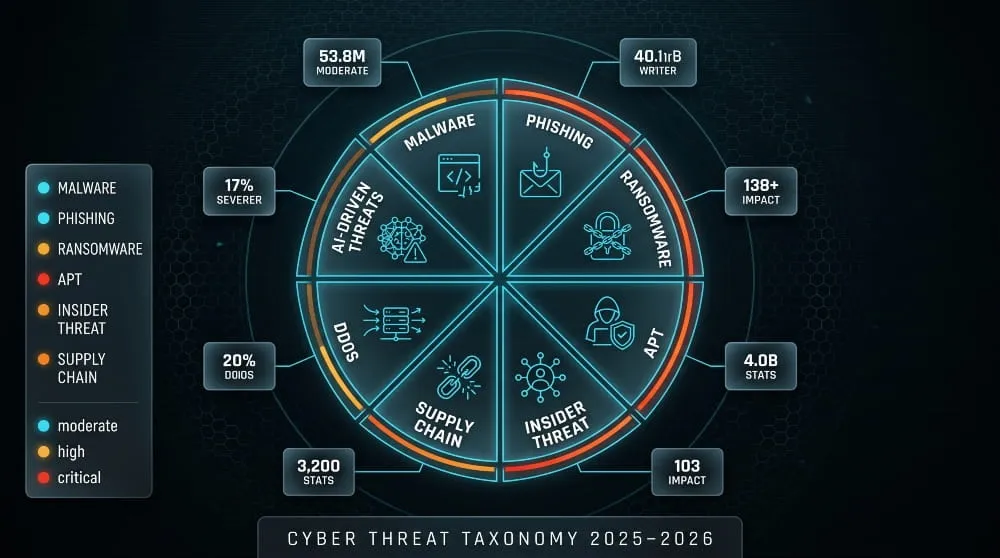
Cyber threats do not arrive in a single form. They span a wide spectrum of methods, motivations, and targets, from automated malware campaigns hitting thousands of organizations simultaneously to surgical, months-long intrusions aimed at a single high-value system. Understanding the distinct types of cyber threats is not an academic exercise; it is the prerequisite for building defences calibrated to the actual risks your organization faces rather than a generalized fear of being hacked.
Malware, Viruses, Ransomware, Spyware, Worms, and Trojans
Malware, malicious software, is the broadest category of cyber threat and the one most organizations will encounter directly at some point. The term covers any code deliberately engineered to damage, disrupt, or gain unauthorized access to a system, and it encompasses several distinct subtypes that behave in meaningfully different ways.
Viruses attach themselves to legitimate files and execute when those files are opened, replicating across systems and often corrupting or deleting data in the process. Worms are self-replicating and do not require a host file; they spread autonomously across networks by exploiting vulnerabilities. The 2017 WannaCry worm encrypted systems across 150 countries within 72 hours by exploiting a single unpatched Windows vulnerability. Trojans disguise themselves as legitimate software to trick users into installing them, and once installed, open backdoors, steal credentials, or download additional payloads. Spyware operates silently in the background, monitoring keystrokes, capturing screenshots, and exfiltrating sensitive data without triggering visible symptoms.
Ransomware deserves particular attention because it has become the defining malware threat of the current era. Rather than simply stealing or destroying data, ransomware encrypts it. It demands payment for the decryption key, often while simultaneously threatening to publish the stolen data on dark web leak sites if the ransom is not paid. The global CostCost of ransomware attacks is projected to exceed $275 billion annually by 2031, according to Cybersecurity Ventures. This figure reflects not just ransom payments but the compounding costs of downtime, recovery, regulatory penalties, and reputational damage.
Phishing and Social Engineering Attacks
Phishing is consistently the most common entry point for cyberattacks globally, and its dominance stems from a simple reality: it is far easier to manipulate a person than to breach a well-configured technical defence. Rather than exploiting software vulnerabilities, phishing exploits human psychology, trust, urgency, authority, and fear.
In a standard phishing attack, the threat actor sends a message, most commonly an email. However, SMS-based smishing and voice-based vishing attacks are increasingly prevalent, impersonating trusted entities and prompting recipients to click a malicious link, open an infected attachment, or disclose credentials directly. The Verizon 2024 Data Breach Investigations Report found that the human element was involved in 68 percent of breaches, with phishing and pretexting accounting for the majority of those incidents.
Spear phishing represents the more dangerous evolution of the technique. Where mass phishing campaigns cast the widest possible net, spear phishing is precisely targeted; the attacker researches a specific individual, incorporates personal details harvested from LinkedIn, corporate websites, or previous breaches, and crafts a message engineered to deceive that person specifically. Business Email Compromise (BEC), a form of spear-phishing in which attackers impersonate executives to authorize fraudulent wire transfers, cost organizations $2.9 billion in 2023, according to FBI IC3 data. AI has significantly accelerated this threat: large language models can now generate grammatically flawless, contextually accurate phishing lures at scale, eliminating the spelling errors and awkward phrasing that once served as reliable warning signs.
Advanced Persistent Threats (APTs)
An advanced persistent threat is a prolonged, targeted cyber intrusion in which a threat actor, typically a nation-state or a sophisticated criminal group operating with nation-state-level resources, gains unauthorized access to a network and maintains that access covertly over an extended period, often months or years.
The defining characteristic of an APT is patience. Unlike opportunistic attacks designed for immediate payoff, APT actors prioritize stealth and persistence over speed. They establish footholds, move laterally through the environment, map internal systems, escalate privileges, and exfiltrate data continuously, all while remaining invisible to the organization’s security team. The 2020 SolarWinds compromise, in which attackers embedded malicious code into a widely used IT monitoring platform and gained access to networks across 18,000 organizations, including multiple US federal agencies, went undetected for approximately nine months.
APTs are predominantly associated with state-sponsored threat actors from China, Russia, Iran, and North Korea, though the tactics have been adopted by well-funded criminal organizations as well. Their targets tend to be strategically valuable rather than immediately profitable: defence contractors, government agencies, research institutions, pharmaceutical companies, and operators of critical infrastructure. The goal is intelligence collection, strategic disruption capability, or intellectual property theft, objectives measured in geopolitical impact rather than immediate financial return.
Insider Threats, Malicious and Unintentional
An insider threat originates within the organization, from current or former employees, contractors, partners, or vendors who have legitimate access to systems and use that access, intentionally or unintentionally, in ways that cause harm.
Malicious insider threats involve deliberate action: an employee stealing customer data before resigning to join a competitor, a disgruntled contractor sabotaging systems after termination, or a privileged user selling access credentials to external threat actors on dark web forums. These cases are relatively rare but tend to be severely damaging precisely because the actor already has access to and knowledge of internal systems, and has established trust that an external attacker must spend significant effort to acquire.
Unintentional insider threats are far more common and, in aggregate, responsible for a significant proportion of security incidents. An employee who clicks a phishing link, uses a weak password, sends sensitive data to the wrong email address, or connects to corporate systems over an unsecured public network has not acted maliciously. Still, the organization’s outcome can be indistinguishable from a deliberate attack. The Ponemon Institute’s 2023 Cost of Insider Risks report found that insider-related incidents cost organizations an average of $16.2 million annually, with negligent insiders accounting for 55% of all incidents.
Denial-of-Service (DoS) and Distributed DoS Attacks
A denial-of-service attack does not attempt to breach a system or steal data. Its objective is simpler and often more immediately destructive: make a service, application, or network unavailable to the people who depend on it by overwhelming it with more traffic or requests than it can handle.
In a standard DoS attack, a single source floods the target with traffic. Distributed denial-of-service (DDoS) attacks coordinate a flood of traffic from thousands or millions of compromised machines, forming a botnet. The distributed nature of DDoS attacks makes them exponentially more difficult to mitigate, because blocking a single IP address does nothing when the attack traffic is arriving from across the globe. The largest DDoS attack ever recorded peaked at 3.8 terabits per second, documented by Cloudflare in late 2024, overwhelming defences that would have absorbed attacks an order of magnitude smaller without difficulty.
DDoS attacks are used for a range of purposes: extortion, competitive disruption, hacktivism, and as a smokescreen to draw security team attention away from a simultaneous data exfiltration attempt occurring under cover of the noise.
Man-in-the-Middle Attacks
A man-in-the-middle (MitM) attack occurs when a threat actor secretly intercepts and potentially alters communications between two parties who believe they are communicating directly and securely with each other. The attacker positions themselves in the middle of the exchange, capturing credentials, session tokens, financial data, or sensitive communications without either party’s knowledge.
Common vectors include compromised public Wi-Fi networks, where an attacker sets up a rogue access point that routes all traffic through their system before forwarding it to the legitimate destination, and SSL stripping attacks that downgrade encrypted HTTPS connections to unencrypted HTTP. ARP spoofing on local networks and DNS hijacking, redirecting domain name lookups to attacker-controlled IP addresses, are also well-established MitM techniques.
The threat has evolved alongside the adoption of encryption. As HTTPS became the default for web traffic, MitM attacks shifted toward targeting the endpoints of encrypted sessions rather than the sessions themselves, intercepting credentials at the login page rather than in transit, or installing malware that reads data before it is encrypted for transmission.
Supply Chain Attacks
A supply chain attack bypasses the target organization’s own defences entirely by compromising a trusted third party, a software vendor, a managed service provider, a hardware supplier, or a development dependency, and using that trusted relationship as the attack vector.
The logic is straightforward and troubling: organizations invest heavily in securing their own environments while, by necessity, extending trust to the vendors and software they depend on to operate. That trust becomes the vulnerability. When an attacker compromises a software build pipeline and injects malicious code into an update that is then automatically distributed to thousands of customers, every one of those customers’ security investments is bypassed in a single operation.
The SolarWinds attack demonstrated the catastrophic potential of this model. More recently, the MOVEit Transfer vulnerability in 2023 exposed data across more than 2,700 organizations, including government agencies, airlines, and financial institutions, through a single zero-day flaw in a widely used file transfer tool. Gartner predicted that by 2025, 45 percent of organizations globally would have experienced a supply chain attack, a figure that reflects how fundamentally this threat type has reshaped enterprise risk assessment.
AI-Driven and Emerging Cyber Threats in 2025–2026
The emergence of capable, accessible AI has introduced a category of cyber threats that did not exist in meaningful form three years ago and is already reshaping the threat landscape faster than most defensive frameworks have adapted.
On the offensive side, AI enables threat actors to automate reconnaissance at a scale no human team could match, generate highly convincing phishing content in any language without the grammatical errors that previously betrayed non-native speakers, and create polymorphic malware that rewrites its own code to evade signature-based detection. Deepfake audio and video have introduced a new dimension to social engineering. In 2024, a finance employee at a multinational firm was deceived into transferring $25 million after attending what appeared to be a video call with the company’s CFO; every participant, except the victim, was an AI-generated deepfake.
Beyond AI, the threat landscape in 2025 and 2026 is being shaped by several converging developments: the growing attack surface created by billions of IoT devices with minimal built-in security, the expanding exposure of operational technology (OT) systems as industrial environments connect to corporate networks, the quantum computing horizon that threatens to render current encryption standards obsolete, and the persistent risk of zero-day vulnerabilities in foundational software that underpins global digital infrastructure. These are not distant theoretical risks; they are active threat vectors that security teams are contending with today.
The Cyber Threat Landscape in 2025–2026
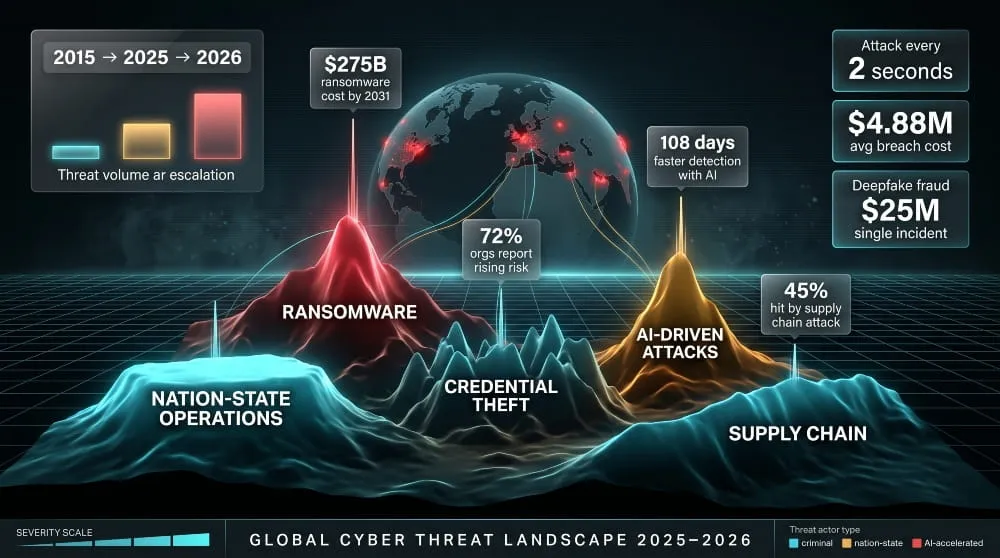
The cyber threat landscape in 2025 is defined by a convergence of factors that has no historical precedent: AI-accelerated attack capabilities, a sprawling and poorly secured attack surface, and threat actors- criminal, state-sponsored, and everything in between- operating with resources and sophistication that rival the defensive budgets of the organizations they target. The question organizations are grappling with is no longer whether they will face a serious cyber threat, but whether they will have the visibility to see it coming.
Biggest Cyber Threats Facing Organizations Today
Ransomware remains the single most operationally devastating cyber threat facing organizations in 2025. Its dominance is not accidental; the ransomware-as-a-service model has lowered the technical barrier to entry so dramatically that virtually any criminal with modest resources can now license a fully operational attack toolkit, complete with support for victim negotiation and cryptocurrency laundering infrastructure. The result is a threat that scales faster than defences do: Cybersecurity Ventures estimates that a ransomware attack now occurs every two seconds globally, a frequency that was unimaginable even five years ago.
Behind ransomware, data extortion has emerged as a distinct and growing threat in its own right. Where earlier ransomware campaigns focused on encrypting data and demanding payment for the decryption key, many threat actors have shifted to a model that skips encryption entirely, stealing data and threatening to publish it unless the victim pays. This approach requires less technical infrastructure, produces faster results, and remains effective even against organizations with robust backup and recovery capabilities.
Credential theft and identity-based attacks represent the third pillar of the current threat environment. Infostealer malware, lightweight, fast-moving code designed to harvest usernames, passwords, session cookies, and authentication tokens, has flooded dark web markets with billions of compromised credentials. Threat actors purchase these credentials for trivial sums and use them to access corporate environments without ever needing to exploit a technical vulnerability. When a threat actor logs in with a legitimate employee’s stolen credentials, they are, from the perspective of most security systems, indistinguishable from the employee themselves.
Top 10 Cyber Security Threats Right Now
The following represent the ten cyber security threats that security teams, threat intelligence analysts, and government agencies consistently identify as the most active and impactful in the current environment.
Ransomware and double-extortion attacks continue to top every major threat ranking, with healthcare, manufacturing, and critical infrastructure bearing disproportionate impact. Phishing and business email compromise remain the primary initial access vector across industries, now supercharged by AI-generated lures that are indistinguishable from legitimate communications. Supply chain attacks targeting software vendors and managed service providers enable a single intrusion to cascade across thousands of downstream victims simultaneously.
Infostealer malware and credential theft have created an unprecedented volume of compromised identity data available to threat actors at minimal CostCost. AI-driven attacks, automated reconnaissance, polymorphic malware, and deepfake-enabled social engineering represent the fastest-growing category in the current landscape. Insider threats, both malicious and negligent, account for a substantial share of incidents that bypass perimeter defences entirely.
DDoS attacks have reached new scale thresholds, with volumetric attacks now capable of overwhelming infrastructure that would have been considered well-protected two years ago. Zero-day exploitation, the use of previously unknown vulnerabilities before patches exist, is increasingly common among state-sponsored actors and top-tier criminal groups who purchase zero-day research through private markets. Cloud misconfigurations and insecure APIs continue to expose sensitive data at an enterprise scale, particularly as cloud adoption outpaces security team expertise. Finally, OT and IoT attacks against connected industrial and consumer devices represent a growing threat as the boundary between digital and physical infrastructure continues to dissolve.
How AI Is Changing the Threat Landscape
AI has introduced a fundamental asymmetry into the threat landscape: it scales offensive capability faster than defensive capability, and it puts sophisticated attack tools within reach of threat actors who previously lacked the technical skills to use them.
On the offensive side, the impact is already measurable. AI enables threat actors to conduct automated vulnerability scanning across millions of targets simultaneously, identifying exploitable weaknesses at a speed no human team could approach. It generates phishing content, emails, SMS messages, voice calls, and, increasingly, video that are contextually accurate, grammatically flawless, and personalized at scale. It powers the development of polymorphic malware that modifies its own signature on each execution, rendering traditional detection approaches based on known malware fingerprints largely ineffective against new variants.
The deepfake threat deserves particular attention because it attacks a control that organizations have historically treated as reliable: human verification. The $25 million deepfake fraud case in Hong Kong in early 2024, in which AI-generated video representations of colleagues deceived an employee during a conference call, demonstrated that social engineering is no longer limited by geography, language, or the physical presence of a trusted person. As the CostCost of generating convincing deepfake audio and video continues to fall, this vector will become accessible to a broader range of threat actors.
On the defensive side, AI is simultaneously the most promising tool available to security teams, enabling faster anomaly detection, automated threat correlation across massive datasets, predictive modelling of attacker behaviour, and a resource that requires skilled implementation to deploy effectively. The organizations that will navigate the AI-accelerated threat landscape most successfully are those treating AI as a force multiplier for human analysts rather than a replacement for human judgement.
Nation-State Cyber Threats, China, Russia, Iran, and Beyond
Nation-state cyber threats occupy a distinct tier of the threat landscape, characterized by resources, patience, and strategic objectives that differ fundamentally from criminal actors. Where ransomware groups seek financial return within days or weeks, state-sponsored threat actors may maintain covert access to a target environment for years, collecting intelligence and pre-positioning for potential disruption without ever triggering a visible incident.
China’s state-sponsored threat activity is primarily oriented around long-term strategic intelligence collection and intellectual property theft. Groups attributed to China’s People’s Liberation Army and Ministry of State Security have conducted sustained campaigns targeting defence contractors, semiconductor manufacturers, pharmaceutical companies, and government agencies across the United States, Europe, and Southeast Asia. The Volt Typhoon campaign, disclosed by US authorities in 2024, revealed that Chinese threat actors had pre-positioned themselves within US critical infrastructure, power grids, water systems, and communications networks, not for immediate exploitation but to retain the capability to disrupt in the event of a geopolitical crisis.
Russia’s cyber threat posture combines intelligence collection with a demonstrated willingness to conduct disruptive and destructive attacks, particularly against Ukraine and NATO-aligned nations. Russian threat actors pioneered the use of wiper malware, software designed purely to destroy data with no financial motive, and have targeted energy infrastructure, media organizations, and government systems with attacks that blur the line between cyber operations and acts of war.
Iran and North Korea represent distinct threat profiles. Iranian cyber operations frequently combine espionage with influence operations and retaliatory attacks against organizations in countries subject to US-led sanctions. North Korea’s cyber operations are uniquely financially motivated among state actors: groups attributed to the Lazarus APT have stolen an estimated $3 billion in cryptocurrency since 2017 to fund the country’s weapons programs, making them simultaneously a state-sponsored espionage threat and the world’s most prolific cybercriminal operation.
Trending Threat Vectors: Cloud, IoT, BYOD, and Remote Work
The expansion of the enterprise attack surface over the past five years has created threat vectors that security architectures designed for the traditional network perimeter were never built to address. Four in particular dominate the current threat conversation.
Cloud environments have become the primary infrastructure layer for most organizations, but the speed of cloud adoption has consistently outpaced the development of cloud security expertise. Misconfigured storage buckets, overly permissive IAM policies, insecure APIs, and inadequate logging create exposure that threat actors actively scan for and exploit at scale. The shared responsibility model is one in which cloud providers are responsible for securing the infrastructure. At the same time, the shared responsibility model, in which customers are responsible for securing their own configurations and data, means that the most common cloud threats are not failures of the provider’s security but of the customer’s implementation.
IoT devices present a threat vector defined by volume and neglect. Billions of connected devices, from industrial sensors and medical equipment to smart building systems and consumer appliances, operate on firmware that is rarely updated, protected by default credentials that are rarely changed, and monitored by security teams that often have no visibility into which IoT devices are even present on their networks. Threat actors exploit these devices as entry points into broader network environments and recruit them into botnets capable of launching DDoS attacks of unprecedented scale.
BYOD policies and the permanent shift toward hybrid and remote work have dissolved the network perimeter that once provided a meaningful layer of default protection. Employees accessing corporate systems from personal devices, home networks, and public Wi-Fi introduce exposure that enterprise security controls cannot fully address. The 2024 Verizon DBIR found that external-facing VPN and remote desktop vulnerabilities were among the most frequently exploited initial access vectors in the past year, a direct consequence of remote work infrastructure being deployed at speed during the pandemic and never fully hardened afterward.
Cyber Threats by Industry: Who Is Most at Risk?
Every industry faces cyber threats, but the nature, frequency, and consequence of those threats vary significantly depending on what an organization holds, how it operates, and how attractive its data or systems are to different categories of threat actor. Understanding industry-specific cyber risk is not about ranking sectors by victimhood; it is about recognizing that the threat model for a regional hospital is categorically different from that of a shipping company or a law firm, and that effective defence has to be calibrated accordingly.
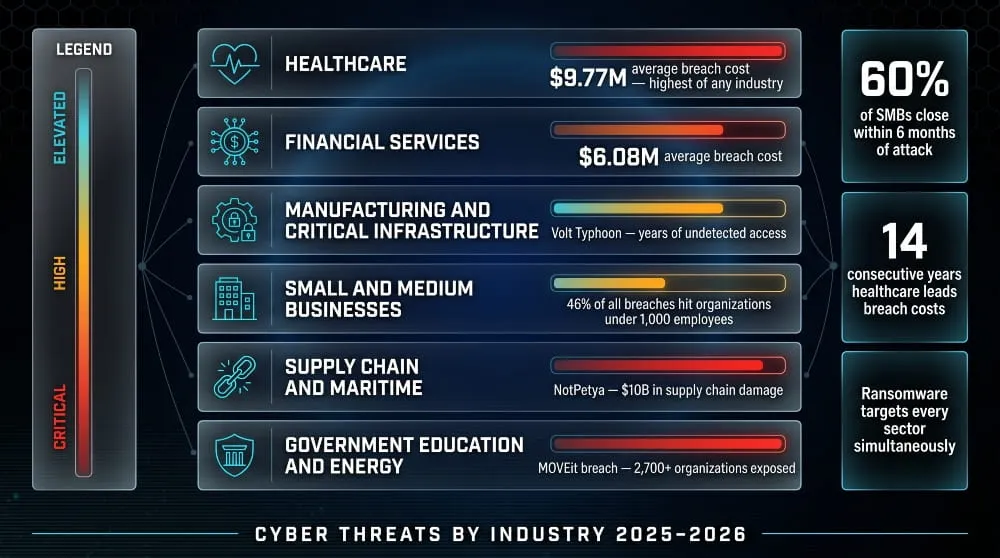
Healthcare Cyber Threats and Patient Data Risks
Healthcare has become the most frequently targeted industry for cyber attacks, a position it has held for more than a decade and shows no sign of relinquishing. The combination of factors that makes healthcare uniquely vulnerable is almost impossible to replicate in any other sector: extraordinarily sensitive personal data, life-critical operational systems that cannot be taken offline for patching, legacy infrastructure that predates modern security architecture by decades, and a workforce whose primary training is clinical rather than security-oriented.
Patient records command the highest per-record price of any data category on dark web markets, routinely fetching 10 to 20 times the value of a stolen payment card, because they contain permanent personal identifiers that enable identity, insurance, and prescription drug fraud. A credit card can be cancelled; a date of birth, Social Security number, and medical history cannot.
The operational consequences of healthcare cyber threats extend beyond data loss into direct patient safety risk. Ransomware attacks on hospital systems have forced emergency departments to divert ambulances, cancel surgeries, and revert to paper-based processes at precisely the moments when digital systems are most critical. A 2024 study published in JAMA Network Open found a statistically significant association between ransomware attacks on hospitals and increases in patient mortality rates in affected facilities, making healthcare cyber threats a matter of life and death in the most literal sense.
IBM’s 2024 Cost of a Data Breach report found that healthcare recorded the highest average breach cost of any industry for the fourteenth consecutive year, at $9.77 million per incident, more than double the cross-industry average.
Financial Sector and Banking Cyber Threats
The financial sector attracts cyber threats for the most direct reason imaginable: it is where the money is. Banks, payment processors, investment firms, insurance companies, and cryptocurrency exchanges are simultaneously high-value targets for financially motivated threat actors and systemically critical infrastructure whose disruptions ripple across the broader economy.
The primary cyber threats facing financial institutions fall into several distinct categories. Account takeover attacks use stolen credentials, sourced from infostealer malware, phishing campaigns, or dark web credential markets, to access customer accounts and initiate unauthorized transfers. Business email compromise targets finance teams with fraudulent payment requests that impersonate executives, vendors, or regulators. Distributed denial-of-service attacks are deployed against financial platforms for both extortion and competitive disruption. And increasingly, sophisticated threat actors target the interconnected infrastructure of the financial system itself, the SWIFT messaging network, interbank settlement systems, and the APIs connecting fintech platforms to core banking infrastructure.
The regulatory environment adds a dimension of complexity unique to the sector. Financial institutions operating under frameworks including DORA in Europe, the SEC’s cybersecurity disclosure rules in the United States, and the Basel Committee’s operational risk guidelines face mandatory breach notification requirements and minimum security standards that make the CostCost of a cyber incident extend well beyond the immediate damage into regulatory penalties and legal liability. The average CostCost of a financial sector data breach reached $6.08 million in 2024, according to IBM. That figure does not capture the reputational CostCost of customer trust erosion that follows a publicly disclosed incident.
Manufacturing and Critical Infrastructure Threats
Manufacturing and critical infrastructure face a cyber threat category that most industries do not: attacks targeting physical outcomes. When a ransomware infection shuts down a manufacturer’s enterprise IT network, production lines stop. When a threat actor gains access to the operational technology systems that control an energy grid, water treatment facility, or pipeline, the potential consequences range from economic disruption to physical safety emergencies.
The convergence of IT and OT- the connection of historically isolated industrial control systems to corporate networks and, increasingly, the internet- has dramatically expanded the attack surface of manufacturing and critical infrastructure environments. Systems that were designed for decades of continuous operation in air-gapped environments are now network-connected but rarely updated, running on unsupported operating systems that cannot be patched without risking operational disruption.
Nation-state threat actors have shown particular interest in critical infrastructure, with a strategic logic that differs from criminal ransomware groups. The goal is not immediate financial return but the pre-positioning of persistent access that could be activated to disrupt a geopolitical crisis, the cyber equivalent of a sleeper capability. The Volt Typhoon campaign disclosed in 2024 revealed that Chinese state-sponsored actors had maintained undetected access to US energy, water, and communications infrastructure for years, specifically in geographic areas near major US military installations.
Ransomware groups have simultaneously identified manufacturing as a high-value target precisely because operational downtime is so costly. A manufacturing facility running at full capacity cannot absorb the extended outages that accompany a ransomware recovery, creating pressure to pay ransoms quickly that criminal groups deliberately exploit.
Cyber Threats to Small and Medium Businesses (SMBs)
Small and medium businesses are not secondary targets for cyber threat actors; they are primary targets, selected specifically because their security posture is typically weaker than that of enterprise organizations, while their data and financial assets remain valuable and accessible. The assumption that threat actors focus exclusively on large organizations is one of the most dangerous misconceptions in cybersecurity, and it is consistently disproven by the data.
Verizon’s 2024 Data Breach Investigations Report found that 46 percent of all cyber breaches affected businesses with fewer than 1,000 employees. SMBs are targeted through the same vectors as larger organizations- phishing, credential theft, ransomware, and vulnerability exploitation- but with the compounding disadvantage of limited dedicated security staff, constrained budgets for security tooling, and less mature incident response capabilities. Recovery from a serious cyber incident is proportionally far more damaging for a small business: the Ponemon Institute found that 60 percent of small businesses close within six months of a significant cyber attack.
SMBs also face the specific risk of being targeted as entry points into larger organizations. Suppliers, contractors, and service providers in the supply chains of enterprise customers carry customer data, system access credentials, and network connectivity that make them attractive intermediate targets. The threat actor’s real objective may be the enterprise customer, but the path of least resistance runs through the smaller, less-defended supplier.
Supply Chain, Maritime, and Logistics Threats
Supply chain, maritime, and logistics operations face cyber threats that are both operationally specific and globally consequential. The interconnected nature of global trade means that a cyber incident affecting a major port operator, a shipping management platform, or a logistics software provider does not stay contained; it propagates downstream through every business that depends on that infrastructure to move goods.
The 2017 NotPetya attack remains the defining illustration of this dynamic. Originally deployed as a destructive wiper against Ukrainian targets, NotPetya spread through global supply chains via infected software updates, ultimately causing an estimated $10 billion in damages. Shipping giant Maersk, which processed a booking every 15 seconds at the time, had its entire IT infrastructure wiped out, requiring the reinstallation of 45,000 PCs and 4,000 servers across 130 countries in 10 days. The attack did not target Maersk specifically; it simply moved through the supply chain connections that global logistics depends on.
Maritime cyber threats have become a dedicated field of security concern as the shipping industry has digitized navigation, cargo management, and port operations. GPS spoofing, the manipulation of vessel positioning signals to redirect ships or create false navigational data, has been documented in multiple geopolitically sensitive maritime zones. Port operations, which now rely heavily on networked crane controls, terminal management systems, and customs processing platforms, represent critical chokepoints whose disruptions cascade immediately into global trade flows.
Government, Education, and Energy Sector Exposure
Government agencies, educational institutions, and energy providers share a common characteristic that makes them recurring targets: they hold data or control infrastructure of significant strategic, financial, or social value while frequently operating under resource and procurement constraints that leave security investment chronically underfunded relative to the threat they face.
Government agencies at every level- federal, state, and municipal- are targeted by a wide spectrum of threat actors. Nation-state groups conduct espionage operations aimed at classified information, diplomatic communications, and defence capabilities. Criminal groups target government payment systems, benefits administration platforms, and citizen data repositories. Hacktivists target government websites to disrupt reputations. The 2023 MOVEit breach exposed data from multiple US federal agencies, state governments, and public sector organizations across multiple countries through a single exploited vulnerability, a stark illustration of how dependency on shared software infrastructure creates collective exposure.
Educational institutions, particularly universities, face cyber threats driven by the combination of open network architectures, designed to facilitate research collaboration rather than restrict access, and an unusually diverse and transient user population that is difficult to train and credential-manage at scale. Research universities also hold intellectual property of significant value to state-sponsored threat actors, particularly in fields such as advanced materials, artificial intelligence, biotechnology, and defence-related engineering.
The energy sector faces threats from both criminal and nation-state actors, with the distinction between the two increasingly difficult to maintain. Ransomware attacks targeting energy infrastructure, including the 2021 Colonial Pipeline attack that triggered fuel shortages across the US East Coast, demonstrate the leverage criminal groups have identified in targeting systems with immediate, visible public consequences. State-sponsored actors pursue longer-horizon objectives: persistent access to grid control systems that could be activated to cause widespread outages at a moment of strategic choice.
Cyber Threat Actors, Who Is Behind the Attacks?
Cyber threat actors are the individuals, groups, or state-sponsored organizations responsible for initiating and executing cyber attacks. Understanding who they are, their motivations, capabilities, organizational structures, and preferred methods is the foundational intelligence requirement for any organization serious about defending itself, because effective defence is not generic; it is calibrated to the specific adversaries most likely to target you.
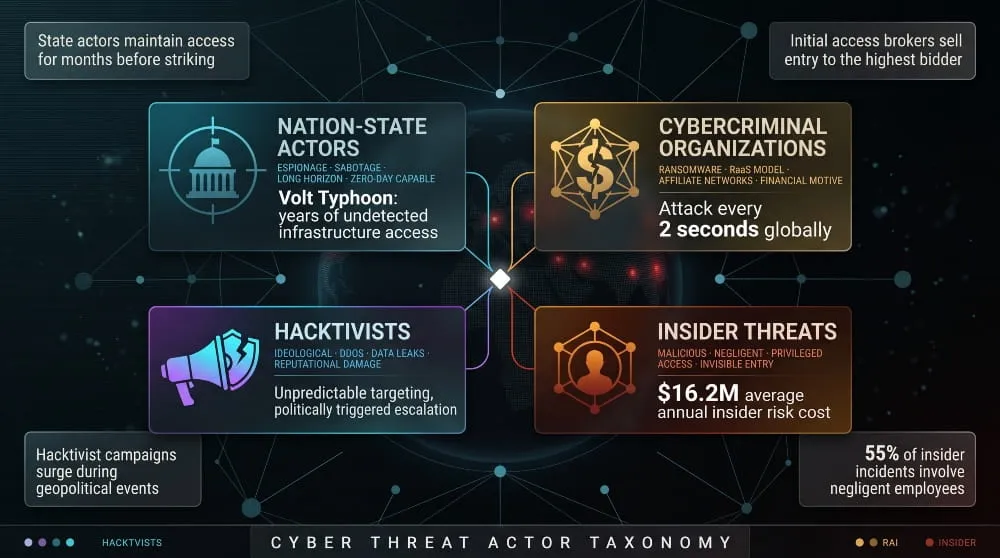
Types of Cyber Threat Actors: Nation-States, Cybercriminals, Hacktivists, Insiders
Cyber threat actors are not a monolithic category. They span a wide range of motivations, capabilities, and operational styles, and conflating them yields security strategies poorly matched to the actual threat.
Nation-state actors are government-sponsored or government-directed groups conducting cyber operations in service of strategic national objectives. Their defining characteristics are patience, resources, and sophistication. They operate with long time horizons, conduct extensive reconnaissance before acting, invest in developing or purchasing zero-day exploits, and prioritize stealth over speed. Their objectives- intelligence collection, critical infrastructure pre-positioning, intellectual property theft, and influence operations- are measured in geopolitical impact rather than financial return. The most capable nation-state groups maintain persistent access to target environments for months or years before their presence is detected, if it is detected at all.
Cybercriminal organizations are financially motivated and operate with a business logic that is increasingly indistinguishable from that of legitimate enterprises. Ransomware groups maintain affiliate programs, customer support functions, negotiation teams, and revenue-sharing structures. Initial access brokers specialize in compromising networks and selling that access to other criminal groups rather than exploiting it themselves. Infostealer operators harvest and sell credential data at scale. The professionalization of cybercrime has created a division of labour that allows individuals with narrow technical skills to participate in large-scale attacks by purchasing the components they cannot build themselves.
Hacktivists are ideologically motivated threat actors who use cyber attacks to advance political, social, or environmental causes. Their typical methods- website defacement, DDoS attacks, and data leaks intended to embarrass or expose target organizations- are generally less technically sophisticated than nation-state or criminal operations. Still, their unpredictability and the reputational damage they can inflict should not be underestimated. Anonymous, KillNet, and similar collectives have demonstrated the capacity to disrupt government and corporate services at scale, particularly during geopolitical events that mobilize large numbers of loosely affiliated participants around a shared cause.
Insider threat actors, as distinct from external adversaries, are covered in depth in their own section, but within the actor taxonomy they represent a uniquely dangerous category because they begin with the access, trust, and institutional knowledge that every other threat actor type must invest significant effort to acquire.
How Threat Actor Groups Operate and Organize
The organizational structures of cyber threat actor groups vary significantly by type and sophistication, but several models have become dominant in the current landscape.
Nation-state cyber units operate within formal military or intelligence organizational hierarchies, with dedicated teams for different mission types: offensive operations, intelligence collection, influence operations, and defensive counter-intelligence. China’s People’s Liberation Army Strategic Support Force, Russia’s GRU and FSB cyber units, and Iran’s Islamic Revolutionary Guard Corps cyber command all maintain large permanent staffs of professional operators with specialized technical roles. These organizations conduct operations with the planning discipline, operational security, and resource allocation of military campaigns, because that is precisely what they are.
Criminal ransomware and extortion groups have converged on the ransomware-as-a-service (RaaS) model as the dominant organizational structure. In this model, a core developer group maintains the ransomware toolkit, the negotiation infrastructure, and the cryptocurrency laundering channels, while affiliates, recruited through dark web forums and vetted for technical capability, conduct the actual intrusions and receive a percentage of ransom payments in return. This structure allows the core group to scale operations dramatically without proportionally increasing their own exposure, since affiliates bear most of the operational risk of conducting intrusions.
Advanced criminal groups have also adopted a supply-chain approach to their operations, with initial access brokers, network reconnaissance specialists, and data exfiltration teams operating as distinct commercial entities that sell services to one another rather than as unified teams. This specialization increases operational efficiency and makes attribution significantly harder, since the group that deploys the ransomware payload may have purchased their network access from a completely separate criminal organization that itself purchased the initial credential from a third-party infostealer operation.
Tracking State-Sponsored Cyber Threats
Tracking state-sponsored cyber threats is one of the most demanding disciplines in threat intelligence, requiring the correlation of technical indicators, malware signatures, infrastructure patterns, TTPs (tactics, techniques, and procedures), and geopolitical context, along with historical attribution data and human intelligence that most organizations cannot access independently.
The primary framework for organizing and communicating state-sponsored threat actor intelligence is the named threat group taxonomy maintained by major security research organizations. CrowdStrike uses animal-themed naming conventions tied to nation attribution: Bears for Russia, Pandas for China, Kittens for Iran, Chollimas for North Korea. Mandiant uses numerical APT designations. Microsoft uses weather-themed names in its current taxonomy. These naming conventions are not cosmetic: they represent clusters of correlated technical and behavioural indicators that analysts use to attribute observed activity to known actor groups with assessed confidence levels.
The core methodology for tracking state-sponsored actors relies on the relative permanence of TTPs compared to the transience of specific indicators. IP addresses change. Domain names rotate. Malware samples are updated to evade detection. But the way a threat actor conducts reconnaissance, establishes persistence, moves laterally, and exfiltrates data- their operational tradecraft- changes slowly, because it reflects human habits, training, and tooling that is expensive and disruptive to alter. The MITRE ATT&CK framework provides the shared vocabulary that allows analysts across organizations and sectors to describe, compare, and correlate observed adversary behaviour against a comprehensive taxonomy of known techniques.
CISA, the NSA, and their international counterparts in the Five Eyes intelligence alliance publish joint cybersecurity advisories that provide organizations with actionable threat intelligence on state-sponsored actor activity, including specific indicators of compromise, observed TTPs, and recommended mitigations. These advisories represent some of the highest-confidence publicly available intelligence on state-sponsored cyber threats and should be integrated into every organization’s threat intelligence program as a baseline.
Threat Vectors Used by Modern Cyber Adversaries
A threat vector is the path or method a cyber adversary uses to gain initial access to a target environment. Understanding which vectors are most actively exploited and by which threat actor categories is essential intelligence for prioritizing defensive investment.
Phishing and spear phishing remain the most consistently exploited initial access vector across all threat actor categories, from opportunistic criminal campaigns to targeted nation-state operations. The universality of email, combined with human susceptibility to well-crafted deception, makes phishing a vector that no security architecture has yet made obsolete. Nation-state actors use highly personalized spear phishing against specific high-value individuals; criminal groups run mass campaigns at scale; and the line between the two is increasingly blurred by AI-generated content that makes personalization cheap.
Exploitation of public-facing vulnerabilities and unpatched software flaws in VPNs, firewalls, web applications, and remote desktop services represents the second dominant initial access vector, particularly for more technically sophisticated threat actors who invest in vulnerability research or purchase zero-day exploits through private markets. The speed at which threat actors now operationalize newly disclosed vulnerabilities has compressed the window between patch release and active exploitation to hours in some cases, making rapid patching a critical and time-sensitive defensive requirement rather than a routine maintenance task.
Valid account abuse, using stolen, purchased, or brute-forced credentials to authenticate as legitimate users, is the third major vector and the one that most comprehensively bypasses traditional perimeter security controls. When a threat actor logs into a VPN, cloud console, or enterprise application using credentials obtained from a dark web infostealer market, they enter the security perimeter looking exactly like the employee whose identity they have assumed. Detecting this type of intrusion requires behavioural analytics that can identify anomalies in how authenticated users behave, not just whether they authenticate successfully.
Supply chain compromise, trusted relationship abuse, and hardware implants round out the primary vector landscape for nation-state actors operating against high-security targets where direct intrusion would be detected too quickly to be operationally useful.
What Is an Insider Threat in Cyber Security?
An insider threat in cybersecurity is a risk that originates within the organization, from any person granted legitimate access to systems, networks, or data who uses that access to cause harm, whether deliberately or through negligence. Unlike external threats that must breach perimeter defences, insider threats already exist within them, which is precisely what makes them among the most difficult and expensive security problems organizations face.
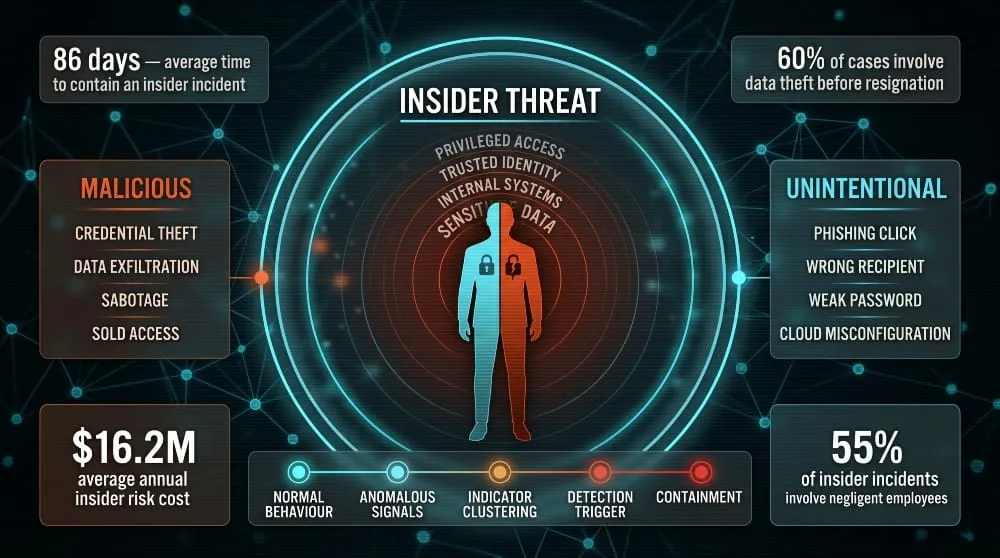
The insider threat category is broader than most security teams account for. It encompasses current employees, former employees whose access has not been properly revoked, contractors and third-party vendors operating within the organization’s environment, and business partners with privileged connectivity to internal systems. The common thread is not malicious intent; it is authorized access combined with the potential for harm, whether that harm is sought or accidental.
The financial weight of insider risk reflects this breadth. The Ponemon Institute’s 2023 Cost of Insider Risks Global Report found that insider-related incidents cost organizations an average of $16.2 million annually, with the average time to contain an insider incident stretching to 86 days, long enough for significant, compounding damage to occur before the source is identified and isolated.
Malicious vs. Unintentional Insider Threats
The insider threat category divides into two fundamentally different problems that require different detection approaches, response procedures, and preventive controls, yet both carry the capacity to cause severe organizational harm.
Malicious insider threats involve deliberate action by someone who has decided to use their legitimate access for harmful purposes. The motivations are varied: financial gain from selling data or access credentials to external threat actors, personal grievance against an employer or colleague, ideological alignment with an adversarial group, coercion by an external party, or competitive intelligence theft on behalf of a future employer. A sales manager who exfiltrates the entire customer database before resigning, a system administrator who plants a logic bomb in critical infrastructure before termination, or a privileged user who sells remote access credentials to a ransomware affiliate- these represent the malicious insider archetype. What makes them particularly damaging is that they understand the organization’s systems, know where the most valuable data resides, and have the access to reach it without triggering the alerts that an external attacker would set off.
Unintentional insider threats are significantly more common and, in aggregate, responsible for a larger share of cyber incidents than their malicious counterparts. These are employees who click a phishing link and unknowingly install malware, who send a sensitive document to the wrong recipient, who use a weak or reused password that is subsequently compromised, who connect to corporate systems over an unsecured public network, or who misconfigure a cloud storage bucket and expose sensitive data to the open internet. The Ponemon report found that negligent insiders accounted for 55 percent of all insider incidents, more than half of all cases, at an average cost of $6.9 million per organization annually. Intent is irrelevant to the outcome: the breach that results from a well-meaning employee’s error is operationally identical to one caused by deliberate sabotage.
Insider Threat Indicators to Watch For
Identifying insider threats before they cause harm requires distinguishing anomalous behaviour from the background noise of normal organizational activity, a challenge that is simultaneously technical, procedural, and deeply human. No single indicator is definitive, but patterns of behaviour that deviate meaningfully from an individual’s established baseline warrant attention and investigation.
On the technical side, indicators include unusual access patterns outside normal working hours or from unexpected geographic locations, large-scale data downloads or transfers to personal devices or external storage, attempts to access systems or data outside the individual’s role or business need, unusual privilege escalation requests, and the installation of unauthorized software including remote access tools. Searches for sensitive data the individual has no documented reason to access, repeated failed authentication attempts against restricted systems, and the disabling or circumvention of security controls are all behaviours that insider threat detection programs flag as elevated-risk signals.
Behavioural and contextual indicators often precede technical ones. An employee who has recently received a negative performance review, been passed over for promotion, announced their resignation, or is known to be experiencing significant personal financial stress represents a changed risk profile that security and HR teams should be aware of, not to treat the individual as a suspect, but to ensure that appropriate monitoring and access controls are in place. Sudden changes in attitude toward colleagues or management, expressions of disillusionment or grievance, and requests for access or information that fall outside normal job functions are contextual signals that, combined with technical anomalies, form a more complete picture of insider risk.
The most effective insider threat detection programs combine User and Entity Behaviour Analytics (UEBA), technology that establishes behavioural baselines and flags deviations, with human judgement from security, HR, and management teams who have the contextual knowledge that technical systems alone cannot supply.
How Insider Threats Harm National Security
Insider threats represent one of the most enduring and damaging categories of risk to national security, a fact documented across decades of espionage cases in which individuals with trusted access to classified systems, intelligence programs, and defence infrastructure have caused harm that external adversaries with far greater resources could not have achieved on their own.
The damage potential of a malicious insider in a national security context is categorically different from that in a commercial organization, because the assets at risk- classified intelligence sources and methods, military capabilities, diplomatic communications, and the identities of covert personnel- carry consequences that extend far beyond financial loss into strategic disadvantage, loss of life, and the long-term degradation of intelligence collection capability.
Historical cases illustrate the scale of the possible harm. Edward Snowden’s 2013 disclosure of NSA surveillance programs, regardless of the political debate surrounding his motivations, demonstrated that a single contractor with the right system access could exfiltrate millions of classified documents and permanently alter the global intelligence landscape. Robert Hanssen, an FBI agent who sold intelligence to Soviet and Russian intelligence services for more than two decades, compromised the identities of US assets abroad, several of whom were subsequently executed, damage that no external cyber intrusion could have produced because the information he betrayed was never accessible to external actors.
The US Department of Defense Cyber Awareness Challenge specifically addresses insider threat recognition because the military and intelligence community’s exposure to this risk category is acute: the combination of vast quantities of sensitive data, large workforces with varying degrees of access, and the inherent difficulty of vetting human behaviour over long careers creates persistent vulnerability that technical controls alone cannot resolve.
Strategies to Reduce Human Cyber Risk
Reducing human cyber risk, the exposure created by the people inside an organization, whether through malice, negligence, or simple error, requires a layered strategy that combines technical controls, organizational policy, and a security culture that treats security awareness as an ongoing practice rather than an annual compliance checkbox.
The principle of least privilege is the most fundamental technical control for mitigating insider threats. Every user, system, and process should have access to only the data and systems required for their specific role, nothing more. When individuals leave the organization, or change roles within it, access should be revoked or adjusted immediately and automatically. Organizations that audit their access permissions regularly consistently find substantial populations of accounts with excessive privileges accumulated over time through role changes, project assignments, and administrative convenience, each one a potential insider threat vector waiting to be exploited.
Data loss prevention (DLP) technology monitors and controls the movement of sensitive data across the organization’s environment, flagging or blocking transfers that violate policy, large downloads to personal devices, emails containing sensitive data sent to external addresses, and uploads to unauthorized cloud storage. UEBA platforms establish individual behavioural baselines and surface anomalies that warrant investigation. Privileged access management (PAM) solutions apply additional controls and monitoring to the accounts with the greatest potential for damage.
Security awareness training that goes beyond annual compliance modules and creates genuine behavioural change is the most effective investment against unintentional insider risk. Training that uses realistic phishing simulations, provides immediate feedback in the moment of a mistake, and connects security behaviours to tangible personal consequences rather than abstract organizational risk has measurably better outcomes than passive video-based compliance training. Organizations that run continuous, simulation-based security awareness programs report phishing click rates that are five to ten times lower than organizations relying on annual training alone.
Finally, a psychologically safe reporting culture, one in which employees feel comfortable reporting their own mistakes, near-misses, and concerns about colleagues’ behaviour without fear of punishment, is a control that no technology can replicate. The incidents that cause the greatest damage are frequently those that went unreported for weeks or months because the person who first noticed something wrong was uncertain, afraid, or unsure whether what they observed was worth escalating.
What Is Cyber Threat Intelligence (CTI)?
Cyber threat intelligence is the process of collecting, processing, and analyzing information about existing and emerging threats to produce actionable knowledge that helps organizations make faster, better-informed security decisions. It is the discipline that transforms raw data, logs, indicators, dark web chatter, malware samples, and adversary behaviour patterns into intelligence that security teams can act on before an attack occurs, rather than after.
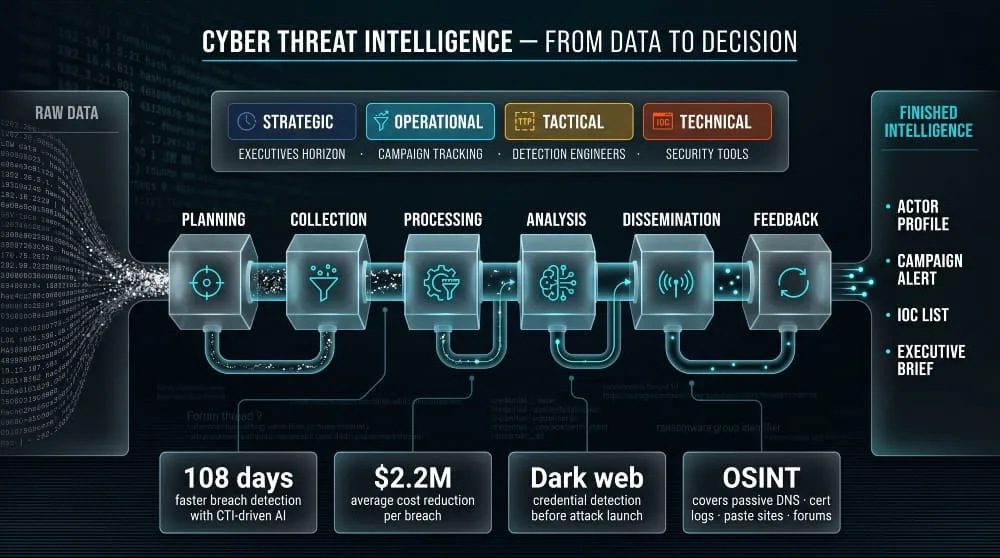
The distinction between data and intelligence is the defining concept of CTI as a discipline. Every organization generates enormous volumes of security-relevant data: firewall logs, endpoint telemetry, threat feeds, vulnerability scan results. Most of it is noise. Cyber threat intelligence is the analytical process that extracts signal from noise, contextualizes indicators, attributes activity to known threat actors, assesses relevance to the specific organization, and produces outputs that drive concrete decisions about where to invest defensive resources, what to patch first, and which threats warrant immediate response. Without that analytical layer, even the most comprehensive data collection produces little protective value.
Cyber Threat Intelligence Definition and Lifecycle
Cyber threat intelligence is formally defined by many practitioners using the intelligence community’s standard: evidence-based knowledge, including context, mechanisms, indicators, implications, and actionable advice, about an existing or emerging menace to assets, that can be used to inform decisions regarding the subject’s response to that menace. The key Word is actionable; intelligence that cannot drive a decision is not intelligence; it is information.
The CTI lifecycle is the structured process through which raw information becomes finished intelligence, and it mirrors the intelligence cycles used by national security agencies adapted for the speed and operational context of commercial security programs. It consists of six phases that operate as a continuous loop rather than a linear sequence.
The planning and direction phase defines the intelligence requirements, the specific questions the organization needs answered to support security decisions. Who is most likely to target us? What techniques are they currently using? Are there active campaigns targeting our industry or technology stack? These requirements drive everything that follows. The collection gathers raw data relevant to those requirements from across the full range of available sources, including technical feeds, dark web monitoring, open-source research, information-sharing communities, and human intelligence, where available. Processing converts collected raw data into a format suitable for analysis, normalizes formats, translates languages, de-duplicates indicators, and filters irrelevant noise. Analysis applies human and machine analytical capability to processed data to produce intelligence assessments, identifying patterns, attributing activity, assessing adversary intent and capability, and drawing conclusions relevant to the organization’s specific context. Dissemination delivers finished intelligence to the people who need it, in a format and at a classification level appropriate to their role and decision-making needs. Finally, feedback from intelligence consumers informs the next planning cycle, ensuring that the program continuously refines its focus toward the questions that most need answering.
Types of CTI: Strategic, Tactical, Operational, and Technical
Cyber threat intelligence is not a single uniform product; it exists at four distinct levels, each serving different audiences, operating at different time horizons, and informing different categories of decision.
Strategic intelligence is designed for executive leadership and board-level decision makers. It operates at the highest level of abstraction, addressing questions about the overall threat landscape relevant to the organization’s industry, geography, and strategic objectives; the geopolitical cyber threat environment; macro trends in adversary targeting; and the potential business impact of emerging threat categories. Strategic CTI informs decisions about security investment priorities, risk appetite, and organizational resilience strategy. It is measured in months and years, not hours.
Operational intelligence sits one level below strategic and is oriented toward security managers and threat response teams. It addresses active campaigns, specific threat actors currently operating relevant to the organization, the objectives of those campaigns, and the infrastructure used to conduct them. Operational intelligence informs decisions about defensive posture adjustments, hunting priorities, and incident response readiness in the near term.
Tactical intelligence addresses the specific techniques, tactics, and procedures (TTPs) that adversaries are currently using. It answers the question of how threat actors operate, the specific methods they use for initial access, lateral movement, privilege escalation, and data exfiltration, and is primarily consumed by security architects, detection engineers, and threat hunters, who translate it into improved detection rules, security controls, and hunting hypotheses.
Technical intelligence is the most granular and most time-sensitive level, consisting of specific indicators of compromise: malicious IP addresses, domains, file hashes, email sender addresses, and URLs associated with known threat activity. It is consumed directly by security tools, SIEMs, firewalls, endpoint detection platforms, and email security gateways, and has the shortest useful lifespan of any CTI type, since infrastructure rotates rapidly and indicators that were accurate yesterday may be stale or actively misleading today.
Open Source vs. Commercial CTI Feeds
Cyber threat intelligence feeds are structured, continuously updated streams of threat data, indicators of compromise, threat actor profiles, vulnerability information, and malware intelligence, delivered in machine-readable formats that integrate directly with security tooling. They broadly fall into open-source and commercial categories, each with distinct strengths, limitations, and appropriate use cases.
Open-source CTI feeds are publicly available at no cost and represent a substantial, legitimate intelligence resource. Sources including MITRE ATT&CK, AlienVault OTX, the Abuse.ch ecosystem, CISA’s known-exploited vulnerabilities catalog, and government-published advisories from the Five Eyes intelligence alliance provide high-quality, actionable intelligence that smaller organizations and individual practitioners can access without a budget. Information-sharing communities, including ISACs (Information Sharing and Analysis Centers), organized around specific industry sectors, provide peer-to-peer intelligence sharing among member organizations that combines the breadth of open source with the contextual relevance of sector-specific knowledge.
The limitations of open source feeds are primarily timeliness and coverage. Because open-source indicators are publicly available, sophisticated threat actors, particularly nation-state groups and top-tier criminal organizations, actively monitor them and quickly rotate their infrastructure away from burned indicators. By the time an indicator appears in a public feed, it may already have limited operational value against the most capable adversaries.
Commercial CTI feeds address these gaps through proprietary collection infrastructure, dark web monitoring operations, malware analysis environments, infiltration of criminal forums, and human intelligence networks that produce intelligence not available from open sources and with faster time-to-publication on emerging threats. The trade-off is cost, which ranges from modest for entry-level commercial feeds to significant for enterprise-grade intelligence platforms with full analyst support. Organizations with mature security programs typically combine open source and commercial sources, using open source feeds for broad coverage and commercial intelligence for the higher-fidelity, faster-moving intelligence that justifies the investment.
Benefits of Cyber Threat Intelligence in Risk Reduction
The core value proposition of cyber threat intelligence is straightforward: organizations that understand the threats targeting them make better security decisions and suffer fewer, less severe incidents than those operating without that understanding. The benefit is not theoretical; it is measurable across multiple dimensions of security program performance.
The most direct benefit is the ability to prioritize. Security teams operate under permanent resource constraints; there are always more vulnerabilities than capacity to patch, more threats than capacity to investigate, more alerts than capacity to analyze. CTI provides the contextual layer that transforms a flat list of vulnerabilities into a prioritized remediation schedule informed by which ones are actively being exploited by threat actors relevant to the organization. A critical CVE that no known threat actor is currently exploiting is a lower priority than a medium-severity vulnerability being actively weaponized by a ransomware group targeting the organization’s industry.
IBM’s 2024 Cost of a Data Breach report found that organizations with high levels of security AI and automation, which underpins modern CTI programs, identified and contained breaches 108 days faster than organizations without these capabilities, and incurred an average of $2.2 million less in breach costs. The speed advantage matters enormously because breach cost scales with dwell time: the longer a threat actor remains undetected in an environment, the more damage they cause and the more expensive the recovery.
Additional benefits include more accurate threat modeling and risk assessments informed by real adversary behaviour rather than theoretical attack scenarios, faster and more confident incident response when analysts can correlate observed activity against known threat actor profiles and TTPs, and more effective security awareness training that reflects the specific phishing techniques and social engineering approaches currently being used against the organization’s sector.
Can Cyber Threat Intelligence Prevent Ransomware Attacks?
Cyber threat intelligence cannot guarantee prevention of ransomware attacks; no security control can, but it meaningfully reduces the probability of a successful attack and dramatically improves the speed and effectiveness of response when attacks do occur. The question is better framed not as prevention versus failure, but as the extent to which CTI shifts the odds.
Ransomware attacks follow a consistent operational pattern. Threat actors establish initial access, most commonly through phishing, exploitation of internet-facing vulnerabilities, or purchase of stolen credentials from initial access brokers. They conduct reconnaissance, move laterally to identify high-value targets and backup systems, escalate privileges, and then deploy the ransomware payload at a moment calculated for maximum impact. This process takes time; Sophos research has found that the median attacker dwell time before ransomware deployment is approximately five days. However, some groups move much faster, and others maintain access for weeks before acting.
Each stage of this attack chain represents an opportunity for CTI-informed defence to intervene. Intelligence on which initial access brokers sell access to organizations in a specific industry enables security teams to investigate whether their own credentials have been compromised before a ransomware group purchases and uses them. Intelligence about the specific vulnerabilities being exploited by active ransomware affiliates enables prioritized patching of the exposure most likely to be weaponized against the organization. Intelligence about the TTPs of ransomware groups, the specific tools, commands, and lateral movement techniques they use, enables detection engineers to build rules that identify ransomware-associated behaviour in the early stages of an intrusion, before encryption occurs.
Dark web monitoring, a core component of a comprehensive CTI program, provides the earliest possible warning of ransomware risk by identifying when an organization’s credentials appear in infostealer logs, when network access to their environment is being advertised for sale on criminal forums, or when a ransomware group has listed them as a victim before public disclosure.
Role of OSINT in Cyber Threat Intelligence
Open source intelligence, OSINT, is the collection and analysis of information derived from publicly available sources, and it forms a foundational layer of most cyber threat intelligence programs. The breadth of intelligence-relevant information accessible through open sources is substantially larger than most practitioners initially appreciate, spanning technical data, human behavioural signals, geopolitical context, and adversary communications across a range of public and semi-public environments.
On the technical side, OSINT sources for CTI include passive DNS databases that track domain resolution history. These certificate transparency logs reveal infrastructure patterns used by threat actors, code repositories where threat actors occasionally expose tooling, paste sites where stolen data and malware configurations are shared, and scanning platforms including Shodan and Censys that index internet-exposed infrastructure and can be used to track adversary command-and-control servers across rotations.
Dark web forums, marketplaces, and Telegram channels, while not strictly open source in the traditional intelligence sense, are accessible to analysts with the appropriate operational security practices and represent one of the highest-value OSINT environments for CTI. These environments are where initial access brokers advertise compromised network access, ransomware groups publish victim data, infostealer logs are sold, and threat actor communications about planned campaigns occasionally surface in advance of attacks. Organizations without the internal capacity to monitor these environments should ensure their CTI program or provider does so on their behalf.
The analytical discipline that elevates OSINT from information collection to actionable intelligence is the correlation of signals across sources, identifying when a domain appearing in a phishing campaign matches infrastructure patterns associated with a known threat actor group, or when an employee credential appearing in an infostealer log matches the access profile that would be most valuable to a ransomware affiliate currently targeting the organization’s sector.
Using CTI in a Security Operations Center (SOC)
The Security Operations Center is where cyber threat intelligence most directly translates into protective outcomes, and the quality of CTI integration is one of the primary determinants of SOC effectiveness. A SOC operating without current, relevant threat intelligence is, by definition, reactive; it responds to alerts generated by events that have already occurred. A SOC integrated with a mature CTI program operates with foresight, hunting for adversary activity before it generates alerts and responding to incidents with the context needed to make accurate, rapid decisions.
The most immediate integration point is indicator-based detection. Technical threat intelligence, including IP addresses, domains, file hashes, and URLs associated with active threat actor infrastructure, is ingested directly into SIEM platforms, endpoint detection tools, email security gateways, and network monitoring systems, where it generates alerts when matches occur in the organization’s environment. This is the most widely implemented form of CTI integration but also the least sophisticated, because it is entirely reactive to known indicators and provides no defence against novel infrastructure or techniques.
More mature CTI integration operates at the TTP level. When analysts understand the specific techniques a relevant threat actor uses, the commands they run, the legitimate tools they abuse, and the lateral movement patterns they follow, they can build detection logic that identifies adversary behaviour regardless of whether specific indicators have been seen before. This approach is substantially more durable than indicator-based detection because TTPs change slowly while infrastructure changes rapidly.
CTI also directly supports SOC triage and investigation. When an alert fires, the analyst’s first questions are whether this is a genuine threat, how urgent it is, and what to do about it. A CTI program that maintains current profiles of threat actors relevant to the organization allows analysts to answer these questions in minutes rather than hours, correlating observed behaviour against known actor profiles, assessing whether the observed activity matches known ransomware precursor behaviour, and escalating with confidence rather than uncertainty.
How AI and Machine Learning Enhance Threat Intelligence
AI and machine learning have become integral to cyber threat intelligence programs at scale, addressing the fundamental constraint that has always limited CTI’s effectiveness: the volume of data requiring analysis vastly exceeds human analytical capacity, and the speed at which the threat landscape evolves vastly exceeds the speed at which human analysts can track it.
Machine learning models applied to threat intelligence perform several functions that complement and amplify human analytical capability. Automated indicator enrichment takes a raw IP address or domain. It rapidly correlates it against multiple intelligence sources, passive DNS records, WHOIS history, and known malware associations to produce a contextualized assessment in seconds that would take an analyst minutes or hours to assemble manually. Malware classification models analyze new samples against known malware families, identifying variants and attributing code to known threat actor toolsets even when specific indicators have not been seen before. Natural language processing applied to dark web forums, threat actor communications, and open-source reporting extracts relevant intelligence signals from vast volumes of text at a speed and scale that no human team could match.
Predictive threat intelligence, the use of machine learning to anticipate which threats are most likely to materialize for a specific organization based on its industry, technology stack, geography, and exposure profile, represents the most advanced application of AI in CTI and the one with the greatest potential to shift organizations from reactive to proactive security postures. By analyzing historical attack patterns, current threat actor targeting trends, and the organization’s specific vulnerability landscape, predictive models can surface the threats most likely to materialize before they manifest as active incidents, allowing security teams to address the exposures most likely to be exploited preemptively.
The limit of AI in threat intelligence is the limit of all machine learning: models are only as good as the data they are trained on, and novel threats, new techniques, new actor groups, and new attack surfaces require human analytical judgment to assess accurately until sufficient data exists to train effective models. The organizations extracting the most value from AI-enhanced CTI treat it as an amplifier of human expertise rather than a replacement for it, using automation to handle the volume and velocity of data processing while reserving human analysis for the contextual judgment, attribution confidence assessments, and strategic intelligence production that machines cannot yet reliably produce.
Cyber Threat Hunting, Finding Threats Before They Strike
Cyber threat hunting is the practice of proactively searching through networks, endpoints, and datasets to find malicious activity that has evaded existing security controls, before it causes damage. Where most security disciplines wait for alerts to fire, threat hunting starts from the assumption that a sophisticated adversary may already be present and working to stay invisible. It deploys human-led investigation to find them.
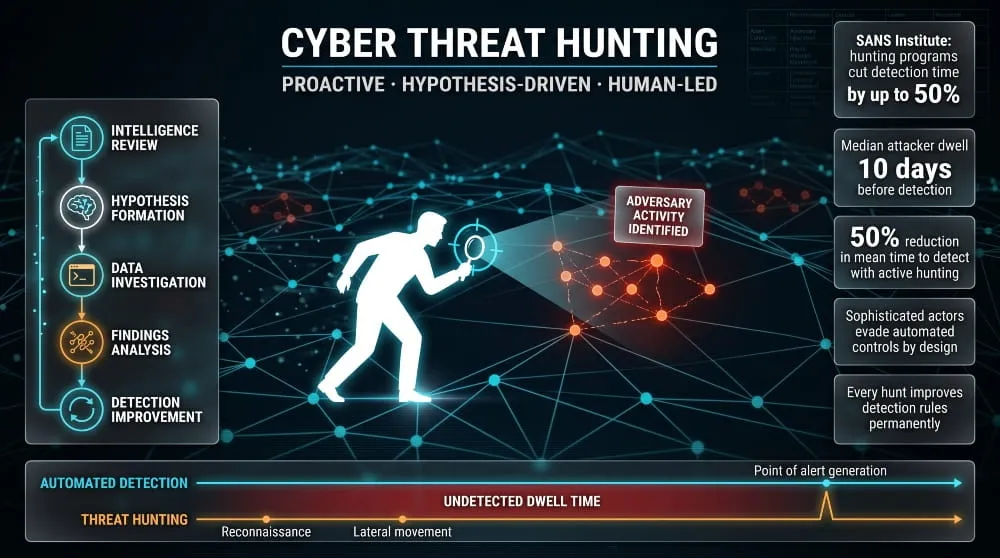
What Is Cyber Threat Hunting?
Cyber threat hunting is a proactive, human-driven security discipline in which skilled analysts actively search an organization’s environment for evidence of threat actor activity that automated detection systems have not flagged. The operative Word is proactive; threat hunting does not begin with an alert. It begins with a hypothesis.
A threat hunter does not sit and wait for the SIEM to fire. They formulate an educated assumption about how a threat actor might be operating within the environment, based on current threat intelligence, knowledge of known adversary TTPs, and understanding of the organization’s specific attack surface, and then conduct a structured investigation to either confirm or disprove that assumption. If evidence of adversary activity is found, it is escalated to the incident response team. If the hypothesis is disproven, the investigation itself produces value: improved visibility, refined detection rules, and a more accurate understanding of what normal looks like in the environment.
The discipline emerged from a recognition that sophisticated threat actors, particularly nation-state groups and advanced criminal organizations, are specifically engineered to evade automated detection. They use living-off-the-land techniques that abuse legitimate system tools, move slowly to avoid triggering anomaly-based detection thresholds, and conduct operations in a way designed to look like normal administrative activity to systems that have not been specifically tuned to recognize the difference. Automated controls catch what they are configured to catch. Threat hunting catches what they are not looking for.
Threat Hunting vs. Threat Detection, Key Differences
Threat detection and threat hunting are complementary disciplines that address fundamentally different parts of the security problem, and conflating them produces security programs with significant blind spots.
Threat detection is automated, reactive, and alert-driven. It operates by continuously monitoring the environment against predefined rules, signatures, and behavioural baselines, generating alerts when observed activity matches a known pattern of concern. Its effectiveness is bounded by the quality of its rules and signatures; it can only detect what it has been configured to look for, which means it is structurally blind to novel techniques, sophisticated evasion, and any malicious activity that falls below its detection thresholds or mimics legitimate behaviour closely enough to avoid triggering rules.
Threat hunting is manual, proactive, and hypothesis-driven. Predefined rules do not constrain it because it does not wait for rules to be triggered; it generates its own investigative questions based on threat intelligence, adversary knowledge, and analytical judgment. A threat hunter can investigate a hypothesis about a technique that has never been observed in the organization’s environment, using raw telemetry and forensic evidence rather than pre-built detections.
The relationship between the two disciplines is iterative and mutually reinforcing. Effective threat hunting continuously improves threat detection: when hunters discover a previously undetected technique or behaviour pattern, they codify that finding into new detection rules that the automated system then monitors going forward. A mature security program treats hunting as the research and development function of the detection capability, the process through which the organization’s automated defences are continuously refined to reflect the current threat landscape rather than the one understood when the rules were last updated.
The Cyber Threat Hunting Process Step by Step
The cyber threat hunting process is structured around a cycle of hypothesis generation, investigation, and improvement rather than a linear sequence with a defined endpoint. Different organizations implement the cycle with varying levels of formality, but the core phases remain consistent across mature threat-hunting programs.
The process begins with intelligence-driven hypothesis formation. The hunter reviews current threat intelligence, active campaigns targeting the organization’s industry, recently disclosed TTPs associated with relevant threat actor groups, newly published MITRE ATT&CK techniques, and formulates a specific, testable hypothesis about how an adversary might currently be operating within the environment. A well-formed hunting hypothesis is specific enough to be actionable: not “there might be malware present” but “a threat actor using living-off-the-land techniques might be abusing PowerShell for lateral movement, and I expect to find evidence of this in process execution logs on privileged workstations.”
With a hypothesis defined, the hunter moves into the data collection and investigation phase. This involves querying the organization’s available telemetry, endpoint detection and response (EDR) data, network flow logs, authentication records, DNS query logs, and process execution histories to surface evidence relevant to the hypothesis. The quality of hunting is directly constrained by the quality of logging and telemetry available: organizations that log comprehensively across their environment give hunters the raw material to investigate effectively, while organizations with visibility gaps force hunters to work around blind spots that sophisticated adversaries will already have identified and exploited.
Investigation findings are analyzed and documented regardless of outcome. If the hypothesis is confirmed and malicious activity is identified, findings are escalated to incident response with full documentation of the evidence chain. If the hypothesis is disproven, the investigation’s findings are still documented; negative results that confirm expected behaviour are as valuable as positive findings because they build the organization’s understanding of its own environment. The final phase converts hunting findings into defensive improvements: new detection rules, updated threat models, refined logging configurations, and intelligence reporting that feeds into the next hypothesis-generation cycle.
Tools and Techniques Used in Threat Hunting
Cyber threat hunting relies on a combination of data sources, analytical tools, and investigative techniques that together give hunters the visibility and analytical capabilities to find adversary activity amid the noise of a complex environment.
Endpoint Detection and Response platforms are the primary data source for most threat hunting operations, providing rich telemetry on process execution, file system activity, registry changes, network connections, and user behaviour at the individual endpoint level. EDR data allows hunters to trace the full execution chain of a suspicious process, from initial execution through all child processes, network connections, and file modifications, providing the forensic detail needed to distinguish malicious activity from legitimate administrative work.
SIEM platforms aggregate log data from across the environment and provide the query infrastructure hunters use to search for patterns across large datasets. The effectiveness of SIEM-based hunting depends heavily on the completeness of log ingestion: a SIEM that receives data from only a portion of the environment has structural blind spots that a threat actor who has mapped the organization’s monitoring coverage will actively exploit.
The MITRE ATT&CK framework serves as the primary reference library for developing threat-hunting techniques. By mapping adversary behaviour to specific techniques in the ATT&CK matrix, hunters can systematically work through the techniques most relevant to their threat model, developing and executing hunts that cover the full range of methods a relevant adversary is known to use. Organizations that track their ATT&CK coverage, the proportion of techniques in the matrix for which they have active detection or hunting capability, have a measurable, improvable metric for their detection posture.
Analytical techniques include stack counting, comparing the frequency of similar events to identify statistical outliers that may indicate malicious activity, temporal analysis to identify unusual patterns in timing or sequencing of events, clustering analysis to group related activities that may represent a coordinated campaign, and graph-based analysis to visualize relationships between entities such as accounts, processes, and network connections in ways that surface patterns invisible in tabular data.
Why Cyber Threat Hunting Is Critical for Modern Organizations
Cyber threat hunting has moved from a capability available only to the most sophisticated security organizations to a critical component of any mature security program, driven by a threat landscape in which the assumption of breach is more operationally accurate than the assumption of prevention.
The statistical case for threat hunting begins with dwell time, the period between a threat actor’s initial access to an environment and their detection. Despite significant investment in automated detection technology, the median attacker dwell time in 2024 remained approximately 10 days globally, according to Mandiant’s M-Trends report, with a meaningful proportion of intrusions going undetected for weeks or months. Every day of undetected dwell time represents additional lateral movement, additional data exfiltration, additional privilege escalation, and additional damage, all of which directly compounds the cost and complexity of recovery.
Threat hunting addresses dwell time directly by actively searching for adversary presence rather than waiting for automated systems to flag it. Organizations with mature threat hunting programs consistently detect intrusions earlier in the attack chain, before ransomware deployment, before mass data exfiltration, before the adversary has achieved the foothold and lateral movement that makes an incident catastrophically expensive. The SANS Institute found that organizations that conduct regular threat hunting reduce their mean time to detect by as much as 50% compared to those relying exclusively on automated detection.
Beyond the direct detection benefit, threat hunting produces compounding security improvements over time. Each hunting engagement improves the organization’s understanding of its own environment, identifies logging gaps and visibility blind spots, generates new detection rules that permanently improve automated coverage, and builds the institutional threat knowledge that makes subsequent hunts more effective. It is one of the few security investments that simultaneously addresses immediate threats and structurally improves the organization’s long-term defensive posture with every cycle of the process.
Cyber Threat Detection and Monitoring
Cyber threat detection and monitoring are the continuous processes through which organizations identify malicious activity in their environments, ranging from automated systems that flag known attack patterns in real time to analytical disciplines that surface adversary behaviour weeks before it becomes a visible incident. Together they form the operational core of a functioning security program, translating the theoretical understanding of threats into the practical ability to find them.
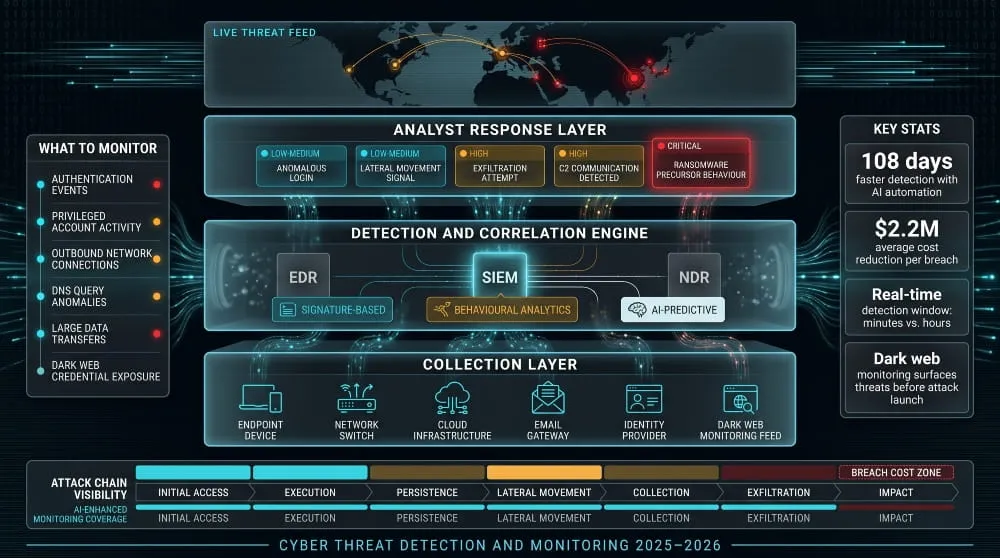
How Real-Time Cyber Threat Detection Works
Real-time cyber threat detection is the automated, continuous analysis of security telemetry to identify indicators of malicious activity as they occur, generating alerts that allow security teams to respond before an attack progresses to its most damaging stages. The emphasis on real-time is not cosmetic; in modern attack scenarios where ransomware can encrypt an entire environment in under four hours, and data exfiltration can transfer terabytes in minutes, detection latency measured in hours rather than seconds can be the difference between containment and catastrophe.
At its most fundamental level, real-time detection works by comparing observed activity against a model of what malicious activity looks like. That model takes two primary forms. Signature-based detection matches observed events, file hashes, network packet patterns, and process behaviours against a library of known malicious indicators, generating an alert when a match occurs. It is fast, precise, and produces very low false positive rates for threats it recognizes. Still, it is structurally blind to any malicious activity that does not match a known signature, making it ineffective against novel malware, zero-day exploits, and living-off-the-land techniques that use legitimate tools for malicious purposes.
Behavioural detection addresses this gap by modeling normal activity across users, systems, and network flows and flagging deviations from that baseline as potentially malicious. A user account that has never accessed the finance server suddenly querying it at 2 AM, a process that typically makes no network connections suddenly initiating outbound communication to an external IP, an endpoint downloading and executing a binary from a temporary directory- none of these activities match a specific malicious signature. Still, all represent statistically anomalous behaviour that warrants investigation. Modern detection platforms combine both approaches, using signatures for high-confidence identification of known threats and behavioural analytics to surface the unknown ones.
The infrastructure through which real-time detection operates spans the full environment: endpoint detection and response agents running on individual devices, network detection and response sensors monitoring traffic flows, cloud security posture management tools auditing cloud configurations, and email security gateways analyzing inbound communications, all feeding telemetry into centralized platforms where correlation engines identify patterns that individual data sources cannot detect in isolation.
Cyber Threat Monitoring: What to Watch and When
Cyber threat monitoring is the sustained practice of maintaining visibility across the organization’s environment and the external threat landscape simultaneously, watching what is happening inside the network while tracking what adversaries are doing outside it. Effective monitoring requires deliberate decisions about what to watch, where to focus analytical attention, and how to ensure that the most critical signals do not get buried under the volume of less significant events.
Inside the organization’s environment, the highest-priority monitoring targets are the assets and activities that represent the greatest risk if compromised or missed. Authentication events, successful and failed logins, privilege escalations, new account creations, and access to sensitive systems are among the most intelligence-rich signals available to security teams, because almost every significant attack involves credential abuse at some stage. Privileged account activity warrants particularly close monitoring: administrator accounts, service accounts, and any credentials with access to critical systems or mass data should be scrutinized for anomalies that regular user accounts would not generate.
Network traffic monitoring focuses on the communications that indicate command-and-control activity, lateral movement, and data exfiltration, the three network-visible stages of most significant intrusions. Unusual outbound connections to external infrastructure, internal east-west traffic between systems that do not typically communicate, large data transfers to cloud storage destinations outside normal business patterns, and DNS queries to newly registered or algorithmically generated domains are the categories of network event that most reliably indicate an active intrusion in progress.
External monitoring extends visibility beyond the organization’s own perimeter into environments where threats originate, and early warning signals emerge. Dark web monitoring tracks criminal forums, infostealer markets, and ransomware group communications for mentions of the organization’s name, leaked credentials, or advertised network access. Brand monitoring identifies phishing infrastructure and impersonation domains before they are used in attacks. Vulnerability intelligence monitoring tracks newly disclosed CVEs relevant to the organization’s technology stack and correlates them with active exploitation reports to drive prioritized remediation.
Timing matters as much as coverage. Monitoring that produces reports reviewed weekly cannot protect against threats that move in hours. Critical authentication and network events require near-real-time analysis. External threat intelligence requires daily review at minimum for organizations in actively targeted industries. The monitoring cadence should be calibrated to the speed at which the threats most relevant to the organization operate, not to the speed most convenient for the security team.
Predictive Threat Detection Using AI and Behavioral Analytics
Predictive threat detection uses machine learning models and behavioural analytics to identify attack activity before it generates a conventional alert, surfacing early-stage signals of an intrusion during reconnaissance, initial access, or lateral movement, before an adversary has achieved their objective and before the damage that triggers a reactive response occurs.
The foundational technology is User and Entity Behaviour Analytics (UEBA), which applies machine learning to establish dynamic baselines of normal behaviour for every user, device, and system in the environment, and then continuously scores observed activity against those baselines to identify statistically anomalous events. Unlike static rule-based detection, UEBA models adapt as behaviour evolves, accommodating the legitimate changes in user activity that accompany role changes, new projects, and organizational shifts, while remaining sensitive to the specific patterns of anomaly that characterize account compromise, lateral movement, and insider threat activity.
The predictive dimension extends beyond individual entity behaviour to the correlation of weak signals across multiple data sources that individually appear innocuous but together form a recognizable attack pattern. A user account accessing a new system for the first time is not alarming in isolation. The same account, shortly after a credential for it appeared in an infostealer log, accessing a new system outside business hours and then querying Active Directory for privileged group memberships is a high-confidence signal of compromise that a predictive model correlating those events will surface, even though no individual event would have triggered a conventional alert.
IBM’s research found that organizations using AI-driven security automation identified breaches an average of 108 days faster than those without it, a time advantage that directly translates to lower breach costs, less extensive lateral movement, and significantly reduced recovery complexity. Predictive detection does not eliminate the need for human analytical judgment. Still, it dramatically reduces the volume of data that human analysts must review by prioritizing the signals most likely to represent genuine threats and suppressing the noise that consumes analytical capacity without producing security value.
Cyber Threat Detection Tools and Platforms Overview
The cyber threat detection market encompasses a range of specialized platforms, each designed to address specific visibility requirements and threat categories. Most mature security programs combine several of them into a layered detection architecture rather than relying on a single tool to provide complete coverage.
Security Information and Event Management (SIEM) platforms sit at the center of most detection architectures, aggregating log and event data from across the environment, endpoints, network devices, cloud infrastructure, applications, and security controls, and providing the correlation engine and query infrastructure through which security teams search for threat activity across their full data estate. Modern SIEM platforms have evolved substantially beyond log aggregation to incorporate machine learning-driven analytics, threat intelligence integration, and automated response orchestration. However, their effectiveness remains directly dependent on the completeness and quality of the ingested data.
Endpoint Detection and Response (EDR) platforms provide deep visibility into activity at the individual device level, process execution, file system changes, registry modifications, memory activity, and network connections, with the capability to isolate compromised endpoints, collect forensic evidence, and execute response actions remotely. Extended Detection and Response (XDR) extends the EDR model by natively integrating telemetry from endpoints, network, email, cloud, and identity sources into a unified detection and investigation platform, addressing the visibility fragmentation that arises when organizations manage multiple point solutions that do not share context.
Network Detection and Response (NDR) platforms analyze network traffic flows to identify command-and-control communications, lateral movement, and data exfiltration- threats that endpoint agents may not capture if attackers operate exclusively at the network level or compromise systems without dropping detectable files. Cloud Security Posture Management (CSPM) tools continuously audit cloud environment configurations against security best practices, identifying misconfigurations that create exploitable exposure before threat actors discover and exploit them. Together, these platform categories address the distinct visibility layers- endpoint, network, cloud, and identity- that a comprehensive detection architecture must cover.
How Dark Web Monitoring Exposes Threats Before They Escalate
Dark web monitoring is the continuous surveillance of criminal forums, marketplaces, ransomware group leak sites, infostealer log markets, and other hidden online environments where threat actors buy, sell, and communicate about their activities, with the specific objective of identifying intelligence relevant to the monitored organization before that intelligence is used to launch an attack.
The value of dark web monitoring in threat intelligence lies in a fundamental characteristic of modern cybercrime: most significant attacks are preceded by activity on dark web infrastructure that, if detected early enough, provides actionable warnings before the attack occurs. Initial access brokers advertise compromised network access on criminal forums days or weeks before the ransomware group that purchases it deploys its payload. Infostealer malware operators sell logs containing employee credentials hours after those credentials are harvested, long before a threat actor uses them to authenticate to corporate systems. Data extortion groups frequently name victims on their leak sites before public disclosure, providing a window during which organizations can take containment and notification action before the data is published.
For organizations operating in high-risk industries, dark web monitoring regularly surfaces threats that would otherwise go entirely undetected until an attack was already underway. The detection of a compromised employee credential in an infostealer log triggers a password reset and session invalidation, preventing the account takeover that would have followed. Identifying an access broker listing for the organization’s network enables immediate investigation and remediation before a ransomware affiliate purchases and exploits that access.
The practical scope of dark web monitoring extends beyond credential and access intelligence to include brand impersonation detection, identifying phishing domains and fraudulent social media accounts being established in preparation for attacks, executive exposure monitoring that tracks when senior leaders’ personal information appears in criminal markets, and supply chain intelligence that surfaces when vendors and partners with access to the organization’s systems have been compromised. DeXpose’s dark web monitoring platform continuously covers this full intelligence surface, surfacing exposure across dark web markets, infostealer logs, ransomware leak sites, and criminal forum activity in a single operational view, giving security teams the earliest possible warning across every dimension of dark web-sourced threats.
Cyber Threat Modeling and Assessment
Cyber threat modeling and assessment are structured analytical processes through which organizations identify what they need to protect, who might attack it, how attacks are most likely to occur, and the consequences of a successful attack. Rather than responding to threats reactively as they materialize, threat modeling builds the understanding needed to make deliberate, evidence-based decisions about where to invest defensive resources before an attack occurs.
What Is Threat Modeling in Cyber Security?
Threat modeling in cyber security is a structured methodology for identifying potential threats to a system, application, or organization, analyzing the attack paths through which those threats could be realized, and prioritizing mitigations based on the probability and impact of each scenario. It is, at its core, a disciplined way of thinking like an attacker before an attacker thinks about you.
The practice originated in software security, where development teams began applying structured threat analysis to application architectures during the design phase, identifying where data flows, where trust boundaries exist, and where an adversary could manipulate the system to achieve an unintended outcome. That foundational approach has since expanded significantly beyond software development into enterprise security architecture, operational technology environments, cloud infrastructure design, and organizational risk management, reflecting the recognition that the same analytical discipline that improves application security produces equally valuable insights when applied at any level of a complex system.
What distinguishes threat modeling from less structured forms of security analysis is its systematic nature. Rather than brainstorming threats in an open-ended way that tends to surface the most obvious or most recently publicized concerns, threat modeling applies a defined methodology to ensure comprehensive coverage, working through the full attack surface, considering the full range of adversary types and motivations, and producing a documented, repeatable analysis that can be updated as the system or threat landscape evolves. The output is not a list of fears but a prioritized, evidence-based risk map that security teams can act on with confidence.
The Cyber Threat Assessment Process
A cyber threat assessment is a formal evaluation of the threats facing a specific organization or system at a given point in time, identifying which threat actors are most likely to target it, which attack vectors they are most likely to use, which assets are most at risk, and what the probable impact of successful attacks would be across operational, financial, reputational, and regulatory dimensions.
The assessment process begins with scope definition: establishing the boundaries of what is being assessed, the assets within that scope, and the security objectives those assets must satisfy. Without a clear scope definition, threat assessments become unwieldy exercises that yield broad observations rather than actionable findings. The scope may be an individual application, a specific business unit’s technology environment, a cloud deployment, an operational technology network, or the organization as a whole. Still, it must be defined explicitly before analysis begins.
Asset identification and characterization follow scope definition. The assessment maps the assets within scope, data, systems, services, processes, and the relationships between them, with particular attention to the assets whose compromise would cause the greatest harm. This mapping identifies where sensitive data resides, how it flows between systems and across trust boundaries, which systems are externally accessible, and which internal systems are most critical to operational continuity. The output is a structured understanding of what exists within the scope that an adversary might target and why.
Threat identification applies intelligence about relevant threat actors, their motivations, capabilities, and known targeting preferences, to the asset map to identify which assets are most likely to be targeted and through which attack paths. This is where current threat intelligence input is most directly valuable: a threat assessment conducted in isolation from knowledge of the current threat landscape will identify threats that exist in theory, while missing those actively exploited against the organization’s industry and technology stack.
Vulnerability analysis examines the specific weaknesses in the assessed environment that identified threats could exploit, producing a correlation between specific threat scenarios and the specific vulnerabilities that would enable them. Risk calculation then combines the probability of each threat scenario being realized with the impact of successful exploitation, producing a prioritized risk register that guides remediation prioritization and security investment decisions. The assessment concludes with a mitigation roadmap, specific, prioritized recommendations for addressing the highest-risk findings in a sequence that reflects both the severity of the risk and the feasibility of the remediation.
Common Threat Modeling Frameworks (STRIDE, MITRE ATT&CK)
Several structured frameworks have been developed to guide the threat modeling process, each with different strengths, appropriate use cases, and levels of abstraction. The two most widely adopted in commercial security practice are STRIDE and MITRE ATT&CK, which address threat modeling at different levels and are frequently used in combination.
STRIDE is a threat categorization framework developed by Microsoft that organizes threats into six categories: Spoofing, Tampering, Repudiation, Information Disclosure, Denial of Service, and Elevation of Privilege. Each category represents a class of attack objective: Spoofing involves impersonating a legitimate identity; Tampering involves unauthorized modification of data; Repudiation involves performing actions that cannot be traced back to the actor; Information Disclosure involves unauthorized access to sensitive data; Denial of Service involves disrupting availability; and Elevation of Privilege involves gaining capabilities beyond those authorized. By systematically working through the STRIDE categories for each component and data flow in a system diagram, analysts ensure comprehensive coverage of the threat space rather than focusing exclusively on the most obvious attack scenarios.
STRIDE is particularly well-suited to application- and system-level threat modeling during the design phase, where its component-by-component methodology cleanly maps to the architecture diagrams and data flow models that development and architecture teams use. Its relative simplicity makes it accessible to non-security specialists; developers and architects can apply STRIDE analysis productively without deep security expertise, which is a significant practical advantage for organizations embedding security into development processes.
MITRE ATT&CK provides a complementary but fundamentally different analytical perspective. Where STRIDE organizes threats by attacker objective, ATT&CK organizes them by adversary behaviour, the specific tactics, techniques, and procedures that real threat actors have been observed using in real attacks. The ATT&CK matrix maps the full cyber attack lifecycle across fourteen tactical phases, from initial access through execution, persistence, privilege escalation, defence evasion, credential access, discovery, lateral movement, collection, command and control, and exfiltration, with hundreds of specific techniques documented under each tactic.
For threat modeling purposes, ATT&CK enables organizations to move from abstract threat categories to concrete adversary behaviours, assessing not just that lateral movement is a threat category but specifically which lateral movement techniques are most commonly used by the threat actors most likely to target them, and then evaluating whether their current detection and prevention controls would identify and block those specific techniques. This level of specificity produces far more actionable threat models than framework-only approaches, particularly for mature security teams with the threat intelligence context needed to apply ATT&CK analysis meaningfully.
Additional frameworks including PASTA (Process for Attack Simulation and Threat Analysis), VAST (Visual, Agile, and Simple Threat modeling), and DREAD (Damage, Reproducibility, Exploitability, Affected Users, Discoverability) address specific use cases and organizational contexts. Still, STRIDE and ATT&CK together effectively cover the analytical needs of most commercial organizations.
Building a Threat Model for Your Organization
Building an effective organizational threat model is a practical exercise in applied intelligence that requires input from security, IT, business leadership, and, critically, current knowledge of the external threat landscape. The output should be a living document that reflects the organization’s current environment and the threat actors most likely to target it, not a theoretical exercise conducted once and filed away.
The starting point is a clear-eyed inventory of what the organization holds that is worth attacking. This means identifying the data assets that represent the greatest value to adversaries, customer records, employee credentials, financial data, intellectual property, operational systems whose disruption would be most damaging, and the systems through which that data flows, is stored, and is accessed. Organizations frequently discover during this exercise that their most sensitive data is not stored where they assumed it was, or that access to it is more broadly distributed across the environment than documented access controls suggest.
The second input is an honest assessment of the organization’s threat actor profile. Which adversary categories are most likely to target an organization of this type, in this industry, in this geography? A financial services firm in Western Europe faces a different primary threat actor profile than a mid-sized healthcare provider in the United States or a defence contractor anywhere. Threat intelligence, whether developed internally or sourced from a CTI provider with relevant sector expertise, should inform this assessment by providing specific knowledge of which threat groups are currently active against comparable organizations and the techniques they are using.
With assets and adversary profile established, the core modeling work maps specific attack paths: the sequences of techniques a relevant threat actor would use to move from initial access to their objective against this specific environment. Each path is assessed for feasibility within the current control environment, and the controls most effective at disrupting each path are identified. The gaps between the controls that would be needed and those currently in place constitute the prioritized remediation roadmap, specific, sequenced investments that address the highest-probability, highest-impact attack scenarios first.
Threat models require regular revisitation to remain useful. The threat landscape evolves continuously, the organization’s technology environment changes with every new system deployed or decommissioned, and threat intelligence regularly surfaces new techniques and actor targeting shifts that may significantly alter the risk profile. Organizations that treat their threat model as a living reference, updated at least quarterly and immediately following significant environmental changes or major threat intelligence disclosures, maintain the accuracy and relevance that make threat modeling genuinely protective rather than a compliance artifact.
How to Protect Against Cyber Threats
Protecting against cyber threats requires a layered defensive strategy that combines technical controls, organizational policy, human behaviour, and operational readiness, because no single tool or practice provides complete protection against the full range of threats organizations face today. The organizations that sustain the strongest cyber defences are not those with the largest security budgets but those that have built the most coherent, well-integrated approach to reducing exposure, detecting intrusions early, and recovering rapidly when prevention fails.
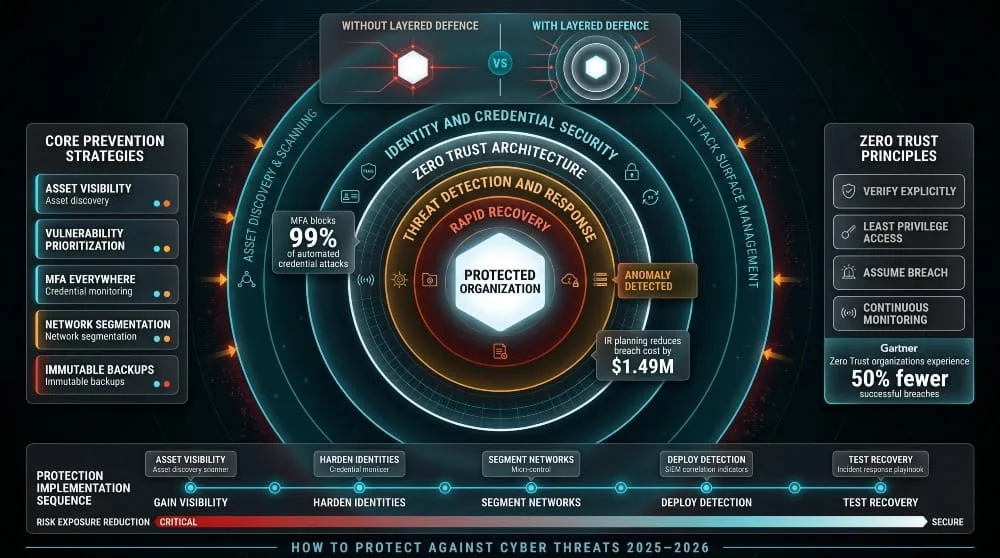
Core Cyber Threat Prevention Strategies
Cyber threat prevention operates across three fundamental dimensions: reducing the attack surface available to adversaries, hardening the systems and credentials that adversaries most commonly target, and ensuring that the people within the organization are equipped to recognize and resist the social engineering techniques that bypass technical controls entirely.
Attack surface reduction begins with visibility. Organizations cannot protect assets they do not know exist, and the chronic underestimation of attack surface size, driven by shadow IT, unmanaged cloud deployments, forgotten legacy systems, and the accumulation of third-party integrations, is one of the most consistently exploited conditions in enterprise environments. Continuous asset discovery and attack surface management, which maintains an accurate, current inventory of every internet-facing and internally networked asset, is the prerequisite on which all other prevention controls depend. You cannot patch what you cannot see, and you cannot monitor what you do not know is there.
Vulnerability management, the systematic identification, prioritization, and remediation of exploitable weaknesses, is the most operationally demanding prevention discipline because the volume of disclosed vulnerabilities vastly exceeds any organization’s capacity to remediate all of them quickly. The organizations that manage this most effectively apply threat intelligence to prioritization: addressing the vulnerabilities being actively exploited by threat actors targeting their industry and technology stack before those with high CVSS scores but no known active exploitation. The Cybersecurity and Infrastructure Security Agency’s Known Exploited Vulnerabilities catalog provides a continuously updated reference for the vulnerabilities that deserve the most urgent remediation attention.
Identity and credential security has become the prevention domain with the greatest impact on overall security posture, reflecting the reality that the majority of significant intrusions involve credential abuse at some stage. Multi-factor authentication applied to all remote access, privileged accounts, and critical applications prevents the overwhelming majority of credential-based account takeovers; Microsoft’s telemetry consistently indicates that MFA blocks more than 99 percent of automated credential stuffing attacks. Password management policies that prevent reuse and enforce minimum complexity, combined with regular credential monitoring against dark web infostealer logs, address credential exposure originating outside the organization’s environment.
Cyber Threat Mitigation Techniques for Businesses
Cyber threat mitigation differs from prevention in an important operational sense: where prevention aims to stop threats from reaching their objectives, mitigation aims to limit the damage when prevention is incomplete, which, given the sophistication and persistence of modern threat actors, it inevitably will be at some point for most organizations.
Network segmentation is one of the highest-impact mitigation controls available to organizations of any size. By dividing the network into distinct segments with controlled, monitored traffic flows between them, segmentation limits the lateral movement available to a threat actor who has achieved initial access. An adversary who compromises a workstation in a segmented network cannot automatically reach the finance server, the backup infrastructure, or the operational technology environment; they must meet additional authentication requirements and undergo monitoring at each boundary, each of which represents an opportunity for detection and containment. Many of the most damaging ransomware incidents in recent years succeeded in part because flat network architectures allowed a single compromised endpoint to reach backup systems and domain controllers within minutes.
Data classification and access control ensure that the organization’s most sensitive assets receive the strongest protections and are accessible only to those with a documented business need. The principle of least privilege, granting each user, system, and process only the access required for their specific function, directly limits the blast radius of any single compromised credential or endpoint. When a phished employee account has access only to the systems required for their role, the damage a threat actor can cause with that credential is structurally bounded.
Regular, tested backups remain one of the most reliable mitigation controls against ransomware specifically. The operative Word is tested; backups that have not been restored successfully in a test environment provide false assurance. Backups stored in network-accessible locations that ransomware can reach and encrypt provide no mitigation at all. An effective backup strategy for ransomware mitigation requires immutable backups stored in environments logically and physically isolated from the production network, with restoration procedures tested regularly enough that the security team has genuine confidence in recovery time and data completeness.
Zero Trust Security as a Defense Against Modern Threats
Zero Trust is a security architecture philosophy built on a single foundational principle: no user, device, or system should be trusted by default, regardless of whether they are inside or outside the network perimeter. Every access request must be explicitly verified, every session must be continuously authenticated, and access must be granted at the minimum privilege level required for the specific action being performed.
The traditional perimeter-based security model, in which everything inside the network boundary was implicitly trusted, and everything outside was scrutinized, has been functionally obsolete for years. Cloud computing dissolved the network perimeter by moving workloads and data outside it. Remote work extended users beyond it. Supply chain attacks and insider threats demonstrated that the most dangerous adversaries frequently operate from inside it. Zero Trust addresses these realities by eliminating the concept of implicit Trust, replacing it with continuous, context-aware verification.
In practical implementation, Zero Trust operates across several dimensions. Identity verification requires strong authentication, MFA at minimum, with risk-based adaptive authentication that applies additional verification requirements when contextual signals suggest elevated risk, such as access from an unfamiliar device, an unusual geographic location, or outside normal working hours. Device trust assessment validates that devices accessing the network meet security posture requirements before granting access, ensuring that endpoints are running current software, have active security controls enabled, and have not been flagged as compromised. Micro-segmentation of network resources limits lateral movement by ensuring that authenticated access to one resource does not implicitly grant access to adjacent ones. Continuous session monitoring evaluates the legitimacy of access throughout a session rather than only at authentication, terminating sessions that exhibit anomalous behaviour even after initial verification.
Gartner estimates that organizations that have implemented Zero Trust principles experience 50 percent fewer successful breaches than those operating on traditional perimeter-based security models, a figure that reflects not a single control’s effectiveness but the cumulative impact of eliminating the implicit trust assumptions that modern threat actors systematically exploit.
Protecting Remote Workers and Cloud Environments
Remote work and cloud adoption have fundamentally changed the attack surface organizations must protect, extending it to home networks, personal devices, and cloud infrastructure that sits entirely outside the traditional security perimeter and cannot be protected by perimeter-based controls that were never designed to reach it.
Protecting remote workers requires a security architecture that travels with the user rather than waiting at the network boundary. Endpoint security, with EDR platforms running on every device used to access corporate systems, whether corporate-owned or personal, provides the visibility and response capabilities that network-level controls cannot deliver when users operate outside the corporate network. Secure Access Service Edge (SASE) frameworks consolidate network security and access controls into a cloud-delivered architecture that applies consistent security policy to users regardless of their location, device, or the cloud services they access.
VPN infrastructure, the traditional remote access solution, has become a significant vulnerability in its own right. VPN appliances from major vendors have been among the most frequently exploited internet-facing vulnerabilities in recent years, with threat actors specifically targeting them because a successful exploitation provides immediate authenticated access to the internal network. Organizations that have not replaced or significantly hardened their VPN infrastructure, applied rigorous patch management, enabled MFA for all VPN authentication, and monitored VPN access logs for anomalous patterns are maintaining one of the most actively targeted attack surfaces in the current threat landscape.
Cloud security operates on a shared responsibility model that requires organizations to actively manage the security of their own configurations, data, and access controls within cloud environments; the provider secures the underlying infrastructure, while everything built on top is the customer’s responsibility. The most common cloud security failures are not platform vulnerabilities but customer misconfigurations: storage buckets with public read access, IAM roles with excessive permissions, databases exposed to the internet without authentication requirements, and logging configurations that provide insufficient visibility for security monitoring and incident investigation.
What Is the Primary Defense Against Cyber Threats?
The primary defense against cyber threats is not a single technology or control; it is the combination of security awareness and identity protection that addresses the two most consistently exploited entry points in modern attacks: human vulnerability and compromised credentials.
Every technical security control in the world can be bypassed if an employee is successfully manipulated into providing their credentials, approving an MFA request they did not initiate, or executing a file they believe to be legitimate. Social engineering, phishing in all its forms, succeeds not because it defeats technology but because it works around it entirely, targeting human judgment rather than system vulnerabilities. Security awareness that creates genuine behavioural change, the ability to recognize and correctly respond to social engineering in the moment, is the control that protects against the attack vector that no firewall, EDR platform, or SIEM can fully address.
Identity protection, ensuring that credentials are strong, unique, protected by MFA, monitored for compromise, and immediately revoked when no longer needed, addresses the second primary attack vector with equal directness. The credential-based intrusion that uses a legitimate username and password to authenticate as a real user bypasses perimeter controls, avoids malware detection, and operates within the trust assumptions of most monitoring systems. Eliminating the credential exposure that enables this attack type, through dark web monitoring for compromised credentials, password hygiene enforcement, and MFA universally applied, removes the most commonly used key from the most commonly picked lock in enterprise security.
These two controls do not eliminate the need for technical defences; network security, endpoint protection, vulnerability management, and detection and response capabilities are all essential components of a complete security program. But if any single answer to the question of primary defence exists, it is this: make your people harder to deceive and your identities harder to steal.
Rapid Recovery and Incident Response Planning
Rapid recovery from cyber incidents and the incident response planning that makes it possible are not concessions to failure; they are acknowledgments of a statistical reality that the most security-mature organizations accept and plan for explicitly. The question for most organizations is not whether they will experience a significant cyber incident but whether they will be prepared to contain it quickly, communicate about it clearly, and restore normal operations before the damage compounds.
Incident response planning produces its value entirely before an incident occurs. A plan created during an active ransomware attack, when systems are encrypted, communications are disrupted, and the security team is operating under acute stress, is not a plan; it is improvisation. Organizations with documented, rehearsed incident response plans consistently contain breaches faster, make better decisions under pressure, and suffer significantly lower costs than those without them. IBM’s research found that organizations with formal incident response teams and regularly tested plans reduced their average breach cost by $1.49 million compared to those without these capabilities.
The core components of an effective incident response plan address the full lifecycle of a cyber incident: detection and initial triage procedures that define how potential incidents are identified and escalated; containment procedures that specify how affected systems are isolated to prevent further spread; eradication procedures that guide the removal of threat actor access and malicious tooling from the environment; recovery procedures that define the sequence and dependencies of system restoration; and post-incident analysis procedures that extract the lessons needed to prevent recurrence.
Communication planning deserves particular attention because it is the component most frequently inadequate in organizations that have otherwise invested meaningfully in technical response capability. During a serious cyber incident, multiple audiences require accurate, timely communication simultaneously: the internal response team coordinating technical actions, senior leadership making business continuity decisions, legal and compliance teams managing regulatory notification obligations, customers and partners whose data or operations may be affected, and potentially regulators, law enforcement, and the public. Pre-approved communication templates, designated spokespersons, and clear escalation chains for communication decisions reduce the chaos that typically surrounds incident communication and prevent secondary reputational damage from inconsistent, delayed, or inaccurate public statements about an incident already being reported externally.
Frequently Asked Questions (FAQ’s)
What kind of cyber threat looks like malware?
A Trojan is the cyber threat most commonly designed to look like legitimate software; it disguises itself as a trusted application, utility, or file to trick users into executing it, after which it installs malicious payloads, opens backdoors, or begins exfiltrating data without any visible indication that something is wrong.
What kind of cyber threat exists within its own executable?
A virus is the cyber threat that exists within its own executable code, attaching itself to legitimate files and programs and activating when those files are run. Unlike worms, which spread autonomously across networks, a virus requires a host executable to propagate. It depends on user action, opening a file or running a program, to trigger its payload.
Are cyber threats increasing year over year?
Yes, by every measurable dimension. The World Economic Forum’s 2025 Global Cybersecurity Outlook found that 72 percent of organizations reported an increase in cyber risk over the prior year, with attack frequency, sophistication, and financial impact all trending upward, driven primarily by the professionalization of cybercrime and the weaponization of AI by threat actors.
What common cyber security threat involves human interaction skills?
Phishing and social engineering are cybersecurity threats built entirely on human interaction. They exploit Trust, urgency, authority, and fear to manipulate people into disclosing credentials, transferring funds, or executing malicious files, bypassing technical controls entirely by targeting human judgment rather than system vulnerabilities.
Which is the biggest cyber security threat right now?
Ransomware remains the single most operationally damaging cybersecurity threat globally in 2025, combining immediate financial harm through extortion with severe operational disruption, reputational damage, and regulatory consequences. Its continued dominance is sustained by the ransomware-as-a-service model, which makes sophisticated attacks accessible to criminal actors without advanced technical capability.
What are the five most common cyber threats?
The five most common cyber threats facing organizations today are phishing and social engineering attacks, ransomware and data extortion, credential theft and account takeover, supply chain attacks targeting trusted third-party software and vendors, and insider threats stemming from negligent or malicious insiders with legitimate system access.
Who can cyber threats be posed by?
Cyber threats can be posed by a wide range of actors, including nation-state groups conducting espionage and sabotage, organized criminal organizations pursuing financial gain, hacktivists motivated by political or ideological causes, malicious insiders exploiting legitimate access, negligent employees whose errors create exploitable vulnerabilities, and lone individuals ranging from opportunistic script kiddies to highly skilled independent researchers operating outside legal boundaries.
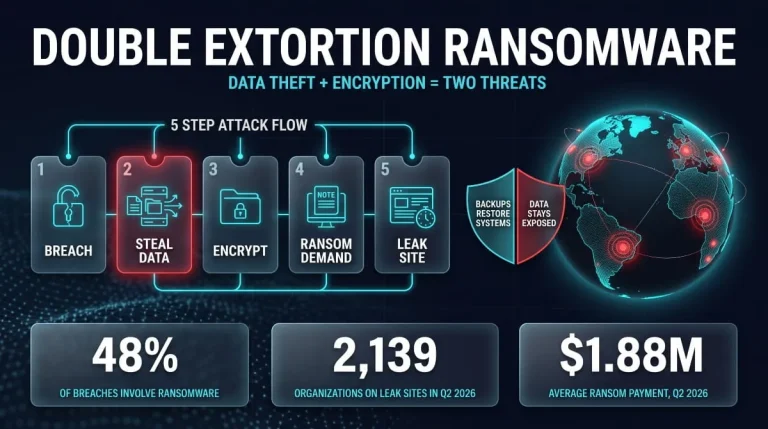
Double Extortion Ransomware | What It Is, How It Works, and How to Defend Against It (2026 Guide)
Double extortion ransomware is an attack in which criminals steal your data, encrypt your systems, and then demand payment twice: once for the decryption key and…
Read more
ShinyHunters | Who They Are, the Canvas Breach, and Every Company They’ve Hacked (Updated 2026)
ShinyHunters is a financially motivated hacking and extortion group that has spent the past several years breaching companies, universities, and cloud platforms, stealing data, and threatening…
Read more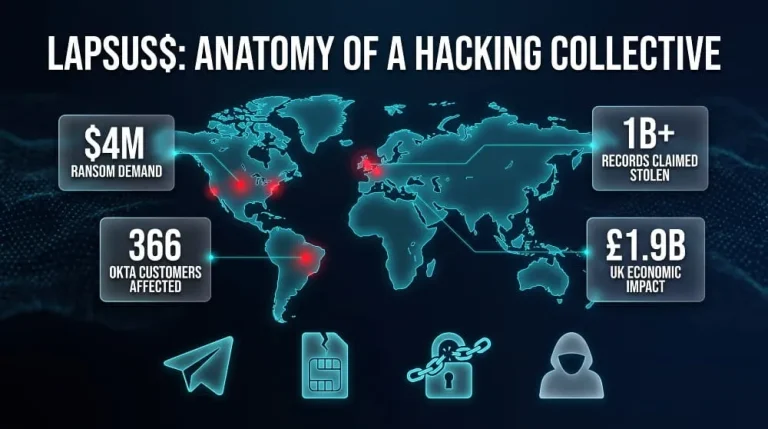
Lapsus$ Explained | The Hacking Group Behind Okta, Uber, Nvidia and Its Return
Lapsus$ is a hacking and extortion group first known for breaching Okta, Microsoft, Nvidia, Samsung, and Uber in 2021 and 2022 using social engineering rather than…
Read more