
AI Phishing Detection | The Complete Guide to How It Works & the Best Tools in 2026
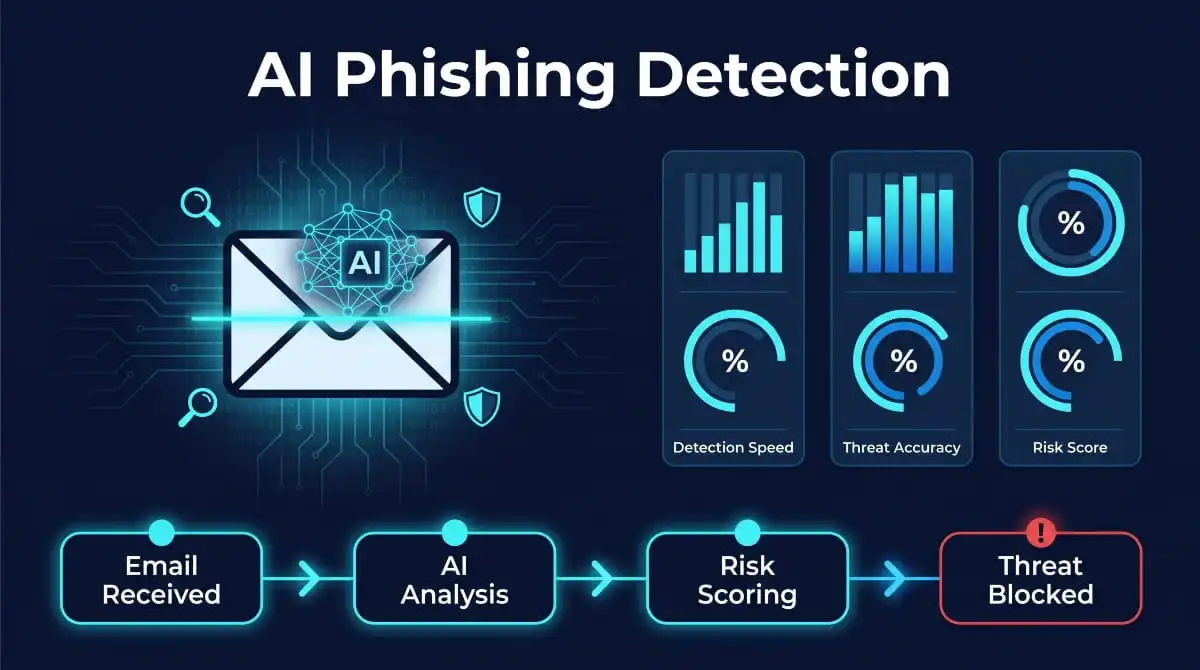
AI phishing detection is the use of machine learning and generative AI models to identify phishing emails, messages, and websites that traditional spam filters and human reviewers can no longer reliably catch. It works by analyzing writing patterns, sender behavior, and technical signals in real time, flagging attacks that look and read exactly like legitimate communication, because increasingly, they were written by AI too.
That shift is why detection has become urgent rather than optional. KnowBe4’s 2025 Phishing Threat Trends Report found that 82.6% of phishing emails now contain AI-generated content, and independent threat research shows user detection rates for AI-generated phishing have fallen to roughly 16%, down from 40–50% for legacy phishing just five years ago. In other words, the old advice- watch for typos, awkward phrasing, generic greetings- no longer works, because AI has erased the tells people were trained to spot.
That’s the gap AI phishing detection tools are built to close. Instead of relying on employees to catch what looks “off,” these platforms use behavioral analysis, threat intelligence, and, increasingly, autonomous AI agents to detect and triage attacks before a single click happens. This guide walks through how that detection actually works, what to look for in a platform, and how the leading vendors in the space compare.
What Is AI Phishing?
AI phishing is any phishing attack- email, text, voice, or video- that’s created or enhanced using generative AI, from writing the message itself to cloning a real person’s voice or face. Instead of a scammer typing out a suspicious email by hand, an AI model generates the content, mimics the target’s tone and context, and in some cases produces synthetic audio or video of a real executive, all in minutes rather than hours.
How AI-Generated Phishing Differs from Traditional Phishing
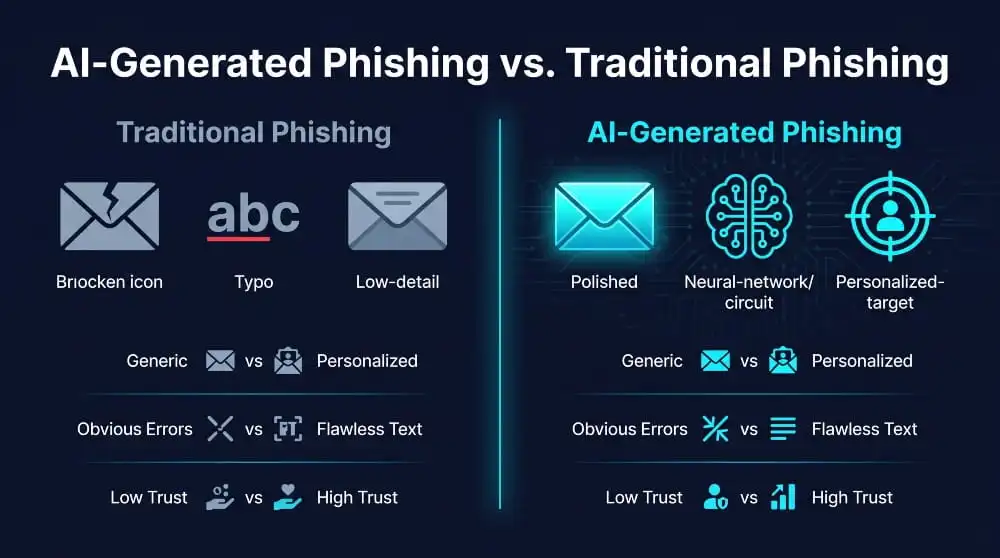
Traditional phishing relied on volume and got caught by its own sloppiness, bad grammar, generic greetings, and mismatched sender addresses. AI phishing removes those tells almost entirely. A language model can write a flawless, personalized email referencing a real project, a real colleague, and a real deadline, tailored to a specific recipient in seconds. The Verizon 2026 Data Breach Investigations Report found that 62% of breaches involve the human element, and that’s precisely the layer AI phishing is engineered to exploit: it doesn’t just avoid detection, it actively earns trust. The result is a measurable jump in effectiveness: AI-generated phishing achieves roughly a 54% click-through rate, compared to about 12% for traditional campaigns. That’s not a marginal improvement; it’s a different category of threat, which is why detection strategies built around spotting typos and broken English no longer hold up.
Real Examples of AI Phishing Attacks
The clearest illustration is the 2024 Arup case, where a finance employee in Hong Kong received a phishing email impersonating the CFO, followed by a video call in which every other participant was an AI-generated executive, leading to fraudulent transfers totaling $25.6 million in a single day. It wasn’t an isolated incident: at least five FTSE 100 companies, including WPP and Octopus Energy, reported similar CEO deepfake impersonation attempts in 2024, and WPP’s own CEO was separately targeted using a cloned voice, scraped YouTube footage, and a fake WhatsApp account to arrange a fraudulent Microsoft Teams meeting with his executive team. These attacks increasingly stack channels: a text message to create urgency, a cloned voicemail to establish authority, then an AI-written email to deliver final instructions, so each channel reinforces the others and makes the whole sequence feel legitimate. That layered, multi-channel pattern is now considered the defining shape of AI phishing heading into 2026, not the exception.
Why AI-Powered Phishing Is Harder to Detect
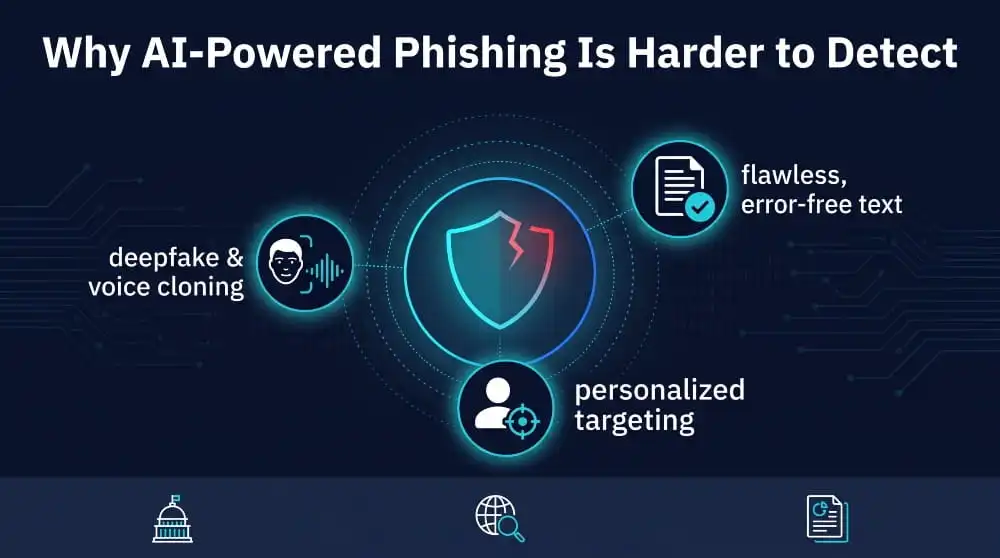
AI-powered phishing is harder to detect because it eliminates the two things detection has always relied on: obvious mistakes and repeatable patterns. Every AI-written message is unique, grammatically flawless, and contextually tailored, so signature-based filters have nothing consistent to match against, and employees have no visible “tell” left to spot.
Deepfakes, Voice Cloning & Executive Impersonation
The same generative models that write convincing emails can now also sound and look like a real person, which turns detection from a text problem into an identity problem. Voice cloning tools need as little as 20 to 30 seconds of audio, easily pulled from an earnings call, a conference talk, or a LinkedIn video, to produce a convincing replica of an executive’s voice. That capability has already produced real losses: in the 2024 Arup fraud case, a finance employee authorized 15 fraudulent transfers totaling $25.6 million after joining a video call where every other participant was an AI-generated executive. Because these attacks mimic a known, trusted voice or face rather than impersonating a stranger, standard phishing training, built around spotting suspicious senders, has little to offer against them.
FBI, CISA, ENISA & Verizon DBIR Warnings on AI Phishing Trends
Federal and international security agencies have converged on the same warning: the old detection playbook no longer applies. CISA now explicitly acknowledges that poor grammar “used to be” a reliable phishing signal, conceding that AI-generated emails arrive with perfect spelling and grammar, effectively retiring the advice it spent two decades promoting. The FBI has separately warned that criminals are using generative AI to commit fraud at greater scale and with more believability, a pattern reflected in its 2025 Internet Crime Report, which logged 191,561 phishing and spoofing complaints, the highest volume of any reported cybercrime category. In Europe, ENISA’s Threat Landscape 2025 report found that AI-assisted phishing accounted for over 80% of observed social engineering activity globally by early 2025, and the Verizon DBIR continues to identify the human element as the entry point in the majority of breaches. Together, these agencies aren’t flagging an emerging risk; they’re describing the current baseline.
2026 AI Phishing Threat Landscape
By 2026, AI involvement in phishing has shifted from common to nearly universal. KnowBe4’s 2025 Phishing Threat Trends Report found that 82.6% of phishing emails now contain AI-generated content. That content performs: AI-generated phishing converts at roughly a 54% click-through rate, compared to about 12% for traditional campaigns. The landscape has also gone multi-channel; a single attack sequence now often moves from an AI-written SMS, to a cloned voicemail, to a deepfake video call, with each channel reinforcing the credibility of the last. That combination of near-universal AI use, high conversion rates, and layered delivery is why detection strategies built for 2019-era phishing are widely considered insufficient heading into 2026, and why purpose-built AI detection, not just user training, has become the baseline expectation for security teams.
How AI Detects Phishing
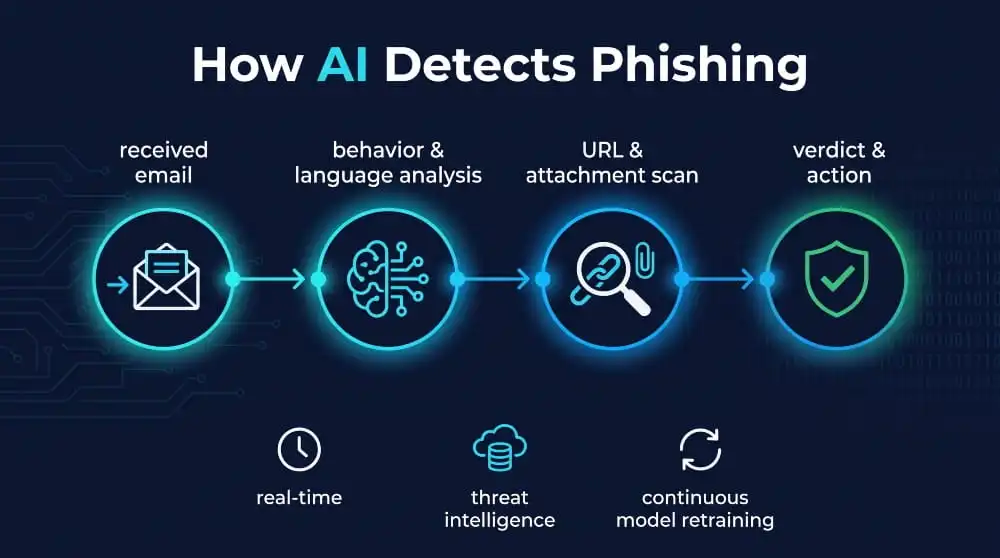
AI detects phishing by analyzing patterns a human reviewer would never catch in time, sender behavior, linguistic structure, URL characteristics, and attachment payloads, and scoring each message for risk before it reaches an inbox. Rather than matching known phishing templates, modern systems learn what legitimate communication looks like for a specific organization and flag deviations, which lets them catch attacks that have never been seen before.
Machine Learning Models for Phishing Detection
Most AI phishing detection systems run on a mix of natural language processing and behavioral models rather than a single algorithm. NLP models assess tone, urgency, and phrasing to catch AI-written content that reads correctly but behaves like a social-engineering attempt, a request bypassing normal approval steps, for instance, or unusual pressure to act quickly. Behavioral models sit alongside this, comparing a message against the sender’s historical patterns: does this person normally email at this time, from this device, requesting this kind of action? Because these models score behavior and intent rather than searching for known-bad keywords, they can flag a phishing attempt even when the wording itself is completely novel, which is the entire point, since AI-generated phishing is novel by design.
AI Analysis of Phishing Content, Attachments & URLs
Beyond the message body, AI detection tools inspect everything attached to and linked from an email. Attachment analysis uses machine learning to flag malicious documents and macros based on structural and behavioral indicators rather than a static virus signature, which matters because attackers routinely alter file structure just enough to slip past traditional antivirus tools. URL analysis works similarly: AI models assess a link’s destination, domain age, redirect chain, and page content in real time, which allows detection systems to catch freshly registered phishing pages and cloned login portals that wouldn’t yet appear on any blocklist. This content-plus-infrastructure approach is why AI detection can catch phishing pages within minutes of them going live, rather than waiting for a threat feed to catch up.
Model Drift: Why AI Detection Models Need Constant Retraining
Phishing detection models lose accuracy over time in a process known as model or concept drift, where the patterns a model learned during training no longer match the tactics attackers are actually using. This happens because phishing itself is adversarial by nature; attackers deliberately shift wording, infrastructure, and delivery methods specifically to evade whatever a detection model has learned to flag, so the “concept” of what phishing looks like keeps changing underneath the model. Research on phishing detection systems attributes this deterioration to two compounding factors: concept drift, where the underlying data distribution shifts, and feature obsolescence, as signals like domain rankings and WHOIS data become unreliable or deprecated over time. That’s why credible AI phishing detection platforms aren’t “set and forget”; they depend on continuous retraining pipelines and drift monitoring to stay effective. A vendor’s approach to retraining frequency is one of the clearest signals of how seriously they take long-term detection accuracy.
Agentic AI & Autonomous Phishing/URL Fraud Detection
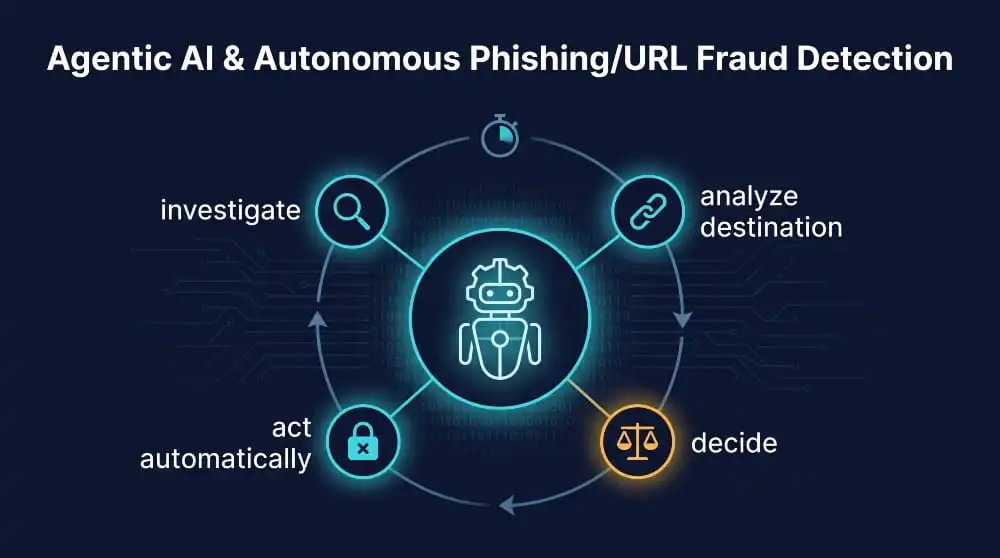
Agentic AI takes phishing detection a step further than traditional machine learning by not just flagging a suspicious email or URL, but investigating, deciding, and acting on it without waiting for a human analyst. Instead of surfacing an alert and stopping there, an AI agent pulls context, correlates it against threat intelligence, reaches a verdict, and can quarantine the message or block the link, all within seconds.
How Agentic AI Triages and Responds to Threats in Real Time
The core difference between AI-assisted and agentic phishing defense is autonomy: assisted tools recommend, agentic systems act. When a user reports a suspicious email, an agent ingests it, checks the sender’s history, scans attachments and links, cross-references threat feeds, and issues a verdict, remediating confirmed threats and escalating only the genuinely ambiguous cases to a human analyst. The time savings are substantial: Google’s agentic SOC tooling reduces a typical 30-minute manual phishing analysis down to about 60 seconds, a shift that matters because phishing remains the primary initial access vector in roughly 80% of breaches, according to Verizon’s Data Breach Investigations Report. That speed is also what makes agentic triage viable at scale; a human team simply can’t manually review the volume of AI-generated phishing hitting inboxes today, but an always-on agent can process every reported email the moment it lands.
Autonomous URL Fraud Detection Explained
Autonomous URL fraud detection applies the same agentic approach to links rather than messages: an AI agent independently investigates a URL’s destination, domain age, redirect behavior, and page content, then decides in real time whether to allow, warn, or block it, without a human needing to review the link first. This matters because phishing pages are often registered and taken down within hours, so by the time a URL appears on a static blocklist, the attack may already be over. Autonomous agents close that gap by evaluating a link’s actual behavior and infrastructure signals at the moment it’s clicked, rather than relying on a list that’s inherently always a step behind. Combined with real-time triage, this gives security teams continuous, self-directed coverage across both the message and the destination it points to, the two places phishing has to succeed for an attack to work.
Key Features to Look For in AI Phishing Detection Platforms
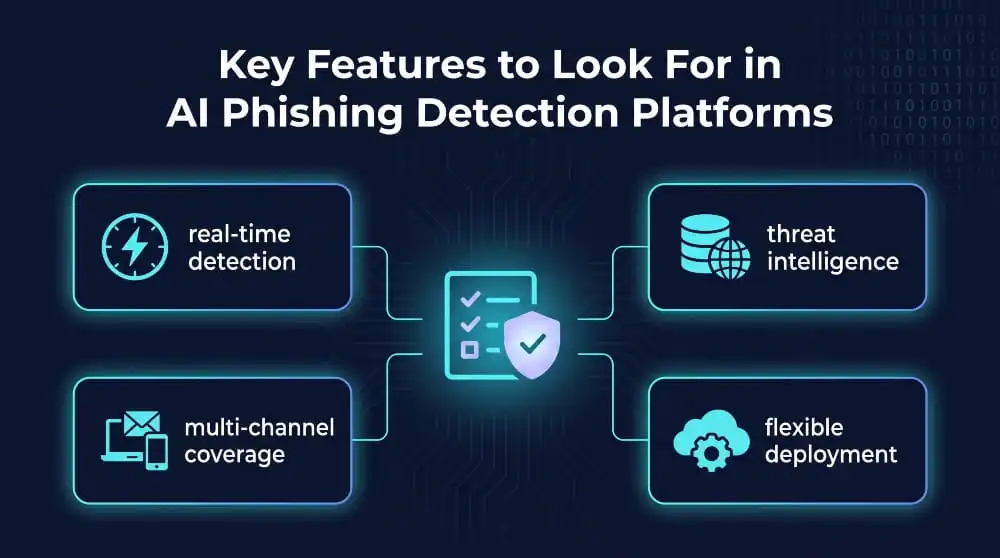
The strongest AI phishing detection platforms share four traits: real-time analysis instead of periodic scanning, integration with existing threat intelligence, coverage across every channel attackers use, and a deployment model that fits how the organization actually runs its infrastructure. Evaluating a vendor against these four areas is a faster way to separate genuine detection capability from marketing language.
Real-Time Detection & SOC Integration
A platform that only scans email in batches, or that flags threats after they’ve already reached an inbox, is working against the pace of modern phishing. Real-time detection analyzes messages, links, and attachments at the moment of delivery, and ideally at the moment of click, since attackers frequently swap a benign landing page for a credential-harvesting one after the email has already passed initial filtering. That real-time layer only creates value if it connects to where security teams actually work: platforms that integrate with the SOC via APIs or SIEM/SOAR connectors let detected threats flow directly into existing alerting and response workflows, rather than sitting in a separate dashboard analysts have to check manually. Without that integration, even accurate detection can end up too slow or too siloed to matter.
Threat Intelligence Feeds & Dashboards
Detection accuracy improves significantly when a platform doesn’t rely solely on its own model, but cross-references incoming threats against live intelligence, newly registered malicious domains, known phishing infrastructure, and attack patterns observed across other organizations. This is part of why legacy filters are struggling: independent security research has found that 91% of security managers report concern about their secure email gateway’s effectiveness against current threats, largely because static, signature-based tools have no mechanism for incorporating fresh intelligence. A clear, well-built dashboard matters just as much as the intelligence feeding it; security teams need to see what was blocked, why, and how confident the system was, not just a raw count of flagged messages.
Multi-Channel Protection (Email, SMS, Mobile, Gmail, Microsoft 365)
Phishing no longer lives in the inbox alone, so detection that only covers email leaves an organization exposed everywhere else. Attackers now routinely combine an SMS message to create urgency, a phone call or voicemail to establish authority, and an email to deliver final instructions. This pattern only works if at least one of those channels goes undefended. Platform coverage should extend across the tools employees actually use day to day: native protection for Gmail and Google Workspace, deep integration with Microsoft 365, SMS and mobile-specific detection, and ideally visibility into voice-based vishing attempts as well. A platform that protects Microsoft 365 exceptionally well but ignores SMS is only solving part of the problem attackers are actively exploiting.
Enterprise vs. Cloud-Native Deployments
How a platform deploys affects both how quickly it can be stood up and how well it scales. Cloud-native platforms typically integrate through APIs without requiring changes to mail routing, which means faster deployment and easier scaling as an organization grows, a meaningful advantage for teams that need protection live in days, not months. Traditional enterprise deployments, often involving on-premises components or gateway rerouting, can offer tighter control for organizations with strict data residency or compliance requirements, but usually take longer to implement and are slower to adapt as attack patterns shift. Neither model is universally correct; the right choice depends on whether an organization’s priority is deployment speed and scalability or maximum control over where data is processed, and vendors should be evaluated against whichever of those actually matches the buyer’s constraints.
Best AI Phishing Detection Tools & Vendors in 2026
The AI phishing detection market splits into three practical categories: email security platforms that detect and block threats in real time, simulation-and-training platforms that build human resilience, and SOC-facing triage tools that investigate and respond to reported threats. Most organizations need at least two of the three, since detection technology and human awareness address different failure points in the same attack chain.
Vendor Comparison Table
| Vendor | Primary Category | AI Phishing Focus & Platform Capabilities |
|---|---|---|
| Proofpoint | Email Security Gateway | Leverages behavioral analysis and link/attachment sandboxing detonation; secures over half of the Fortune 100 enterprise environments. |
| Mimecast | Email Security Gateway | Correlates automated phishing simulation outcomes directly with live, real-world inbound email threat telemetry. |
| Abnormal Security | Behavioral BEC Detection | API-based cloud deployment that builds behavioral baseline models for communication partners within hours of tenant connection. |
| IRONSCALES | Behavioral BEC Detection | Augments native Microsoft 365 and Google Workspace protection layers with adaptive behavioral analysis and user feedback loops. |
| KnowBe4 | Awareness Training & Threat Detection | Hosts the industry’s largest simulation content library; features KnowBe4 Defend for AI-driven Microsoft 365 threat detection. |
| Hoxhunt | Awareness Training | Uses AI to dynamically generate personalized phishing simulation content tailored to individual employee profiles within a gamified engine. |
| Ninjio | Awareness Training | Focuses on human-risk management using narrative-focused, anime-style micro-learning content based on real-world breaches. |
| Phished | Awareness Training | Employs an AI algorithm to automatically generate hyper-personalized phishing scenarios and adaptive training pathways. |
| Cofense | Simulation & SOC Triage | Focuses on user report rates; pairs continuous employee simulation with Cofense Triage to automate SOC incident response. |
| TitanHQ | Email Security Gateway | Combines SpamTitan gateway filtering with SafeTitan Security Awareness Training for end-to-end email threat management. |
| Adaptive Security | Awareness Training | Specializes in advanced threat simulation vectors, including generative deepfake audio/video and custom AI-persona phishing campaigns. |
| Ecosystem Vendors: Outthink, Defendify, Infosec, Caniphish, Traliant, PhishingBox, Guardey, Arsen, Hook Security, Dune Security, Riot Security, Cymulate, Pentera |
Mixed: Awareness Training, Simulation, & BAS Testing | Provides varied security awareness, automated breach and attack simulation (BAS), and human risk management. Specific AI capabilities should be verified directly against vendor product documentation. |
How These Vendors Handle AI-Generated Phishing
Vendors are converging on the same underlying response to AI-generated phishing: behavioral analysis over signature matching, but they apply it at different points in the attack chain. Email security gateways like Proofpoint and Mimecast inspect messages, links, and attachments before delivery, using multi-signal detection across sender reputation, language, and attachments rather than known-bad templates. Abnormal Security and IRONSCALES instead layer on top of native Microsoft 365 or Google Workspace filtering, building behavioral models of normal communication patterns so that AI-written messages get flagged for deviating from established sender behavior rather than for containing suspicious keywords. Awareness and simulation vendors take a complementary approach, training employees against realistic AI-generated pretexts rather than the outdated grammar-and-spelling red flags. Adaptive Security, for instance, differentiates itself with deepfake- and AI-persona-based phishing simulations rather than static, template-based campaigns.
AI Phishing Triage Tools by Vendor
On the response side, the platforms built specifically for handling reported and flagged phishing emphasize speed and reduced analyst workload. Cofense pairs its PhishMe simulation platform with Cofense Triage on the response side, and its threat intelligence feed informs both simulation content and live detection. KnowBe4 Defend evaluates links, language, sender reputation, attachments, and QR codes together in a single multi-signal pass, with one-click remediation to remove malicious emails across every affected mailbox at once. This triage layer matters because volume, not accuracy alone, is the real bottleneck security teams face. A platform that correctly flags a threat but still requires a human to investigate and remediate it manually doesn’t meaningfully reduce the burden AI-generated phishing has created.
Criteria for Evaluating an AI Phishing Defense Vendor
Choosing among these vendors comes down to matching platform type to the actual gap in an organization’s defenses, not picking the highest-rated tool in the category overall. Security teams should test detection quality against real, recent phishing and BEC samples pulled from their own threat landscape, rather than relying solely on vendor-provided demonstration scenarios, since detection claims vary significantly in how they’re measured. Beyond raw detection accuracy, worthwhile criteria include: deployment complexity and time-to-value (API-based tools like Abnormal deploy in hours; full gateway replacements take longer), how well the platform integrates with existing Microsoft 365, Google Workspace, or SIEM/SOAR infrastructure, whether pricing reflects a standalone detection layer or a bundled suite including archiving and training, and, critically, how frequently the vendor retrains its detection models against emerging AI phishing tactics, since a platform’s resistance to model drift is one of the clearest indicators of long-term reliability.
How to Respond to and Remediate AI Phishing Incidents
Responding to an AI phishing incident means moving through three stages fast: containing the immediate threat, assessing what the attacker actually accessed, and closing the gap that let the message through in the first place. The speed of that first stage matters more than almost anything else; the longer an AI-generated phishing email sits unaddressed, the more time an attacker has to move laterally, harvest credentials, or exfiltrate data before anyone notices.
Reducing Response Time with AI-Driven Triage
Manual incident response can’t keep pace with AI-generated phishing volume, which is exactly the gap AI-driven triage is built to close. Organizations with AI and automation fully deployed detect breaches roughly 190 days faster on average, 51 days versus 241 days for those without it, a difference that translates directly into avoided cost, since automated detection and response capabilities have been shown to reduce identification and containment time by roughly 80 days, saving close to $1.9 million per incident compared to non-automated environments. That speed comes from letting AI handle the repetitive first pass, ingesting a reported email, checking sender history, scanning links and attachments, and cross-referencing threat intelligence, so human analysts spend their time on the genuinely ambiguous cases instead of triaging every single report from scratch.
Risk Scoring & Threat Prioritization
Not every flagged message carries the same risk, and treating them as if they do wastes the exact response time an organization is trying to protect. AI-driven risk scoring solves this by weighing multiple signals together- sender reputation, the sensitivity of the systems or data referenced, the recipient’s access level, and how closely the message matches known BEC or credential-harvesting patterns- to produce a single prioritized queue rather than a flat list of alerts. This matters because the cost curve for phishing-driven breaches isn’t linear: IBM’s 2025 Cost of a Data Breach Report found phishing-caused breaches average $4.88 million per incident with a detection-and-containment timeline of 254 days, and that every additional day of undetected access adds measurable cost; breaches contained before the 200-day mark cost $3.87 million on average, rising to over $5 million past that threshold. Prioritizing by actual risk, rather than by order received, is what lets a security team catch the one high-severity executive-impersonation attempt buried among dozens of lower-risk reports before it becomes the incident that crosses that cost threshold.
Frequently Asked Questions (FAQ’s)
What is AI phishing?
AI phishing is a phishing attack- email, text, voice, or video- created or enhanced with generative AI, producing flawless, personalized messages or cloned voices that are far harder to distinguish from legitimate communication than traditional phishing.
How accurate is AI phishing detection?
Accuracy varies by platform, but modern AI detection tools that combine behavioral analysis with real-time threat intelligence consistently outperform static filters, which struggle because 82.6% of phishing emails now contain AI-generated content with no consistent pattern left to match against. No platform catches 100% of attacks, which is why layered detection plus human triage remains standard practice.
Can AI fully stop phishing attacks?
No single AI tool fully stops phishing; it significantly reduces both volume and response time, but effective defense still combines AI detection, employee awareness, and fast incident triage rather than relying on automation alone.
What’s the best AI phishing detection platform for Gmail, mobile, or enterprise?
The best fit depends on the environment: Google Workspace-native tools suit Gmail-heavy teams, mobile-specific vendors cover SMS and voice channels enterprise gateways miss, and larger organizations typically need a full gateway (Proofpoint, Mimecast) or behavioral layer (Abnormal Security, IRONSCALES) rather than a single-channel tool.
ShinyHunters | Who They Are, the Canvas Breach, and Every Company They’ve Hacked (Updated 2026)
ShinyHunters is a financially motivated hacking and extortion group that has spent the past several years breaching companies, universities, and cloud platforms, stealing data, and threatening…
Read more
Lapsus$ Explained | The Hacking Group Behind Okta, Uber, Nvidia and Its Return
Lapsus$ is a hacking and extortion group first known for breaching Okta, Microsoft, Nvidia, Samsung, and Uber in 2021 and 2022 using social engineering rather than…
Read more
Cybercrime Explained | The Complete Guide to Types, Causes, Costs & Prevention
Cybercrime is any criminal activity that targets or uses a computer, network, or internet-connected device, from stealing financial data and holding systems for ransom to impersonating…
Read more