
Cybercrime Explained | The Complete Guide to Types, Causes, Costs & Prevention
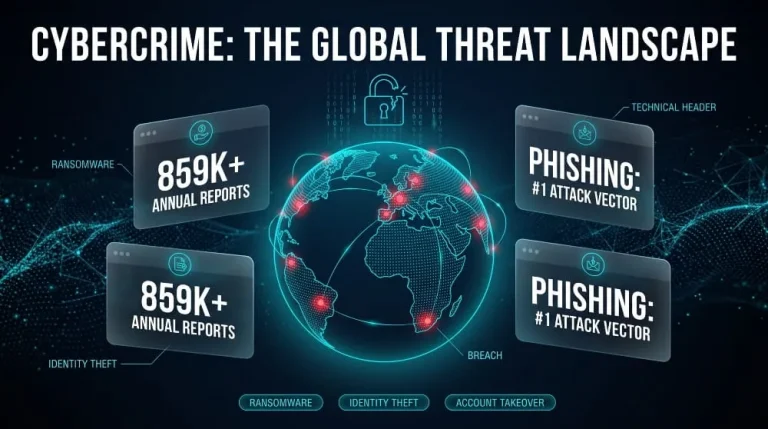
Cybercrime is any criminal activity that targets or uses a computer, network, or internet-connected device, from stealing financial data and holding systems for ransom to impersonating individuals online and disrupting critical infrastructure. Unlike traditional crime, it rarely requires physical proximity to a victim: a single attacker can compromise thousands of accounts across different countries without ever leaving their desk.
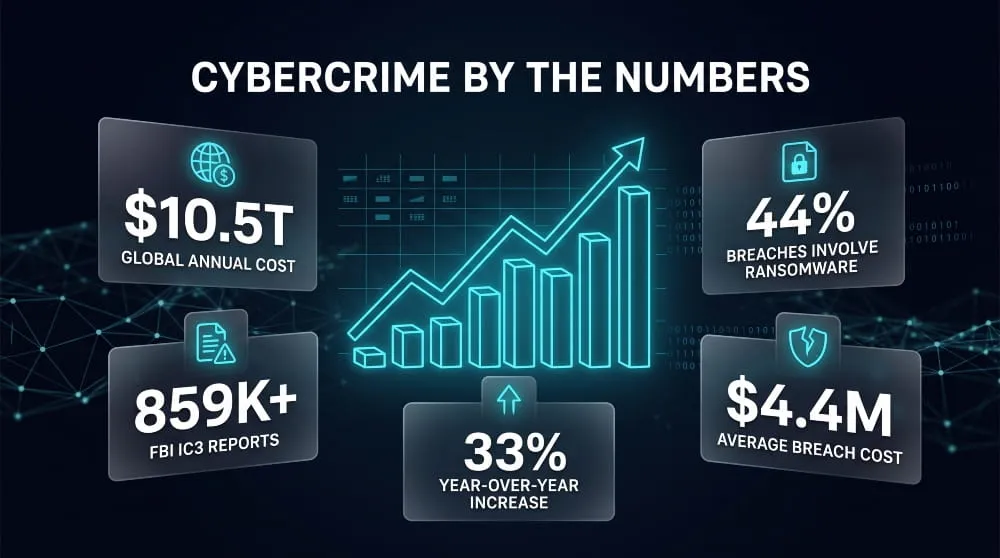
What makes cybercrime distinct isn’t just where it happens, but how fast it’s growing and how much it costs. Global losses from cybercrime are projected to reach $10.5 trillion annually by 2025, according to Cybersecurity Ventures, a figure that would make it, if measured as a national economy, larger than every country except the US and China. That scale is why understanding cybercrime is no longer a niche concern for IT departments; it’s a baseline literacy issue for individuals, business leaders, and policymakers alike.
This guide breaks down what cybercrime actually is, the main types you’re likely to encounter, why it happens, what it costs the world, and the concrete steps that reduce your risk of becoming its next data point.
What Is Cybercrime? (Definition & Meaning)
Cybercrime is any illegal act that uses a computer, network, or connected device either as the target of the crime or as the tool to commit it. That covers a wide range of conduct: breaking into a system without authorization, stealing or altering data, using malware to extort a victim, or committing fraud through digital channels. The core idea is simple: if the offense couldn’t happen, or couldn’t happen at that scale, without digital infrastructure, it falls under cybercrime.
How Cybercrime Differs from Traditional/Ordinary Crime
The defining difference is reach without physical presence. A traditional crime, burglary, assault, fraud committed in person, requires the offender to be physically near the victim or the target. Cybercrime removes that constraint: the Budapest Convention on Cybercrime, the first international treaty addressing this category of offense, was drafted specifically because computer networks made it possible to commit crimes and store or transfer the evidence of them across borders in ways ordinary criminal law hadn’t anticipated. That cross-border, one-to-many quality also makes cybercrime harder to prosecute: a single actor can victimize people in dozens of jurisdictions simultaneously, and evidence often sits on servers outside the reach of any one country’s law enforcement.
Cybercrime vs. Computer Crime vs. Cybersecurity: What’s the Difference
These three terms get used interchangeably, but they describe different things. Computer crime is often used as a narrower, older synonym for cybercrime, referring specifically to offenses where a computer system itself is the target: hacking, unauthorized access, data destruction, rather than crimes merely facilitated by one. Cybercrime is the broader, more current term, encompassing both computer-targeted offenses and internet-enabled ones like phishing, romance scams, or online harassment. Cybersecurity, by contrast, isn’t a crime category; it’s the discipline of practices, tools, and policies designed to prevent cybercrime. In short: cybercrime is the offense, and cybersecurity is the defense against it.
Types and Categories of Cybercrime
Cybercrime isn’t one uniform activity; it spans a spectrum from opportunistic scams targeting a single person to coordinated, business-like criminal enterprises targeting corporations and governments. Understanding the main categories clarifies who’s at risk, what motivates the attacker, and which defenses apply.
Financially Motivated Cybercrime (Fraud, Identity Theft, Account Takeover)
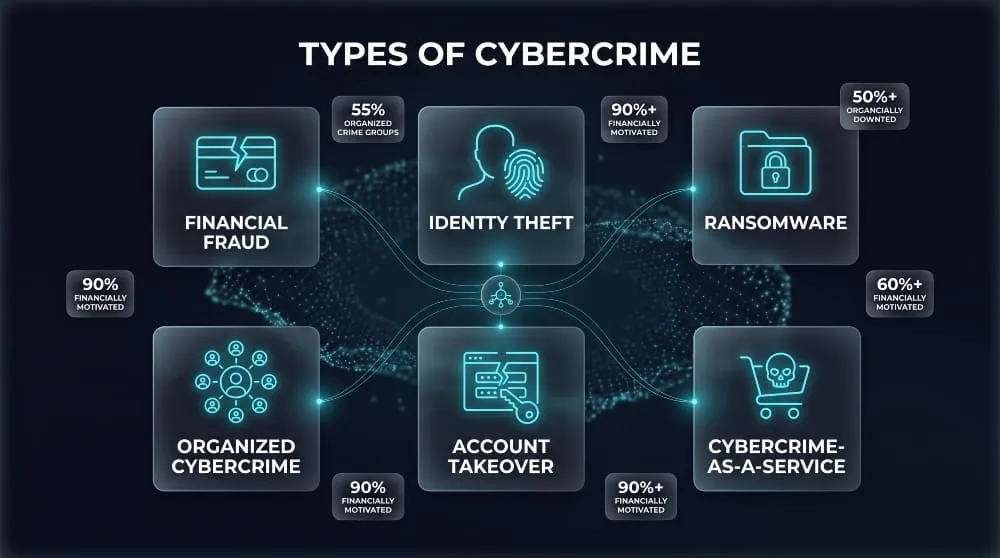
The overwhelming majority of cybercrime exists to make money, not to cause chaos or make a political statement. This category includes online fraud (fake purchases, payment scams, business email compromise), identity theft (using stolen personal data to open accounts or file fraudulent claims), and account takeover, where attackers use stolen or leaked credentials to hijack banking, email, or shopping accounts. Verizon’s long-running Data Breach Investigations Report has tracked this trend for years, and financially motivated incidents have consistently made up the large majority of confirmed breaches. This pattern holds across industries and regions rather than being concentrated in any one sector.
Organized Cybercrime and Cybercrime-as-a-Service
A significant share of today’s cybercrime is no longer the work of a lone hacker. Still, it is the work of structured criminal groups operating with the division of labor you’d expect from a legitimate business. Verizon’s research has found that organized criminal groups were behind more than half of the data breaches it analyzed in a given year, a sign that cybercrime has matured into an industry with its own supply chains. That industry now includes “cybercrime-as-a-service,” where specialists sell ready-made ransomware kits, stolen credentials, phishing infrastructure, or hacking access to other criminals, lowering the technical skill required to launch an attack and letting less sophisticated actors buy their way into serious criminal capability.
Cybercrime Against Individuals vs. Organizations
The same underlying tactics, phishing, malware, credential theft, play out differently depending on the target. Cybercrime against individuals tends to focus on personal data, financial accounts, and emotional manipulation: think romance scams, stolen banking credentials, or ransomware locking a personal device. Cybercrime against organizations is typically higher-stakes and more coordinated, targeting intellectual property, customer databases, or operational systems, and often involves a longer attack timeline; attackers may sit inside a network for weeks gathering data before striking. Organizations also face compounding damage individuals don’t: regulatory penalties, reputational harm, and the cost of restoring trust with customers and partners after a breach becomes public.
Real-World Examples and Cases of Cybercrime
Cybercrime becomes easiest to understand through the patterns it repeats across real incidents; the same handful of tactics show up again and again, just against different targets. Documented cases make the abstract categories above concrete.
Common Cybercrime Cases and Patterns
Data breaches involving stolen personal records are among the most well-documented forms of cybercrime. The 2017 Equifax breach is a widely cited example: attackers exploited an unpatched web application vulnerability to access the personal data of roughly 147.9 million people, including names, Social Security numbers, and dates of birth, a case that illustrates how a single unaddressed technical flaw can cascade into one of the largest identity-theft exposures on record. Beyond large-scale breaches, the everyday patterns are more familiar: phishing emails designed to trick someone into handing over login credentials, business email compromise scams that impersonate an executive to redirect a wire transfer, and ransomware that encrypts a company’s files until a payment is made. What connects these cases isn’t sophistication; many succeed through simple deception or an unpatched system rather than an exotic technical exploit, but rather because a single point of failure can affect thousands or millions of people at once.
Is Hacking, Phishing, Doxxing, or Cyberbullying Considered Cybercrime?
Is hacking a cybercrime? Yes, gaining unauthorized access to a computer system or network is a core cybercrime offense under laws like the Budapest Convention, whether the hacker steals data, causes damage, or simply proves they could get in.
Is phishing a cybercrime? Yes. Phishing, sending fraudulent messages designed to trick someone into revealing credentials, financial details, or installing malware, qualifies as cybercrime because it uses digital deception to commit fraud or enable further unauthorized access.
Is doxxing a cybercrime? It depends on jurisdiction and intent, but often yes. Publishing someone’s private information (home address, workplace, phone number) without consent and with intent to harass or endanger them can fall under harassment, stalking, or privacy-violation statutes, many of which now explicitly cover online conduct.
Is cyberbullying a cybercrime? Sometimes. Cyberbullying itself isn’t automatically a criminal offense everywhere. Still, it can cross into cybercrime when it involves threats, harassment, stalking, or the non-consensual sharing of images- conduct that many countries have folded into existing harassment or cybercrime statutes as online behavior has increasingly required legal definition.
The History and Evolution of Cybercrime
Cybercrime began as soon as computer networks became interconnected enough to abuse; the earliest cases predate the modern internet by decades and originated in phone systems rather than computers themselves. Tracing that history explains why today’s threats look so different from the crude experiments that started it all.
When and How Cybercrime Began
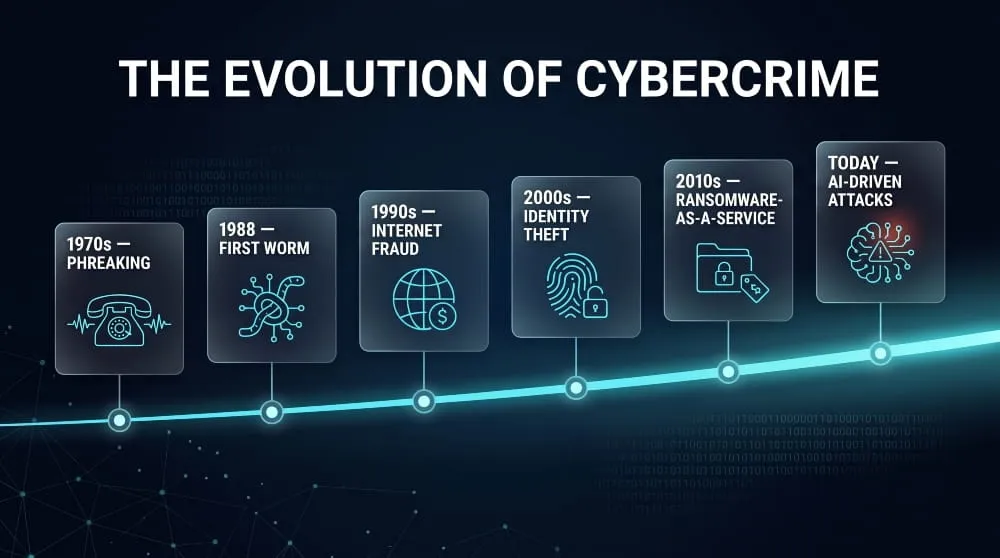
The earliest precursor to cybercrime was “phreaking” in the 1970s, where attackers reverse-engineered the tone systems telephone companies used to route long-distance calls, allowing free or manipulated calls. Most historians point to November 2, 1988, as the true beginning of cybercrime, when Cornell graduate student Robert Tappan Morris released the Morris Worm onto the early internet. Morris didn’t intend it to be malicious; he later said he built it to gauge the size of a still-young network of roughly 60,000 connected machines, but a flaw in its code caused it to replicate uncontrollably, crashing an estimated 6,000 systems and causing damage the US government estimated at up to $10 million. The following year, in 1989, the first known ransomware attack emerged: 20,000 infected floppy disks were mailed to attendees of a World Health Organization AIDS conference, locking victims’ files until they mailed $189 to a P.O. box in Panama. Morris himself became the first person convicted under the US Computer Fraud and Abuse Act in 1989; cybercrime and cybercrime law essentially came into existence together.
How Cybercrime Has Evolved with Technology
Every major shift in computing has produced a corresponding shift in cybercrime. The rise of the commercial internet in the 1990s turned isolated worms into global outbreaks and gave rise to organized hacking groups exploiting the growing number of connected businesses. The 2000s brought the explosion of e-commerce and online banking, which shifted cybercrime’s center of gravity toward financial fraud and identity theft rather than the more experimental, reputation-driven hacking of earlier decades. The 2010s saw ransomware evolve from a novelty into a full criminal business model, complete with “ransomware-as-a-service” kits sold to less technical criminals. At the same time, smartphones and social media opened entirely new surfaces for phishing, scams, and account takeover. Today, artificial intelligence is the newest inflection point, making phishing messages more convincing and lowering the skill barrier for launching attacks, the same pattern seen at every prior stage: as legitimate technology becomes more powerful and accessible, cybercrime adapts to exploit it just as quickly.
Cybercrime Statistics and the Cost to the Global Economy
Cybercrime statistics tell a consistent story: attacks are growing faster than defenses, and the financial toll now rivals the GDP of major economies. Looking at the current numbers puts the scale of the problem, and the case for taking prevention seriously, into concrete terms.
Latest Cybercrime Statistics
Cybersecurity Ventures projects that global cybercrime cost the world $10.5 trillion in 2025, up from just $3 trillion in 2015, more than tripling in a decade at a compounding growth rate of roughly 15% per year. In the United States alone, the FBI’s Internet Crime Complaint Center (IC3) received over 859,000 complaints in 2024, with reported losses exceeding $16 billion, a 33% jump from the year before. Phishing and spoofing remain the most frequently reported attack type, while ransomware continues to feature heavily in confirmed data breaches, according to Verizon’s annual Data Breach Investigations Report. Business email compromise scams alone accounted for more than $55 billion in losses reported to the FBI over a recent ten-year period, a reminder that even low-tech social engineering remains one of cybercrime’s most lucrative tactics.
The Economic and Financial Impact of Cybercrime
Beyond headline totals, cybercrime’s financial impact shows up in specific, measurable costs that compound across an organization. IBM’s Cost of a Data Breach Report has tracked the average global breach cost at over $4 million in recent years, factoring in detection, containment, lost business, and regulatory response. If measured as a national economy, cybercrime’s projected annual damage would rank as the third-largest in the world, trailing only the United States and China, a comparison researchers use precisely because dollar figures in the trillions are otherwise hard to contextualize. That cost isn’t confined to large enterprises, either: smaller businesses often face disproportionate damage relative to their size, since a six-figure breach response can be far more disruptive to a company with limited cash reserves than to a multinational absorbing the same loss. The upward trend across nearly every metric- complaint volume, average loss, breach cost- is precisely what has pushed cybercrime prevention from an IT line item to a board-level financial risk.
Causes and Effects of Cybercrime
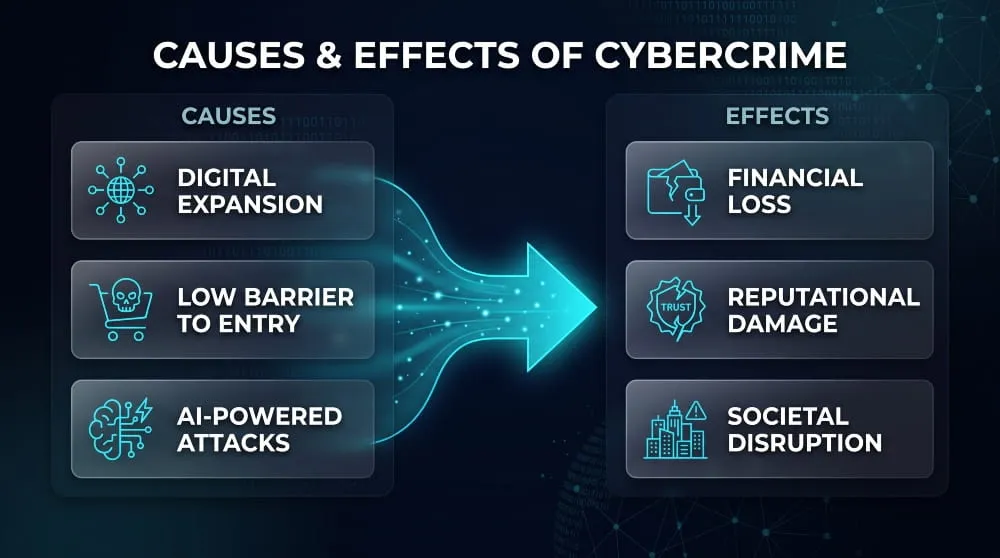
Cybercrime rises for a straightforward reason: as more of daily life and business moves online, the attack surface and the potential payoff both grow. At the same time, the risk of getting caught stays comparatively low. Understanding what fuels that growth, and what it actually costs once an attack succeeds, explains why cybercrime has become a permanent fixture of the modern economy rather than a passing threat.
What Drives the Rise in Cybercrime
Several forces compound to push cybercrime higher year over year. The most fundamental is sheer digital expansion: more devices, more cloud services, more remote work, and more of people’s financial and personal lives conducted online all mean more entry points for an attacker to exploit. Low barriers to entry make it worse: cybercrime-as-a-service means someone with minimal technical skill can rent ransomware kits, buy stolen credentials, or hire a hacking service outright, turning what once required real expertise into a commodity purchase. Anonymity and jurisdiction gaps add further cover, since an attacker operating from one country against a victim in another often falls into legal gray zones that are slow and expensive to prosecute. Artificial intelligence has recently accelerated all of this at once; phishing emails are harder to distinguish from legitimate messages, and automated tools let attackers scale operations that once required manual effort. Underlying it all is simple economics: financially motivated cybercrime persists because it works, and the return on a successful attack routinely outweighs the cost and risk of attempting it.
How Cybercrime Impacts Businesses and Society
The effects of cybercrime extend well past the initial financial loss. For businesses, a single incident typically triggers a chain of costs- incident response, regulatory fines, customer notification, credit monitoring, and legal exposure- that often dwarf the value of whatever was initially stolen; IBM’s data breach research has consistently shown that the average breach costs organizations several million dollars once every downstream expense is counted. Reputational damage compounds the financial hit, since customers and partners often lose trust in a company after a public breach, and that erosion can outlast technical remediation by years. At a societal level, cybercrime undermines confidence in digital infrastructure that governments, healthcare systems, and financial institutions depend on, and successful attacks on critical services, utilities, hospitals, and transportation carry consequences that go beyond dollars to public safety. Individuals absorb their own share of the damage too: identity theft victims often spend significant time and money over months or years resolving fraudulent accounts and restoring their credit, a burden that falls disproportionately on people with fewer resources to fight it. Taken together, these ripple effects are why cybercrime is treated less as an isolated IT problem and more as a systemic economic and social risk.
Cybercrime Laws and International Conventions
Because cybercrime routinely crosses national borders, no single country’s laws can fully address it, so two major international treaties now anchor the global legal response. Together, they define the baseline for how governments criminalize, investigate, and cooperate on cybercrime cases.
The Budapest Convention on Cybercrime Explained
The Budapest Convention on Cybercrime, adopted by the Council of Europe in 2001, was the first international treaty specifically focused on cybercrime and remains the most widely adopted framework today. Its core purpose is harmonization: it requires signing countries to establish common criminal offenses, illegal access to computer systems, data interference, computer-related fraud, and forgery among them, so that conduct treated as a crime in one country doesn’t fall into a legal gap when it crosses into another. Beyond defining offenses, the Convention also sets procedural standards for how member states collect electronic evidence and cooperate with each other’s investigations, which is often the harder practical problem, since evidence in a cybercrime case frequently sits on servers outside the investigating country’s jurisdiction. Notably, several major states, including Russia and China, never joined the Budapest Convention, leaving a gap in truly global coverage and setting the stage for a newer UN-led effort.
The UN Convention Against Cybercrime
The United Nations Convention against Cybercrime, adopted by the UN General Assembly on December 24, 2024, is the first comprehensive global treaty on the subject and the first international criminal justice treaty negotiated in over two decades. It opened for signature at a ceremony in Hanoi, Vietnam, on October 25, 2025, where 72 UN member states signed on, and it will remain open for further signatures at UN Headquarters until December 31, 2026. The Convention will formally enter into force 90 days after the 40th country ratifies it, and its provisions go further than the Budapest Convention in some respects, establishing a universal framework for collecting and sharing electronic evidence, criminalizing cyber-enabled offenses like online exploitation, and creating a 24/7 cross-border cooperation network for urgent cases. Its broader membership base, expected to include countries that eventually stayed outside the Budapest Convention, makes it the closest thing to a single global standard for prosecuting cybercrime across borders.
How to Prevent Cybercrime
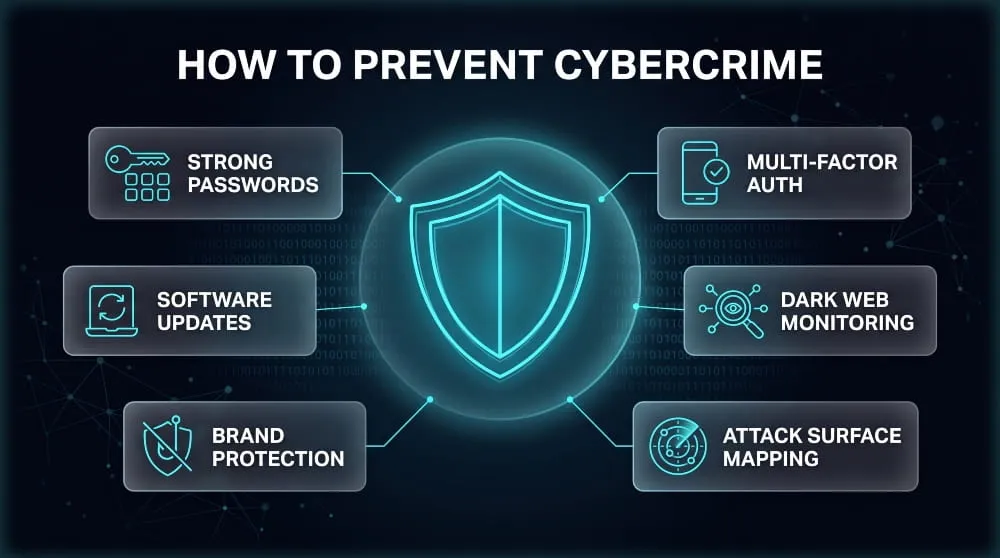
Cybercrime prevention comes down to closing the gaps attackers rely on- weak credentials, unpatched systems, and blind spots in what’s already been exposed- before those gaps get exploited. Tactics differ for individuals and organizations, but the principle is the same: visibility into risk makes prevention possible.
Practical Cybercrime Prevention Tips for Individuals
Most cybercrime against individuals succeeds through a handful of predictable weaknesses, which means a few consistent habits close most of the risk. Using unique, strong passwords for every account, ideally through a password manager, prevents a single leaked credential from unlocking multiple accounts, since credential reuse is one of the most common ways attackers gain access after a breach. Enabling multi-factor authentication adds a second barrier that stops most account takeover attempts even when a password is compromised. Treating unexpected emails, texts, or calls asking for personal information or urgent payment with skepticism blocks most phishing attempts, which remain the most reported cybercrime tactic year after year. Keeping software and devices updated closes known vulnerabilities before attackers exploit them, and periodically checking whether your email or personal data has appeared in a known breach through a free breach-lookup tool gives you the chance to change exposed passwords before they’re used against you.
How Organizations Can Combat and Reduce Cybercrime Risk
Organizations face a fundamentally different scale of risk, since a single compromised employee credential or unpatched vendor system can expose an entire customer base. Effective prevention starts with knowing what’s exposed: attack surface mapping identifies which assets, domains, servers, and cloud accounts are visible and vulnerable to an outside attacker before that attacker finds them first. Because a large share of cybercrime against businesses involves stolen credentials and leaked data circulating in criminal marketplaces well before an attack is even attempted, continuous dark web monitoring has become a standard layer of defense, giving security teams early warning when company credentials, customer records, or internal data surface for sale rather than finding out only after a breach becomes public. Brand protection extends that visibility outward, catching phishing domains and impersonation attempts designed to defraud customers using a company’s name before those campaigns can scale. Given how often breaches originate through a third party rather than a direct attack, supply chain monitoring, tracking vendors’ own exposure, closes a gap that internal security measures alone can’t cover. None of these measures make an organization immune. Still, together they shift cybercrime defense from reactive cleanup to early detection, which is consistently the difference between a contained incident and a headline-making breach.
How to Report Cybercrime
Reporting cybercrime promptly matters for both your recovery and law enforcement’s ability to track and prosecute the people behind it; most countries now have a dedicated channel for this, separate from general police reports. In the United States, that’s the FBI’s Internet Crime Complaint Center (IC3), which received over 859,000 reports in 2024 alone; the UK routes reports through Action Fraud, and most other countries maintain an equivalent national cybercrime unit or portal. Reporting to the right agency also feeds the aggregated statistics used to track cybercrime trends, which is why underreporting remains a persistent problem; many victims, especially in cases involving smaller financial losses or embarrassment, never file a report at all, leaving the true scale of cybercrime larger than official figures suggest.
Steps to Take After You’ve Been a Victim
After discovering you’ve been targeted, prioritize containment: change passwords on any account you believe was compromised, starting with email and financial accounts, and enable multi-factor authentication if it isn’t already active. Next, contact your bank or credit card provider directly if financial information was involved, since most institutions can freeze transactions or reverse fraudulent charges faster when notified immediately rather than after a delay. From there, file a report with your country’s dedicated cybercrime reporting agency, providing dates, screenshots, transaction details, and any communication from the attacker gives investigators the specifics they need to act. If personal identification data such as a Social Security number or government ID was exposed, placing a fraud alert or credit freeze with major credit bureaus adds a layer of protection against identity theft that can otherwise surface months later. Finally, document everything you’ve done and keep records of the incident; beyond helping your case, that documentation is often required if you later need to dispute fraudulent accounts or charges stemming from the same breach.
Frequently Asked Questions (FAQ)
What is the most common type of cybercrime?
Phishing is the most frequently reported cybercrime worldwide, according to both the FBI’s IC3 and Verizon’s Data Breach Investigations Report. It succeeds by tricking people into handing over credentials or payment details rather than exploiting a technical flaw.
What’s the difference between cybercrime and a cyber attack?
A cyberattack is a specific technical action: a hack, a malware infection, or a denial-of-service strike. Cybercrime is the broader legal category; every cyber attack committed with criminal intent counts as cybercrime, but cybercrime also includes non-technical acts like online fraud or harassment.
Is cybercrime increasing?
Yes. FBI IC3 complaints rose 33% between 2023 and 2024, and Cybersecurity Ventures projects global cybercrime costs will keep climbing well past $10 trillion annually.
Which industries are most vulnerable to cybercrime?
Finance, healthcare, and retail consistently rank among the most targeted sectors, largely because they hold high volumes of financial and personal data that’s easy to monetize once stolen.
Can cybercrime be fully prevented?
No single measure eliminates the risk, but layered defenses, strong authentication, monitoring, and employee awareness dramatically reduce both the likelihood of a successful attack and the damage if one does.
Cybercrime Laws Around the World | A Complete Investigator’s Reference Guide
Cybercrime laws are the country-specific and international legal frameworks that define which online acts- unauthorized access, data theft, fraud, harassment- count as crimes and what penalties…
Read more
Lesser-Known Ransomware Groups Still Targeting Businesses in 2026
Groups like Monti, Vice Society, Royal (now rebranded as BlackSuit), Cuba, Nokoyawa, Yanluowang, and Lorenz rarely make national headlines like LockBit or Qilin, but they’re still…
Read more
New & Emerging Ransomware Groups 2025-2026 | How to Respond
Newer/emerging ransomware groups are ransomware-as-a-service operations that surfaced in 2025 and 2026; among them are Interlock, BlackSuit, SafePay, Fog, Cactus, Lynx, 8Base, El Dorado, and Cicada3301,…
Read more