
Cybersecurity Breaches | Statistics, Major Incidents & Response Guide (2025–2026)
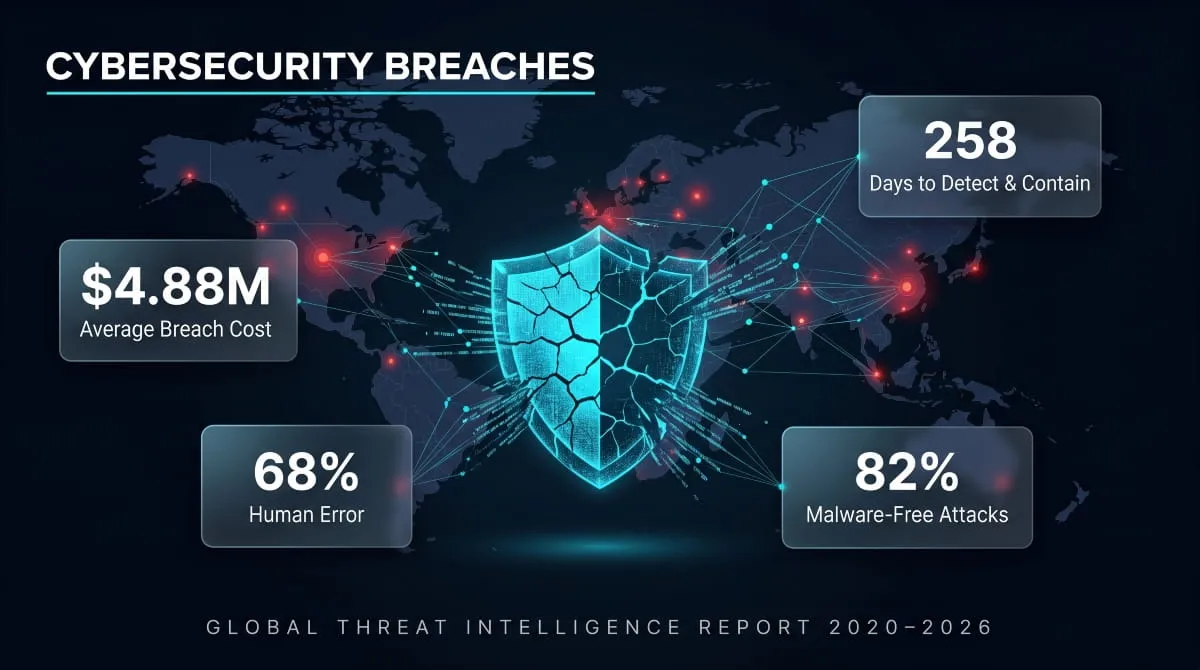
A cybersecurity breach occurs when an unauthorized party gains access to a system, network, or dataset and exposes, steals, or manipulates sensitive information that was never meant to be seen. These incidents range from a single compromised employee credential to coordinated nation-state attacks that take down critical infrastructure, and they are now so common that IBM’s 2024 Cost of a Data Breach Report put the global average cost of a single breach at $4.88 million, the highest figure ever recorded.
What makes cybersecurity breaches particularly dangerous is not just the immediate damage, but also the consequences that follow: regulatory penalties, litigation, reputational collapse, and, in some cases, permanent operational disruption. Organizations across every sector- healthcare, finance, retail, government, education- have learned this the hard way, and the incidents that define each year have become case studies that reshape how security teams think, build, and respond.
This guide covers everything: what a cybersecurity breach actually is, the biggest incidents in recent history, statistics broken down by year and industry, the root causes that consistently appear across thousands of cases, and the prevention and response steps that set prepared organizations apart from those who learn too late.
What Is a Cybersecurity Breach?
A cybersecurity breach is any unauthorized event in which an individual, group, or automated system successfully bypasses an organization’s security controls to access, steal, alter, or destroy protected resources. The “breach” is the moment of successful intrusion; everything that follows is a consequence.
Cybersecurity Breach Definition
A cybersecurity breach is the unauthorized access to or acquisition of data, systems, or networks that compromises their confidentiality, integrity, or availability. It is not merely an attempted attack; it is a successful one. The attacker has crossed the perimeter, whether that perimeter is a firewall, an authentication system, an employee’s inbox, or a misconfigured cloud bucket.
The term is used interchangeably across legal, regulatory, and technical contexts. Still, the core meaning holds: something that was protected is no longer protected, and someone who should not have access now has it. Under frameworks like GDPR and the SEC’s cybersecurity disclosure rules, even a brief, contained breach can trigger mandatory reporting obligations, which is why precise definition matters beyond semantics.
Security Breach vs. Data Breach, What’s the Difference?
A security breach and a data breach are related but not identical, and conflating them leads to imprecise incident response. A security breach refers to any unauthorized access to a system or network; it describes the intrusion itself. A data breach is a specific outcome of that intrusion: it occurs when the accessed system contains sensitive, protected, or confidential data that is exposed or exfiltrated.
Every data breach involves a security breach. But not every security breach produces a data breach. An attacker who gains access to a network and is caught before reaching any sensitive files has triggered a security breach, not a data breach. The distinction matters enormously for legal reporting thresholds, insurance claims, and incident classification. Most state breach notification laws and federal frameworks like HIPAA are triggered specifically by data exposure, not mere unauthorized access.
Types of Cybersecurity Breaches
Cybersecurity breaches are not monolithic; they differ in method, target, scope, and intent, and understanding the main categories is the foundation of any competent defense posture.
Credential-based breaches are the most common. An attacker obtains valid login credentials through phishing, credential stuffing, brute-force attacks, or purchasing them from a dark web market, and then simply logs in. Because they appear to be legitimate users, these breaches are among the hardest to detect quickly. Verizon’s 2024 Data Breach Investigations Report found that stolen credentials were involved in over 77% of web application breaches.
Malware-driven breaches involve malicious software deployed inside a network to exfiltrate data, encrypt files for ransom, or maintain persistent access. This category includes ransomware, infostealers, spyware, and remote access trojans (RATs). The deployment method varies: phishing attachments, drive-by downloads, compromised software updates, but the outcome is an attacker with deep, durable access.
Physical breaches occur when an unauthorized individual gains physical access to hardware, servers, or devices. Stolen laptops, unattended terminals, and compromised USB drives fall into this category. Physical breaches are underreported and disproportionately damaging in regulated sectors like healthcare and finance.
Insider breaches involve current or former employees, contractors, or partners who abuse their legitimate access, whether for financial gain, sabotage, or negligence. Insider threats are particularly dangerous because traditional perimeter defenses offer no protection against someone already inside.
Third-party and supply chain breaches occur when an attacker compromises a trusted vendor or software provider to reach the ultimate target. The SolarWinds breach is the defining case: attackers compromised a software update mechanism used by thousands of organizations, including U.S. federal agencies, turning a trusted tool into a delivery vehicle for espionage.
How a Cybersecurity Breach Happens: Attack Vectors Explained
A cybersecurity breach rarely happens in a single moment. It follows a chain: reconnaissance, access, persistence, exfiltration, and understanding where that chain is most vulnerable is what modern security strategy is built around.
Phishing remains the dominant initial access vector. An employee receives a convincing email, clicks a link, enters credentials on a spoofed login page, and hands an attacker the keys to the environment. Spear-phishing, targeted, personalized campaigns, significantly raises the success rate against high-value individuals. Business email compromise (BEC) is a direct evolution of this vector and accounted for over $2.9 billion in losses in 2023, according to the FBI IC3 report.
Unpatched vulnerabilities give attackers a direct path into systems without requiring any human cooperation. When a critical CVE is disclosed and organizations fail to patch promptly, threat actors, including automated scanning bots, exploit the window of opportunity. The MOVEit breach of 2023, which affected over 2,700 organizations and exposed data belonging to more than 93 million individuals, began with a single SQL injection vulnerability that went unpatched for days after public disclosure.
Misconfigured cloud infrastructure has become one of the fastest-growing access vectors as organizations move workloads to AWS, Azure, and GCP. Publicly exposed storage buckets, overly permissive identity and access management (IAM) policies, and unprotected API endpoints hand attackers sensitive data without requiring any exploitation at all; the door is simply left open.
Compromised third-party access exploits the trust relationships organizations extend to vendors, managed service providers, and software suppliers. Attackers target the weakest link in a supply chain to reach better-defended targets further up it. As organizations have hardened their perimeters, supply chain compromise has grown in proportion as a preferred entry method.
Credential stuffing and brute force automate the abuse of stolen credentials, either trying known username/password combinations from previous breaches against new services, or systematically guessing weak passwords at scale. Without multi-factor authentication, these attacks succeed at alarming rates simply because users reuse passwords across services.
The common thread across nearly all of these vectors is that the technical vulnerability is rarely the whole story. IBM’s research consistently shows that breaches with a human error component, a clicked link, a misconfiguration, or a weak password take significantly longer to detect and cost more to contain than purely technical intrusions. The attack vector explains how the door opened. The organizational context explains why it was never properly locked.
Cybersecurity Breach Statistics (2020–2026)
The numbers behind cybersecurity breaches tell a story that no single incident can: this is a problem getting measurably worse, faster, and more expensive with each passing year. Across every metric- frequency, cost, recovery time, and scope- the trajectory since 2020 has moved in one direction.
Global Cost of Cybersecurity Breaches
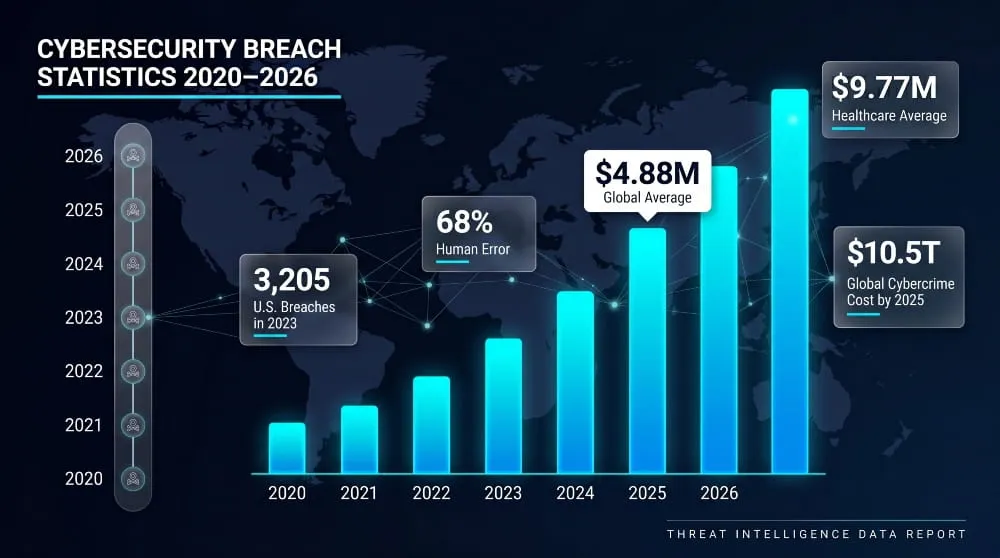
The global cost of cybersecurity breaches has reached a scale that now registers as a macroeconomic concern, not just a technology problem. IBM’s 2024 Cost of a Data Breach Report placed the global average cost of a single breach at $4.88 million, a 10% increase over 2023 and the largest single-year jump since the pandemic. That figure aggregates direct costs including detection, containment, notification, and regulatory response, alongside longer-tail losses from customer churn, litigation, and reputational damage.
When scaled across the total volume of incidents, the picture becomes starker. Cybersecurity Ventures estimated global cybercrime costs, of which data breaches represent the largest single category, at $9.5 trillion in 2024, with projections reaching $10.5 trillion annually by 2025. To put that in perspective, if cybercrime were a national economy, it would rank third in the world, behind the United States and China.
The cost is not evenly distributed. Organizations that detect and contain a breach within 200 days spend, on average, $1.1 million less than those that take longer, a gap that invests in detection capability one of the most financially defensible decisions a security team can make.
Average Cost of a Cybersecurity Breach by Industry
Industry context reshapes everything about breach cost. A breach that costs one sector $3 million may cost another $10 million for an incident of identical technical scope, because the downstream consequences, regulatory penalties, liability exposure, and operational disruption vary dramatically by vertical.
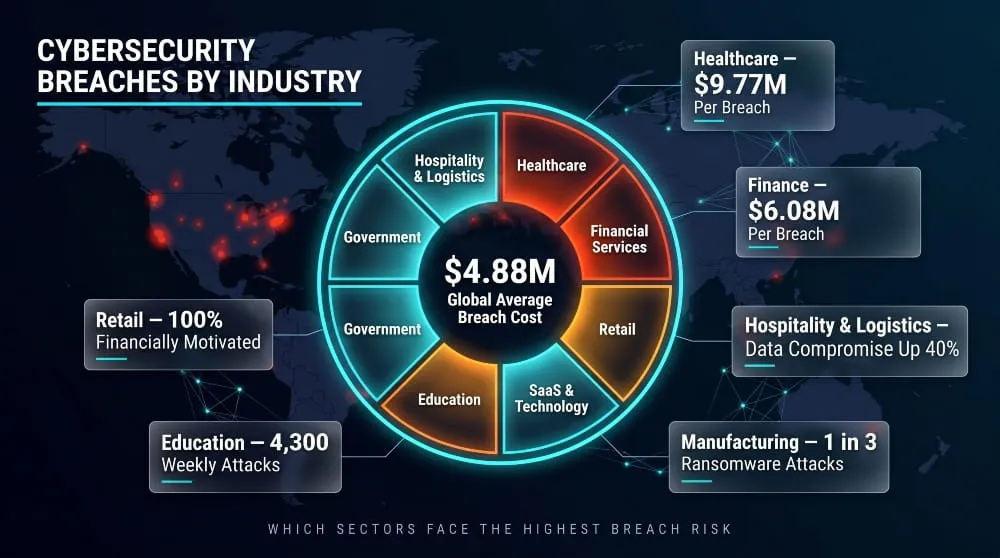
Healthcare has held the title of the most expensive breached industry for 14 consecutive years, according to IBM’s 2024 report, with an average breach cost of $9.77 million per incident. The reasons are structural: patient data is among the most valuable on dark web markets, HIPAA penalties stack on top of civil liability, and clinical operations cannot simply pause during recovery. A breached hospital doesn’t get to go offline.
Financial services sits in second place at approximately $6.08 million per breach, driven by regulatory scrutiny from bodies like the OCC, SEC, and state financial regulators, as well as the direct fraud losses that follow credential and account data exposure. The industrial sector, manufacturing, energy, and utilities have seen their average breach cost climb sharply since 2022 as ransomware groups increasingly target operational technology (OT) environments where downtime translates directly into production loss and, in some cases, physical safety risk.
At the lower end of the cost spectrum, retail and hospitality breaches average closer to $2–3 million, still significant, but cushioned somewhat by lower regulatory penalty exposure compared to healthcare or finance. The caveat is volume: retail and hospitality are breached far more frequently, making aggregate sector losses substantial even when per-incident costs appear modest.
How Many Cybersecurity Breaches Happen Each Year?
Precise global breach counts are difficult to establish because disclosure laws vary, underreporting is endemic, and many breaches go undetected for months or years. What the available data does confirm is sustained, significant growth in incident frequency across the period from 2020 to 2026.
The Identity Theft Resource Center (ITRC) tracked 3,205 publicly disclosed data compromises in the United States alone in 2023, a 78% increase over 2022 and a new record. That figure covers only reported U.S. incidents; global volume, including unreported events and incidents in jurisdictions with weaker disclosure requirements, is estimated to be orders of magnitude higher.
The COVID-19 period accelerated the trend meaningfully. The rapid shift to remote work in 2020 expanded attack surfaces overnight; home networks, personal devices, and hastily deployed collaboration tools became entry points that enterprise security teams had never had to defend at scale. Breach volumes rose approximately 68% between 2020 and 2021 according to ITRC data, and despite incremental declines in some categories in subsequent years, total compromises have continued to set records.
By 2025 and into 2026, AI-assisted attack tooling has further compressed the time between vulnerability disclosure and exploitation, meaning that even well-resourced organizations face breach attempts at a pace that did not exist five years ago. The volume problem is not stabilizing; it is structurally worsening.
Percentage of Cybersecurity Breaches Caused by Human Error
Human error is the single most consistent factor across cybersecurity breach data, appearing in study after study as either the primary cause or a critical contributing condition. Verizon’s 2024 Data Breach Investigations Report attributed 68% of breaches to a non-malicious human element, meaning an employee made a mistake, fell for social engineering, or misconfigured a system, without any malicious intent.
That 68% figure encompasses phishing clicks, use of weak or reused passwords, accidental data exposure, misconfigured cloud storage, and misdirected emails containing sensitive information. It does not include deliberate insider actions, which are tracked separately and add further to the human-factor total.
The implication that gets consistently underweighted in security investment decisions is this: the majority of breaches are not won by technically sophisticated adversaries defeating hardened defenses. They are won because a person clicked something they shouldn’t have, left a door open, or chose convenience over security hygiene. This is not an argument against technical controls; it is an argument for treating security awareness, identity management, and configuration governance with the same rigor as endpoint detection or network monitoring. The human layer is the attack surface that most organizations defend least effectively, given its actual exposure.
Expected Cost Trends for Cybersecurity Breaches Worldwide
Every credible projection points in the same direction: breach costs will continue to rise through 2026 and beyond, driven by a convergence of structural rather than cyclical factors.
The regulatory environment is tightening in ways that directly increase per-incident cost. The SEC’s cybersecurity disclosure rules, which took effect in late 2023, require publicly traded companies to report material breaches within four business days, compressing the window for quiet remediation and introducing legal and reputational consequences that did not previously exist on this timeline. GDPR enforcement in Europe has matured, with fines scaling to 4% of global annual revenue for serious violations. State-level breach notification laws in the U.S. now cover all fifty states, each with their own timelines and requirements.
AI is operating as a cost multiplier on both sides of the equation. On the attacker side, AI-generated phishing, automated vulnerability scanning, and deepfake-enabled social engineering are lowering the cost and skill threshold for launching sophisticated attacks. On the defender side, IBM’s 2024 data found that organizations with extensive AI and automation deployed in their security operations identified and contained breaches an average of 98 days faster than those without, translating to an average savings of $2.2 million per incident. The gap between organizations that have adopted AI-assisted defense and those that have not is widening, and it shows up directly in breach costs.
Cybersecurity Ventures projects that by 2025, global cybercrime costs will grow at roughly 15% year-over-year, a rate that outpaces most industries and most defensive investment cycles. For organizations using historical breach cost figures to size their security budgets, the baseline is already outdated. The cost of the next breach will almost certainly exceed that of the last one.
Biggest Cybersecurity Breaches in History
The history of cybersecurity breaches is not a list of isolated incidents; it is a progression, each major event reshaping how attackers operate and how defenders respond. The breaches that define each era reveal the vulnerabilities underestimated, the trust misplaced, and the assumptions that failed under pressure.
Most Significant Cybersecurity Breaches of All Time
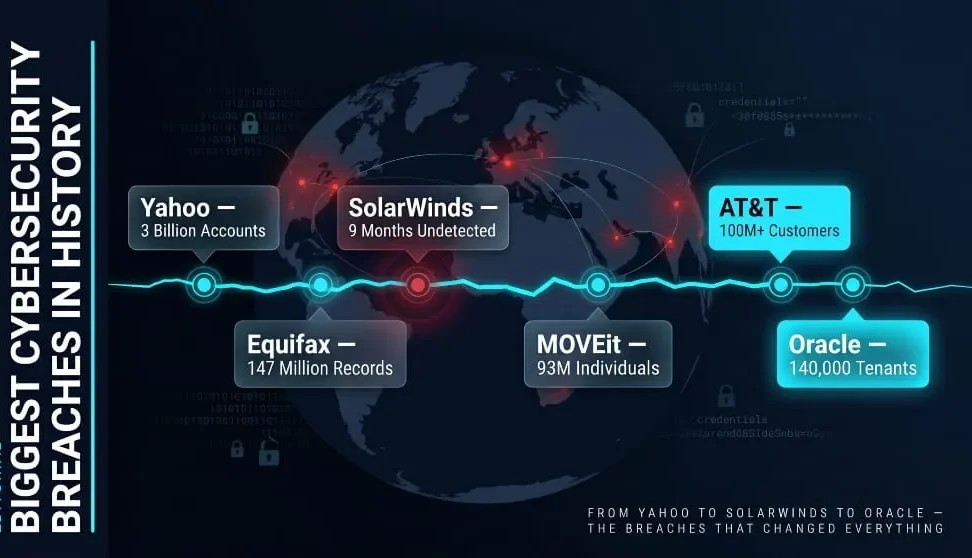
Certain cybersecurity breaches stand apart not just for their scale, but for the permanent changes they forced across the industry. The Yahoo breach of 2013–2014, disclosed years after the fact, remains one of the largest in terms of the raw number of records compromised, with 3 billion accounts compromised in a single incident. The 2017 Equifax breach exposed the Social Security numbers, birth dates, and addresses of 147 million Americans. It became the defining argument for why credit bureaus and data brokers required far more rigorous security mandates than they had voluntarily adopted.
The Office of Personnel Management (OPM) breach, attributed to Chinese state-sponsored actors and discovered in 2014–2015, exposed security clearance files and background investigation records for over 21 million U.S. government employees and contractors, including fingerprint data on 5.6 million individuals. It remains one of the most strategically damaging intelligence operations ever conducted against the United States, and its effects on national security cannot be fully quantified.
What these incidents share is not just scope. They each demonstrated that the institutions trusted to protect sensitive data- a major internet platform, the largest consumer credit bureau, and the U.S. federal government- were operating on security architectures that had not kept pace with the threat environment. The lesson repeated across all of them: the assumption that nothing would go wrong is not a security posture.
Major Cybersecurity Breaches: 2020–2022
The 2020–2022 period was defined by two converging forces: the rapid, unplanned expansion of remote work infrastructure during the pandemic, and the professionalization of ransomware as a full-scale criminal industry. Both created conditions that attackers immediately and relentlessly exploited.
SolarWinds, discovered in December 2020, was the event that set the tone for the entire era. The Kaseya VSA ransomware attack in July 2021 affected over 1,500 businesses through a single managed service provider, demonstrating that ransomware groups had fully internalized the supply-chain attack model. The Colonial Pipeline attack in May 2021 forced the shutdown of a fuel pipeline supplying 45% of the East Coast’s fuel, resulting in a $4.4 million ransom payment and a brief but serious fuel supply disruption across multiple states, the first time ransomware had produced visible, physical consequences felt by ordinary consumers.
Log4Shell, the critical Apache Log4j vulnerability disclosed in December 2021, became one of the most aggressively exploited vulnerabilities in the history of enterprise software, affecting hundreds of millions of devices across virtually every sector. The Uber breach of 2022, in which an 18-year-old attacker used social engineering to compromise a contractor’s credentials and then escalated privileges across Uber’s internal systems, was a stark demonstration that multi-million-dollar security teams could be undone by a single convincing text message.
Major Cybersecurity Breaches: 2023–2024
The 2023–2024 period elevated two vectors to defining status: the mass exploitation of file transfer software and the abuse of cloud-hosted storage. MOVEit in mid-2023 and the Snowflake-linked campaigns of 2024 together affected hundreds of major organizations and exposed data belonging to hundreds of millions of individuals, demonstrating that a single vulnerable platform used across many enterprises becomes an extraordinary force multiplier for threat actors.
The MGM Resorts breach in September 2023 showed that no amount of technical infrastructure can protect against an attacker willing to pick up the phone. The Caesars Entertainment breach, which occurred in the same period and resulted in a reported $15 million ransom payment, confirmed that the hospitality sector had become a high-priority target for groups specializing in social engineering.
AT&T disclosed two breaches in 2024 that collectively affected more than 100 million customers. The first involved personal information tied to approximately 73 million current and former customers, including names, contact details, dates of birth, Social Security numbers, account numbers, and passcodes. The second involved call and text records tied to nearly all AT&T wireless customers, unlawfully downloaded from AT&T’s workspace on a third-party cloud platform. The records in the second breach did not include names or financial information, but did capture metadata, which numbers were called or texted, how long calls lasted, and for some customers, cell tower identifiers that could be used to approximate location. The Department of Justice determined that delaying public disclosure was warranted due to national security concerns, which is why the breach was not announced until July 12, 2024.
Microsoft disclosed in January 2024 that the Russian state-sponsored group Midnight Blizzard, also tracked as Nobelium, had used a password spray attack beginning in late November 2023 to compromise a legacy non-production test tenant account and gain access to a small percentage of Microsoft corporate email accounts, including members of the senior leadership team and employees in cybersecurity and legal functions. In a follow-up update, Microsoft confirmed that the attackers used information obtained from those emails to gain, or attempt to gain, unauthorized access to company source code repositories and internal systems, with password-spray volumes increasing as much as tenfold in February compared to January.
Major Cybersecurity Breaches: 2025–2026
The 2025–2026 period has been marked by the continued weaponization of third-party and supply chain access, AI-assisted social engineering, and the targeting of critical infrastructure at a scale and frequency that has prompted direct regulatory and government responses.
One of the most widely covered incidents of 2025 was the coordinated ransomware campaign against major UK retailers, including Marks & Spencer, the Co-op, and Harrods. The attackers, linked to the Scattered Spider group, used sophisticated social engineering to compromise a third-party service provider and from there infiltrated multiple retail networks, deployed tailored ransomware payloads, exfiltrated customer data, and issued extortion demands.
In February 2026, Singapore’s Cyber Security Agency revealed that a China-linked group designated UNC3886 had breached all four of the country’s major telecommunications providers in a months-long espionage campaign, using zero-day exploits and rootkits to gain persistent network access. Singapore launched an eleven-month counteroperation, its largest ever, to remove the attackers and harden defenses.
In early 2026, NYC Health + Hospitals, the largest public health system in the United States, confirmed a months-long intrusion originating at an unnamed third-party vendor, in which an unauthorized actor had access to parts of its network from late November 2025 through February 2026, copying files during that window. Alongside medical and financial records, attackers exfiltrated biometric fingerprint and palm print data, affecting at least 1.8 million people.
SolarWinds, The Breach That Rewrote Supply Chain Security
The SolarWinds breach, discovered in December 2020 and attributed to the Russian SVR intelligence service, represents a categorical shift in how sophisticated threat actors approach high-value targets. Rather than attacking the targets directly, the attackers, tracked as Cozy Bear, APT29, and Nobelium, inserted malicious code into a routine software update for SolarWinds’ Orion network monitoring platform, which was deployed across approximately 18,000 organizations worldwide, including the U.S. Departments of Treasury, Commerce, Homeland Security, and State.
The malware, named SUNBURST, lay dormant for up to two weeks after installation before activating, a deliberate design choice to evade behavioral detection systems that flag activity immediately following a new deployment. Once active, it established a covert communication channel with attacker-controlled infrastructure. It provided persistent, deep access to the target’s internal network while mimicking legitimate Orion traffic patterns to avoid detection.
The breach went undetected for approximately nine months. It was discovered not by any government agency or SolarWinds’ own monitoring, but by FireEye, which noticed the attackers using tools stolen from its own red team. The scale of the intelligence collection during that nine-month window has never been fully disclosed, and the long-term strategic damage to U.S. government operations remains classified in significant part.
SolarWinds permanently elevated supply chain security as a board-level and regulatory priority. It was the primary driver of the Biden administration’s May 2021 Executive Order on Improving the Nation’s Cybersecurity. It accelerated federal adoption of zero-trust architecture requirements, with consequences still being implemented years later.
MOVEit, Mass Exploitation and Its Aftermath
The MOVEit breach of May–June 2023 demonstrated what a single exploited vulnerability in widely deployed enterprise software can produce at scale. The Cl0p ransomware group exploited a previously unknown SQL injection vulnerability in Progress Software’s MOVEit Transfer file-sharing application, a tool used by government agencies, financial institutions, healthcare systems, and large enterprises worldwide to securely transfer sensitive files.
In 2023, the MOVEit breach ultimately affected over 2,700 organizations and exposed data belonging to more than 93 million individuals, one of the largest mass-exploitation events in the history of enterprise software. Victims included the U.S. Department of Energy, Shell, British Airways, the BBC, Aon, PricewaterhouseCoopers, Ernst & Young, and numerous state and local government agencies. The breach required no phishing campaign, no social engineering, no insider assistance. Cl0p had a working zero-day exploit against software that organizations trusted implicitly, and they used it to extract data from hundreds of victims before a patch was even available.
The MOVEit campaign also marked an evolution in Cl0p’s operational approach. Rather than encrypting victim systems and demanding ransom for decryption keys, the traditional ransomware model, Cl0p focused on data theft and extortion, threatening to publish exfiltrated data on its dark web leak site if demands were not met. This shift toward pure extortion, without the disruptive encryption component, has since become a widespread tactic among ransomware groups because it imposes costs on victims without the operational complexity of a full network encryption deployment.
MGM Resorts, Social Engineering at Scale
The MGM Resorts breach of September 2023 is the incident most frequently cited by security professionals when discussing the limits of purely technical defenses. The Scattered Spider group, a loosely affiliated network of primarily English-speaking young adults, did not breach MGM’s network through a software vulnerability. They called MGM’s IT help desk.
Using information gathered from LinkedIn about an MGM employee, they impersonated that employee during a 10-minute phone call and convinced the help desk to reset the employee’s account credentials. From that single point of entry, the attackers deployed ransomware across MGM’s infrastructure, causing the shutdown of casino floor systems, hotel check-in platforms, digital room keys, slot machines, and ATMs across multiple MGM properties in Las Vegas and beyond. The operational disruption lasted approximately ten days, and MGM estimated the total impact at $100 million in that quarter alone.
The MGM breach occurred in the same month as the Caesars Entertainment compromise, also attributed to Scattered Spider, which reportedly resulted in Caesars paying approximately $15 million to prevent the public release of its stolen loyalty program database. That two major casino and hospitality conglomerates with extensive security operations were both compromised through variations of the same social engineering playbook within weeks of each other illustrates a consistent and under-addressed gap: organizations invest heavily in technical controls, but a convincing phone call or text message can circumvent them all in minutes.
AT&T, Oracle, Microsoft, and Other Recent Major Incidents
The period from 2024 into 2026 has been characterized by breaches at some of the most recognizable names in global technology and telecommunications, each exposing a different dimension of systemic vulnerability.
AT&T’s dual 2024 disclosures were covered in detail above. Still, their combined scope, more than 100 million customers affected across two separate incidents with different root causes, makes them collectively among the most significant consumer data events in U.S. telecom history. The second breach’s connection to the broader Snowflake customer exploitation campaign illustrated how a single misconfigured cloud workspace, without multi-factor authentication enforced, becomes a direct line into an enterprise’s most sensitive datasets.
Oracle’s 2025 security incidents spanned three separate events across Oracle Cloud’s authentication infrastructure, legacy Cerner healthcare servers, and the Oracle E-Business Suite, collectively exposing millions of records and compromising patient health data across dozens of hospitals. The Oracle Cloud breach potentially exposed authentication data for over 140,000 tenants, including Java KeyStore files, encrypted SSO and LDAP passwords, and Enterprise Manager keys, giving attackers a path to lateral movement across interconnected systems. Oracle initially stated publicly that there had been no breach of Oracle Cloud, while separately notifying healthcare customers that an unauthorized actor had accessed Cerner data on a legacy server that had not yet been migrated to Oracle Cloud, using compromised customer credentials. The gap between Oracle’s public statements and its private customer notifications drew significant regulatory and media scrutiny.
Microsoft’s Midnight Blizzard incident demonstrated that even the world’s largest software company is not immune to the most fundamental credential-based attack vectors. The attackers exploited a legacy test tenant account that lacked multi-factor authentication, used password spraying to gain access, then escalated privileges via compromised OAuth applications to access the mailboxes of senior executives and critical teams, exfiltrating emails, attachments, certificates, cryptographic keys, and credentials. The incident prompted Microsoft to launch its Secure Future Initiative and publicly acknowledge that its own legacy infrastructure had created the opening the attackers exploited, a level of organizational transparency that set a precedent for how major vendors communicate breach accountability.
Cybersecurity Breaches by Industry
No sector is immune to cybersecurity breaches, but the threat landscape varies substantially by industry, including attack frequency, preferred methods, per-incident cost, and the specific data or infrastructure attackers target. Understanding these distinctions matters because a one-size-fits-all security posture rarely maps to the actual risk profile of any given sector.
Financial Services, Banks, Payment Networks, and Insurers
Financial services organizations operate at the intersection of the highest attacker motivation and the most stringent regulatory scrutiny, making them simultaneously among the most targeted and the most security-aware of any industry. The average financial services firm pays approximately $5.9 to $6.08 million per data breach, the second highest average of any sector, behind healthcare, and API and web application attacks on financial services companies increased 65% in a single year.
The primary attack vector in financial services is credential theft. The FBI reports that over 80% of banking fraud results from identity theft or credential-based attacks, and financial services report five times as many phishing attacks as any other industry, with 57% of financial institutions experiencing phishing attempts on a daily or weekly basis. Payment networks, insurers, and mortgage lenders are increasingly targeted alongside traditional banks; in early 2024, mortgage lender loanDepot suffered a breach that exposed the personal and financial records of nearly 17 million customers.
The regulatory environment compounds financial impact. A breach that might cost a retail company $3 million in remediation can cost a bank multiple times that figure when OCC enforcement actions, SEC disclosure obligations, and civil litigation are included. In 2023, the number of data compromises in the financial services industry in the United States alone reached 744, up from just 138 in 2020, representing a more than five-fold increase in three years.
Retail and E-Commerce Cybersecurity Breaches
Retail and e-commerce present a paradox in cybersecurity breach data: they are among the lower-cost industries per incident, but among the highest in volume and frequency, and the cost trajectory is moving in the wrong direction. The global average cost of a cybersecurity breach against retail businesses reached $3.54 million in 2025, up from $3.48 million in 2024, according to IBM. This is lower than in healthcare and financial services, but it applies across a sector that is being hit more frequently.
According to Verizon’s 2025 Data Breach Investigations Report, 100% of confirmed retail breaches are financially motivated. In 2024, 68% of retail and e-commerce organizations experienced an API security incident, with third-party breaches climbing to 52.4% of all retail incidents. The shift away from point-of-sale card skimming toward credential theft and API exploitation reflects how the retail attack surface has changed as organizations moved more of their operations into cloud-hosted platforms and loyalty program databases.
Publicly disclosed ransomware attacks against retailers jumped 58% in Q2 2025 compared to Q1 2025, and one analysis noted an 85% increase in attacks against UK retailers in the first four months of 2025 compared to the same period in 2024. The Marks & Spencer, Co-op, and Harrods campaign of 2025, all linked to Scattered Spider, demonstrated that even sophisticated retail security postures can be defeated through supply chain compromise combined with social engineering.
Healthcare and Hospital Cybersecurity Incidents
Healthcare has been the most expensive sector for cybersecurity breaches for fourteen consecutive years, and the reasons are structural rather than cyclical. Patient data is uniquely valuable: a complete health record commands significantly more on dark web markets than a credit card number, because it contains the combination of identifiers needed for insurance, prescription, and identity fraud. And unlike a breached credit card, a medical record cannot be cancelled and reissued.
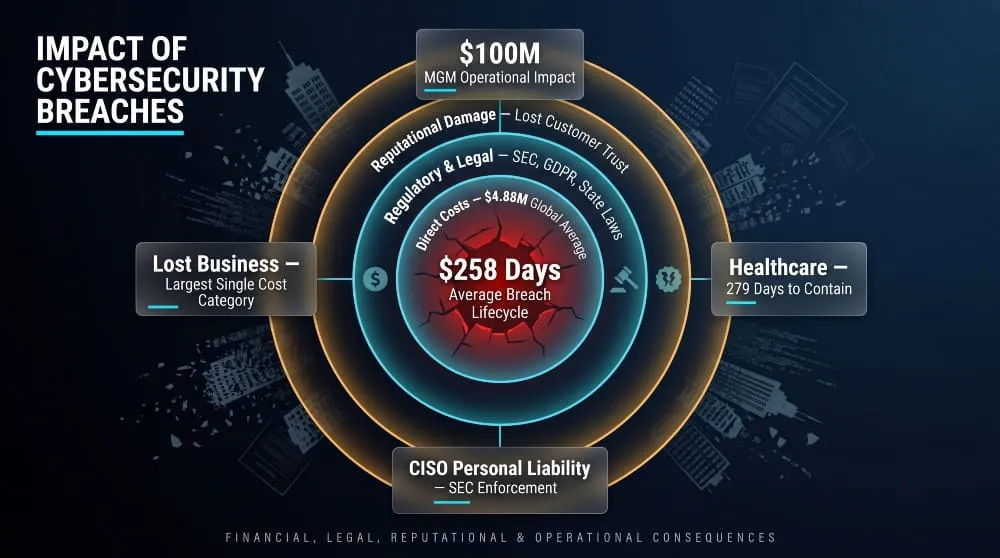
Healthcare is the most expensive industry for data breaches at $11.2 million per incident, approximately 2.5 times the global average, and has held the top position for fifteen consecutive years according to IBM’s 2025 Cost of a Data Breach Report. The average time to identify and contain a healthcare breach is 279 days, the longest of any industry, and each compromised medical record adds approximately $398 to the total cost of the incident.
In 2024, healthcare reported the highest combined total of ransomware and data theft attacks among U.S. critical infrastructure sectors, with 444 incidents comprising 238 ransomware events and 206 data breaches. Only critical manufacturing had more ransomware incidents, with 258, but far fewer data breaches. The Change Healthcare ransomware attack of March 2024, in which a single breach of a healthcare payment processing company disrupted billing and claims operations for hospitals, pharmacies, and physician practices across the United States, affected the health records of over 100 million people and became the largest healthcare data breach in U.S. history.
Manufacturing Cybersecurity Breach Statistics
Manufacturing has emerged as one of the most aggressively targeted sectors in ransomware operations, for reasons that attackers have understood and exploited systematically: manufacturing environments have very low tolerance for downtime, legacy operational technology (OT) systems that were not designed with cybersecurity in mind, and historically lower security investment relative to sectors like finance or healthcare.
Manufacturing accounted for over one-third of all ransomware attacks globally in 2024, making it the single most targeted sector in that category. The average cost of a data breach in manufacturing reached $5.56 million in 2024. On average, up to 44% of all computers used in manufacturing environments are affected by ransomware, and approximately 62% of ransomware victims in the sector pay the demanded ransom.
The OT dimension distinguishes manufacturing breaches from those in most other industries. When ransomware encrypts systems in a factory or processing plant, the consequences extend beyond data exposure to physical production halts, supply chain disruptions, and, in some cases, safety risks to workers or surrounding communities. Toyota’s experience between 2022 and 2023 illustrated this acutely: a cyberattack on a parts supplier forced the shutdown of fourteen Japanese plants. It resulted in the loss of production of approximately 13,000 vehicles, while a subsequent attack on Toyota Financial Services in Germany triggered an $8 million ransom demand.
SaaS and Technology Sector Breaches
The technology sector occupies a uniquely dangerous position in the breach landscape: technology companies are both high-value targets in their own right and trusted intermediaries through which attackers can reach hundreds or thousands of downstream organizations. A breach of a SaaS provider, a cloud platform, or an identity management vendor is not a single incident; it is a potential entry point into every organization that trusts that vendor.
The Snowflake incident of 2024 is the defining case study for SaaS-era breach dynamics. The breach affected more than 100 of Snowflake’s enterprise customers, making it one of the most significant data security incidents of the decade. Snowflake customers were targeted through credential-based attacks that exploited misconfigurations in SSO enforcement, IP restrictions, and dormant accounts, a reminder that attackers don’t need to breach the platform itself if they can walk through the front door using stolen credentials from a customer’s environment. The downstream impact included AT&T’s exposure of call records for approximately 110 million customers and Ticketmaster’s exposure of data belonging to roughly 560 million individuals.
The broader SaaS security challenge lies in scale and visibility. Organizations now manage dozens, if not hundreds, of SaaS applications, each with its own security settings, identity systems, and vulnerabilities. As businesses have moved from on-premises to cloud-based applications, the perimeter has dissolved, leaving organizations reliant on remote access and third-party integrations to manage critical operations. The Okta breach, the Microsoft Midnight Blizzard incident, and the Cloudflare intrusion that followed the Okta compromise all illustrate how a single compromised identity provider can cascade into multiple downstream victims within the same attack chain.
Education Sector Cybersecurity Breaches
Education has become one of the fastest-growing targets for cybersecurity breaches, driven by a combination of factors that make schools and universities structurally difficult to defend: large and transient user populations, open network environments designed for collaboration rather than restriction, aging IT infrastructure, under-resourced security teams, and databases containing highly sensitive personal information about minors.
In 2025, education became the most attacked sector globally, with institutions averaging over 4,300 weekly cyberattacks each, and phishing attacks in the education sector specifically surged 224% in 2024. The average breach cost in education rose to $3.80 million per incident in 2025. Among higher-education institutions that reported ransomware attacks, 59% reported full data exfiltration before any encryption occurred, indicating that attackers prioritized stealing data over locking it.
The 2025 PowerSchool breach, which exposed personal information belonging to 62 million students and 9.6 million teachers nationwide, stands as one of the most consequential education-sector breaches in U.S. history, demonstrating how quickly a single compromised ed-tech platform can cause national-scale damage. Student records are particularly attractive to threat actors because they contain rich personal data, Social Security numbers, dates of birth, and family information belonging to individuals who may not discover their information was compromised for years, giving attackers a long window for exploitation.
Government and Critical Infrastructure Breaches
Government organizations and critical infrastructure operators face a threat landscape that differs from commercial sectors in one critical dimension: many of their attackers are not financially motivated criminals but nation-state intelligence services with unlimited resources, long time horizons, and strategic objectives that may not manifest for years after initial access.
In 2024, government agencies faced a 300% increase in ransomware attacks compared to 2023; 60% of state and local governments reported experiencing a cyberattack in the previous twelve months, and the average cost of a data breach for government entities rose to $9.5 million. Cyberattacks on Taiwan by Chinese groups doubled to 2.4 million daily attempts in 2024, primarily targeting government systems and telecommunications firms, with successful attacks rising 20% compared to 2023.
The Salt Typhoon campaign, disclosed in late 2024 and attributed to Chinese state-sponsored actors, represented one of the most consequential infrastructure breaches in recent memory, compromising telecommunications networks used by U.S. government officials, law enforcement, and intelligence personnel. Recent attacks on cities including Dallas and Oakland, combined with the Salt Typhoon infiltration and the 2025 PowerSchool breach, demonstrate how quickly local disruptions can escalate into national security concerns, with hospitals delaying surgeries, schools suspending classes, and cities shutting essential services. For critical infrastructure sectors, the question is no longer whether a breach will occur but whether operations can continue when it does.
Hospitality and Logistics Breach Statistics
Hospitality and logistics occupy adjacent positions in the breach risk landscape: both handle large volumes of consumer personal data, rely extensively on third-party vendors and technology partners, and operate environments where point-of-entry control, whether physical or digital, is structurally complicated by the nature of the business.
In hospitality, the 2023 breaches by MGM Resorts and Caesars Entertainment set a new precedent for the damage a single social engineering campaign can inflict. MGM’s estimated $100 million impact from a ten-day operational disruption spanning casino floors, hotel check-in systems, room keys, and payment infrastructure demonstrated that hospitality companies carry a distinct category of risk: their technology is not just administrative; it is the operational environment through which guests experience the entire product. A breach that takes those systems offline doesn’t just expose data; it stops the business.
Logistics and supply chain operations face a different but equally serious threat profile, centered on operational disruption and the sensitivity of the cargo, route, and counterparty data they hold. The 2021 JBS Foods ransomware attack forced the shutdown of beef processing plants across the United States and Australia, leading to an $11 million ransom payment and temporary supply disruptions in North American meat supply chains. The 2025 UNFI cyberattack, which disabled electronic ordering and delivery systems for a major U.S. grocery wholesaler, caused measurable grocery shortages and forced retailers to find alternative suppliers, a direct demonstration of how a single logistics company’s breach can produce visible, physical consequences for end consumers. As supply chains have digitized and centralized, the blast radius of a single logistics breach has grown proportionally.
Root Causes of Cybersecurity Breaches
Cybersecurity breaches rarely occur because an attacker defeated an impenetrable system; they occur because of specific, identifiable, and, in most cases, preventable failures. Understanding root causes is not an academic exercise; it is the foundation of every meaningful security investment decision an organization can make.
Human Error, The Leading Cause of Cybersecurity Breaches
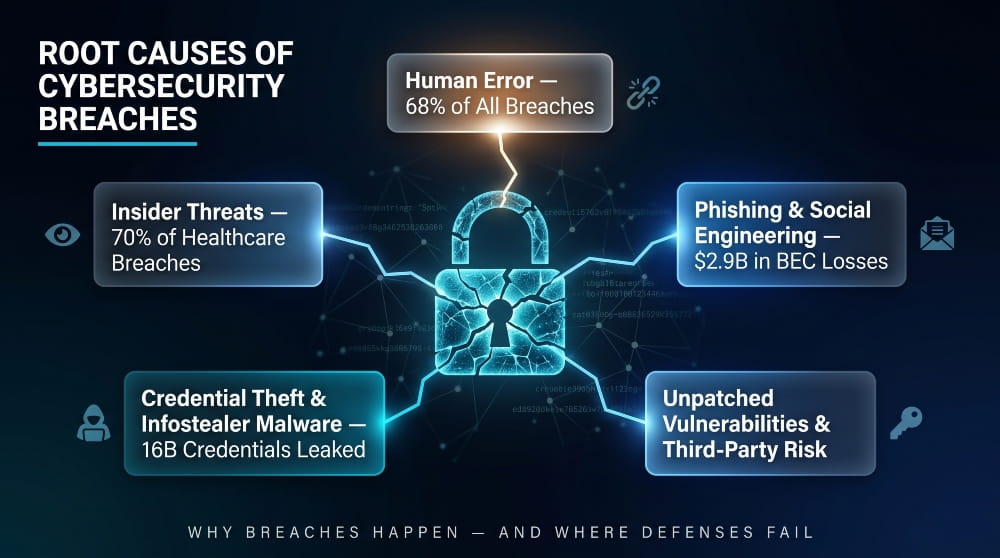
Human error is the single most consistent factor in cybersecurity breach data, appearing across years, industries, and attack types as either the primary cause or the condition that enabled everything else. Verizon’s 2024 Data Breach Investigations Report found that the human element is involved in 68% of all breaches, a figure that excludes malicious human contributions. It does not include deliberate insider actions, which are tracked separately and add further to the total human-factor share.
What falls under the human error umbrella is broader than most organizations account for in their security training programs. Clicking a phishing link is the obvious example. Still, the category also includes misconfigurations, such as a developer exposing a cloud storage bucket to the public internet and an administrator leaving an unneeded port open. This IT team ships a new system with default credentials still active. It includes misdirected emails containing sensitive attachments, weak or reused passwords chosen for convenience, and failure to apply a patch because a system “seemed fine.” None of these require malicious intent. They require only the normal human tendencies toward efficiency, familiarity, and optimism that every organization employs at scale.
The organizational implication is significant. Technical controls, firewalls, endpoint detection, and network segmentation are designed to contain incidents that result from human error. They are not substitutes for reducing the error rate in the first place. IBM’s research consistently shows that breaches involving a human element take longer to detect and cost more to contain than purely technical intrusions, which means the human layer is both the most exposed and the most under-defended surface in most security architectures.
Phishing and Social Engineering
Phishing is the most reliably successful initial access vector in cybersecurity, not because it is technically sophisticated but because it targets the one component of every security architecture that cannot be patched: the person reading the email. A well-constructed phishing message does not need to defeat an endpoint detection system or exploit an unpatched vulnerability. It needs to be persuasive enough that a person acts on it before they think critically about whether they should.
According to Fortinet’s research, government organizations worldwide averaged 2.8 phishing attempts per user in 2024, while financial services reported five times the phishing volume of any other industry. The mechanics have evolved well beyond the generic “urgent account verification” emails of a decade ago. Spear-phishing, targeted, personalized campaigns that reference the victim’s employer, colleagues, or recent activity, has become the standard approach against high-value individuals. Business email compromise (BEC), which involves impersonating a trusted executive or vendor to authorize fraudulent transactions, resulted in over $2.9 billion in reported losses in 2023 according to the FBI IC3 report.
Social engineering extends the principles of phishing beyond email. Voice phishing (vishing) has grown dramatically; vishing operations grew 442% between the first and second half of 2024, with attackers impersonating IT help desks, vendors, or regulators to extract credentials or authorize system changes over the phone. The 2023 MGM Resorts breach required nothing more than a 10-minute call to an IT help desk to initiate an intrusion that cost the company an estimated $100 million. The Scattered Spider group’s repeated success across multiple major organizations using variations of the same script illustrates that voice-based social engineering remains among the highest-return attack methods available and one of the hardest to defend against solely through technical means.
Generative AI has materially elevated the threat. AI-generated phishing emails have eliminated the typos, awkward phrasing, and generic formatting that trained employees previously used to identify suspicious messages. Deepfake audio and video now make vishing attacks more convincing at scale. The arms race between AI-assisted attackers and defender awareness programs is, at present, moving faster on the offensive side.
Unpatched Vulnerabilities and Third-Party Risk
Every unpatched vulnerability in an internet-facing system is an unlocked door, and threat actors have automated the process of finding them. When a critical CVE is publicly disclosed, the window between disclosure and active exploitation has compressed from weeks to hours in many cases, with automated scanning infrastructure probing millions of systems for the vulnerable endpoint before most organizations have even reviewed the advisory.
The MOVEit breach of 2023 is the defining recent case study. A single SQL injection vulnerability in a widely deployed file transfer application went unpatched long enough for the Cl0p ransomware group to compromise over 2,700 organizations and expose data belonging to more than 93 million people. The vulnerability was not obscure or technically exotic; it was a well-understood attack class against a known application. What it required was an organization that had not applied the patch within the exploitation window.
Third-party risk compounds the patching problem by extending an organization’s vulnerability surface to every vendor, supplier, and software provider it trusts. An organization may maintain excellent patch hygiene across its own systems while remaining entirely exposed through a managed service provider running outdated software, a payroll vendor with a misconfigured API, or a compromised upstream software update mechanism. The 2025 Marks & Spencer, Co-op, and Harrods campaign demonstrated precisely this: attackers compromised a third-party service provider and used that access to infiltrate multiple retail networks, deploy ransomware, and exfiltrate customer data, without ever needing to breach any of the target organizations’ perimeter defenses directly.
The practical challenge is that most organizations lack complete, up-to-date visibility into their third-party attack surface. They know who their primary vendors are, but they frequently lack visibility into those vendors’ security postures, their sub-processors, or the software dependencies running inside the tools they have deployed. Every layer of trust extension without verification is a potential breach path.
Credential Theft and Infostealer Malware
Stolen credentials are the most efficient attack vector in the modern threat landscape because they eliminate the need to breach anything. An attacker with valid username and password combinations does not force entry; they log in. From the perspective of most authentication systems, they are indistinguishable from legitimate users until they take an action that triggers behavioral detection, which may not occur for days, weeks, or months.
Verizon’s 2024 Data Breach Investigations Report found that stolen credentials were involved in over 77% of web application breaches, a figure that reflects the maturation of an entire ecosystem built around the acquisition and sale of credentials. Dark web markets and criminal Telegram channels trade in bulk credential databases harvested from previous breaches, phishing campaigns, and infostealer malware infections. The volume available means that for many organizations, valid employee or customer credentials are already circulating on underground markets before the security team is aware of any incident.
Infostealer malware, software designed specifically to extract credentials, session cookies, browser-saved passwords, and cryptocurrency wallet data from infected endpoints, has emerged as one of the most consequential and underappreciated threats in corporate security. Infostealers like Redline, Raccoon, and Lumma operate at an industrial scale, distributed through malvertising campaigns, trojanized software downloads, and YouTube video descriptions that link to fake tools. Once installed on an endpoint, they typically operate silently, exfiltrate everything of value within minutes, and self-delete. The resulting credential logs are sold in bulk. In 2025, over 16 billion credentials from major platforms including Google, Facebook, and Apple were leaked in one of the largest credential exposure events ever recorded.
The Snowflake campaign of 2024 illustrated the downstream consequences with unusual clarity. Attackers used credentials harvested by infostealer malware infections on employee devices, on accounts that did not have MFA enabled, to access cloud data warehouses containing sensitive data for over 100 major enterprises. No zero-day exploit was required. No network perimeter was breached. The credentials were the vulnerability.
Insider Threats
Insider threats occupy a distinct category in cybersecurity breach analysis because the controls designed to defend against external attackers offer little or no protection against someone who already has legitimate access. The challenge is not detecting a breach of the perimeter; it is identifying when authorized activity crosses into unauthorized or harmful territory, often with no clear technical signal that anything is wrong.
Insider threats take two broad forms. Malicious insiders are current or former employees, contractors, or partners who deliberately misuse their access for financial gain, competitive advantage, espionage, or retribution following termination or a dispute. Negligent insiders do not act with harmful intent but cause significant damage regardless: the system administrator who misconfigures a cloud storage policy, the employee who forwards sensitive documents to a personal account for convenience, the departing executive who downloads client data before their last day.
Healthcare’s breach profile is instructive: Verizon’s 2024 DBIR data shows that 70% of healthcare breaches involve an internal actor, the highest insider involvement rate of any major sector, compared to 30% from external threats. The disparity reflects the number of healthcare employees who routinely handle sensitive patient data and the difficulty of distinguishing legitimate clinical access from unauthorized curiosity or deliberate exfiltration without robust data access monitoring.
The financial services sector faces a similar insider risk profile, compounded by the high market value of the data employees handle daily. Cases involving employees selling customer account information to fraud rings, transferring proprietary trading data to competitors, or improperly accessing high-net-worth client records appear regularly in regulatory enforcement actions and rarely make headlines unless the scale is exceptional.
What makes insider threats particularly difficult to manage is organizational culture. Effective detection requires monitoring employee behavior at a level of granularity that many organizations are reluctant to implement, both for practical reasons related to the volume of alerts generated and for cultural reasons related to employee trust and privacy expectations. The result is that insider threats are systematically underreported relative to their actual frequency, and organizations routinely discover insider incidents months or years after they began.
Impact of Cybersecurity Breaches
The impact of a cybersecurity breach extends far beyond the moment of discovery; it unfolds over months and years in financial losses, legal proceedings, regulatory penalties, and organizational damage that rarely appear in initial incident reports. For most organizations that experience a serious breach, the direct remediation cost is only the beginning.
Financial Impact, Direct Costs and Long-Term Losses
The financial impact of a cybersecurity breach is measured in two distinct phases that together constitute the true cost: the immediate, visible expenses incurred in the weeks following discovery, and the longer-tail losses that accumulate over months and years as legal, regulatory, and commercial consequences materialize.
Immediate costs include forensic investigation to determine the scope and origin of the breach, containment and remediation of affected systems, legal counsel, crisis communications, mandatory notification to regulators and affected individuals, and credit monitoring services offered to breach victims. For large organizations, these direct response costs alone can run into the tens of millions of dollars before any regulatory penalty or lawsuit has been filed.
IBM’s 2024 Cost of a Data Breach Report placed the global average total breach cost at $4.88 million, representing the average across organizations of all sizes and sectors. Healthcare remains the most expensive sector at $9.77 million per incident, but the number that often surprises organizations is how much of the total cost is deferred. IBM’s research consistently shows that more than half of breach costs are incurred in the second and third years after the incident, driven by litigation settlements, regulatory fines, and the slower-to-quantify damage of customer attrition.
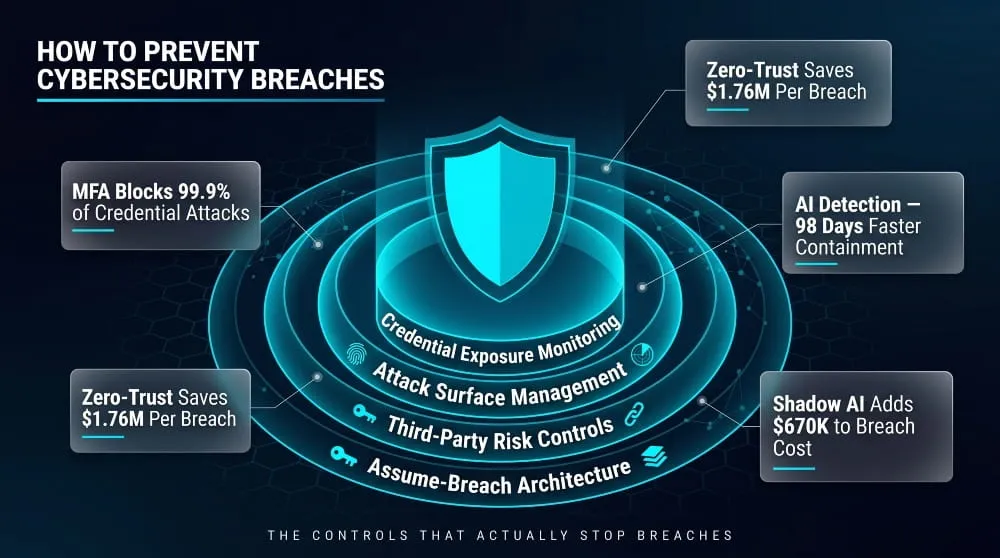
Lost business, meaning customers who leave following a breach and the revenue impact of reputational damage, frequently represents the largest single cost category in IBM’s data, exceeding even technical remediation. For consumer-facing businesses, the value of the lost data is often secondary to the value of customer relationships that erode when the incident becomes public. Organizations with extensive AI and automation deployed in their security operations contain breaches an average of 98 days faster than those without, translating to $2.2 million in average savings per incident, a figure that makes the ROI calculation for security investment more concrete than most budget conversations allow.
Regulatory and Legal Consequences (SEC Rules, GDPR, State Laws)
The regulatory and legal consequences of a cybersecurity breach have become one of the most significant cost drivers of total incident impact, and the landscape has shifted substantially over the last three years, permanently raising the stakes for organizations that experience a material incident.
The SEC’s cybersecurity disclosure rules, which took effect in December 2023, require publicly traded companies to report material cybersecurity incidents within four business days of determining that a breach is material. That timeline has fundamentally changed the calculus around incident disclosure. The previous norm, investigate thoroughly, understand the full scope, then communicate carefully, has been replaced by a legally mandated cadence that compresses disclosure into days, often before the complete picture is clear. Organizations that fail to meet the deadline or are found to have mischaracterized the materiality of an incident face SEC enforcement action, in addition to other consequences they are managing. SolarWinds and its CISO faced the first major SEC enforcement action under the new rules in 2023, creating a precedent that has reordered how general counsels and CISOs interact during incident response.
GDPR enforcement in Europe has matured into a meaningful financial threat for global organizations. The regulation permits fines of up to 4% of global annual revenue for serious violations, and enforcement actions against major companies, including Meta’s €1.2 billion fine in 2023 for data transfer violations, have demonstrated that regulators are willing to apply penalties at a scale that affects quarterly earnings. Breach notification under GDPR must occur within 72 hours of discovery to the relevant supervisory authority, a timeline that strains most organizations’ incident response capabilities and that regulators have shown increasing willingness to penalize when missed.
In the United States, all fifty states now have breach notification laws, each with different definitions of what constitutes a breach, different timelines for notification, different thresholds for what types of data trigger the obligation, and different enforcement mechanisms. Organizations operating nationally face the operational challenge of mapping a single incident against fifty different compliance frameworks simultaneously, often while managing the incident itself. State attorneys general have become aggressive enforcers: settlements following major breaches regularly include not just financial penalties but mandatory security program improvements, third-party audits, and multi-year compliance monitoring, commitments that impose costs well beyond the settlement figure itself.
Class action litigation follows breach disclosures at an increasing pace and with greater regularity. While many breach-related lawsuits have historically been dismissed for failure to demonstrate concrete harm, courts have progressively recognized theories of harm based on increased risk of future fraud, loss of value of personal information, and the time and burden of protective measures, making breach litigation a more consistent financial exposure than it was five years ago.
Impact on Consumer Trust and Brand Reputation
The reputational impact of a cybersecurity breach is both the most consequential and the most difficult to quantify category of harm, because consumer trust erodes differently across industries, customer demographics, and breach types, and because the damage often does not appear immediately in the metrics that organizations monitor most closely.
The relationship between breach disclosure and consumer behavior is not uniform. Customers of financial institutions who experience a breach often remain with the institution if the response is perceived as competent and transparent, because switching costs are high and because the institution’s ability to make them financially whole matters more than their sense of outrage. Customers of healthcare providers, e-commerce platforms, and consumer applications are less forgiving, particularly when the breached data includes sensitive personal information, medical records, Social Security numbers, or payment credentials, rather than metadata or contact details.
IBM’s research consistently attributes lost business to the largest single cost category in many breach calculations, and the mechanism is primarily reputational. Organizations that handle breach disclosure poorly, are slow to notify, minimize in their public statements, and are reluctant to acknowledge the full scope face substantially worse long-term reputational damage than those that communicate clearly and act visibly to protect affected individuals. The contrast between Uber’s 2016 breach response, in which the company paid a ransom to cover up the incident and concealed it from regulators for a year, and more transparent responses from other organizations, illustrates how the response shapes the reputational consequence at least as much as the breach itself.
For B2B technology companies, the reputational impact operates differently but with potentially greater commercial consequences. Enterprise customers conduct formal security reviews of their vendors, and a breach disclosure triggers simultaneous reviews across the entire customer base. Contracts may include security warranty provisions, breach notification requirements, or termination rights that activate upon a security incident. The pipeline and renewal discussions happening at the same time as the incident response create commercial pressure distinct from the consumer trust dynamic but equally real in its financial impact.
Operational Disruption, What Happens Inside an Affected Organization
The operational impact of a cybersecurity breach begins the moment it is detected and continues until technical remediation is complete. What unfolds inside an organization during and after a significant breach is a sustained period of disruption that touches every function- IT, legal, communications, human resources, finance, and executive leadership- simultaneously and at a pace that normal organizational processes are not designed to accommodate.
In the immediate phase, incident response teams work to contain the breach, preserve evidence, and restore critical systems. In ransomware incidents, this often means taking entire environments offline to prevent further encryption, a decision that halts operations and cascades across every business process that depends on those systems. The MGM Resorts breach illustrated this at a scale visible to millions of people: hotel check-in systems, room keys, casino floor operations, payment processing, and reservation platforms were all affected, and the disruption lasted approximately ten days. MGM estimated the operational impact at $100 million in a single quarter.
Ransomware attacks on hospitals have resulted in patient care being diverted to other facilities, surgical procedures being postponed, and medication administration systems reverting to manual paper-based processes. The 2024 Change Healthcare breach disrupted claims processing and payment systems for pharmacies and hospitals across the United States for weeks, with some smaller providers facing serious cash flow pressure because they could not submit claims or receive reimbursements through the affected system.
Beyond the acute phase, the operational disruption continues in less visible but persistent ways. IT teams that spent weeks in incident response have deferred months of normal maintenance, development, and project work. Legal and compliance functions face sustained demands from regulatory investigations, litigation, and notification obligations. Senior executives commit substantial time to board reporting, investor communications, regulatory meetings, and media inquiries. The total organizational cost of this sustained diversion of attention and capacity rarely appears in breach cost estimates. Still, it is real, substantial, and experienced at every level of the affected organization.
Impact on Employees and Internal Stakeholders
The impact of a cybersecurity breach on employees and internal stakeholders is among the least-discussed dimensions of incident consequences. Yet, it affects the day-to-day functioning of organizations for far longer than most external observers appreciate.
In the immediate aftermath of a breach, employees in IT and security functions are subjected to extreme pressure, often working around the clock, managing ambiguous, rapidly evolving situations, communicating upward to leadership that seeks certainty that cannot yet exist, and managing public and regulatory scrutiny simultaneously. Security teams that experience major breaches report elevated burnout and turnover in the months following the incident, creating a secondary vulnerability as organizations lose experienced personnel at precisely the moment institutional knowledge about the incident is most valuable.
For the broader workforce, a breach involving employee data carries direct personal harm. When a breach exposes payroll records, Social Security numbers, benefits information, or performance data, as many enterprise breaches do, every affected employee becomes a potential victim of identity theft. They face the same practical burden as any breach victim: monitoring credit reports, freezing credit files, replacing compromised documents, and managing the anxiety of not knowing how their information will be used. The distinction between being an employee of a breached organization and being a customer of one collapses entirely when it is HR and payroll systems that are compromised.
For individual employees who are identified as the entry point for a breach, the person who clicked the phishing link, the administrator whose credentials were stolen, the contractor whose remote access was compromised, the personal and professional consequences can be severe. Public attribution of human error in high-profile incidents has resulted in terminations, public criticism, and in some cases personal legal exposure. The CISO role has become particularly fraught: the SEC’s enforcement action against SolarWinds’ CISO following the 2020 breach introduced the prospect of personal liability for security leaders, permanently altering how CISOs negotiate their employment terms, insurance coverage, and incident response authority. When individual accountability follows organizational failure, the human cost of a cybersecurity breach extends well beyond the organization’s balance sheet.
How to Prevent Cybersecurity Breaches
Preventing cybersecurity breaches requires more than deploying security tools; it requires building an organizational posture that reduces the attack surface, limits damage when controls fail, and treats security as a continuous operational discipline rather than a periodic project. No organization can guarantee it will never be breached. Still, the gap between organizations that experience manageable incidents and those that experience catastrophic ones is almost always explained by the depth of their prevention program.
Most Overlooked Aspects of Breach Prevention
The most commonly discussed breach prevention measures- firewalls, antivirus software, and security awareness training- receive the majority of security budget attention. The controls that are most frequently absent or underinvested are less visible but disproportionately responsible for the breaches that actually occur.
Multi-factor authentication on every privileged account remains one of the most overlooked controls in practice, despite being one of the most documented breach-prevention mechanisms. The Snowflake campaign of 2024, which compromised data from over 100 major enterprises, succeeded entirely because customer accounts lacked MFA enforcement. The Microsoft Midnight Blizzard breach began with a legacy test account that lacked MFA. These are not edge cases; they are consistent findings across breach investigations year after year. MFA is not a sophisticated or expensive control. Its absence at scale reflects failures in organizational processes, not resource constraints.
Credential exposure monitoring is a prevention layer that most organizations have not operationalized despite its direct relationship to breach risk. Infostealer malware infections on employee devices continuously harvest credentials and deposit them into dark web markets and criminal Telegram channels. An organization whose employee credentials are circulating on underground forums is at elevated risk of breaches from the moment they are exposed. Still, without active monitoring of those channels, the organization has no way of knowing until an attacker uses those credentials to log in. Continuous monitoring of credential exposure, paired with rapid response protocols for rotating compromised credentials, closes this gap.
Access privilege hygiene, the ongoing practice of ensuring users hold only the access they actually need, is consistently underprioritized because it generates friction and requires regular review rather than one-time configuration. Over-provisioned accounts are a force multiplier for attackers: a compromised account with broad permissions enables lateral movement across an environment that a correctly provisioned account would have contained. IBM’s research on breach containment consistently shows that organizations with mature identity governance experience significantly shorter breach lifecycles and lower total costs.
Offboarding controls represent another systemic gap. Access credentials belonging to former employees, terminated contractors, and departed vendors persist in active systems with remarkable frequency. These dormant accounts are low-visibility, low-maintenance entry points that attackers, particularly former insiders, can exploit long after the individual’s legitimate relationship with the organization has ended.
The Assume-Breach Mindset, Why Prevention Alone Isn’t Enough
The assume-breach mindset is the operating principle that every security architecture should be designed on the assumption that a determined attacker will eventually succeed in gaining some form of access, and that the objective of security is therefore not just to prevent that access but to limit its consequences when it occurs. It is the foundational principle of zero-trust architecture and represents a significant departure from the perimeter-defense model that dominated security thinking for decades.
The perimeter model, built on the assumption that the network boundary is the primary line of defense, has systematically failed in the modern environment for structural rather than executional reasons. Remote work has dissolved the network boundary. Cloud infrastructure has moved critical systems entirely outside the traditional perimeter. Third-party access has extended trust relationships to hundreds of vendors and partners who operate outside the organization’s direct control. The MOVEit breach, the SolarWinds compromise, and the Snowflake campaign all succeeded by bypassing the perimeter entirely, entering through trusted software, credentials, or vendor relationships rather than breaking through a firewall.
Assume-breach architecture designs for the adversary who is already inside. It means implementing network microsegmentation so that a compromised endpoint cannot reach the entire environment. It means enforcing least-privilege access so that a stolen credential provides minimal lateral movement capability. It means deploying endpoint detection and response (EDR) tools that can identify behavioral anomalies indicative of post-compromise activity. It means conducting regular red-team exercises that simulate real-attacker behavior within the network and reveal gaps in detection and response before a real attacker exploits them.
IBM’s 2024 data quantifies the operational value of this posture directly: organizations with mature zero-trust frameworks deployed experienced an average breach cost of $3.47 million, $1.76 million less than organizations without zero-trust architecture. Detection speed drives that gap. An organization is designed to detect breaches faster because it actively looks for adversarial behavior within its own environment rather than relying on perimeter controls to prevent them.
Cybersecurity Measures That Reduce Breach Risk in 2025–2026
The cybersecurity controls with the strongest evidence base for reducing breach risk in the current threat environment cluster around identity, visibility, and response capabilities, reflecting the dominant attack patterns of the period.
Identity security has become the central battleground in breach prevention because credentials are now the primary initial access vector across industries and attack types. Beyond MFA, this means implementing phishing-resistant authentication standards (FIDO2/passkeys where possible), enforcing conditional access policies that evaluate login context rather than just credentials, deploying identity threat detection and response (ITDR) tools that monitor for anomalous authentication behavior, and establishing continuous credential exposure monitoring. Every dollar invested in hardening identity infrastructure addresses the root cause of most breaches.
Attack surface management provides the visibility foundation on which all other controls depend. An organization cannot protect assets it does not know exist, and the modern enterprise attack surface, spanning cloud infrastructure, SaaS applications, remote access endpoints, shadow IT, and third-party integrations, grows faster than most security teams can manually track. Continuous, automated attack surface discovery identifies exposed assets, misconfigured cloud resources, and forgotten internet-facing systems before attackers do. Organizations using attack surface management platforms have documented reductions in mean time to detect and remediate exposure, which directly translate into lower breach probability.
Endpoint detection and response (EDR) and extended detection and response (XDR) provide the behavioral visibility needed to detect post-compromise activity, the phase between initial access and data exfiltration where early intervention can contain an incident before it becomes a breach. Modern EDR platforms use behavioral analysis rather than signature matching, enabling them to identify infostealer activity, lateral movement, and privilege-escalation patterns that do not match any known malware signatures. AI-assisted threat detection has materially reduced mean time to detection in organizations that have deployed it.
Third-party and supply chain risk management has elevated from a compliance checkbox to an operational security discipline as supply chain breaches have grown as a share of total incidents. This means conducting security assessments of critical vendors before onboarding, establishing contractual security requirements with measurable standards, monitoring vendor security posture continuously rather than at contract renewal, and limiting the scope of access any single third party holds to the minimum required for the service relationship. Organizations that treat their vendors’ security posture as an extension of their own attack surface are structurally better positioned than those that treat vendor risk management as a procurement function.
Security awareness training remains necessary but requires evolution beyond annual phishing simulations. The most effective programs deliver continuous, contextual training triggered by actual employee behavior, a failed phishing simulation followed by immediate, relevant instruction rather than deferred annual training. Simulated social engineering exercises that replicate current attack techniques, including AI-generated phishing and voice-based scenarios, better prepare employees for the threats they actually face.
How Cybersecurity Advisors Help Organizations Stay Protected
Cybersecurity advisors, whether external consultants, managed security service providers (MSSPs), or dark web and threat intelligence platforms, bridge the gap between an organization’s internal security capabilities and the threat landscape it actually faces. For the majority of organizations that do not have the resources to build a fully staffed, 24/7 security operations function internally, external expertise is not supplemental. It is structural.
The most direct value advisors provide is threat visibility that organizations cannot generate internally. Dark web monitoring platforms continuously index criminal forums, leak sites, ransomware group blogs, and underground markets to identify when an organization’s credentials, data, or infrastructure details appear in adversarial contexts, often providing the earliest possible warning of impending attack activity. When a threat actor posts an organization’s stolen credentials for sale before deploying them, or announces an organization as a ransomware victim on a leak site, the window between that disclosure and active exploitation is narrow. Organizations with monitoring in place can act within that window. Organizations without it typically learn about the exposure after the damage has occurred.
Penetration testing and red team services provide a different category of value: an adversarial perspective on an organization’s actual security posture rather than its intended posture. The gap between what an organization believes its controls achieve and what an attacker can actually accomplish through them is one of the most consistent findings in security assessments across all sectors. A red team that maps an organization’s real-world breach path before an attacker does allows that organization to remediate the path rather than experience its consequences. IBM’s research shows that organizations that conduct regular security testing and exercises identify and contain breaches significantly faster than those that rely solely on controls.
Incident response retainers ensure that when a breach occurs, and for most organizations, the question is when rather than if, expert response capability is available immediately rather than procured under duress. The difference between an organization that has a pre-negotiated IR retainer with an experienced firm and one that begins cold-calling incident response vendors after discovery is measured in days of additional breach duration, which translates directly into scope, cost, and regulatory exposure. For organizations operating in regulated industries, having a documented and tested incident response plan supported by qualified external expertise is not just best practice; it is increasingly an expectation embedded in regulatory frameworks and cyber insurance underwriting criteria.
Cybersecurity Breach Response | What to Do
When a cybersecurity breach is detected, the quality of the response determines the extent of the damage. Organizations that move quickly, systematically, and with a pre-established plan contain breaches faster, spend less on recovery, and emerge with significantly less regulatory and reputational exposure than those that improvise under pressure.
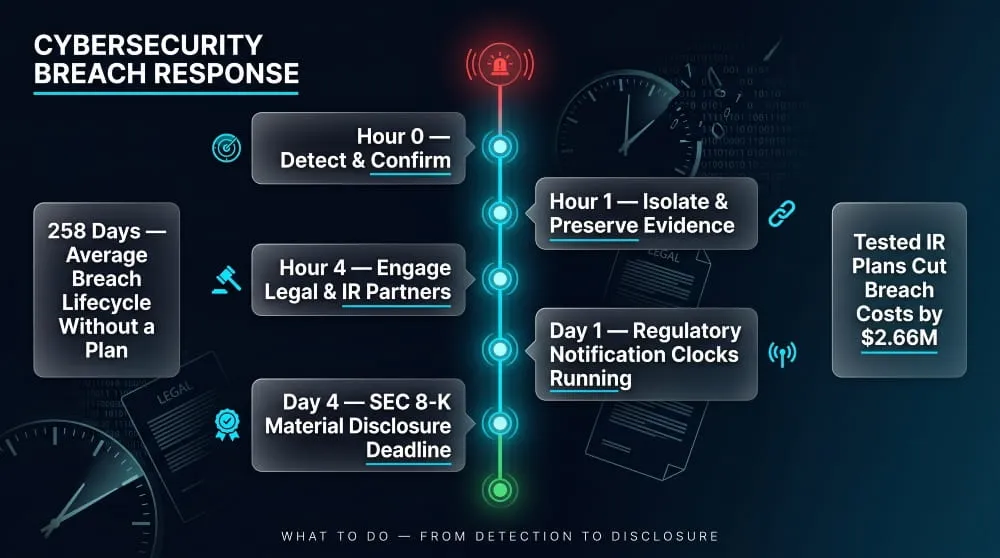
Immediate Steps After a Cybersecurity Breach
The first hours following breach detection are the most consequential in the entire incident lifecycle. Decisions made, and mistakes made, in this window shape everything that follows: how much additional data is exposed, how long the attacker retains access, what evidence is preserved for forensic analysis, and how regulators and counsel view the organization’s response.
The priority is detection confirmation. Not every security alert is a confirmed breach, and acting as though a potential incident is a confirmed catastrophe before verification wastes resources and creates unnecessary internal alarm. However, the threshold for escalating to full incident response posture should be low; the cost of treating a false positive as a real incident is far lower than the cost of treating a real incident as a false positive. The moment initial indicators suggest unauthorized access to sensitive systems or data, incident response protocols should activate.
In parallel with verification, the affected systems and accounts need to be isolated to prevent further attacker movement. This does not necessarily mean taking systems offline, a decision that carries its own operational consequences. Still, it does mean revoking the access path that enabled the intrusion, whether that is a compromised credential, a vulnerable endpoint, or a misconfigured cloud resource. Containment and evidence preservation must happen simultaneously: isolating systems in ways that destroy forensic logs or overwrite attacker artifacts undermines the investigation that follows. Engaging a qualified forensic investigator early, even before the full scope is known, ensures the evidence chain is maintained.
Notification obligations begin running from the moment of discovery in most regulatory frameworks, not from when the investigation is complete. Legal counsel should be engaged within the first hours to identify which notification timelines apply, preserve legal privilege over investigation findings, and begin mapping the organization’s disclosure obligations. Waiting until the investigation is concluded before calling legal is one of the most common and consequential mistakes organizations make in the immediate response phase.
Breach Containment and Incident Management
Breach containment is the process of stopping the bleeding, limiting the attacker’s ability to move further through the environment, exfiltrate additional data, or escalate privileges, while preserving the evidence and operational continuity needed to sustain the investigation and recovery that follow.
Effective containment begins with scope determination: understanding which systems were accessed, which data may have been exposed, how the attacker gained initial access, and what lateral movement occurred between initial access and detection. This is forensic work that requires log analysis, network traffic review, and endpoint investigation, and it takes time that feels impossible to afford when an incident is active. The temptation to rush to remediation, wiping and reimaging affected systems before their activity has been fully analyzed, is one of the most common mistakes in incident management. Remediated systems cannot be investigated. Gaps in the forensic picture result in incomplete remediation, leading to reinfection.
Once the attacker’s footprint is understood, containment moves to systematic removal: rotating all potentially compromised credentials across the environment, revoking active sessions, removing persistence mechanisms the attacker may have established, and patching or isolating the vulnerability or misconfiguration that enabled initial access. IBM’s 2024 research found that organizations using AI and automation in their security operations contained breaches an average of 98 days faster than those without, a gap driven primarily by the speed of detection and scope determination, which inform and enable every containment action that follows.
Incident management during an active breach requires clear command structure. Security teams, legal counsel, external IR partners, communications, and executive leadership all need defined roles, defined communication channels, and defined decision-making authority. Breaches that turn into prolonged crises often do so not because of technical failures in containment but because unclear authority, competing priorities, and uncoordinated communications within the organization slow every decision that needs to be made quickly. A breach is not the time to establish governance structures; it is the time to execute those established in advance.
Cybersecurity Disclosure Requirements and SEC Reporting
The regulatory disclosure landscape for cybersecurity breaches has transformed over the last three years, and the organizations most exposed to its consequences are those still operating under pre-2023 assumptions about how much time they have to communicate an incident.
The SEC’s cybersecurity disclosure rules, effective December 2023, require publicly traded companies to file an 8-K report disclosing a material cybersecurity incident within four business days of determining that the incident is material. The four-day clock does not begin at discovery; it begins at the materiality determination, which has made the materiality assessment itself a critical, legally sensitive decision that occurs in the middle of an active incident response. Organizations are simultaneously trying to understand what happened, contain the damage, and make a legally defensible determination about whether the incident meets the SEC’s materiality threshold. Legal counsel must be embedded in incident response from the first hours specifically to manage this assessment in real time.
The SEC rules also require annual disclosure of cybersecurity risk management processes, governance structures, and board oversight mechanisms in Form 10-K filings, meaning that organizations must now publicly document their security posture and that the adequacy of that posture will be evaluated against the disclosed standards when an incident occurs. The enforcement action against SolarWinds and its CISO in 2023 demonstrated that the SEC is prepared to pursue charges against both the organization and individuals when disclosures are found to have materially misrepresented the company’s security posture.
GDPR breach notification must be made to the relevant supervisory authority within 72 hours of becoming aware of a personal data breach, one of the most demanding timelines in any regulatory framework and one that frequently expires before the investigation has produced the information regulators expect to receive. The 72-hour notification can be made without complete information, with a commitment to provide further details as the investigation continues. Still, organizations that miss the deadline face additional regulatory scrutiny on top of the underlying incident. Where a breach is likely to result in high risk to individuals, notification to affected data subjects is also required, a separate obligation that carries its own timeline and content requirements.
State-level notification laws in all 50 U.S. states layer additional obligations on top of the federal and international frameworks. Some states, including California, New York, and Washington, have among the most stringent requirements regarding notification timelines, the definition of covered data, and the breadth of organizations subject to their provisions. Operating a multi-state notification response requires dedicated legal project management to ensure each jurisdiction’s requirements are met without any single notification creating legal exposure in another.
Crisis Communication After a Breach
How an organization communicates a cybersecurity breach to its customers, employees, partners, regulators, and the public shapes its reputational consequences at least as much as the breach itself. The organizations that emerge from significant incidents with their credibility intact are almost always those that communicated early, clearly, and honestly, even when the full picture was not yet available.
The cardinal rule of breach communication is not to get ahead of confirmed facts, but also not to delay communicating to avoid short-term discomfort. The middle path is to acknowledge what is known, be explicit about what is not yet known, and commit to providing updates as the investigation progresses. Audiences, customers, regulators, and investors are more forgiving of organizations that communicate imperfect information promptly than those that communicate perfect information slowly. The perception that an organization was trying to manage the story rather than inform its stakeholders is the reputational wound that tends not to heal.
Customer notification letters are a legal requirement in most jurisdictions and a reputational document simultaneously. The legal requirement to inform affected individuals of what data was exposed, when the breach occurred, what the organization is doing in response, and what steps individuals can take to protect themselves should be met with language clear enough for a non-technical reader to act on. Notifications that are dense with legal hedging, vague about the actual data exposed, or formulaic in their expression of concern tend to generate media coverage and regulatory scrutiny that notifications written for genuine comprehension avoid.
For public companies, investor communications must be coordinated with legal counsel to ensure consistency between the public record and the SEC disclosures being prepared simultaneously. For any organization, media inquiries should be routed through a designated spokesperson who has been briefed on approved messaging and understands the boundary between what can and cannot be said during an active investigation. Inconsistent statements across channels, a customer notification that contradicts an SEC filing, or a CEO interview that departs from the official incident timeline, create legal exposure and amplify reputational damage.
The internal communication dimension is frequently underprioritized. Employees learn about their employer’s breach from news coverage when the internal communication strategy does not get ahead of external disclosure. When employees learn from outside sources before their own leadership, the trust damage inside the organization compounds the trust damage outside it.
What to Do Before a Breach Happens: Building a Response Plan
The single most impactful thing an organization can do to improve its breach response is to build and test the response plan before any breach occurs. IBM’s research consistently shows a direct correlation between incident response plan maturity and breach outcomes; organizations with regularly tested IR plans contain breaches faster, spend less on remediation, and experience lower total breach costs than those responding to incidents without a prior framework.
An effective incident response plan is not a document that sits in a shared drive and is consulted only during a crisis. It is a living, operational framework that clearly defines roles and responsibilities so that any member of the response team knows what they are accountable for without needing to be told. It establishes communication chains, who notifies whom, in what sequence, using which channels, with what information, for both the internal response team and external parties including legal counsel, IR retainer partners, regulators, and communications advisors. It identifies the critical systems and data assets whose compromise would trigger specific response protocols, and it documents the vendor and partner contacts needed to execute containment and recovery at speed.
Tabletop exercises are the mechanism through which plan documents become organizational muscle memory. A well-designed tabletop presents the response team with a realistic breach scenario, a ransomware deployment discovered on a Friday night, a credential-stuffing campaign against a cloud environment, a supply chain compromise announced by a vendor, and walks through the decisions, communications, and escalations the plan prescribes. The gaps that surface in tabletops are almost always process and communication gaps rather than technical ones: unclear decision authority, missing contact information, regulatory timelines that nobody on the team had memorized, or response steps that assume capabilities the organization does not actually have. Finding those gaps in a tabletop costs an afternoon. Finding them during a real incident costs millions.
Cyber insurance has become a standard component of breach preparation for organizations of all sizes. Still, it is most valuable when the policy terms are understood before the incident rather than during it. Insurers increasingly require documentation of specific security controls as a condition of coverage, and policies differ significantly in what incident response costs they cover, what notification and disclosure costs they include, and what exclusions apply. An organization that assumes its cyber policy covers a ransomware payment and discovers during the event that it does not is in a materially worse position than one that negotiated coverage terms with that scenario specifically in mind.
Cybersecurity Breach Trends to Watch
The cybersecurity breach landscape in 2025 and 2026 is not evolving incrementally; it is accelerating across multiple dimensions simultaneously. Attack speed is increasing, attacker tooling has become commoditized, and the integration of artificial intelligence on the offensive side is fundamentally changing what defenders need to detect and how quickly they need to respond.
Emerging Attack Patterns in 2025–2026
Several attack patterns have either emerged or substantially matured in the 2025–2026 period in ways that represent a meaningful shift from the threat landscape of previous years, not just more volume of the same tactics, but structural changes to how breaches are initiated, executed, and monetized.
Malware-free intrusions have become the dominant attack methodology, overtaking traditional malware deployment as the primary technique across incident response investigations. CrowdStrike’s 2026 Global Threat Report found that 82% of detections in 2025 were malware-free, meaning attackers relied on legitimate tools, stolen credentials, and living-off-the-land techniques rather than deploying malicious code that security tools are trained to recognize. This shift has been deliberate: endpoint detection tools have improved substantially at identifying known malware signatures, so sophisticated attackers have largely stopped using them against hardened targets. Instead, they authenticate with valid credentials, use built-in system tools like PowerShell and WMI, and move laterally through an environment in ways that are technically indistinguishable from legitimate administrative activity.
Breakout time compression is a direct consequence of the operational maturity that the eCrime ecosystem has achieved. CrowdStrike recorded the fastest eCrime breakout time of 27 seconds in 2025, meaning the elapsed time between initial access and lateral movement to another system was under half a minute in the fastest observed cases, while the average eCrime breakout time dropped to just 29 minutes, a 65% speed increase from 2024. These figures define the detection window that defenders are actually operating within: not hours or days, but minutes. Organizations that cannot detect anomalous activity and initiate response within that window are effectively defending against an attacker who already has the run of the environment.
Third-party and supply chain compromises have continued their trajectory as one of the fastest-growing initial access vectors. Verizon’s 2026 Data Breach Investigations Report recorded a 60% year-over-year increase in third-party involvement in breaches, now present in 48% of all confirmed incidents, up from 30% the previous year, with IBM’s five-year data showing that major supply chain and third-party compromises have nearly quadrupled since 2020. The attack logic has not changed: compromise a trusted vendor to reach better-defended downstream customers. Still, the scale of execution has grown to the point where third-party risk management is no longer a compliance function. It is a primary security discipline.
Shadow AI has introduced a new category of unintentional exposure that security teams are only beginning to quantify. MIT’s State of AI in Business 2025 report found that while only 40% of companies pay for official generative AI subscriptions, employees at more than 90% of firms regularly use personal AI tools on the job. IBM found that high levels of shadow AI can add as much as $670,000 to a breach cost, exposing more personal and sensitive data in the process, making it one of the top three costliest breach factors. Employees pasting sensitive data into consumer AI tools, storing credentials in personal AI assistant histories, and connecting unauthorized AI applications to corporate systems are creating data-exposure pathways that lie entirely outside traditional security monitoring.
Industries at Highest Risk Right Now
The risk distribution across industries in 2025 and 2026 reflects a combination of data value, operational vulnerability, and the strategic calculus of organized threat actors who have become sophisticated enough to choose their targets based on expected return rather than opportunistic scanning.
Mandiant’s M-Trends 2026 report found that high technology was the most targeted industry, representing 17% of all investigated cases, followed by financial services at 14.6%, business and professional services at 13.3%, and healthcare at 11.9%. The elevation of high technology to the top position reflects the dual value it offers attackers: direct access to intellectual property and credentials, plus the supply-chain leverage that compromising a technology provider creates across its entire customer base.
Healthcare’s persistent presence near the top of targeting lists is structural. Ransomware attacks against hospitals and health systems create immediate, life-affecting operational pressure, making payment more likely and faster than in most other sectors. The regulatory environment also makes the cost of non-compliance with breach notification a compounding factor that healthcare organizations cannot ignore. Ransomware threat actors in 2025 demonstrated deliberate sector-based targeting, focusing specifically on industries where operational disruption creates cascading economic and reputational consequences, with manufacturing, professional services, and critical business services becoming consistent targets across Europe and North America, particularly for groups like Akira that made calculated geographic pivots toward industrial and logistical hubs where downtime carries immediate financial and regulatory impact.
For the first time in six years, North America became the most attacked region globally in 2025, accounting for 29% of all IBM X-Force incident response cases, up from 24% in 2024, displacing Asia-Pacific from the top position, a shift IBM attributes to the region’s combination of high digital adoption, massive cloud footprints, and deeply connected ecosystems that are expanding faster than the security controls governing them.
How AI Is Changing the Breach Landscape
Artificial intelligence has become the defining force reshaping cybersecurity breaches in the 2025–2026 period, operating simultaneously as an offensive accelerant in attackers’ hands and a defensive force multiplier in defenders’ hands, with the balance between those two effects determining the breach outcomes of organizations worldwide.
On the offensive side, AI’s most immediate impact has been on the quality and scale of social engineering. Over 80% of phishing emails identified in late 2024 and early 2025 involved some form of AI assistance, generating messages that match a target’s communication style, reference recent organizational events, and bypass spam filters that were trained on the grammatically awkward, generically formatted phishing emails of previous years. The practical consequence is that the visual and linguistic cues that employees were trained to use to identify suspicious messages have become largely unreliable.
Deepfake technology has elevated voice and video-based social engineering from a theoretical concern to an operational reality. The FBI’s 2025 IC3 report logged a 37% rise in AI-assisted business email compromise and documented hundreds of deepfake-based scams involving cloned voices of executives and government officials. The financial sector has been hit hardest; finance experienced a 47% year-over-year increase in AI-enhanced malware and remains the primary target for deepfake-enabled business email compromise, but the attack type has spread across industries and organization sizes. According to Cyble’s Executive Threat Monitoring report, AI-powered deepfakes were involved in over 30% of high-impact corporate impersonation attacks in 2025.
CrowdStrike documented an 89% increase in attacks by AI-enabled adversaries in 2025, and noted that legitimate AI tools were exploited at more than 90 organizations to generate malicious commands and steal sensitive data, with ChatGPT mentioned in criminal forums 550% more than any other model. The abuse of legitimate AI infrastructure to generate attack content creates a detection challenge that signature-based systems are poorly equipped to address: the content is generated by the same tools organizations use for legitimate purposes, and it behaves accordingly.
On the defensive side, the data on AI-assisted security operations is equally clear in the other direction. Organizations using AI security tools saved an average of $1.9 million per breach and detected threats 60% faster than those relying on traditional systems, achieving 95% detection accuracy compared to 85% with conventional approaches. IBM’s research on organizations with extensive security AI and automation found that they experience breaches an average of 98 days earlier than those without it. The gap between AI-equipped defenders and those still operating on manual processes and legacy tools is widening. That gap is now measurable in dollars and days at a scale that makes the investment case for AI-assisted defense straightforward.
The most important shift for security leaders to internalize is not any specific AI capability on either side of the equation; rather, it is the change in operational tempo. AI has compressed the time available for human decision-making in breach scenarios, accelerated the throughput of both attack and defense operations, and made the degree of automation in a security program a primary determinant of breach outcomes. Organizations that treat AI adoption as a future consideration rather than a current operational necessity are not just behind the curve; they are operating with a structural disadvantage against adversaries who made that calculation years ago.
Frequently Asked Questions (FAQ’s)
What is the most common type of cybersecurity breach?
Credential-based breaches are the most common type, with stolen or compromised login credentials involved in over 77% of web application breaches according to Verizon’s 2024 DBIR. Attackers obtain valid usernames and passwords through phishing campaigns, infostealer malware, or dark web credential markets, and then simply log in.
What is the average cost of a cybersecurity breach?
IBM’s 2024 Cost of a Data Breach Report puts the global average cost of a single cybersecurity breach at $4.88 million, the highest figure ever recorded at the time of publication. That figure rises significantly by industry, reaching $9.77 million in healthcare and $6.08 million in financial services.
What percentage of cybersecurity breaches are caused by human error?
Verizon’s 2024 Data Breach Investigations Report found that 68% of breaches involve a non-malicious human element, meaning an employee clicked a phishing link, misconfigured a system, or used a weak credential without any malicious intent. This figure has remained consistently above 60% across multiple years of DBIR data.
What are the biggest cybersecurity breaches of all time?
The largest breaches by record count include Yahoo (3 billion accounts), Cam4 (10.88 billion records), and the 2024 National Public Data breach (2.9 billion records). By strategic impact, SolarWinds stands apart, compromising U.S. federal agencies and thousands of organizations through a single poisoned software update that went undetected for 9 months.
How do I know if my organization has been breached?
Common indicators include unexpected account lockouts, unusual login activity from unfamiliar locations or times, large outbound data transfers, and security tools alerting to anomalous behavior. Many organizations discover breaches through external notification, from a threat intelligence provider, a dark web monitoring service, or a third party that detected their data circulating on criminal forums.
What should a company do immediately after a cybersecurity breach?
Activate your incident response plan, isolate affected systems to prevent further attacker movement, and engage legal counsel immediately; regulatory notification clocks start running from the moment of discovery, not when the investigation concludes. Preserve forensic evidence before reimaging any systems, and notify your incident response retainer partner if one is in place.
How long does it take to detect a cybersecurity breach?
IBM’s 2024 research found the global average time to identify a breach is 194 days, with an additional 64 days to contain it, a combined lifecycle of 258 days. Organizations with AI and automation deployed in their security operations detect and contain breaches significantly faster, with the gap translating to an average of $2.2 million in savings per incident.

Top 10 Active Ransomware Groups to Watch in 2026
Cl0p, BlackCat/ALPHV, RansomHub, Play, Medusa, Hunters International, INC Ransom, BianLian, Rhysida, and REvil are the ten ransomware groups causing the most damage in 2026, operating leak…
Read more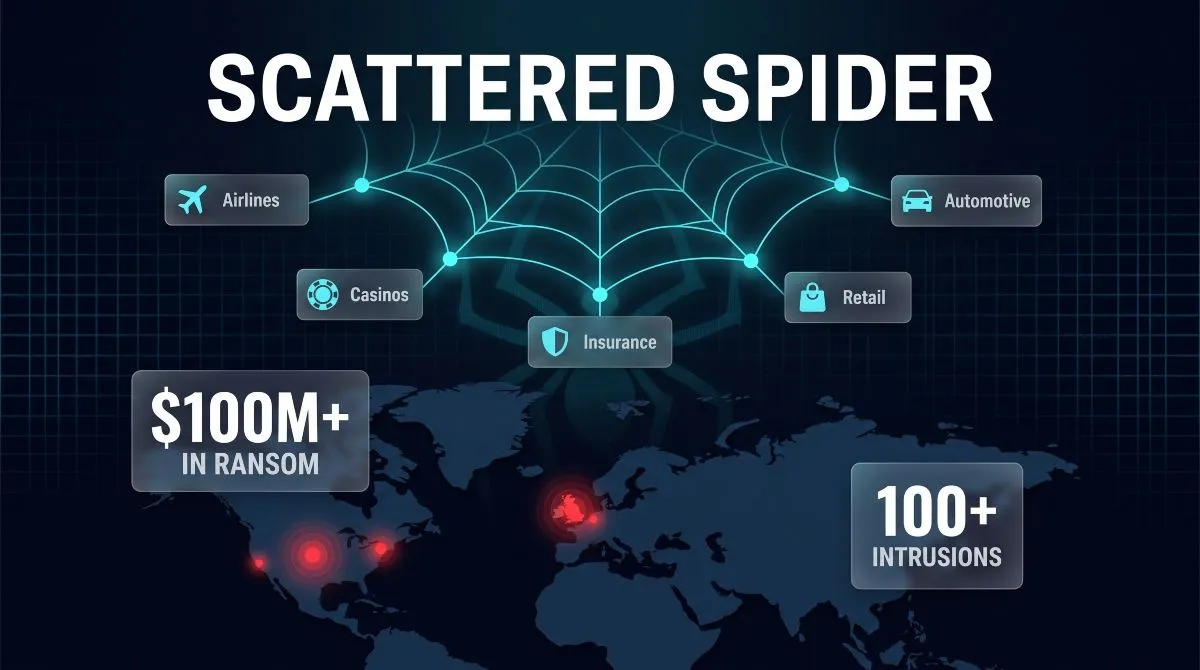
Scattered Spider | Who They Are, How They Attack, and How to Stop Them
Scattered Spider is a loosely organized cybercrime collective known for breaking into major companies through social engineering rather than malware, tricking help desks and employees into…
Read more
DragonForce Ransomware | Group Profile, Cartel Alliance & Attack Analysis (2026)
DragonForce ransomware is a ransomware-as-a-service (RaaS) operation that began as a pro-Palestine hacktivist collective based in Malaysia before pivoting to ransomware, and has since grown into…
Read more