Dark web red rooms are alleged live-streaming channels on the Tor network where viewers pay in cryptocurrency to watch, and sometimes direct, acts of torture or murder against unwilling victims. The concept has circulated online for over a decade, spawning viral threads, reaction videos, and hundreds of thousands of monthly search queries.
But here is what cybersecurity researchers, law enforcement agencies, and dark web analysts consistently agree on: no verified red room has ever been documented.
That gap between what people believe exists and what actually does is precisely what this guide addresses. Whether you encountered the term on Reddit, a true crime forum, or a late-night YouTube rabbit hole, you deserve a straight answer, not more speculation. What follows is a factual breakdown of where the red room myth came from, why it persists, what the named variants (monkey room, nth room, blank room soup) actually are, and what real dark web threats look like for ordinary people whose data is genuinely at risk right now.
What Is a Dark Web Red Room?
A dark web red room is a fictional concept describing a live-streamed broadcast, hosted on the Tor network and accessible only via a hidden onion URL, in which a person is tortured or killed on camera. At the same time, a paying audience watches and submits requests in real time. The term has become one of the most searched dark web topics globally, despite no credible evidence that such a service has ever existed.
The Origin of the “Red Room” Term
The red room concept did not originate on the dark web. It traces back to a 2004 Japanese Flash animation called Red Room (赤い部屋), a horror short in which a pop-up window appears on a character’s computer asking “Do you like red?”, a prelude to a gruesome ending. The animation spread rapidly across early internet forums and became one of the first viral creepypasta stories of the broadband era.
By the late 2000s, as public awareness of Tor and the dark web grew through media coverage of Silk Road and similar marketplaces, the red room concept migrated. Forum users began presenting it not as fiction but as something that could plausibly exist in the hidden corners of the internet most people could not access. The story mutated from a horror short into an urban legend presented as fact.
What a Red Room Is Claimed to Be
According to the mythology, a red room operates as a pay-per-view torture broadcast. The standard narrative includes several consistent elements: the stream is accessible only through a specific onion link shared in private dark web forums, entry costs a fee paid in Bitcoin or Monero, and viewers can submit instructions, for an additional payment, that dictate what happens to the victim on screen. Some versions of the story include a chat interface running alongside the video feed.
The name of the room, in most tellings, comes from what the walls eventually look like.
These details have remained remarkably stable across years of retelling, which is itself a feature of urban legend mechanics rather than evidence of authenticity. Real criminal operations on the dark web are documented to change constantly to avoid detection; a fixed, interactive, live-streamed production would represent an operational security failure of enormous scale.
Why the Name “Red Room”?
The “red room” label does double duty as both a visual reference and a psychological trigger. Red carries immediate associations with blood, danger, and transgression, making it an effective hook for horror content. Combined with “room,” it implies an enclosed, inescapable space, which amplifies the Dread the concept is designed to provoke.
From a search behavior standpoint, the phrase is also deceptively simple. It is short, memorable, and ambiguous enough to feel like insider knowledge, the kind of term someone might whisper rather than announce. That quality has made it highly shareable across social platforms, forums, and comment sections, which is a major reason it continues to generate search volume years after its debunking became widely available.
Are Dark Web Red Rooms Real? The Truth
Dark web red rooms are not real. No law enforcement agency, cybersecurity firm, or independent dark web researcher has ever documented a verified red room broadcast, not a single confirmed case, anywhere, in the entire documented history of Tor network investigations.

What Cybersecurity Experts and Law Enforcement Say
The consensus across the security community is unambiguous. Agencies, including the FBI, Europol, and the UK’s National Crime Agency, have conducted extensive operations targeting illegal content on the dark web, operations that have successfully dismantled child exploitation networks, drug marketplaces, weapons trafficking rings, and ransomware infrastructure. None of these investigations, across decades of combined dark web surveillance, has produced evidence of a functioning red room.
Cybersecurity researchers who map dark web content professionally, including teams at Recorded Future, DarkOwl, and similar threat intelligence firms, categorize red rooms alongside other dark web myths. When journalists and security analysts have followed claimed red room links, they have found one of three things: scam pages designed to extract Bitcoin from curious users, shock image sites with no live component, or simply dead links.
The scam angle is well-documented. A 2019 analysis by Vice’s Motherboard identified numerous dark websites explicitly marketing themselves as red rooms, all of which were straightforward fraud operations collecting entry fees and delivering nothing. The fraud itself is the product.
Why Real-Time Dark Web Torture Streams Are Technically Implausible
Beyond the absence of evidence, the architecture of a genuine red room would require its operators to solve several serious technical problems simultaneously, each of which creates significant exposure to detection and arrest.
Live video streaming generates substantial bandwidth. Tor, by design, is slow; it routes traffic through multiple encrypted relays to anonymize users, and that process is fundamentally incompatible with the demands of high-quality, real-time video broadcast. Any operator attempting to run a live stream over Tor would face constant latency, degraded video quality, and a dramatically increased risk of traffic correlation attacks that could expose the server’s physical location.
Beyond bandwidth, a live interactive broadcast requires a stable, persistent infrastructure: a hosting environment, a payment processing layer, a chat interface, and an audience management system, all running simultaneously, all maintaining anonymity, all under operational conditions where a single technical failure could expose the location of the stream, the operator, or both. Law enforcement has de-anonymized far more technically sophisticated dark web operations using far smaller attack surfaces than a live-streamed production would present.
The people who actually run illegal operations on the dark web understand this. Real criminal infrastructure prioritizes minimal footprint, automated processes, and rapid takedown resilience. A live interactive torture broadcast is the operational opposite of all three.
Documented Evidence (Or Lack Thereof)
In the absence of any verified red room, what passes for “evidence” online falls into predictable categories. Claimed screenshots are invariably traced back to edited images, horror fiction forums, or staged photography. Purported links either resolve to scam pages or return 404 errors. “Footage” circulating on YouTube and Reddit has been traced, without exception, to horror short films, staged viral videos, or unrelated crime scene material repurposed for shock value.
The most frequently cited piece of supposed red room footage, a video known informally as “1 Lunatic 1 Ice Pick,” which circulated widely in the early 2010s, was not a red room. It was a documented murder committed by Luka Magnotta in Montreal in 2012. Magnotta was arrested, tried, and convicted. The video was evidence in a criminal prosecution, not a dark web broadcast. Its repeated misidentification as red room content illustrates precisely how the myth sustains itself: real violence, stripped of context, gets repackaged as confirmation of a fictional framework.
Where the Myth Comes From (4chan, Creepypasta, Urban Legends)
The red room myth is a product of three overlapping internet subcultures that share a common incentive: the social reward of possessing and sharing forbidden knowledge.
4chan’s /x/ board, dedicated to paranormal and horror content, was an early and prolific amplifier of dark web mythology beginning around 2008 to 2010. Threads presenting dark web red rooms as real, complete with fabricated onion links and invented personal testimonies, were a recurring format. The platform’s anonymity made fabrication costless and an absolute plausible deniability.
Creepypasta, the genre of internet horror fiction that includes Slender Man, Jeff the Killer, and similar figures, provided the narrative templates. Red room stories follow classic creepypasta structure: second-hand testimony, escalating Dread, and an ambiguous ending that leaves the reader uncertain whether the story is fictional. That structural ambiguity is intentional. It is what makes creepypasta spread.
The broader dark web urban legend ecosystem supplied the credibility scaffolding. By the early 2010s, mainstream media coverage of Silk Road had established the dark web in public consciousness as a genuinely lawless space where anything could be purchased. That accurate-but-incomplete framing made outlandish claims about dark web content feel plausible to audiences with no firsthand knowledge of how Tor actually works. Red rooms slotted neatly into a pre-existing mental model that real journalism had inadvertently constructed.
Red Room Footage, What People Actually Find
When people go searching for dark web red room footage, what they actually encounter is one of three things: reaction videos staged by content creators, deliberate hoaxes designed to go viral, or real criminal evidence misidentified and stripped of its original context. None of it is a red room. All of it functions as fuel for a myth that does not need facts to survive, only attention.
Reaction Videos and Why They Go Viral
The dominant format for red room content on mainstream platforms is the reaction video. A creator, typically in the true crime or dark web “exploration” niche, films themselves, watching something on screen while performing escalating expressions of shock and horror. The audience rarely sees what the creator is supposedly watching. The reaction is the content.
This format is well-suited to viral spread. Platforms reward watch time, emotional engagement, and shares, and a video promising forbidden content from the dark web delivers all three, regardless of whether the footage is real, staged, or simply a horror short from a film school portfolio. Titles like “I Found a Real Red Room on the Dark Web” generate clicks precisely because they cannot be immediately disproven by a viewer with no dark web access.
The creator assumes no real risk. If the footage is fake, and it almost always is, that revelation can itself become a follow-up video. The myth is monetizable in both directions.
YouTube’s own enforcement data illustrates the scale of this ecosystem. The platform removes millions of videos annually for violations of violent or graphic content, yet red room reaction content consistently navigates moderation by keeping the alleged source footage off-screen. The reaction is technically clean. The implication does the rest of the work.
Known Hoaxes and Staged Content
Several specific pieces of content have circulated for years under the Red Room label and been thoroughly traced to non-dark-web origins.
The video most commonly presented as red room footage, referenced in the previous section, is the Luka Magnotta recording from 2012. This documented murder became criminal evidence in a Canadian court. It was never a broadcast. It was never interactive. It was filmed by the perpetrator, distributed through mainstream file-sharing platforms, and investigated by Interpol. Its repeated repackaging as dark web content is a function of how effectively the red room framework absorbs any sufficiently disturbing video that lacks an immediately obvious origin.
A second category of circulating content comes from horror film productions. Several low-budget horror shorts, including deliberately ambiguous found-footage style films produced for film festivals and online distribution, have been stripped of their credits, re-uploaded, and presented as authentic. One Japanese horror short produced in the early 2000s inspired copycat productions specifically designed to be mistaken for real footage, a creative choice that fed directly back into the myth’s growth.
The third and most cynical category is purpose-built fraud content: dark web pages and surface web videos produced specifically to simulate the red room aesthetic, dimly lit rooms, distorted audio, countdown timers, Bitcoin wallet addresses, with the explicit goal of extracting money from believers. Security researchers and journalists have repeatedly documented these operations, and they continue to operate because the audience that believes in red rooms is also the one most likely to pay to access one.
How to Identify Fabricated Dark Web Content
Fabricated dark web content follows consistent patterns that become easy to recognize once you know what to look for.
The first signal is the absence of a verifiable origin. Authentic criminal evidence, the kind that results in prosecutions, has a documented chain of custody. It appears in court records, law enforcement press releases, and investigative journalism with named sources. Content presented as dark web footage rarely has any of these anchors. It circulates without origin, without date, without the institutional trail that real criminal documentation leaves behind.
The second signal is inconsistent production quality. Genuine hidden-camera or surveillance footage has specific visual characteristics: fixed angles, poor lighting, and no editing. Content presented as red room footage frequently contains cuts, audio manipulation, and framing choices that indicate post-production work, the fingerprints of someone constructing an experience rather than recording one.
The third signal is the monetization layer. Real criminal content is not gated behind a Bitcoin payment on a sketchy onion site. When a supposed dark web page requires payment to proceed, charges a “membership fee” to access footage, or solicits cryptocurrency before revealing anything substantive, the operation is a scam targeting the curious, not a criminal enterprise broadcasting actual violence.
If a piece of content cannot be traced to a documented source, contains production inconsistencies, or requires payment to access, it is fabricated. That framework accounts for the overwhelming majority of what circulates under the red room label.
Dark Web Chat Rooms, What Actually Exists
Dark web chat rooms do exist, but they bear no resemblance to the red room mythology built around them. They are text-based communication channels running on Tor-accessible platforms, used primarily by journalists, political dissidents, privacy advocates, and, on the criminal end, fraud operators and data traders. Live-streamed violence is not part of what they host.

What Dark Web Chat Rooms Are Used For (Legitimately)
The legitimate use cases for dark web communication channels are well-documented and, in many contexts, genuinely important. Journalists operating in authoritarian regimes use Tor-based messaging and forum infrastructure to communicate with sources without exposing either party to government surveillance. Whistleblowers use SecureDrop, an onion-hosted platform operated by the Freedom of the Press Foundation and used by major newsrooms including The New York Times, The Washington Post, and The Guardian, to submit documents without creating a traceable connection to the recipient organization.
Political dissidents in countries with aggressive internet censorship use dark web forums to organize, share information, and access content blocked at the national level. Privacy researchers, security professionals, and penetration testers use Tor-accessible channels to study network behavior and test anonymization tools in controlled environments.
None of this is exotic. It is the functional application of anonymization technology to real-world communication problems. The dark web is a tool, and, like most tools, its character is determined by who uses it and for what purpose.
How Dark Web Forums Differ from Red Room Claims
The actual architecture of dark web forums makes the red room premise structurally incoherent. Most dark web communication infrastructure is text-based. Forums running on platforms like Dread, the dark web’s closest equivalent to Reddit, operate through standard message board mechanics: threaded posts, user accounts, upvotes, and moderator hierarchies. They are slow, text-heavy, and optimized for asynchronous communication rather than real-time interaction.
Even the more sophisticated dark web chat platforms, which offer real-time messaging rather than forum-style threading, are primarily used to coordinate transactions on dark web markets. A buyer and a vendor negotiating a drug purchase do not need video infrastructure. They need encrypted text and a reliable escrow system. The criminal economy of the dark web is transactional and text-driven because text is low-bandwidth, low-footprint, and difficult to attribute.
The red room model, live video, real-time audience interaction, and pay-per-request mechanics require an entirely different and far more complex technical stack than anything the documented dark web communication ecosystem actually supports. The gap between what red rooms are claimed to be and what dark web chat infrastructure actually looks like is not a matter of degree. It is a categorical mismatch.
Are Dark Web Chat Rooms Dangerous?
The honest answer is: it depends entirely on what you are doing there and what you are sharing in the process.
For the vast majority of people who stumble onto dark web forums out of curiosity, the primary risk is not violence; it is exposure. Dark web marketplaces and forums are actively monitored by law enforcement agencies in the US, EU, and UK. Europol’s 2023 cybercrime report documented over 6,500 suspects identified through dark web investigations in a single year, the majority of whom were caught through operational security mistakes made by users who believed their anonymity was absolute.
A secondary risk is credential and data exposure. Dark web forums are active trading environments for stolen personal information, email addresses, passwords, financial credentials, and Social Security numbers, harvested from breaches and sold in bulk. The danger most people face from the dark web is not encountering something horrifying on a live stream. It is that their own data is already being traded in those text-based forums right now, without their knowledge.
That is the real dark web threat landscape: not red rooms, but the quiet, transactional circulation of personal data that funds fraud, account takeover, and identity theft at scale. Understanding what dark web chat rooms actually are, and are not, is the first step toward understanding what genuine exposure looks like.
Every “Room” Variant Explained
The red room concept has spawned a family of named variants, the monkey room, the nth room, the blue room, blank room soup, each with its own mythology, its own viral circulation pattern, and its own relationship to reality. Some are pure fiction. One is not. Understanding which is which matters because conflating them does a disservice to both critical thinking and the real victims involved in the genuine case.
The Monkey Room, What It Is and Whether It’s Real
The monkey room is a claimed dark web channel where users allegedly pay to watch animal abuse, specifically, harm inflicted on primates, live on stream. It circulates primarily in the same forums and subreddits that amplify Red Room content, and it follows the same structural pattern: a hidden onion URL, a cryptocurrency entry fee, and a live, interactive audience.

It is not real in the form described. No verified monkey room broadcast has ever been documented by law enforcement or independent researchers. However, the underlying behavior it references, the filming and distribution of animal cruelty content, is a genuine and prosecuted criminal category that exists on both the surface web and dark web. The monkey room mythology takes a real category of criminal content. It reframes it inside the red room framework, lending it the same false specificity that makes all these variants feel more credible than they are.
The conflation is deliberate in some cases and incidental in others. Either way, the result is the same: a real problem gets buried under a fictional narrative that makes it harder to take seriously.
The Nth Room, A Real Case (South Korea, 2018–2020)
The nth room is the entry in this list that requires a different register entirely, because it was real.
Between 2018 and 2020, a network of Telegram-based chat rooms in South Korea operated a systematic sexual exploitation and extortion scheme targeting women and minors. Victims, some as young as 11, were coerced into producing explicit content through blackmail and manipulation. That content was then distributed through a tiered room structure, with access to more severe material gated behind higher cryptocurrency payments. The rooms were numbered, and the highest tier, “Room N”, gave the case its name.
The primary operator, Cho Ju-bin, was arrested in March 2020 following a joint investigation by South Korean police and civilian digital rights groups. He was convicted and sentenced to 42 years in prison. A second key operator received a 34-year sentence. Over 70 individuals involved in operating or accessing the rooms were prosecuted. Investigators identified approximately 74 victims and over 260,000 people who had accessed the rooms at various levels.
The nth room case is the closest documented real-world analog to the red room mythology, a paid, tiered, criminal content network operating through chat infrastructure. But the mechanics are entirely different from the red room model. There was no live torture stream. There was no interactive kill-on-demand audience. There was a systematic, text-and-image-based extortion and distribution network that caused severe and documented harm to real people. It deserves to be understood on its own terms, not absorbed into a fiction that dilutes its gravity.
Blue Room, Black Room, White Room, Shout Room, Origins and Reality
These variants follow a consistent production pattern: take the red room template, change the color, adjust the claimed content slightly, and redistribute. None has documented real-world counterparts.
The blue room variant, sometimes called the “blue room suicide”, claims to be a live-streamed broadcast of suicide, with viewers interacting in real time. It circulates primarily in East and Southeast Asian internet communities, particularly in Thai-language forums, where the “red room dark web pantip” search queries originate. Pantip is a major Thai web forum where the mythology has had significant traction.
The black room and white room variants are structurally identical to the red room but with different aesthetic framings, the black room implying total sensory deprivation torture, the white room implying clinical or institutional horror. Both are creepypasta derivatives with no documented basis.
The shout room is a lesser-known variant claiming to be an audio-only channel, a dark web stream of someone screaming in prolonged distress. It surfaces occasionally in horror fiction communities and shares the same origin infrastructure as the others: anonymous forum posts, no verifiable links, no evidence trail.
What connects all of these variants is their narrative utility. Each one occupies a slightly different horror niche, animal cruelty, suicide, clinical violence, pure audio terror, while sharing the same foundational claim: that the dark web hosts an interactive, pay-to-access cruelty economy. The variations exist to keep the mythology fresh and to serve different audience sensibilities, not because different criminal operations independently arrived at the same business model.
Blank Room Soup, The Viral Video Explained
Blank room soup is not a dark web video. It is a piece of found footage that achieved viral status through decontextualization and the now-familiar process of red room myth absorption.
The original video shows a distressed individual eating soup in a featureless room while an unseen figure in a costume stands nearby. The footage is genuinely unsettling, as ambiguous, context-free video often is. It circulated initially without explanation, which created the conditions for speculation, and the dark web mythology ecosystem supplied the explanation it sought.
The video has been traced to a low-budget art or experimental film project. It was not filmed on the dark web. It was not a broadcast. Nobody was harmed in its production. Its repeated misidentification as dark web content is a textbook example of how the red room framework operates: unsettling footage, missing context, and an audience primed to believe equals apparent confirmation of a myth that requires no actual evidence to sustain itself.
Dark Web Torture Room, Separating Fact from Fiction
The “dark web torture room” framing is a broader, less specific variant of the red room myth, one that functions more as a category label than a named channel. It appears in search queries from users looking for confirmation that extreme violence exists somewhere on the dark web in an interactive, accessible form.
The factual answer is that documented dark web criminal content involving real violence does exist, but not in the form the torture room concept describes. Law enforcement operations have uncovered child sexual abuse material networks, snuff film distribution rings, and hitman-for-hire scam operations. These are prosecuted criminal categories with documented case histories. They are static distribution networks, not live interactive broadcasts, and accessing them carries serious criminal liability in most jurisdictions.
The distance between what these operations actually are and what the torture room mythology describes is significant. Real dark web criminal content is transactional, distributed, and archival. It does not have a chat interface. It does not take audience requests. It does not run on Tor’s bandwidth-constrained infrastructure as a live stream. The torture room concept is the red room concept with the serial numbers filed off, the same fictional architecture dressed in slightly different language.
Why These Myths Spread So Effectively
Dark web myths spread because they are structurally engineered to spread, not through conspiracy, but through the accidental convergence of human psychology, platform mechanics, and a subject matter that is genuinely difficult for most people to verify firsthand. The red room concept, in particular, has proven unusually durable because it sits at the intersection of several powerful amplification systems.
The Psychology of Dark Web Urban Legends
The core psychological engine behind dark web urban legends is what researchers call the “forbidden knowledge effect”, the measurably stronger drive to seek out information that has been framed as secret, dangerous, or inaccessible. A 2021 study published in the Journal of Experimental Psychology found that warnings labeling information as restricted or forbidden consistently increased the desire to access it, regardless of the information’s actual content. The dark web, by its nature, is the perfect vessel for forbidden knowledge: it is real, it is inaccessible to most people without technical effort, and it has a documented history of hosting genuinely illegal content. That combination makes implausible claims about it feel credible in a way they would not if attached to a more familiar context.
Red Room mythology also exploits a well-documented feature of how people assess risk and reality: the availability heuristic. When an idea is easy to recall because it has been encountered repeatedly in vivid form across multiple platforms, the brain treats that ease of recall as evidence of truth. The more a person has seen red room content, the more real it feels, independent of whether any of that content contained verifiable evidence. Repetition functions as proof in the absence of the ability to disprove.
A third psychological layer is the social reward structure around insider knowledge. Sharing a red room link, a claimed screenshot, or a personal testimony of dark web exploration carries social currency in certain online communities. It signals access, fearlessness, and proximity to the forbidden. That social reward exists regardless of whether the content is real, which means the incentive to share is entirely decoupled from any obligation to verify.
Social Media, Reddit, and Quora’s Role in Amplifying Myths
Platform architecture has done as much to sustain dark web mythology as human psychology. Reddit, Quora, and social media platforms are optimized for engagement, and few topics generate engagement as reliably as claims about the dark web.
Reddit’s subreddit structure created dedicated communities, r/deepweb, r/onions, r/darknet, where dark web mythology mixed freely with genuine technical discussion. A new user encountering a red room claim in a thread alongside accurate information about Tor had no reliable way to distinguish between them. Upvote mechanics rewarded compelling narratives over accurate corrections, meaning that a vivid first-person red-room testimony consistently outperformed a technically detailed debunking in visibility and reach.
Quora’s format created a different but equally effective amplification mechanism. The platform’s question-and-answer structure lent an air of authority to any response that was detailed and confidently written, regardless of its factual basis. Searches for “red room dark web quora” generate consistent volume specifically because Quora results surface prominently in Google for question-format queries, and the answers those pages contain range from careful debunking to elaborately detailed fiction presented as firsthand experience, with no reliable signal to help a reader tell the difference.
On platforms like TikTok and YouTube, the recommendation algorithm’s preference for watch-time and emotional response created a pipeline from curiosity to mythology. A user who watches one dark web explainer video is served progressively more sensational content, a documented feature of recommendation systems that several platform transparency reports have acknowledged. The red room sits near the top of the dark web content pyramid in terms of sensationalism, which means it is algorithmically favored regardless of its factual status.
How Creepypasta Became “Dark Web Fact”
The migration of creepypasta from clearly labeled fiction to accepted fact is one of the more instructive media phenomena of the early internet era, and the red room is its clearest case study.
Creepypasta as a genre was built on deliberate ambiguity. Unlike traditional horror fiction, which announces itself as fiction through publication context and authorial framing, creepypasta was designed to circulate without those contextual markers. It was copied and pasted across forums, stripped of authorship, and reposted in contexts, news aggregators, social media feeds, and message boards where the fictional framing was absent or invisible. That stripping of context was not a bug. It was the distribution mechanism.
When the dark web entered public consciousness as a real and genuinely lawless space, accelerated by mainstream media coverage of Silk Road’s 2013 takedown, creepypasta authors had a new and powerful credibility scaffold to attach their fiction to. Stories that might previously have been read as obvious horror fantasy could now be framed as plausible dark web activity, because audiences knew the dark web was real and knew they could not easily verify claims about it. The fictional architecture of the red room, hidden URLs, cryptocurrency payments, and anonymous operators, mapped perfectly onto what the public understood about how dark web markets actually worked.
The result was a genre collapse. Creepypasta that referenced the dark web stopped being processed as horror fiction by a meaningful portion of its audience and started being processed as underground journalism. By the time platforms like Reddit and YouTube had built large communities around dark web content, the distinction between documented dark web activity and creepypasta-derived mythology had become functionally invisible to casual consumers, which is precisely where the myth has remained ever since.
What the Real Dark Web Actually Contains
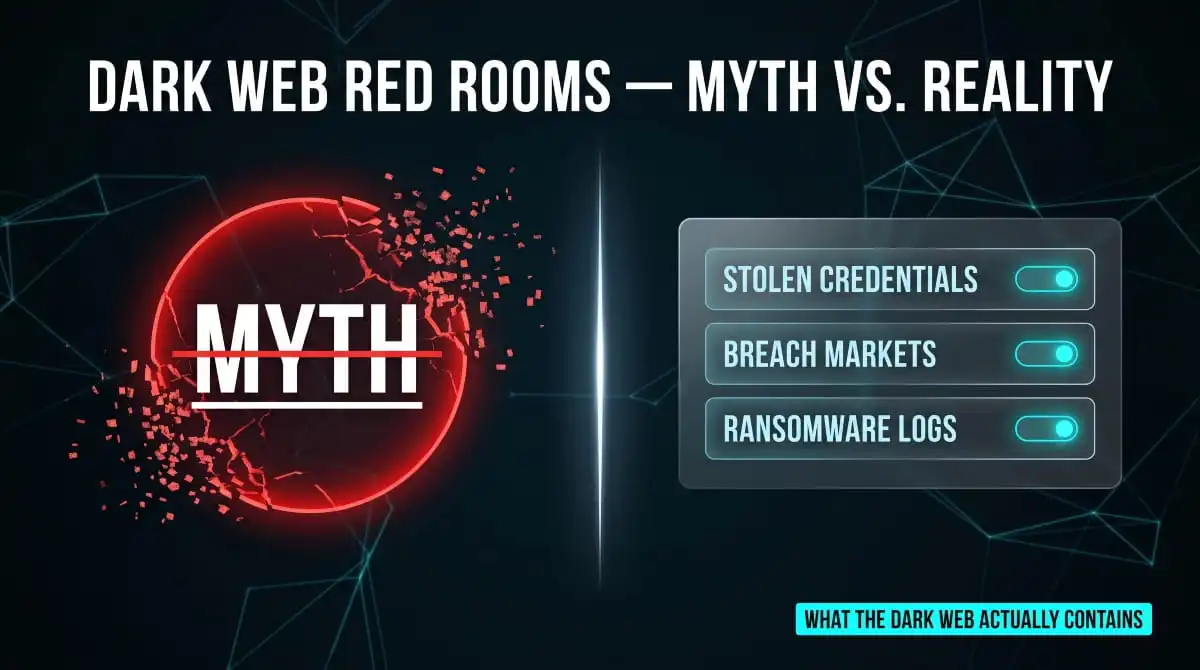
The real dark web is not a theater of live-streamed violence; it is a marketplace. The documented criminal economy of the dark web runs on stolen data, compromised credentials, ransomware infrastructure, and fraud tooling: transactional, scalable, and largely invisible to the people it affects most directly. Understanding what actually exists there is more useful, and more alarming, than anything the red room mythology has ever offered.

Illegal Marketplaces vs. Myths
Dark web illegal marketplaces operate on the same basic mechanics as legitimate e-commerce platforms. They offer vendor listings, customer reviews, dispute-resolution systems, and search functionality. The difference is the inventory: narcotics, stolen financial credentials, forged documents, malware-as-a-service packages, and bulk personal data harvested from breaches.
The scale of this economy is documented and significant. At its peak in 2022, Hydra Market, a Russian-language dark web marketplace, was processing an estimated $1.35 billion in annual transactions before its seizure by German federal authorities in April of that year. Hydra’s takedown was the largest dark web marketplace enforcement action in history at the time, and it was followed within months by the emergence of successor platforms that collectively absorbed a substantial portion of its former user base. The market did not disappear. It redistributed.
What these marketplaces do not include is the interactive violence infrastructure described in Red Room mythology. The incentive structure of dark web criminal commerce runs in exactly the opposite direction: toward automation, toward low operational footprint, toward products that can be listed, sold, and delivered without direct human interaction. A live-stream torture broadcast requires persistent human presence, real-time technical management, and a visible infrastructure that law enforcement could identify and dismantle within hours. No rational criminal operator builds that when they can sell a database of two million stolen credentials with a single file upload.
Actual Threat Categories: Stolen Data, Credential Leaks, Ransomware
The three categories that represent the real dark web threat landscape for individuals and organizations are stolen personal data, credential leaks, and ransomware, each operating through distinct but sometimes overlapping distribution channels.
Stolen personal data arrives on dark web markets primarily through large-scale breaches of consumer-facing platforms. When a retailer, healthcare provider, or financial institution is compromised, the harvested records, names, email addresses, dates of birth, social security numbers, and payment card details are packaged and sold in bulk. IBM’s 2023 Cost of a Data Breach Report found that the average breach took 204 days to identify and 73 days to contain, meaning the data from a major breach typically circulates on dark web markets for months before the affected organization publicly confirms the incident.
Credential leaks are a distinct but related category. Infostealer malware, deployed through phishing emails, malicious downloads, and compromised browser extensions, harvests login credentials directly from infected devices and uploads them to dark web repositories called logs. These logs are sold or shared in bulk and used to conduct account takeover attacks against banking platforms, email providers, corporate VPNs, and e-commerce accounts. The 2024 National Public Data breach exposed an estimated 2.9 billion records, including Social Security numbers and addresses, making it one of the largest single credential exposure events ever documented.
Ransomware infrastructure represents the third major category and operates at the organizational rather than the individual level. Dark web forums host ransomware-as-a-service platforms where criminal groups license malware tooling to affiliates, negotiate ransom payments, and publish stolen data on dedicated leak sites when victims refuse to pay. The ransomware ecosystem is one of the most financially significant and well-documented criminal industries on the dark web, generating billions in annual revenue across hundreds of active groups.
How Your Personal Data Ends Up on the Dark Web
Most people whose data appears on the dark web did nothing wrong and took no unusual risks. Their exposure is a downstream consequence of breaches at organizations they trusted with their information, companies, healthcare providers, government agencies, and platforms that were compromised through vulnerabilities that had nothing to do with the individual user.
The pathway from breach to dark web listing typically follows a predictable sequence. An organization is compromised through a vulnerability exploit, a phishing attack against an employee, or a third-party supply chain weakness. The attacker exfiltrates user records before deploying any visible payload, ransomware, or defacement, to maximize the window between compromise and detection. Those records are then either sold directly to brokers on dark web markets, posted on leak forums to establish the attacker’s credibility, or held for targeted fraud operations against high-value individuals in the dataset.
Infostealer malware creates a parallel pathway. A single malware infection on a personal or work device can harvest saved passwords, session cookies, autofill data, and stored payment credentials in minutes, uploading them to a dark web log repository before any antivirus detection triggers. The user experiences nothing unusual. Their credentials were already circulating before they knew anything had happened.
The practical consequence is that exposure on the dark web is not a hypothetical risk for a subset of high-profile targets. It is a statistical near-certainty for anyone who has maintained online accounts for more than a few years. Have I Been Pwned, the breach notification database maintained by security researcher Troy Hunt, currently indexes over 14 billion compromised accounts, a figure that continues to grow with every major breach disclosure.
How to Protect Yourself from Real Dark Web Threats
Protecting yourself from real dark web threats means monitoring the places where your data actually gets traded, not avoiding fictional dangers, but staying ahead of the documented ones. The good news is that meaningful protection does not require technical expertise or access to the dark web. It requires the right monitoring infrastructure and a clear response protocol when exposure is confirmed.

Dark Web Monitoring, What It Is and How It Works
Dark web monitoring is the continuous, automated scanning of dark web markets, leak forums, paste sites, ransomware group blogs, and credential repositories for personal or organizational data that should not be there. When a match is found, an email address in a breach database, a password in a stealer log, or a social security number in a leaked dataset, the monitoring service alerts the affected individual or organization before that data can be weaponized.
The technical process works through a combination of indexed dark web sources and real-time crawler infrastructure. Reputable monitoring platforms maintain persistent access to dark web data sources, including Tor-hosted markets, Telegram channels used for data trading, and the public-facing leak pages that ransomware groups use to publish stolen files, and cross-reference that data against a protected identity profile. The match triggers an alert. The user does not need to access the dark web themselves, navigate Tor, or know where to look. The monitoring layer does that work continuously in the background.
The distinction between dark web monitoring and a one-time breach check matters here. A single scan tells you whether your data appeared in a previously indexed breach. Continuous monitoring tells you the moment new exposure occurs, which is the operationally useful signal, because the window between a breach and criminal use of the stolen data is often measured in hours, not weeks.
What to Do If Your Data Is Found on the Dark Web
Finding your data on the dark web is not an emergency that requires panic; it is a signal that calls for a specific, prioritized response. The data cannot be removed from dark web markets or forums once it has been listed. The response is therefore entirely forward-looking: close the attack surface that the exposed data opens.
The priority is credential rotation. If the exposed data includes a password, even one you no longer actively use, change it immediately on every platform where it was or might have been reused. Password reuse is the primary attack vector enabled by credential leaks, and rotating the compromised credential before an attacker attempts account takeover is the highest-value action available. Enable multi-factor authentication on every account where it is offered, prioritizing email, banking, and any platform connected to payment information.
If the exposed data includes financial information, card numbers, bank account details, or sufficient personal identifiers that could be used for credit fraud, place a credit freeze with all three major bureaus: Equifax, Experian, and TransUnion. A credit freeze is free, reversible, and prevents new credit accounts from being opened in your name, regardless of what information an attacker holds. It is the most effective single action available against identity theft enabled by dark web data exposure.
If the exposure involves a Social Security number, file an identity theft report with the FTC at IdentityTheft.gov, which generates a personalized recovery plan and provides documentation useful for disputing any fraudulent accounts that have already been opened. Monitor your existing accounts, bank statements, credit card activity, and credit report inquiries for anomalies in the weeks following confirmed exposure.
The underlying principle is simple: you cannot control what has already been leaked. You can control how quickly you close the leaky doors.
Free Tools to Check Your Exposure
The fastest way to find out whether your data is already circulating on the dark web is to run a check against a platform that indexes real dark web sources, not just public breach databases, but the stealer logs, market listings, and leak forums where fresh exposure actually appears first.
DeXpose offers a free dark web report at dexpose.io/free-darkweb-report that scans across dark web markets, malware logs, and confirmed breach data to surface any exposure tied to your email address or organization. Unlike basic breach notification tools that index only previously reported incidents, DeXpose’s monitoring infrastructure covers active dark web sources, meaning it can identify exposure from recent stealer log uploads and market listings that public databases have not yet picked up.
The check takes seconds. The output tells you specifically where your data was found, which exposure category it represents, and what the recommended response is. For individuals concerned about personal data exposure, the free report is the logical first step before any other protective action, because you cannot respond effectively to exposure you do not know exists.
For organizations managing employee credential risk, customer data liability, or ransomware group targeting, DeXpose’s continuous monitoring at dexpose.io/darkweb-breaches-monitoring extends that coverage to organizational assets, delivering real-time alerts when company data surfaces in any monitored dark web source.
The red room does not exist. Your data exposure very likely does. The difference between those two facts is the difference between a myth worth debunking and a threat worth acting on.
Frequently Asked Questions (FAQ’s)
What does “red room” mean on the dark web?
A red room is a claimed live-stream broadcast on the dark web where viewers pay cryptocurrency to watch, and direct acts of torture or murder against an unwilling victim. The name originates from a 2004 Japanese horror animation and migrated into dark web mythology as Tor entered public consciousness. No verified red room has ever been documented by law enforcement or independent researchers.
Has anyone ever found a real red room on the dark web?
No. Every claimed red room link has resolved to either a scam page collecting cryptocurrency, a shock site with no live component, or a dead URL. Law enforcement agencies, including the FBI and Europol, have conducted extensive dark web investigations without producing a single confirmed red room case.
What is the monkey room on the dark web?
The monkey room is a claimed dark web channel where users allegedly pay to watch live animal abuse involving primates. It follows the same fictional architecture as the red room myth and has no documented real-world counterpart. However, the underlying category of animal cruelty content does exist as a prosecuted criminal offense on both the surface and dark web.
Is the nth room a real dark web red room?
The nth room was real, but it was not a red room. It was a Telegram-based sexual extortion and exploitation network operating in South Korea between 2018 and 2020, affecting approximately 74 victims and accessed by over 260,000 users before its operators were arrested and sentenced to decades in prison. It involved no live torture stream and bore no structural resemblance to Red Room mythology.
What are dark web chat rooms actually used for?
Dark web chat rooms are primarily text-based communication channels used by journalists, whistleblowers, political dissidents, privacy researchers, and, on the criminal end, fraud operators coordinating transactions on dark web markets. Platforms like SecureDrop, used by major newsrooms including The New York Times and The Guardian, run on dark web infrastructure to protect sources.
What is blank room soup?
Blank room soup is a decontextualized video showing a distressed person eating soup in a featureless room while a costumed figure stands nearby. It has been traced to a low-budget experimental film project that was never hosted on the dark web and caused no harm during its production. Its misidentification as dark web content is a textbook example of how unsettling footage without context gets absorbed into red room mythology.
Are blue rooms and black rooms real?
Blue rooms and black rooms are color-variant derivatives of the red room myth with no documented real-world counterparts. The blue room variant, which claims to live-stream suicide, circulates primarily in Thai-language forums, explaining the “red room dark web Pantip” search cluster. Both variants follow the same fictional architecture as the red room and exist to serve different horror niches within the same mythology ecosystem.
What are the real dangers of the dark web?
The real dangers of the dark web are data-driven and transactional: stolen credentials, bulk personal data sold in breach marketplaces, infostealer malware logs, and ransomware infrastructure, not live-streamed violence. IBM’s 2023 Cost of a Data Breach Report found the average breach takes 277 days to identify and contain, meaning your data can circulate on dark web markets for months before you know it exists. Run a free exposure check at dexpose.io/free-darkweb-report to find out what is already out there under your name.