A ransomware data breach occurs when attackers encrypt an organization’s systems and simultaneously steal sensitive data, using the threat of public exposure as a second lever to force payment. It is both a system-availability crisis and a data privacy violation, which is why it triggers legal notification obligations that a simple ransomware attack without exfiltration does not.
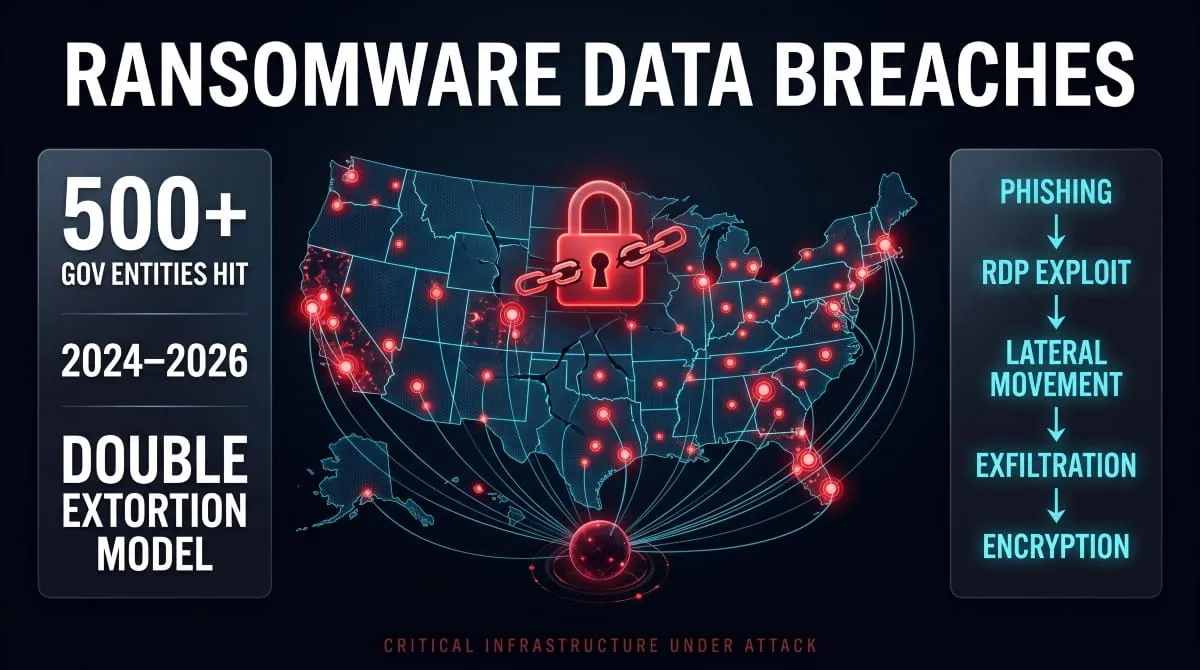
The scale of the problem has outpaced most organizations’ ability to respond. In 2024 alone, ransomware groups claimed responsibility for breaches affecting hundreds of U.S. government entities, from major county governments to small municipal utilities, and the pace accelerated into 2025 and 2026. According to the Cybersecurity and Infrastructure Security Agency (CISA), ransomware remains the most disruptive cyber threat facing state and local governments, with public sector entities now accounting for a disproportionate share of confirmed incidents globally.
This tracker documents confirmed and reported ransomware data breach incidents across U.S. government agencies and private-sector organizations, organized by state and sector. It also explains the legal threshold between a ransomware attack and a reportable data breach, the attack patterns driving the surge, and what affected individuals and organizations should do when their data is at risk.
What Is a Ransomware Data Breach?
A ransomware data breach is a cyberattack in which threat actors both encrypt an organization’s data to demand payment and exfiltrate it to use as additional leverage, leaving the victim facing simultaneous operational paralysis and the exposure of sensitive personal or organizational information. Not every ransomware attack qualifies as a data breach under the law. Still, the majority of modern ransomware incidents do, because exfiltration has become the default tactic for virtually every major ransomware group operating today.
How Ransomware Leads to Data Exposure
Ransomware attacks rarely begin with encryption. The encryption is the final stage, the moment the attacker makes themselves visible. Before that, threat actors typically spend days or weeks inside a compromised network conducting reconnaissance, escalating privileges, and systematically copying high-value data to external infrastructure they control.
This pre-encryption dwell period is what transforms a ransomware attack into a data breach. By the time files are locked and a ransom note appears, the data has already left the building. Encryption is the distraction; exfiltration is the damage. This is why organizations that successfully restore from backups and refuse to pay the ransom still face breach notification obligations; the data was taken regardless of whether the ransom was paid.
Ransomware vs. Data Breach, Are They the Same Thing?
Ransomware and data breaches are not the same thing, but they frequently overlap. A data breach is any incident in which unauthorized parties gain access to protected information. Ransomware is a delivery mechanism, a class of malware, that may or may not result in a breach depending on whether data was accessed or exfiltrated, not merely encrypted.
Early ransomware variants from the mid-2010s were primarily encryption-only attacks: systems were locked, but data was not necessarily stolen. A ransom payment (or a clean backup restore) resolved the incident without triggering breach notification laws in many jurisdictions. That model is largely obsolete. Since 2019, double-extortion ransomware, where attackers steal data before encrypting it and threaten to publish it on dark web leak sites if payment is refused, has become the dominant operational pattern among ransomware groups. Today, the practical answer to “is ransomware a data breach?” is almost always yes.
What Type of Breach Is Ransomware? (Legal & Technical Answer)
Legally, ransomware that involves data exfiltration is classified as an unauthorized access and acquisition breach, the category that triggers notification requirements under most U.S. state breach notification laws, HIPAA, and the EU’s GDPR. It is not merely a system-integrity incident or an availability attack; once personal data has been accessed and copied by an unauthorized party, it meets the threshold for a reportable breach in the vast majority of regulatory frameworks.
Technically, ransomware incidents that involve exfiltration are categorized under the VERIS framework and NIST guidelines as a combination of hacking (initial access), malware (execution and persistence), and data exfiltration, a multi-stage incident rather than a single event. This matters because incident response teams must address all three components, not just the ransomware payload itself.
When Is a Ransomware Attack a Reportable Data Breach?
A ransomware attack becomes a reportable data breach the moment there is evidence, or reasonable basis to believe, that personal data was accessed or acquired by an unauthorized party. Under most U.S. state laws, this triggers a formal notification obligation to affected individuals and, in many states, to the state attorney general, regardless of whether the attacker actually published or monetized the stolen data.
The critical determination is not whether data was encrypted, but whether it was accessed. If forensic investigation cannot rule out exfiltration, which is common, since attackers often operate without leaving clean logs, regulators and courts have increasingly taken the position that organizations must assume exfiltration occurred and notify accordingly. The FBI and CISA both advise that the absence of confirmed exfiltration is not the same as confirmed non-exfiltration, and notification timelines, typically 30 to 72 hours for federal contractors and regulated industries, and 30 to 90 days under most state laws, begin from the moment the incident is discovered, not when exfiltration is confirmed.
Why Government Entities Are the Hardest-Hit Targets
Government entities, particularly county governments, municipal agencies, and small city administrations, have become the most consistently targeted sector in the ransomware data breach landscape. They hold large volumes of sensitive personal data, operate on constrained IT budgets, and face legal transparency obligations that make concealment nearly impossible, which creates a threat profile that ransomware groups have learned to exploit systematically.

Legacy Infrastructure and Underfunded IT Security
The core vulnerability of government entities is structural. Most county and municipal systems run on infrastructure that was never designed to withstand modern threat actors, aging Windows servers, unpatched software, flat network architectures with minimal segmentation, and remote access solutions that were bolted on during the pandemic without adequate security hardening. These are not edge cases; they are the norm across thousands of local government networks in the United States.
The budget gap compounds the problem. A mid-sized county government might allocate less than 5% of its IT budget to cybersecurity, a fraction of what a comparably sized private-sector organization would spend. Dedicated security operations centers, endpoint detection and response tools, and 24/7 monitoring are luxuries most municipal IT departments cannot afford. Many rely on a small team, sometimes a single administrator, to manage everything from helpdesk tickets to firewall rules. According to the Multi-State Information Sharing and Analysis Center (MS-ISAC), over 60% of state and local government entities that reported a ransomware incident lacked a formal incident response plan at the time of the attack.
The Public Records Problem: Why Local Governments Can’t Pay and Can’t Stay Silent
Local governments find themselves in an impossible position when hit by ransomware. On the one hand, paying a ransom using public funds is legally and politically fraught; several states have introduced or passed legislation restricting or prohibiting ransomware payments by government agencies, and even where payments are technically permitted, the political fallout is severe. On the other side, the public sector’s transparency obligations mean that system outages, audit findings, and breach notifications become part of the public record in ways that private companies can avoid.
This dynamic explains why so many government ransomware incidents surface through indirect channels: a county commission meeting agenda that mentions “cybersecurity remediation costs,” a state auditor’s report flagging irregular IT expenditures, a permitting office that goes offline for weeks with no explanation. The paper trail exists even when official communications do not, and investigative journalists and researchers have become adept at reading it. The result is that government ransomware data breaches are both harder to quietly resolve and harder to fully disclose, leaving affected residents in a prolonged state of uncertainty about whether their personal data was exposed.
Ransomware Groups Specifically Targeting Municipal Systems
The surge in government ransomware incidents is not incidental; it reflects a deliberate strategic shift by ransomware groups toward targets they have profiled as high-probability, lower-resistance victims. Groups including LockBit, BlackCat/ALPHV, Cl0p, Qilin, and Rhysida have all claimed government entities among their highest-profile victims in the 2024–2026 period, with Rhysida and Qilin in particular demonstrating a pattern of targeting county governments, school districts, and municipal utilities across multiple U.S. states.
The targeting logic is straightforward. Government systems often have predictable network architectures, publicly available procurement records that reveal software versions, and IT staff stretched too thin to respond quickly to initial access attempts. Ransomware-as-a-service affiliates, who do the actual intrusion work while the ransomware developer takes a revenue cut, actively seek these environments because dwell time is longer, detection is slower, and the operational pressure to restore services quickly creates leverage that forces faster negotiation. For a ransomware affiliate scanning for accessible RDP ports or unpatched VPN appliances, a county government network is a reliable target, unlike a hardened enterprise environment.
Ransomware Data Breaches by U.S. State (2024–2026 Tracker)
This section documents confirmed and reported ransomware-related data breach incidents across U.S. government entities by state, drawn from public records, state auditor reports, official breach notifications, local news reporting, and dark web monitoring intelligence. Where an incident has been publicly acknowledged by the affected entity or a credible third-party source, it is included. The breadth of this tracker reflects a documented national pattern: ransomware data breaches against local government are not isolated events but a systemic, ongoing crisis affecting every region of the country.

California, Cities and Counties Hit by Ransomware
California has the largest concentration of documented government ransomware data breach incidents among U.S. states in the 2024–2026 period, reflecting both its population density and the sheer number of independent municipal governments operating across the state. Incidents span the full geographic range of California, from major cities to small agricultural communities in the Central Valley.
The City of Fresno experienced a significant ransomware-related cyber incident affecting municipal systems, with investigation and remediation efforts extending into 2025 and 2026. The City of Pasadena confirmed a data breach following a ransomware attack that disrupted city operations. Riverside and Riverside County both reported separate ransomware incidents, underscoring how a single geographic area can sustain multiple unrelated attacks within the same reporting window. The City of Fullerton and the City of Thousand Oaks each reported ransomware-related cyber incidents impacting municipal networks. Ventura confirmed a data breach with official notices issued to affected residents. Carlsbad reported a ransomware incident within the 2024–2025 window. Irvine, one of California’s largest cities, reported cyber incidents consistent with ransomware intrusion patterns.
In Northern California, the City of Folsom reported a ransomware data breach affecting city systems in 2025–2026. Milpitas confirmed a ransomware incident, notable given the city’s proximity to Silicon Valley, demonstrating that technical sophistication in a region’s private sector does not insulate local government from attack. San Ramon reported a ransomware-linked data breach. Lawndale confirmed a cyber incident with ransomware characteristics. Visalia, a major Central Valley city, reported a ransomware attack on its infrastructure. The City of Monterey and Monterey County each reported separate ransomware incidents. Santa Clara County and Santa Cruz County both confirmed ransomware-related data breach events. Nevada County and Placer County reported ransomware cyber incidents affecting county systems. Redding confirmed a ransomware data breach. Tracy reported a ransomware-linked incident.
In Southern California and the greater Los Angeles region, Newport Beach, La Quinta, South Pasadena, El Cerrito, Cupertino, San Luis Obispo, Irwindale, Pinole, El Centro, Colma, National City, Clearlake, Sausalito, El Segundo, Redondo Beach, Walnut, Baldwin Park, La Puente, Glendora, Moorpark, Santa Fe Springs, and Covina all reported ransomware-related data breach incidents within the tracker period.
In the Central Valley, Arroyo Grande, Paso Robles, Tulare, Reedley (with coverage in the Fresno Bee), Chowchilla, Riverbank, and Oakdale each confirmed ransomware or ransomware-adjacent cyber incidents affecting city systems. Colusa County and Plumas County reported ransomware incidents at the county level. Mendocino County confirmed a ransomware incident. The City of Escalon’s incident drew additional scrutiny following a finance director’s audit report. Lathrop and Delano each reported ransomware-related data breaches. Barstow confirmed a breach. Palo Alto, Fremont, and Roseville round out Northern California’s documented incidents for this period.
Florida, Cities and Counties Hit by Ransomware
Florida ranks alongside California as one of the most heavily affected states for government ransomware data breaches, with incidents documented across its full geography, from the Panhandle to Miami-Dade. The state’s large number of independent municipalities, many with aging IT infrastructure, has made it a consistent target.
The City of Bradenton confirmed a ransomware data breach. Panama City reported a ransomware incident spanning the 2024–2026 window. Hollywood confirmed a ransomware breach that took systems offline, created a significant permitting backlog, and disrupted public-facing services for an extended period. The City of Orlando reported cyber incidents consistent with ransomware intrusion affecting city systems across multiple years. Boca Raton confirmed a ransomware data breach. Seminole County, St. Johns County (specifically referenced in public reporting under the sjcfl.us domain), Pasco County, Pinellas County, and Sarasota County all reported county-level ransomware incidents, with Pinellas County confirming a cybersecurity breach affecting county systems.
Santa Rosa County reported a ransomware incident affecting county systems. Pensacola confirmed a ransomware breach. Homestead, Miramar, Palmetto, Parkland, and Sebring each reported ransomware-related cyber incidents. Winter Haven confirmed a data breach. Tavares reported a ransomware incident extending across multiple years. Dania Beach’s incident attracted additional attention due to an associated indictment. Lauderdale Lakes, Deerfield Beach, and Royal Palm Beach each confirmed ransomware-related data breaches. Sebastian and Port Orange reported incidents. Orange City confirmed a ransomware-linked data breach. West Park reported a ransomware cyberattack. Rockledge confirmed a breach.
Bonita Springs, Cape Canaveral, Lynn Haven, Marco Island, Miami Springs, and Dade City each reported ransomware incidents. Coral Gables confirmed a cybersecurity breach. Oldsmar, already known for an earlier water-treatment facility incident, reported additional ransomware-related activity. Hialeah Gardens and the City of Hialeah both confirmed separate incidents within the tracker window. Bal Harbour Village reported a ransomware data breach with associated service outages. Golden Beach confirmed a cyber incident. Glades County reported a ransomware-linked data breach. The City of Seminole confirmed a separate incident from Seminole County. In Palm Bay, the BridgePay payment portal breach in February 2026 involved ransomware and affected residents making municipal payments. North Miami Beach (nmb.us) confirmed a ransomware data breach. North Port reported a cyber incident involving ransomware and a data breach. Hallandale Beach confirmed a ransomware data breach affecting city systems.
Colorado, Cities and Counties Hit by Ransomware
Colorado has documented one of the highest per-capita concentrations of government ransomware data breach incidents in the country during the 2024–2026 period, with incidents spread across both urban Front Range communities and rural mountain counties.
Arapahoe County confirmed a ransomware data breach, with reporting spanning both 2025 and 2026. Burlington reported a ransomware incident. Centennial confirmed a ransomware attack with implications for data breaches. Eagle County reported a ransomware data breach. Fountain confirmed a ransomware incident affecting city systems. Greenwood Village reported a breach. Jefferson County confirmed a ransomware data breach affecting county government operations. La Plata County reported an incident. Lamar confirmed a ransomware data breach. Littleton reported a cyber incident. Park County confirmed a ransomware-related data breach. Westminster reported a ransomware incident affecting city systems in 2025.
Grand County confirmed a ransomware data breach, with separate reporting referencing both a general cyber incident and a specific data breach investigation. Gunnison County reported a breach. Clear Creek County confirmed a cybersecurity incident with ransomware characteristics. Logan County reported a ransomware data breach. Washington County confirmed an incident. Central City and Gilpin County reported a joint ransomware data breach under investigation. The City of Delta confirmed that it is investigating a ransomware data breach. Ault reported an incident. Greeley confirmed a ransomware data breach affecting city systems. Crested Butte, the Town of Mountain Village, the Town of Vail, which faced additional scrutiny due to associated ARPA fund audit findings, and the Town of Snowmass Village each reported ransomware incidents within the tracker window.
Georgia, Cities and Counties Hit by Ransomware
Georgia has experienced a broad, geographically dispersed wave of government ransomware data breaches, affecting both major Atlanta-area suburbs and smaller rural counties.
Cherokee County confirmed a ransomware data breach. Sandy Springs reported a cyber incident spanning multiple years. Camden County confirmed a ransomware data breach with reported IT outages. Decatur reported a ransomware incident affecting city systems. Fayetteville confirmed a data breach. Monroe reported a ransomware-linked incident. Alpharetta confirmed a breach in 2025–2026. Carrollton and the City of Carrollton confirmed incidents; these represent related but separate reporting streams. Lilburn reported a ransomware data breach. Grovetown confirmed a cybersecurity incident. Douglasville reported a ransomware breach in 2026. Bainbridge confirmed a breach. Barrow County reported a cyber incident with ransomware characteristics. Glynn County confirmed a ransomware data breach. Newnan reported a breach. Heard County confirmed cyber incidents spanning 2024–2026. Berrien County reported a ransomware data breach. Cairo (Grady County) confirmed an incident. Catoosa County reported a breach. Tift County confirmed a ransomware data breach. Lumpkin County reported an incident with ongoing updates through 2025–2026. The City of College Park confirmed a ransomware data breach under investigation. LaGrange reported a ransomware incident that also impacted building permits and city services.
Virginia, Cities and Counties Hit by Ransomware
Virginia’s government ransomware data breach incidents in this period are concentrated in smaller independent cities and rural counties, the segment of Virginia’s unusual city-county governance structure most vulnerable to under-resourced IT environments.
The Town of Herndon confirmed a ransomware data breach. Washington County confirmed an incident. Montgomery County reported a ransomware breach. Surry County confirmed a breach. Poquoson, which drew particular attention due to a state auditor review, confirmed a ransomware incident with formal audit findings attached. Northumberland County reported a ransomware data breach. Pulaski County confirmed cyber incidents with data breach implications. Patrick County reported a ransomware data breach. Petersburg and the City of Petersburg both confirmed ransomware-related cyber breach incidents in 2025–2026, with reporting referencing ongoing recovery and investigation.
Massachusetts, Cities and Towns Hit by Ransomware
Massachusetts has documented an unusually high number of town-level ransomware data breach incidents, a pattern reflecting the state’s large number of small, independent municipal governments, many of which operate with minimal dedicated IT security staff.
Brockton confirmed a ransomware-linked data breach. Abington reported an incident. Braintree confirmed a ransomware data breach, with separate reporting on the cyberattack and its breach implications. Marlborough reported a breach with an associated finance and audit review. Lynn confirmed a ransomware data breach. Somerville reported a ransomware attack with data breach implications. Williamstown, Dalton, Beverly, Methuen, Greenfield, Brookline, Holbrook, and Berkley each confirmed incidents. Eastham, Boxborough, Barre, Billerica, Norwood, and Northborough each reported ransomware data breach events within the tracker window. The Towns of Adams, Natick, Carlisle, Millbury, Pepperell, East Longmeadow, Belmont, and Warren all confirmed cyber incidents involving ransomware and data breaches. West Newbury reported a ransomware data breach. Lakeville confirmed a breach spanning 2024–2026.
Connecticut, Cities and Towns Hit by Ransomware
Connecticut’s documented government ransomware incidents cluster primarily in smaller towns, consistent with the pattern seen in Massachusetts.
Brookfield confirmed a ransomware data breach. Hebron reported an incident. Norwich confirmed a ransomware data breach. Old Lyme reported a breach. Rocky Hill confirmed a ransomware data breach under investigation. Wallingford reported a breach. West Hartford confirmed a cyber incident with ransomware characteristics in 2025–2026. Tolland reported a ransomware data breach. Ansonia confirmed a ransomware cybersecurity breach. North Haven reported a data breach incident within the tracker period.
Idaho, Cities and Counties Hit by Ransomware
Idaho has sustained a series of concentrated government ransomware data breaches, with multiple cities and counties across the state confirming incidents in overlapping timeframes, suggesting that shared infrastructure vulnerabilities or coordinated targeting may be factors.
Nampa confirmed a ransomware data breach, with reporting spanning 2025 and 2026. Twin Falls reported a ransomware breach. The City of Jerome confirmed a ransomware data breach, with the ci.jerome.id.us domain specifically referenced. Jerome County confirmed a separate cyber incident with ransomware characteristics. Gooding County reported a ransomware data breach spanning 2024–2025. Jefferson County confirmed a ransomware data breach and was notably associated with a FEMA disaster declaration related to the cyber incident, one of the few cases nationwide in which a ransomware attack triggered federal emergency relief. Shoshone County confirmed a breach, with details separately reported. Lewiston reported a ransomware data breach. Rathdrum confirmed a breach. Kuna reported a ransomware data breach. Gem County confirmed an incident that surfaced through commissioner meeting minutes and an associated indictment. Idaho Falls reported a data breach with ransomware characteristics.
Kentucky, Cities and Counties Hit by Ransomware
Kentucky’s government ransomware incidents are distributed across both urban centers and rural counties, with several cases involving additional accountability proceedings beyond the initial breach.
Harrodsburg confirmed a ransomware data breach. Versailles reported a cyber incident. Owensboro confirmed a ransomware attack with data breach implications spanning 2024–2025. Meade County reported a ransomware data breach. Shelby County confirmed a breach. Christian County reported a ransomware data breach. Calloway County confirmed an incident spanning 2024–2025. Daviess County reported a ransomware data breach. Nicholasville confirmed a ransomware attack with breach implications. Corbin reported a breach. Cumberland County confirmed a ransomware data breach. Richmond reported a ransomware-linked cyber breach spanning 2024–2026.
Louisiana, Parishes and Cities Hit by Ransomware
Louisiana’s ransomware data breach incidents are notable for the frequency with which they have triggered state auditor involvement, indictments, or formal fiscal emergency declarations, reflecting how ransomware attacks in under-resourced parishes can cascade into broader governance failures.
Mandeville confirmed a ransomware data breach. Concordia Parish reported an incident. Claiborne Parish confirmed a breach. East Carroll Parish reported a ransomware data breach. Lincoln Parish’s incident resulted in a government indictment and consent decree, among the most legally consequential ransomware-related proceedings involving a local government entity in this period. Opelousas confirmed a ransomware data breach. The state auditor specifically flagged De Soto Parish’s incident as part of a fiscal emergency determination. St. Mary Parish confirmed a ransomware data breach. DeRidder reported a breach. Youngsville confirmed a ransomware incident.
Iowa and Midwest, Municipalities Hit by Ransomware
Scott County confirmed a ransomware data breach. Mahaska County reported an incident. Keokuk confirmed a ransomware data breach spanning 2024–2026. Algona’s incident resulted in an indictment and audit findings, one of the more consequential small-city ransomware cases in the Midwest during this period. DeWitt confirmed a ransomware data breach with associated bond and ARPA fund implications. Marengo reported a ransomware incident that also involved infrastructure failures. Johnston confirmed a ransomware breach. A major employer closure in the community compounded Chariton’s incident. Denison Municipal Utilities confirmed a ransomware attack that affected utility operations and customer data.
Illinois, Indiana, and Missouri, Ransomware Incidents
Montgomery County (IL) confirmed a ransomware data breach spanning 2024–2026. Kankakee County reported a cyberattack with ransomware characteristics. Perry County (IL) and Marion County (IL) each confirmed ransomware-related breaches. Randolph County (IL) reported a breach. Johnson County (IN) confirmed a ransomware data breach. Clark County (IN) reported a cyber incident. Clinton County (IN) confirmed a breach. Boone County (IN), specifically the city of Lebanon, confirmed a ransomware data breach linked to an indictment in 2025–2026. Callaway County (MO), Washington County (MO), McDonald County (MO), Newton County (MO), and Greene County (MO) each reported ransomware data breach incidents within the tracker window. Madison County (MS) confirmed a ransomware cyberattack. Montgomery County (IN) reported a separate breach from the Illinois county of the same name. Evansville confirmed a ransomware data breach spanning 2024–2026.
Kansas, Nebraska, and Iowa, Government Ransomware Attacks
Finney County (KS) confirmed a ransomware data breach. Butler County (KS) reported a breach spanning 2024–2026. Grant County (KS) confirmed a cyber attack with ransomware characteristics. In Nebraska, the City of Fremont reported a ransomware data breach affecting city systems. Boone County (NE) confirmed a ransomware-linked cyber breach. The City of Crete (NE) reported a ransomware data breach.
Maryland and Mid-Atlantic, Government Ransomware Breaches
Harford County (MD) confirmed a ransomware data breach spanning 2024–2026. Charles County (MD) reported a cybersecurity breach involving ransomware. The City of Laurel (MD) confirmed a ransomware data breach. Howard County (MD) reported a ransomware incident involving the government. In New Jersey, Allendale, Englewood Cliffs, Scotch Plains, and Beachwood each confirmed ransomware data breach incidents. Atlantic County reported a breach that also led to the resignation of its finance director, one of the more notable personnel consequences of a ransomware incident at the county level. Burlington County (NJ) confirmed a cyber incident. Nassau County (NY) reported a ransomware breach. The City of Rochester (NY) confirmed a ransomware data breach affecting city systems in 2025–2026.
Minnesota and North Central States, Ransomware Incidents
Washington County (MN) confirmed a ransomware data breach spanning 2024–2026. Scott County (MN) reported a cyber breach. Redwood County confirmed a ransomware data breach spanning 2024–2026. Becker County reported a breach. Lincoln County (MN) confirmed a ransomware data breach. Brown County (MN) reported an incident spanning 2024–2026. Morrison County confirmed a ransomware data breach.
North Carolina, South Carolina, and Tennessee
Sampson County (NC) confirmed a ransomware data breach. Stokes County (NC) reported a ransomware attack. The Town of Southern Pines confirmed a ransomware data breach. Carrboro reported a ransomware incident beginning in late August 2024 and extending through subsequent reporting periods. Rock Hill (SC) confirmed a ransomware attack with data breach implications. North Augusta (SC) reported a ransomware data breach that also triggered a state audit review.
Alabama, Arkansas, and Deep South Ransomware Incidents
Northport (AL) confirmed a ransomware data breach. Guntersville (AL) reported a series of cyber incidents with ransomware characteristics spanning 2025–2026. Phenix City (AL) confirmed a ransomware cyberattack with implications for data breaches. Tallassee’s incident drew attention due to mayoral-level involvement in the response. The City of Tarrant (AL) confirmed a ransomware breach that also resulted in a financial audit review. Shelby County (AL) reported a ransomware data breach. In Arkansas, Jonesboro confirmed a ransomware data breach. Benton reported a breach. El Dorado confirmed a ransomware-related cyber incident.
Montana, North Dakota, and Mountain States
Missoula (city) confirmed a ransomware data breach. Missoula County confirmed a separate cybersecurity breach with ransomware characteristics spanning 2024–2025. The City of Helena reported a ransomware data breach. Billings County (ND) confirmed a ransomware data breach involving system outages spanning 2024–2026.
Arizona and Southwest Government Ransomware Breaches
Lake Havasu City confirmed a ransomware data breach, with separate reporting on both a general cyber incident and a specific breach investigation. Queen Creek reported a ransomware breach. Scottsdale confirmed a cyber incident with ransomware characteristics in 2025–2026. The City of Page confirmed a ransomware data breach. Greenlee County’s incident attracted additional scrutiny due to an associated indictment and broader governance scandal tied to the breach.
Hawaii, Utah, and Pacific, Ransomware Incidents
The City and County of Honolulu confirmed a ransomware data breach spanning 2024–2026, making it one of the largest single-jurisdiction government ransomware incidents in the Pacific region during this period. Hawaii County reported a separate ransomware data breach. Salt Lake City confirmed a ransomware breach with data breach implications in 2025–2026.
New England, Maine, New Hampshire, and Beyond
Bar Harbor (ME) confirmed a ransomware data breach. Winslow (ME) reported a breach spanning 2024–2026. Maine state government confirmed ransomware-related data breach activity. New Hampshire state government reported ransomware-linked data breach incidents spanning 2024–2025. The Kittery (ME) Police Department confirmed a cyberattack with ransomware characteristics in June 2025. The Town of York (ME) reported a ransomware data breach.
Michigan and Great Lakes Region, Ransomware Breaches
Cass County (MI) confirmed a ransomware data breach, which also resulted in the termination of an administrator and an audit review of grants management, among the more consequential governance outcomes of a local government ransomware attack in the Midwest. Monroe County (MI) confirmed a ransomware data breach affecting county government systems. Allegan County reported a breach spanning 2024–2026. Oceana County’s incident resulted in an indictment and leadership changes. Antrim County confirmed a ransomware breach spanning 2024–2025. The City of Lansing confirmed a ransomware data breach affecting city systems in 2025–2026.
Enterprise and Private Sector Ransomware Data Breaches
Government entities dominate the headlines in the 2024–2026 ransomware data breach landscape, but the private sector has sustained some of the most operationally and financially significant incidents of the same period. Enterprise ransomware data breaches differ from municipal incidents in scale of exposure and downstream liability; a single attack on a technology vendor or financial services firm can cascade into breach notifications affecting millions of individuals across dozens of dependent organizations.

Conduent Ransomware Data Breach
Conduent, a business process services company that administers benefit payments and government services on behalf of numerous state and local agencies, confirmed a ransomware data breach that disrupted operations and raised serious concerns about the exposure of sensitive personal data belonging to benefit recipients. The significance of the Conduent breach extends beyond the company itself: because Conduent processes transactions on behalf of government clients, the incident created downstream exposure for individuals whose data resides in Conduent-managed systems but who had no direct relationship with the company and no immediate way to know their information was at risk. This third-party vendor breach dynamic, in which the attacked organization is a processor rather than the data’s original custodian, is one of the defining characteristics of enterprise ransomware incidents and a primary reason supply chain monitoring has become a critical component of organizational risk management.
Coinbase Data Breach (2025–2026)
Coinbase, the largest cryptocurrency exchange in the United States, confirmed a data breach in 2025–2026 in which threat actors obtained customer data through a combination of social engineering and insider access, and subsequently attempted to extort Coinbase using the threat of public exposure, a tactic structurally identical to double-extortion ransomware even if a traditional ransomware payload was not deployed. The exposed data included names, addresses, phone numbers, email addresses, government ID information, and partial account data belonging to a subset of Coinbase customers. Coinbase publicly disclosed that attackers demanded approximately $20 million to suppress the data, a demand the company refused. The incident is categorized alongside ransomware data breaches in this tracker because the extortion mechanism- steal data, threaten exposure, demand payment- mirrors the operational model of ransomware groups regardless of whether encryption occurred.
Insight Partners Ransomware Breach
Insight Partners, a major venture capital and private equity firm with a portfolio spanning hundreds of technology companies globally, confirmed a ransomware-related data breach that raised immediate concerns about the exposure of sensitive financial, strategic, and personnel data across its portfolio. The nature of Insight Partners’ business, holding confidential information about dozens of high-value technology companies, their financials, their intellectual property, and their personnel, made the breach particularly consequential. A ransomware intrusion into a firm of this type does not merely expose one organization’s data; it potentially exposes non-public information about every company in that firm’s portfolio, creating a ripple of breach risk that extends far beyond the primary victim.
Sensata Technologies Ransomware Breach
Sensata Technologies, an industrial technology company that produces sensors and controls for automotive, aerospace, and industrial applications, confirmed a ransomware attack that affected its operational systems and data. The Sensata incident is representative of a growing category of ransomware attacks targeting industrial and manufacturing companies, in which the consequences of a breach extend beyond data exposure to potential disruption of production systems and supply chains. Sensata filed a disclosure with the SEC consistent with the agency’s cybersecurity incident reporting requirements introduced in 2023, which mandate timely public disclosure of material cybersecurity incidents. These requirements have significantly increased the visibility of enterprise ransomware data breaches that might previously have gone unreported or been disclosed only to directly affected individuals.
Hertz, Cl0p Ransomware Data Breach
Hertz confirmed a data breach resulting from its use of Cleo file transfer software, which the Cl0p ransomware group exploited in a mass exploitation campaign targeting organizations using vulnerable Cleo products. The Hertz breach exposed customer personal information, including names, contact details, driver’s license numbers, and, in some cases, payment card data and Social Security numbers. The Cl0p group’s exploitation of file transfer software vulnerabilities, a tactic the group also deployed against MOVEit and GoAnywhere in prior campaigns, represents one of the most scalable ransomware-adjacent attack strategies in operation: rather than targeting individual organizations one at a time, a single vulnerability exploit against a widely used software product yields simultaneous access to the data of every organization using that product. The Hertz breach is one of dozens attributable to this Cl0p campaign. Still, it received significant public attention due to the company’s consumer-facing profile and the sensitivity of the driver’s license data involved.
Capcom Ransomware Attack (Ragnar Locker), What Was Exposed
Capcom, the Japanese video game developer and publisher, was attacked by the Ragnar Locker ransomware group in late 2020, with the full scope of the breach becoming clearer in subsequent years. The attack resulted in the exfiltration of approximately 1TB of data, including personal information belonging to employees, former employees, job applicants, and business partners, as well as internal business documents, financial records, and unreleased game development materials. Ragnar Locker claimed responsibility and published a portion of the stolen data on its dark web leak site after Capcom did not meet ransom demands. The Capcom incident remains one of the most extensively documented ransomware data breaches in the entertainment sector and a reference case for understanding how ransomware groups leverage stolen intellectual property, not just personal data, as extortion material.
UKG Kronos Ransomware Breach and the Puma Employee Data Leak (2022)
In December 2021, Ultimate Kronos Group (UKG) suffered a ransomware attack on its Kronos Private Cloud platform, disrupting workforce management systems used by thousands of employers across the United States and triggering a data breach that affected employees at multiple major organizations. Among the most prominent downstream victims was Puma, the athletic apparel company, whose employee data, including Social Security numbers belonging to approximately 6,600 current and former employees, was confirmed to have been exposed as a result of the UKG Kronos breach. The UKG Kronos incident is a defining case study in third-party ransomware data breach liability: the affected employees had no relationship with UKG, were unaware their data was held on its platform, and could not influence the security posture of a vendor their employer had selected. Puma was required to notify affected employees and provide credit monitoring services despite being a victim itself rather than the attacked party.
Sophos Ransomware Incident History
Sophos, a cybersecurity company specializing in endpoint protection and firewall products, has a documented history of ransomware incidents that is notable precisely because of its sector. In 2020, Sophos disclosed that a zero-day vulnerability in its XG Firewall product had been exploited by threat actors, later attributed to a Chinese state-linked group, who attempted to deploy ransomware against organizations using the affected product. Separately, Sophos has been transparent about its internal security incidents over the years, including disclosures of unauthorized access to customer data. The Sophos incidents matter in the ransomware data breach landscape for two reasons: they illustrate that cybersecurity vendors are themselves targets, and they demonstrate that the attack surface for ransomware intrusion includes the security products organizations rely on for protection, a supply chain vulnerability with particularly high consequences when exploited at scale.
The Pattern: What Ransomware Data Breaches Have in Common
Across hundreds of documented incidents, from rural county governments in Colorado to multinational enterprises, ransomware data breaches follow a recognizable operational pattern. The targets, ransomware groups, and ransom demands differ. Still, the underlying sequence of intrusion, lateral movement, exfiltration, and encryption repeats with enough consistency that security researchers can reliably reconstruct what happened in most incidents before forensic investigation is complete. Understanding that pattern is the most practical starting point for any organization trying to reduce its exposure.

Attack Vectors Used Most Often (Phishing, RDP, VPN Exploits)
The majority of ransomware data breaches begin through one of three entry points: phishing emails that deliver credential-harvesting malware or direct payload execution, exposed Remote Desktop Protocol (RDP) ports that allow attackers to authenticate directly into a network using stolen or brute-forced credentials, and unpatched vulnerabilities in internet-facing VPN appliances or file transfer software that give attackers a foothold without requiring any user interaction at all.
Phishing remains the most common initial access vector across all sectors. Still, RDP exploitation is disproportionately prevalent in government ransomware incidents, a direct consequence of the remote-access infrastructure many agencies deployed rapidly during the pandemic, without adequate credential controls or network segmentation. VPN exploitation, particularly against products from vendors like Fortinet, Citrix, and Pulse Secure, has enabled some of the most scalable ransomware campaigns of the 2024–2026 period, with groups like Cl0p demonstrating that a single unpatched vulnerability in widely deployed software can yield simultaneous access to hundreds of organizations. According to Coveware’s ransomware incident data, RDP compromise and phishing together account for the initial access vector in more than 70% of ransomware cases handled by incident responders.
What Data Gets Stolen in Ransomware Attacks
Ransomware groups do not steal data indiscriminately; they target the categories of information that carry the highest extortion value and the greatest downstream harm to victims. In government ransomware data breaches, the most commonly exfiltrated data includes personally identifiable information belonging to residents and employees (names, Social Security numbers, dates of birth, driver’s license numbers, addresses), financial records, law enforcement databases, court records, and internal administrative documents. The presence of law enforcement or public safety data in municipal systems makes government breaches particularly sensitive, since its exposure can compromise active investigations or endanger individuals in witness protection or domestic violence programs.
In enterprise ransomware data breaches, attackers prioritize employee HR and payroll records, customer databases, intellectual property, financial statements, and merger or acquisition documents- information that has both extortion value against the company and market value if sold to competitors or state-sponsored actors on dark web forums. Healthcare organizations face a distinct category of exposure: patient records are protected by HIPAA and fetch high prices on dark web markets, making hospitals and health systems among the most aggressively targeted sectors in the ransomware ecosystem.
The Double-Extortion Model Explained
Double extortion is the ransomware tactic that transformed data encryption from a recovery problem into a data breach event. Under the original ransomware model, attackers encrypted files and demanded payment for the decryption key; organizations with clean backups could restore their systems and decline to pay. Double extortion closes that exit. Before deploying the encryption payload, attackers exfiltrate a copy of the most sensitive data they can find on the compromised network. They then present the victim with two simultaneous threats: pay to receive the decryption key and restore operations, and pay to prevent the stolen data from being published on a dark web leak site accessible to the public, journalists, regulators, and other threat actors.
This model was pioneered at scale by the Maze ransomware group around 2019 and has since been adopted by virtually every major ransomware operation. Most groups maintain dedicated leak sites, sometimes called “shame sites”, where they publish victim names, proof-of-life samples of stolen data, and countdown timers to full publication. The existence of these sites formally converts a ransomware attack into a data breach requiring legal notification in most jurisdictions. Once data appears on a publicly accessible leak site, it has been disclosed to unauthorized parties, regardless of whether the victim paid the ransom.
Why Paying the Ransom Doesn’t Stop the Breach
Paying a ransomware demand does not undo a data breach, does not guarantee data deletion, and in most documented cases does not even reliably produce a working decryption key. When an organization pays a ransom, it is purchasing a promise from a criminal organization, a promise that is unenforceable, unverifiable, and routinely broken. Multiple ransomware groups have accepted payment and subsequently published the stolen data anyway, either because different factions within the group disagreed on the deal, because the data had already been sold to third parties before payment was received, or simply because there was no operational incentive to honor the agreement.
From a legal standpoint, payment changes nothing about breach notification obligations. If personal data was exfiltrated, whether or not it was later published, the affected organization is required to notify affected individuals and regulators under U.S. state breach notification laws, HIPAA, and other applicable frameworks. The FBI and CISA both advise against paying ransoms because such payments fund future attacks, encourage further targeting of the paying organization, and do not constitute remediation of the underlying breach. Organizations that pay and do not notify, on the assumption that the data will be deleted, have, in several cases, faced regulatory enforcement action when the same data later surfaced on dark web markets, demonstrating that the ransom payment accomplished nothing except a financial loss on top of an unresolved breach.
Legal and Compliance Obligations After a Ransomware Data Breach
When a ransomware attack involves the unauthorized access or acquisition of personal data, which in modern double-extortion incidents it almost always does, it triggers a specific set of legal obligations that exist independently of whether systems have been restored, whether a ransom was paid, or whether the stolen data has appeared publicly. The compliance clock starts at discovery, not resolution, and the consequences of missing notification deadlines or failing to report at all have become significantly more serious as regulators across every level of government have sharpened their enforcement posture on data breach obligations.

When Ransomware Becomes a Reportable Data Breach Under U.S. Law
A ransomware attack crosses the threshold into a reportable data breach the moment there is a reasonable belief that personal information was accessed or acquired by an unauthorized party, not when that belief is confirmed beyond a reasonable doubt, and not when the data becomes publicly available. This distinction matters enormously in practice, because ransomware forensics are rarely clean. Attackers operate in compromised environments for days or weeks before encryption, often deliberately clearing logs to obscure their activity. The absence of definitive evidence of exfiltration is not the same as evidence of its absence, and U.S. regulators and courts have increasingly adopted that position.
All 50 U.S. states, the District of Columbia, Puerto Rico, and the U.S. Virgin Islands now have data breach notification laws on the books. While the specific definitions of “personal information,” the notification timelines, and the thresholds for triggering notification vary by jurisdiction, the shared legal standard across virtually all of them is unauthorized access to unencrypted personal data, a standard that a ransomware intrusion involving network traversal and file access meets even if the organization cannot confirm that specific files were copied and transmitted externally. When forensic investigation cannot rule out exfiltration, the legally defensible position in most jurisdictions is to treat the incident as a reportable breach.
State-by-State Notification Requirements
State breach notification laws vary in ways that create genuine compliance complexity for organizations, particularly those that hold data on residents of multiple states, which includes virtually every county government, university, utility, and enterprise of any meaningful size.
Notification timelines range from 30 days in states like Florida and Washington to 60 days in others, with a handful of states requiring notification “in the most expedient time possible” without specifying a hard deadline, language that regulators have interpreted aggressively in enforcement actions. California’s breach notification law, amended repeatedly under the California Consumer Privacy Act framework, requires notification to affected California residents without unreasonable delay and mandates notification to the California Attorney General when a breach affects more than 500 state residents. New York’s SHIELD Act expanded the definition of private information subject to notification to include biometric data, email addresses with associated passwords, and account credentials, categories that appear frequently in ransomware exfiltration datasets. Texas, Colorado, and Virginia have each strengthened their breach notification frameworks in recent years, shortening timelines and expanding the categories of covered data.
For government entities specifically, several states impose additional notification obligations beyond standard breach notification law, requiring disclosure to a state cybersecurity agency, the legislature, or the public within defined timeframes. Louisiana, which has documented some of the most consequential government ransomware incidents in this tracker, requires state agencies to notify the Office of Technology Services and the Governor’s Office of Homeland Security within one hour of discovering a cybersecurity incident, a timeline that most organizations would struggle to meet given how ransomware incidents typically unfold.
Federal Obligations: HIPAA, CISA Reporting, and CIRCIA
At the federal level, ransomware data breach reporting obligations are governed by a patchwork of sector-specific requirements that were significantly strengthened in the 2022–2024 period.
Under HIPAA, covered entities and business associates, including hospitals, health systems, health insurers, and their vendors, must notify affected individuals within 60 days of discovering a breach involving protected health information, notify the Department of Health and Human Services simultaneously, and notify prominent media outlets in states where more than 500 residents are affected. A ransomware attack on a HIPAA-covered entity is presumed to be a reportable breach unless the entity can demonstrate through a documented risk assessment that there is a low probability the data was compromised, a standard that has become extremely difficult to meet given the exfiltration-first architecture of modern ransomware operations. The HHS Office for Civil Rights has levied significant fines against healthcare organizations that failed to meet HIPAA breach notification requirements following ransomware incidents.
CISA’s voluntary reporting framework for cybersecurity incidents was formalized and substantially expanded by the Cyber Incident Reporting for Critical Infrastructure Act (CIRCIA), signed into law in 2022 and now moving toward full implementation through final rulemaking. Under CIRCIA, covered entities, which include organizations across 16 critical infrastructure sectors including government facilities, energy, transportation, healthcare, and financial services, will be required to report covered cyber incidents to CISA within 72 hours of reasonable belief that an incident has occurred, and to report ransomware payments within 24 hours of payment. These timelines are among the tightest in U.S. cybersecurity law. They will require most affected organizations to begin reporting before their internal investigations have reached firm conclusions on the scope of the breach.
What Happens When Government Entities Fail to Report
Government entities that fail to meet their ransomware data breach reporting obligations face a compounding set of consequences that go beyond the regulatory penalties applicable to private-sector organizations, as their accountability mechanisms include not only regulators but also auditors, legislators, and the general public.
State auditors have become one of the primary accountability mechanisms for government failures to report ransomware breaches. Across Louisiana, Virginia, Iowa, Michigan, and several other states documented in this tracker, state auditor reports have publicly named local government entities that failed to meet notification requirements, failed to implement basic security controls before an incident, or mishandled ARPA and other federal funds that were designated for cybersecurity improvements. These findings become permanent public record, trigger mandatory remediation plans, and in several documented cases have preceded criminal referrals or indictments of local officials. The Algona, Iowa incident, the Lincoln Parish case in Louisiana, and the Oceana County case in Michigan each involved audit findings or indictments that followed the ransomware data breaches and were directly linked to the handling of the incidents and their aftermaths.
For the residents affected by unreported or under-reported government ransomware data breaches, the practical consequence of notification failure is the loss of the ability to take protective action, placing a fraud alert, monitoring credit reports, changing passwords, or enrolling in identity protection services, during the window when their data is most actively being monetized on dark web markets. Regulators have explicitly cited this harm in enforcement actions, and courts in several states have allowed class action claims to proceed on the basis that delayed or inadequate notification constituted actionable harm to affected individuals, regardless of whether concrete identity theft had yet occurred.
Incident Response Best Practices for Ransomware Data Breaches
Effective incident response to a ransomware data breach is measured in hours, not days; the decisions made in the first few hours after discovery determine how much additional damage occurs, how much evidence is preserved for forensic investigation, and whether the organization meets its legal notification obligations. Having a tested incident response plan before an attack is the single most consequential preparation an organization can make; improvising a response during an active ransomware incident, under operational pressure and with degraded systems, reliably produces worse outcomes across every measurable dimension.

Immediate Containment Steps
The priority in any ransomware data breach response is stopping the spread, not recovering data, not communicating with the attacker, and not attempting to identify who is responsible. Containment means immediately isolating affected systems from the rest of the network, before the full scope of the intrusion is understood, because ransomware encryption and lateral movement occur faster than most incident response teams can investigate.
In practice, this means taking affected segments offline, disabling network shares and connected drives that have not yet been encrypted, revoking active remote access sessions, and forcing password resets on privileged accounts, particularly domain administrator and service accounts, which ransomware groups routinely compromise during the dwell period before encryption. Organizations should resist the instinct to reboot affected systems: rebooting can destroy volatile memory artifacts that forensic investigators need to reconstruct the attacker’s path through the network, and in some ransomware variants, a reboot triggers additional encryption stages. Internet-facing systems that have not yet been confirmed as compromised should be assessed and patched immediately, since ransomware affiliates frequently maintain persistence on multiple systems simultaneously and will re-enter a network that has been partially cleaned if the original access vector remains open.
How to Preserve Evidence for Forensic Investigation
Evidence preservation in a ransomware data breach serves two purposes: it supports the forensic investigation that will determine the scope of the breach and the notification obligations it triggers, and it produces the documentation that regulators, insurers, and courts will require if the incident results in enforcement action or litigation. Both purposes are undermined by the same common mistake: restoring systems too quickly before forensic images have been captured.
Before any remediation begins, organizations should capture forensic images of affected systems’ hard drives and, where possible, preserve volatile memory. Event logs, authentication logs, VPN access logs, firewall logs, and email server logs for the 30 to 90 days preceding the incident should be collected and preserved in their original format; these are the primary data sources investigators use to establish the timeline of intrusion, the accounts used for lateral movement, and the files that were accessed or exfiltrated. Network flow data and DNS query logs, if retained, can be equally valuable for identifying the external infrastructure used by attackers to exfiltrate data. According to the SANS Institute, the average ransomware attacker has been inside a network for between 9 and 14 days before deploying the encryption payload, meaning the relevant evidence window is almost always longer than organizations initially assume.
Chain of custody documentation should begin immediately and be maintained throughout the investigation if the organization anticipates regulatory proceedings, litigation, or insurance claims, which it should, in any significant ransomware data breach, forensic work should be conducted or supervised by a qualified third-party forensic firm rather than solely by internal IT staff, both for technical rigor and to ensure that findings will be credible to external reviewers.
Notifying Affected Individuals and Agencies
Notification in a ransomware data breach is not a single action but a sequenced set of communications to different audiences on different timelines, governed by different legal requirements. Getting the sequence right requires knowing what obligations apply before the incident occurs, not researching them in the middle of one.
The notification sequence typically begins with internal escalation to legal counsel and executive leadership, followed by notification to cyber insurance carriers (most policies require prompt notification as a condition of coverage), followed by law enforcement notification to the FBI’s Internet Crime Complaint Center (IC3) and, for critical infrastructure entities, CISA. Law enforcement notification is voluntary under most frameworks but is practically valuable: the FBI maintains decryption keys for some ransomware variants obtained through prior operations and has, in documented cases, been able to assist victims before forensic investigation is complete.
Regulatory notification, to state attorneys general, HHS for HIPAA-covered entities, the SEC for public companies, and CISA for critical infrastructure operators under CIRCIA, must be completed within the timeframes specified by applicable law, which in the tightest cases means within 72 hours of the organization forming a reasonable belief that a breach occurred. Notification to affected individuals should follow as quickly as the investigation permits. Notice content should be specific enough to allow recipients to take meaningful protective action, the name of the attacker group if known, the categories of data involved, the approximate date range of exposure, and concrete steps the affected individual can take, including credit monitoring enrollment, fraud alert placement, and relevant monitoring resources.
Recovering Without Paying: Backup Strategies and Restoration
The only reliable alternative to paying a ransom in a ransomware data breach is having clean, tested, offline backups that were not accessible to the attacker during the intrusion. This is not a novel insight; it is the foundational principle of every ransomware resilience framework published by CISA, NIST, and the MS-ISAC, yet it remains the single most common gap among the organizations that appear in this tracker. Ransomware groups are aware that backups represent their primary obstacle and routinely spend a significant portion of their dwell time identifying, accessing, and encrypting or deleting backup repositories before deploying the main payload.
Backup architecture that survives a ransomware data breach requires three properties: the backups must be offline or air-gapped so that an attacker with network access cannot reach them, they must be immutable so that they cannot be altered or deleted even by a compromised administrator account, and they must be tested regularly enough that the organization has verified it can actually restore from them within an operationally acceptable timeframe. The 3-2-1-1-0 backup rule, three copies of data, on two different media types, with one offsite, one offline, and zero unverified backups, represents the current best-practice standard for ransomware-resilient backup architecture.
Restoration from backup in the aftermath of a ransomware data breach does not resolve the breach itself; the data exfiltration has already occurred. Still, it eliminates the operational leverage the attacker holds and removes the pressure to pay a ransom that would not undo the breach anyway. Organizations that restore from backup still face the full spectrum of notification obligations and forensic investigation requirements; what they avoid is the additional harm of funding criminal infrastructure and the unreliable promise of data deletion that ransomware payment represents.
How to Check If Your Organization’s Data Was Exposed
The most dangerous period after a ransomware data breach is the window between when data is stolen and when it surfaces publicly, a gap that can span days, weeks, or months, during which affected individuals and organizations have no way of knowing their information is already circulating in criminal markets. Checking whether your organization’s data was exposed requires looking in places that standard security tools do not reach: dark web forums, ransomware leak sites, credential marketplaces, and private Telegram channels where stolen data is bought, sold, and traded before it ever becomes publicly visible.

What Dark Web Monitoring Catches That Antivirus Misses
Antivirus and endpoint protection tools are designed to detect and block malicious activity on systems you control; they have no visibility into what happens to your data after it leaves your network. Once credentials, personal records, or internal documents have been exfiltrated in a ransomware data breach, they exist entirely outside your perimeter, and no amount of endpoint security will surface them.
Dark web monitoring operates on a fundamentally different principle. Rather than watching your systems for threats coming in, it watches criminal infrastructure for evidence of your data going out, continuously scanning ransomware leak sites, dark web marketplaces, paste sites, credential databases, and closed threat actor forums for mentions of your domain, your employees’ email addresses, your organization’s name, and the data types associated with your sector. When exfiltrated data is posted to a ransomware group’s leak site, dark web monitoring detects it in near real-time, often before mainstream media or breach notification services have identified the incident. When stolen credentials from your organization appear in an infostealer log dump or a credential stuffing database, dark web monitoring surfaces that exposure before attackers have had the opportunity to use those credentials for account takeover or follow-on intrusion.
The practical gap between what antivirus detects and what dark web monitoring detects is most evident in the aftermath of third-party breaches. If a vendor, contractor, or government agency that holds your employees’ or customers’ data is hit by ransomware, your own security tools will show nothing, because nothing happened on your network. Dark web monitoring is the only mechanism that connects the dots between a breach at a third party and the exposure of data you are responsible for protecting.
Signs Your Data Appeared After a Ransomware Attack
Not every organization receives formal notification when its data is exposed in a ransomware data breach, particularly when the breach occurred at a third-party vendor, a government agency, or a partner organization rather than directly at the organization itself. There are, however, observable signals that suggest data has been exposed and is being actively exploited.
A sudden increase in targeted phishing attempts against specific employees, particularly senior leaders, finance staff, or IT administrators, is one of the earliest indicators that detailed organizational data has fallen into the hands of threat actors. Credential-stuffing attacks against employee accounts, particularly those using corporate email addresses, suggest that a credential database containing your organization’s users has been published or sold. Unsolicited contact from journalists, researchers, or threat intelligence firms seeking information about a specific incident is often the first external notification an organization receives that its data has appeared on a leak site. For government entities, freedom of information requests targeting IT procurement, cybersecurity expenditures, or incident response contracts can signal that someone has linked publicly available information to an unreported breach.
For individuals, the indicators are similar: unexpected password reset emails, unfamiliar login attempts on accounts associated with a work email address, or targeted calls and messages using information that was never publicly shared, a home address, a partial Social Security number, a job title combined with a personal phone number, are consistent with the downstream use of data exfiltrated in a ransomware data breach.
Run a Free Dark Web Exposure Report
If your organization has been named in any of the incidents documented in this tracker, or if you operate in a sector that has sustained repeated ransomware data breach activity, the fastest way to establish your current exposure is a dark web scan covering your domain, your employees’ credentials, and your organization’s presence across breach databases and criminal markets.
DeXpose’s Free Dark Web Report provides an instant exposure assessment covering dark web markets, infostealer malware logs, and public breach databases, giving you a concrete picture of what is already visible about your organization in criminal infrastructure, without requiring a sales conversation or a contract.
Run your free dark web exposure report
If you need continuous monitoring rather than a point-in-time snapshot, the only approach that catches exposure as it happens rather than after the damage is done, DeXpose’s dark web monitoring platform provides persistent visibility into your organization’s exposure across the full range of criminal data sources, with alerting designed to surface incidents in the window where protective action is still possible.
Frequently Asked Questions (FAQ’s)
Is ransomware the same as a data breach?
Ransomware and data breaches are not the same thing, but modern ransomware attacks almost always produce a data breach. When attackers exfiltrate data before encrypting systems, the standard double-extortion model used by virtually every major ransomware group today, the incident meets the legal and technical definition of a data breach regardless of whether encryption occurred.
When is a ransomware attack considered a notifiable breach?
A ransomware attack becomes a notifiable breach the moment there is a reasonable belief that an unauthorized party accessed personal data, not when exfiltration is confirmed, nor when stolen data appears publicly. Under U.S. state breach notification laws and federal frameworks including HIPAA and CIRCIA, organizations cannot wait for forensic certainty; if investigation cannot rule out exfiltration, notification is required.
What type of data is typically stolen in a ransomware attack?
Ransomware groups prioritize data with the highest extortion and resale value: Social Security numbers, driver’s license data, employee HR and payroll records, financial documents, and internal administrative files in government attacks; customer databases, intellectual property, and M&A materials in enterprise attacks. Healthcare organizations face the additional exposure of protected health information, which commands premium prices on dark web markets.
Can ransomware victims recover data without paying the ransom?
Yes, organizations with clean, tested, offline backups that the attacker could not access can restore their systems without paying. The FBI and CISA both advise against paying ransoms, noting that payment does not guarantee data deletion, does not resolve the underlying breach, and funds further criminal activity.
How long does it take to recover from a ransomware data breach?
Operational recovery from a ransomware data breach typically takes between three weeks and several months depending on the size of the organization, the scope of the encryption, and the quality of backup infrastructure in place. Full recovery, including the completion of forensic investigation, regulatory notification, and remediation of the exploited vulnerabilities, routinely extends beyond a year for government entities and large enterprises.
Are government ransomware incidents publicly disclosed?
Government ransomware incidents are subject to public records laws, breach notification requirements, and state auditor oversight that make full concealment extremely difficult, but timely, complete disclosure remains inconsistent. Many incidents surface indirectly through audit reports, commission meeting minutes, budget amendments, or investigative journalism rather than proactive official notification, leaving affected residents without the information they need to protect themselves.