A cyber attack is any deliberate attempt by an individual, group, or nation-state to breach, disrupt, or destroy a computer system, network, or dataset, typically to steal data, extort money, or cause operational damage. Understanding the different types of cyber attacks is no longer optional for security professionals and business leaders; it’s the baseline.
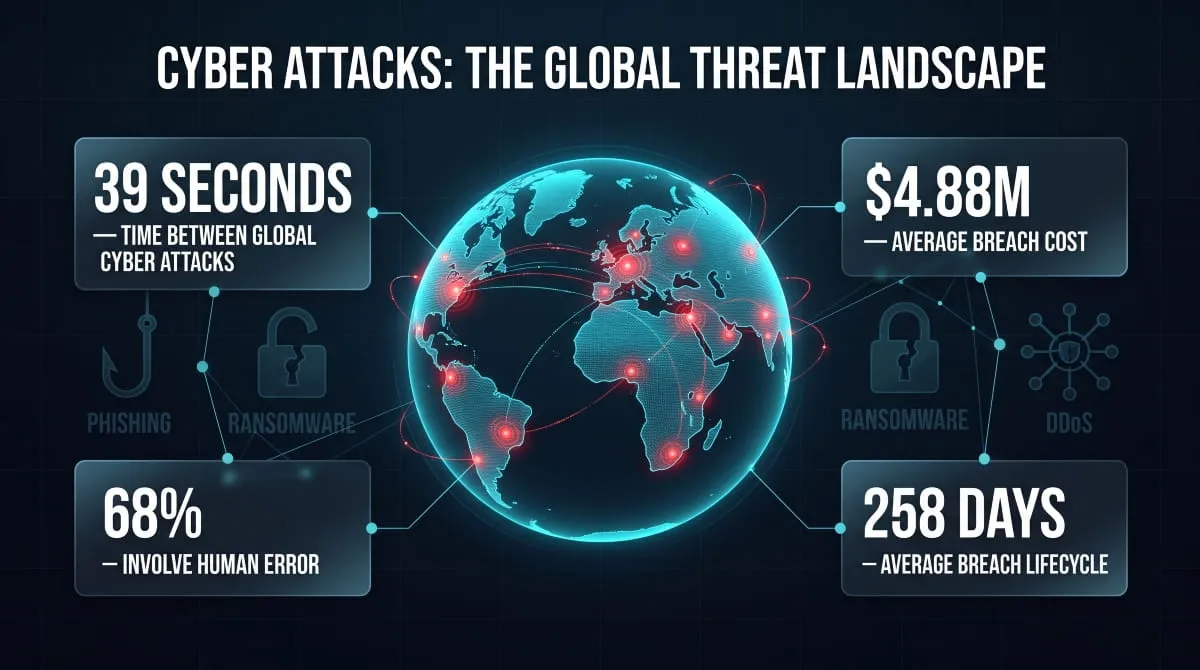
The threat landscape has grown both broader and more sophisticated. According to IBM’s Cost of a Data Breach Report, the global average cost of a data breach reached $4.88 million in 2024, the highest ever recorded. That number doesn’t capture the reputational damage, regulatory exposure, or operational downtime that follows. Meanwhile, a cyber attack occurs somewhere in the world every 39 seconds, with phishing, ransomware, and supply chain attacks accounting for the majority of confirmed incidents.
This guide covers every major type of cyber attack, how each works, which industries and infrastructure it targets most, what the historical record shows, and what organizations can do to prevent, detect, and respond. Whether you’re building a security program from scratch, assessing your organization’s attack surface, or trying to understand a specific threat in the news, every section here is designed to give you a clear, actionable answer.
What Is a Cyber Attack? (Definition, Meaning, and How It Works)
A cyber attack is a deliberate, malicious act targeting a computer system, network, device, or digital infrastructure, carried out to gain unauthorized access, steal data, disrupt operations, or cause damage. The Word deliberate is doing important work in that definition. It’s what separates a cyber attack from a software bug, a misconfigured server, or an accidental data exposure.
At its core, every cyber attack follows the same basic logic: an attacker identifies a vulnerability, exploits it through some method of entry, and then pursues an objective, whether that’s exfiltrating credentials, deploying ransomware, wiping systems, or establishing persistent access for future use. The method, the entry point, and the objective vary enormously depending on who the attacker is and what they’re after. That variation is precisely why understanding the full range of attack types matters.
Cyber Attack Definition in Simple Terms
In the simplest terms, a cyber attack is when someone tries to break into or compromise a digital system they don’t have permission to access, and does so intentionally.
That system might be a corporate network, a hospital’s patient database, a government agency’s communications infrastructure, a personal email account, or an industrial control system managing a power grid. The target doesn’t have to be large or high-profile. Small businesses account for 43% of all cyber attack targets, largely because they tend to have weaker defenses than enterprises while still holding valuable financial and customer data.
The attacker might be a lone criminal motivated by money, an organized criminal group running ransomware-as-a-service operations, a nation-state intelligence unit conducting espionage, or a hacktivist collective trying to make a political statement. What unites all of them is intent: every cyber attack is chosen, not accidental.
Cyber Attack vs. Data Breach, What’s the Difference?
These two terms appear together so frequently that they’re often used interchangeably, but they describe different things, and the distinction matters for legal, regulatory, and operational reasons.

A cyber attack is the act itself: the intrusion attempt, the exploit, the malicious action taken against a system. A data breach is a specific outcome: it occurs when a cyberattack (or, less commonly, an internal error) results in unauthorized access to protected data, and that data is confirmed to have been viewed, copied, or exfiltrated.
Every data breach involves some form of security incident, but not every cyber attack results in a data breach. A DDoS attack that takes a website offline, for instance, is a cyber attack, but if no data is accessed or stolen, it doesn’t qualify as a data breach under most regulatory frameworks. Conversely, a data breach can sometimes occur without a traditional “attack” at all, such as through a misconfigured cloud storage bucket that exposes records publicly. Understanding where the two concepts overlap and diverge is particularly important for organizations navigating breach notification laws, SEC disclosure requirements, and cyber insurance claims.
Cyber Attack vs. Ransomware: Key Distinctions
Ransomware is a type of cyber attack, not a synonym for one. The confusion arises because ransomware has become so dominant in breach reporting and media coverage that it often stands in for the broader category.
A cyber attack is the umbrella term covering any malicious action against a digital system. Ransomware is one specific method within that umbrella: a class of malware that encrypts a victim’s files or locks them out of their systems, then demands payment, typically in cryptocurrency, in exchange for the decryption key. What makes ransomware distinct within the broader attack landscape is the monetization model. Rather than quietly stealing data and selling it, ransomware operators create immediate, visible operational damage that forces a decision: pay or lose access.
Modern ransomware attacks have evolved to combine multiple techniques: initial access through phishing, lateral movement across the network, data exfiltration before encryption (known as double extortion), and a public leak threat if the ransom isn’t paid. So while ransomware is one type of cyber attack, a single ransomware incident often involves half a dozen attack techniques layered together.
What Is a Cyber Attack in the Context of War and Nation-States?
When a nation-state conducts or sponsors a cyber attack, the objectives shift from financial gain to strategic ones: intelligence collection, infrastructure disruption, military advantage, political destabilization, or covert sabotage.
Nation-state cyber attacks operate on a different scale and with different resources than criminal operations. State-sponsored threat actors typically have sustained funding, access to zero-day exploits, long-term persistence in target networks, and the operational patience to stay undetected for months or years. The line between cyber attack and act of war remains legally contested; no binding international treaty currently defines when a cyber attack crosses the threshold that would trigger a kinetic military response under international law. What’s clear from historical examples, Estonia (2007), Ukraine’s power grid (2015), and the SolarWinds supply chain compromise (2020), is that state-level cyber attacks are capable of causing real-world infrastructure damage, political disruption, and national security consequences at a scale no criminal group has matched.
What Makes Something a Cyber Attack (vs. a Bug or Outage)?
The defining characteristic of a cyber attack is intent. A software bug causes a system crash due to a coding error. A cloud outage occurs when services are taken offline due to infrastructure failure. A cyberattack causes damage because someone chose to cause it.
This distinction isn’t just semantic; it shapes the legal and regulatory response, the insurance outcome, and the appropriate technical countermeasure. A bug gets patched. An outage gets an RCA (root cause analysis) and an SLA credit. A cyber attack triggers an incident response plan, potentially law enforcement notification, regulatory disclosure obligations, and forensic investigation.
In practice, organizations sometimes struggle to make this call quickly. A sudden system outage might look indistinguishable from a DDoS attack in the first hour. Encrypted files might initially appear to be a storage failure before ransomware is confirmed. Key indicators pointing to a deliberate attack rather than a technical failure include the presence of malicious code or tools, evidence of unauthorized lateral movement within the network, external command-and-control communications, or a ransom demand. When in doubt, organizations are increasingly advised to treat ambiguous incidents as potential attacks until investigation proves otherwise, because the cost of responding too slowly to an actual attack almost always exceeds the cost of over-responding to a false alarm.
All Types of Cyber Attacks Explained (Complete Taxonomy)
Before diving into specific attack methods, it helps to understand how cyber attacks are classified at the structural level. The taxonomy of cyber attacks isn’t just academic; knowing which category an attack falls into shapes how defenders prioritize controls, how incident responders triage events, and how security teams allocate limited resources. Most attacks that appear complex on the surface fit cleanly into one of a handful of fundamental categories.
Targeted vs. Untargeted Cyber Attacks
The first and most strategically important distinction in any cyber attack taxonomy is whether the attack was designed for a specific victim or cast broadly to catch whoever it reaches.
Untargeted attacks, sometimes called opportunistic attacks, are not aimed at any particular organization. The attacker deploys a method at scale and waits to see who responds or who gets compromised. Phishing emails sent to millions of addresses, malware distributed through malicious advertising networks, and automated scanning tools probing the internet for unpatched vulnerabilities are all untargeted. The victim isn’t chosen; they’re caught. These attacks succeed through volume: even a 0.1% success rate across 10 million attempts yields 10,000 compromised accounts.
Targeted attacks work in the opposite direction. The attacker selects a specific organization, individual, or system and tailors the campaign to defeat that target’s specific defenses. Spear phishing emails crafted to impersonate a CFO’s known colleague, supply chain compromises designed to reach a specific downstream customer, and APT intrusions that persist inside a network for months without triggering alerts are all targeted. These attacks require significantly more time and resources from the attacker, which is why they tend to be associated with either high-value criminal operations or nation-state actors who have identified a strategic objective worth the investment.
The practical implication for defenders is that untargeted attacks are largely defeated by hygiene, patching, multi-factor authentication, email filtering, and user awareness training. Targeted attacks require a different posture: threat intelligence, behavioral detection, attack surface reduction, and the assumption that a sufficiently motivated adversary will eventually find a way in.
Active vs. Passive Attacks in Cyber Security
Active and passive attacks differ in what the attacker does once inside, or while attempting to get inside, a system.
A passive attack involves observation without interference. The attacker monitors, intercepts, or copies data without altering the system or disrupting its operation. Network eavesdropping, packet sniffing, and traffic analysis are passive attacks. The victim’s systems continue functioning normally; nothing appears wrong. The goal is intelligence gathering, credentials, communications, strategic information, and the defining characteristic is that the attack leaves minimal forensic trace. Passive attacks are particularly dangerous precisely because they’re difficult to detect. An attacker can sit quietly inside a network, reading emails and capturing login credentials, for months before anyone notices.
An active attack involves direct interference: modifying data, disrupting systems, deploying malware, or impersonating legitimate users or services. Man-in-the-middle attacks, ransomware deployment, DDoS attacks, and session hijacking are all active. Active attacks are generally more detectable than passive ones because they produce observable effects: systems go down, files get encrypted, and anomalous network traffic appears. The trade-off for the attacker is higher visibility; the trade-off for the defender is that detection, while more possible, often comes after damage has already been done.
Many sophisticated attack campaigns combine both. An attacker might spend weeks in passive reconnaissance mode, mapping the network, identifying high-value targets, and learning the organization’s communication patterns before launching an active payload at the moment of maximum impact.
Physical vs. Cyber vs. Cyber-Physical Attacks
Not every attack on a digital system happens remotely through a network connection. The physical dimension of cybersecurity is underappreciated and increasingly relevant as the line between the digital and physical world continues to blur.
A purely cyber attack occurs entirely through digital means: network intrusions, malware delivery via email, and exploitation of software vulnerabilities. No physical access to the target system is required. The vast majority of attacks organizations face today fall into this category.
A physical attack with a cyber dimension involves an attacker gaining physical access to a device or facility to compromise it, plugging a malicious USB drive into an air-gapped system, installing a hardware keylogger on a workstation, or accessing a server room to connect directly to internal infrastructure. These attacks bypass network-level security controls entirely and are particularly relevant in scenarios involving insider threats or physically accessible public-facing devices.
Cyber-physical attacks are the most consequential category: intrusions that use digital means to cause damage in the physical world. When attackers compromise an industrial control system and alter the operational parameters of a power plant, water treatment facility, or manufacturing line, the attack crosses the boundary between the digital and the physical. The Stuxnet worm, which caused physical damage to centrifuges at Iran’s Natanz uranium enrichment facility by manipulating their control software, remains the defining example. As operational technology (OT) and IT networks become more connected, cyber-physical attacks represent one of the most serious and growing threat vectors in critical infrastructure security.
Nation-State vs. Criminal vs. Hacktivist Attacks
A monolithic “hacker” archetype does not engage in cyberattacks. The attacker category determines the objective, the sophistication, the persistence, and the appropriate defensive and legal response.
Nation-state actors are government-sponsored or government-directed groups operating with strategic intelligence or military objectives. They typically have significant resources, access to sophisticated tooling (including zero-day exploits that cost hundreds of thousands of dollars on the open market), and the operational patience to sustain long-term campaigns inside target networks. Their objectives include espionage, intellectual property theft, election interference, infrastructure sabotage, and pre-positioning for potential future conflict. Attribution is difficult by design; state actors routinely use false flags, compromised infrastructure in third countries, and techniques borrowed from criminal groups to obscure their origin.
Criminal groups operate primarily for financial gain. The professionalization of cybercrime over the last decade has produced sophisticated organizations that operate with division of labor, customer service functions, and affiliate programs, ransomware-as-a-service being the most prominent example. Criminal actors are opportunistic by nature but increasingly capable of targeted, high-value campaigns against large enterprises and critical infrastructure when the financial return justifies the effort. Verizon’s 2024 Data Breach Investigations Report found that financially motivated attacks account for over 90% of confirmed data breaches globally.
Hacktivists use cyber attacks to advance ideological, political, or social objectives. Their methods tend toward disruption rather than stealth, including DDoS attacks against government websites, defacement of public-facing platforms, and data dumps designed to embarrass target organizations. Anonymous remains the most recognizable hacktivist collective, but the landscape includes dozens of groups aligned with political, environmental, and geopolitical causes. Hacktivist attacks are rarely as sophisticated as nation-state or professional criminal operations, but they can cause significant reputational damage and operational disruption, particularly against organizations with limited security resources.
The categories are not mutually exclusive. Criminal groups are sometimes contracted or tolerated by nation-states in exchange for operational latitude. Hacktivists occasionally deploy tools or techniques sourced from criminal marketplaces. And the line between state-directed and state-tolerated cyber activity is frequently blurred by design.
Types of Cyber Attackers and Their Motivations
Understanding who launches cyber attacks and why is as important as understanding how. Motivation shapes method, and method shapes the appropriate defensive posture.
Financial gain drives the largest volume of attacks globally. This category includes ransomware operators, business email compromise (BEC) fraud groups, credential theft operations that sell access on dark web marketplaces, and payment card skimming operations. Financial attackers are rational actors: they pursue targets where the expected return exceeds the effort and risk.
Espionage and intelligence collection motivate nation-state actors and, increasingly, corporate competitors. The goal is to obtain access to sensitive information, government communications, military capabilities, negotiating positions, and proprietary technology without the target ever knowing the access occurred.
Disruption and sabotage motivate both nation-state actors in pre-conflict scenarios and hacktivist groups reacting to current events. The objective isn’t to steal anything; it’s to cause operational, financial, or reputational damage. Critical infrastructure attacks fall predominantly into this category.
Ideological or political motivations drive hacktivist operations, in which the attack itself is a form of public statement or protest rather than a means to a financial end.
Personal grievances motivate insider threats: current or former employees, contractors, or business partners who misuse legitimate access to damage an organization, steal proprietary data, or expose sensitive information. Insider attacks are particularly difficult to detect precisely because the attacker starts with authorized access, and their early behavior can be indistinguishable from normal work activity.
Finally, a small but persistent category of attackers is motivated primarily by curiosity or the challenge itself, so-called “gray hat” actors who probe systems without clear malicious intent but without authorization. While their motivation may be benign, the access they obtain and the vulnerabilities they expose carry the same legal and security risk as any other unauthorized intrusion.
The Most Common Types of Cyber Attacks (How Each One Works)
The most common types of cyber attacks range from mass-scale phishing campaigns to precision supply chain intrusions, but each exploits a technical vulnerability, a human one, or both. This section covers each major attack method in full: what it is, how it works mechanically, and why it succeeds.

Social Engineering Attacks
Phishing Attacks, The #1 Most Common Cyber Attack
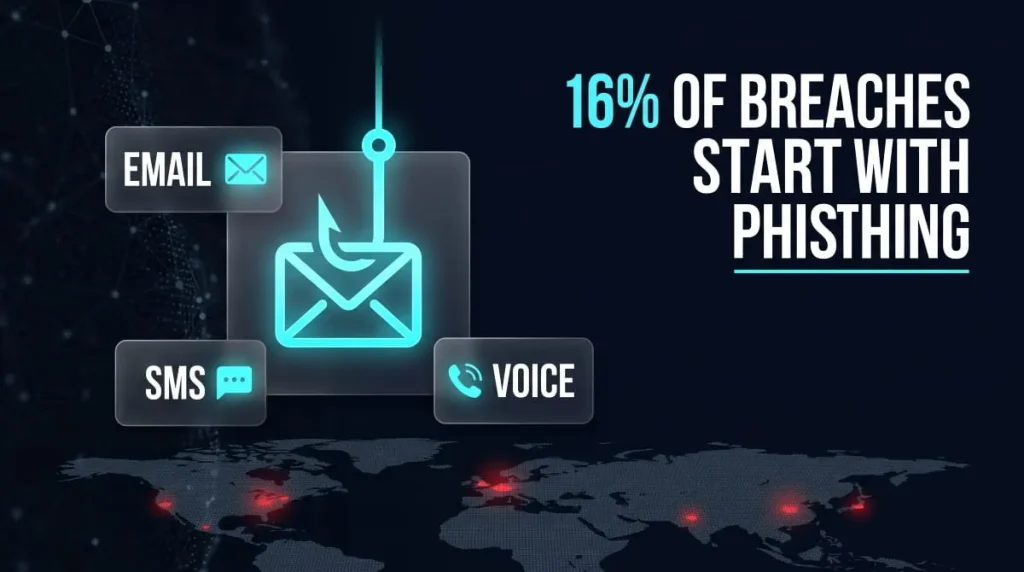
Phishing is the single most common type of cyber attack worldwide and has held that position for over a decade. The core mechanic is deception: an attacker impersonates a trusted entity, a bank, an employer, a government agency, or a cloud platform to trick the target into revealing credentials, clicking a malicious link, downloading a payload, or transferring money.
A phishing attack typically arrives as an email that looks legitimate at a glance. The sender address may closely mimic a real domain (support@paypa1.com instead of paypal.com), the branding may be pixel-perfect, and the message creates urgency: your account is at risk, your package couldn’t be delivered, your invoice is overdue. The link inside directs the victim to either a spoofed login page that harvests the credentials they enter or a page that silently deploys malware as soon as it loads.
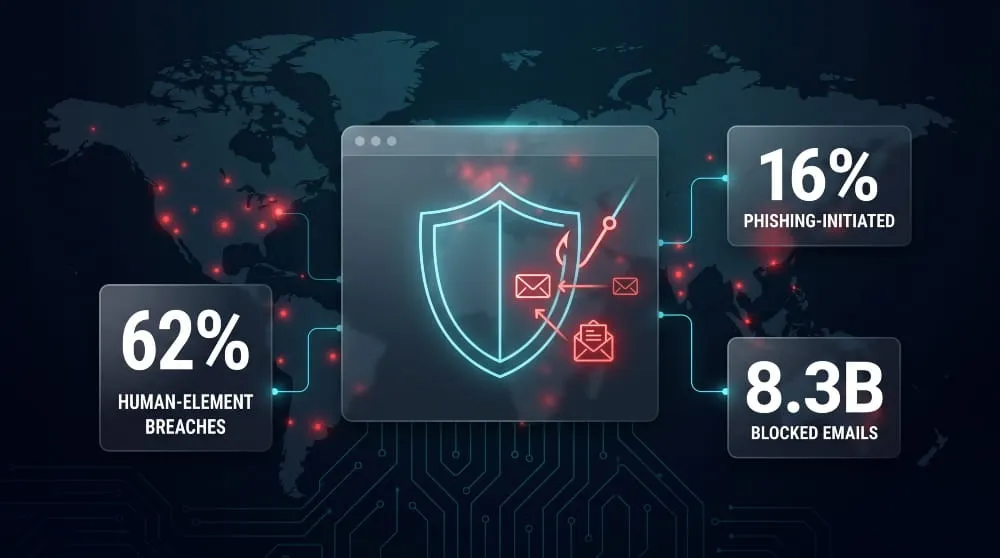
Phishing succeeds not because targets are unsophisticated, but because the attacks are designed to exploit psychological reflexes that work on almost everyone under the right conditions: urgency, authority, familiarity, and fear. The Verizon 2024 DBIR found that phishing was present in over a third of all breaches, more than any other initial access vector.
Spear Phishing
Spear phishing is phishing with a target already selected. Instead of a generic message sent to millions, the attacker researches a specific individual, their name, role, colleagues, recent activity, and vendor relationships, and crafts a message tailored to that person. A spear phishing email might reference a real project the target is working on, appear to come from someone they correspond with regularly, and ask for something plausible in context: approving a wire transfer, reviewing an attached document, or updating login credentials before a system migration.
The personalization dramatically increases success rates. Where a generic phishing email might achieve a 1–3% click rate, a well-researched spear phishing email can exceed 30%. Nation-state actors and sophisticated criminal groups use spear phishing almost exclusively for initial access because the precision justifies the additional preparation time.
Whaling Attacks
Whaling applies the spear-phishing model to the highest-value targets within an organization: C-suite executives, board members, legal counsel, and finance directors. The name reflects the logic: if spear phishing is fishing for individuals, whaling is going after the biggest targets.
Whaling attacks are often financially motivated. A common variant is business email compromise (BEC), where an attacker impersonates a CEO or CFO and instructs a finance employee to wire funds to a fraudulent account as part of an “urgent, confidential” transaction. The FBI estimates that BEC attacks have caused more than $55 billion in global losses since 2013, more than any other type of cybercrime by total financial impact. Executives are specifically targeted because they have the authority to authorize large transactions, override standard approval processes, and operate in environments where urgency is the norm.
Vishing (Voice Phishing)
Vishing moves the phishing attack from email to phone call. The attacker calls the target, or increasingly, uses an automated voice system, while impersonating a bank fraud department, an IT helpdesk, a government tax authority, or a technical support representative. The objective is the same as email phishing: extract credentials, personal information, or authorization for a financial transaction through social manipulation.
Vishing has become significantly more dangerous with the emergence of AI-generated voice cloning. Attackers can now create convincing audio impersonations of real individuals, including executives, family members, or known colleagues, using as little as a few seconds of publicly available audio. In 2024, a finance employee at a multinational firm transferred $25 million after participating in a deepfake video call that impersonated the company’s CFO. Vishing is no longer limited to unsophisticated scam calls; it has become a capable vector for high-value targeted fraud.
Smishing (SMS Phishing)
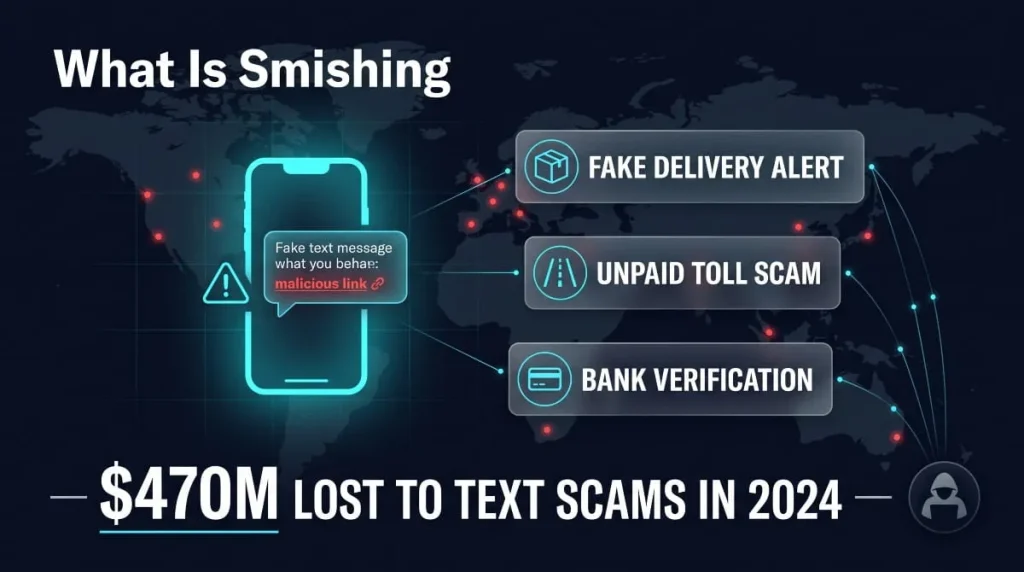
Smishing delivers phishing attacks via SMS text message. The format is typically a short message with a sense of urgency and a link: a failed package delivery, a suspicious charge on your account, a verification code that needs confirmation, or a government benefit requiring immediate action.
Smishing exploits several features of mobile communication that make it more effective than equivalent email attacks. SMS messages have open rates above 90%, compared to roughly 20% for email. Text messages are displayed immediately on a lock screen with no spam filter. And mobile browsers make it harder to carefully inspect URLs before clicking; a spoofed domain looks more convincing on a small screen than on a desktop. As authentication has shifted toward SMS-based one-time passwords, smishing attacks increasingly target those codes directly, enabling real-time account takeover even on accounts with SMS-based two-factor authentication enabled.
Social Engineering Attacks, Manipulation at Scale
Social engineering is the broader discipline from which phishing descends. Where phishing uses a specific medium, email, phone, text, social engineering describes any attack that manipulates human psychology rather than exploiting a technical vulnerability. The attacker’s primary tool is not code; it’s persuasion.
Every social engineering attack exploits one or more well-documented psychological mechanisms. Authority causes people to comply with requests from figures perceived as powerful or official. Urgency suppresses deliberate thinking and triggers reactive compliance. Scarcity creates pressure to act before an opportunity disappears. Social proof makes people more likely to do something when they see others doing it. Familiarity lowers guard when the attacker has done enough research to appear known and trusted.
Social engineering attacks are particularly effective against organizations because they target the layer of security that can’t be patched: people. A firewall can be updated; human judgment under pressure is consistently exploitable. Security awareness training reduces susceptibility but doesn’t eliminate it; sophisticated social engineering campaigns are designed to defeat trained defenders, not just uninformed ones.
Baiting, Tailgating, and Pretexting Attacks
These three techniques extend social engineering into the physical world and into constructed scenarios, and they frequently appear as components of more complex attack campaigns rather than standalone methods.
Baiting exploits curiosity or greed to get a target to take an action that compromises security. The classic example is an attacker leaving USB drives labeled “Payroll Q3” or “Confidential, Executive Compensation” in a company parking lot or lobby. A meaningful percentage of people who find them will plug them in out of curiosity, and the drives execute malware the moment they’re connected. Digital baiting works similarly: fake software downloads, pirated content laced with Trojans, or too-good-to-be-true offers that require an account login.
Tailgating, sometimes called piggybacking, is the physical security equivalent of a credential bypass. An attacker follows an authorized employee through a secured door without presenting their own credentials, relying on social norms around politeness and the discomfort people feel about challenging someone who appears to belong. Tailgating is often used to gain physical access to server rooms, data centers, or office environments, where subsequent attacks can be conducted directly against internal systems.
Pretexting involves creating a fabricated scenario, a pretext, to extract information or access from a target. An attacker might call a help desk impersonating a senior employee who has forgotten their password, pose as an IT auditor requesting access to systems for a compliance review, or pretend to be a new vendor needing to be onboarded to internal systems. Pretexting attacks rely on the attacker having done enough background research to make the scenario plausible, and on the target’s natural inclination to be helpful to someone who seems to have a legitimate reason for their request.
Malware Attacks
Ransomware Attacks: How Criminals Hold Data Hostage
Ransomware is a type of malware that encrypts a victim’s files or locks them out of their systems entirely and demands payment in exchange for the decryption key. It has become the dominant financially motivated cyber attack type of the last decade, and the one most likely to cause immediate, visible, operational damage to an organization.
A typical ransomware attack unfolds in stages. Initial access is usually obtained through phishing, the exploitation of a public-facing vulnerability, or the purchase of compromised remote desktop credentials on a dark web access broker marketplace. Once inside, the attacker moves laterally through the network, mapping systems, escalating privileges, identifying backup infrastructure, and exfiltrating a copy of sensitive data before deploying the encryption payload. That final step, stealing data before encrypting it, is the basis of double extortion: the attacker threatens not just to withhold the decryption key but to publish the stolen data publicly if the ransom isn’t paid.
The financial impact of ransomware is severe and growing. The average ransomware payment in 2024 exceeded $2 million, according to Sophos, and that figure excludes recovery costs, downtime losses, legal fees, and regulatory penalties, which typically dwarf the ransom itself. Healthcare organizations have become a primary target because downtime in a hospital environment poses a direct risk to patient safety, increasing the pressure to pay quickly.
Modern ransomware operates as a service. Groups like LockBit, BlackCat/ALPHV, and Cl0p develop and maintain the ransomware platform, while affiliates, independent operators who pay a percentage of ransom proceeds back to the developer, handle the actual intrusion and deployment. This model has dramatically lowered the technical barrier to conducting ransomware attacks, expanding the pool of potential attackers well beyond those capable of developing their own tools.
Malware Attacks, Viruses, Worms, Trojans Explained
Malware, malicious software, is the broad category covering any code designed to damage, disrupt, or gain unauthorized access to a system. Ransomware is one type of malware. But the category is far broader, and the distinctions between malware subtypes matter because they determine how it spreads, what it does once deployed, and how defenders detect and remove it.
A virus attaches itself to a legitimate file or program and executes when that file is opened or run. It requires a human action, opening an infected document or running an infected executable, to activate, and it spreads by infecting other files on the same system or network share. Viruses were the dominant form of malware in the early era of computing, when software was primarily distributed on physical media.
A worm operates without attaching to a host file and, crucially, spreads automatically across networks without user interaction. A worm exploits a network vulnerability to move from system to system, replicating itself as it goes. WannaCry, which infected more than 200,000 systems across 150 countries in May 2017, was a worm that exploited an unpatched Windows SMB vulnerability to propagate at a speed no human-operated campaign could match. The combination of self-replication and network traversal makes worms capable of causing damage at a scale and speed that other malware types cannot approach.
A Trojan disguises itself as legitimate software to trick users into installing it. Unlike viruses, Trojans don’t self-replicate; their spread depends on users being deceived into downloading and executing them. Once installed, a Trojan may open a backdoor for remote access, download additional malware, log keystrokes, or exfiltrate data, all while appearing to be a normal application. Remote access trojans (RATs) are particularly prevalent as tools for establishing persistent, covert control over a compromised system.
Botnet Attacks: When Infected Machines Become Weapons
A botnet is a network of internet-connected devices that have been infected with malware and placed under the centralized control of an attacker, called the botmaster or bot herder. Each infected device, called a bot or zombie, executes instructions from the botmaster without the device owner’s knowledge. The devices in a botnet might be computers, servers, routers, IoT devices, or any other internet-connected hardware.
Botnets are the infrastructure behind several other major attack types. DDoS attacks use botnet traffic to overwhelm targets. Spam campaigns use botnet-controlled email accounts to send phishing messages at scale. Credential stuffing attacks use botnets to distribute login attempts across thousands of IP addresses, defeating rate-limiting controls. Cryptocurrency mining botnets exploit victims’ processing power to generate revenue for attackers. The Mirai botnet, which in 2016 used hundreds of thousands of compromised IoT devices to launch what was then the largest DDoS attack ever recorded, demonstrated both the scale botnets can reach and the vulnerability of poorly secured connected devices.
Botnet membership is often invisible to the device owner. An infected home router or smart camera may participate in attacks against major infrastructure while showing no symptoms detectable by the average user. This invisibility makes botnets difficult to dismantle and explains why major law enforcement operations against them, such as the FBI’s 2024 disruption of the Volt Typhoon botnet used by Chinese state actors, require coordinated international action.
Infostealer Malware, The Dark Web’s Favorite Weapon
Infostealers are a category of malware with one specific objective: collect and exfiltrate credentials, session cookies, saved passwords, autofill data, cryptocurrency wallet information, and system details from the infected device, then transmit everything to the attacker’s infrastructure.
Unlike ransomware, which announces itself, infostealers are designed to operate silently. They run in the background, harvest everything of value from the browser, password manager, and application cache, and exfiltrate the data without disrupting the system’s normal function. The victim often has no idea that anything has happened. The stolen credentials and session tokens are then packaged into logs and sold on dark web marketplaces, sometimes within hours of the infection.
Infostealer logs are one of the primary sources of corporate credential exposure on the dark web. When an infostealer infects an employee’s personal device through a malicious browser extension, a cracked software download, or a phishing link, their saved work credentials, VPN logins, and active session cookies may be extracted and sold to threat actors who then use them to access corporate systems directly. Prominent infostealer families include RedLine, Vidar, Raccoon, and LummaC2. According to SpyCloud’s 2024 Identity Exposure Report, infostealer malware was responsible for recapturing over 343 million credentials from the dark web in a single year, underscoring why dark web monitoring for stolen credentials has become a foundational security control rather than an optional one.
Network & Infrastructure Attacks
DDoS Attacks (Distributed Denial of Service), Explained
A Distributed Denial of Service attack overwhelms a target system, website, API, network link, or application server with more traffic than it can handle, forcing it offline or degrading its performance to the point of inaccessibility. The attack doesn’t require breaking into the system; it simply exhausts its capacity to serve legitimate users.
The “distributed” element distinguishes DDoS from a basic DoS attack. A single-source denial-of-service attempt is easily blocked by filtering traffic from that IP address. A distributed attack routes traffic from thousands or millions of compromised devices, typically a botnet, making it effectively impossible to block by source without also blocking legitimate traffic. Volumetric DDoS attacks can generate traffic measured in terabits per second; the largest recorded attack, mitigated by Cloudflare in 2024, peaked at 5.6 Tbps and involved over 13,000 compromised IoT devices.
DDoS attacks are used for several purposes: extortion (pay or stay offline), as a cover for a concurrent intrusion attempt, to harm a competitor, or as a political statement. Financial services, gaming platforms, and e-commerce infrastructure are the most frequent targets given that downtime translates directly and immediately into revenue loss.
Man-in-the-Middle (MitM) Attacks
A man-in-the-middle attack occurs when an attacker secretly intercepts and potentially alters the communication between two parties who each believe they are communicating directly with each other. The attacker sits between the victim and the legitimate service, reading, recording, or modifying the data flowing in both directions.
MitM attacks require the attacker to first position themselves on the communication path. This is typically achieved through ARP spoofing on a local network, by operating a rogue Wi-Fi access point that victims unknowingly connect to, or through DNS hijacking that redirects traffic to an attacker-controlled server. Once in position, the attacker can harvest credentials as they’re entered into login forms, inject malicious content into web pages, intercept session tokens to take over authenticated sessions, or silently modify financial transactions in transit.
The widespread adoption of TLS encryption has reduced the effectiveness of MitM attacks against encrypted traffic; an attacker who intercepts a properly encrypted HTTPS connection cannot read its contents. However, MitM attacks remain highly effective against unencrypted connections, against users who ignore certificate warnings, or in scenarios where the attacker can also compromise the certificate validation process itself.
DNS Attacks and DNS Spoofing
The Domain Name System (DNS) is the internet’s address book, the service that translates human-readable domain names like dexpose.io into the IP addresses that computers use to route traffic. Because DNS sits at the foundation of how internet communication is directed, attacks against it can redirect entire populations of users to attacker-controlled infrastructure without those users doing anything wrong.
DNS spoofing, also called DNS cache poisoning, involves inserting fraudulent DNS records into a resolver’s cache. When a user’s device queries the poisoned resolver for a domain, it receives a false IP address and is directed to an attacker-controlled server instead of the legitimate one. If that server hosts a convincing replica of the real site, the user may enter credentials that go directly to the attacker while believing they’ve logged into the legitimate service.
DNS hijacking goes further: rather than poisoning a cache, the attacker directly modifies the authoritative DNS records for a domain, typically by compromising the domain registrar account or the DNS management panel. This redirects all traffic for that domain globally, not just for users of a particular resolver. DNS tunneling uses DNS query and response packets as a covert channel to exfiltrate data from a compromised network that blocks other outbound communication, a technique favored by advanced attackers operating in environments with strict egress filtering.
ARP Poisoning and Spoofing Attacks
Address Resolution Protocol (ARP) is the mechanism that maps IP addresses to physical MAC addresses on a local network. ARP poisoning exploits the fact that ARP has no authentication mechanism; any device on a network can send ARP messages claiming to be any other device, and most systems will accept and cache those claims without verification.
In an ARP poisoning attack, the attacker broadcasts false ARP replies associating their own MAC address with the IP address of another device, typically the network gateway. Devices on the network update their ARP cache with this false mapping and begin sending traffic intended for the gateway to the attacker instead. The attacker can then forward the traffic on to its actual destination (enabling passive interception) or manipulate it in transit (enabling a man-in-the-middle attack). ARP poisoning is confined to local network segments; it cannot be executed remotely across the internet, making it most relevant in shared network environments such as corporate offices, hotels, co-working spaces, and any location using shared Wi-Fi infrastructure.
Packet Sniffing Attacks
Packet sniffing is the capture and analysis of data packets as they traverse a network. In its legitimate form, packet sniffing is a standard network diagnostic tool used by administrators to troubleshoot performance issues. In its malicious form, it’s a passive surveillance technique that captures everything transmitted over a network segment in cleartext, including credentials, session tokens, emails, file transfers, and any other unencrypted data.
For packet sniffing to work as an attack, the attacker must either have access to the network segment carrying the target traffic or must first use another technique, such as ARP poisoning, to redirect that traffic through their own device. On older hub-based networks, all traffic was visible to all connected devices by default. Modern switched networks are more restrictive, but ARP spoofing and compromised network infrastructure remain viable paths to packet capture. The primary defense against packet sniffing is encryption: traffic protected by properly implemented TLS cannot be read even if it is captured.
Application & Code Attacks
SQL Injection Attacks
SQL injection is one of the oldest and most persistently exploited application vulnerabilities. It occurs when an attacker inserts malicious SQL code into an input field, a search box, a login form, or a URL parameter, which is then executed by the application’s database without proper validation or sanitization.
The mechanism is straightforward: if an application constructs database queries by directly concatenating user-supplied input, an attacker can terminate the intended query and append their own. A login form vulnerable to SQL injection might be bypassed by entering ‘ OR ‘1’=’1 as a username, causing the database to return all records rather than checking credentials. More sophisticated injections can extract entire database contents, modify or delete records, execute operating system commands, or create backdoor accounts. The OWASP Top 10 has listed injection attacks as a critical web application risk in every edition since the list’s inception, a consistent reminder that this decades-old vulnerability class remains widely unaddressed in production systems.
Cross-Site Scripting (XSS) Attacks
Cross-site scripting attacks inject malicious scripts, typically JavaScript, into web pages that are then served to and executed by other users’ browsers. Unlike SQL injection, which targets the server-side database, XSS targets the client side: it weaponizes a legitimate website against the people who visit it.
In a stored XSS attack, the malicious script is saved to the target application’s database, in a comment field, a profile bio, or a forum post, and executes in the browser of every user who views that content. In a reflected XSS attack, the malicious script is embedded in a link and executes only when a victim clicks it. In either case, the script runs in the context of the legitimate site, with access to the victim’s session cookies, saved credentials, and the ability to make requests on their behalf. XSS is widely used to hijack authenticated sessions, redirect users to phishing pages, log keystrokes, and conduct drive-by malware downloads against visitors to compromised or vulnerable websites.
Buffer Overflow Attacks
A buffer overflow occurs when a program writes more data to a fixed-length buffer than the buffer was designed to hold. The excess data spills into adjacent memory regions, overwriting data that was stored there, including, in exploitable scenarios, the program’s execution instructions.
Attackers exploit buffer overflows by carefully crafting input that overwrites specific memory locations with attacker-controlled code. When the overwritten return address is executed during program execution, the processor jumps to the attacker’s code rather than the program’s intended next instruction, allowing the attacker to execute arbitrary code with the permissions of the vulnerable process. Buffer overflows have been the underlying mechanism in some of the most significant vulnerabilities in computing history, including the Morris Worm in 1988 and numerous critical vulnerabilities in operating systems and network services since. Modern mitigations, address space layout randomization (ASLR), stack canaries, and non-executable memory regions, have made buffer overflow exploitation significantly harder but not impossible, particularly in legacy systems and embedded devices.
Brute Force Attacks and Dictionary Attacks
A brute-force attack attempts to gain access to an account or an encrypted resource by systematically trying every possible password or key until the correct one is found. Given unlimited time and no rate limiting, brute force will eventually succeed against any password; the question is whether that time is measured in milliseconds or millennia.
The practical effectiveness of brute force depends entirely on password length, complexity, and the controls in place to slow or stop repeated attempts. A six-character password using only lowercase letters has roughly 300 million combinations; a modern consumer GPU can test that entire space in under a second. A sixteen-character random password with mixed case, numbers, and symbols has more combinations than current computing power could realistically exhaust.
A dictionary attack narrows the search space by using precompiled lists of common passwords, previously compromised credentials, words from natural language dictionaries, and predictable patterns, rather than trying every possible combination. Dictionary attacks succeed because human-chosen passwords are not random: they cluster around recognizable words, names, dates, and simple substitutions. Tools like Hashcat can test billions of dictionary entries per second against stolen password hashes, making weak passwords recoverable in seconds. The most effective defense is not a complex password policy but the elimination of reused, predictable credentials through password managers and multi-factor authentication.
Credential Stuffing Attacks
Credential stuffing exploits a single persistent human behavior: reusing the same username and password across multiple services. When credentials from one breached service are obtained by an attacker, as happens routinely, given the billions of records exposed in data breaches over the past decade, those credentials are automatically tested against hundreds of other services to find where else they work.
The attack is automated at scale using bots that distribute login attempts across thousands of IP addresses to evade rate limiting and IP-based blocking. Success rates for credential stuffing campaigns are typically low, often below 1%. Still, against a database of 100 million breached credential pairs, even a 0.5% success rate yields 500,000 compromised accounts across the services the attacker targets. SpyCloud’s research indicates that 70% of breached passwords are reused across other accounts, meaning the value of any given credential breach extends far beyond the organization that was directly compromised. Credential stuffing is why major platforms report waves of unauthorized login attempts after large public breaches; attackers immediately weaponize the new data to try to log in to every other service where the same credentials might work.
Advanced & Emerging Attacks
Zero-Day Attacks, Exploiting Unknown Vulnerabilities
A zero-day attack exploits a software vulnerability that is unknown to the vendor and therefore has no patch available. The name refers to the number of days the vendor has had to address the problem: zero. From the moment an attacker discovers the vulnerability to the moment the vendor releases a fix, every system running that software is exposed, with no available defensive measure beyond turning off the affected functionality entirely.
Zero-day vulnerabilities are extraordinarily valuable in the threat actor economy. A reliable zero-day exploit targeting a widely deployed platform, a popular browser, an enterprise VPN, or an operating system kernel can sell for anywhere from tens of thousands to millions of dollars on the exploit market. Nation-state intelligence agencies maintain stockpiles of zero-day exploits for use in high-priority operations; criminal groups with sufficient resources acquire them for high-value targets whose expected returns justify the investment.
The defensive challenge with zero-days is fundamental: you cannot patch a vulnerability you don’t know exists. Effective mitigation requires defense-in-depth strategies, network segmentation, least-privilege access, behavioral anomaly detection, and rapid incident response capability that limit the damage an attacker can do even after they’ve exploited an unknown vulnerability to gain initial access.
Supply Chain Attacks, Hitting Targets Through Vendors
A supply chain attack compromises a target not by attacking them directly but by first compromising a trusted third party, a software vendor, a managed service provider, a hardware manufacturer, or a contractor, and then using that compromised access to reach the actual target through an already-trusted relationship.
Supply chain attacks are particularly dangerous because they exploit the implicit trust organizations extend to their vendors. Security teams scrutinize inbound traffic and unknown executables; they rarely scrutinize a software update from a vendor whose product has been running in production for years. The SolarWinds attack of 2020 demonstrated the full potential of this vector: attackers compromised the build process for SolarWinds’ Orion network monitoring software, inserting a backdoor into a legitimate software update that was then distributed to roughly 18,000 organizations, including US government agencies and Fortune 500 companies. Each of those organizations willingly installed the update, trusting the vendor, and, in doing so, handed the attackers authenticated access to their networks.
Supply chain attacks have expanded beyond software updates. Hardware implants, compromised open-source libraries, malicious code contributed to widely used software packages, and the compromise of managed service providers who hold administrative access to dozens or hundreds of client environments are all established supply chain attack vectors.
APT (Advanced Persistent Threat) Attacks
An Advanced Persistent Threat describes a prolonged, sophisticated, targeted intrusion in which an attacker establishes and maintains a covert presence inside a target’s network, often for months or years, to pursue strategic objectives. The three words in the name each carry weight: advanced, because these campaigns use sophisticated tooling, custom malware, and multi-stage techniques; persistent, because the goal is long-term access rather than a quick smash-and-grab; and threat, because capable, well-resourced actors with defined objectives carry them out.
APT campaigns are primarily associated with nation-state actors and characterized by patience and stealth. An APT operator who gains initial access to a network will move slowly, study the environment, avoid triggering alerts, and establish multiple redundant persistence mechanisms before pursuing their primary objective, whether that’s intelligence collection, pre-positioning for infrastructure disruption, or intellectual property theft. The average dwell time for an APT intrusion, the time between initial compromise and detection, has historically been measured in months. However, improvements in detection capabilities have reduced this in recent years.
What distinguishes APT from other attacks is not just the technical sophistication but the sustained human intelligence behind it: a team of analysts studying the target organization, selecting the right tools for the specific environment, and adjusting tactics in real time based on what they observe inside the network.
Watering Hole Attacks
A watering hole attack compromises a website that the attacker knows the target population regularly visits, then waits for members of that population to visit it and infects them through the compromised site. The name comes from the predatory tactic of waiting at a watering hole for prey to arrive rather than pursuing them directly.
The attacker begins by identifying which websites the target group frequents: industry forums, trade association sites, sector-specific news outlets, or regional interest sites. They then compromise one of those sites, typically by exploiting a vulnerability in the site’s CMS or hosting environment, and inject malicious code that silently exploits browser or plugin vulnerabilities to deliver a payload to visitors. The victims arrive at a legitimate site they trust, do nothing wrong, and leave infected.
Watering hole attacks are difficult to defend against from the victim’s side because they don’t require any user action beyond visiting a familiar, legitimate website. They’re most associated with nation-state actors conducting targeted espionage. The compromised site is chosen specifically because it attracts the type of target the attacker wants to reach. However, criminal groups use the same technique to reach user populations with a similar financial profile.
Insider Attacks: The Threat from Within
An insider attack is carried out by someone who already has authorized access to an organization’s systems: a current employee, a former employee who retains access after departure, a contractor, or a business partner with system-level permissions. What distinguishes an insider attack from an external intrusion is that the attacker begins within the security perimeter, with legitimate credentials and a plausible reason for accessing systems.
Insider attacks fall into two broad categories. Malicious insiders deliberately use their access to steal data, sabotage systems, commit fraud, or assist external attackers, sometimes for financial gain, sometimes in response to grievance, and sometimes as agents of an outside party who recruited them specifically for their access. Negligent insiders cause security incidents not through malice but through carelessness: falling for phishing attacks, mishandling sensitive data, turning off security controls for convenience, or misconfiguring systems in ways that expose them to external attack.
Malicious insider incidents, while less frequent than external attacks, tend to cause disproportionate damage because the attacker already knows where valuable data is stored, how monitoring systems work, and what actions are likely to raise flags. The 2024 Verizon DBIR found that insider threats accounted for 35% of all data breaches, a figure that underscores both their frequency and the difficulty organizations face in detecting attacks from people they are designed to trust.
AI-Generated and Deepfake Cyber Attacks (2025–2026)
Artificial intelligence has materially changed the threat landscape in ways that are not theoretical: attackers are actively using AI tools to conduct more convincing, more scalable, and more adaptive attacks than were possible even three years ago.
AI-generated phishing content eliminates one of the most reliable signals that trained users have historically used to identify phishing attempts: poor grammar, awkward phrasing, and implausible scenarios. Large language models can now produce phishing emails that are grammatically perfect, contextually plausible, and stylistically indistinguishable from legitimate communications, at scale, in any language, and personalized to individual targets based on publicly available information about them. The same capability that makes AI writing assistants useful for legitimate content creation makes them useful for crafting highly convincing social engineering attacks.
Deepfake audio and video have extended this capability into voice- and face-based impersonation. As noted in the vishing section, AI voice cloning can produce convincing impersonations of real individuals from seconds of reference audio. A deepfake video can sustain that impersonation across a video call. In 2025, these techniques are being used not just in isolated high-value fraud cases but increasingly in automated campaigns targeting financial authorization, identity verification, and multi-factor authentication systems that rely on voice or facial biometrics.
AI is also being used to accelerate vulnerability discovery, to generate novel malware variants that evade signature-based detection, and to automate the analysis of target environments during post-compromise reconnaissance. The defensive implication is that the baseline sophistication of the average attack is rising; techniques that previously required significant human expertise are becoming accessible to a much broader range of threat actors.
Juice Jacking, Evil Twin, and Emerging Mobile Attack Types
As mobile devices have become primary endpoints for both personal and corporate activity, attackers have developed techniques specifically designed to exploit the contexts in which mobile devices are used.
Juice jacking exploits USB charging infrastructure. A compromised public charging station at an airport, hotel, conference center, or shopping mall can exploit the data-transfer capabilities of a USB connection to install malware on a connected device or extract data from it while it charges. The attack is invisible to the user, who sees only a device charging normally. The FBI and CISA have both issued advisories recommending that travelers avoid public USB charging ports and use AC power adapters or carry-only USB cables (which have the data pins physically removed) instead.
An evil twin attack deploys a rogue Wi-Fi access point with the same name as a legitimate network, a hotel’s guest network, an airport’s public Wi-Fi, or a coffee shop’s hotspot. When a device connects to the evil twin instead of the legitimate network, the attacker can control all traffic passing through it, enabling credential harvesting, session hijacking, and content injection. Devices configured to auto-connect to previously used networks are particularly vulnerable, as they may connect to an evil twin matching a saved network name without prompting the user.
Beyond these specific techniques, the mobile attack surface continues to expand as mobile-first authentication, digital wallet technology, and enterprise applications run on personally owned devices proliferate. The convergence of personal and professional use on a single device that is carried everywhere, connected to dozens of networks, and subject to far less rigorous security management than corporate endpoints represents one of the most significant and underaddressed attack surfaces in enterprise security today.
The Anatomy of a Cyber Attack: Stages, Steps, and Kill Chain
Most cyber attacks don’t happen in a single moment; they unfold in stages, each one building on the last. Understanding the anatomy of a cyber attack is foundational to both offensive security and defensive strategy: you can only interrupt an attack at a stage you understand, and every stage represents a detection and intervention opportunity that organizations with the right controls can exploit.

The framework most commonly used to describe this sequence is the Cyber Kill Chain, developed by Lockheed Martin in 2011 and still the dominant model for describing intrusion campaigns. The original model defines seven stages. What follows is that framework applied to how attacks actually work in 2025, with the nuances that a decade of evolving threat actor behavior has added.
Stage 1, Reconnaissance (How Attackers Find Their Targets)
Reconnaissance is the intelligence-gathering phase, and in most targeted attacks, it represents the largest time investment. Before an attacker launches anything, they need to understand who they’re going after, what systems they’re running, who works there, how the organization communicates, and where the exploitable gaps are likely to be.
Passive reconnaissance involves collecting information without interacting with the target directly, pulling data from public sources that leave no trace of the inquiry. This includes reviewing the organization’s website and job postings (which routinely reveal the technology stack, internal tools, and organizational structure), mining LinkedIn for employee names, roles, and reporting relationships, searching certificate transparency logs for subdomains, analyzing WHOIS records and DNS configurations, and reviewing any public code repositories where employees may have inadvertently committed credentials or internal configuration details. Threat actors conducting passive reconnaissance leave no footprint on the target’s systems because they never touch them.
Active reconnaissance involves direct interaction with the target environment, port scanning to identify open services, banner grabbing to determine software versions, probing web application inputs, or sending reconnaissance emails to map which addresses are active and what email security controls are in place. Active reconnaissance carries a higher risk of detection but yields more precise technical intelligence on exploitable conditions.
For nation-state actors and sophisticated criminal groups, reconnaissance may run for weeks or months before any action is taken. The depth of intelligence gathered at this stage directly determines the precision and effectiveness of every subsequent stage.
Stage 2, Weaponization and Initial Access Vectors
With reconnaissance complete, the attacker selects or constructs the tool they’ll use to gain entry, the weapon matched to the vulnerability they’ve identified. Weaponization is the process of pairing an exploit with a delivery mechanism to create a deployable attack payload.
This might mean crafting a spear phishing email with a malicious attachment that exploits a known vulnerability in the target’s version of Microsoft Office. It might mean acquiring a zero-day exploit for a VPN appliance that the target runs on its perimeter. It might mean purchasing valid credentials for the target’s environment from a dark web access broker, which in 2024 has become one of the most common initial access methods, effectively compressing weaponization into a commercial transaction. It might mean setting up a domain that closely resembles the target’s domain for impersonation campaigns, or preparing a watering hole by compromising a site that the target’s employees are known to visit.
The initial access vectors most commonly observed in confirmed intrusions are phishing (still the leading vector by volume), exploitation of public-facing applications (particularly VPNs, remote desktop services, and web applications with unpatched vulnerabilities), use of valid stolen credentials, and supply chain compromise. The weaponization stage is where attackers make the key decision about which door they’ll try to open, and the sophistication of that decision reflects the quality of their reconnaissance.
Stage 3, Delivery and Execution
Delivery is the moment the attack transitions from preparation to action: the weaponized payload reaches the target environment. Execution is the moment it runs.
Delivery mechanisms vary by attack type and target profile. A phishing email delivers a malicious attachment or a link to a credential-harvesting page. A drive-by download delivers malware when a victim visits a compromised website. An attacker with stolen VPN credentials delivers themselves, logging in directly to the target network without needing to exploit any technical vulnerability. A supply chain attack delivers the payload inside a legitimate software update that the target’s own systems pull down and install automatically.
Execution, the moment the payload actually runs, is a critical detection window. Modern endpoint detection and response (EDR) platforms are specifically designed to monitor process execution events and flag anomalous behavior: a document spawning a PowerShell process, a compressed file executing code, an unexpected outbound network connection from a business application. Attackers who have studied the target environment during reconnaissance will attempt to choose execution methods that blend into the environment’s normal behavior, using legitimate system tools (a technique called “living off the land”) rather than custom malware that might trigger signature-based detection. The use of native Windows utilities like PowerShell, WMI, and certutil as attack tools has become so common precisely because they’re present on every Windows system and their execution is less likely to trigger alerts than an unknown binary.
Stage 4, Lateral Movement Inside a Network
Initial access rarely lands an attacker where they ultimately need to be. The compromised workstation of a junior employee is not the domain controller. The contractor’s laptop is not the database server containing financial records. Lateral movement is the process by which an attacker extends their foothold from the initial point of compromise to other systems within the network, progressing toward the target data or infrastructure.
Lateral movement techniques exploit the trust relationships, shared credentials, and connectivity that exist between systems on the same network. Pass-the-hash attacks use captured NTLM credential hashes to authenticate to other systems without needing the actual plaintext password. Pass-the-ticket attacks steal Kerberos authentication tickets and replay them to access services to which the legitimate user was authorized. Remote service exploitation targets internal services, SMB shares, RDP sessions, and internal web applications accessible from the compromised system. Admin tools like PsExec, WMI, and PowerShell remoting allow an attacker with appropriate credentials to execute commands on remote systems without installing anything new.
A key goal during lateral movement is identifying and compromising additional credential sources, particularly those associated with privileged accounts, to accelerate progress toward high-value targets. An attacker who moves from a workstation to a system running a password management utility, a backup agent with network-wide access credentials, or a service account with broad permissions has dramatically accelerated their ability to reach the rest of the environment. The average attacker moves laterally within an environment for 146 days before being detected, according to Microsoft’s 2024 Digital Defense Report, a window that makes lateral movement detection one of the highest-value defensive investments an organization can make.
Stage 5, Privilege Escalation
Privilege escalation is the process of expanding access rights beyond what the initially compromised account holds, moving from a standard user account to an administrator account, from a local administrator to a domain administrator, from a service account to system-level access. It is often interleaved with lateral movement rather than strictly sequential; attackers escalate where they can, move to where they need to be, and escalate again.
Local privilege escalation exploits vulnerabilities in the operating system or installed software to gain higher permissions on the already-compromised system. Unpatched kernel vulnerabilities, misconfigured file permissions, DLL hijacking opportunities, and token manipulation are common local escalation techniques. Domain privilege escalation targets Active Directory, the directory service that manages authentication and authorization across most Windows enterprise environments, to gain network-wide rights. DCSync attacks trick domain controllers into replicating password hashes to an attacker-controlled system. Kerberoasting extracts service account tickets from Active Directory and cracks them offline to recover plaintext passwords. Pass-the-ticket and Golden Ticket attacks forge or steal authentication tokens that grant domain-wide access.
The criticality of privilege escalation to the overall attack chain explains why least-privilege principles, ensuring every account has only the access it actually requires and no more, represent one of the highest-impact defensive controls available. An attacker who compromises a user account with no administrative rights and cannot escalate has a significantly constrained attack surface compared to one who compromises an account with broad permissions or can readily obtain them.
Stage 6, Data Exfiltration or Payload Deployment
Having achieved the required access and privilege levels, the attacker executes their primary objective. The nature of that objective determines what stage six looks like.
In a ransomware attack, payload deployment is the encryption event, the moment the ransomware binary executes and begins encrypting files across local drives and network shares. In sophisticated campaigns, data exfiltration precedes encryption: the attacker copies a selection of the most sensitive data to an external server first, establishing the basis for double extortion before locking the victim out. In an espionage campaign, the objective is data exfiltration without encryption or disruption, quietly copying files, emails, credentials, and intellectual property to attacker-controlled infrastructure while leaving the target’s systems fully operational. In destructive attacks, such as NotPetya or those targeting Ukrainian infrastructure, the objective is to destroy systems or disrupt operations rather than steal data.
Exfiltration is typically conducted over encrypted channels to blend with normal HTTPS traffic, in staged batches to avoid triggering data loss prevention controls due to volume thresholds, and using legitimate cloud services (Dropbox, Google Drive, Mega) or attacker-controlled servers as destinations. The choice of exfiltration channel reflects the attacker’s understanding of what egress monitoring the target has in place, another dividend of thorough reconnaissance.
Stage 7, Covering Tracks
After achieving their objective, sophisticated attackers invest significant effort in removing evidence of their presence, not because they necessarily expect to return, but because slower detection extends the window during which any secondary objectives can be pursued and limits the quality of forensic investigation that defenders can conduct.
Track covering involves clearing Windows event logs, deleting shell history files, removing installed tools and malware binaries from disk, restoring file access timestamps to their original values, and, in cases where the attacker established persistence mechanisms, deciding whether to remove them (reducing detection risk) or maintain them (preserving the ability to return). Rootkits can make processes, files, and network connections invisible to the operating system’s own reporting mechanisms. Anti-forensic tools overwrite deleted file space to prevent recovery.
Nation-state actors and highly sophisticated criminal groups often invest heavily in track-covering because detection, attribution, and public disclosure carry legal, diplomatic, and operational consequences. Less sophisticated actors may skip this stage entirely, either because they don’t expect to be caught, because they’ve already completed their objective and have no interest in returning, or because they simply lack the operational security discipline. In incident response, the extent to which an attacker has attempted to cover their tracks is itself useful intelligence: it speaks to the threat actor’s sophistication and likely identity.
Attack Vectors vs. Attack Surface: What’s the Difference?
These two terms are closely related but describe different things, and the distinction matters for how security teams prioritize defensive investment.
An attack vector is the specific path or method an attacker uses to gain access to a system. Phishing is an attack vector. An unpatched VPN vulnerability is an attack vector. Stolen credentials used to log into a remote desktop service are an attack vector. The vector is the mechanism of entry, the how of the attack.
The attack surface is the total set of points across an organization’s environment where an attacker could potentially attempt entry, the aggregate of all possible vectors available to an adversary. An organization’s attack surface includes every externally exposed IP address, every web application, every employee email account, every third-party vendor with network access, every remote access tool, every API endpoint, and every physical location where unauthorized access could be attempted. A large organization with extensive cloud infrastructure, a global workforce on personal devices, dozens of SaaS applications, and hundreds of vendors may have an attack surface of extraordinary complexity.
The relationship between the two is directional: reducing the attack surface reduces the number of attack vectors available. Every system taken offline, every unused port closed, every vendor connection removed, every legacy application decommissioned, and every employee account with stale access disabled makes the remaining surface smaller and therefore the defender’s job more tractable. Attack Surface Management (ASM), the practice of continuously discovering, inventorying, and assessing the attack surface, has emerged as a distinct security discipline precisely because most organizations have accumulated more exposed surface than they can manually track.
Attack Trees and Attack Graphs: How Security Teams Map Threats
Attack trees and attack graphs are structured analytical frameworks used by security teams to model how an attacker might achieve a specific objective against a particular environment and to identify which defensive controls would be most effective at preventing or disrupting that path.
An attack tree represents a goal-oriented model, with the attacker’s ultimate objective at the root and the conditions required to achieve it branching downward into increasingly specific sub-goals and techniques. A node might represent “gain domain administrator access,” with child nodes representing the different paths to achieve it, through credential theft, through exploitation of a specific vulnerability, through compromising a trusted admin workstation, each of which can be further decomposed into its own prerequisite conditions. The tree structure makes it possible to identify which defensive controls would block the most branches: a single control that defeats multiple paths is more valuable than a control that addresses only one.
An attack graph is a more complex network-based representation that models all possible paths through a specific network configuration from an attacker’s initial access point to a defined target. Rather than a tree focused on a single goal, an attack graph captures the full space of reachable states given the environment’s topology, vulnerability profile, and trust relationships. Attack graphs are computationally intensive to generate for large environments but provide a uniquely comprehensive view of how an attacker could realistically navigate from any given entry point to any given target.
Both frameworks serve the same fundamental defensive purpose: shifting from reactive security, responding to attacks after they occur, to anticipatory security, understanding how attacks would likely unfold and positioning controls to interrupt them before they reach their objective. Used alongside the MITRE ATT&CK framework, which catalogs the specific tactics and techniques observed in real-world attacks, attack trees and attack graphs give security teams a structured, evidence-based foundation for threat modeling, red team planning, and security control prioritization.
Cyber Attack Statistics 2025–2026: Frequency, Cost, and Trends
The numbers behind the global cyberattack landscape are not abstractions; they represent operational disruptions, regulatory consequences, and financial losses that organizations of every size are absorbing right now. This section pulls together the most reliable cyberattack statistics for 2025 and 2026, organized by the questions security leaders and business owners most need answered.

How Many Cyber Attacks Happen Per Day in the US (and Globally)?
A cyber attack occurs somewhere in the world approximately every 39 seconds, a figure derived from continuous monitoring of global threat telemetry and widely cited across the security industry. That translates to more than 2,200 attacks per day globally. However, the actual figure depends heavily on what counts as a discrete attack: individual phishing emails, automated port scans, credential stuffing attempts, and active intrusion campaigns all qualify under different counting methodologies.
In the United States specifically, the FBI’s Internet Crime Complaint Center (IC3) received 880,418 complaints in 2023, the most recent year with fully compiled data, representing reported losses exceeding $12.5 billion. That figure captures only reported incidents; the FBI consistently notes that the majority of cyber incidents go unreported, meaning actual attack volume is a substantial multiple of what complaint data reflects. The Cybersecurity and Infrastructure Security Agency (CISA) monitors hundreds of thousands of indicators of compromise across federal civilian networks alone on any given day.
At the enterprise level, large organizations report detecting thousands of attempted intrusions per month across their perimeter. Most of these are automated and opportunistic: bots scanning for known vulnerabilities, credential-stuffing tools testing login pages, and phishing campaigns generating delivery attempts at scale. The challenge for security operations centers is not the absence of signals but the volume of them: identifying the small number of meaningful threats within an enormous, continuous noise floor of automated attack traffic.
Average Cost of a Cyber Attack by Business Size
The average cost of a data breach globally reached $4.88 million in 2024, according to IBM’s Cost of a Data Breach Report, the highest figure the annual study has recorded since its inception in 2004. That average, however, masks significant variation by organization size, industry, and geography.
For large enterprises, breach costs can be dramatically higher. The most expensive breaches in IBM’s 2024 study exceeded $50 million when total costs were calculated, encompassing direct costs such as forensic investigation, legal fees, notification expenses, credit monitoring for affected individuals, and regulatory fines, as well as indirect costs including lost business, customer churn, reputational damage, and the productivity impact of response activities.
For mid-market organizations with 500-1,000 employees, the average breach cost in 2024 was approximately $3.4 million, according to Ponemon Institute research. For small businesses with fewer than 500 employees, the average figure sits closer to $3.3 million, a number that appears lower in absolute terms but is catastrophically larger relative to revenue and operational capacity. An organization generating $10 million in annual revenue absorbing a $3.3 million breach cost is facing an existential financial event, not a manageable line item.
Beyond direct breach costs, the full financial impact of a cyber attack includes components that don’t always appear in breach cost studies: cyber insurance premium increases following an incident (which have risen 50–100% for organizations that file claims), the cost of remediation and security program investment required to satisfy insurers and regulators post-incident, and the opportunity cost of management attention diverted to incident response during periods that could otherwise be spent on business development.
Are Cyber Attacks Increasing? Year-Over-Year Data
The trajectory is unambiguous: cyber attacks are increasing in both frequency and impact, and have been doing so consistently for more than a decade with no indication of reversal.
Global ransomware attacks increased by 68% in 2023 compared to the prior year, according to Malwarebytes’ State of Malware Report. Phishing attacks increased by 58% in 2023 year-over-year, according to Zscaler’s ThreatLabz research. The number of publicly disclosed data breaches reached an all-time high in 2023. That record was subsequently broken again in 2024, with the Identity Theft Resource Center reporting more breaches in the first half of 2024 than in the entirety of 2023.
Several structural factors are driving this trajectory and show no sign of abating. The professionalization of cybercrime, particularly the ransomware-as-a-service and initial access broker ecosystems, has dramatically lowered the technical barrier to conducting attacks, expanding the attacker population. The expanding attack surface created by cloud adoption, remote work infrastructure, and IoT proliferation has multiplied the number of potential entry points available to attackers faster than organizations can secure them. And the emergence of AI-assisted attack tools is beginning to accelerate attack velocity, scale, and sophistication simultaneously.
The one meaningful countertrend is improving detection capability: the average time to detect and contain a breach has fallen from 280 days in 2020 to 258 days in 2024, according to IBM- progress, but still a window that allows attackers more than eight months of undetected access before containment in the average incident.
Most Common Cyber Attack Types by Frequency (2025)
Phishing remains the most common initial access vector for confirmed breaches by a substantial margin, appearing in over a third of all incidents tracked in the Verizon 2024 DBIR. Behind phishing, the most frequently observed attack types by volume in 2024 and into 2025 follow a consistent pattern across major threat intelligence reports.
Social engineering, broadly defined to encompass phishing, pretexting, and business email compromise, accounts for the largest share of successful intrusions. The Verizon DBIR found that the human element was present in 68% of breaches, reflecting the persistent effectiveness of social engineering over exploiting technical vulnerabilities directly. Ransomware remained the most common malware type in breach incidents, appearing in 23% of all breaches in the same study. System intrusion, encompassing the exploitation of software and system vulnerabilities, was the leading pattern in critical infrastructure attacks. Web application attacks, primarily credential-based attacks against externally accessible applications, ranked consistently among the top three incident patterns across multiple industry sectors.
What’s shifted in 2025 relative to prior years is the growing proportion of attacks that begin with valid stolen credentials rather than active exploitation, attackers simply logging in using credentials purchased from access brokers or harvested by infostealer malware. This technique doesn’t require deploying malware at the initial access stage, making it harder to detect and explaining why identity-based attacks are growing faster than technically complex intrusion attempts.
Phishing Attack Statistics, Why It’s Still #1
Phishing has occupied the top position in attack frequency rankings for more than a decade, and the statistics for 2024–2025 confirm that more technically sophisticated alternatives have not displaced it.
The Anti-Phishing Working Group (APWG) recorded over 1 million unique phishing sites per quarter in 2024, a figure that has roughly tripled since 2020. The financial services sector remains the most impersonated industry, followed by SaaS and webmail platforms, which are targeted because compromising a single email account can yield access to everything connected to it. Business email compromise, a phishing variant targeting financial transactions, generated $2.9 billion in reported losses in the FBI’s 2023 IC3 report, making it the highest-loss cybercrime category for the third consecutive year.
The reason phishing remains dominant despite decades of security awareness training is structural, not a failure of training programs. Attackers have continuously adapted to defense improvements: as organizations deployed email security gateways, attackers moved to link-based rather than attachment-based delivery; as attachment scanning improved, attackers began using QR codes and voice calls to bypass email controls entirely. The rise of AI-generated phishing content has further eroded the reliability of the grammatical and contextual tells that security awareness programs have historically trained users to recognize. A 2024 study by IBM found that AI-generated phishing emails achieved a click rate 11% higher than those written by human attackers, without the time investment required to craft them manually.
Ransomware Statistics, Financial Impact, and Recovery
Ransomware’s financial impact in 2024 was the highest ever recorded across every meaningful metric: ransom payment amounts, total victim costs, and the number of organizations publicly listed on ransomware leak sites all reached new peaks.
The average ransom payment for organizations that paid in 2024 was $2.73 million, according to Sophos’ State of Ransomware 2024 report, nearly double the 2023 figure of $1.54 million. That escalation reflects both the increasing targeting of large enterprises by ransomware groups and the professionalization of ransom negotiation on the attacker side, with groups employing experienced negotiators who anchor high and concede slowly. Critically, paying the ransom does not guarantee recovery: Sophos found that only 8% of organizations that paid a ransom in 2024 recovered all their data, while 35% recovered half or less.
Total recovery costs, including downtime, remediation, staff time, device replacement, and legal and regulatory response, averaged $2.73 million for organizations that did not pay the ransom and $3.58 million for those that did, in part because organizations that pay often also face the same recovery work after receiving a decryptor that works imperfectly or only for a subset of affected systems. The average downtime caused by a ransomware attack in 2024 was 24 days, nearly a month of operational disruption regardless of the payment decision.
Healthcare continues to bear a disproportionate share of ransomware attacks: the sector accounted for more ransomware incidents than any other in 2024, with the Change Healthcare attack alone estimated to have caused over $870 million in losses to UnitedHealth Group and to have cascaded disruption across the US healthcare payment system for months.
Small Business Cyber Attack Statistics
Small businesses are not less targeted than large enterprises; they are targeted differently and are often more vulnerable to the potential impact of an attack on organizational survival.
Verizon’s DBIR found that small businesses (defined as organizations with fewer than 1,000 employees) were the victims in 46% of all breach incidents in 2023, nearly half of all confirmed breaches globally, despite representing a fraction of total enterprise IT spending. The reasons are structural: small businesses typically have smaller security teams (or none), less mature patch management and access control processes, fewer security monitoring capabilities, and more limited capacity to absorb and recover from the financial and operational disruption an attack causes.
The National Cybersecurity Alliance’s 2023 research found that 60% of small businesses that experienced a significant cyber attack went out of business within six months, a statistic that has remained remarkably consistent across multiple studies over nearly a decade, suggesting it reflects a genuine structural reality rather than a methodological artifact. The combination of high breach costs relative to revenue, limited cyber insurance penetration (fewer than 20% of small businesses carry adequate coverage, according to the Insurance Information Institute), and the difficulty of maintaining operations during extended remediation periods creates conditions in which a single significant attack can be terminal.
The most common attack types against small businesses differ somewhat from the enterprise threat landscape. Phishing and business email compromise dominate, accounting for the majority of financial losses. Ransomware targeting small businesses tends to involve lower ransom demands than enterprise campaigns. Attackers calibrate their demands to what victims can realistically pay, but the recovery burden is no smaller in proportion.
Cyber Attack Statistics by Country and Region
Cyber attacks are a global phenomenon, but attack frequency, primary threat actors, and sector targeting vary significantly by geography, shaped by geopolitical relationships, economic profiles, internet infrastructure maturity, and the presence or absence of active nation-state adversaries.
The United States remains the most targeted country in the world by total attack volume, reflecting both the size of its economy and the concentration of high-value targets across financial services, technology, healthcare, defense, and critical infrastructure sectors. The UK, Germany, and Canada consistently rank among the most targeted countries outside the US, reflecting similar profiles of economic value and internet infrastructure maturity.
In the Asia-Pacific region, Japan, Australia, and India have seen significant increases in attack volume over 2023–2025, driven by a combination of growing economic profile, rapid digitization, and proximity to nation-state threat actors with active cyber programs. India specifically saw a 300% increase in cyber attack incidents between 2021 and 2023, according to India’s Computer Emergency Response Team (CERT-In), with critical infrastructure and financial services as primary targets.
Ukraine has faced the most intensive state-directed cyber attack campaign of any country in modern history, with Russian threat actors conducting concurrent destructive attacks against government systems, critical infrastructure, and media organizations throughout the ongoing conflict. This campaign has served as a real-world laboratory for understanding the operational integration of cyber attacks with conventional military activity, and the lessons have been studied closely by both offensive and defensive cyber programs globally.
Latin America has seen particularly rapid growth in ransomware targeting, with Brazil, Mexico, and Colombia among the most targeted nations in the region. Lower cybersecurity maturity relative to North American and Western European organizations, combined with high internet adoption rates, has made the region an increasingly attractive target for criminal ransomware groups.
AI-Powered Cyber Attack Trend Data (2025–2026)
AI’s integration into the attack ecosystem represents the most significant structural change to the threat landscape since the industrialization of ransomware in the mid-2010s. Unlike that shift, which took several years to materialize fully, AI-powered attack capabilities are evolving and being weaponized in operational campaigns on a timeline measured in months.
The most immediately impactful application of AI in offensive operations has been in social engineering at scale. CrowdStrike’s 2025 Global Threat Report noted a measurable increase in the sophistication and personalization of phishing campaigns attributable to the use of large language models for content generation. Attacks that previously required skilled human authors to be convincing can now be produced at machine speed, in any language, with contextual personalization derived from publicly available target information.
AI voice and video synthesis has moved from a theoretical concern to an operational reality. Gartner estimates that by 2026, AI-generated deepfake attacks on enterprise authentication and financial authorization systems will have caused cumulative global losses exceeding $40 billion, a figure that encompasses BEC fraud conducted through voice cloning, identity verification bypass using deepfake video, and the undermining of voice-based multi-factor authentication systems.
On the vulnerability discovery and exploitation side, AI-assisted code analysis tools are accelerating the pace at which security researchers and threat actors can identify exploitable weaknesses in software. This has implications for the zero-day market and for the window between vulnerability disclosure and patch deployment during which organizations are exposed: if attackers can move from a disclosed CVE to a working exploit faster than organizations can patch, the effective window of vulnerability shrinks in the attacker’s favor.
The defensive community is adopting AI at the same pace, using it for behavioral anomaly detection, automated threat hunting, and accelerated incident response. The net effect of AI adoption on both sides of the threat landscape in 2025 is an acceleration of the overall cycle: faster attacks, faster detection, and faster adaptation on both sides, putting organizations with limited security resources at a structural disadvantage relative to those who can invest in AI-augmented defensive capabilities.
The Biggest Cyber Attacks in History, Timeline, and Impact
The biggest cyber attacks in history are not just cautionary tales; they are case studies that have shaped modern security doctrine, redefined what governments and organizations consider acceptable risk, and, in several instances, changed the course of geopolitics. Each attack in this timeline introduced something new: a technique, a scale, a target category, or a consequence that had not been seen before. Taken together, they form the empirical foundation for contemporary cybersecurity strategy.

The Estonia DDoS Attack (2007), The First Cyber War
In April and May of 2007, Estonia became the first country to experience a sustained, coordinated cyberattack on its national infrastructure. Following a political dispute with Russia over the relocation of a Soviet-era war memorial in Tallinn, Estonian government websites, parliamentary systems, banks, newspapers, and broadcast media were simultaneously hit with waves of distributed denial-of-service attacks that lasted for three weeks.
What made Estonia 2007 significant was not the technical sophistication of the attacks, the DDoS methods employed were well-understood at the time, but the strategic intent and the target selection. This was not criminal activity oriented toward financial gain. It was a coordinated disruption of a nation’s digital public infrastructure timed to coincide with a political crisis, executed at a scale that overwhelmed the small country’s capacity to defend itself. Estonian banks were inaccessible to customers for days. Government communications were disrupted during a national emergency. The country’s digital economy, among the most advanced in Europe at the time, was effectively paralyzed in waves.
Estonia’s experience forced NATO to confront the question of whether a cyber attack on a member state could trigger Article 5 collective defense obligations. This question remains legally unresolved to this day. It also led directly to the establishment of the NATO Cooperative Cyber Defence Centre of Excellence in Tallinn, which remains the alliance’s primary institution for cyber security research and doctrine. The Tallinn Manual, a scholarly document analyzing how international law applies to cyber operations, takes its name from Estonia’s capital specifically because of this attack.
Stuxnet (2010), The Attack That Changed Cyber Warfare
Stuxnet is the most consequential cyber weapon ever publicly documented. Discovered in 2010 but believed to have been deployed as early as 2008, it was a computer worm jointly developed by the United States and Israel under the code name Operation Olympic Games, designed with a single, precise objective: physically destroy the uranium enrichment centrifuges at Iran’s Natanz nuclear facility without firing a shot.
What made Stuxnet a watershed moment in the history of cyber attacks was that it crossed the boundary between the digital and physical worlds with surgical precision. The worm was designed to target a very specific configuration of Siemens programmable logic controllers (PLCs) controlling centrifuge motors, the exact configuration in use at Natanz. Once it identified its target, it subtly manipulated the centrifuge rotation speeds to cause physical stress and mechanical failure, while simultaneously reporting normal operating conditions to the monitoring systems. Hence, Iranian technicians saw nothing wrong until centrifuges began failing in significant numbers. An estimated 1,000 centrifuges were destroyed.
Stuxnet introduced several concepts that have defined offensive cyber operations ever since. It demonstrated that a cyber attack could cause physical destruction of industrial infrastructure, establishing cyber-physical attack as a real operational category rather than a theoretical concern. It showed that air-gapped networks, previously considered immune to remote attack, could be penetrated through physical media and supply chain vectors. It used four zero-day vulnerabilities simultaneously, an extraordinary expenditure of intelligence resources that signaled state-level backing. And it established the precedent that cyber weapons could be instruments of geopolitical strategy deployed outside declared armed conflict.
The Aramco Attack (2012), 30,000 Computers Wiped
On August 15, 2012, a piece of malware called Shamoon infected the network of Saudi Aramco, the world’s largest oil company, and within hours had wiped the data from approximately 30,000 workstations and servers, replacing the content of hard drives with an image of a burning American flag. The attack is believed to have been conducted by an Iranian-linked threat group in response to the Stuxnet campaign.
Shamoon’s technical mechanism was not particularly sophisticated: it was a wiper malware that overwrote the master boot record of infected systems, rendering them unable to boot and destroying the data they contained. What was significant was the scale of destruction and the target. Thirty thousand systems wiped out simultaneously at the world’s most strategically important energy company represented a level of destructive capacity never before demonstrated in a real-world attack. Saudi Aramco spent months recovering, purchasing replacement hard drives in quantities that reportedly strained global supply, and reverting to typewriters and fax machines for internal communications.
Shamoon established destructive wiper malware as a viable state-level attack tool, a means of causing maximum operational disruption without the complexity of ransomware’s financial mechanics. The technique was revisited multiple times in subsequent years, most notably in attacks against Ukrainian organizations in 2022 that used similar wiper malware deployed at the outset of Russia’s full-scale invasion.
Adobe & Target (2013), Retail and Consumer Data at Scale
Two separate but structurally important breaches occurred in 2013 that together defined the parameters of large-scale data breach impact on consumer trust and regulatory response.
Adobe disclosed in October 2013 that attackers had accessed encrypted credentials and payment card data for approximately 38 million active user accounts, along with, more significantly, the source code for several Adobe products. The source code theft was arguably more consequential than the credential breach, as it gave attackers a roadmap to identify vulnerabilities in software used by hundreds of millions of people globally.
The Target breach, disclosed in December 2013, affected 40 million payment card records and the personal information of 70 million customers, obtained through a third-party HVAC vendor whose network credentials were compromised and then used to pivot into Target’s payment card network. The Target breach became the defining case study for supply chain and third-party risk for nearly a decade. It demonstrated that a major retailer with substantial security investments could be compromised by a vendor with minimal security controls. It drove regulatory and industry focus on third-party risk management, which continues to shape security program requirements today. Target ultimately paid $292 million in settlements, fines, and remediation costs.
Ukraine Power Grid (2015), Critical Infrastructure Goes Dark
On December 23, 2015, roughly 230,000 Ukrainian civilians lost power in the middle of winter when attackers remotely accessed the control systems of three regional electricity distribution companies and triggered a coordinated blackout. It was the first confirmed cyberattack to cause a power outage, and it demonstrated definitively that attacks on critical infrastructure could produce real-world physical consequences for civilian populations.
The attack was attributed to Sandworm, a threat group operating under the direction of Russia’s GRU military intelligence agency. The operation was technically sophisticated across multiple dimensions: the attackers used spear phishing to gain initial access to the utilities’ IT networks, then spent months conducting reconnaissance and learning the operational technology environment before moving into the OT network and taking control of industrial control systems. On the day of the attack, they simultaneously triggered breakers at multiple substations, overwrote firmware on serial-to-Ethernet converters to prevent remote recovery, and launched a telephone denial-of-service attack against the utilities’ customer service lines to prevent the public from reporting outages.
Ukraine’s power grid was attacked again in December 2016, this time with a more automated tool called Industroyer (also known as Crash Override), the first malware specifically designed to control industrial control system protocols directly. The 2015 and 2016 Ukraine attacks collectively established that nation-state actors had developed both the capability and the willingness to use cyber attacks against civilian infrastructure as an instrument of political coercion.
WannaCry Ransomware (2017), Global Lockdown
WannaCry was the first cyber attack to combine ransomware’s financial mechanics with a worm’s self-propagating spread, resulting in the most geographically widespread cyber attack ever recorded at the time. Within 24 hours of its initial deployment in May 2017, WannaCry infected more than 200,000 systems across 150 countries.
The attack exploited EternalBlue, an NSA-developed exploit targeting a vulnerability in the Windows SMB protocol that had been leaked by the group known as The Shadow Brokers two months earlier. WannaCry used EternalBlue to propagate across networks without any user interaction, no phishing email, no malicious attachment, no action required from the victim beyond being connected to a network with an unpatched Windows system. It encrypted files on infected systems and demanded ransom payments in Bitcoin.
WannaCry’s most severe impact was on the UK’s National Health Service, where it knocked out approximately one-third of NHS England trusts, forcing the cancellation of nearly 20,000 appointments and operations and causing estimated damages of £92 million. That impact on healthcare, directly affecting patient care and safety, established a principle that has shaped ransomware targeting philosophy ever since: healthcare organizations are high-value targets precisely because the operational consequences of downtime create maximum pressure to pay.
WannaCry was eventually stopped by a security researcher who discovered a kill switch domain embedded in the malware’s code and registered it for less than $11, triggering a mechanism that halted the worm’s propagation. The attack’s total damages were estimated at $4–8 billion globally.
NotPetya / Maersk (2017), The $10 Billion Attack
Six weeks after WannaCry, a second EternalBlue-based attack emerged. Where WannaCry was criminal ransomware that happened to spread globally, NotPetya was a state-directed destructive weapon deliberately disguised as ransomware. Attributed by multiple governments to Sandworm, the same GRU unit responsible for the Ukraine power grid attacks, NotPetya’s primary target was Ukrainian organizations. Still, its spread through multinational supply chains made it the most financially destructive cyberattack in history.
NotPetya was initially distributed via a trojanized update to M.E.Doc, a Ukrainian accounting software used by virtually every company operating in Ukraine. This elegant supply chain attack gave it immediate, trusted access to a vast population of target systems. From there, it spread using EternalBlue and a credential-harvesting tool called Mimikatz, which extracted network credentials from infected systems and used them to propagate across corporate networks. Unlike genuine ransomware, NotPetya had no functional decryption mechanism; it was a wiper designed to destroy, not extort.
The collateral damage from NotPetya, which escaped Ukrainian borders via multinational corporate networks, was catastrophic. Shipping giant Maersk lost an estimated $300 million and had to reinstall 45,000 PCs and 4,000 servers across 130 countries in ten days, an incident that became the definitive case study in recovery from total network destruction. Pharmaceutical company Merck lost $870 million. FedEx subsidiary TNT Express reported a $400 million loss. Total global damages are estimated at over $10 billion, making NotPetya the costliest cyber attack ever recorded by a significant margin.
Equifax (2017), 147 Million Exposed
In the summer of 2017, attackers exploited an unpatched vulnerability in Apache Struts, a web application framework, on an Equifax system and spent 76 days inside the network before being detected, exfiltrating the personal data of 147 million Americans: names, Social Security numbers, birth dates, addresses, driver’s license numbers, and 209,000 payment card numbers.
Equifax’s breach was not technically sophisticated; the vulnerability exploited had a patch available for over two months before the attack began, and Equifax’s internal processes for applying that patch had failed. What made the breach historically significant was the nature and scale of the data exposed. Social Security numbers are effectively permanent identifiers that cannot be changed after exposure; the 147 million people whose SSNs were stolen face an elevated risk of identity theft and fraud that extends indefinitely. The breach affected nearly half the US adult population.
Equifax ultimately paid $575 million in a settlement with the FTC, CFPB, and 50 US states, the largest data breach settlement in US history at the time. The case became the central reference point for regulatory and legislative arguments that organizations holding sensitive personal data have a non-negotiable duty to apply security patches on a defined timeline, and it directly influenced the development of data protection regulations requiring documented patch management programs.
SolarWinds Supply Chain Attack (2020)
The SolarWinds attack, publicly disclosed in December 2020 and attributed to Russia’s Foreign Intelligence Service (SVR), is the most operationally sophisticated supply chain attack on record. Attackers compromised the build environment for SolarWinds’ Orion network monitoring platform, software used by approximately 33,000 organizations globally, including US federal agencies, Fortune 500 companies, and critical infrastructure operators. They inserted a backdoor called SUNBURST into a legitimate software update.
The SUNBURST backdoor was distributed to roughly 18,000 organizations as part of a routine, cryptographically signed update. It lay dormant for two weeks after installation before activating, and then conducted careful reconnaissance before establishing covert command-and-control communication designed to mimic normal Orion network traffic. The attackers were extraordinarily disciplined in operational security: they used the backdoor selectively, escalating activity only in approximately 100 organizations they had identified as high-priority targets to minimize the likelihood of detection.
The breach of multiple US government agencies, including the Treasury Department, the Department of Homeland Security, the State Department, and parts of the Pentagon, raised the most serious concerns about the depth of access achieved and the intelligence collected. The full scope of data accessed has never been publicly disclosed. The SolarWinds attack reshaped US cybersecurity policy, directly accelerating the Biden administration’s 2021 Executive Order on Improving the Nation’s Cybersecurity and establishing software supply chain security as a top-tier national security priority.
Colonial Pipeline Ransomware (2021)
On May 7, 2021, the Colonial Pipeline Company shut down 5,500 miles of pipeline infrastructure carrying 45% of the East Coast’s fuel supply after a ransomware attack by the criminal group DarkSide. The shutdown, a voluntary operational decision made out of concern that the ransomware might spread from IT systems to operational technology, caused fuel shortages across the southeastern United States, panic buying, and price spikes, prompting the Biden administration to declare a regional emergency.
Colonial Pipeline paid $4.4 million in Bitcoin ransom within hours of the attack. The US Department of Justice subsequently recovered approximately $2.3 million of that payment by tracing the Bitcoin transactions to a wallet for which the FBI had obtained the private key, a landmark demonstration of law enforcement’s growing capacity to pursue ransomware proceeds through blockchain analytics.
The Colonial Pipeline incident elevated ransomware to a national security policy priority in the United States. It demonstrated that ransomware attacks on private-sector critical infrastructure can produce consequences, including fuel shortages, supply chain disruptions, and public panic, previously associated with physical attacks. It also demonstrated the gap between IT and OT security: Colonial’s operational technology network was not directly compromised, but the company lacked confidence in its ability to safely continue operations with its IT systems infected, illustrating how IT ransomware can produce OT consequences through organizational risk aversion even without crossing the IT/OT boundary.
Kaseya VSA Supply Chain Attack (2021)
Two months after Colonial Pipeline, the REvil ransomware group exploited a zero-day vulnerability in Kaseya’s VSA remote monitoring and management software, used by managed service providers to administer client systems, to simultaneously push ransomware to an estimated 1,500 organizations across 17 countries. The attack compressed what is normally a sequential, target-by-target campaign into a single simultaneous strike against MSP clients globally.
The Kaseya attack illustrated the multiplier effect of supply chain attacks against managed service providers: compromising a single MSP platform gave attackers access to every client organization the MSP managed, regardless of those clients’ individual security postures. REvil demanded $70 million for a universal decryptor, at the time the largest ransom demand ever made. Kaseya obtained a decryptor from a third party (believed to be law enforcement) without paying for it. Still, the attack’s disruption to small and medium businesses that relied on affected MSPs was extensive. Several weeks later, REvil’s infrastructure went offline, widely interpreted as a law enforcement action, though the group subsequently re-emerged under new branding.
MGM Resorts Social Engineering Attack (2023)
The September 2023 attack on MGM Resorts International stands out in the historical record not because of its technical complexity, the initial access required none, but because of how dramatically it demonstrated that social engineering alone, with no technical exploit whatsoever, could bring a $14 billion hospitality and gaming company to its knees.
The attacker group, Scattered Spider, used a ten-minute phone call to MGM’s IT helpdesk, impersonating an employee and requesting a multi-factor authentication reset, to gain initial access to MGM’s systems. From there, they deployed ransomware across MGM’s network, taking down slot machines, hotel key card systems, digital payment infrastructure, and reservations platforms across multiple Las Vegas properties for ten days. MGM’s total losses from the incident were estimated at $100 million in the 10-day disruption period alone, plus ongoing remediation and legal costs.
The MGM attack became the defining case study for vishing-based social engineering at the enterprise level and for the vulnerability of IT helpdesk processes to identity-based attacks. It established Scattered Spider, a loosely organized group of primarily English-speaking young attackers who also compromised Caesars Entertainment (which paid a reported $15 million ransom) in the same period, as one of the most effective criminal threat groups operating against US enterprises, despite using techniques far less sophisticated than those of nation-state campaigns.
Change Healthcare Attack (2024), Healthcare’s Worst Day
The February 2024 ransomware attack on Change Healthcare, a subsidiary of UnitedHealth Group that processes approximately 15 billion healthcare transactions annually and handles claims for roughly one in three Americans, caused the most extensive disruption to US healthcare operations ever recorded from a single cyber incident.
The ALPHV/BlackCat ransomware group gained access through compromised credentials on a Citrix remote access portal that lacked multi-factor authentication. The subsequent encryption of Change Healthcare’s systems took offline the clearinghouse infrastructure that connects healthcare providers to insurers for claims processing, prior authorizations, and payment across the US healthcare system. Hospitals, pharmacies, physician practices, and health systems across the country were unable to submit claims or receive payment for weeks. The American Hospital Association estimated that hospitals were losing $1 billion per week in cash flow during the disruption.
UnitedHealth Group paid a $22 million ransom, as confirmed by the payment appearing on the Bitcoin blockchain, yet still faced a secondary extortion attempt from a different group claiming to hold the stolen data. The company’s CEO testified before Congress that approximately one-third of Americans had their health information exposed in the breach. Total losses to UnitedHealth Group were reported at over $870 million for the year, with the full financial impact still accumulating through litigation and regulatory investigation. The Change Healthcare attack set the benchmark for what a single point of failure in critical healthcare infrastructure looks like. It triggered congressional scrutiny of healthcare cybersecurity requirements, which is expected to produce new regulations through 2025 and 2026.
Major Cyber Attacks in 2025, Running Timeline
The pattern established by historical attacks, escalating scale, evolving technique, and expanding target categories has continued into 2025 with several significant incidents already shaping security policy and organizational response.
State-sponsored campaigns attributed to Chinese threat actors, including the Salt Typhoon intrusion into US telecommunications infrastructure, disclosed in late 2024 and continuing into 2025, have demonstrated persistent access to communications networks carrying sensitive government and private-sector traffic, raising concerns about the intelligence-collection implications that extend beyond any single incident. The telecommunications sector’s emergence as a primary espionage target reflects the intelligence value of communications metadata and content at scale.
AI-assisted attacks have moved from theoretical to observed in confirmed incidents, with multiple threat intelligence vendors reporting phishing campaigns in early 2025 that show clear evidence of LLM-generated content, personalized at a scale and quality that manual production could not achieve. Deepfake-assisted fraud has resulted in confirmed losses of hundreds of millions globally through video call impersonation of executives and financial controllers.
The historical record of cyber attacks teaches a consistent lesson: the next significant attack will exploit something the current defense posture was not designed to address. The organizations that absorb historical case studies as operational intelligence, asking “could this happen to us?” and “where is our equivalent vulnerability?”, are better positioned than those that treat each major incident as an isolated event with no relevance to their own risk profile.
Which Industries Are Most Targeted by Cyber Attacks?
No industry is immune to cyber attacks, but attackers are not indiscriminate; they target sectors where the data is most valuable, operational disruption is most leverageable, or defenses are most exploitable. The industries covered in this section consistently appear at the top of breach frequency and financial impact rankings across every major threat intelligence report, each for reasons specific to their data profile, operational dependencies, and security maturity relative to their exposure.
Healthcare Cyber Attacks, Hospitals, Devices, and Patient Data
Healthcare is the most attacked industry sector in the United States and has held that position for fourteen consecutive years, according to IBM’s Cost of a Data Breach Report, which also found that healthcare breach costs averaged $9.77 million per incident in 2024, nearly double the cross-industry average and the highest of any sector tracked.
The reasons healthcare attracts disproportionate attack volume are structural. Patient records contain the most complete set of personally identifiable information of any data category: name, date of birth, Social Security number, insurance details, financial information, and medical history, making them worth ten to forty times more than payment card data on dark web marketplaces, where a complete medical record can fetch between $250 and $1,000 depending on completeness. Unlike a credit card number, which can be cancelled and replaced, a medical record’s value is permanent because the underlying information cannot be changed.
Beyond data value, healthcare organizations face a compounding vulnerability: they operate life-critical systems under time pressure, where downtime is not an inconvenience but a patient-safety event. A hospital that cannot access electronic health records, cannot process medication orders through connected pharmacy systems, or cannot operate imaging equipment cannot safely provide care. Ransomware operators understand this calculus precisely: the pressure to restore systems quickly in a healthcare environment is qualitatively different from that in any other sector, which is why healthcare organizations that pay ransoms tend to pay faster and with less negotiation than any other industry.
The attack surface in healthcare has expanded dramatically with the proliferation of connected medical devices, infusion pumps, cardiac monitors, imaging systems, and implantable devices that run on legacy operating systems, frequently lack encryption, and sit on networks shared with general clinical infrastructure. A 2024 study by Claroty found that 63% of known exploited vulnerabilities tracked by CISA exist in healthcare networks, and that the average healthcare organization has over 20,000 connected devices, the majority of which run software that cannot be patched without vendor involvement. This combination of high data value, operational urgency, and an enormous vulnerable device footprint makes healthcare the most comprehensively targeted sector in the threat landscape.
Financial Sector Cyber Attacks, Banks, Credit, and Fintech
Financial services organizations are attacked for the most direct reason in the threat actor economy: they hold money, and they hold the credentials, account data, and transaction infrastructure that can be used to reach money held elsewhere. The sector faces the broadest combination of attack types of any industry, criminal groups targeting direct financial fraud, nation-state actors conducting economic espionage and pre-positioning for infrastructure disruption, and hacktivists targeting institutions as political symbols.
The direct financial attack surface in banking encompasses online banking credential theft, payment card fraud, business email compromise targeting wire transfer authorization, ATM jackpotting, interbank messaging system attacks (SWIFT network fraud), and, increasingly, attacks on real-time payment infrastructure. The 2016 Bangladesh Bank heist, in which attackers used compromised SWIFT credentials to attempt the transfer of nearly $1 billion from the Bangladesh central bank’s account at the Federal Reserve Bank of New York, successfully moving $81 million before the scheme was detected, remains the defining case study for the vulnerability of interbank transfer systems to social engineering and credential compromise.
Fintech companies and cryptocurrency platforms present a different risk profile than traditional banks: they tend to have faster development cycles, less regulatory oversight of security practices, and customer bases that interact entirely through digital channels with no physical branch fallback. Cryptocurrency exchange hacks have produced some of the largest single-incident financial losses in cyberattack history, with multiple exchanges losing hundreds of millions of dollars in digital assets to smart contract vulnerabilities, private key compromise, and insider theft. The Bybit exchange hack in February 2025, attributed to North Korea’s Lazarus Group, resulted in the theft of approximately $1.5 billion in cryptocurrency, the largest single crypto theft ever recorded.
Financial institutions are also among the most regulated organizations for cybersecurity, subject to requirements from the OCC, FDIC, Federal Reserve, CFPB, SEC, and state-level regulators, which has driven security investment significantly above the cross-industry average. This regulatory pressure, combined with the direct financial motivation to defend against attacks, means the financial sector has more mature security programs than most. The implication is that attackers targeting financial institutions tend to be more sophisticated than average, and that the attacks that succeed against well-defended banks often represent the leading edge of attack capability.
Critical Infrastructure, Power Grid, Water, and Pipeline Attacks
Critical infrastructure, the systems whose disruption would have cascading consequences for public safety, national security, and economic function, represents the highest-stakes target category in the cyber threat landscape. CISA designates 16 critical infrastructure sectors, but the ones that attract the most attention from both attackers and defenders are energy (including power generation and distribution), water and wastewater, and transportation systems, including pipelines.
Power grid attacks represent the convergence of cyber capability and physical consequence at their most serious. A sustained outage of electrical infrastructure in a major metropolitan area would disable hospitals, water treatment, telecommunications, financial systems, and heating or cooling, resulting in direct civilian harm. The Ukraine power grid attacks of 2015 and 2016 demonstrated that this capability is operational, not just theoretical. In the United States, multiple threat intelligence disclosures have confirmed that nation-state actors, including Russian and Chinese groups, have achieved persistent access to US electric utility networks, a phenomenon security officials characterize as pre-positioning: establishing covert footholds that could be activated to disrupt during a time of geopolitical crisis.
Water systems represent a particularly exposed critical infrastructure category because small utilities with limited IT and security resources dominate the sector. The 2021 Oldsmar, Florida, incident, in which an attacker remotely accessed the water treatment plant’s control systems and briefly increased the sodium hydroxide level to 111 times the safe level before an operator noticed and reversed the change, demonstrated that the potential for harm from water system attacks is concrete, not theoretical. CISA’s 2024 advisories documented continued targeting of water and wastewater systems by Iranian-linked threat actors exploiting default credentials on internet-exposed industrial control systems.
Following the Colonial Pipeline incident, pipeline infrastructure is now recognized as a category where IT network ransomware can produce OT consequences through operational risk management decisions, even without crossing the IT/OT boundary. The resulting policy attention has driven new TSA security directives for pipeline operators that mandate cybersecurity program requirements with federal enforcement backing, a significant shift from the previously voluntary framework.
Energy Sector Cyber Attacks, OT and ICS Threats
The energy sector’s cyberattack surface extends beyond the power grid to encompass oil and gas extraction and refining, renewable energy generation, and the operational technology (OT) and industrial control systems (ICS) that manage physical processes across all of these environments. The convergence of IT and OT networks, driven by operational efficiency and remote monitoring requirements, has expanded this attack surface dramatically over the past decade.
OT and ICS environments pose security challenges fundamentally different from those in IT environments. The systems involved were often designed decades ago, before cybersecurity was a design consideration, and run proprietary protocols that were never intended to be network-connected. They cannot be patched within the timelines that IT security practice demands. A firmware update for a safety-critical industrial controller may require weeks of testing and validation as well as a planned maintenance window during which the vulnerability remains open. And the consequences of a compromise that causes incorrect operation of an industrial process are physical: equipment damage, production loss, environmental release, or worker safety events.
Dragos’ 2025 OT Cybersecurity Year in Review found that 23 threat groups specifically target OT environments, up from 9 when Dragos began tracking this category in 2017, reflecting growing attacker interest in industrial targets. The most concerning development in energy sector OT security is the emergence of purpose-built ICS malware: Stuxnet (2010), Industroyer (2016), TRITON/TRISIS (2017, targeting safety instrumented systems in a Middle Eastern petrochemical plant), and Industroyer2 (2022) all represent purpose-built tools designed to manipulate or destroy industrial processes rather than just accessing the IT network that monitors them.
Government and Military Cyber Attacks
Government and military organizations face the broadest range of threat actor types of any sector: nation-state espionage operations targeting classified information and diplomatic communications, criminal ransomware groups targeting state and local government agencies with limited security resources, and hacktivists targeting government websites as platforms for political statements. The objectives range from the collection of strategic intelligence to the disruption of public services to the theft of tax records and benefits information from citizen-facing agencies.
Nation-state espionage against government targets is among the oldest and most persistent categories of cyber threat activity. The OPM breach of 2014–2015, attributed to Chinese intelligence, resulted in the theft of security clearance investigation files for 21.5 million current, former, and prospective US government employees and contractors, including extraordinarily sensitive background investigation materials and 5.6 million sets of fingerprints. The intelligence value of that dataset, which identifies intelligence community personnel, maps their personal relationships and vulnerabilities, and could be used to identify potential recruitment targets or detect undercover operatives, is incalculable.
State and local governments have a very different risk profile from federal agencies: they hold large volumes of citizen data, tax records, motor vehicle information, and benefits data, and frequently operate with IT infrastructure and security budgets a fraction of those of federal counterparts. Ransomware attacks against municipalities, school districts, and county governments have consistently ranked among the highest-frequency public-sector incidents over the past five years, with groups like RansomHouse and LockBit specifically targeting local government organizations that have demonstrated a willingness to pay ransoms under public pressure to restore citizen services.
Retail Cyber Attacks, Supply Chain to POS Systems
The retail sector is attacked primarily for payment card data, personally identifiable customer information, and loyalty program credentials, all categories with immediate monetization value on criminal marketplaces. The sector’s broad consumer-facing attack surface, combined with complex supply chains and distributed physical infrastructure, creates extensive opportunity for both targeted intrusions and opportunistic attacks.
Point-of-sale (POS) system attacks remain a persistent vector in brick-and-mortar retail, despite the shift toward chip-and-PIN and contactless payment technology. POS malware targets the brief moment during a transaction when cardholder data exists in system memory in an unencrypted state, a technique first observed in the 2013 Target breach and still operational despite more than a decade of industry response. E-commerce environments face web skimming attacks, also called Magecart attacks, which inject malicious JavaScript into checkout pages to capture payment card data in transit directly in the browser, without compromising the retailer’s backend systems.
The retail sector’s supply chain complexity creates substantial third-party risk that is difficult to manage at scale. A major retailer may work with hundreds of vendors with varying degrees of access to shared systems, EDI interfaces, and customer data, each of which represents a potential entry point for an attacker who has already compromised the vendor. The CISA advisory on retail sector threats noted that supply chain attacks accounted for a disproportionate share of retail sector breaches compared to other industries, reflecting both the sector’s supply chain complexity and the security maturity gap between large retailers and their smaller supplier bases.
Manufacturing and Automotive Cyber Attacks
Manufacturing became one of the most attacked sectors globally in 2023 and 2024, a development driven by two converging trends: the increasing connectivity of industrial environments through Industry 4.0 technology, and ransomware groups’ recognition that manufacturing organizations face particularly high operational downtime costs, creating a strong incentive to pay quickly.
IBM’s X-Force Threat Intelligence Index identified manufacturing as the most attacked industry globally for the third consecutive year in its 2024 edition, a position it had not occupied as recently as 2019. The sector’s vulnerability reflects the rapid pace of IT/OT network convergence in manufacturing environments: production machinery, robotics, quality control systems, and supply chain management platforms are increasingly integrated with corporate networks and the internet, creating an attack surface that didn’t exist a decade ago without the corresponding security maturity to manage it.
The automotive subsector faces compounding exposure through its extended supply chains and the connected vehicle ecosystem. Automotive manufacturers depend on networks of tier-1, tier-2, and tier-3 suppliers whose systems are deeply integrated with production scheduling and inventory management, any one of which can serve as an entry point for an attack that propagates to the OEM. The 2024 CDK Global attack, which took down the software platform used by approximately 15,000 US automotive dealerships for sales, financing, and service management, demonstrated how a single platform compromise could cascade into an industry-wide operational disruption affecting thousands of organizations simultaneously.
Airlines, Airports, and Transportation Attacks
Aviation and transportation infrastructure represents a target category where cyber attacks can produce safety-critical physical consequences in addition to operational and financial disruption. The interconnected nature of air traffic control systems, airline reservation and check-in infrastructure, airport operations platforms, and maintenance management systems means that a significant cyber incident at any point in this ecosystem can cascade across the others.
Airlines are attacked primarily for passenger data. Frequent flyer credentials have significant dark web market value due to the loyalty points they hold, the travel pattern intelligence they contain, and their utility for impersonation and operational disruption. The 2023 British Airways breach, settled for £20 million with the UK’s Information Commissioner’s Office following a 2018 Magecart attack that harvested payment card data for 500,000 customers, remains the most financially significant aviation data breach on record in Europe.
Aviation’s most concerning cybersecurity vulnerability is at the intersection of IT and safety-critical systems. Modern commercial aircraft contain hundreds of networked computer systems across avionics, cabin management, and in-flight entertainment, networks that were designed under the assumption of physical separation, which is increasingly difficult to maintain in connected environments. Regulatory bodies, including the FAA and EASA, have published cybersecurity requirements for aviation that recognize this threat. Still, the pace of regulatory development has lagged behind that of attack capability.
Law Firms and Legal Sector Attacks
Law firms are among the most data-rich and, relative to their data holdings, least well-defended targets in the threat landscape. They hold confidential information spanning virtually every sensitive category, merger and acquisition strategy, litigation positions, criminal defense records, intellectual property details, personal financial information, and government and corporate secrets shared under attorney-client privilege, for clients across every industry sector.
The intelligence and extortion value of law firm data makes these organizations targets for both nation-state espionage and criminal ransomware groups. Nation-state actors targeting a law firm advising on a major merger gain access to deal strategy and valuation information that has direct financial and competitive intelligence value. A criminal group that encrypts and exfiltrates a law firm’s client files can threaten to publish privileged communications, creating an extortion dynamic particularly potent because disclosure would harm not just the law firm but also every client whose confidences are at stake.
The legal sector’s security posture has historically lagged significantly behind its data sensitivity profile. Many law firms, particularly mid-size and regional practices, have invested in legal technology without corresponding investment in security, running legacy systems, maintaining minimal IT staff, and operating without the security monitoring infrastructure that their data holdings would justify. The American Bar Association’s 2023 Legal Technology Survey Report found that 29% of law firms had experienced a data breach at some point in their history, and that only 36% had an incident response plan. These statistics reflect an industry whose professional culture around confidentiality has not translated into the technical security infrastructure required to protect it in a modern threat environment.
Education, Universities, and Schools Under Attack
Educational institutions have become consistent ransomware targets over the past five years, a development that reflects the sector’s combination of valuable data, limited security resources, and operational characteristics that make ransomware’s leverage particularly effective.
Universities hold a uniquely diverse and valuable data portfolio: student personally identifiable information, research data spanning government-funded defense and health research, intellectual property in various stages of development, financial aid and payment records, and healthcare data from campus medical facilities. Research universities conducting sensitive government-funded research are also espionage targets for nation-state actors seeking to acquire the output of federally funded R&D without conducting the research themselves, a pattern CISA and the FBI have documented extensively in advisories directed at the higher education sector.
The security challenge in education is structural: universities in particular operate as open networks by design, with diverse user populations including students, faculty, visiting researchers, and administrative staff who expect low-friction access to shared resources. Enforcing the access controls and segmentation that security best practice requires is culturally and operationally difficult in an environment built around open intellectual exchange. K-12 school districts face the opposite structural problem: extremely limited IT budgets and staff relative to their data holdings and attack surface, with many districts relying on a single IT generalist to manage both operational technology and security for an organization serving thousands of students.
The financial impact of ransomware attacks in the education sector has been severe relative to the sector’s budgetary capacity. The 2022 Los Angeles Unified School District attack, the second-largest school district in the US, resulted in the publication of 500GB of sensitive student data after LAUSD declined to pay the ransom, exposing records including psychological evaluations and health information for hundreds of thousands of current and former students.
IoT and Connected Device Attacks
The Internet of Things has expanded the cyberattack surface into the physical fabric of homes, offices, hospitals, factories, and cities, largely without the security infrastructure that enterprise IT environments have developed over decades. IoT devices are attacked for two primary reasons: the data they collect and transmit, and the network access and processing capacity they provide as components of botnets and attack infrastructure.
The security profile of most IoT devices is inherently weak. Manufacturers have historically prioritized cost, power efficiency, and time-to-market over security, producing devices with hardcoded default credentials, unencrypted communications, no patch delivery mechanism, limited or no authentication, and operating systems that cannot be updated after deployment. A 2024 analysis by Forescout found that the average enterprise environment contains over 3,000 IoT devices, fewer than half of which appear in the organization’s asset inventory, and that 84% of these devices communicate without encryption.
The operational impact of IoT compromise ranges from privacy violations and smart home cameras and baby monitors accessed without authorization to physical safety consequences in industrial and healthcare environments where connected devices control physical processes. The healthcare IoT segment is particularly concerning: infusion pumps with network interfaces, nurse call systems, and connected patient monitoring devices all represent potential entry points into clinical networks that may be physically adjacent to life-critical systems. Beyond individual device compromise, the aggregation of millions of weakly secured IoT devices into botnets represents a collective infrastructure threat: the Mirai botnet demonstrated in 2016 that the cumulative bandwidth available from consumer IoT devices is sufficient to overwhelm major internet infrastructure, and successive generations of IoT malware have refined and extended this capability significantly.
How to Prevent Cyber Attacks: Protection Strategies for 2025
Preventing cyber attacks requires a layered strategy; no single control stops every threat. Still, the right combination of technical controls, organizational processes, and security awareness closes the gaps that attackers consistently exploit. This section covers what actually works in 2025, organized from foundational controls through advanced resilience strategies, for both organizations and individuals.

The First Line of Defense Against Cyber Attacks
The first line of defense against cyber attacks is identity, specifically, ensuring that only authorized users can access systems and that those users are who they claim to be. More confirmed breaches begin with compromised credentials than with any other initial access vector, which means that strengthening authentication is the highest-return defensive investment available to organizations of any size.
Multi-factor authentication (MFA) is the single most impactful control available. Microsoft’s internal telemetry consistently shows that MFA blocks over 99% of automated credential-based attacks, including brute-force, credential stuffing, and password spray attacks. Despite this, MFA adoption remains incomplete across most organizations, particularly for legacy systems, service accounts, and vendor access portals that are often excluded from MFA rollouts that cover primary corporate systems. Every account with access to sensitive data or critical systems that lacks MFA is an unlocked door in an otherwise locked building.
Beyond MFA, the foundational controls that constitute an effective first line of defense are patch management, applying security updates to internet-facing systems on a defined, rapid timeline, since the majority of successful exploits target vulnerabilities for which patches have been available for weeks or months, email security filtering to reduce phishing delivery volume before it reaches users, and endpoint detection and response (EDR) deployment to monitor and interrupt malicious activity at the device level. These three controls, implemented consistently and completely, address the mechanisms behind the majority of successful intrusions. The gap between organizations that have these controls in policy and organizations that have them deployed completely and correctly across their entire environment is where most breaches actually occur.
How to Protect Your Business from Cyber Attacks (Step-by-Step)
Protecting a business from cyber attacks is not a single project with a completion date; it is an ongoing program built in sequence, starting with the controls that address the highest-probability threats and expanding from there.
The starting point is visibility: you cannot protect what you cannot see. Before implementing controls, organizations need a complete and up-to-date inventory of all assets connected to their networks, servers, workstations, mobile devices, cloud instances, IoT devices, and third-party connections. Most organizations that commission their first asset discovery exercise find systems they didn’t know existed, vendor connections that were never formally authorized, and shadow IT that has accumulated outside formal procurement processes. Every unknown asset is a potential unmanaged entry point.
From that visibility baseline, the sequence that addresses the highest-risk exposures first runs roughly as follows. Enforce MFA across all remote access, email, cloud services, and privileged accounts. This. This closes the credential-based attack path, which accounts for the largest breach volume. Patch internet-facing systems and prioritize the vulnerabilities listed in CISA’s Known Exploited Vulnerabilities catalog, which documents the specific vulnerabilities being actively exploited in real-world attacks. Segment the network so that a compromise in one area cannot freely spread to others. Ransomware’s ability to encrypt an entire organization’s data depends on its ability to move laterally across a flat network, and segmentation directly limits that blast radius.
Implement email filtering and anti-phishing controls at the gateway level, and layer security awareness training on top, not as a compliance checkbox but as a genuine effort to help employees recognize the specific techniques currently being used against organizations like yours. Establish a backup strategy that follows the 3-2-1 rule: three copies of data, on two different media types, with one copy offline and air-gapped from the primary network. Back up regularly and test the restore. An untested backup is not a backup; it is a hypothesis. Finally, establish logging and monitoring so that when an incident occurs, and statistical probability suggests it will, you have the forensic record needed to understand what happened, contain it, and prevent recurrence.
How to Protect Yourself from a Cyber Attack at Home
Individual protection against cyberattacks relies on a smaller set of controls than enterprise security. Still, the underlying logic is identical: reduce the attack surface, make credential compromise harder, and ensure that if one account or device is compromised, the damage doesn’t cascade to everything else connected to it.
The most impactful personal security control is using unique passwords for every account, managed through a password manager. Password reuse is the mechanism that makes credential stuffing attacks effective; a breach at one service becomes access to dozens of others. A password manager eliminates reuse by generating and storing complex, unique credentials for every account, requiring the user to remember only one strong master password. The major password managers, Bitwarden, 1Password, and Dashlane, are available at low or no cost and eliminate the trade-off between security and convenience that causes most people to reuse passwords.
Enable MFA on every account that supports it, prioritizing email accounts (which serve as the recovery mechanism for all other accounts), financial accounts, and any account containing sensitive personal information. Use an authenticator app rather than SMS-based codes where possible, since SMS-delivered one-time passwords are vulnerable to SIM-swapping attacks. Keep devices updated; operating system and application updates deliver security patches that close vulnerabilities attackers are actively exploiting. Use a reputable endpoint security product on personal computers and ensure the home router’s firmware is up to date, as home routers are a persistent target for botnets and are often left with factory-default credentials.
Be skeptical of unsolicited communications requesting action, whether via email, text, phone, or social media. The defining characteristic of social engineering attacks is the combination of urgency and a request to click, call back, provide credentials, or transfer funds. Any communication that creates pressure to act immediately before verifying the source independently is the profile of an attack, regardless of how convincing the surface presentation is.
Cyber Attack Risk Assessment: Know Your Attack Surface
A cyber attack risk assessment is the structured process of identifying what you have, what threatens it, how likely those threats are to materialize, and what the impact would be if they did. It is the analytical foundation for security investment decisions; without it, security spending is driven by vendor marketing and compliance checklists rather than by actual organizational risk.
An effective risk assessment starts with asset identification and classification: cataloging every system, application, and data store, then classifying each by the sensitivity of the data it holds and the operational criticality of the function it performs. A system that holds payment card data and is internet-accessible is a fundamentally different risk exposure than an internal wiki with no external access path, and the assessment needs to reflect that difference explicitly.
From the asset inventory, the assessment maps threat vectors, the specific ways an attacker could reach each asset, and evaluates existing controls against those vectors. Gaps between the threat landscape and the control environment represent residual risk: the exposure that remains after existing controls are accounted for. The output is a prioritized register of risks ranked by the combination of likelihood and impact. This tool allows security leaders to make the case for specific investments in terms of the risk they address rather than the technology they represent.
For most organizations, a useful shortcut into risk assessment is to align with CISA’s Known Exploited Vulnerabilities (KEV) catalog and the MITRE ATT&CK framework: the KEV catalog tells you which vulnerabilities are actively exploited right now and should be patched immediately, regardless of internal risk scoring. At the same time, ATT&CK provides a comprehensive map of real-world attacker techniques against which you can systematically evaluate your detection and prevention coverage.
Mitigation Strategies for the Most Common Attack Types
Different attack types require different mitigation approaches, and prioritizing mitigation investment requires understanding which attacks are most likely given your industry, size, and threat profile.
Against phishing, the most common initial access vector, the mitigation stack combines technical controls and human factors. At the technical layer: email gateway filtering that detects malicious links and attachments, DMARC/DKIM/SPF email authentication that prevents domain spoofing, and browser isolation or URL sandboxing that detonates suspicious links in a contained environment before the user’s device is exposed. At the human layer: security awareness training that teaches employees to recognize current phishing techniques specifically, not generic security hygiene, and simulated phishing exercises that provide immediate feedback when employees click, reinforcing learning through experience rather than instruction alone.
Against ransomware: the mitigation hierarchy runs from prevention (MFA, patching, email filtering, network segmentation) through detection (EDR with behavioral analytics capable of identifying encryption activity and anomalous file access patterns) through containment (network segmentation that limits lateral movement) through recovery (tested offline backups that enable restoration without paying ransom). Any organization that cannot restore from backup within a timeframe acceptable to the business is operationally dependent on the goodwill of a criminal organization. This dependency should be resolved before the incident, not during it.
Against credential-based attacks, credential stuffing, password spraying, and brute force, MFA is the primary mitigation, supported by account lockout policies, anomalous login detection, and regular credential exposure monitoring to identify compromised passwords before attackers use them. Against supply chain attacks: vendor risk management processes that assess security posture before granting access, least-privilege principles applied to all third-party connections, and continuous monitoring of vendor-connected network segments for anomalous activity.
How to Prevent Supply Chain Cyber Attacks
Supply chain cyberattacks are among the most difficult to prevent because they exploit trust relationships that organizations cannot simply eliminate. Vendors and partners need access to systems to perform the functions for which they were engaged. The mitigation strategy is therefore not to eliminate third-party access but to apply rigorous controls to every third-party connection and continuously validate that those controls remain effective.
The starting point is a vendor risk assessment before granting access. Every vendor, contractor, or partner who receives network access or access to sensitive data should be subject to a security assessment proportional to the access they’ll hold, reviewing their security certifications, their incident history, their patch management practices, and the specific controls they have in place to protect credentials that could be used to access your environment. This assessment should be repeated on a defined schedule rather than conducted once at onboarding and never revisited.
Access granted to vendors should follow least-privilege principles: vendors should have access only to the specific systems and data they need for the specific function they perform, for the duration required. Vendor access that is broader than necessary, persistent beyond the need, or unmonitored is the attack surface that supply chain attackers exploit. Just-in-time access provisioning, where vendor access is granted on request for a defined window and automatically revoked afterward, significantly reduces this exposure compared to always-on vendor accounts.
Software supply chain risk requires a different mitigation approach: verifying the integrity of software updates and components before deployment, monitoring vendor security advisories for the products used in your environment, and, where possible, staging and testing updates in a non-production environment before broad deployment. The SolarWinds attack succeeded in part because the infected update was cryptographically signed, making it indistinguishable from a legitimate update to automated verification systems, a reminder that code signing is a necessary but not sufficient integrity control, and that behavioral monitoring of newly deployed software for anomalous network communications remains an important detection layer.
How to Prevent Ransomware Attacks Specifically
Ransomware prevention is not a single control but a sequence of overlapping defenses, each designed to interrupt the attack at a different stage of the kill chain. Because a determined ransomware group that is stopped at one stage will attempt to find another path, this approach is more effective.
Initial access prevention focuses on closing the most common entry points: deploying MFA on all remote access services (VPN, RDP, and cloud-hosted management portals are the three most common ransomware entry points in confirmed incidents), patching internet-facing systems on a rapid cycle, and filtering email to reduce phishing delivery volume. Access brokers, criminals who sell already-compromised credentials and network access to ransomware groups, are a significant factor in the current threat landscape; monitoring the dark web for credentials associated with your organization allows you to detect and rotate compromised passwords before an access broker sells them to a ransomware affiliate.
If initial access prevention fails, lateral movement prevention and detection become critical. Network segmentation limits the blast radius of an intrusion by preventing free movement across the environment. Privileged access management controls restrict which accounts can authenticate to which systems, making lateral movement more difficult and easier to detect. EDR with behavioral analytics can identify the specific patterns associated with ransomware reconnaissance and lateral movement, tools like Mimikatz, unusual authentication patterns, and bulk file access activity, before encryption begins.
The ultimate backstop against ransomware is a verified, tested, offline backup that an attacker who has compromised the primary network cannot access. Ransomware groups routinely identify and destroy or encrypt backup systems before deploying the primary payload precisely because backups eliminate the leverage that makes ransom demands effective. Backups stored on the same network, connected through the same credentials, are not protected against a sophisticated ransomware campaign; they will be found and destroyed. Only backups that are offline, air-gapped, or stored on immutable media with write-once architecture are genuinely safe from ransomware operators who have achieved network access.
Cyber Attack Preparedness, Building Resilience Before It Happens
Preparedness is the set of capabilities, plans, and tested procedures that determine how quickly and effectively an organization can respond when a cyber attack succeeds. The question for every organization is not whether to prepare for a cyber attack, but which attack scenario to prepare for, because organizations that have tested their response before an incident always outperform those that develop their response in real time during one.
The foundation of preparedness is an incident response plan that defines, in advance, who does what when a cyber incident is detected. The plan should specify the roles and responsibilities of the internal response team, the external resources available (legal counsel, forensic investigators, public relations support, cyber insurance contacts), the criteria for declaring an incident versus a security event, the notification obligations that apply to your organization under applicable regulations, and the communication protocols for internal stakeholders and external parties including regulators, customers, and law enforcement.
A plan that exists only as a document is less valuable than one that has been tested through tabletop exercises and structured simulations, in which the response team walks through a realistic attack scenario, makes decisions in sequence, and identifies gaps in the plan before they are exposed during an actual incident. CISA provides free tabletop exercise resources specifically designed for this purpose. Organizations that conduct regular tabletop exercises, including scenarios that simulate ransomware, data exfiltration, and executive impersonation, consistently demonstrate faster containment times and lower total incident costs than those that haven’t.
Resilience extends beyond the incident response plan to include the operational architecture decisions that determine how quickly normal operations can be restored: the recovery time objective (RTO) that defines acceptable downtime for each critical system, the recovery point objective (RPO) that defines acceptable data loss, and the tested procedures for restoring each critical system within those parameters. Organizations that know their RTO and RPO for each critical system and have demonstrated through testing that they can meet those targets are resilient. Organizations that assume backup and recovery will work without testing that assumption are not.
Attack Surface Management: Reducing Your Exposure
Attack surface management (ASM) is the continuous practice of discovering, inventorying, assessing, and reducing the set of points through which an attacker could attempt to enter an organization’s environment. It has emerged as a distinct security discipline because most organizations’ attack surfaces have grown faster than their ability to manually track and manage them, driven by cloud adoption, remote work infrastructure, shadow IT, and the proliferation of third-party integrations.
The attack surface has three primary components. The external attack surface encompasses everything internet-accessible: web applications, API endpoints, cloud storage, email systems, VPN and remote access portals, and any other service that faces the public internet. The internal attack surface encompasses systems, accounts, and connections accessible from within the network. And the digital supply chain attack surface encompasses the third-party software, services, and vendor connections that carry implicit trust but represent potential compromise paths.
Effective ASM starts with continuous external discovery, using the same automated scanning and reconnaissance techniques that attackers use to find exposed assets, and doing so continuously rather than periodically, since new exposure can be introduced between point-in-time assessments by a cloud misconfiguration, a developer standing up a test environment, or a vendor enabling a new integration. Findings from external discovery feed directly into prioritized remediation: internet-facing assets with known exploited vulnerabilities represent the highest-priority exposure and should be addressed before any other security project.
The practical output of a mature ASM program is an accurate, current external asset inventory with continuous monitoring for new exposure, a process for rapid remediation of newly discovered risks, and visibility into the security posture of third-party connections. Organizations that implement continuous ASM typically discover assets they didn’t know were internet-accessible, legacy systems, forgotten development environments, misconfigured cloud storage, and expired certificate infrastructure that would be invisible to a defender looking only at the known environment but highly visible to an attacker scanning for opportunity.
Is your organization’s data already on the dark web? Threat actors don’t wait for you to find them; compromised credentials, leaked employee data, and exposed records may already be circulating in dark web markets and criminal forums right now, before any attack has been detected on your end. DeXpose monitors the dark web continuously for your organization’s exposed data, giving you the intelligence to act before attackers do. Run your free dark web exposure report →
What to Do During and After a Cyber Attack, Incident Response Guide
When a cyber attack is detected, the decisions made in the first hours determine whether it becomes a contained incident or a catastrophic breach. This guide covers everything organizations need to know about responding to a cyber attack, from the first signs of compromise through recovery, regulatory disclosure, and crisis communications.

How to Know If You’ve Been Cyber Attacked
The most dangerous cyberattacks are the ones organizations don’t recognize as such. Unlike a physical breach, a cyber intrusion often produces no immediate, obvious signal, and sophisticated attackers deliberately suppress indicators of compromise to extend their dwell time inside a network before detection.
That said, there are consistent patterns that indicate a cyber attack is underway or has already occurred. Unexpected system slowdowns or crashes, particularly across multiple machines simultaneously, can indicate ransomware encryption activity or a destructive wiper payload consuming processing resources. Files that appear encrypted, renamed with unfamiliar extensions, or replaced with ransom notes are unambiguous indicators of ransomware deployment. Unusual outbound network traffic at unexpected hours, particularly large data transfers to unfamiliar external IP addresses, may indicate exfiltration in progress. Accounts that have been locked out, passwords changed without user action, or new administrative accounts appearing without authorization indicate credential compromise and potential attacker persistence activity. Security tools that have been turned off, antivirus, logging agents, and EDR sensors, without an authorized change management record, are a serious indicator, since turning off defensive tools is a standard attacker technique before deploying a final payload.
Subtler indicators that require monitoring infrastructure to detect include authentication events from unusual geographies or at unusual hours, lateral authentication attempts using service accounts that don’t normally authenticate interactively, and anomalous access to sensitive file repositories. These behavioral anomalies are what security information and event management (SIEM) systems and EDR platforms are specifically designed to surface, and why organizations without logging and monitoring infrastructure are effectively blind to intrusions until the attacker chooses to make themselves visible, typically by deploying ransomware or exfiltrating large volumes of data.
What Happens During a Cyber Attack: Timeline Inside a Breach
Understanding the internal timeline of a cyber attack, what the attacker is doing, in what sequence, and over what timeframe, fundamentally changes how organizations think about detection priorities and response urgency.
The timeline varies by attack type, but a sophisticated intrusion targeting a medium-to-large organization follows a recognizable arc. Initial access is established through a phishing email, an exploited vulnerability, or compromised credentials, and the attacker gains access to a single endpoint or to a specific system with authenticated access. This is the moment from which dwell time begins accumulating, though it is often the moment least likely to be detected.
In the hours and days that follow initial access, the attacker conducts internal reconnaissance: mapping the network, identifying domain controllers and backup systems, locating data repositories, and harvesting credentials from the compromised system and any systems reachable from it. This phase is characterized by relatively low-volume, targeted activity that blends into normal administrative traffic in environments without behavioral monitoring. Tools like Mimikatz for credential harvesting, BloodHound for Active Directory mapping, and Cobalt Strike for command-and-control are commonly observed in this phase.
Over the following days, weeks, or months in nation-state campaigns, the attacker moves laterally, escalates privileges, and establishes persistence mechanisms that survive individual system remediation. Data targeted for exfiltration is identified, staged in a compressed archive, and transferred to external infrastructure. Only then, in a ransomware scenario, is the encryption payload deployed, typically timed to maximize impact: overnight, during a holiday weekend, or immediately after confirming that backup systems have been identified and compromised. The entire sequence from initial access to ransomware deployment averaged 5.5 days in 2024, according to Secureworks’ State of the Threat Report. This window is both long enough for detection to be possible and short enough that organizations without active monitoring typically miss it entirely.
Immediate Steps to Take After a Cyber Attack
The first hour of response to a confirmed cyber attack is the most consequential. The actions taken, and the actions mistakenly not taken, in that window shape the trajectory of the entire incident.
The priority is containment, not cleanup. The instinct to immediately remove malware, restore from backup, or shut down affected systems is understandable but often counterproductive if executed before the scope of the compromise is understood. Premature remediation can destroy forensic evidence, alert the attacker to initiate the final payload ahead of schedule, and fail to address persistence mechanisms that will simply reintroduce the compromise after recovery. Containment means isolating affected systems from the rest of the network, disconnecting compromised machines from network access while preserving their forensic state, and blocking the attacker’s known command-and-control infrastructure at the network perimeter.
Activate the incident response team and initiate the incident response plan. If no formal plan exists, this is the moment to establish command: who is making decisions, who is executing technical response, who is handling communications, and who is engaging external resources. Engage legal counsel immediately; attorney-client privilege attached to the incident investigation from the outset provides meaningful protection for sensitive findings in subsequent regulatory and litigation proceedings. Notify your cyber insurance carrier; most policies require prompt notification and many provide access to pre-approved incident response vendors as a policy benefit.
Preserve evidence before making changes to affected systems. Forensic investigation requires memory captures, log files, network traffic records, and system images that disappear when systems are shut down or reimaged. Engaging a qualified incident response firm, whether through your insurance carrier, a pre-established retainer, or an emergency engagement, should occur within the first hours of any incident involving confirmed data exfiltration, ransomware deployment, or the compromise of systems holding regulated data. Document every action taken during the response, with timestamps, from the moment the incident is declared. This record becomes essential for regulatory reporting, insurance claims, and legal proceedings.
How to Build a Cyber Attack Incident Response Plan
A cyber attack incident response plan is a documented, tested set of procedures that defines how an organization detects, contains, investigates, and recovers from a cyber incident. Organizations with a tested incident response plan incur, on average, $2.66 million less in breach costs than those without, according to IBM’s 2024 Cost of a Data Breach Report. This figure invests in developing and maintaining a single, straightforward justification for any organization that holds sensitive data.
An effective incident response plan has six core components that align with the NIST incident response lifecycle. The preparation phase establishes the team, tools, and procedures before any incident occurs: defining roles and responsibilities, establishing communication channels, retaining external resources, and ensuring that logging and monitoring infrastructure are in place to support detection. The detection and analysis phase defines what constitutes a security event versus a declared incident, the criteria for escalation, and the procedures for initial triage and scope assessment. The containment phase defines the network isolation, account disabling, and perimeter blocking actions appropriate to different incident types. The eradication phase defines the procedures for removing the attacker’s tooling, closing the initial access vector, and validating that all persistence mechanisms have been fully identified and eliminated. The recovery phase defines the sequence for restoring systems to operation, the testing required before production systems are brought back online, and the monitoring posture to be maintained during the post-incident period. The post-incident review phase defines the process for documenting lessons learned, updating the plan based on what the incident revealed, and implementing the control improvements identified by the investigation.
The plan should include an explicitly defined escalation matrix: who is notified at what thresholds, who has authority to make which decisions, and the communication protocols for engaging the CEO, board, legal counsel, insurers, regulators, and law enforcement. It should be tested through tabletop exercises at least annually, not to confirm that everyone has read the document, but to surface the decision points, gaps, and ambiguities that only become visible when the plan is actually executed under pressure.
Cyber Attack Communications Plan: What to Tell Stakeholders
Communications during a cyber attack are as consequential as the technical response, and organizations that handle them poorly often sustain reputational damage that outlasts the operational impact of the incident itself. The communications challenge is managing multiple audiences with different information needs, varying legal exposure implications, and varying tolerance for uncertainty, simultaneously under time pressure.
The internal communications audience, employees, IT staff, and leadership, needs to know what happened, what is being done, what they should and should not do (particularly regarding affected systems and external inquiries), and when they can expect updates. Internal communications should be routed through channels known not to be compromised. If the corporate email system is involved in the incident, communications through it may reach the attacker or be unavailable entirely. Establishing an out-of-band communication channel, a group text thread, a personal email distribution list, and/or a pre-established conference bridge as part of the incident response plan preparation avoids improvising under pressure during an active incident.
The board and executive communications audience needs strategic situational awareness: the nature and confirmed scope of the incident, the likely financial and regulatory exposure, the reputational risk dimensions, the response approach and timeline, and the decisions they may be required to make. Board members have governance obligations around material cybersecurity incidents under SEC rules for public companies; they need information sufficient to fulfill those obligations, delivered clearly and without technical jargon.
Customer and partner communications should be timed to coincide with or follow regulatory notification where applicable, not to delay transparency, but to ensure that affected parties receive accurate, complete information rather than preliminary characterizations that may require correction. The message should state what happened in plain language, what data was or may have been affected, what the organization is doing in response, and what affected individuals should do to protect themselves. Vague language, minimization, or legalistic framing that appears designed to reduce rather than inform understanding consistently produces worse reputational outcomes than direct, honest disclosure.
SEC Cyber Attack Disclosure Requirements (2024–2025)
The SEC’s cybersecurity disclosure rules, which took effect for large accelerated filers in December 2023 and for smaller reporting companies in June 2024, fundamentally changed the disclosure obligations of publicly traded companies following a cyberattack, and the penalties for noncompliance are significant.
Under the rules, public companies must disclose material cybersecurity incidents on Form 8-K within four business days of determining that a breach is material. Materiality in this context follows the existing SEC standard: information is material if a reasonable investor would consider it important in making an investment decision. The determination of materiality must be made promptly after discovery; the rules explicitly state that companies cannot delay a materiality determination indefinitely while investigation is ongoing. Companies that attempt to investigate extensively before making a materiality determination, in the hope that the investigation will reveal the incident to be non-material, risk SEC scrutiny of whether the materiality assessment was conducted in good faith and within a reasonable timeline.
The 8-K disclosure must include a description of the material aspects of the incident: its nature, scope, and timing; the material impact or reasonably likely material impact on the company; and whether data was compromised. Companies are not required to disclose information that would impede ongoing law enforcement investigation, but must disclose the existence of the incident itself and its material aspects. Annual reports on Form 10-K must include disclosures about cybersecurity risk management processes and board oversight of cybersecurity risk, regardless of whether a material incident occurred during the reporting year.
The first major enforcement action under these rules will define the SEC’s interpretive posture on materiality thresholds and timeliness requirements, and legal counsel should be involved in materiality determinations from the earliest stages of incident response in any organization subject to SEC reporting obligations.
Recovering from a Cyber Attack: Operational and Legal Steps
Recovery from a cyber attack is not simply the restoration of technical systems; it encompasses simultaneous operational, legal, regulatory, and reputational workstreams that must be managed in parallel, often over weeks or months.
On the operational side, recovery sequencing should prioritize systems in the order that restores business function, starting with the most critical systems to core operations and working outward to supporting infrastructure. Each system should be restored from a clean backup image, validated to confirm that the restoration is free of attacker persistence mechanisms, and then reconnected to the production network. Systems restored into an environment where the initial access vector remains open will simply be recompromised. Eradication of the attacker’s foothold must precede recovery, not follow it.
The legal workstream begins at incident detection and runs concurrently with technical response throughout the recovery period. Legal counsel manages privilege protection for forensic investigation findings, assesses regulatory notification obligations across all applicable jurisdictions, coordinates with law enforcement, oversees the legal review of external communications, and manages the litigation risk assessment following any significant breach. The notification obligations triggered by a cyber attack involving personal data are extensive and jurisdiction-specific: US state breach notification laws impose varying timelines and content requirements across all 50 states, HIPAA imposes specific notification requirements for covered entities and business associates, GDPR imposes a 72-hour notification requirement to the relevant supervisory authority for EU resident data, and sector-specific regulations impose additional requirements for financial services, telecommunications, and critical infrastructure operators.
The forensic investigation conducted during recovery serves multiple purposes: understanding the root cause and attack path (necessary for preventing recurrence), determining the full scope of data accessed or exfiltrated (necessary for notification obligations), and producing the evidence record that will support insurance claims, regulatory responses, and potential litigation. The investigation should be conducted or supervised by qualified forensic professionals whose methodology and chain-of-custody practices will withstand regulatory and legal scrutiny.
Average Time to Detect and Contain a Cyber Attack
The time between a cyber attacker’s initial access and the organization’s detection of that access, the dwell time, is one of the most consequential metrics in incident response. A longer dwell time means more data exfiltrated, more systems compromised, more persistence established, and a higher total breach cost.
The global average time to identify a breach was 194 days in 2024, according to IBM’s Cost of a Data Breach Report, a figure that, while an improvement from the 207 days reported in 2023, still represents more than six months of undetected attacker access in the average incident. The average time to contain a breach after identification was an additional 64 days, bringing the average total breach lifecycle, from initial access to full containment, to 258 days, or nearly nine months.
These averages mask significant variation by detection method. Breaches identified through an organization’s internal security monitoring were detected, on average, 148 days after they occurred. Breaches disclosed by a benign third party, a researcher, or a vendor, or through law enforcement notification, averaged 215 days to detection. Breaches disclosed by the attacker, typically through a ransom demand or a leak site posting, averaged 273 days. The practical implication is that organizations that invest in internal security monitoring, SIEM, EDR, network detection and response detect breaches roughly 100 days earlier than those that rely on external notification, and that 100-day difference translates directly into a significant reduction in the scope of data exfiltrated and the total cost of the incident.
The average dwell time for ransomware incidents is substantially shorter than for espionage-motivated intrusions, because ransomware operators typically deploy the encryption payload within days or weeks of initial access rather than maintaining quiet persistence for months. This shorter pre-detection window doesn’t reduce total incident cost; ransomware incidents cause immediate operational disruption that rapidly drives up costs, but it does mean the detection opportunity is concentrated in the behavioral anomalies of the reconnaissance and lateral movement phases rather than the extended data exfiltration patterns associated with espionage campaigns.
Crisis Communications and Press Release Guidance
Crisis communications following a cyber attack are a discipline distinct from both technical incident response and standard corporate communications, and organizations that treat them as an afterthought consistently produce external messaging that amplifies rather than mitigates reputational damage.
The foundational principle of cyberattack crisis communications is controlled, accurate, and timely transparency. Controlled means that messaging is coordinated, consistent across all channels, and cleared through legal counsel before release. Accurate means that statements are limited to what has been confirmed, and that speculation, minimization, and premature characterization of scope that subsequently prove incorrect are each more damaging than the initial disclosure. Timely means that communications to affected parties are not delayed beyond what regulatory obligations and the accuracy of the investigation require.
The initial press release or public statement following a confirmed cyber attack should clearly establish four things: the organization is aware of the incident, the organization has activated its response, the investigation is underway, and the organization will provide updates as confirmed information becomes available. This statement need not, and should not, include unconfirmed characterizations of scope or impact. What it must not include is language that appears designed to minimize concern or deflect accountability, which journalists, regulators, and affected individuals consistently identify and respond to negatively.
As the investigation confirms the scope of the incident, updated communications should follow, describing what data was affected, who is impacted, what the organization has done in response, and what affected individuals should do. These communications should be written in plain language accessible to a non-technical audience: the people reading them are not security professionals; they are customers, employees, and partners trying to understand whether they are at risk and what they should do about it. Where appropriate, offer concrete support, credit monitoring services, a dedicated response hotline, and identity theft protection rather than generic assurances. The organizations that emerge from major cyber incidents with their reputations intact are consistently those that treat affected parties as people owed honest information and practical help, not as legal liabilities to be managed with carefully worded disclosures.
Live Cyber Attack Maps and Monitoring Tools
Live cyber attack maps are real-time data visualizations that display cyber attack activity, typically DDoS traffic, malware infections, or honeypot-detected intrusion attempts, as they’re recorded across global sensor networks. They’re useful for building situational awareness about the scale and geography of internet threat activity. However, they capture only a narrow slice of the broader attack landscape and shouldn’t be mistaken for comprehensive threat intelligence.

How to Read a Real-Time Cyber Attack Map
A live cyberattack map visualizes data collected from a network of sensors, honeypots, and traffic-monitoring points distributed globally, typically operated by a cybersecurity vendor as both a research tool and a marketing showcase. The animated lines, pulsing dots, and country-by-country activity counters represent real or recently recorded attack telemetry, though the specific methodologies vary significantly across providers.
The data displayed generally falls into a few categories: DDoS attack traffic detected by the provider’s network infrastructure, malware command-and-control communications observed by threat intelligence sensors, honeypot interactions (deliberately exposed decoy systems designed to attract and log attack attempts), and in some cases, aggregated threat intelligence from the provider’s broader customer base. The geographic origin and destination shown on these maps typically reflect the source and target IP addresses observed in the underlying traffic. However, IP geolocation is an imperfect proxy for an attacker’s identity, since sophisticated attackers route traffic through proxies, VPNs, and compromised infrastructure to obscure their actual location.
It’s important to understand what these maps do not show: they do not represent the totality of global cyberattack activity, since each map captures only traffic visible to that provider’s sensor network. They do not distinguish between automated, opportunistic scanning (the vast majority of recorded “attacks”) and genuinely targeted intrusion attempts. And the dramatic, war-room aesthetic of most live attack maps is partly a design choice intended to convey scale and urgency rather than a neutral data visualization, useful for general awareness, but not a substitute for organization-specific threat intelligence.
Best Live Cyber Attack Maps (Norse, Cloudflare Radar, etc.)
Several cybersecurity vendors maintain public, live cyberattack maps, each built on different underlying data sources and offering varying levels of detail.
Cloudflare Radar is among the most data-rich and frequently updated, drawing on traffic visibility across a significant percentage of global internet traffic that passes through its CDN and security infrastructure. It provides real-time DDoS attack tracking, internet outage detection, and traffic anomaly visualization with substantially more underlying data volume than most competing maps, given the scale of Cloudflare’s network.
Kaspersky’s Cyberthreat Real-Time Map visualizes malware detections, vulnerability scans, and intrusion attempts recorded by Kaspersky’s global sensor network and customer telemetry, using a distinctive 3D globe. Fortinet’s Threat Map similarly draws on the company’s global telemetry from its firewalls and security appliances to display attack activity by type and geography. Check Point’s ThreatCloud map provides a comparable visualization drawing on that company’s threat intelligence network.
The Norse Corporation attack map, historically one of the most recognized for its dramatic, war-room visual style, is no longer actively maintained following the company’s 2016 shutdown. However, it is still frequently referenced for its earlier prominence and is sometimes confused with currently active alternatives. For current, actively maintained options, Cloudflare Radar and the major security vendor maps listed above provide the most reliable ongoing visibility. None of these public maps, however, provide attack intelligence specific to any individual organization; for that, organization-specific monitoring is required.
What Active Cyber Attack Monitoring Looks Like at the Enterprise Level
Enterprise cyber attack monitoring bears little resemblance to the public live attack maps described above. Where a public map shows aggregated, anonymized global activity for general awareness, enterprise monitoring is organization-specific, continuous, and designed to drive actionable response rather than visualization.
At the core of enterprise monitoring is a Security Information and Event Management (SIEM) platform that aggregates log data from across the environment, firewalls, endpoints, servers, cloud infrastructure, applications, and identity systems into a centralized system capable of correlating events across sources to identify patterns that wouldn’t be visible from any single log source in isolation. Layered on top of SIEM, Endpoint Detection and Response (EDR) platforms monitor individual devices for malicious process execution, lateral movement indicators, and behavioral anomalies, and can automatically isolate compromised endpoints when high-confidence threats are detected. Network Detection and Response (NDR) tools monitor network traffic patterns for anomalies that indicate command-and-control communication, data exfiltration, or lateral movement that wouldn’t necessarily trigger an endpoint-level alert.
Most mature security programs operate this monitoring infrastructure through a Security Operations Center (SOC), either an internal team or an outsourced Managed Detection and Response (MDR) provider, staffed to triage alerts, investigate anomalies, and execute initial containment actions around the clock. The volume of alerts generated by enterprise monitoring infrastructure is substantial: large organizations routinely report tens of thousands of security events per day, the overwhelming majority of which are automated noise, false positives, or low-severity activity that requires no action. The core operational challenge of enterprise monitoring is not detecting potential threats; modern tooling generates far more signal than any team can manually review, but accurately triaging that signal to identify the small number of events that represent genuine, actionable threats requiring immediate response.
Dark Web Monitoring vs. Cyber Attack Monitoring: What’s the Difference?
These two monitoring disciplines are complementary but address fundamentally different stages of risk, and understanding the distinction is important for organizations building a complete security monitoring strategy.
Cyber attack monitoring, SIEM, EDR, NDR, and SOC operations are reactive in that they detect attack activity once it begins in your environment: an intrusion attempt, malware execution, an anomalous authentication event, or data exfiltration in progress. It’s monitoring your own infrastructure for signs that an attack is happening or has happened. This is essential, but, by definition, it can only detect threats after an attacker has already begun attacking your systems.
Dark web monitoring operates further upstream, before an attack reaches your network at all. It continuously scans dark web marketplaces, criminal forums, paste sites, ransomware leak sites, and Telegram channels where threat actors trade stolen credentials, discuss target organizations, and sell initial access to compromised networks. The objective is to identify exposure, leaked employee credentials, exposed customer data, mentions of your organization in threat actor discussions, or initial access listings referencing your infrastructure before those exposures are acted upon. A set of employee credentials harvested by infostealer malware and listed for sale on a dark web marketplace represents a live, actionable threat to your organization days or weeks before any of that activity would register in your internal SIEM or EDR, because the attacker hasn’t yet touched your network.
The combination of both disciplines closes the gap between pre-attack exposure and active intrusion. Dark web monitoring identifies the credentials, access, and intelligence that make an attack possible before it happens, allowing your team to rotate compromised passwords, revoke exposed access, and harden specific systems identified in threat actor discussions. Cyber attack monitoring then catches anything that gets past that earlier layer. Organizations that rely solely on internal monitoring are, in effect, waiting for the attack to start before they have any visibility into it, and given that the median dwell time for confirmed breaches still runs into months, that’s a costly place to begin defending.
See what’s already exposed about your organization on the dark web. Continuous dark web monitoring for leaked credentials, exposed employee data, and threat actor chatter referencing your organization. Explore DeXpose’s Dark Web & Breaches Monitoring or learn more about how dark web monitoring fits into a complete security program.
Frequently Asked Questions (FAQ’s)
What is the most common type of cyber attack?
Phishing is the most common type of cyberattack, serving as the initial access vector in over a third of all confirmed breaches. It succeeds because it exploits human trust and urgency rather than relying solely on technical vulnerabilities.
What is the most dangerous cyber attack?
Nation-state attacks on critical infrastructure, like the Ukraine power grid attacks, are widely considered the most dangerous, since they can cause direct physical harm and cascading societal disruption. Ransomware against healthcare runs a close second, given the direct patient safety risk.
How long does a cyber attack last?
The full lifecycle from initial access to containment averages 258 days globally, though ransomware deployment itself often happens within days of initial access. Operational disruption from a confirmed ransomware attack typically lasts 24 days on average.
What is the average cost of a cyber attack on a small business?
Small businesses face average breach costs of approximately $3.3 million, according to research from the Ponemon Institute. That figure is often catastrophic relative to small-business revenue, with 60% of small businesses closing within 6 months of a major attack.
Is phishing still the #1 cyber attack method?
Yes, phishing remains the top attack vector even with more advanced techniques available, partly because AI-generated phishing content has eliminated the grammatical errors that once made it easier to spot. It was present in over a third of breaches in the most recent Verizon DBIR.
What is a nation-state cyber attack?
A nation-state cyberattack is one conducted or sponsored by a government for strategic objectives, espionage, infrastructure disruption, or political destabilization, rather than for financial gain. These attacks typically involve significant resources and long-term persistence inside target networks.
What is a zero-day cyber attack?
A zero-day attack exploits a software vulnerability unknown to the vendor, meaning no patch exists at the time of exploitation. This leaves every system running that software exposed until the vendor identifies and fixes the flaw.
What would happen during a nationwide cyber attack?
A coordinated nationwide cyberattack targeting critical infrastructure could turn off power, water, communications, and financial systems simultaneously, as demonstrated at the regional scale during Estonia’s 2007 attack and Ukraine’s 2015–2016 power grid attacks. The cascading effects on hospitals, transportation, and emergency services would be the primary danger.
Are cyber attacks considered acts of war?
There’s no binding international treaty that defines when a cyber attack legally constitutes an act of war, leaving the question largely unresolved. NATO has acknowledged that a sufficiently severe cyber attack on a member state could trigger collective defense obligations, but no such case has been formally invoked.
What’s the difference between a cyber attack and a data breach?
A cyber attack is the malicious action itself, the intrusion attempt or exploit. A data breach is a specific outcome that occurs only when an attack results in confirmed unauthorized access to protected data.
What is the chief weapon of a cyber attacker?
Deception is the chief weapon of most cyber attackers, whether through phishing emails, impersonation, or social engineering designed to manipulate human trust. Technical exploits matter, but compromised credentials and human error remain the leading cause of successful breaches.
How do I know if my company has been cyber-attacked?
Warning signs include unexpected system slowdowns, encrypted or renamed files, unusual outbound network traffic, unauthorized new admin accounts, and disabled security tools. Many attacks go undetected without active monitoring, since sophisticated attackers deliberately avoid triggering obvious alarms.