A security breach is any incident in which an unauthorized party gains access to a system, network, application, or physical location, bypassing the protections intended to restrict access. It doesn’t always involve stolen data; a breach occurs the moment protected boundaries are crossed, whether or not the intruder views, copies, or misuses anything inside.
The distinction matters because a security breach is the broader event. In contrast, a data breach is one possible outcome of it, the point where compromised access actually leads to exposed information. Every data breach starts with a security breach, but not every security breach ends in a data breach; some are caught and contained before any data is touched.
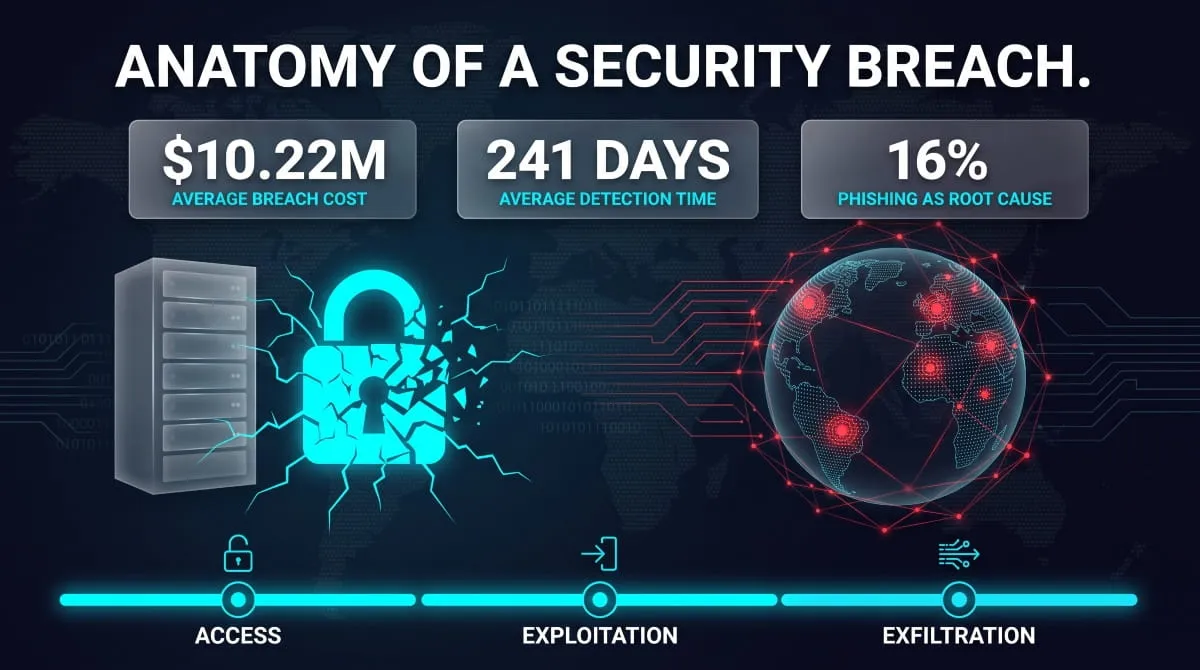
These incidents are also increasingly common and expensive. IBM’s 2025 Cost of a Data Breach Report found that the average cost of a data breach for U.S. companies jumped to an all-time high of $10.22 million, underscoring that understanding how breaches happen and how to stop them has become a business priority rather than just an IT concern.
What Is a Security Breach? (Definition)
A security breach is any incident where an unauthorized party gains access to a system, network, application, or physical location that’s supposed to be protected, regardless of whether data is actually stolen or exposed. The access itself is the breach; what happens afterward determines its severity.
This makes “security breach” a broader term than most people realize. It covers everything from a hacker exploiting a software vulnerability to an employee using a stolen badge to walk into a restricted server room. Not every security breach results in stolen information, but every data breach starts with one.
Security Breach vs. Data Breach: What’s the Difference
A security breach is unauthorized access; a data breach is the specific outcome when that access results in sensitive information being viewed, copied, or stolen. In other words, every data breach is a security breach, but not every security breach becomes a data breach.

For example, if an attacker breaches a company’s network but is detected and expelled before touching any files, that’s a security breach without a data breach. If the same attacker exfiltrates customer records before being caught, it escalates into a data breach, the kind that typically triggers legal notification requirements. This distinction matters for incident response teams because it changes the compliance and disclosure obligations that follow.
Common Legal/Regulatory Definitions
Most breach notification laws define a security breach narrowly, focusing on unauthorized acquisition of specific categories of personal data rather than access alone. In the U.S., all 50 states now have breach notification statutes. Still, the triggering definition varies; some require “acquisition” of data, while others use the broader “access” standard, which affects whether an incident legally requires disclosure.
At the federal and international levels, definitions get more specific. HIPAA defines a breach as the unauthorized acquisition, access, use, or disclosure of protected health information that compromises its security or privacy. The GDPR takes an even wider view under Article 4(12), defining a personal data breach as any breach of security leading to the accidental or unlawful destruction, loss, alteration, unauthorized disclosure of, or access to personal data. This regulatory patchwork is precisely why organizations increasingly rely on continuous dark web monitoring to detect exposure before it crosses the legal threshold that forces public disclosure.
How Do Security Breaches Occur?
Security breaches occur when an attacker or insider finds a gap in an organization’s defenses, a weak password, an unpatched system, a careless click, or a misconfigured server, and uses it to gain access that should have been blocked. The specific method varies widely, but nearly every breach follows the same underlying pattern: a weakness is found, that weakness is exploited, and access spreads from there.
The Anatomy of a Breach (Access → Exploitation → Exfiltration)
Most security breaches unfold in three stages: initial access, exploitation, and exfiltration. In the access stage, an attacker finds a way in, often through phishing, a stolen credential, or an unpatched vulnerability. IBM’s 2025 Cost of a Data Breach Report found that phishing was the most common root cause, accounting for 16% of breaches studied, with supply chain compromises close behind at nearly 15%.

Once inside, the exploitation stage begins: the attacker escalates privileges, moves laterally across systems, and locates valuable data or infrastructure to target. The final stage, exfiltration, is where data is copied out or systems are locked down for ransom. This is also the stage where a security breach technically becomes a data breach, since sensitive information changes hands. The longer this whole process goes undetected, the more expensive it becomes. Organizations in IBM’s study took an average of 241 days to identify and contain a breach, and breaches lasting past that window carried significantly higher costs.
Human Error and Employee-Caused Breaches
Not every breach is the work of an external hacker; a large share starts with an honest mistake. IBM’s research attributes 26% of data breaches to human error, such as misdirected emails, misconfigured cloud storage, or falling for phishing messages, compared to 51% to malicious attacks and 23% to IT system failures.
Employee-caused breaches are particularly costly to prevent because they don’t involve breaking through a technical barrier; they involve someone with legitimate access making an unintentional error. This is why security awareness training, access controls, and least-privilege policies are treated as core defenses rather than optional extras: they reduce the likelihood that a single mistake will turn into an organization-wide incident.
External Attacks vs. Internal Threats
External attacks come from outside the organization, hackers, cybercriminal groups, or nation-state actors probing networks for exploitable weaknesses. Internal threats originate from within: employees, contractors, or vendors who either intentionally misuse legitimate access or accidentally expose it. Both paths can lead to the same outcome, but they call for different defenses.
External threats are typically countered with perimeter security, threat intelligence, and continuous monitoring for exposed credentials or leaked data on the dark web. Internal threats are better addressed through access controls, activity monitoring, and the principle of least privilege, ensuring that employees have only the access their role requires. Most mature security programs treat these as complementary layers rather than an either/or choice, since a single unguarded entry point, internal or external, is often all it takes.
Types of Security Breaches
Security breaches take different forms depending on which layer of an organization’s infrastructure gets exploited: the network, the cloud, the database, an API, a connected device, a physical location, or a customer-facing application. Each type exploits a different weak point, but all of them share the same core definition: unauthorized access to something meant to be protected.

Network Security Breaches
A network security breach happens when an attacker gains unauthorized access to an organization’s internal network, often through weak firewalls, misconfigured routers, or compromised credentials. Once inside, the attacker can move laterally between connected systems, which is why network breaches frequently serve as the entry point for larger, multi-system incidents rather than staying contained to a single machine.
Cloud Security Breaches
A cloud security breach occurs when attackers exploit misconfigured storage buckets, weak identity and access controls, or exposed APIs to reach data hosted in cloud environments. These breaches are especially costly when data is spread across multiple environments: IBM’s 2025 Cost of a Data Breach Report found that breaches involving multiple environments, public cloud, private cloud, and on-premises systems together cost an average of $5.05 million, compared to $4.01 million for breaches confined to on-premises systems alone. The complexity of managing access across hybrid setups is often the root cause.
Database Security Breaches
A database security breach happens when attackers gain direct access to structured data stores, often through SQL injection, stolen admin credentials, or unpatched database software. Because databases are usually where the most sensitive records live, customer PII, financial data, and health records, a database breach tends to escalate quickly into a full data breach once access is achieved.
API Security Breaches
An API security breach occurs when attackers exploit weaknesses in the interfaces that enable applications and services to communicate, commonly through broken authentication, excessive data exposure, or a lack of rate limiting. As organizations connect more services through APIs, these interfaces have become a growing attack surface, since a single insecure endpoint can expose the same data that dozens of other security layers were built to protect.
IoT Device Security Breaches
An IoT security breach occurs when attackers compromise internet-connected devices, cameras, sensors, medical equipment, and industrial controllers, which often ship with weak default credentials or receive infrequent security updates. These devices are attractive targets precisely because they’re easy to overlook; a single unmonitored device can give an attacker a foothold into an otherwise well-defended network.
Physical Security Breaches
A physical security breach involves unauthorized entry into a restricted physical location, a data center, server room, or office, rather than a digital system. This can happen through tailgating, stolen access badges, or social engineering tactics that trick employees into granting entry. Physical breaches are often underestimated, but they can lead directly to digital compromise once an intruder gains hands-on access to unlocked terminals or network hardware.
Application/Ecommerce Security Breaches
An application or e-commerce security breach targets customer-facing software directly, often through vulnerable checkout systems, exposed payment processing code, or flaws in how user sessions are handled. Because these applications process payment details and personal information in real time, a single vulnerability can expose thousands of transactions before it’s detected, making application-layer security one of the highest-priority areas for any organization handling online payments.
Common Causes of Security Breaches
Security breaches are rarely random; they trace back to a specific, exploitable weakness, whether that’s a deceptive email, a reused password, an unpatched server, or a vulnerable vendor. Understanding these root causes is the fastest way to identify where an organization’s defenses need strengthening.

Phishing & Social Engineering
Phishing is a type of security breach that redirects users to malicious websites, typically by disguising a fake login page or fraudulent link as a trustworthy source to trick people into entering credentials or downloading malware. It works by exploiting trust rather than technical weaknesses, which is why it remains effective even against organizations with strong technical defenses.
Social engineering extends this same principle beyond email; attackers impersonate coworkers, vendors, or IT support over phone calls, texts, or chat platforms to manipulate someone into granting access or revealing information. IBM’s 2025 Cost of a Data Breach Report identified phishing as the single most common root cause of breaches, responsible for 16% of incidents studied, with an average cost of $4.8 million per breach.
Weak or Stolen Credentials
Weak or stolen credentials remain one of the most direct paths into a system, since a valid username and password bypass most other defenses entirely. This includes reused passwords compromised in unrelated breaches, credentials guessed through brute-force attacks, and login details harvested from phishing attempts or dark web marketplaces.
The risk compounds when the same password is reused across multiple accounts; a single leaked credential set can unlock access to unrelated systems the victim never expected to be at risk. This is exactly why continuous dark web monitoring for exposed credentials has become a standard part of breach prevention rather than an afterthought.
Unpatched Vulnerabilities
Unpatched vulnerabilities are known software flaws that haven’t yet been fixed by an available security update, giving attackers a documented, often publicly disclosed entry point into a system. Once a vulnerability is disclosed, it becomes a race between defenders applying the patch and attackers building exploits to exploit the delay.
This is particularly dangerous because the vulnerability itself isn’t a secret; security researchers, vendors, and attackers often learn about it at the same time. Organizations that fall behind on patch management effectively leave a documented entry point open, which is why timely patching is one of the highest-leverage, lowest-cost defenses available.
Third-Party & Supply Chain Exposure
Third-party and supply chain exposure occurs when an attacker breaches a vendor, contractor, or software provider connected to an organization’s systems, using that trusted relationship as an indirect way in. Rather than attacking a well-defended target directly, attackers target the weakest link in its network of partners and integrations.
This attack path has grown significantly in scale: IBM’s 2025 report found supply-chain compromises were the second-most common initial access vector, involved in nearly 15% of breaches studied, trailing only phishing. Because these breaches originate outside an organization’s direct control, they’re often harder to detect and require ongoing visibility into vendor and third-party risk, not just internal systems.
Security Breaches by Industry
Not every industry faces the same breach risk; the type of data an organization holds and how quickly it can detect an intrusion directly shape both how often breaches occur and how expensive they become. Financial services, healthcare, and manufacturing consistently rank among the costliest sectors, each for different structural reasons.

Financial Sector Security Breaches
Financial institutions are high-value targets because they hold something attackers can monetize immediately: account credentials, payment data, and direct access to funds. A security breach in this sector often triggers rapid, cascading fraud, since stolen banking credentials can be used or resold within hours of exposure.
According to IBM’s 2025 Cost of a Data Breach Report, the financial sector ranked among the top five costliest industries for data breaches globally, alongside industrial, energy, and technology organizations. Heavy regulatory oversight adds another layer of cost: financial firms typically face steep compliance penalties on top of direct breach remediation, which is why banks and fintech companies tend to invest disproportionately in fraud detection and continuous credential monitoring.
Healthcare (EHR) Security Breaches
A healthcare security breach typically involves unauthorized access to electronic health records (EHR), data that includes medical history, insurance details, and Social Security numbers, all of which carry long-term value to attackers because, unlike a credit card, a stolen medical identity can’t simply be canceled and reissued.
This is reflected directly in the cost data: IBM’s 2025 report found that healthcare remained the most expensive industry for data breaches for the 14th consecutive year, averaging $7.42 million per breach, largely due to slower detection and containment timelines than in other sectors. The sensitivity of patient data, combined with often-outdated hospital IT infrastructure, keeps healthcare a persistent target.
Manufacturing & Supply Chain Security Breaches
A manufacturing security breach usually targets either the operational technology (OT) running production lines or the network of suppliers and vendors feeding into it, making supply chain exposure the defining risk for this sector. Attackers frequently breach a smaller, less-defended supplier first, then use that trusted connection to reach the primary manufacturer.
This mirrors a broader trend across industries: IBM’s 2025 report found that supply-chain compromises were the second-most common initial attack vector overall, accounting for nearly 15% of breaches studied. For manufacturers, a successful breach can halt production entirely, making operational downtime, not just data loss, one of the most costly consequences of an attack in this sector.
The Real Cost: Consequences & Business Impact
A security breach rarely ends when the intruder is removed from the system; the real cost shows up afterward, in the form of financial losses, legal exposure, reputational damage, and mandatory disclosures that can stretch on for months. These consequences often outweigh the cost of the breach itself.
Financial and Legal Consequences
The direct financial impact of a security breach includes investigation costs, system remediation, legal fees, and regulatory fines, but the largest expense is often the least visible: lost business from customers and partners who walk away afterward. IBM’s 2025 Cost of a Data Breach Report put the average cost of a data breach for U.S. companies at an all-time high of $10.22 million, with lost business alone averaging $1.38 million and post-breach response costs adding another $1.2 million.
Legal consequences compound the financial burden. Depending on the data exposed and the jurisdiction involved, organizations can face class-action lawsuits, regulatory investigations, and contractual penalties from business partners, costs that frequently extend well beyond the initial incident response.
Reputational Damage
Reputational damage is harder to quantify than a fine, but it tends to have the longest tail of any breach consequence. Customers who lose trust in how their data was handled often take their business elsewhere permanently, and that erosion of trust can affect partnerships, investor confidence, and future sales long after the technical issue is resolved.
This damage compounds with recovery time. IBM’s research found that most breached organizations experienced significant operational disruption, and nearly two-thirds were still recovering more than 100 days after the breach, a prolonged visibility window that gives negative headlines more time to shape public perception before the story fades.
Regulatory Notification Requirements
Most jurisdictions legally require organizations to notify affected individuals and regulators once a breach meets a specific threshold, typically when personal data has been accessed or acquired without authorization. In the U.S., all 50 states have their own breach notification statutes. At the same time, regulations such as HIPAA and the GDPR impose stricter disclosure timelines for health data and EU residents’ personal data, respectively.
Missing these notification deadlines carries its own financial risk, separate from the breach itself. Regulators can and do impose penalties for late or incomplete disclosure, in addition to any fines tied to the breach’s underlying cause. This is one of the reasons detection speed matters as much as prevention: the sooner a breach is identified, the sooner an organization can meet its legal notification obligations and limit the additional exposure that comes with delay.
Biggest & Most Notable Security Breaches
Some security breaches are remembered for how much data they exposed; others for how they changed the way organizations think about defense entirely. Looking at both historical and recent breaches shows a clear trend: the scale of exposure continues to grow, even as detection and response improve.

Historic Breaches That Changed Cybersecurity
The Yahoo breach, disclosed in 2016 but dating back to 2013-2014, remains the largest single-company breach on record, compromising all 3 billion of its user accounts and reshaping how the industry thinks about long-term, undetected intrusions. The Equifax breach of 2017 became a different kind of landmark: it exposed the sensitive financial data of roughly 147 million people. It ultimately cost the company an estimated $1.38 billion, making it the most expensive data breach in history and a case study in the cost of delayed patching.
These breaches mattered less for their size alone than for what came after. Yahoo’s breach pushed companies to scrutinize how long attackers can lurk undetected inside a network. At the same time, Equifax’s regulatory fallout, including a landmark FTC settlement, helped drive the modern wave of state and federal breach notification laws still in effect today.
Recent/Current Security Breach Trends (2025–2026)
The defining trend of 2025 and 2026 has been third-party and supply-chain exposure, particularly through interconnected SaaS and CRM platforms. A wave of breaches tied to compromised Salesforce integrations hit companies including Qantas, TransUnion, and Farmers Insurance, with attackers exploiting misconfigured API permissions and over-privileged access rather than breaking through the core system directly.
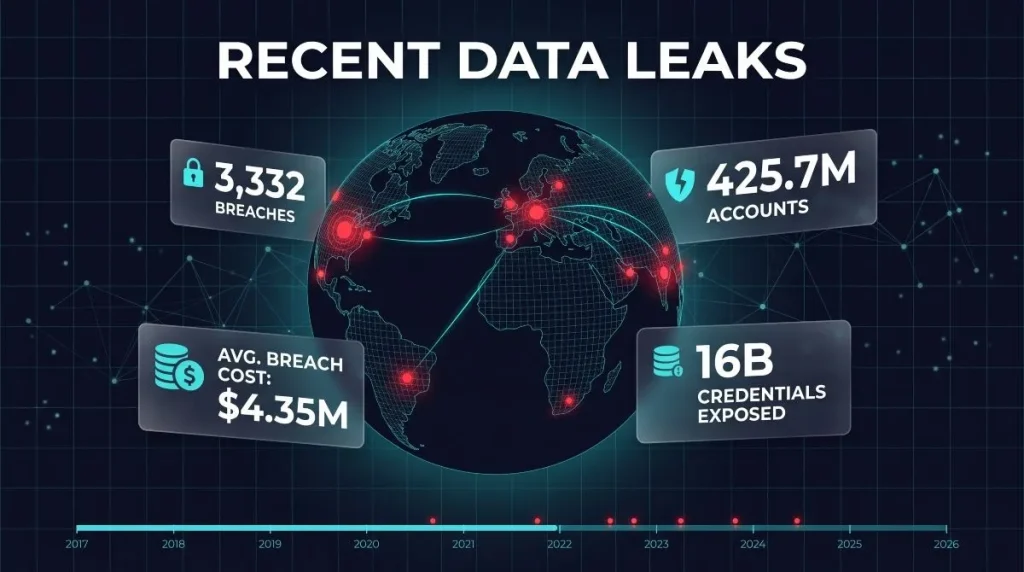
Credential-based attacks also reached a new scale: in June 2025, researchers uncovered a database aggregating nearly 16 billion username-and-password combinations pulled from infostealer malware and prior leaks across roughly 30 datasets, one of the largest credential exposures ever documented. Ransomware has evolved alongside this shift, with data exfiltration now present in 44% of ransomware incidents in 2025, up from 32% the year before, as attackers increasingly steal data before encrypting systems rather than relying on encryption alone. Together, these trends point to the same conclusion: modern breaches are less about a single dramatic hack and more about small, overlooked gaps in vendor access and credential hygiene compounding into massive exposure.
How to Detect a Security Breach
Detecting a security breach comes down to spotting behavior that deviates from normal system activity, unexpected logins, unfamiliar data transfers, or unexplained performance issues. The earlier these signals are caught, the less damage a breach can do before it’s contained.

Warning Signs and Indicators of Compromise
Most security breaches leave behind indicators of compromise long before they’re formally detected: unusual login times or locations, spikes in outbound network traffic, unexplained new user accounts, disabled security tools, or files accessed or modified without a clear business reason. Individually, these signs can look like routine noise; together, they usually point to unauthorized activity.
Detection speed matters enormously to the outcome. IBM’s 2025 Cost of a Data Breach Report found that organizations took an average of 241 days to identify and contain a breach, and breaches that dragged on past that window consistently carried higher costs, driven by extended business disruption and a longer opportunity for attackers to expand their access.
Tools for Continuous Monitoring
Manual review can’t keep pace with how fast breaches unfold, which is why continuous monitoring has become the standard for catching compromise early rather than months later. Dark web monitoring plays a central role here; it flags stolen credentials, leaked customer records, or internal documents the moment they surface on dark web marketplaces, forums, or breach dumps, often well before the exposure is publicly reported or the affected systems show any internal signs of intrusion.
Attack surface mapping complements this by giving security teams visibility into every exposed asset, forgotten subdomains, unpatched endpoints, and misconfigured cloud storage that could serve as entry points, so gaps are closed before an attacker finds them rather than after. Together, these two approaches shift detection from a reactive, after-the-fact process to a continuous one, catching exposure at the earliest possible point rather than waiting for internal alarms to trigger.
How to Prevent and Respond to a Security Breach
Preventing a security breach relies on closing the specific gaps attackers exploit, such as weak credentials, unpatched systems, and unmonitored access. At the same time, a fast, well-rehearsed response limits the damage when prevention isn’t enough. Together, these two efforts determine whether an incident remains contained or becomes a full-scale breach.

Prevention Best Practices
Strong breach prevention starts with the fundamentals: enforcing multi-factor authentication, applying security patches promptly, and limiting employee access to only what each role actually requires. These controls matter because they directly counter the most common causes of breaches. IBM’s 2025 Cost of a Data Breach Report found that 51% of breaches stemmed from malicious attacks, 26% from human error, and 23% from IT system failures, meaning prevention has to address technical, human, and operational weaknesses simultaneously rather than any single one.
Regular employee training and phishing simulations address the human element, while continuous vulnerability scanning and patch management close the technical gaps before attackers find them. Organizations that treat these practices as ongoing operational habits, rather than annual checklist items, consistently show shorter breach lifecycles and lower overall costs.
Incident Response Checklist
When a security breach is suspected, the priority is containment, isolating affected systems to stop the intrusion from spreading before the root cause is even confirmed. From there, response typically follows a consistent sequence: identify the scope of access gained, preserve evidence for investigation, eradicate the attacker’s foothold, and restore affected systems from clean backups.
Once systems are stable, the response shifts to obligations outside the network: notifying legal and compliance teams to determine breach-notification requirements, communicating with affected customers or partners as required, and conducting a post-incident review to identify the factors that enabled the breach. Organizations with a tested incident response plan consistently recover faster than those improvising in real time, since much of the delay in a breach comes from uncertainty about who should act and when.
How Dark Web Monitoring Reduces Breach Risk
Dark web monitoring reduces breach risk by detecting exposed credentials, leaked customer data, or internal documents on dark web marketplaces and forums before they are used to carry out an attack. Since a large share of breaches start with stolen or reused credentials, catching that exposure early, before an attacker acts on it, closes the window of opportunity that would otherwise lead to unauthorized access.
This kind of visibility is especially valuable because breached data often surfaces on the dark web long before an organization detects unusual activity internally. DeXpose’s Free Darkweb Report gives organizations an immediate, no-cost way to check whether their data is already circulating on dark web markets, in malware logs, or in public breach dumps, turning what would otherwise be a blind spot into an early warning system.
Frequently Asked Questions (FAQ’s)
What type of security breach redirects users to malicious websites?
Phishing is a type of security breach that redirects users to malicious websites, typically by disguising a fraudulent link or fake login page as a trustworthy source to steal credentials or install malware. It exploits trust rather than a technical vulnerability, which is why it remains one of the most common entry points for attackers even against organizations with strong technical defenses. IBM’s 2025 Cost of a Data Breach Report identified phishing as the single most frequent root cause of breaches, responsible for 16% of incidents studied.
What’s the difference between a security breach and a data breach?
A security breach is any unauthorized access to a system, network, or physical location. In contrast, a data breach is the specific outcome in which that access results in sensitive information being viewed, copied, or stolen. Every data breach starts as a security breach, but not every security breach escalates into a data breach; some are detected and contained before any data is actually touched.
What are the most common causes of security breaches?
The most common causes are phishing and social engineering, weak or stolen credentials, unpatched software vulnerabilities, and third-party or supply-chain exposure. According to IBM’s 2025 report, 51% of breaches were caused by malicious attacks, 26% by human error, and 23% by IT system failures, showing that prevention must address technical, human, and vendor-related risks all at once, not just one category.
How can businesses detect a security breach early?
Businesses detect security breaches early by monitoring indicators of compromise, unusual login activity, unexpected data transfers, or disabled security tools, and by using continuous monitoring tools such as dark web monitoring and attack surface mapping to catch exposure before it’s exploited. Speed matters: IBM found organizations took an average of 241 days to identify and contain a breach, and the longer that window stays open, the higher the eventual cost.
What are the biggest security breaches in history?
The largest security breaches in history include the Yahoo breach, which compromised all 3 billion of its user accounts, and the Equifax breach of 2017, which exposed the data of roughly 147 million people and ultimately cost the company an estimated $1.38 billion, the most expensive data breach on record. More recently, a 2025 credential-stuffing database aggregating nearly 16 billion username-and-password combinations became one of the largest exposures ever documented, underscoring how breach scale continues to grow even as detection improves.