Social engineering attacks are cyberattacks that manipulate people, rather than machines, into handing over sensitive information, access, or money, using psychological pressure such as urgency, authority, or trust rather than malicious code. Rather than breaking through a firewall, an attacker convinces someone to open the door for them.
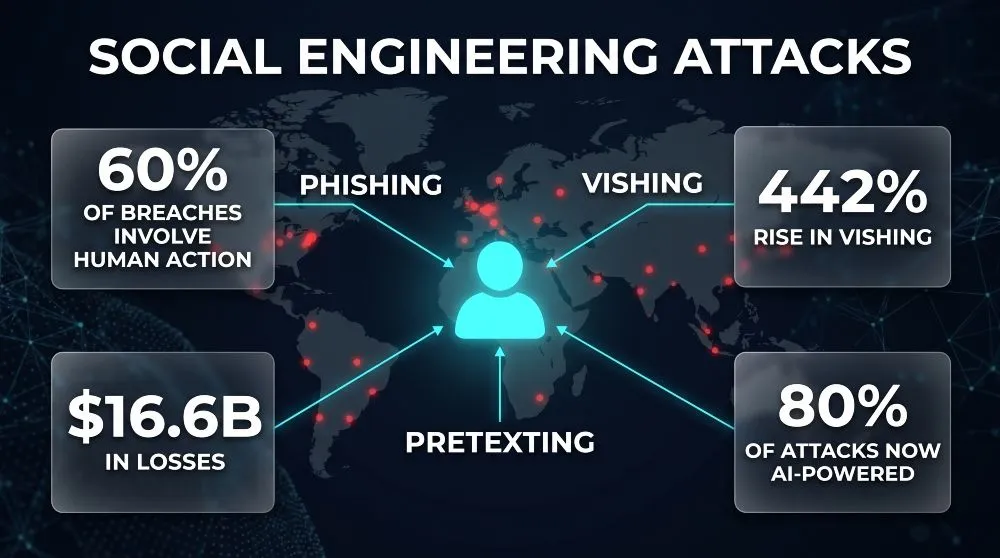
This human-first approach makes social engineering the most common way real-world breaches happen. According to Verizon’s 2025 Data Breach Investigations Report, roughly 60% of confirmed breaches involved a human action- a rushed click, a convincing phone call, a misdirected file- rather than a purely technical exploit. That single number explains why firewalls and endpoint tools alone can’t fully stop these attacks: the target isn’t your network, it’s your judgment.
This guide breaks down exactly how social engineering attacks work, the most common forms they take, real incidents that show the damage they cause, and the practical steps that actually reduce your risk, whether you’re securing a household, a security team, or an entire organization.
What Is a Social Engineering Attack?
A social engineering attack is any attempt to manipulate a person into taking an action or revealing information that compromises their own security, such as handing over a password, approving a payment, or clicking a malicious link, by exploiting trust, fear, or urgency rather than a technical flaw. It’s a con, executed with the tools and reach of the internet.
Social Engineering Attack Definition
At its core, a social engineering attack targets human decision-making instead of software or hardware. The attacker studies how people naturally behave- the instinct to help a colleague, the reflex to comply with authority, the panic of a ticking deadline- and builds a scenario that triggers one of those instincts on command. A fraudulent email from “IT support” requesting a password reset, a phone call impersonating a company executive to request an urgent wire transfer, and a fake delivery text with a malicious link are all forms of social engineering: different channels, same underlying manipulation. The goal is almost always one of three things: stolen credentials, unauthorized financial transfers, or a foothold into a larger system.
How Social Engineering Differs from Technical Cyberattacks
A technical cyberattack looks for a weakness in code, an unpatched server, a misconfigured database, or an exploitable software bug. A social engineering attack looks for a weakness in a person. It can work even when every technical control is airtight, because it bypasses them entirely by convincing someone to act on the attacker’s behalf. This is precisely why the human element remains the industry’s biggest liability rather than its infrastructure: Verizon’s 2025 Data Breach Investigations Report found that roughly 60% of confirmed breaches involved a human action, a click, a phone call, a misdirected file, not a purely technical exploit. That statistic is the clearest evidence that no amount of firewall spending can close a gap that only awareness and process can.
How Social Engineering Attacks Work
Social engineering attacks work by moving a target through a deliberate sequence: research, contact, manipulation, exit, rather than happening as a single spontaneous trick. Understanding that sequence, and the psychological levers pulled at each step, is what makes the difference between spotting an attack in progress and becoming its next statistic.

The Social Engineering Attack Cycle
Most social engineering attacks follow a repeatable four-stage cycle. It starts with an investigation: the attacker gathers information about the target, often from public sources such as LinkedIn, company websites, or social media, to learn names, roles, relationships, and routines. Next comes hooking, where the attacker makes contact- an email, a phone call, a text- using a pretext built from that research to seem legitimate and establish a connection. The third stage is exploitation, where the attacker leverages the trust or urgency they’ve built to extract the actual target: a password, a payment, a file, or physical access. The cycle closes with exit, where the attacker disengages cleanly, often without the victim realizing anything was wrong until the damage is already done. Each stage builds on the last, which is why attacks that feel sudden to the victim are usually the product of careful, invisible groundwork.
Psychological Triggers Attackers Exploit (Trust, Urgency, Authority, Fear)
Every social engineering attack leans on one or more core psychological triggers, because these are the shortcuts the human brain uses to make fast decisions under pressure. Trust is exploited by impersonating someone familiar, a coworker, a vendor, or a help desk technician, so the target’s guard drops before the request is even made. Urgency compresses decision-making time, pushing a target to act before they’ve had a chance to verify anything; this is why the median time for a victim to click a phishing link is just 21 seconds, faster than most security teams can react. Authority works because people are conditioned to comply with instructions from a perceived superior, which is why so many business email compromise scams impersonate executives. Fear closes the loop by threatening a consequence- a suspended account, a missed deadline, a legal problem- that makes compliance feel like the safer option. Attackers rarely rely on just one trigger; the most effective attacks stack two or three together, layering a familiar sender with urgent language and an authoritative tone to make hesitation feel like the riskier choice.
Types of Social Engineering Attacks
Social engineering attacks take several distinct forms, each built around a different channel or hook, but all sharing the same goal of manipulating a person rather than a system. Knowing the specific type at play makes it far easier to recognize one before it succeeds.

Phishing, Vishing, and Smishing
Phishing, vishing, and smishing are the three channel-based variants of social engineering, distinguished only by the medium the attacker uses to reach the target. Phishing arrives via email, typically impersonating a trusted brand or colleague and prompting the recipient to visit a fake login page or open a malicious attachment. Vishing is the phone-call version, often used to impersonate IT support, a bank, or an executive requesting urgent action, and it has surged sharply in recent years; CrowdStrike’s 2025 threat report recorded a 442% increase in vishing attacks year-over-year. Smishing uses text messages, often spoofing a delivery notification or account alert, to get a target to tap a malicious link on a device where security scrutiny is naturally lower. All three rely on the same playbook of manipulation; only the delivery method changes.
Pretexting and Baiting
Pretexting and baiting are social engineering techniques that rely on a fabricated scenario to lower a target’s guard. Pretexting involves the attacker inventing a believable backstory and posing as a new vendor, an auditor, or a fellow employee to justify the need for certain information or access, building the deception over one or more interactions rather than a single message. Baiting instead dangles something enticing, like a free download, a USB drive labeled “Payroll 2026” left in an office parking lot, or a too-good-to-be-true offer, counting on curiosity or greed to get the target to take the action that delivers the payload. Pretexting is now one of the most prevalent techniques in real breaches: Verizon’s 2025 DBIR attributes roughly 30% of social engineering incidents to pretexting, nearly double its share from prior years.
Tailgating and Physical Social Engineering
Tailgating is a physical form of social engineering in which an attacker gains access to a restricted building or area by following an authorized person through a secured door, often relying on politeness or on someone holding the door open, rather than on any digital deception. It belongs to a broader category of physical social engineering that includes dumpster diving, in which attackers sift through discarded documents or hardware for sensitive information, and shoulder surfing, in which they simply observe someone entering a password or PIN in person. These techniques matter because they bypass every firewall and email filter, exploiting workplace norms and physical environments rather than digital ones.
Quid Pro Quo and Watering Hole Attacks
Quid pro quo and watering hole attacks are social engineering techniques built around an exchange or an ambush rather than direct impersonation. In a quid pro quo attack, the attacker offers something of perceived value, often posing as tech support offering to “fix” a problem, in exchange for the credentials or access needed to do so. A watering hole attack takes a more patient route. Rather than targeting individuals directly, the attacker compromises a legitimate website that a specific group is known to visit and then waits for members of that group to become infected simply by browsing a site they already trust. Both techniques succeed by embedding the attack inside something the target already expects or trusts, rather than sending an obviously suspicious request.
Real-World Examples of Social Engineering Attacks
Social engineering attacks aren’t a theoretical risk; they’ve been the entry point behind some of the most damaging breaches on record, and the pattern behind them barely changes even as the targets and technology evolve. Looking at real incidents makes the abstract mechanics of manipulation concrete.

Famous Social Engineering Attacks
Several social engineering attacks have become industry-defining case studies because of how much damage a single manipulated employee caused. In the 2020 Twitter Bitcoin scam, attackers used phone-based social engineering to trick Twitter employees into handing over access to internal administrative tools, then hijacked roughly 130 high-profile verified accounts, including those of major public figures and brands, to post a cryptocurrency scam that collected over $100,000 in Bitcoin within minutes. In 2011, attackers breached security firm RSA by sending a phishing email to a small group of employees with a malicious spreadsheet attachment, ultimately compromising the seed data behind millions of SecurID authentication tokens used by corporations and governments worldwide. And in a business email compromise scheme uncovered in 2019, a scammer impersonated a legitimate Asian hardware supplier and convinced finance staff at both Google and Facebook to wire more than $100 million in fraudulent invoice payments over several years. Each case shares the same lesson: the strongest technical defenses fail the moment a trusted person is convinced to act.
Recent Social Engineering Attacks (2025-2026)
Social engineering has only grown more organized and more targeted in the years since. The group known as Scattered Spider became one of the most prolific threat actors of 2025 by consistently exploiting one weak point: IT help desks. After compromising MGM Resorts and Caesars Entertainment in 2023 by convincing help desk staff to reset employee credentials and bypass multi-factor authentication, the group used the same vishing-based playbook throughout 2025 against major UK retailers including Marks & Spencer, Co-op, and Harrods, causing operational shutdowns and, in MGM’s case, an estimated $100 million in losses. A related threat cluster, ShinyHunters, ran parallel vishing campaigns targeting Salesforce logins at companies including Chanel, Adidas, Pandora, and Qantas. What makes this wave notable isn’t new malware; security researchers have repeatedly noted that these intrusions use no exploit code at all, relying entirely on convincing a help desk employee that the caller is who they claim to be, which is precisely what lets the activity slip past endpoint detection tools built to catch technical attacks rather than conversations.
Warning Signs of a Social Engineering Attack
The clearest warning sign of a social engineering attack is a request that creates pressure to act immediately, bypass normal verification, or share something sensitive, regardless of how legitimate the sender appears. Because these attacks are designed to feel routine, spotting them comes down to noticing when a familiar-looking interaction breaks from familiar patterns.

Red Flags in Email, Phone, and In-Person Interactions
Across every channel, the warning signs of a social engineering attack tend to cluster around the same core behaviors: urgency, unusual requests, and pressure to skip verification. In email, this shows up as messages demanding immediate action on a password reset, invoice payment, or login confirmation, often from a sender address that’s almost, but not exactly, correct, paired with generic greetings or subtle spelling errors that a legitimate organization’s automated systems wouldn’t produce. On the phone, the red flags are a caller claiming to be IT support, a bank, or an executive who already seems to know internal details (gathered from prior research), combined with a refusal to let the target call back through an official number to confirm their identity, a tactic security teams increasingly flag given how central help-desk vishing has become to major 2025 breaches like the Scattered Spider attacks on MGM Resorts and several UK retailers. In person, tailgating attempts often look like someone without a visible badge asking to be let through a secured door because they “forgot” theirs, or a visitor lingering near workstations or filing cabinets for no clear reason. The common thread across all three channels is the same: legitimate requests can almost always tolerate a pause for verification, while social engineering attempts are designed to punish hesitation.
How to Prevent Social Engineering Attacks
Preventing social engineering attacks requires layering human awareness with technical controls, since no single safeguard closes a gap that’s fundamentally about human judgment. The strongest defenses combine trained employees, verification processes that don’t rely solely on trust, and visibility into what happens after an attack succeeds.
Employee Security Awareness Training
Security awareness training is the single most effective defense against social engineering because it directly targets the vulnerability these attacks exploit: an untrained person’s snap judgment. Effective programs go beyond a once-a-year compliance video, using regular phishing simulations, realistic vishing scenarios, and clear escalation procedures. Hence, employees know exactly how to verify a suspicious request rather than freeze or comply under pressure. The impact is measurable: organizations that run consistent security awareness training have been shown to cut phishing click rates by as much as 86% within 12 months, according to KnowBe4’s 2025 research, proof that this is a training gap far more than a technology gap. Training works best when it’s specific to the roles most targeted, particularly help desk and IT support staff, since these positions have become the preferred entry point for major social engineering-driven breaches in 2025.
Technical and Policy Safeguards
Technical and policy safeguards close gaps that training alone can’t cover, particularly in moments when a well-intentioned employee is still deceived. Phishing-resistant multi-factor authentication, methods like hardware security keys rather than SMS codes, which can themselves be socially engineered, make stolen credentials far less useful to an attacker. Strict callback verification policies for any request involving credential resets, financial transfers, or access changes require a second, independent check before action is taken, which is precisely the step attackers try to bypass by creating a sense of urgency. Least-privilege access controls limit the damage a single compromised account can cause, and clear policies on visitor badges and building access reduce the risk of physical social engineering, such as tailgating. None of these controls need to be exotic; they need to be consistently enforced, since most successful social engineering attacks exploit a process that existed on paper but wasn’t followed in practice.
How Dark Web Monitoring Helps Catch Social Engineering Fallout Early
Dark web monitoring adds a critical layer of defense after a social engineering attack, catching the fallout before stolen credentials or data can be used for further damage. When an employee is tricked into revealing a password, or when a company’s customer data is exposed in a breach, that information frequently surfaces for sale or trade on dark web marketplaces and forums well before the affected organization becomes aware that anything was compromised. Continuous monitoring tools like DeXpose scan these hidden corners of the internet for an organization’s leaked credentials, email addresses, and sensitive records, sending an alert the moment exposed data appears so security teams can force password resets and contain the damage before attackers can act on what they’ve stolen. In a threat landscape where the initial breach often happens through a single deceived employee rather than a technical exploit, this early-warning layer is what turns a successful social engineering attack from a slow-building crisis into a contained incident.
Social Engineering vs. Other Attack Types
Social engineering is often confused with the specific attacks it enables. Still, the distinction matters: social engineering describes the manipulation tactic itself, whereas phishing, ransomware, and other named attacks are often just the delivery method or payload used by a social engineering attempt.

Is Phishing a Social Engineering Attack?
Yes, phishing is one of the most common forms of social engineering, not a separate category. Phishing specifically refers to the fraudulent emails, texts, or messages used to trick someone into revealing credentials or clicking a malicious link. At the same time, social engineering is the broader umbrella term covering any manipulation tactic that targets human behavior, including vishing, pretexting, baiting, and tailgating. In other words, every phishing attack is social engineering, but not every social engineering attack is phishing. This distinction matters for defense strategy: email filters can catch some phishing attempts, but they do nothing against a vishing call or an in-person tailgating attempt, which is why phishing-focused tools alone are an incomplete defense against social engineering as a whole.
Social Engineering vs. Technical Attacks (DoS, MITM, Ransomware)
Social engineering and technical attacks like denial-of-service (DoS), man-in-the-middle (MITM), and ransomware differ in what they exploit: social engineering manipulates a person, while these technical attacks exploit a system, network, or software vulnerability directly. A DoS attack floods a system with traffic to take it offline without ever needing to deceive an employee; a MITM attack intercepts communication between two parties by exploiting an insecure network connection; and while ransomware itself is a technical payload that encrypts files for extortion, it’s frequently delivered through a social engineering attack in the first place, a phishing email or a socially engineered help desk call, as seen in the 2023 MGM Resorts breach, is often what gives ransomware operators their initial foothold. This overlap is the key point: social engineering and technical attacks aren’t always mutually exclusive categories; rather, they’re different stages of the same intrusion, with social engineering frequently serving as the door through which a technical attack walks.
The Rise of AI-Powered Social Engineering Attacks
AI is rapidly becoming the dominant force behind social engineering attacks, enabling attackers to generate convincing phishing emails, cloned voices, and even videos in minutes rather than the hours of manual research that older attacks required. This shift is turning social engineering from a skill-dependent craft into a scalable, automated operation.

How Generative AI Is Changing Social Engineering
Generative AI has removed most of the friction that once limited social engineering attacks. The numbers reflect just how fast that shift has happened: security researchers at Abnormal Security estimate that AI now powers over 80% of social engineering activity, with 91% of security professionals reporting they’ve encountered an AI-enabled email attack in just the past six months. Large language models let attackers write flawless, personalized phishing emails in any language instantly, eliminating the spelling and grammar errors that once served as a reliable red flag. Voice-cloning tools now let attackers replicate an executive’s voice from a few seconds of publicly available audio, powering vishing calls convincing enough to authorize fraudulent wire transfers, while deepfake video is beginning to do the same for video calls. The result is that pretexts once limited by an attacker’s personal skill and time are now limited only by the data available about a target, data that’s often sitting in plain sight on social media and company websites.
Defending Against AI-Driven Social Engineering
Defending against AI-driven social engineering requires shifting away from defenses that rely on spotting obvious mistakes, since AI has largely eliminated them. Verification processes matter more than ever: any request involving money, credentials, or sensitive data, especially one that arrives via voice or video, should be confirmed through a separate, previously established channel rather than trusted because it “sounds right.” Organizations are increasingly adopting phishing-resistant multi-factor authentication and codeword-based verification for high-risk requests such as executive wire transfers, precisely because these methods don’t rely on a human to judge whether a voice or message is authentic. Security awareness training is also evolving to specifically cover AI-generated threats, teaching employees that fluent writing and a familiar-sounding voice are no longer proof of legitimacy. The organizations managing this risk best are treating AI-powered social engineering not as a new category of threat requiring entirely new tools, but as the same manipulation tactics executed with far greater speed and polish, which means the fundamentals of verification and skepticism matter more, not less.
Social Engineering Attack Statistics and Impact
Social engineering attack statistics consistently point to the same conclusion: this isn’t a niche threat vector; it’s the primary way modern breaches happen. According to Verizon’s 2025 Data Breach Investigations Report, roughly 60% of confirmed breaches involved a human action rather than a purely technical exploit, and separate industry research from Sprinto puts the broader figure even higher, estimating that 98% of all cyberattacks involve some form of social engineering.

The financial impact scales with that prevalence. The FBI’s Internet Crime Complaint Center logged $16.6 billion in reported losses in 2024 alone, a 33% year-over-year increase, with business email compromise, a social engineering tactic that relies on impersonating executives or vendors, accounting for $2.77 billion of that total across more than 21,000 reported incidents. Individual incidents can be costly in isolation, too: CRC Group estimated the average cost of a social engineering attack at $130,000 in 2024. This figure climbs sharply for large-scale breaches like the 2023 MGM Resorts attack, which resulted in an estimated $100 million in losses.
The trend is also accelerating rather than plateauing. Vishing attacks alone surged 442% year-over-year according to CrowdStrike’s 2025 threat report. Abnormal Security estimates that AI now powers more than 80% of all social engineering activity, a shift that’s making these attacks faster to launch, harder to detect, and available to a far wider pool of attackers than the specialized skill set social engineering once required. Taken together, these numbers make the case plainly: the human element, not the network perimeter, is where most organizations remain most exposed.
Frequently Asked Questions (FAQ’s)
What Is the Primary Goal of a Social Engineering Attack?
The primary goal is almost always to obtain something the attacker couldn’t get through technical means alone: stolen credentials, unauthorized financial transfers, or unauthorized system access, by manipulating a person rather than exploiting code.
Which of the Following Is a Social Engineering Attack? (exam-style Q&A)
Any scenario in which an attacker manipulates a person into taking an action or making a disclosure qualifies, including phishing emails, vishing calls, pretexting, baiting, and tailgating; a brute-force password attack or a SQL injection does not, since those exploit systems rather than people.
Do Social Engineering Attacks Only Happen Through Email?
No, email is just one channel. Social engineering also happens by phone (vishing), text (smishing), and in person (tailgating, impersonation), so email-only defenses like spam filters leave every other channel unprotected.