
Vishing vs Smishing vs Phishing | Guide to Voice, SMS, and Digital Scams
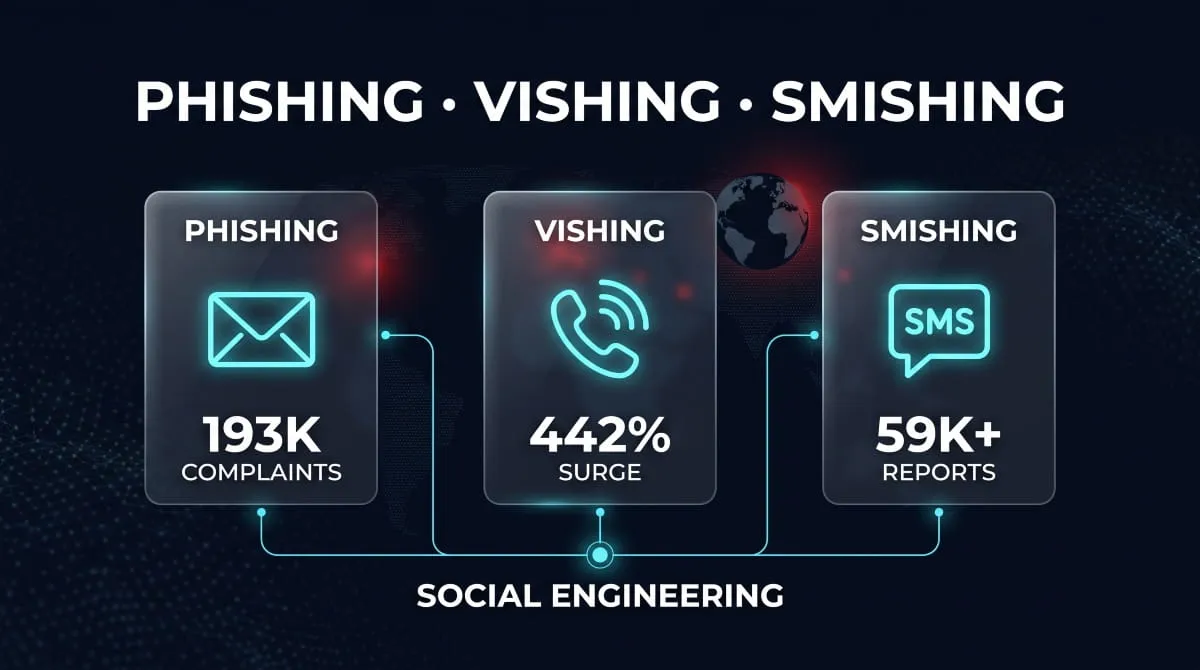
Vishing, smishing, and phishing are all social engineering attacks that trick you into handing over sensitive information. Still, they’re defined by the channel the attacker uses: vishing happens over a phone call, smishing arrives as a text message, and phishing is the original, broader term most often used for email-based scams, though it’s also used as an umbrella for the whole category. The FBI’s IC3 logged phishing and spoofing as the single most-reported cybercrime in 2024, with over 193,000 complaints, and its “smishing” toll-scam subset alone accounted for nearly 60,000 reports in that year. Understanding the difference matters because each channel exploits trust differently: a caller impersonating your bank feels more urgent than a text, and a text feels more disposable than an email, and knowing which one you’re facing is the first step in spotting it before it costs you.
What Is Vishing? (Voice Phishing Explained)
Vishing is phishing conducted over a phone call, where an attacker impersonates a trusted source, a bank, a government agency, tech support, or even a coworker, to manipulate a victim into revealing credentials, verifying account details, or authorizing a payment. The term blends “voice” and “phishing.” It has moved from a minor nuisance to one of the fastest-growing attack vectors in cybersecurity: vishing attempts surged 442% in the second half of 2024 alone, according to CrowdStrike’s 2025 Global Threat Report, and now account for the majority of phishing-related incident response cases enterprises deal with.
How Vishing Attacks Work
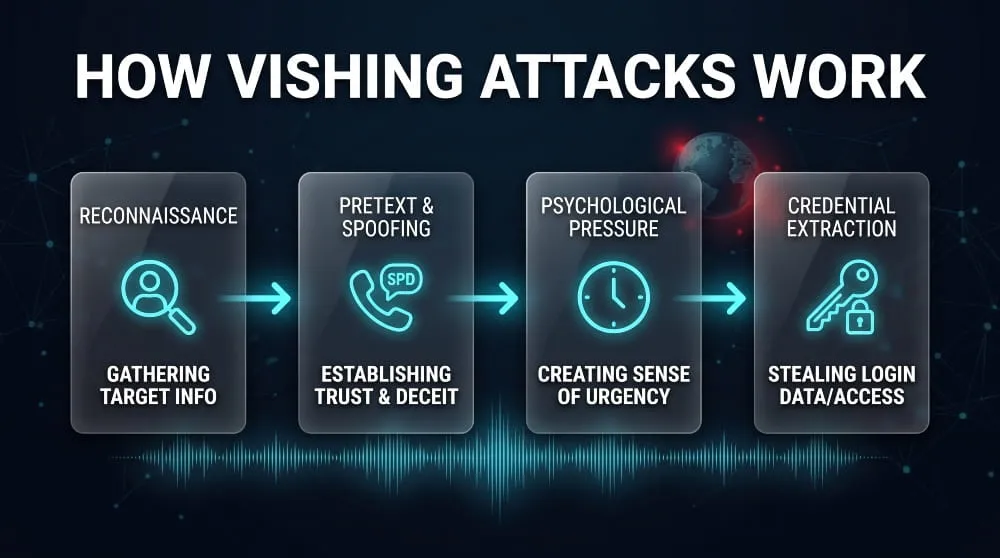
A vishing attack typically starts with reconnaissance: the attacker gathers just enough personal or organizational detail, from a data breach, a LinkedIn profile, or a prior smishing text, to sound credible on the call. From there, they build a pretext (a fake but plausible reason for calling), place the call using spoofed or VoIP-based numbers to mask their real identity, and lean on psychological pressure to keep the victim from thinking too carefully. Most vishing calls succeed or fail within the first minute; if the attacker can establish trust and urgency before the victim pauses to verify, they’re usually able to extract credentials, a one-time passcode, or a wire transfer approval before the call ends.
Common Vishing Tactics (Caller ID Spoofing, Deepfake Voice, Urgency)
Three tactics show up in nearly every vishing case. Caller ID spoofing lets attackers display a legitimate-looking number, often matching a real bank or company, so the call passes a victim’s first instinct to check who’s calling. Urgency and authority do the rest of the work: the caller claims your account has been compromised, a payment is overdue, or a superior needs an immediate approval, all designed to short-circuit careful judgment. The newest and most dangerous addition is AI voice cloning, which lets attackers recreate a real person’s voice- a CEO, a family member, a known vendor contact- from just a few seconds of audio, making deepfake vishing calls convincing enough to fool even trained employees who would normally catch a scripted scam.
What Is Smishing? (SMS Phishing Explained)
Smishing is phishing delivered through text message, where an attacker sends a fraudulent SMS designed to look like it’s from a delivery service, bank, or government agency to get the recipient to click a malicious link or reply with sensitive information. The term combines “SMS” and “phishing.” It has become one of the most common scam formats precisely because texts feel more trustworthy and more urgent to act on than email. The FBI’s IC3 tracked over 59,000 complaints tied to toll-payment smishing scams alone in 2024, a single narrow category that shows how much volume this channel generates.
How Smishing Attacks Work
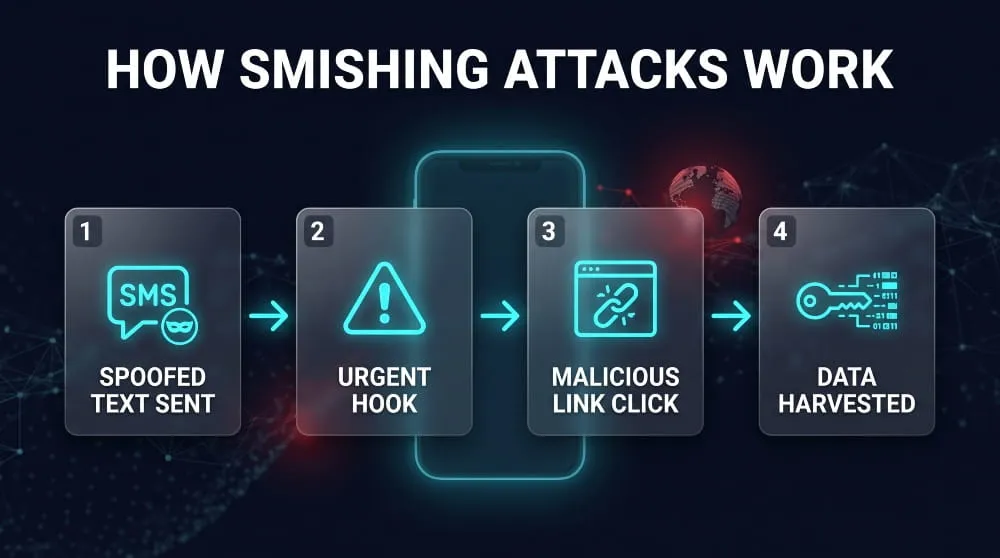
A smishing attack usually starts with a text that mimics a familiar, low-friction interaction: a package delivery update, an unpaid toll notice, or a bank fraud alert, sent from a spoofed number or a short code designed to look legitimate. The message creates a small, plausible reason to click: confirm an address, pay a small fee, or verify your identity. That link leads to a fake but convincing login page or payment form built to harvest credentials or card details in seconds. Because the interaction happens on a phone, victims often have less time and fewer visual cues to catch the warning signs they’d notice on a desktop browser.
Common Smishing Message Patterns
Most smishing messages follow a handful of recognisable patterns. Delivery and shipping scams claim a package is held up pending a small fee or address confirmation. Financial alerts impersonate a bank or payment app, warning of suspicious activity and asking the recipient to “verify” by tapping a link. Toll and parking notices claim an unpaid balance with a looming late fee to force a fast, unthinking click. And impersonation texts pose as a coworker, boss, or family member, often referencing real names or events pulled from a prior data breach, and asking for a quick favour like a gift card purchase or a wire transfer. The common thread across all of them is manufactured urgency paired with a link or reply that’s built to be acted on before it’s questioned.
Vishing vs Smishing: Key Differences
Vishing and smishing are both social engineering scams built on the same psychological playbook: urgency, impersonation, and a request for information or money. Still, they differ in the channel, the techniques attackers use to exploit it, and how often each one actually reaches you.
Delivery Channel
Vishing is delivered through a live or automated phone call, while smishing arrives as a text message. That single difference shapes everything else about the attack: a phone call gives the attacker a real-time conversation to build trust and pressure a victim before they have time to think, while a text message relies on a single moment, the tap of a link, rather than sustained back-and-forth manipulation.
Attacker Techniques
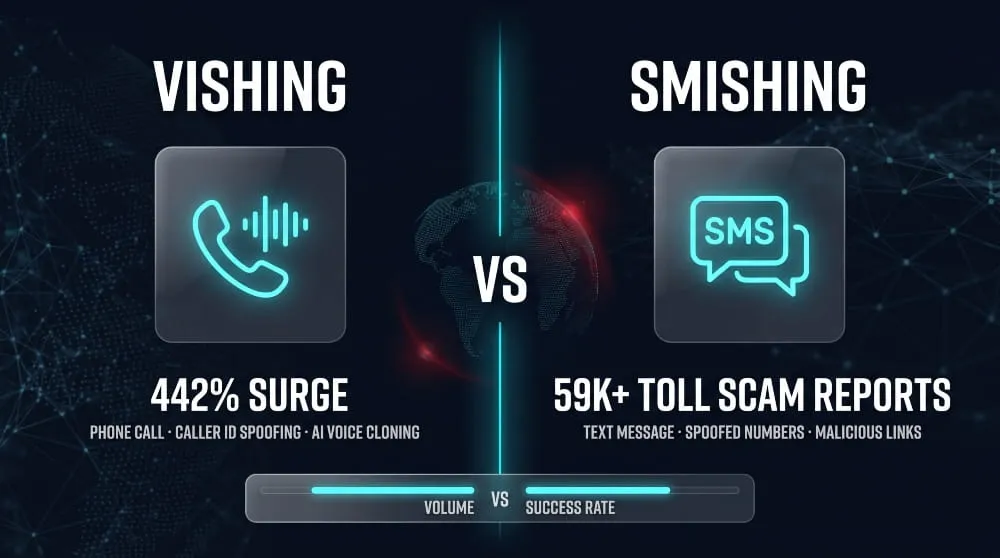
Because a call is interactive, vishing attackers lean on caller ID spoofing, scripted pretexts, and increasingly AI voice cloning to sound like a real person the victim already trusts, adapting their story in real time as the conversation unfolds. Smishing attackers, working with a much shorter format, rely instead on spoofed sender numbers, urgent one-line hooks (a delivery fee, a toll notice, a fraud alert), and a malicious link or reply-to number that does the actual data harvesting; the message itself just needs to get a thumb to tap before the recipient stops to question it.
Which Is More Common?
Smishing generally reaches more people, since a single SMS campaign can blast millions of numbers at near-zero cost per message, while vishing takes more attacker time and effort per call but converts at a notably higher rate, vishing attempts surged 442% in the second half of 2024 alone, and industry research puts the success rate of a targeted vishing call above 30% of contacted victims, well above what most smishing campaigns achieve per message. In practice, most people encounter smishing texts far more frequently. Still, a successful vishing call tends to cause more damage per incident because it often targets a specific, higher-value victim rather than a mass audience.
How Vishing and Smishing Relate to Phishing
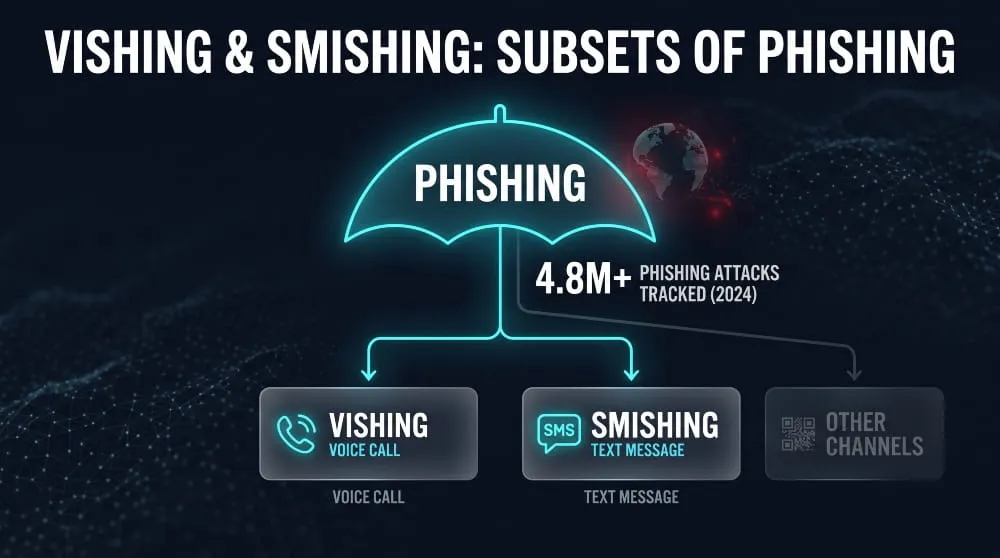
Vishing and smishing are both subcategories of phishing, not separate attack types. Phishing is the umbrella term for any scam that impersonates a trusted source to steal information or money, and vishing and smishing simply describe which channel that impersonation travels through.
Is Vishing a Type of Phishing?
Yes, vishing is a form of phishing that uses a phone call instead of email as its delivery method. The underlying goal is identical to any phishing attack: impersonate someone trustworthy, create urgency, and extract credentials, personal data, or a payment, but vishing swaps the written message for a live voice, which lets the attacker adapt in real time to a victim’s hesitation in a way a static email never can. That real-time adaptability is part of why vishing has become the fastest-growing branch of phishing rather than a niche variant of it.
Phishing vs Vishing vs Smishing at a Glance
| Vector | Phishing | Vishing (Voice Phishing) | Smishing (SMS Phishing) |
|---|---|---|---|
| Delivery Channel | Electronic Mail (Email) | Voice Communication (Cellular / VoIP) | Short Message Service (SMS / Instant Messaging) |
| Attack Format | Structured text messages containing embedded malicious hyper-links or weaponized file attachments. | Interactive live agent conversation or pre-recorded automated voice (IVR) dialogue. | Concise written message paired with a shortened call-to-action link or direct reply prompt. |
| Primary Technique | Header sender-address spoofing, lookalike domain mirrors, and fake authentication portals. | Caller ID spoofing, urgency-driven pretexting, and AI-driven deepfake voice cloning. | Sender ID spoofing, artificial SMS gateway routing, and high-urgency one-line psychological hooks. |
| Typical Goal | Mass credential harvesting, session hijacking, and initial access malware payload delivery. | Extracting real-time MFA tokens, immediate bank transfer authorizations, or sensitive internal data. | Driving clicks to mobile-optimized phishing portals for payment card or identity theft. |
| Scale & Economics | Massive volume with low marginal cost per attempt via automated spam networks. | Targeted lower volume with higher operational effort, but elevated success rate per contact. | Extremely high volume with automated mass-distribution channels and near-zero unit cost. |
The table makes the relationship clear: phishing describes the intent (impersonation for theft), while vishing and smishing describe the delivery mechanism. Every vishing or smishing attempt is technically a phishing attack. Still, not every phishing attack is vishing or smishing, since the term also covers email, quishing (QR codes), and other emerging channels.
Other Related Attack Types
Vishing and smishing are the two most common phishing subtypes. Still, they sit alongside several other named attack variants that describe either a different targeting strategy (spear phishing, whaling) or a different delivery mechanism (quishing, pharming); understanding where each one fits helps make sense of the full phishing landscape rather than treating every scam as a one-off.
Spear Phishing
Spear phishing is a targeted attack aimed at a specific individual or small group, built using research on that person, their job title, coworkers, recent projects, or public social media activity, to make the message far more convincing than a generic mass phishing email. Unlike broad phishing campaigns that rely on volume, spear phishing relies on personalization, which is also what makes it far harder to catch with standard spam filters.
Whaling
Whaling is a specific form of spear phishing that targets senior executives, finance leaders, or other high-value “big fish” within an organization, usually to authorize a large wire transfer or extract confidential data. Because the target holds real authority, whaling emails and calls often impersonate another executive or board member and lean heavily on urgency and confidentiality, the same pretext structure used in vishing, but aimed at the person with the power to approve the request.
Quishing (QR Code Phishing)
Quishing uses a malicious QR code instead of a text link to route victims to a fake login page or payment form, exploiting the fact that a QR code hides its destination until scanned. This makes it especially effective at slipping past email security filters that scan for suspicious links in text, since the malicious URL is embedded in an image instead. QR codes went from appearing in just 0.8% of phishing attacks in 2021 to 10.8% by early 2024, according to Egress’s Phishing Threat Trends Report, making it one of the fastest-growing phishing subtypes in recent years.
Pharming
Pharming redirects victims to a fake website without requiring them to click anything at all, typically by compromising DNS settings or a router so that even typing the correct web address leads to a malicious lookalike site. It’s the most technically involved of these attack types since it doesn’t rely on tricking a person into clicking; it manipulates the infrastructure connecting them to the internet, which makes it harder to spot but also less common than message-based attacks like vishing, smishing, and quishing.
Real-World Examples of Vishing and Smishing Attacks
The clearest way to recognize vishing and smishing is to see how they actually play out: the pretexts, the pressure tactics, and the fallout are strikingly consistent across real reported incidents, even as the technology behind them keeps advancing.
Bank Impersonation Calls
The most common vishing scenario involves a caller claiming to be from your bank’s fraud department, warning that suspicious activity was just detected on your account. The caller ID often matches the bank’s real number thanks to spoofing, and the script moves fast: they “verify” your identity by asking for your card number, a one-time passcode just texted to you, or your online banking login, all under the guise of “securing” your account. In reality, no legitimate bank will ever ask you to read back a one-time passcode over the phone, since that code is the exact credential the attacker needs to complete a takeover.
Delivery/Package Smishing Texts
The most widespread smishing pattern mimics a shipping notification: “Your package could not be delivered, update your address here,” paired with a link to a convincing but fake courier site. A close cousin of this, unpaid toll notices claiming a small fee is due before a penalty kicks in, became so widespread that the FBI’s IC3 logged more than 59,000 complaints tied to toll-scam smishing in 2024 alone, making it one of the single largest smishing categories tracked that year. Both patterns work because the ask is small and mundane enough that people click without thinking twice.
AI Deepfake Voice Scams
The newest and most damaging evolution of vishing uses AI-cloned voices to impersonate someone the victim already trusts. In one widely reported 2024 case, an employee at engineering firm Arup authorized a $25 million transfer after a video call where attackers used deepfake audio and video to impersonate senior company executives convincingly; most of the funds were never recovered. Cases like this illustrate why voice can no longer be treated as reliable proof of identity, even when it sounds exactly like someone you know.
What’s the Goal of Vishing and Smishing Attacks?
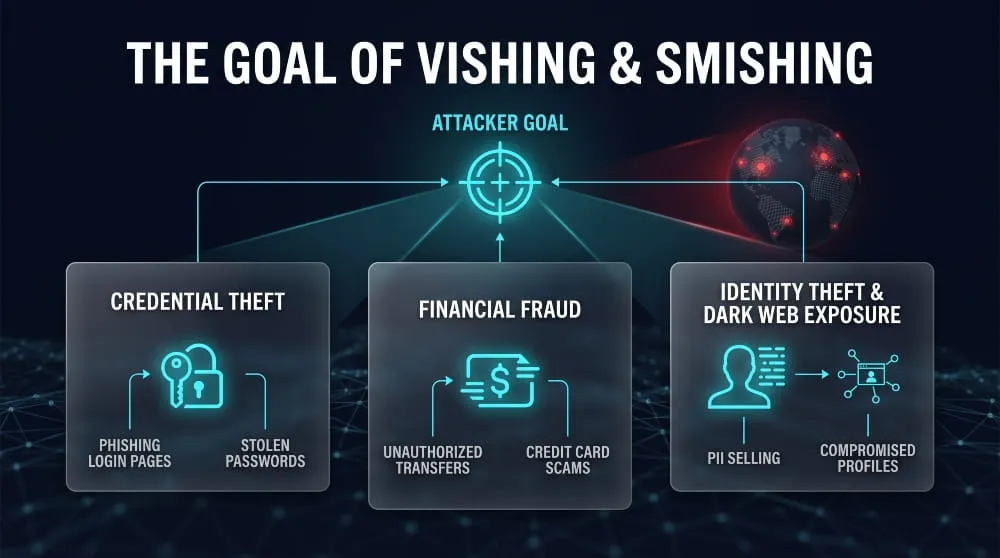
Every vishing and smishing attack ultimately works toward one of three outcomes: stealing login credentials, extracting money directly, or harvesting enough personal data to enable identity theft down the line, and most successful attacks accomplish more than one of these at once.
Credential Theft
The most immediate goal of a vishing call or smishing text is usually to capture a username, password, or one-time passcode by directing the victim to a fake login page or asking them to read the code aloud. Once an attacker has valid credentials, they can access email, banking, or corporate accounts directly, often bypassing multi-factor authentication entirely if the victim was tricked into handing over the verification code in real time.
Financial Fraud
A second, more direct goal is to get money moving immediately, whether that’s a gift card purchase, a wire transfer, or a fraudulent payment made to “resolve” a fake toll or delivery fee. This is where vishing tends to cause the most damage per incident, since a live phone call lets an attacker apply sustained pressure and adapt their story if a victim hesitates, the same dynamic that led one engineering firm to authorize a $25 million transfer after a deepfake voice and video call in 2024.
Identity Theft and Dark Web Exposure
Even when an attack doesn’t lead to an immediate payout, the personal data collected- a Social Security number, date of birth, account numbers, or answers to security questions- has lasting value. That information is routinely bundled and sold on dark web marketplaces, where it fuels identity theft, synthetic identity fraud, and future targeted attacks long after the original call or text is forgotten. This is why monitoring whether your personal information has surfaced on the dark web matters even after a single vishing or smishing attempt seems resolved; the data itself can still be circulating.
How to Protect Yourself from Vishing and Smishing
The best defense against vishing and smishing isn’t spotting every scam at a glance; it’s building a habit of independently verifying any unexpected call or text before acting on it, since that single pause is what breaks the urgency these attacks depend on.
Verifying Suspicious Calls and Texts
If a call or text claims to be from your bank, a delivery service, or a government agency, don’t respond through the channel it arrived on; hang up or ignore the message, then contact the organization directly using a number or website you already know to be legitimate, such as the one on the back of your card or the official app. Never read a one-time passcode aloud to anyone who calls you, since no legitimate institution will ever ask for one over the phone, and be skeptical of any request that pressures you to act within minutes; that urgency is the tactic, not a coincidence.
What to Do If You’ve Already Responded
If you’ve already shared a password, card number, or one-time code, act immediately rather than waiting to see if anything happens: change the affected password right away, contact your bank or card issuer to flag potential fraud and freeze the account if needed, and enable or re-verify multi-factor authentication on anything tied to the compromised login. Reporting the incident to the FBI’s IC3 (ic3.gov) or your local equivalent also helps, both for your own record and because it feeds the data authorities use to track and disrupt these campaigns.
Monitoring for Compromised Data
Even after you’ve secured the immediate account, the information an attacker collected during a vishing call or smishing click doesn’t just disappear; it’s often bundled with data from other breaches and sold or traded on dark web marketplaces, where it can resurface months later in a more targeted attack. Ongoing dark web monitoring can flag if your email, phone number, or other personal details show up in these listings, giving you a chance to change credentials and lock down accounts before that exposed data gets used against you a second time.
FBI, CISA, and FTC Warnings on Vishing and Smishing
Federal agencies have repeatedly issued formal warnings about vishing and smishing, treating both as active, escalating threats rather than routine background scams, a signal worth taking seriously given how rarely these agencies issue joint or repeated advisories on the same topic.
Official Guidance Summary
The FBI, in a public advisory issued through its Internet Crime Complaint Center, has warned since April 2025 about a campaign impersonating senior U.S. officials using both smishing (SMS and MMS text messaging) and vishing, which the bureau notes may incorporate AI-generated voices to target individuals, including current and former senior federal officials. The FBI’s core guidance is to independently verify the identity of anyone calling or texting you before responding, research the originating number or organization, and call back a number you’ve identified yourself rather than one provided by the caller or message. CISA has published complementary phishing guidance aimed at stopping social engineering attempts at the earliest possible stage. At the same time, the FTC has separately warned about large-scale smishing campaigns, including one that impersonated toll collection agencies and delivery services across all 50 states in early 2024. Together, the pattern from all three agencies is consistent: verify independently, never confirm sensitive information over an inbound call or text, and report suspected incidents to the FBI’s IC3 at ic3.gov so the data can feed broader efforts to track and disrupt these campaigns.
Frequently Asked Questions (FAQ’s)
Which occurs more often, vishing or smishing?
Smishing generally reaches more people, since a single SMS campaign can be sent to millions of numbers at almost no cost per message, while vishing takes more time and effort per attempt but converts at a much higher rate. Vishing attempts surged 442% in the second half of 2024 alone, according to CrowdStrike’s 2025 Global Threat Report. Most people encounter smishing texts far more frequently day-to-day, but a successful vishing call tends to cause more damage per incident.
Is vishing a form of phishing?
Yes, vishing is a form of phishing that uses a phone call instead of email or text as its delivery method. The goal is the same as any phishing attack: to impersonate a trusted source to extract credentials, personal data, or money, but a live voice call lets the attacker adapt in real time to a victim’s hesitation in a way a written message can’t.
Cybercrime Explained | The Complete Guide to Types, Causes, Costs & Prevention
Cybercrime is any criminal activity that targets or uses a computer, network, or internet-connected device, from stealing financial data and holding systems for ransom to impersonating…
Read more
Cybercrime Laws Around the World | A Complete Investigator’s Reference Guide
Cybercrime laws are the country-specific and international legal frameworks that define which online acts- unauthorized access, data theft, fraud, harassment- count as crimes and what penalties…
Read more
Lesser-Known Ransomware Groups Still Targeting Businesses in 2026
Groups like Monti, Vice Society, Royal (now rebranded as BlackSuit), Cuba, Nokoyawa, Yanluowang, and Lorenz rarely make national headlines like LockBit or Qilin, but they’re still…
Read more